Volume 4, No. 5, May 2013 (Special Issue)
International Journal of Advanced Research in Computer Science
TECHNICAL NOTE
Available Online at www.ijarcs.info
VCCM – Virtual Conference Content Mapping
I. Sai Krishna
Department of Computer Science & Engineering Vignan University
Venkatrama Phani Kumar S
Department of Computer Science & Engineering Vignan University
K.V.Krishna Kishore
Department of Computer Science & Engineering Vignan University
Abstract: Web-based applications gained popularity and global acceptance because of its usability in terms of better functionality and mobility and access to information available throughout the world. Developing web-based applications with new development methodology, namely web development life cycle (WDLC) is cost effective over desktop applications because it deploys once and then able to access ubiquitously. There is no universally accepted process model for the development of Web-based applications. Moreover, shaping the process model for small applications such as online software development for conferences has been relatively neglected. This paper presents an expanded lifecycle process model for the development of Web-based applications. It consists of three sets of processes, i.e., requirement processes, development processes, and evolution processes.This research study attempts to investigate and seek insight understanding about issues related to Virtual Conference Content Mapping (VCCM), from developers view point mainly in information quality management. The results were presented in which the uniqueness and the special requirements of VCCM are explained. The development methodology through the web development life cycle in stages associated with activities involved is discussed and the main success factors that derived from multiple sub-factors for consideration during the development of VCCM are discovered. To conclude, this paper presents the outcomes from a comprehensive analysis on the web-based Virtual Conference Content Mapping. Further studies will be carried out to obtain issues, reusability and challenges encountered by developers during development.
Keywords: Web Development life cycle, Virtual conference Content Mapping, Web based application.
I. INTRODUCTION
Conventional conference management relies on physical procedures. In 90s, E-mail grew to be a consistent and lucrative method to mail the file as an attachment and it unwrapped the opportunity of transferring paper-work by electronic means. Nevertheless, if the count of paper-works maximizes to greater extent, the charge of handling these papers physically turned into tiresome work. Frequently, issues like gathering the incorrect author’s data, discarding some papers and minimization of conference management may take place.
With advancement in years, the progressive conferences curved to conference management systems that are Web-based[2]. Tasks like circulating conference data, managing paper uploads and appraisals have been employed. But as there is an enhancement in the existing systems, there are similar kinds of predicament issues on the other edge of the knife. Current systems are reliable, have maintainability property in worse network situations and are capable of avoiding redundancies. But these can be marked up to some extent only. The proposed system has an extended feature improvements and a better working system in avoiding the redundancies to maximum extent, automation of every action with no physical involvement and very flexible to the networks. The system is termed as Virtual Conference Content Mapping (VCCM), the system with automation and traceable capabilities [4].
II. STRUCTURALDESIGNANDACTIONSERIES
This structure utilizes a Multi-client architecture and it is the key component for being a web-based frame. The structure allows the functionalities of four sets of VCCM-users: authors, critics, admin and admin-lead. We presume that the critics shall utilize judges from outside, yet the critics are liable for the genuine examination and would partake in their conference. Due to the sake of plain and clarified entries, the admin, lead and critics are presumed as the renowned professors of university.
From the user’s view, the computer browser is a merely mechanism to facilitate the VCCM users, authors, critics and lead, to connect and interact with the VCCM-server. In the VCCM-server resides the business logic of the structure. By analyzing the client's call, the VCCM-server generates a suitable reply.
Lastly the database coordinates with the server and stores every detail given by clients.
The sketch for the course of procedures is mentioned below, the players included and the procedures that are devised by VCCM; considering this, the communication among every set and the automated along with physical procedures maintained by it are displayed.
III. CONSTRUCTION AND EXECUTION
It is clear that VCCM-users shall utilize the browsers (IE/Netscape/Firefox/Chrome) to connect and interact with the VCCM-server as VCCM is a web-based frame. The next procedure is providing the feature to upload respective paper by the authors and the feature to the reviewers to be able to get the uploaded papers in order to examine them and deliver the review comments and remarks about the paper. A discussion also has to be taken among the critics in-order to make the necessary alterations considering a few situations during the examination of the paper. At the client end, VCCM provides functionality to the authors to upload the paper-work and other required forms, with all kind of formats applicable. The server side scripting language used is JAVA and J2EE for the best and secured performance.
The VCCM utilizes couple of important java classes namely MultiRequest and MultiRequestServlet [3]. As VCCM utilizes JSP as the mediator server code, a JSP manager (can be a servlet manager) is required and has to be installed at server. As VCCM runs on JSP server, JSP has the facility to include the java code into the HTML code and no separate plain java code or plain HTML code is required. This serves the half purpose of complexity. As an automated internal Java code is generated by the JSP server. VCCM runs on Tomcat server and the generation of java code is managed by the Tomcat server. The system also makes utilization of an asynchronous client cum server managed language named AJAX, in-order to make the functionality and performance the best.
The database manager and server utilized is MySQL. As VCCM has a limited count of users, but needs a best database performance manager that can smartly match up with languages like Java/C/C++ and user friendly one and MySQL is an apt for the requirements. When an inline SQL-query is shot to the database, the SQL is traversed and the result is sent to the JSP manager and respective class of Java works on the actions fro the result provided by the database.
IV. VCCMACTIONSERIES
A. Data entries through interaction with MySQL
The first and foremost step of any successful architecture is to provide an attractive and user friendly GUI (Graphical User Interface) which is displayed on the user’s browsers. This is the key point for the web-based frames. The failed web-based systems consists the bad GUI as one of the major reasons for their failure. Today there are many automated tools for the required designs. VCCM is designed with a sketch and a plan considering all the test cases according to the user’s convenience.
The initial step for the author is to provide the paper details that are going to be uploaded in the respective paper. The respective java classes imports all the author provided details and transfers them to the JSP manager. When all the constraints are satisfied, the manager interacts with the database using the query coded according to the entry and places the provided values into the query. First the database
Along with the storage of the author’s details and depending on the entry of the record the database server automatically generates an Id for the entry of record and denotes the author’s details with that Id. This Id is unique for every entry this makes the removal of redundancy of data. The generated Id is in return sent back to the JSP manager which is stored in its buffer. This Id is utilized in the next step to rename the name of the uploaded file. Reason for this is explained in the 4.C section.
Later in the confirmed entries the same unique Id is utilized in-order to check whether the entered details are previously registered are not. This step is taken in-order to avoid the fake registrations. Here the Java classes utilize the help of AJAX in order to communicate with the database server and returns the value spontaneously at that point to the client side and alerts the client as success or failure.
B. Concealed generated data storage for tracking
purpose
The purpose of tracking is to note and traverse each and every entry and denote whether it’s a valid registration or a fake registration. The specialty of VCCM is its tracking procedure and locating the address of where the entry of the author has been made; on what date and at what time. If any of the particular has been modified, then on what date is it modified and what time. These are the main functionalities of tracking.
Java has an expert feature of noting the remote IP address of the system from which the data entries are being made with a special java method. There are many browsers that hide the original IP address of the system and alter it with fake one. Even in such conditions java classes has the functionality to crack the fakeness and denote the original IP address of the system. Using the IP address with some special procedure the address and details of the author can be know to the lead, if he thinks that the entry is a fake one. Such entries can be immediately deleted, which makes the left over data compact and refined one.
In the later step the registered date and time storage is the for our (lead / admin) assessment regarding the entries so that we can sort data date wise and also any complaints from the delayed data entry person saying that the entries are made in prior, to handle such situations these fields are required.
The reason behind calling these data as a concealed data is because no entry is manually made when these data are concerned. These are all the server generated and automated data, which are automatically generated by the server, and interacts with database and stores them at the point of storing the manually entered data.
C. Uploading the Paper-Work and Requested forms
As the uploading of file is a multi-part data and the data entry is a form data there should be an optimal difference between their entries. The two classes of java utilized in order to manage the upload of content are the File Input Stream and File Output Stream.
Uploading of any content involves many major issues like uploading the right extension paper and the size of the content should not exceed the limit of java heap storage, and the scanning the uploaded content whether if it contains any virus or malicious contents in it. These constraints are measurably taken care by VCCM.
As we know that the performance of the system is best measured in collaborative time, i.e. when a same content is being accessed from different networks and it is the responsibility of the system to handle such situations with utmost care. In the case of coordination mechanism, if two people are entering the details at the same time, the person who has submitted it first will be provided the Id and the second person will be redirected back indicating that there has been a coordination entry and please re enter your details.
The other significant use of VCCM is that, consider that there is couple of systems in two different networks and they are accessing VCCM for uploading their paper-work. If the author accessing from second network is trying to upload his paper, but has a problem of weak connection, the author has still got the best probability to upload his papers to the Web server. VCCM has got the feature of detection of remote network speed and functions depending on the connection. This will significantly pace up the course of action of the uploading of paper.
D. Procedure Management
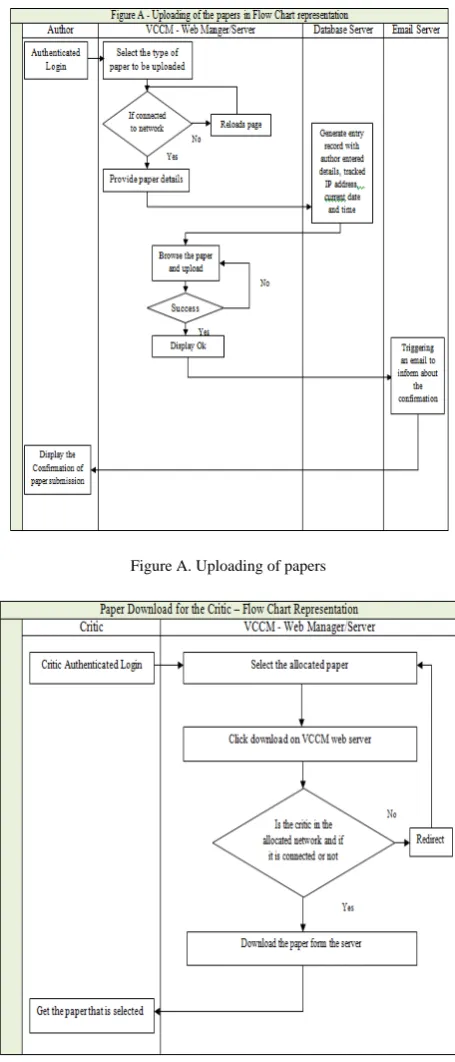
[image:3.595.323.551.50.582.2]The focal point of procedure management at this current instance is during the author’s submission of his papers or during the critics downloading his allocated papers. Figure A and Figure B portray the series of mutual situations correspondingly.
[image:3.595.319.555.330.596.2]Figure A. Uploading of papers
Figure B. Paper download for critics
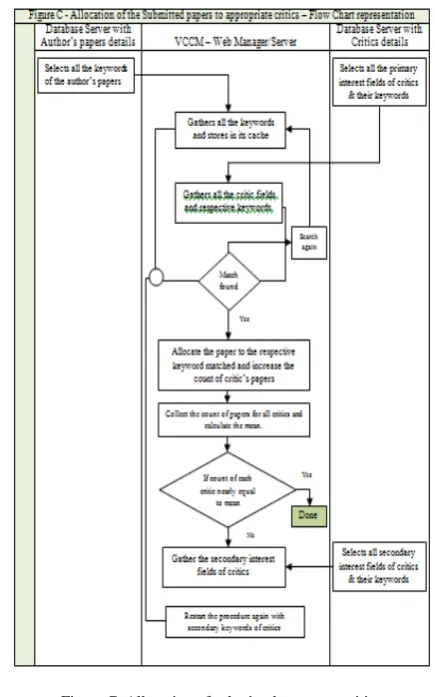
E. Critic-Paper allotment procedure
VCCM allocates the paper to the critic considering three major constraints, they are:
(a) Area of interest of critic (Considering two – One as major and other as minor)
(b) Total number of papers registered. (c) Total jury in the critics
Figure C. Allocation of submitted papers to critics
F. Traceability
The procedure for tracing the IP address of the client system from where the registration is made is done by special java method like “request.getRemoteAddr()” id registration are made from genuine IP systems.
There is a possibility of hiding the IP address and make it a fake one. So in-order to crack it some more java methods are
available “request.getHeader("VIA") “ //RETURNS GATEWAY ,
“request.getHeader("X-FORWARDED-FOR") “
//RETURNS IP ADDRESS OF CLIENT SYSTEM. These are default library methods which help us in tracking the IP. Once IP of client system is derived we can get the details of the client easily. Thus java is served as the secured way interfacing the data.
G. Automated Certification
[image:4.595.47.265.51.400.2]VCCM facilitates the lead to manage all the details of the finalized user and enables an automated generation of certificates and send it as an attachment to the respective participant. This is one of the reasons, which makes VCCM unique from other systems. The sample screenshots of the system are shown in following figures.:
[image:4.595.315.559.59.322.2]Figure D. Home page for VCCM
Figure E. Entry of details and upload of papers
Figure F. Critic / Lead/ Admin login
Figure G. Details of users / papers / allotted paper details
V.CONCLUSION
[image:4.595.315.563.384.509.2] [image:4.595.316.560.538.650.2]VCCM is to offer not only a conference content management and also used to index these papers submitted to the digital library in order to get enhanced propagation. VCCM is completely set and is being used live for the conferences.
VI. ACKNOWLEDGEMENT
The efforts were guided and supported relatively by faculty of Computer Science and Engineering department, Vignan University, Vadlamudi, A.P, India.
VII. REFERENCES
[1] R. Snodgrass. Summary of Conference Management Software. http://www.acm.org/sigs/sgb/summary.html [2] API and UI Reference Site, http://api.jqueryui.com/
[3] MultiRequest and MultiRequestServlet, www.geocities.com/jasonpell