University of South Carolina
Scholar Commons
Theses and Dissertations
12-15-2014
Who Let the Elephant in the Room? Analyzing
Race and Racism through a Critical Family Literacy
Book Club
Lamar L. Johnson
University of South Carolina - Columbia
Follow this and additional works at:https://scholarcommons.sc.edu/etd Part of theCurriculum and Instruction Commons
This Open Access Dissertation is brought to you by Scholar Commons. It has been accepted for inclusion in Theses and Dissertations by an authorized administrator of Scholar Commons. For more information, please [email protected].
Recommended Citation
Who Let the Elephant in the Room? Analyzing Race and Racism through a Critical Family Literacy Book Club
by
Lamar L. Johnson
Bachelor of Arts
University of South Carolina, 2010
Master of Arts in Teaching University of South Carolina, 2011
Master of Education
University of South Carolina, 2012
________________________________________________________________________
Submitted in Partial Fulfillment of the Requirements
For the Degree of Doctor of Education in
Curriculum and Instruction
College of Education
University of South Carolina
2014
Accepted by:
Gloria Boutte, Major Professor
Tambra Jackson, Major Professor
Allison Anders, Committee Member
Rhonda Jeffries, Committee Member
DEDICATION
To my parents, Robert and Barbara Howard and my grandmother, Fannie Mae Johnson.
Your words of wisdom, your hard work, and most importantly, your unconditional love
were sources of inspiration and encouragement.
And
To my students
Thanks so much for supporting me through this project. Remember, we are freedom
ACKNOWLEDGEMENTS
There are many people who were influential and instrumental in the development
of this dissertation---too many to name. Nonetheless, I have been blessed and fortunate
to have so many supportive people around me---thank you for your love, support, and
time during this process. I will be forever grateful of your kind words and most
importantly, your unwavering faith in me to achieve this goal. Some of those people are
(in no particular order):
Barbara and Robert Howard
Fannie Mae Johnson
Dr. Gloria Boutte
Dr. Tambra Jackson
Dr. Allison Anders
Dr. Rhonda Jefferies
Dr. Nathaniel Bryan
Dywanna Smith
Brittany Garvin
Roblesha Howard
Dalisha Williams
Shel Lessington
Jennifer Doyle
Devin Biggers
Shea Husser
Michael Irby
Zaphane Holland
Garridon Hankins
ABSTRACT
The purpose of this study was to interpret, investigate, and analyze how race,
racism, and power are embedded and intertwined not only in society but also in the
education system and in homes and communities. Specifically, through parent and
student engagement during a series of book club meetings, I investigated how parents’
racial identities impacted how they created critical dialogue pertaining to issues of race,
racism, and power with their children.
Guided by critical race pedagogy, critical race theory (CRT) and CRT
methodology, this study used race as a critical analytic lens to examine the lives and work
of people of color and Whites as well as the roles their homes, schools, and communities
played in the development of their racial and cultural identities. I conducted in-depth
reflexive interviews and focus groups with high school freshmen and their parents to
investigate their experiences as they maneuvered race-related processes and discourses in
society, schools, home, and communities.
Drawing from interviews, memos, field notes, and other forms of research data, I
created composite characters, and I presented the findings of this study through a
dramaturgical performance.
Findings showed that parents created dialogues with their children about social
and equity issues in “episodic” moments (our memory of experiences and specific events
in time in a sequential form). Furthermore, because of their involvement in the book club
evidenced by the findings and reoccurring themes from the data. Throughout the book
club, some of the students and parents possessed a colorblind approach when it came to
race. Furthermore, implications are provided to support educators, policy makers,
researchers, parents, and students in challenging and overturning racial practices in
various social institutions such as homes and schools as we begin to address and
challenge the perplexity and the systemic effects of racism while taking different
TABLE OF CONTENTS
DEDICATION ... iii
ACKNOWLEDGEMENTS ... iv
ABSTRACT ... vi
LIST OF TABLES ... xi
CHAPTER ONE: INTRODUCTION ...1
STATEMENT OF THE PROBLEM ... 8
RESEARCH PURPOSE AND QUESTIONS ...12
SIGNIFICANCE OF THE STUDY...13
RATIONALE FOR A CRITICAL FAMILY LITERACY BOOK CLUB ...14
DEFINITIONS OF TERMS ...15
CHAPTER TWO: REVIEW OF RELATED RESEARCH ...17
THEORETICAL AND CONCEPTUAL FRAMEWORK ...17
THE SOCIALCULTURAL NATURE OF LITERACY ...26
CRITICAL LITERACY ...30
LITERACY AND RACIAL JUSTICE ...31
PARENTAL INVOLVEMENT...35
POSITIVISTIC LITERATURE ON PARENT INVOLVEMENT ...42
ECOLOGICAL LITERATURE ON PARENT INVOLVEMENT ...44
CRITICAL LITERATURE ON PARENT INVOLVEMENT ...47
PILOT STUDY ...54
PARTICIPANTS ...55
RESEARCH QUESTIONS ...55
PROCEDURES...55
DATA SOURCES AND DATA COLLECTION...56
FINDINGS ...58
CHAPTER FOUR: METHODOLOGY ...63
ROLE OF NARRATIVE IN CRITICAL RACE METHODOLOGY ...65
CONTEXT AND PARTICIPANTS ...66
DATA COLLECTION AND METHODS ...67
OBSERVATIONS AND FIELD NOTES ...67
INTERVIEWS ...67
FOCUS GROUPS ...67
DATA ANALYSIS: CREATING COMPOSITE CHARACTERS ...68
RESEARCHER’S SITUATED KNOWLEDGE ...76
TRUSTWORTHINESS ...80
LIMITATIONS ...81
CHAPTER FIVE: DRAMATURGICAL PERFORMANCE ...83
ACT ONE: OVERTURE OF THE PLAY...84
ACT TWO: “HERE IN THE SOUTH, WE ARE TWENTY YEARS BEHIND”: RACE IN THE SOUTH...89
ACT THREE: “I FEEL LIKE I DON’T BELONG”: RACE AS AN IDENTITY CONSTRUCTOR ...92
ACT FIVE: “BLACK IS IN AND LIGHT IS OUT”: COLORISM ...98
ACT SIX: BLACKNESS AS A TOOL OF RESISTANCE ...100
CONCLUSION ...104
SUMMARY ...104
DISCUSSION SECTION ...104
IMPLICATIONS FOR POLICY AND PRACTICE ...127
FURTHER RESEARCH ...132
CONCLUDING THOUGHTS...134
REFERENCES ...137
APPENDIX A Parent Interview Questions ...146
APPENDIX B Parent Letter ...147
APPENDIX C Parent and Student Letter ...149
APPENDIX D Interview Questions...151
LIST OF TABLES
Table 2.1 Traditional and Sociocultural Assumptions About Literacy ...27
Table 2.2 Traditional Parent Involvement Models ...39
Table 2.3 Critically Responsive Parent Involvement Practices ...42
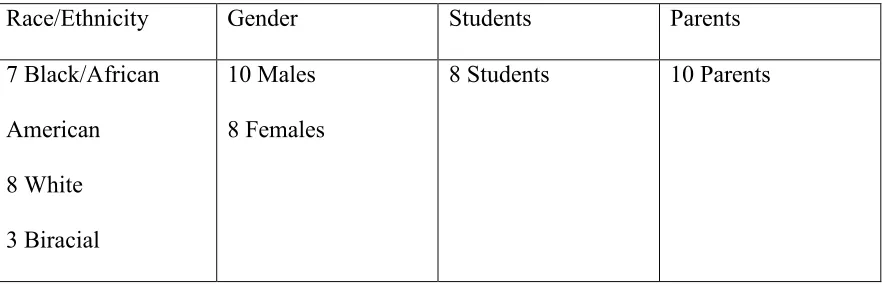
Table 3.1 Pilot Study Participants ...55
Table 3.2 Critical Family Literacy Book Club Meetings ...57
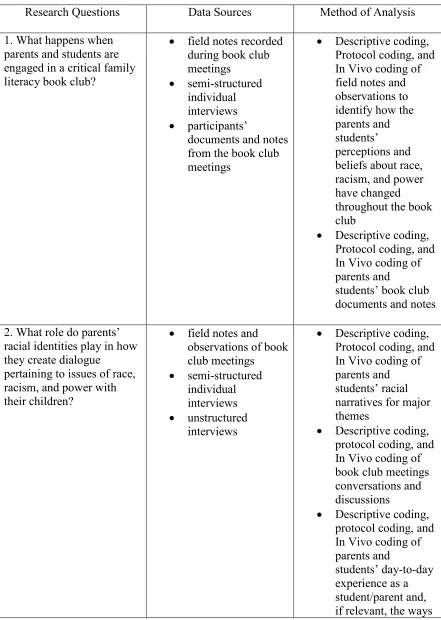
Table 4.1 Research Questions, Data Sources, and Analysis ...64
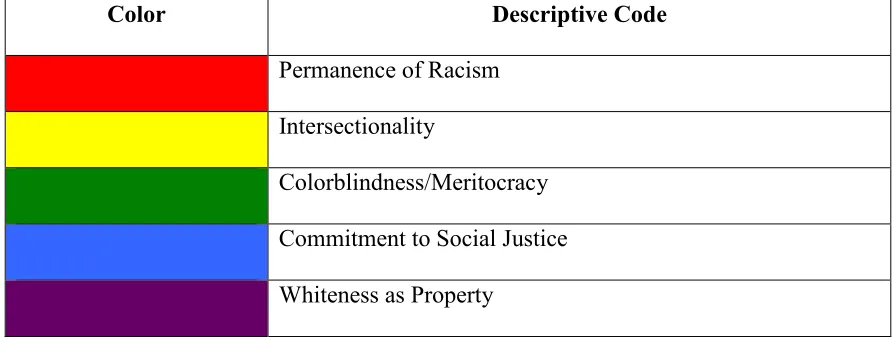
Table 4.2 Color-Coded Method ...69
Table 4.3 In Vivo Codes ...70
CHAPTER ONE
INTRODUCTION TO THE STUDY
Imagine a “typical” little boy consumed by the loud bangs and booms of video
games, the plastic Wal-Mart brand of a G.I. Joe figure, and wooden tracks filled with
miniature racing cars. I was that “typical” little boy. In addition to my amusement with
video games and toys, books also fascinated me. The simplicity of endless pages bound
together to create a vision captivated my attention. The intricate linking of words to
create images, the use of words to convey a message, and the simple beauty of language
itself gave me a great love and appreciation for education and knowledge. Indeed, my
great love of books contributed to my decision to become an English teacher.
When my students look at me, they see a young, African American man standing
alone at the front of the class, teaching. They cannot see the people who have surrounded
me all my life with a hedge of protection. My students may not see the personal burden
of racism that have shaped my multiple identities and who I am as a teacher. Although I
encounter(ed) racial oppression and marginalization, these hegemonic experiences
push(ed) me to develop inner strength and to fight for justice, equality, and fairness for
all humankind. However, there was a point in time when I rejected my Black identity. I
viewed being Black as an impediment. During this point in my life, I believed I was
incapable of excelling because of my skin color.
I had my first deliberating encounter with racism when I was in fifth grade. One
each child an invitation. I was thrilled. When I got home, I told my parents that I needed
swimming trunks because I had been invited to a pool party. However, the next day, the
boy came to class and uninvited all of the Black children although I did not understand
exactly why he had done so. All of this was very confusing to me as a 10-year old child.
Devastated and depressed, I went home and explained the situation to my parents.
They were outraged, and my mom called the boy’s mother, Mrs. Thomas (pseudonym),
who was my former second grade teacher. Until that time, I thought she “adored” having
me as her student---at least that was what she had told me. My mother explained to me
that Ms. Thomas had disinvited me because of the color of my skin. I vividly remember
Mom on the phone with Mrs. Thomas asking, “How can you call yourself a teacher and
you are behaving like this? You are supposed to love each and every child no matter
what his or her skin color is.”
My parents later explained that Mrs. Thomas did not want the Black children
there because of our race. This act of immoral and malevolent racism triggered
something in me. Internalizing the racism without knowing it, I realized that my skin
color prevented me from engaging in a desirable social opportunity. I began to question
my culture and Black people’s place in society. Since this event taught me that Whites
are able to do things that Blacks cannot, my outlook on White people changed. I began to
view them as superior to Blacks. I thought that they were more intelligent than Blacks,
and believed that they all came from privileged backgrounds. Unbeknownst to me at the
time, these ideas were also reinforced in books I read in school. Secretly, I was ashamed
of my culture, my community, and my identity. I gradually went from being an extrovert
tried to ensure I gave well-informed responses before I spoke, because I did not want my
White peers to think I was unintelligent and incompetent. Even though I put on a great
facade, I was defeated and thought I was incapable of succeeding as a Black male.
All of these thoughts contributed to my understanding of what it meant to be both
Black and a male—to be the absolute lowest on the racial totem pole. I witnessed and
experienced firsthand how the interplay of race and gender often propel the
disenfranchisement and marginalization of people of color, especially Black males.
Later, when I became a doctoral student, I learned and became familiar with the
grim statistics and body of literature which reified what I had lived firsthand. For
example, the Schott Foundation for Public Education (2012) presented alarming statistics
that showed of all the racial/ethnic and gender groups, Black males are the least likely to
obtain a high school diploma. Nationally, in 2011, only 10% of Black males were
proficient in eighth grade reading (Schott Foundation for Public Education, 2012).
According to the National Center for Education Statistics (2013), in 2007, 57% of Black
male high school students were suspended from school and 15 % of Black males were
expelled from high school as opposed to only 2 % of White males. These statistics were
exacerbated by the immense amount of mass media, which positioned Black males as
incompetent, inhumane, unemployed, imprisoned, and fatherless (Jackson, Boutte, &
Wilson, 2013). On many levels, Black males are frequently viewed as the problem for
many social problems; however, few sources acknowledged the micro and macro systems
of power that continue to stifle the social mobility, cultural/racial uplifting of Black males
(Howard, 2010; Jackson, Boutte, & Wilson, 2013). Yet, despite this dismal backdrop,
to oppress them mentally and physically, others are able to dodge the tumultuous waves
of structural inequities. Despite many odds like some of the Black males who do manage
to succeed, I believe that I have been able to defy the pervasive and prevailing negative
forecasts about Black men. I attribute my success to my parents, family members,
selected teachers, and community members who supported me, while also lovingly and
forcefully pushing me to become a successful Black man.
One teacher, in particular, who was instrumental in what I am labeling as my
success, was my seventh grade English language arts teacher, Ms. Ryans. She
emphasized the importance of literacy. Ms. Ryans was an excellent teacher whose
reputation preceded her. When I was in the sixth grade, I remember riding the bus and
hearing the older kids talk about Ms. Ryans. They spoke about how great a teacher she
was.
Mrs. Ryans was one of the six Black teachers who taught at my middle school.
She was a native of the school district; therefore, she knew and understood the
community, the demographics, and most importantly, the students well. She invested her
time in, and demonstrated her love and care, not only for me, but also other kids. She
positively helped me to transform in a way that allowed me to develop an appreciation
for and see the importance of my identity and my culture through books. As Rosenblatt
(1996) noted, “(a)ny knowledge about man and society that schools can give him should
be assimilated into the stream of his actual life” (p.3). I began to see how I could use
books as a vehicle to learn more about other cultures, the world, and myself. She
provided me with the first book in which I positively saw my culture, language, and
life-changing book, titled Johnathon. Jo Ann Burroughs’s (1999) novel, Johnathon, had a
profound impact on me. In the book, the main character Johnathon was a first grader
who came from an abusive family. He was neglected and unloved. His first grade
teacher became his “success coach” and she provided him with the nurturance and the
unconditional love, which he did not receive from his home environment. Johnathon was
put into foster care, and he moved to another city. Years later, the first grade teacher
became ill. She was rushed to another city to have major heart surgery performed by a
renowned heart surgeon. Right before her surgery, she saw a tall Black man with big,
brown eyes and a round face. In a slow, solemn voice she said, “Johnathon.” The
surgeon replied, “Teacher” (p.121).
Johnathon inspired me in such a way that I could never forget. Despite odds
greater than I could imagine, Johnathon succeeded as a Black man. This storyline caused
me to view Johnathon as a role model of sorts. This was the first book that I had
encountered with a successful, Black male character. It gave me hope. Johnathon
became a renowned heart surgeon, and surpassed numerous obstacles along the way. But
most importantly, Johnathon became a successful Black man. This changed my
perception of how I viewed African Americans, particularly African American males.
Sitting in my seventh grade English language arts class, I thought to myself how I too
could be like Johnathon. His success motivated me. Realizing the damage that my
second grade teacher caused me, I wanted to be the teacher in the book. I developed a
hunger and thirst to save lives through education. My goal was to fight for people of
motivated to do well in school. I knew if I wanted to impact lives, I had to pursue higher
education.
Teaching became my passion and students were my focus. Reading became my
drug and I was hooked. Ms. Ryans pushed and challenged my human psyche. At the
time, I wondered why she was pushing me because I was only a middle school student.
Because of her hard work and her rigor, I became more self-determined and intrinsically
motivated not only to do well in school, but also in life. Ms. Ryans genuinely cared for
all of her students, and she explicitly showed each student how much she valued them.
Ms. Ryans found something special to love in each child.
As a teacher, I constantly reflect upon and draw from my experiences as a student
and as an African American male. Looking back on my K-12 experience, out of all of
my teachers, I only had one teacher who took an interest in the cultural capital (Moll,
1992) that I brought from home and who practiced a pedagogical style I came to know as
culturally relevant pedagogy (Ladson-Billings, 1994, 2009). I believe it is important for
teachers to show students how much they care by validating who they are as cultural
beings (Au, 2009; Howard, 2010; Ladson-Billings, 2009). When I saw how much Ms.
Ryans cared for me, it made me want to excel as a student, a brother, a son, and a Black
male. She was not biologically related to me; therefore, she did not have to care for me,
but she did. This has directed me to believe how pertinent it is for teachers to show every
student how much they care.
I draw upon this particular racial narrative because this memory forged the
beginning of my racial identity as a Black male. I want teachers, policymakers, scholars,
inform and shape their ideologies and practices inside and outside of schools (Greene,
2013) while exploring the roles that homes and schools play in the development of one’s
racial and cultural identities.
If my work can prevent even one Black male or student of color —from the pain
and damage that I experienced to my psyche, then my teaching would have made a
difference. I will never forget that one pivotal incident from my fifth grade class of being
disinvited from a party, which resulted in my temporary loss of hope as a young, Black
male. The poem, “Incident” by Countee Cullen graphically captures the indelible pain
that I felt. Nevertheless, while I did not know it then, this unfortunately all-too-common
incident of being excluded or ridiculed propelled me into being a “Freedom Scholar” who
plan to dedicate my career and life interrupting racism. My goal is to be like Ms. Ryans
and other educators whom I now know who are determined to be a power for good in the
world.
The Incident by Countee Cullen
Once riding in old Baltimore,
Heart-filled, head-filled with glee;
I saw a Baltimorean
Keep looking straight at me.
Now I was eight and very small,
And he was no whit bigger,
His tongue, and called me, "Nigger."
I saw the whole of Baltimore
From May until December;
Of all the things that happened there
That's all that I remember (Cullen, 1923).
Statement and Discussion of the Problem
Racism is entrenched and deeply ingrained within the American landscape (Bell,
1992; Gay, 2002; Hammond, Hoover, & McPhail, 2005; Jackson & Boutte, 2009;
Ladson-Billings, 2009; Landsman & Lewis, 2011; Tatum, 2009). Furthermore, Bell
(1992) develops the claim that racism is worldwide and deeply-rooted in society that it is
normal and inescapable. Although a significant body of literature exists on best practices
for serving students from culturally and linguistically diverse backgrounds, dialogues
about how racism and racist ideologies shape our country, our lives (particularly our
schooling), our sense of self, and our ways of knowing are not transpiring between
teachers and students (Bolgatz, 2005; Baszile, 2003; Jay, 2006; Lynn & Parker, 2006).
The problem addressed in the present study is threefold. First, many teachers and
parents do not tackle issues of racism inside or outside the classroom (Au, 2009; Matias,
2013). Second, there are a plethora of studies that have focused on the pedagogical
application of critical race theory in higher education (Cook, 2013; Hughes & North,
2012; Lynn, Jennings, & Hughes 2013; Lynn & Parker, 2006; Matias, 2013); however,
there are few studies that illustrate the ways teachers can pedagogically enact critical race
theory in the K-12 classroom (Matias, 2013). Third, few studies have examined the effect
theoretical frameworks in a secondary school space (Lynn, 1999; Lynn & Parker, 2006;
Matias, 2013). Each of these problems are discussed in turn.
P-12 Teachers Typically Do Not Address Issues of Racism
Racial inequality continues to seep through the day-to-day life in schools.
According to Lewis (2003) schools play a major role in the drawing and the redrawing of
racial lines. There is a growing body of literature that indicates schools as central
institutions involved in the reproduction and transformation of race (Baszile, 2006;
Boutte, 2012; Jay, 2006; Ladson-Billings, 2009; Matias, 2013). Race shapes classroom
practices, and it is an integral part of students of color daily experiences in schools.
However, oftentimes, adults such as teachers do not fully address the issue of race and
racism, which in return perpetuates racial inequities (Lewis, 2003). Race-based
conversations open the window for those who witness(ed), live(d), or possess(ed)
knowledge about racial inequity to speak their truth about particular racialized
experiences (Lewis, 2003; Matias, 2013; Parker & Lynn, 2006). Those who do not live
with the everyday burden of racism can learn about people who are racially oppressed. In
the meantime, those who are free from such a burden can challenge their roles in the
oppression of people from culturally and linguistically diverse backgrounds. Matias
(2013) explains racial discussions are sometimes viewed as awkward and taboo or what I
refer to in the present study as the “elephant in the room” (the issue that people know
exists, but do not talk about). In a society where discussions of racism is considered to be
taboo, it is not surprising that teachers and parents may experience discomfort around
discussions on race and racism (Baszile, 2006; Bolgatz, 2005; Jay, 2006; Lynn & Parker,
classroom) can be quite frightening. Teachers, students, scholars, and parents
dysconsciously1, consciously, fearfully, and/or angrily avoid these topics (Bolgatz, 2005;
King, 1991). Reflecting on my prior experiences, I have encountered both parents and
teachers who are unnerved by discussions on race and racism. If we as educators desire to
tackle these issues that derive as a result of what Anna Deavere Smith (1993) calls, “our
struggle to be together in our differences,” (p. x), it is important to engage in critical
dialogue about these issues. There is a need for parents and teachers to eradicate the
trepidation of discussing issues such as race, racism and power with children. When
educators purposefully avoid these issues, barriers and boundaries that continuously place
students of color on the margins are being perpetuated (Matias, 2013). That is, avoidance
of discussions of race and racism stifles the humanity and critical consciousness of
people who are disenfranchised while reproducing Eurocentric ideologies and values that
pathologize people of color in a negative light. The creation of a “critical” relationship
between parents and educators, which allows for open discussion, can put a dent in the
system of oppression (Yosso, 2002). Hence, in the present study, I used a critical family
literacy book club as a mechanism for engaging parents and students in discussions about
race and racism.
Critical Race Frameworks and Pedagogies Have Not Been Used Widely In Schools
Since paradigms and frameworks used in P-12 schools often lag behind those
in higher education, many recent theoretical and conceptual frameworks have not
permeated school settings. It is not a revelation to note that practice in P-12 schools tend
to trail behind new and emergent bodies of literature that are commonly discussed in
teacher education programs. While many academic discussions are about P-12 schools,
they are often largely theoretical and not readily accessible to practitioners (Lynn,
Jennings, & Hughes, 2013). Consequently, CRT and Critical Race Pedagogical practices
have not been widely applied in school settings. Yet, in order to understand the role that
race and racism play in the academic achievement among students of color in P-12 school
settings, it is important to examine how social constructions of race and racism are
ingrained throughout school structures, processes, and discourses (Jay, 2006).
Although Critical Race Theory (CRT) was introduced by Ladson-Billings and
Tate (1995) nearly two decades ago, in many ways it is still relatively new to teacher
education programs. While popular and considered to be cutting-edge in some academic
circles, it is not without criticism or contention (Cole, 2009; Ladson-Billings, 1998). A
discussion of major criticisms of CRT is beyond the scope and relevance of the present
discussion; however, it should be noted that many emerging non-positivistic paradigms
and theories are often slow to gain notoriety and momentum. So as a relatively recent
theoretical framework in teacher education, CRT’s tenets in teacher eduP-12 school
settings remain understudied. More needs to be known concerning whether CRT can be
used as an analytic tool to understand P-12 settings. For example, how might CRT be
applied to incidents like the one described in the anecdote about my fifth-grade
experience? In the present study, Critical Race Theory was used to conceptualize,
implement, and examine a critical literacy book study with parent-student dyads in a
The Need for Critical Race Theoretical Studies Involving Parents and Students
As evidenced by the incident that I encountered in fifth grade, parents are
essential players who can help shape knowledge of race and racism (Harro, 2000).
Indeed, parents and educators remain two of the most essential learning resources
children have. However, parents are typically not involved in discussions about race
unless a problem emerges (Yosso, 2002). Both teachers and parents are influential in
promoting or contradicting notions of love or hate (Grosland & Horsford, 2013); hence,
families should be invited into discussions about race and racism.
Few studies have examined the effect of educating parents and students through
critical race pedagogical and critical race theoretical frameworks in a secondary school
space (Lynn, 1999; Lynn & Parker, 2006; Matias, 2013). The present study sought to
illuminate, and thus better understand, the racial experiences and understandings of
parents and students across various racial and ethnic backgrounds. More specifically, it
was designed to capture the voices of parents and students of color regarding their
experiences with and challenges to, race, racism, and power while simultaneously
welcoming the voices and experiences of White parents and students as a way to begin
critical dialogue across different racial and age groups. The present study will add to the
extant literature on this topic by adding findings on the role that these issues (race and
racism) play among high school students and their parents.
Purpose of the Study and Research questions
The purpose of this study was to investigate, analyze, and interpret how race,
This study examined the role a critical family literacy book club played in helping parents
build cultural competence and critical consciousness with their children.
This study was guided by two research questions: (1) What happens when parents
and students are engaged in a critical family literacy book club? (2) What roles do
parents’ racial identities play in how they create dialogue pertaining to issues such as
race, racism, and power with their children?
Significance of the Study
According to Critical Race Theory, racism is permanent, pervasive, and persistent
(Bell, 1992). The acts of racism that are interwoven throughout American society are also
mirrored in social institutions such as schools. As demonstrated by the historical and
contemporary (mis)treatment of African Americans, none of these malicious acts are
incidental (Perry, Steele, & Hilliard, 2003). Stated more pointedly, there is pervasive and
systematic devaluation of African Americans in society, which systematically seeks to
eradicate critical consciousness from African Americans (and other people who have
been marginalized) while attempting to convince them that they are inferior to whites
(Perry, Steele, & Hilliard, 2003). This systematic devaluation is not limited to society at
large, but is also threaded throughout classrooms, instructional practices, and curricular
designs. Most of the media, images, and mainstream curriculum are distorted and depict
people of color in a negative light (Jackson & Boutte, 2009; Lynn & Parker, 2006).
Historically and presently, systemic racism coupled with subtle racial microagressions2
2Microagressions are small and ongoing acts of racism and racial oppression such as
words, actions, or environments which communicate small racial insults or derogatory comments intentional or unintentional towards people of color and other oppressed
encourage the misinformation and miseducation of African American children
(DuBois,1903; Woodson, 1933; Perry, Steele, & Hilliard, 2003).
Rationale For A Critical Family Literacy Book Club
Following the line of reasoning that parents, teachers, and students should engage
in ongoing discussions about race and racism instead of ignoring these issues, a critical
family literacy book was used in this study as a mechanism for conversation and
dialogue. The book club stemmed from the hope and faith in the possibilities for schools
to act as forces for equity and justice and “from an understanding that they often fall short
(Lewis, 2003, p. 11). With the initial focus on the book’s characters and settings, the idea
was that opening conversations about race may be less threatening (Morrell, 2004). The
critical nature of the book club provided a space for families to critique, challenge, and
evaluate the roles that race and racism play in their lives as well as other intersections
such as gender, sexual orientation, class, and nationality (Crenshaw, 1991). In addition,
family literacy book clubs enable schools to build upon families’ literacy practices by
exploring how students and parents engage in literacy practices outside of school.
Furthermore, if used effectively, the book club can serve as an essential tool that can
contribute to the creation of a bi-directional partnership between homes and schools
(Boutte & Johnson, 2014) since they are two social institutions that need to work together
to ensure that children are able to maintain their own cultural, racial, and ethnic identities
while also excelling academically (King, 2005). That is not to say students should not go
beyond their own social identities; however, in order to counter hegemony, racism, and
bigotry, students need to have a complete and full understanding of their ethnicities
collaborate and work toward helping students to accept themselves and to recognize their
full potential and value. An underlying assumption is that once people of color learn how
to fully love ourselves, it should be easier to understand, accept, appreciate, and love the
full humanity of other racial and ethnic groups.
The instructional approach used in the present study was unique since it
welcomed parents as learners into a secondary English language arts classroom to build
cultural competence, racial literacy, and critical consciousness among the teacher,
parents, and students. The present study examined a newly created family literacy book
club, which served as a tool for creating an open space in which parents and students
were able to engage in critical responses to micro and macro systems of power.
Terms and Definitions
Terms and definitions that are pertinent to this study are defined below.
Critical Literacy: Critical literacy interrogates society by critiquing injustices and
inequities such as racism, sexism, classism, and gender inequality. The intent of critical
literacy is to build cultural competence, liberation, and critical consciousness (Morrell,
2004). Critical literacy can be used to critique texts of all types, including (but not
limited to) media, print, non-print, and movies.
Critical Race Pedagogy: Critical race pedagogy situates race in the K-12 classroom. It
engages students in self-reflexivity and critical dialogue about race, while disrupting
issues of White supremacy (Lynn, 1999).
Critical Race Theory: Critical race theory in education examines the relationship of
race, racism, and power in P-20 school settings. Critical race scholars and activists try to
Dysconscious Racism: This form of racism is unintentional, a covert, and nonviolent
form of racism. King (1992) defines dysconscious racism as an uncritical habit of mind
in regards to race.
Microagressions: Microagressions are small and ongoing acts of racism and racial
oppression such as words, actions, or environments which communicate small racial
insults or derogatory comments intentional or unintentional towards people of color and
other oppressed groups (Bryan & Browder, 2013; Sue & Constantine, 2007).
Racial Literacy: Racial literacy is a tool that enables individuals to understand race in
American landscape and how race operates throughout various institutions such as
schools and political policies. The concept of racial literacy focuses on a set of practices
structured to teach individuals how to recognize, respond, and counter different forms of
everyday racism as well as develop strategies for coping and countering theses oppressive
forces.
Overview of Chapter 2—Literature Review
Chapter 2 will provide an overview of the literature. It begins with the conceptual
framework, which include critical race theory and critical race pedagogy about how they
inform the proposed study. Additionally, a synthesis and discussion of related research
CHAPTER TWO
REVIEW OF RELATED LITERATURE
Prior to beginning this study, I reviewed extant literature in education, which
would inform the study. The nexus of my inquiry focused on two interrelated bodies of
literature: literacy as it relates to racial justice and parent involvement. Hence, these
bodies of literature are the impetuses that gave rise to this particular research study.
Below I describe the conceptual framework for the study, followed by a review of the
bodies of literature on literacy and parental involvement. The discussion of literacy
includes three major topics: (1) the sociocultural nature of literacy; (2) critical literacy;
and (3) literacy as a tool of racial justice. Since parent involvement research and literature
are vast and covers many schools of thought, it is presented via three major paradigms:
(1) positivistic; (2) ecological; and (3) critical. Additionally, the review of literature on
parent involvement is limited to urban contexts like the one for the present study.
Conceptual Framework
This study is framed from a Critical Race Theoretical perspective in order to
understand how parents’ racial and cultural identities impact conversations about social
and equity issues with their children, in particularly race and racism. This study also
draws from Critical Race Pedagogy (CRP), which applies Critical Race Theory (CRT)
tenets to teaching in classrooms. Concomitantly, critical race pedagogical and critical
race theoretical frameworks dismantle “traditional” ideologies and epistemologies while
positive racial identity development and liberation of teachers, students, and parents. The
following discussion of CRT explains key tenets as well as points of departure from
“traditional” epistemologies.
Critical Race Theory
Race has become metaphorical---a way of referring to and disguising
forces, events, classes, and expressions of social decay and economic
division far more threatening to the body politic than biological “race”
ever was. Expensively kept, economically unsound, a spurious and
useless political asset in election campaigns, racism is as healthy today as
it was during the Enlightenment. (Morrison, 1992, p. 63).
Nearly two decades ago, Ladson-Billings and Tate (1995) introduced critical race
theory (CRT) to the field of education. CRT evolved from Critical Legal Studies (CLS),
which was created in the mid-70s by a group of legal scholars who were involved in the
Civil Rights Movement. In Mark Kelman’s (1987) foundational piece, A Guide to
Critical Legal Studies, Kelman illustrated how CLS challenged the social and political
issues during that era. These challenges contradicted and served as a paradox to the
assumption of the U.S. law being a fair and just system (Unger, 1986). More specifically,
critical legal scholars examined the ways the law contributed to the social hierarchical
production of the wealthy and powerful. CLS challenged and critiqued legal theories and
practices that seemed normative. An earlier work by Unger (1986) also contended that
laws reflected the practices and ideologies of the people who were in power and of higher
socioeconomic statuses. Unger explained that people in power utilized laws as tools to
in society. Critical legal scholars challenged the notion of the law as a neutral device and
recast it as a device that perpetuates oppression (Kelman, 1987). Furthermore, critical
legal scholars worked to overturn the unethical and misuse practices of the law; and, they
used the law as a tool that could achieve this goal (Unger, 1986).
Critical race theory evolved in the 1980s. Unlike Critical Legal Studies, CRT
called for a critical analysis of race in the American society (Milner, 2007). Advancing
the proposition that racism is normal and interwoven throughout the American society,
leading CRT theorist, Derrick Bell, (1992) postulated that race should be situated within
its social and historical contexts social structures and institutions such as the educational
system should be evaluated to determine how racism is embedded within them.
Critical race theory is an intellectual and social mechanism that focuses on the
deconstruction of marginalization and hegemonic forces and discourses that people of
color encounter. It works to reconstruct the humanity and agency of people of color
while focusing on the construction of equitable and fair distribution of power within
society (Ladson-Billings, 2009). Seven major propositions guide critical race theory
when used as an analytic framework. CRT: (1) recognizes and accepts the permanence of
racism (Bell, 1992; Delgado & Stefancic, 2012; Ladson-Billings, 1995); (2) recognizes
the intersectionality of race, racism, and power with other forms of oppression such as
sexism, classism, sexual orientation, and religion (Cook, 2013; Lynn & Parker, 2006;
Soloranzo & Yosso, 2002); (3) challenges and critiques liberalism’s notions of
colorblindness, meritocracy, and neutrality (Bell, 1992; Cook, 2013; Ladson-Billings,
1998); (4) challenges White supremacy and Whiteness as property (Bell, 1992; Cook,
through the lived experiences of the oppressed individuals and groups through
counterstorytelling (Bell, 1992; Cook, 2013; Delgado & Stefancic, 2012; Lynn & Parker,
2006); (6) recognizes racial equality for people of color can transpire or can be
accommodated when it converges with the interests of the individual in power (Bell,
1992, 1997; Delgado & Stefancic, 2012); and (7) is committed to social justice (Yosso,
2000).
A brief definition of each tenet follows.
1. Permanence of Racism: There are some CRT scholars who believe that
race is permanent (Bell, 1992). From this point of view, African
Americans and other people of color will never gain full equality in this
country; however, racial realists believe individuals can obtain a certain
freedom from knowing the truth. Racial realists believe that combating
racism is a struggle that is ineffective for ending racism, but suggest that
the struggle can liberate African Americans and other people of color
(Bell, 1992; Delgado & Stefancic, 2012).
2. Intersectionality: CRT scholars have beliefs that race, class, gender,
sexual orientation, religion, national origin, and marginalized other social
identities are other oppressive factors that can function separately or can
add to the multiple forms of oppression depending upon the setting
(Delgado & Stefancic, 2012). The intersectionality makes it difficult to
self-identify which particular intersection(s) are being operated.
3. Critique on Colorblindness/Meritocracy: CRT critiques liberalism as a
2012). Liberals tend to embrace a meritocratic notion of “we have
arrived,” and society is not racially stratified. They embrace and employ
colorblindness. Colorblindness can be nebulous because it can stand in
the way of recognizing racism. CRT scholars argue liberalists disregard
the tacit forms of racism, which are embedded in the thoughts, discourses,
and structures of the oppressor. Not identifying these microaggressions (or
daily, ongoing, and covert acts of discrimination) contributes to the
ongoing oppression of people of color.
4. Counterstorytelling: CRT scholars draw upon counternarratives to
challenge and counter the master or dominant narrative that continue to
oppress people of color. Counternarratives illustrate how racism and
racial discrimination are entrenched in the everyday lives and experiences
of people of color. (Delgado &Stefancic, 2012).
5. Interest Convergence: Racial equality and fairness are met when Whites
remain privileged and are benefited (Delgado & Stefancic, 2012). Whites
will support racial justice only when it benefits them. Thus, there is a
merge between the interests of White people and racial justice (Bell,
1992).
6. Whiteness as Property: CRT makes a link between Whiteness and
property. Historically, Whites have been the proprietors of institutions,
education, language, knowledge, citizenship, and literacy. Thus, to be
White is parallel with having collateral since it translates into
ideology and assumptions about the normalization of Whiteness as
property (Delgado &Stefancic, 2012; Harris, 1995).
7. Commitment to Social Justice: CRT challenges racism, sexism, classim,
and other hegemonic and subordinate forms that are in place to
marginalize people of Color. Hence, merging CRT and social justice
enables individuals to build a critical consciousness. Critical
consciousness unmasks the beliefs and ideologies that may impede
humanity, freedom, justice, and democracy. Building a critical
consciousness is an architecture that enables CRT scholars to challenge
and interrogate the dominant ideology and power structures through
providing the lived experiences of the oppressed groups and individual
(Delgado & Stefancic, 2012).
The last tenet, in particular, is also a key tenet of critical race pedagogy. Indeed,
critical race theory, critical race pedagogy, and social justice are inextricably linked in
that they are linked and threaded through liberatory practices, while resisting and
challenging dominant structures and narratives.
Critical Race Pedagogy
Critical race pedagogy (CRP) was introduced by Marvin Lynn in 1999 (Lynn,
1999). Having previously studied Critical Theory and, later, Critical Race Theory, Lynn
found that CRT addressed race in a direct way that Critical Theory did not. Adapting
CRT’s tenets for application in the classroom, he coined the term, “Critical Race
CRP can be used in classrooms to challenge racial inequities within the context of
schooling in the U.S. It draws from African American epistemological frameworks and
theories (DuBois, 1908; Hilliard, 2009; King, 1991; Woodson, 1933) that challenge and
critique social and equity issues while building the racial and ethnic uplifting of people
who are often on the margins in society (Lynn, Jennings, & Hughes, 2013). Like CRT,
critical race pedagogy strives to understand the racial and hegemonic repressive
structures that are in place to disenfranchise students of color (Lynn, 1999). CRP is
viewed as a promising route for educators to use when confronting racial blind spots and
knowledge about living, learning, and teaching race (Hughes & North, 2012). Racial
blind spots are hidden biases that people possess, and individuals may or may not
recognize how these hidden biases sustain racial oppression. Five key tenets of CRP are
presented below (Lynn, 1999).
1. CRP must be intimately cognizant of the necessary intersection of
other oppressive constructs such as class, gender and sexual
orientation (p. 26).
2. CRP must recognize and understand the endemic nature of racism (p.
25).
3. CRP must recognize the importance of understanding the power
dynamics inherent in schooling (p. 26).
4. CRP must emphasize the importance of…reflexivity…[and how the]
5. CRP must encourage the practice of an explicitly liberatory form of
both teaching and learning…advocating for justice and equity in both
schooling and education as a necessity if there is to be justice and
equity in the broader society (pp. 27-28).
These five tenets of CRP are the foundation for directing teachers, parents, students, and
teacher educators toward transformative instructional practices that dismantle narratives
that continue to oppress people of color.
Because of the rapidly changing racial demographics in U.S. schools, employing a
critical race pedagogy in educational institutions is vital if schools are to avoid mirroring
historical and current types of institutionalized racism that are prevalent within the
American society (Lynn, Jennings, & Hughes, 2013). Virtually 80% of the teaching force
is comprised of White, monolingual, middle-class women (National Education
Association, 2013). However, the student population is increasingly comprised of
culturally and linguistically diverse students (Moore & Lewis, 2012). As noted in the
academic literature, there is a cultural/racial mismatch between teachers and students
(Anderson, 1988; Emdin, 2013; Hill, 2009; Ladson-Billings, 1995; Moore & Lewis,
2012; Morrell, 2004). Many teachers encounter teaching students who are
demographically different than they are (Perry, Steele, & Hillard, 2003). While not
arguing that critical race pedagogy is a panacea for social and racial justice, it does have
the potential to empower students politically, socially, intellectually, and emotionally
(Esposito & Swain, 2007; Ladson-Billings, 1995) and can lead to educational success
Critical race pedagogy creates a space for critical dialogue and praxis about
race-related issues. In contrast to issues of gender and social class, race remains largely
untheorized (Hughes & North, 2012). That is, there is not a language that enables us to
discuss race and racial disparities in manners that are beneficial and emancipator to those
who are oppressed by racism. This pedagogy sheds light on the endemic nature of racism
and enables teachers to re-conceptualize critical race studies by situating race at the
forefront of classroom practices, while moving oppressive situations from private to
public spaces (Lynn & Parker, 2006; Lynn, 1995).
In Ladson-Billings’ (1995) book, The Dreamkeepers: Successful Teachers of
African Americans, she argued that the effect of racism continues to permeate and invade
U.S. schools. Racial disparities perpetuate political, economic, and social injustices and
inequities. Racial incongruence between teachers and students frequently impedes on the
representation of students of Color in gifted and talented courses, amount of funding
distributed for each child, obtainment of a high school diploma, success on standardized
tests, and literacy and numeracy achievement (Anyon, 2005; Ladson-Billings, 1995;
Landsman & Lewis, 2011; Moore & Lewis, 2012).
Critical race pedagogical practices create a space for critical discussions about
social and equity issues in society. In such contexts, critical race pedagogical teaching
will likely cause discomfort to those who are already uncomfortable with race-related
discussions (Bolgatz, 2005; Matias, 2013). It provides a contested environment that
critiques, challenges, and evaluates the oppressed and the oppressor, which requires
naming the key players and how these significant people or events exacerbates and
CRT and CRP were selected for the framework of the proposed study because I
view critical race pedagogy as the impetus for approaching critical race theory issues in
the classroom. Both CRP and CRT refute deficit types of thinking and language, which
are prominently seen and implemented in the classroom. Valencia (2010) explained that
deficit thinking is positioned in racial and class bias; it “blames the victim” for school
failure instead of evaluating how educational institutions such as schools are designed to
prevent poor students and students of color from learning. Critical race pedagogical and
critical race theoretical frameworks can assist in enabling the participants in this study to
challenge, evaluate, and analyze the various micro and macro institutions of power while
dismantling and countering dominant/deficit ideologies by capturing the participants’
voices, lived experiences, and stories. The next section examines racial justice as it
relates to literacy.
Review of Literature on Literacy
While literacy is a broad topic, this review of literature illuminates how literacy as
a social practice can foster cultural identities and racial justice. The following review of
literature explores: (a) the sociocultural nature of literacy, (b) critical literacy, and (c)
literacy and racial justice.
The sociocultural nature of literature
Building on the work of Morrell (2004) and Perry (2012), literacy is defined as “a
communicative act in which any text is integral to the nature of participants’ interactions
and interpretive processes” (Morrell, 2004, p. 11). Literacy is seen as a meaning
making process with any type of text. Literacy practices are fluid and social practices,
A review of the academic literature on literacy yielded two major ways of
thinking: (1) literacy as a neutral process and (2) literacy as a social process (Bandt,
2001; Freire, 1970; Hagwood, 2002; Morrell, 2004; National Early Literacy Panel, 2008;
National Reading Panel, 2001; Street, 2001). Earlier conceptions of literacy did not
consider its sociocultural nature; however, more recent accounts focus on its social
nature. Table 2.1 presents a summary of major assumptions from literature on the two
different schools of thought—traditional and sociocultural.
Table 2.1: Traditional and Sociocultural Assumptions About Literacy
Traditional Assumptions About Literacy Sociocultural Assumptions About Literacy Literacy is viewed as a technical,
skill-based and neutral process (National Reading Panel, 2000).
Literacy is a social practice, which involves interactions between the reader and the text. Texts reflect the writer’s ideas and readers’ ideas and experiences affect how texts are read (Kirkland, 2008).
Literacy is an intricate system where meaning is derived only from print with a main focus on fluency, decoding of words, vocabulary, and active comprehension strategies (National Early Literacy Panel, 2008).
Literacy is a meaning making process where meaning derives from readers’ prior knowledge and experiences.
Comprehension and understanding texts are important (Perry, 2012).
The focus is on isolated skills and
strategies such as knowledge of the letters of the alphabet, comprehension of the names and sounds of letters associated with printed words, phonological awareness, and the ability to work with, to think about, and to notice the individual sounds in words (Wise, 1992).
Literacy practices are dynamic and constantly evolving---new practices are learned through everyday practices and sense making. Literacy is broader than reading skills. Holistic approaches to reading are preferred so reading involves more than phonological awareness.
Context clues and making sense of texts are stressed (Hagwood, 2002; Street, 2001). The ability to read a text and rapidly recall
selected events and characters in the story are emphasized (Girolametto, L., Pearce, P. S., & Weitzman, E., 1996).
Literacy is more than a set of rigid cognitive skills; it also involves power relationships where social institutions are evaluated and critiqued (Freire, 1973; Morrell, 2004).
critical and sociopolitical consciousness (King, 1991).
A limitation of traditional conceptions about literacy is that many students do not
see texts as relevant or as familiar stories that are related their lives (Morrell, 2004; Perry,
2012). Contrastingly, sociocultural perspectives on literacy view the various ways in
which people incorporate literacy in their everyday practices (Perry, 2012). Scholars who
view literacy as a social practice explore ways to make instruction relevant and
meaningful by incorporating children’s home language and literacies in the classroom
(Heath, 1983; Freire, 1970; Perry, 2012; Street, 1984). Language and literacy are used in
many ways depending on the context. As Street (1984) explained:
The rich cultural variation in these practices and conceptions leads us to rethink what we mean by them and to be wary of assuming a single literacy where we may simply be imposing assumptions derived from our own cultural practice onto other people’s literacies (p. 430).
Expounding on theses ideas, Street (2001) noted that much of sociocultural research in
literacy is constructed on the assumption that in order to understand literacy it demands
detailed and comprehensive accounts of actual practice in various cultural settings. Street
cautioned, however, that it is not enough “to extol simply the richness and variety of
literacy practices made accessible through such ethnographic detail; we also need bold
theoretical models that recognize the central role of power relations in literacy practices”
(p. 430).
Conceptions of literacy as a social practice has been profoundly influenced by
Perry and Hart (2012) work with refugee English learners (ELs) which was grounded in
data that explicated the numerous ways people utilize reading and writing in their
worked with local refugees. In the study, the authors’ examined tutors and teachers of
adult refugee learners to better understand how English as a second language (ESL) and
adult basic literacy (ABL) programs are preparing teachers to provide better language and
literacy instruction to adult refugees. Brandt’s (2001) concept of literacy sponsorship
served as the theoretical framework for this study. Literacy sponsorship is defined as,
“any agents, local or distant, concrete or abstract, who enable, support, teach, model, as
well as recruit, regulate, suppress, or withhold literacy” (p. 111). Bandt’s notion of
literacy sponsorship foregrounds societal issues such as, racism, economic, political,
gender and immigration; furthermore, this study is guided by two broad research
questions: (1) From their point of view, how prepared are local educators to teach
refugees? (2) What supports are needed to help these educators better meet refugees’
educational needs? The analysis focused on three local organizations in one Southeastern
U.S. city that provided most of the ESL and literacy education and instruction to local
refugees. Data methods consisted of responses of open-ended questionnaires,
semistructured interviews, and observations. The authors’ analyzed their data through
several coding processes. The findings suggested that although many of the teachers of
refugees were certified, it was evident that such certification was not required or
expected. Hence, adult refugees who were seeking language and literacy classes could be
taught by someone with no certification and little, if any, training in language and
literacy. Thus, the findings illustrated the ways in which literacy practices for refugees is
being sponsored, more specifically the ways it is being controlled, contained, and
withheld (Bandt, 2001), even if it is unintentional. The authors provided implications on
The concept of literacy as a social practice is greatly influenced by Street’s
(1985) work contrasting the autonomous and ideological models of literacy. The
autonomous model is formal literacy instruction, which conceptualizes literacy in a rigid
and technical manner. This particular model views literacy as a set of skills that one has
or does not have (Hammond, Hoover, & McPhail, 2005; Perry, 2012). The ideological
mode conceptualizes literacy as practices not as a set of skills. These practices are
situated in specific spaces and linked to cultural and power structures in society (Perry,
2012). Building on sociocultural conceptions about literacy practices being shaped by
power structures (Hammond, Hoover, & McPhail, 2005). Critical Literacy schools of
thought about literacy address issues of power in more detail.
Critical Literacy
From a Critical Literacy perspective, literacy is viewed as a tool of liberation and
as a tool that unveils and challenges the structures and systems that oppress different
groups of people, and as a tool of liberation and critical transformation (Street, 1984).
Critical literacy focuses on identities and the ways in which individuals respond to power
and domination through literate practices (Freire, 1970; Hammond, Hoover, McPhail,
2005; Morrell, 2004; Perry, 2012). Therefore, identity construction is a vital component
that is linked to critical literacy Hagood (2002). Texts reflect cultural and societal
structures of race, gender, and class and, therefore, represent varying position of power
(Hagood, 2002).
Moje and Luke (2009) presented a theoretical overview of how identities are
mediated by the texts that individuals encounter. Identities are negotiated and are
furthermore, a theoretical construct about identity, “is crucial, not to control the identities
that students produce, construct, form, or enact but to avoid controlling identities” (p. 61).
French sociolinguist theorist, Bourdieu (1991), provided a framework for understanding
critical theory and for recognizing the ways in which critical theories can and do connect
with theories of literacy as a social practice. Bourdieu’s areas of research provided
connections among language use, power, and politics. Bourdieu contended that “(t)he
social uses of language (including literacy) also symbolically reproduce power
relationships and social differences. Various agents have more or less symbolic power,
depending upon whether or not their symbolic capital is recognized by those in power”
(p. 62). The work of Bourdieu and others emphasize the need for educators to understand
the multiple ways in which people practice literacy and understand how these practices
are linked to who we are and the environment in which we exist. In the U.S. race is a key
social identity that can be examined in relation to literacy issues.
Literacy and Racial Justice
Historically, Black people who were enslaved and those who were free fathomed
and embraced the importance of literacy since it was inextricably linked to freedom
(Jackson & Boutte, 2009). Literacy was and is considered to be necessary for gaining
power and liberation--physically, mentally and spiritually. “Literacy is inseparable from
the struggle for freedom because education interrogates power. Hence, African-centered
philosophies that guide effective teaching practices for African American students are, in
fact, a matter of liberation” (Jackson & Boutte, p. 110) and empowerment. On the other
disenfranchisement of people of color as it is in public schools today (Hammond,
Hoover, McPhail, 2005; Morrell, 2004; Perry, 2012).
Throughout history and currently, literacy has been a barrier for African
Americans and people of color (Ladson-Billings, 1995; Prendergast, 2003). It is one of
the tools society uses to perpetuate this cycle of oppression and hegemonic actions, which
sustains the privilege and power Whites continue to have over the oppressed
(Prendergast, 2003). Historically, African American children have been subjugated and
deprived of an equitable education (Anderson, 1988; Perry, Steel, and Hilliard, 2003).
Literacy has been racially and socially stratified as a right for White students and as a
privilege for children of color (Rogers & Mosley, 2006). Furthermore, the notions of
literacy as a right and privilege can be explicated. Hence, if literacy is situated in a
historical context, literacy operated in favor of Whites by symbolizing literacy as an
alienable right that no one would contest. On the other hand, if we explore the
intersections of race, literacy, and education, we can gain a better sense of how students
of color have fought for access to be seen or heard throughout classroom practices,
curricular designs, policies, and literature and literacy practices. Ladson-Billings (2003)
expatiated that literacy is a device that signifies a form of property owned and utilized by
whites in the society. Literacy educators, scholars, teachers, and policy makers need to
restructure the meaning of literacy and restructure how literacy should be implemented in
the classroom. Drawing upon literacy as a social practice, enables a site for racial and
cultural uplifting while moving away from literacy as a site of oppression and
of how racial justice allows students to understand race, how it developed, why it is, and
how it is used to propel social and equity issues (Grosland & Horsford, 2013).
Racial literacy conveys a more fluid structure of understanding race in American
society. Often, race is a forbidden subject, but in order to disrupt individual, institutional,
and collective racism, first, there must be critical dialogue about this particular issue. In
one of the few empirical pieces on racial literacy (Matias, 2013; Rogers & Mosley,
2006). Rogers and Mosley (2006) conducted a study that used racial literacy as an
analytic tool, diagnostic device, and as an instrument of process. In the study, the authors
demonstrated the ways in which White children do engage in dialogue about race, racism,
and antiracism within the context of literacy curriculum. Critical race theory, Whiteness
studies, and critical discourse analysis served as the analytic frameworks for this study.
Data were collected at an elementary school in the Midwest during the 2002-2003 school
year in a second grade classroom. Participants included five African American students,
one Korean American student, and 13 White students. Data consisted of classroom
literacy lessons through ethnographic documentation, researcher/teacher journal, student
artifacts, and interviews. Rogers and Mosley (2006) analyzed their data through using a
critical discourse analysis which helped to make clear the interpretations, descriptions,
and explanations between the text, discursive practices, and social interactions. The
authors’ findings suggested that children began to see whiteness in their visual and
linguistic analysis and synthesis of the texts while simultaneously enacting and disrupting
white privilege. However, Rogers and Mosley (2006) contended that in order for
individuals to understand race—race has to be addressed rather than ignored. Creating a
for students to operate within a democracy; but, more importantly, it provides students
with the chance to become critical democratic citizens. Hence, racial literacy is a
framework that needs to be further explored. Although this study was conducted at the
elementary level, the study adds to this body of knowledge by illustrating racial literacy
at the secondary level space.
Au (2009) explained how most literacy scholars and literacy teachers do not
employ racial literacy, and yet race is notably tacit in literacy scholars and literacy
teachers’ classrooms. Dialogue about race, racism, power, and antiracist education is
typically rooted in the language of diversity, multicultural education, and culturally
relevant pedagogy; however, classroom teachers and scholars can employ these
principles and frameworks, and the topic of race can still remain silent (Au, 2009; Knaus,
2011; Prendergast, 2003; Rogers & Mosley, 2006). Hence, there are some classroom
teachers who use literature that overtly depicts racism, but conversations about race and
racism do not occur. The avoidance of racial discussions can be detrimental to all
students. For example, students who are oppressed are not able to challenge and critique
the pervasive and systemic social structures that continue to marginalize them; in
addition, the avoidance of racial discussions in classrooms reifies the silencing of
students of color voices and their epistemic orientation of living and knowing. More
specifically, this issue exacerbates the marginalization of students of color because White
students are not challenged to explore, critique, and evaluate where they situate
themselves living in a racially stratified society as well as understanding the roles they