Making Speech Look Like Text
in the Regulus Development Environment
Elisabeth Kron
3 St Margarets Road, Cambridge CB3 0LT, England [email protected]
Manny Rayner, Marianne Santaholma, Pierrette Bouillon, Agnes Lisowska
University of Geneva, TIM/ISSCO, 40 bvd du Pont-d’Arve CH-1211 Geneva 4, Switzerland
[email protected] [email protected] [email protected]
Abstract
We present an overview of the de-velopment environment for Regulus, an Open Source platform for construction of grammar-based speech-enabled systems, focussing on recent work whose goal has been to introduce uniformity between text and speech views of Regulus-based appli-cations. We argue the advantages of be-ing able to switch quickly between text and speech modalities in interactive and offline testing, and describe how the new func-tionalities enable rapid prototyping of spo-ken dialogue systems and speech transla-tors.
1 Introduction
Sex is not love, as Madonna points out at the be-ginning of her 1992 book Sex, and love is not sex. None the less, even people who agree with Madonna often find it convenient to pretend that these two concepts are synonymous, or at least closely related. Similarly, although text is not speech, and speech is not text, it is often conve-nient to pretend that they are both just different as-pects of the same thing.
In this paper, we will explore the similarities and differences between text and speech, in the con-crete setting of Regulus, a development environ-ment for grammar based spoken dialogue systems. Our basic goal will be to make text and speech processing as similar as possible from the point of view of the developer. Specifically, we arrange
c
2008. Licensed under the Creative Commons Attribution-Noncommercial-Share Alike 3.0 Unported li-cense (http://creativecommons.org/licenses/by-nc-sa/3.0/). Some rights reserved.
things so that the developer is able to develop her system using a text view; she will write text-based rules, and initially test the system using text in-put and outin-put. At any point, she will be able to switch to a speech view, compiling the text-based processing rules into corresponding speech-based versions, and test the resulting speech-based sys-tem using speech input and output.
Paradoxically, the reason why it is so important to be able to switch seamlessly between text and speech viewpoints is that text and speech are in fact not the same. For example, a pervasive prob-lem in speech recognition is that of easily confus-able pairs of words. This type of problem is of-ten apparent after just a few minutes when running the system in speech mode (the recogniser keeps recognising one word as the other), but is invis-ible in text mode. More subtly, some grammar problems can be obvious in text mode, but hard to see in speech mode. For instance, articles like “the” and “a” are short, and usually pronounced unstressed, which means that recognisers can be reasonably forgiving about whether or not to hy-pothesise them when they are required or not re-quired by the recognition grammar. In text mode, it will immediately be clear if the grammar requires an article in a given NP context: incorrect vari-ants will fail to parse. In speech mode, the symp-toms are far less obvious, and typically amount to no more than a degradation in recognition perfor-mance.
The rest of the paper is structured as follows. Sections 2 and 3 provide background on the Reg-ulus platform and development cycle respectively. Section 4 describes speech and text support in the interactive development environment, and 5 de-scribes how the framework simplifies the task of
switching between modalities in regression testing. Section 6 concludes.
2 The Regulus platform
The Regulus platform is a comprehensive toolkit for developing grammar-based speech-enabled systems that can be run on the commercially avail-able Nuance recognition environment. The plat-form has been developed by an Open Source con-sortium, the main partners of which have been NASA Ames Research Center and Geneva Univer-sity, and is freely available for download from the SourceForge website1. In terms of ideas (though not code), Regulus is a descendent of SRI Inter-national’s CLE and Gemini platforms (Alshawi, 1992; Dowding et al., 1993); other related systems are LKB (Copestake, 2002), XLE (Crouch et al., 2008) and UNIANCE (Bos, 2002).
Regulus has already been used to build sev-eral large applications. Prominent examples are Geneva University’s MedSLT medical speech translator (Bouillon et al., 2005), NASA’s Clarissa procedure browser (Rayner et al., 2005) and Ford Research’s experimental SDS in-car spoken dia-logue system, which was awarded first prize at the 2007 Ford internal demo fair. Regulus is de-scribed at length in (Rayner et al., 2006), the first half of which consists of an extended tutorial in-troduction. The release includes a command-line development environment, extensive online docu-mentation, and several example applications.
The core functionality offered by Regulus is compilation of typed unification grammars into parsers, generators, and Nuance-formatted CFG language models, and hence also into Nuance recognition packages. These recognition packages produced by Regulus can be invoked through the Regulus SpeechServer (“Regserver”), which pro-vides an interface to the underlying Nuance recog-nition engine. The value added by the Regserver is to provide a view of the recognition process based on the Regulus unification grammar frame-work. In particular, recognition results, originally produced in the Nuance recognition platform’s in-ternal format, are reformatted into the semantic no-tation used by the Regulus grammar formalism.
There is extensive support within the Regulus toolkit for development of both speech translation and spoken dialogue applications. Spoken
dia-1
http://sourceforge.net/projects/ regulus/
logue applications (Rayner et al., 2006, Chapter 5) use a rule-based side-effect free state update model similar in spirit to that described in (Larsson and Traum, 2000). Very briefly, there are three types of rules: state update rules, input management rules, and output management rules. State update rules take as input the current state, and a “dialogue move”; they produce as output a new state, and an “abstract action”. Dialogue moves are abstract rep-resentations of system inputs; these inputs can ei-ther be logical forms produced by the grammar, or non-speech inputs (for example, mouse-clicks in a GUI). Similarly, abstract actions are, as the name suggests, abstract representations of the concrete actions the dialogue system will perform, for ex-ample speaking or updating a visual display. Input management rules map system inputs to dialogue moves; output management rules map abstract ac-tions to system outputs.
Speech translation applications are also rule-based, using an interlingua model (Rayner et al., 2006, Chapter 6). The developer writes a second grammar for the target language, using Regulus tools to compile it into a generator; mappings from source representation to interlingua, and from in-terlingua to target representation, are defined by sets of translation rules. The interlingua itself is specified using a third Regulus grammar (Bouillon et al., 2008).
To summarise, the core of a Regulus application consists of several different linguistically oriented rule-sets, some of which can be interpreted in ei-ther a text or a speech modality, and all of which need to interact correctly together. In the next sec-tion, we describe how this determines the nature of the Regulus development cycle.
3 The Regulus development cycle
Small unification grammars can be compiled di-rectly into executable forms. The central idea of Regulus, however, is to base as much of the development work as possible on large, domain-independent, linguistically motivated re-source grammars. A rere-source grammar for En-glish is available from the Regulus website; similar grammars for several other languages have been developed under the MedSLT project at Geneva University, and can be downloaded from the Med-SLT SourceForge website2. Regulus contains
2
an extensive set of tools that permit specialised domain-specific grammars to be extracted from the larger resource grammars, using example-based methods driven by small corpora (Rayner et al., 2006, Chapter 7). At the beginning of a project, these corpora can consist of just a few dozen exam-ples; for a mature application, they will typically have grown to something between a few hundred and a couple of thousand sentences. Specialised grammars can be compiled by Regulus into effi-cient recognisers and generators.
As should be apparent from the preceding de-scription, the Regulus architecture is designed to empower linguists to the maximum possible ex-tent, in terms of increasing their ability directly to build speech enabled systems; the greater part of the core development teams in the large Reg-ulus projects mentioned in Section 1 have indeed come from linguistics backgrounds. Experience with Regulus has however shown that linguists are not quite as autonomous as they are meant to be, and in particular are reluctant to work directly with the speech view of the application. There are sev-eral reasons.
First, non-toy Regulus projects require a range of competences, including both software engineer-ing and lengineer-inguistics. In practice, linguist rule-writers have not been able to test their rules in the speech view without writing glue code, scripts, and other infrastructure required to tie together the various generated components. These are not nec-essarily things that they want to spend their time doing. The consequence can easily be that the lin-guists end up working exclusively in the text view, and over-refine the text versions of the rule-sets. From a project management viewpoint, this results in bad prioritisation decisions, since there are more pressing issues to address in the speech view.
A second reason why linguist rule-writers have been unhappy working in the speech view is the lack of reproducibility associated with speech in-put. One can type “John loves Mary” into a text-processing system any number of times, and ex-pect to get the same result. It is much less reason-able to expect to get the same result each time if one says “John loves Mary” to a speech recogniser. Often, anomalous results occur, but cannot be de-bugged in a systematic fashion, leading to general frustration. The result, once again, is that linguists have preferred to stick with the text view, where they feel at home.
Yet another reason why rule-writers tend to limit themselves to the text view is simply the large number of top-level commands and inter-mediate compilation results. The current Regulus command-line environment includes over 110 dif-ferent commands, and compilation from the initial resource grammar to the final Nuance recognition package involves creating a sequence of five com-pilation steps, each of which requires the output created by the preceding one. This makes it diffi-cult for novice users to get their bearings, and in-creases their cognitive load. Additionally, once the commands for the text view have been mastered, there is a certain temptation to consider that these are enough, since the text and speech views can reasonably be perceived as fairly similar.
In the next two sections, we describe an en-hanced development environment for Regulus, which addresses the key problems we have just sketched. From the point of view of the linguist rule-writer, we want speech-based development to feel more like text-based development.
4 Speech and text in the online development environment
The Regulus GUI (Kron et al., 2007) is intended as a complete redesign of the development envi-ronment, which simultaneously attacks all of the central issues. Commands are organised in a struc-tured set of functionality-based windows, each of which has an appropriate set of drop-down menus. Following normal GUI design practice (Dix et al., 1998, Chapters 3 and 4); (Jacko and Sears, 2003, Chapter 13), only currently meaningful commands are executable in each menu, with the others shown greyed out.
man-Figure 1: Using the Stepper window to browse trees in the Toy1 grammar from (Rayner et al., 2006, Chapter 4). The upper left window shows the analysis tree for “switch on the light in the kitchen”; the lower left window shows one of the subtrees created by cutting the first tree at the higher NP node. Cut subtrees can be recombined for debugging purposes (Kron et al., 2007).
[image:4.595.76.514.437.705.2]regulus_config(regulus_grammar,
[toy1_grammars(toy1_declarations), toy1_grammars(toy1_rules),
toy1_grammars(toy1_lexicon)]). regulus_config(top_level_cat, ’.MAIN’).
regulus_config(nuance_grammar, toy1_runtime(recogniser)).
regulus_config(to_interlingua_rules,
toy1_prolog(’eng_to_interlingua.pl’)). regulus_config(from_interlingua_rules,
toy1_prolog(’interlingua_to_fre.pl’)).
regulus_config(generation_rules, toy1_runtime(’generator.pl’)).
regulus_config(nuance_language_pack, ’English.America’).
regulus_config(nuance_compile_params, [’-auto_pron’, ’-dont_flatten’]). regulus_config(translation_rec_params,
[package=toy1_runtime(recogniser), grammar=’.MAIN’]). regulus_config(tts_command,
’vocalizer -num_channels 1 -voice juliedeschamps -voices_from_disk’).
Figure 3: Config file for a toy English→French speech translation application, showing items relevant to the speech view. Some declarations have been omitted for expositional reasons.
ager, TTS engine etc), can then be started using a single menu command.
In accordance with the usual Regulus design philosophy of declaring all the resources associ-ated with a given application in its config file, the speech resources are also specified here. Figure 3 shows part of the config file for a toy translation application, in particular listing all the declara-tions relevant to the speech view. If we needed to change the speech resources, this would be done just by modifying the last four lines. For example, the config file as shown specifies construction of a recogniser using acoustic models appropriate to American English. We could change this to British English by replacing the entry
regulus_config(nuance_language_pack, ’English.America’). with
regulus_config(nuance_language_pack, ’English.UK’).
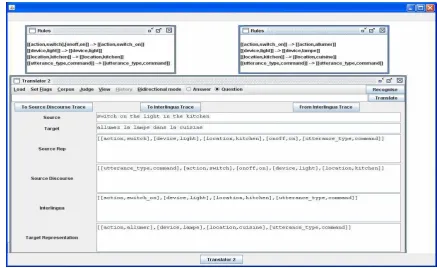
When the speech resources have been loaded, the Translate window can take input equally easily in text or speech mode; the Translate button pro-cesses written text from the input pane, while the Recognise button asks for spoken input. In each case, the input is passed through the same process-ing stages of source-to-interlprocess-ingua and interlprocess-ingua- interlingua-to-target translation, followed by target-language generation. If a TTS engine or a set of recorded target language wavfiles is specified, they are used to realise the final result in spoken form (Figure 4). Every spoken utterance submitted to recognition is logged as a SPHERE-headed wavfile, in a time-stamped directory started at the beginning of the current session; this directory also contains a meta-data file, which associates each recorded wavfile
with the recognition result it produced. The Trans-late window’s History menu is constructed using the meta-data file, and allows the user to select any recorded utterance, and re-run it through the sys-tem as though it were a new speech input. The consequence is that speech input becomes just as reproducible as text, with corresponding gains for interactive debugging in speech mode.
5 Speech and text in regression testing
In earlier versions of the Regulus development environment (Rayner et al., 2006, §6.6), regres-sion testing in speech mode was all based on Nuance’s batchrec utility, which permits of-fline recognition of a set of recorded wavfiles. A test suite for spoken regression testing conse-quently consisted of a list of wavfiles. These were first passed through batchrec; outputs were then post-processed into Regulus form, and finally passed through Regulus speech understand-ing modules, such as translation or dialogue man-agement.
Figure 4: Speech to speech translation from the GUI, using a Japanese to Arabic translator built from MedSLT components (Bouillon et al., 2008). The user presses the Recognise button (top right), speaks in Japanese, and receives a spoken translation in Arabic together with screen display of various processing results. The application is defined by a config file which combines a Japanese recogniser and analy-sis grammar, Japanese to Interlingua and Interlingua to Arabic translation rules, an Arabic generation grammar, and recorded Arabic wavfiles used to construct a spoken result.
and Miller, 2007) will also receive asynchronous inputs from the robot control and monitoring pro-cess; once again, all inputs have to be processed in the appropriate temporal order. A third example is contextual bidirectional speech translation (Bouil-lon et al., 2007). Here, the problem is slightly different — we have only speech inputs, but they are for two different languages. The basic issue, however, remains the same, since inputs have to be processed in the right order to maintain the correct context at each point.
With examples like these in mind, we have also effected a complete redesign of the Regulus envi-ronment’s regression testing facilities. A test suite is now allowed to consist of a list of items of any type — text, wavfile, or non-speech input — in any order. Instead of trying to fit processing into the constraints imposed by thebatchrecutility, of-fline processing now starts up speech resources in the same way as the interactive environment, and submits each item for appropriate processing in the order in which it occurs. By adhering to the prin-ciple that text and speech should be treated uni-formly, we arrive at a framework which is simpler, less error-prone (the underlying code is less
frag-ile) and above all much more flexible.
6 Summary and conclusions
The new functionality offered by the redesigned Regulus top-level is not strikingly deep. In the context of any given application, it could all have been duplicated by reasonably simple scripts, which linked together existing Regulus compo-nents. Indeed, much of this new functionality is implemented using code derived precisely from such scripts. Our observation, however, has been that few developers have actually taken the time to write these scripts, and that when they have been developed inside one project they have usu-ally not migrated to other ones. One of the things we have done, essentially, is to generalise previ-ously ad hoc application-dependent functionality, and make it part of the top-level development en-vironment. The other main achievements of the new Regulus top-level are to organise the existing functionality in a more systematic way, so that it is easier to find commands, and to package it all as a normal-looking Swing-based GUI.
over-all usability, and to the development cycle it sup-ports. In effect, the Regulus top-level becomes a generic speech-enabled application, into which developers can plug their grammars, rule-sets and derived components. Applications can be tested in the speech view much earlier, giving a correspond-ingly better chance of catching bad design deci-sions before they become entrenched. The mecha-nisms used to enable this functionality do not de-pend on any special properties of Regulus, and could readily be implemented in other grammar-based development platforms, such as Gemini and UNIANCE, which support compilation of feature grammars into grammar-based language models.
At risk of stating the obvious, it is also worth pointing out that many users, particularly younger ones who have grown up using Windows and Mac environments, expect as a matter of course that de-velopment platforms will be GUI-based rather than command-line. Addressing this issue, and sim-plifying the transition between text- and speech-based, views has the pleasant consequence of im-proving Regulus as a vehicle for introducing lin-guistics students to speech technology. An initial Regulus-based course at the University of Santa Cruz, focussing on spoken dialogue systems, is de-scribed in (Hockey and Christian, 2008); a similar one, but oriented towards speech translation and using the new top-level described here, is currently under way at the University of Geneva. We expect to present this in detail in a later paper.
References
Alshawi, H., editor. 1992. The Core Language Engine. MIT Press, Cambridge, Massachusetts.
Bos, J. 2002. Compilation of unification grammars with compositional semantics to speech recognition packages. In Proceedings of the 19th International
Conference on Computational Linguistics, Taipei,
Taiwan.
Bouillon, P., M. Rayner, N. Chatzichrisafis, B.A. Hockey, M. Santaholma, M. Starlander, Y. Nakao, K. Kanzaki, and H. Isahara. 2005. A generic multi-lingual open source platform for limited-domain medical speech translation. In Proceedings of the
10th Conference of the European Association for Machine Translation (EAMT), pages 50–58,
Bu-dapest, Hungary.
Bouillon, P., G. Flores, M. Starlander,
N. Chatzichrisafis, M. Santaholma, N. Tsourakis, M. Rayner, and B.A. Hockey. 2007. A bidirectional
grammar-based medical speech translator. In
Pro-ceedings of the ACL Workshop on Grammar-based Approaches to Spoken Language Processing, pages
41–48, Prague, Czech Republic.
Bouillon, P., S. Halimi, Y. Nakao, K. Kanzaki, H. Isa-hara, N. Tsourakis, M. Starlander, B.A. Hockey, and M. Rayner. 2008. Developing non-european trans-lation pairs in a medium-vocabulary medical speech translation system. In Proceedings of LREC 2008, Marrakesh, Morocco.
Copestake, A. 2002. Implementing Typed Feature Structure Grammars. CSLI Press, Chicago.
Crouch, R., M. Dalrymple, R. Kaplan, T. King, J. Maxwell, and P. Newman, 2008. XLE
Documenta-tion. http://www2.parc.com/isl/groups/nltt/xle/doc.
As of 29 Apr 2008.
Dix, A., J.E. Finlay, G.D. Abowd, and R. Beale, edi-tors. 1998. Human Computer Interaction. Second
ed. Prentice Hall, England.
Dowding, J., M. Gawron, D. Appelt, L. Cherny, R. Moore, and D. Moran. 1993. Gemini: A natural language system for spoken language understanding. In Proceedings of the Thirty-First Annual Meeting of
the Association for Computational Linguistics.
Hockey, B.A. and G. Christian. 2008. Zero to spoken dialogue system in one quarter: Teaching computa-tional linguistics to linguists using regulus. In
Pro-ceedings of the Third ACL Workshop on Teaching Computational Linguistics (TeachCL-08),
Colum-bus, OH.
Hockey, B.A. and D. Miller. 2007. A demonstration of a conversationally guided smart wheelchair. In
Pro-ceedings of the 9th international ACM SIGACCESS conference on Computers and accessibility, pages
243–244, Denver, CO.
Jacko, J.A. and A. Sears, editors. 2003. The human-computer interaction handbook: Fundamen-tals, evolving technologies and emerging applica-tions. Lawerence Erlbaum Associates, Mahwah, New Jersey.
Kron, E., M. Rayner, P. Bouillon, and M. Santa-holma. 2007. A development environment for build-ing grammar-based speech-enabled applications. In
Proceedings of the ACL Workshop on Grammar-based Approaches to Spoken Language Processing,
pages 49–52, Prague, Czech Republic.
Larsson, S. and D. Traum. 2000. Information state and dialogue management in the TRINDI dialogue move engine toolkit. Natural Language Engineering,
Spe-cial Issue on Best Practice in Spoken Language Di-alogue Systems Engineering, pages 323–340.
Rayner, M., B.A. Hockey, J.M. Renders,
Annual Meeting of the Association for Compu-tational Linguistics (interactive poster and demo track), Ann Arbor, MI.
Rayner, M., B.A. Hockey, and P. Bouillon. 2006.