A Scalable Decoder for Parsing-based Machine Translation
with Equivalent Language Model State Maintenance
Zhifei Li and Sanjeev Khudanpur
Department of Computer Science and Center for Language and Speech Processing Johns Hopkins University, Baltimore, MD 21218, USA
[email protected] and [email protected]
Abstract
We describe a scalable decoder for parsing-based machine translation. The decoder is written in JAVA and implements all the es-sential algorithms described in Chiang (2007): chart-parsing, m-gram language model inte-gration, beam- and cube-pruning, and unique
k-best extraction. Additionally, parallel and distributed computing techniques are ex-ploited to make it scalable. We also propose an algorithm to maintain equivalent language model states that exploits theback-off prop-erty ofm-gram language models: instead of maintaining a separate state for each distin-guished sequence of “state” words, we merge multiple states that can be madeequivalentfor language model probability calculations due to back-off. We demonstrate experimentally that our decoder is more than 30 times faster than a baseline decoder written in PYTHON. We propose to release our decoder as an open-source toolkit.
1 Introduction
Large-scale parsing-based statistical machine trans-lation (MT) has made remarkable progress in the last few years. The systems being developed differ in whether they use source- or target-language syn-tax. For instance, the hierarchical translation sys-tem of Chiang (2007) extracts a synchronous gram-mar from pairs of strings, Quirk et al. (2005), Liu et al. (2006) and Huang et al. (2006) perform syntac-tic analyses in the source-language, and Galley et al. (2006) use target-language syntax.
A critical component in parsing-based MT sys-tems is the decoder, which is complex to
imple-ment and scale up. Most of the systems described above employ tailor-made, dedicated decoders that are not open-source, which results in a high barrier to entry for other researchers in the field. How-ever, with the algorithms proposed in (Huang and Chiang, 2005; Chiang, 2007; Huang and Chiang, 2007), it is possible to develop a general-purpose de-coder that can be used by all the parsing-based sys-tems. In this paper, we describe an important first-step towards an extensible, general-purpose, scal-able, and open-source parsing-based MT decoder. Our decoder is written in JAVA and implements all the essential algorithms described in Chiang (2007): chart-parsing, m-gram language model integration, beam- and cube-pruning, and uniquek-best extrac-tion. Additionally, parallel and distributed comput-ing techniques are exploited to make it scalable.
Straightforward integration of an m-gram lan-guage model (LM) into a parsing-based decoder substantially increases its computational complex-ity. Therefore, it is important to develop efficient methods for LM integration. We propose an algo-rithm to maintain equivalent LM states by exploit-ing theback-off property ofm-gram LMs. Specifi-cally, instead of maintaining a separate state for each distinguished sequence of “state” words, we merge multiple states that can be madeequivalentfor LM calculations by anticipating such back-off.
We demonstrate experimentally that our decoder is 38 times faster than a previous decoder written in PYTHON. Furthermore, the distributed computing permits improving translation quality via large-scale LMs. We have successfully use our decoder to trans-late about a million sentences in a parallel corpus for large-scale discriminative training experiments.
2 Parsing-based MT Decoder
In this section, we discuss the core algorithms imple-mented in our decoder. These algorithms have been discussed by Chiang (2007) in detail, and we reca-pitulate the essential parts here for completeness.
2.1 Grammar Formalism
Our decoder assumes a probabilistic synchronous context-free grammar (SCFG). Following the nota-tion in Venugopal et al. (2007), a probabilistic SCFG comprises a set of source-language terminal sym-bols TS, a set of target-language terminal symbols
TT, a shared set of nonterminal symbols N, and a set of rules of the form
X→ hγ, α,∼, wi, (1)
whereX ∈N, γ ∈[N∪TS]∗is a (mixed) sequence
of nonterminals and source terminals,α∈[N∪TT]∗
is a sequence of nonterminals and target terminals,
∼is a one-to-one correspondence oralignment be-tween the nonterminal elements of γ and α, and w ≥ 0 is a weight assigned to the rule. An illus-trative rule for Chinese-to-English translation is
N P → hN P0dN P1, N P1 ofN P0i,
where the Chinese word d (pronounced de or di) meansof, and the alignment, encoded via subscripts on the nonterminals, causes the two noun phrases aroundd to be reordered aroundof in the transla-tion. The rule weight is omitted in this example.
A bilingual SCFG derivation is analogous to a monolingual CFG derivation. It begins with a pair ofaligned start symbols. At each step, an aligned pair of nonterminals is rewritten as the two corre-sponding components of a single rule. In this sense, the derivations are generated synchronously.
Our decoder presently handles SCFGs of the kind extracted by Heiro (Chiang, 2007), but is easily ex-tensible to more general SCFGs and closely related formalisms such as synchronous tree substitution grammars (Eisner, 2003; Chiang, 2006).
2.2 MT Decoding as Chart Parsing
Given a source-language sentence f∗, the decoder
must find the target-language yielde(D)of the best
derivation D among all derivations with source-language yieldf(D) =f∗, i.e.
e∗ = e
µ
arg max
D:f(D)=f∗w(D)

, (2)
wherew(D)is the composite weight ofD.
The parser may be treated as a deductive proof system (Shieber et al., 1995). Formally (cf. (Chiang, 2007)), a parser defines a space of weighteditems, with some items designated asaxiomsand some as goals, and a set ofinference rulesof the form
I1:w1 · · · Ik :wk
I :w φ ,
which states that if all the antecedent items Ii are
provable, respectively with weightwi, then the con-sequentitemI is provable with weightw, provided the side condition φholds. For a grammar with a maximum of two (pairs of) nonterminals per rule1,
Figure 1 illustrates the resulting chart parsing proce-dure, including the integration of anm-gram LM.
The actual decoding algorithm maintains achart, which contains an array of cells. Each cell in turn maintains a list of proveditems. The parsing process starts with the axioms, and proceeds by applying the inference rules to prove more and more items until a goal item is proved. Whenever the parser proves a new item, it adds the item to the appropriate chart cell. It also maintains backpointers to antecedent items, which are used fork-best extraction, as dis-cussed in Section 2.4 below.
In a SCFG-based decoder, an item is identi-fied by its source-language span, left-side non-terminal label, and left- and right-context for the target-languagem-gram LM. Therefore, in a given cell, the maximum possible number of items is O(|N||TT|2(m−1)), and the worst case decoding
complexity is
O
³
|N|K|TT|2K(m−1)n3
´
, (3)
where K is the maximum number of nonterminal pairs per rule andnis the source-language sentence length (Venugopal et al., 2007).
X→hγ,αi:w (X → hγ, α, wi)∈G
X→hfij+1, αi:w
[X, i, j;q(α)] :wp(α)
Z→hfi1
i+1Xf
j
j1+1, αi:w [X,i1,j1;e1] :w1
[Z, i, j;q(α0)] :ww1p(α0) α
0
=α[e1/X]
Z→hfi1
i+1X1f
i2 j1+1Y2f
j
j2+1, αi:w [X,i1,j1;e1] :w1 [Y,i2,j2;e2] :w2
[Z, i, j;q(α0)] :ww1w2p(α0) α
0
=α[e1/X1, e2/Y2]
Goal item:[S,0, n;hsim−1? eh/si]
Figure 1: Inference rules from Chiang (2007) for a parser with anm-gram LM.Gdenotes the translation grammar.
w[x/X]denotes substitution of the stringxfor the symbolX in the stringw. The function p(·)provides the LM probability for allcompletem-grams in a string, while the functionq(·)elides symbols whosem-grams have been accounted for byp(·). Details about the functionsp(·)andq(·)are provided in Section 4.
2.3 Pruning in a Decoder
Severe pruning is needed in order to make the decod-ing computationally feasible for SCFGs with large vocabularies TT and detailed nonterminal sets. In
our decoder, we incorporate two pruning techniques described by (Chiang, 2007; Huang and Chiang, 2007). Forbeam pruning, in each cell, we discard all items whose weight is worse, by a relative thresh-oldβ, than the weight of the best item in the same cell. If too many items pass the threshold, a cell only retains the top-bitems by weight. When combining smaller items to obtain a larger item by applying an inference rule, we usecube-pruning to simulate k-best extraction in each destination cell, and discard combinations that lead to an item whose weight is worse than the best item in that cell by a margin of ².
2.4 k-best Extraction Over Hyper-graphs
For each source-language sentence f∗, the output
of the chart-parsing algorithm may be treated as a hyper-graphrepresenting a set of likely hypotheses Din (2). Briefly, a hyper-graph is a set ofvertices andhyper-edges, with each hyper-edge connecting a setof antecedent vertices to a consequent vertex, and a special vertex designated as thetarget vertex. In parsing parlance, a vertex corresponds to an item in the chart, a hyper-edge corresponds to a SCFG rule with the nonterminals on the right-side replaced by back-pointers to antecedent items, and the target
vertex corresponds to the goal item2.
Given a hyper-graph for a source-language sen-tencef∗, we use the k-best extraction algorithm of
Huang and Chiang (2005) to extract itskmost likely translations. Moreover, since many different deriva-tionsDin (2) may lead to the same target-language yielde(D), we adopt the modification described in Huang et al. (2006) to efficiently generate theunique kbest translations off∗.
3 Parallel and Distributed Computing
Many applications of parsing-based MT entail the use of SCFGs extracted from millions of bilin-gual sentence pairs and LMs extracted from bil-lions of words of target-language text. This requires the decoder to make use of distributed computing to spread the memory required to load large-scale SCFGs and LMs ontomultiple processors. Further-more, techniques such as iterative minimum error-rate training (Och et al., 2003) as well as web-based MT services require the decoder to translate a large number of source-language sentences per unit time. This requires the decoder to make use of parallel computing to utilize eachindividual multi-core pro-cessormore effectively. We have incorporated two such performance enhancements in our decoder.
3.1 Parallel Decoding
We have enhanced our decoder to translate multiple source-language sentences in parallel by exploiting the ability of a multi-core processor to concurrently run several threads that share memory. Specifi-cally, given one (or more) document(s) containing multiple source-language sentences, the decoder au-tomatically splits the set of sentences into several subsets, and initiates concurrent decoding threads; once all the threads finish, the main thread merges back the translations. Since all the threads naturally share memory, the decoder needs to load the (large) SCFG and LM into memoryonly once. This multi-threading provides a very significant speed-up.
3.2 Distributed Language Models
It is not possible in some cases to load a very large LM into memory on asingle machine, particularly if the SCFG is also very large. In other cases, load-ing the LM each time the decoder runs may be too time-consuming relative to the time required for de-coding itself, such as in iterative dede-coding with up-dated combination weights during minimum error-rate training. It is therefore desirable to have dedi-cated servers to load parts of the LM3— an idea that
has been exploited by (Zhang et al., 2006; Emami et al., 2007; Brants et al., 2007).
Our implementation can load a (partitioned) LM on different servers before initiating decoding. The decoder remotely calls the servers to obtain individ-ual LM probabilities, and linearly interpolates them on the fly using a given set of interpolation weights. With this architecture, one can deal with a very large target-language text corpus by splitting it into many parts and training separate LMs from each. The run-time interpolation capability may also be used for LM adaptation, e.g. for building document-specific language models.
To mitigate potential network communication de-lays inherent to a distributed LM, we implement a simplecachemechanism in thedecoder. The cache saves the outcomes of the most recent LM calls, including interpolated LM probabilities; the cache is reset whenever its size exceeds a threshold. We could have maintained a cache at each LM server as well; however, the resultant saving is not
signif-3Similarly, distributing the SCFG is also possible.
icant because thetriedata-structures used to imple-mentm-gram LMs are quite fast relative to the cache lookup overhead.
4 Equivalent LM-state Maintenance
It is clear from the complexity (3) of the inference rules (Figure 1) that a straightforward integration of an m-gram LM adds a multiplicative factor of
|TT|2K(m−1)to the computational complexity of the decoder, whereTT is the set of target-language
ter-minal symbols. We illustrate in this section how this potentially very large multiplier can be dramatically reduced by exploiting thestructureof the LM.
4.1 Applying anm-gram LM in the Decoder
Integrating an LM into chart parsing requires two functions p(·) and q(·) (see Figure 1) that oper-ate on strings overTT ∪ {?}, where ? is a special
“placeholder” symbol for an elided part of a target-language string.
The function p(e) calculates the LM probability of thecompletem-grams ine≡e1 . . . el, i.e.
p(e1 . . . el) = Y
m≤i≤l & ?6∈ei
i−(m−1)
PLM(ei|hi), (4)
where hi = ei−(m−1). . . ei−1 is the m−1-word “LM history” of the target-language wordei.
Since thep-probability ofedoes not include the LM probability for thepartialm-grams (i.e., the first
(m−1)words) ofe, theexactweights of two items
[X, i, j;e]and[X, i, j;e0]in the chart arenot
avail-able during the bottom-up pruning of Section 2.3. Therefore, as an approximation, we also compute
ˆ
p(e) =
min{mY−1,|e|}
k=1
PLM(ek|e1 . . . ek−1), (5)
anestimateof the LM probability of them−1-gram prefix ofe. This estimated probability is taken into account for pruning purposes (only).
The functionq(e1 . . . el)determines the left and right LM statesthat must be maintained for future computation of the exact LM probability, respec-tively, ofe1 . . . em−1andel+1 . . . el+m−1.
q(e1 . . . el) (6)
= (
e1. . . el ifl < m−1,
4.2 Back-off Parameterization ofm-gram LMs
While many different methods are popular for esti-matingm-gram LMs, most store the estimated LM parameters in the ARPAback-off file format; using the notationeji to denote a target-language word se-quence eiei+1 . . . ej, the LM probability calcula-tion is carried out as
PBO(em|em1−1) (7)
= (
π(em
1 ) ifem1 ∈ LM
β(em1 −1)×PBO(em|em2 −1) otherwise,
where the lower order probabilityPBO(em|em2−1) is recursively defined in the same way, andβ(em1−1)
is the back-off weight of the history. The LM file contains the parameterπ(·)for eachlisted m-gram, and the parametersπ(·)andβ(·)for each listedm-e
gram,1≤m < m; fore unlistedm-grams,e β(·) = 1
by definition.
Observe from (7) that ifem
1 isnot listedin the LM, the back-off weight β(·) is the same for all words em, and the backed-off probabilityPBO(em| ·)is the
same for all wordse1. Furthermore, asmgrows, the fraction of possiblem-grams actually observed in a training corpus diminishes rapidly.
4.3 The Equivalent LM State of an Item
The maximum possible number of items in acell in-creases exponentially with the LM orderm, as dis-cussed in Section 2.2. With pruning (cf. Section 2.3), we restrict the maximum number of items in each cell to some thresholdb. Intuitively, therefore, if we increase the LM orderm, we should also in-crease the beam sizebto reduce search errors. This could slow down the decoder significantly.
Recall from the previous subsection, however, that when m increases, the fraction of m-grams that will need to back-off also increases. Moreover, even for modest values of m, the decoder consid-ers many “unseen”m-grams (due to reordering and translation combinations) that do not appear in natu-ral texts, leading to frequent back-off during the LM probability calculation (7). In this subsection, we propose a method to collapse equivalent LM states so that the decoder effectively considers many more items in each cell without increasing beam size.
We merge multiple LM states (6) that already have—or back-off to—the same “LM history” in the calculation (7) of LM probabilities, e.g. due to different unlisted m-grams that back-off to the samem−1-gram. For simplicity, we only consider LM state merging by the functionq(·)of (6) when l≥m−1.
Though the equivalent LM state maintenance technique is discussed here in the context of a parsing-based MT decoder, it is also applicable to standard left-to-right phrase-based decoders. In par-ticular, the right-side equivalent LM state mainte-nance proposed in Section 4.3.1 may be used.
4.3.1 Obtaining the Equivalent Right LM State
Recall that the right LM state el
l−(m−2) of el1 serves as the “LM history” for calculating the ex-act LM probabilities of the yet-to-be-determined word el+1. Recall further the computation (7) of PBO(el+1|el
l−(m−2)).
• If them-gramell+1−(m−2) isnot listedin the LM foranywordel+1, then the LM will back-off to PBO(el+1|ell−(m−3)), which does not depend on the wordel−(m−2).
• If them−1-gramel
l−(m−2)also is not listed in the LM, thenβ(el
l−(m−2)) = 1.
If these two conditions hold true, q(·) may safely elide the wordel−(m−2)in (6) no matter what words followel
1. TherightLM state is thus reduced from m−1words tom−2words.
The argument above can be applied recursively to the resulting right LM state el
l−(m−2)+i, where
i∈ [0, m−2], leading to theequivalent right state computation procedure of Figure 2. The procedure
IS-A-PREFIX(em1e)checks if its argumentem1e is a pre-fix of anyk-gram listed in the LM,k∈[m, me ].
4.3.2 Obtaining the Equivalent Left LM State
Recall that the left LM state em1−1 of el1 is the prefix whose exact LM probability is unknown during bottom-up parsing, and is replaced by the estimated probability pˆ(em1−1) of (5) for pruning purposes. Recall further the computation (7) of PBO(em−1|em0 −2).
EQ-R-STATE(el
l−(m−2)) 1 ers←el
l−(m−2)
2 fori←0tom−2 ¤left to right 3 ifIS-A-PREFIX(ell−(m−2)+i)
4 break ¤stop reducingers
5 else
6 ers←el
[image:6.612.315.531.67.209.2]l−(m−2)+i+1 ¤reduce state 7 return ers
Figure 2: Equivalent Right LM State Computation.
PBO(em−1|em1 −2), which can be computed right away based onem1−1 without waiting for the unknowne0. Moreover, the back-off weight β(em0−2)does not depend on the wordem−1.
Therefore,q(·)may safely elide the wordem−1, and reduce theleftLM state in (6) fromem1−1 toem1−2. Also,p(·)should also co-optPBO(em−1|em1−2)into the complete m-gram probability of (4) and pˆ(·)
should excludeem−1in (5).
The argument above can again be applied recur-sively to the resulting left LM stateei
1,i∈[1, m−1], leading to theequivalent left stateprocedure of Fig-ure 3. The procedFig-ure IS-A-SUFFIX(em1e) checks if eme
1 is a suffix of any listedk-gram in the LM, k ∈
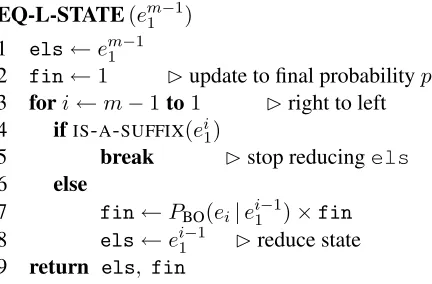
[m, me ]. In Figure 3, fin refers to the probability that can be computed right away based on the state itself, for co-opting into thecompletem-gram prob-ability of (4) as mentioned above.
4.3.3 Modified Cost Functions for Parsing
When carrying out the reduction of the left and right LM states to their shortest equivalents, the for-mula (4) for calculating the probability of the com-pletem-grams in an item[X, i, j;e], wheree=el
1, is modified as
p(el1)
= EQ-L-STATE(em1−1).fin× Y
m≤i≤l&?6∈ei
i−(m−1)
PLM(ei|hi)
with the further qualification that some care must be taken later to incorporate the back-off weights of the “LM histories” of the suffix ofem1−1that went miss-ing due to left LM state reduction.
EQ-L-STATE(em1−1)
1 els←em1−1
2 fin←1 ¤update to final probabilityp 3 fori←m−1to1 ¤right to left 4 ifIS-A-SUFFIX(ei1)
5 break ¤stop reducingels
6 else
[image:6.612.72.292.69.183.2]7 fin←PBO(ei|ei1−1)×fin 8 els←ei1−1 ¤reduce state 9 return els, fin
Figure 3: Equivalent Left LM State Computation.
The estimated probability of the left LM state is modified as
ˆ
p(e) = (
ˆ
p(e) if|e|< m−1 ˆ
p(EQ-L-STATE(em1−1).els) otherwise,
withpˆas defined in (5).
Finally, the LM state function is
q(el1)
=
e1 . . . el ifl < m−1
EQ-L-STATE(em1−1).els ?
EQ-R-STATE(el
l−(m−2)).ers otherwise.
4.3.4 Suffix and Prefix Look-Up
As done in the SRILM toolkit (Stolcke, 2002), a back-offm-gram LM is stored using a reversetrie data structure. We store the suffix and prefix infor-mation in the same data structure without incurring much additional memory cost. Specifically, the pre-fix information is stored at the back-off state, while the suffix information is stored as one bit alongside the regularm-gram probability.
5 Experimental Results
In this section, we evaluate the performance of our decoder on a Chinese to English translation task.
5.1 System Training
up to about 19M words on each side. To train the English language models, we use the English side of the parallel text and a subset of the English Giga-word corpus, for a total of about 130M Giga-words.
We use the GIZA toolkit (Och and Ney, 2000), a suffix-array architecture (Lopez, 2007), the SRILM toolkit (Stolcke, 2002), and minimum er-ror rate training (Och et al., 2003) to obtain word-alignments, a translation model, language models, and the optimal weights for combining these mod-els, respectively.
5.2 Improvements in Decoding Speed
We use a PYTHON implementation of a state-of-the-art decoder as our baseline4for decoder
compar-isons. For a direct comparison, we use exactly the same models and pruning parameters. The SCFG contains about 3M rules, the5-gram LM explicitly lists about 49M k-grams, k = 1,2, . . . ,5, and the pruning usesβ = 10,b= 30and²= 0.1.
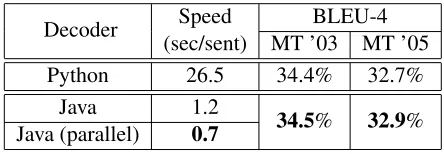
Decoder Speed BLEU-4 (sec/sent) MT ’03 MT ’05 Python 26.5 34.4% 32.7%
Java 1.2
[image:7.612.74.296.343.420.2]34.5% 32.9% Java (parallel) 0.7
Table 1: Decoder Comparison: Translation speed and quality on the 2003 and 2005 NIST MT benchmark tests.
As shown in Table 1, the JAVA decoder (without explicit parallelization) is 22 times faster than the PYTHON decoder, while achieving slightly better translation quality as measured by BLEU-4 (Pap-ineni et al., 2002). The parallelization further speeds it up by a factor of 1.7, making the parallel JAVA de-coder is 38 times faster than the PYTHON dede-coder. We have used the decoder to successfully decode about one million sentences for a large-scale dis-criminative training experiment.
5.3 Impact of a Distributed Language Model
We use the SRILM toolkit to build eight7-gram lan-guage models, and load and call the LMs using a
4We are extremely thankful to Philip Resnik at University of Maryland for allowing us the use of their PYTHON decoder as the baseline. Thanks also go to David Chiang who originally implement the decoder.
distributed LM architecture5as discussed in Section 3.2. As shown in Table 2, the7-gram distributed lan-guage model (DLM) significantly improves trans-lation performance over the 5-gram LM. However, decoding is significantly slower (12.2 sec/sent when using the non-parallel decoder) due to the added net-work communication overhead.
LM type #k-grams MT ’03 MT ’05
5-gram LM 49 M 34.5% 32.9%
7-gram DLM 310 M 35.5% 33.9%
Table 2: Distributed language model: the 7-gram LM cannot be loaded alongside the SCFG on a single ma-chine; via distributed computing, it yields significant im-provement in BLEU-4 over a5-gram.
5.4 Utility of Equivalent LM States
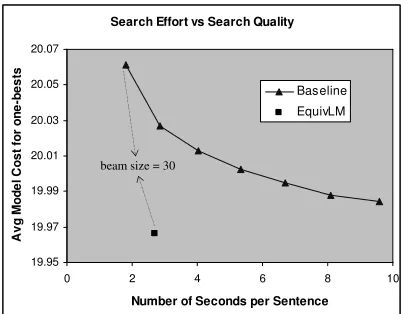
To reduce the number of search errors, one may ei-ther increase the beam size, or employ techniques such as the equivalent LM state maintenance de-scribed in Section 4. In this subsection, we compare the tradeoff between the search effort (measured by decoding time per sentence) and the search qual-ity (measured by the average model cost of the best translation found).
Intuitively, collapsing equivalent LM states is use-ful only when the language model is very sparse, i.e., most of the evaluated m-grams will need to back-off. A sparse LM is obtained in practice by using a large order m relative to the amount of training data. To test this intuition, we train a7-gram LM using only the English side of the parallel text (∼
19M words). Figure 4 compares maintenance of the full LM state v/s the equivalent LM state. The beam sizebfor decoding with equivalent LM states is fixed at 30; it is increased considerably—30, 50, 70, 90, 120, and 150—with the full LM state in an effort to reduce search errors. It is clear from the figure that collapsing items that differ due only to equivalent LM states improves the search quality considerably while actually reducing search effort. This shows the effectiveness of equivalent LM state maintenance.
Search Effort vs Search Quality
19.95 19.97 19.99 20.01 20.03 20.05 20.07
0 2 4 6 8 10
Number of Seconds per Sentence
A
v
g
M
o
d
e
l
C
o
s
t
fo
r
o
n
e
-b
e
s
ts
Baseline
EquivLM
[image:8.612.83.287.60.217.2]beam size = 30
Figure 4: Search quality with equivalent7-gram LM state maintenance (EquivLM) and without it (Baseline) as a function of search effort as controlled by the beam size.
We also train a3-gram LM using an English cor-pus of about 130M words, and repeat the above ex-periments. In this case, maintaining equivalent LM states costsmoredecoding time than using the full LM state to achieve the same search quality. This is due partly to our inefficient implementation of the prefix- and suffix-lookup required to determine the equivalent LM state, and partly to the fact that with 130M words, a3-gram LM backs off less frequently.
6 Conclusions
We have described a scalable decoder for parsing-based machine translation. It is written in JAVA and implements all the essential algorithms described in Chiang (2007): chart-parsing, m-gram language model integration, beam- and cube-pruning, and uniquek-best extraction. Additionally, parallel and distributed computing techniques are exploited to make it scalable. We demonstrate that our decoder is 38 times faster than a baseline decoder written in PYTHON, and that the distributed language model is very useful to improve translation quality in a large-scale task. We also describe an algorithm that exploits theback-off property of anm-gram model to maintain equivalent LM states, and show that bet-ter search quality is obtained with less search effort when the search space is organized to exploit this equivalence. We plan to incorporate some additional syntax-based components into the decoder and re-lease it as an open-source toolkit.
Acknowledgments
We thank Philip Resnik, Chris Dyer, Smaranda Muresan and Adam Lopez for very helpful discus-sions, and the anonymous reviewers for their con-structive comments. This research was partially sup-ported by the Defense Advanced Research Projects Agency’s GALE program via Contract No
¯ HR0011-06-2-0001.
References
Thorsten Brants, Ashok C. Popat, Peng Xu, Franz J. Och, and Jeffrey Dean. 2006. Large Language Models in Machine Translation.In Proceedings of EMNLP 2007. David Chiang. 2006. An Introduction to Synchronous Grammars. Available at http://www.isi.edu/∼chiang/papers/synchtut.pdf. David Chiang. 2007. Hierarchical phrase-based
transla-tion.Computational Linguistics, 33(2):201-228. Jason Eisner. 2003. Learning non-isomorphic tree
map-pings for machine translation.In Proceedings of ACL 2003.
Ahmad Emami, Kishore Papineni, and Jeffrey Sorensen. 2007. Large-scale distributed language modeling. In Proceedings of ICASSP 2007.
Michel Galley, Jonathan Graehl, Kevin Knight, Daniel Marcu, Steve DeNeefe, Wei Wang, and Ignacio Thayer. 2006. Scalable inference and training of context-rich syntactic translation models.In Proceed-ings of COLING/ACL 2006.
Liang Huang and David Chiang. 2005. Better k-best pars-ing.In Proceedings of IWPT 2005.
Liang Huang and David Chiang. 2007. Forest Rescoring: Faster Decoding with Integrated Language Models.In Proceedings of the ACL 2007.
Liang Huang, Kevin Knight, and Aravind Joshi. 2006. Statistical syntax-directed translation with extended domain of locality.In Proceedings of AMTA 2006. Yang Liu, Qun Liu, and Shouxun Lin. 2006.
Tree-to-string alignment template for statistical machine trans-lation.In Proceedings of COLING-ACL 2006. Adam Lopez. 2007. Hierarchical Phrase-Based
Transla-tion with Suffix Arrays. In Proceedings of EMNLP 2007.
Franz Josef Och. 2003. Minimum error rate training in statistical machine translation.In Proceedings of ACL 2003.
Kishore Papineni, Salim Roukos, Todd Ward, and Wei-Jing Zhu. 2002. BLEU: a method for automatic eval-uation of machine translation.In Proceedings of ACL 2002.
Chris Quirk, Arul Menezes, and Colin Cherry. 2005. De-pendency Treelet Translation: Syntactically Informed Phrasal SMT.In Proceedings of ACL 2005.
Stuart Shieber, Yves Schabes, and Fernando Pereira. 1995. Principles and implementation of deductive parsing.Journal of Logic Programming, 24:3-15. Andreas Stolcke. 2002. SRILM - an extensible language
modeling toolkit.In Proceedings of the International Conference on Spoken Language Processing, volume 2, pages 901-904.
Ashish Venugopal, Andreas Zollmann, Stephan Vo-gel. 2007. An Efficient Two-Pass Approach to Synchronous-CFG Driven Statistical MT.In Proceed-ings of NAACL 2007.