Volume 9, No. 1, January-February 2018
International Journal of Advanced Research in Computer Science
RESEARCH PAPER
Available Online at www.ijarcs.info
ISSN No. 0976-5697
SMART CROP FIELD IRRIGATION IN IoT ARCHITECTURE USING SENSORS
M.Savitha MCA
M.Phil Scholar [Part Time] Department of Computer SciencePKR Arts College for Women Gobichettipalayam, India
O.P.UmaMaheswari
Assistant Professor Department of Computer SciencePKR Arts College for Women Gobichettipalayam , India
Abstract: This Paper deals with the improvement of growth of crops by means of managing and monitoring the soil texture. The automated irrigation system has been designed and implemented helps the farmers efficiently by all means. The system developed is very useful and works in cost effective manner. It manages the water consumption to a greater extent mainly during the rainy season. It needs minimal maintenance and the power consumption is also greatly reduced. This system can be used in large field. The crop productivity increases and the wastage of crops is very much reduced using this irrigation system. The developed system is more helpful and gives more feasible results. Prediction system can be developed with the help of the data obtained using sensors.
Keywords: Internet of Things(IoT), smart irrigation, sensors, IoT architecture, Arduino board ,ThingSpeak Application.
1.INTRODUCTION:
An Internet of Things is a kind of system provided with interrelated computing devices, mechanical and digital machines, things, animals or people that exhibit distinctive identifiers so as to transfer data over through a network without manpower or human-computer interaction (HCI). It was predicted that IoT will consist of about 30 billion objects by 2020.
2.LITERATURE SURVEY:
The Internet is the global system of interconnected networks that enables TCP/IP to connect billions of worldwide devices.
In diverse set of areas many intelligent applications have been developed but all of these applications are not readily available. However this preliminary research indicates the potential of IoT in improving the quality of life. Some uses of IoT applications are home automation, fitness tracking, health monitoring, environment protection, smart cities, and industrial manufacturing.
2.1 Home Automation
MavHome presents an intelligent agent, where various prediction algorithms have been used to perform automated tasks in response to user triggered events and adapts itself to the routines of the inhabitant [1]. A prediction algorithm predicts the sequence of events in a home. A sequence matching algorithm manages the sequences of events in a queue and also stores their frequency. This prediction is based on match length and frequency but other applications use compression based prediction and Markov models [2]. Sixsmith et al used low cost infrared sensor array technology for providing information regarding the location, size, and velocity of a target object.Many smart phone based applications are available to detect a fall on the basis of readings from
the accelerometer and gyroscope data [3].
Smart home applications have challenges and issues too[4]. Security and privacy [5] is the most important one among
them because all the data inform of events that takes place in the home is being recorded.
Smart home systems are made to address the owners if they detect any abnormalities which can be achieved using Artificial Intelligence and machine learning algorithms. Reliability is considered as an issue because there is no system administrator to monitor the system[5].
2.2 Smart Cities 2.2.1 Smart Transport
Smart transport application manages day to day traffic in cities using sensors and process intelligent information systems. . [6] implemented a vehicle tracking system for managing traffic surveillance using video sequencing captured on the roads.
Smart transport does not responsible for managing traffic conditions but also gets rid of the safety of people travelling in vehicles, which is mainly in the hands of drivers. IoT applications are developed to help drivers to become safe. Such applications monitor driving behavior of drivers and help them to enable safe drive by detecting when they are feeling drowsy or tired and helping them to deal with it [7]. A smart phone application designed by White et al. detects the happening of an accident with the help of an accelerometer and acoustic data[8].
2.2.3 Smart Water Systems and Entertainment:
Due to the scarcity in the availability of water in most parts of the world, it is more vital to manage the water resources effectively. As a result, most cities are ready to imply smart solutions that place a lot of meters on water supply lines and storm drains. It has been implemented in the existing work by Hauber-Davidson and Idris [9].They describe various designs for smart water meters.They can also help us predict flooding.
Logmusic is a type of entertainment application, encourages music on the basis of weather, time, temperature, and location [11].
2.2.4 Smart Environment and Agriculture
Internet of Things based farming techniques enables and expects to produce much food production in this current era [12].
Pesticide residues in crop production are detected using an Acetylcholinesterase biosensor device. . Consumers can scan the QR code and check the amount of pesticides in it from the knowledge of a centralized database and decide to buy or not [13].
2.2.5 Health and Fitness
Stress recognition applications are fairly popular[14]. [K. Frank, et al., 2013] nowadays. In the paper [15] , a smart mat is being to count the number of exercise steps performed.
2.2.6 Supply Chain and Logistics
Bo and Guangwen [16] explained about an information transmission system for supply chain management, based on the Internet of Things.
2.2.7 Energy Conservation
Some of the IoT applications assigned in smart grid are online monitoring of transmission lines for disaster prevention and efficient use of power in smart homes by indulging smart meter to monitor total energy consumption [17].
The central issues are how to achieve full interoperability between interconnected devices, and how to provide them with a high degree of smartness by enabling their adaptation and autonomous behavior.
3.SYSTEM METHODOLOGY AND IMPLEMENTATION: Arduino Controller
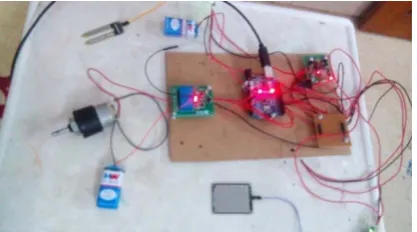
[image:2.595.39.248.537.653.2]Arduino is an open-source based hardware and software consisting of a circuit board, which can be programmed, referred to as a microcontroller and instant software called Arduino. Integrated Development Environment has been used to write and upload the computer code to the physical board.
Figure 4.1 Connections Established on Arduino Controller According to the table 1,circuit board includes eight types of components.
Table 1 Cost of Making Circuit Board
Board Utilities Cost
Arduino board 2500
Wifi module board 850
Motor 300
Temperature Sensor 50
Soil moisture sensor 800
Rain fall sensor 250
2 channels relay 450
Three sensors namely soil, temperature and rainfall sensors are connected to a wi-fi module to store the details about the field and to display it sequentially. It is then connected to the controller. Then the data send to the relay unit to perform on and off operation of the motor. All details about the field are viewed directly with the help of ThingSpeak application mainly designed for IoT application. In this work, we successfully developed a system that can help in an automated irrigation system by analyzing the moisture level of the ground. The grounded sensors all around the farming land will give notification about the need of water and accordingly it will be supplied. Application is developed by using Embedded C Programming.
4.RESULTS AND DISCUSSIONS:
This work in paper helps the farmers monitor crop-field using sensors (soil moisture, temperature, humidity, Light) and automate the irrigation system. Operations are controlled through remote device or computer connected to Internet and the operations will be performed by interfacing sensors, Wi-Fi modules.Operations are controlled through remote device or computer connected to Internet and the operations will be performed by interfacing sensors, Wi-Fi modules.
This project application is designed in such a way to analyze the data received and to check with the threshold Values of moisture, humidity and temperature. The decision making is done at server to automate irrigation. If soil moisture value greater than 500 means soil considered as dry condition so motor is switched On automatically. If soil moisture value less than 500 means soil considered as wet condition so motor is switched Off automatically. If rain fall sensor value above 400 means there is no water fall in crop-field so motor is switched On automatically. If rain fall sensor value less than 400 means soil considered as wet condition it has water fall so motor is switched Off automatically. If Temperature level of the field area above 40 means there is high temperature in crop-field so motor is switched On automatically. If Temperature level of the field area less than 40 means it has consider normal temperature so at the moment motor is switched Off automatically. Relay is used to perform on/off operation efficient manner.
Figure 4.1 Serial Port Configuration
[image:3.595.328.547.134.326.2]Figure 4.1 specifies serial port connection between board and the system. To access the wifi mode the serial port is needed. Click the putty icon from the IoT programming field. Here we can find the serial port COM41 at speed 9600.
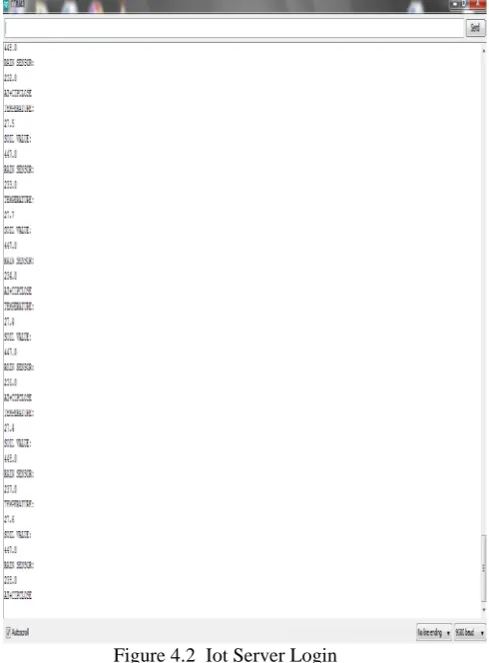
Figure 4.2 Iot Server Login
The above figure 4.2 shows the IoT server login screen in which we can able to view the details of all the three sensors namely soil, temperature and rainfall at any time. This data will be shown as graph in ThingSpeak Application with specific date and time aspects.
The user has to create an account and then he can log into the application with the proper username and
password. In ThingSpeak application, the user can clearly view the details about the field through sensors and may know the climatic conditions like moisture, humidity, rainfall, etc. Once the Sign in process gets over the user can login and get the up to date details about the field as shown in Figure 4.3.
[image:3.595.45.290.340.672.2]Figure 4.3 Home Screen of ThingSpeak Application
Figure 4.4 Graph representation of sensors using ThingSpeak
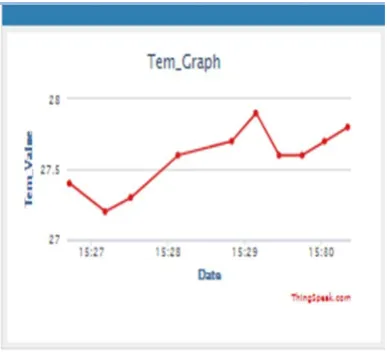
[image:3.595.317.558.354.632.2]Figure 4.5 Performance of Temperature Sensor
[image:4.595.340.534.56.254.2]Above figure 4.5 shows the performance of temperature sensor in the field. In this graph the temperature is found to be 27.4, 27.1, 27.3, 27.5, 27.7, and so on. Here 15 declare the data and 27, 28, 29, and 30 specifies the minutes respectively.
Figure 4.6 Performance of Rain fall Sensor
Above figure 4.6 represents the rainfall found in the soil. In this graph the rainfall is found 249 on 15th in 27th minute, rainfall is found 150 on 15th in 28th minute, rainfall is found 151 on 15th in 29th minute, rainfall is found 150 on 15th in 30th minute respectively.
The Following figure 4.7 represents the Soil moisture Sensor in the field. Soil moisture measurement unit is m3/m3 (cubic meters) and we can convert this value to mm.
[image:4.595.51.269.326.519.2]In this graph, the soil moisture is found 444 on 15th in 27th minute, 438 on 15th in 28th minute, 444 on 15th in 29th minute, 442 on 15th in 30th minute respectively.
Figure 4.7 Performance of Soil moisture Sensor
5.CONCLUSION AND FUTURE ENCHANCEMENt:
5.1 Conclusion:
In this work, we successfully developed a system that can help in an automated irrigation system by analyzing the moisture level of the ground. The grounded sensors all around the farming land will give notification about the need of water and accordingly it will be supplied. To achieve this, arduino controller promotes the remote irrigation system. The proposed system can be sited at the remote location and required water provides for plantation whenever the humidity of the soil goes below the set-point value.
Mainly the arduino controller based irrigation system can work constantly for indefinite time period, even in abnormal circumstances. If the plants get water at the proper time then it helps to increase the production up to 40 %. This system can be used to irrigate very large areas as it only needs to divide the whole land into number of sectors and single controller can control the whole process. It saves human energy, time, cost, etc. In case of irrigation, the other factors like temperature, rainfall and soil can be checked continuously and accordingly the information is supplied the user. It is also possible to correct the various parameters through the controller programming and user will get the required information.
5.2 Future Enchancement:
In the future, the prediction system can be developed based on the information gathered in the specific area. In the particular area the soil moisture is estimated following the temperature and rainfall. According to the area the prediction data varies and it is provided to the farmers so that they can plan to their farming. In addition to this, if the tank is empty automatic filling technology can also be implemented through wireless sensor technology
.
6.REFERENCES
[2]. S. K. Das, D. J. Cook, A. Bhattacharya, E. O. Heierman III, and T.-Y. Lin, 2002.The role of prediction algorithms in the MavHome smart home architecture. IEEE Wireless Communications, 9(6):77–84.
[3]. A. Sixsmith and N. Johnson, 2004. A smart sensor to detect the falls of the elderly, IEEE Pervasive Computing, vol 3(2):42– 47.
[4]. W. Keith Edwards and R. E. Grinter, 2001. At home with ubiquitous computing: seven challenges. In Ubicomp 2001: Ubiquitous Computing, pp. 256–272.
[5] .R. J. Robles and T.-H. Kim, 2010. A Review on security in smart home development. International Journal of Smart Home, vol. 15.
[6] .S.-H. Yu, J.-W. Hsieh, Y.-S. Chen, and W.-F. Hu, 2003. An automatic traffic surveillance system for vehicle tracking and classification. In Image Analysis, pp. 379– 386.
[7]. W. Hu, X. Hu, J.-Q. Deng et al., 2014. Mood-fatigue analyzer: towards context-aware mobile sensing applications for safe driving. Journal of Electrical and Computer Engineering 25 in Proceedings of the 1st ACM Workshop on Middleware for Context-Aware Applications in the IoT (M4IOT ’14), pp. 19–24. [8] .J. White, C. Thompson, H. Turner, B. Dougherty, and D.
C. Schmidt, 2011. WreckWatch: automatic traffic accident detection and notification with smartphones. Mobile Networks and Applications, 16(3):285–303. [9] .G. Hauber-Davidson and E. Idris, 2006. Smart water
metering Water. vol. 33(3):56–59.
[10] .B. Guo, D. Zhang, Z. Wang, Z. Yu, and X. Zhou, 2013. Opportunistic IoT: Exploring the harmonious interaction between human and the internet of things, Journal of Network and Computer Applications, vol. 36(6): 1531– 1539.
[11]. M. Lee and J.-D. Cho, 2014. Logmusic: context-based social music recommendation service on mobile device. in Proceedings of the ACM International Joint Conference on Pervasive and Ubiquitous Computing (UbiComp ’14), pp. 95–98.
[12]. K.-H. Chang, 2014. Bluetooth: a viable solution for IoT. IEEE Wireless Communications, 21(6):6–7
[13] .G. Zhao, Y. Guo, X. Sun, and X. Wang, 2015. A system for pesticide residues detection and agricultural products traceability based on acetylcholinesterasebiosensor and internet of things. International Journal of Electrochemical Science, 10(4):3387–3399.
[14]. K. Frank, P. Robertson, M. Gross, and K. Wiesner, 2013. Sensorbased identification of human stress levels. In Proceedings of the IEEE International Conference on Pervasive Computing and Communications Workshops (PerCom Workshops ’13), pp. 127– 132.
[15]. M. Sundholm, J. Cheng, B. Zhou, A. Sethi, and P. Lukowicz, 2014. Smart-mat: recognizing and counting gym exercises with lowcost resistive pressure sensing matrix. In Proceedings of the ACM International Joint Conference on Pervasive and Ubiquitous Computing (UbiComp ’14), pp. 373–382.
[16]. Y. Bo and H. Guangwen, 2009. Supply chain information transmission based on RFID and internet of things. In Proceedings of the Second ISECS International Colloquium on Computing, Communication, Control, and Management (CCCM ’09), pp. 166–169.