
Volume 5, No. 6, July-August 2014
International Journal of Advanced Research in Computer Science
RESEARCH PAPER
Available Online at www.ijarcs.info
A Comparative Analysis of uses of 1-D and 2-D Barcodes
Awadhesh Kumar
Department of Computer Science, KNGD Modi Engineering College, Modinagar
Ghaziabad, India
Ajeet Kumar Nigam
Department of Computer Science, Dr. KN Modi Engineering College, Modinagar
Ghaziabad, India
Abstract: A comparative review is presented of available barcodes suitable for keeping the variety of information in different ways. Ex isting barcode technologies’ backgrounds, characteristics, advantages and disadvantages, are described in relation to their possible use by many applications with certain limitations. Due to the fact that the mobile smart phones’ present versatility and ubiquity, the implantation and operation of 2D barcode technology emerges as a very attractive alternative to keep large amount of data with minimal use of database. Here especially Quick Response (QR) Code is more popular and most commonly used.
Keywords: 2 D Barcodes, QR Codes, Data Matrix Code.
I. INTRODUCTION
Abarcodeis an opticalmachine-readablerepresentation of data relating to the object to which it is attached [1]. The barcodes have been spread from supermarkets to department stores, factory floor, the military, the health industry and many more. Recent years have also seen demand to increase the density of information in barcodes. Traditional 1-dimensional barcodes are getting replaced by 2D barcodes worldwide. Linear barcodes are created by translating supported characters that should be displayed into combination of narrow and wide bars which are combined method of encoding, checksum specification. To identify the start and end of a barcode special pattern are used to indicate to scanner that the barcode starts and identify what type of symbolgy is used.
In 2Dimensional barcodes many thousand alphanumeric characters can be placed in a single symbol [8]. One of the most important advantages of 2D barcode is that large amount of data can be read easily and written accurately. The durability 2D barcode is much better that of 1Dimensional barcode. The 2D barcode is mainly classified into three types of barcode which are data Matrix, QR code and PDF 417 barcodes. The data Matrix is 2D matrix barcode consisting of black and white cells arranged in either square or rectangular pattern. The information to be encoded can be text or numeric data. Usual data size is from few bytes up to 1556 bytes. The length of encoded data depends on number of cells in matrix. Error correction code are often used to increase the reliability, even if one or more cells are damaged it is unreadable message can still be read.
II. ONEDIMENSIONALBARCODE
Originally barcodes systematically represented data by varying the widths and spacing of parallel lines, and may be referred to as linear or one-dimensional (1D). 1-D barcode
that is made up of lines and spaces of various widths that creates specific patterns.
A. Types of 1D code:
There are various types of 1-D bar codes, whose characteristics may not always differentiate them from each other. Most of them were originally developed to meet the needs of specific industries and were then standardized for use in different areas. Among the most relevant types available and their uses are:
a. Numeric-Only Barcodes
a) Codabar: Older code often used in library
systems, sometimes in blood banks
b) Code 11: Used primarily for labeling
telecommunications equipment
c) EAN-13: European Article Numbering
international retail product code
d) EAN-8: Compressed version of EAN code for use
on small products
e) Industrial 2 of 5: Older code not in common use
f) Interleaved 2 of 5: Compact numeric code, widely
used in industry, air cargo
g) MSI: Variation of the Plessey code commonly
j) UPC-A: Universal product code seen on almost all
retail products in the USA and Canada
k) Standard 2 of 5: Older code not in common use
l) UPC-E: Compressed version of UPC code for use
on small products
b. Alpha-numeric barcodes:
a) Code 128: Very capable code, excellent density, high reliability; in very wide use world-wide
b) Code 39: General-purpose code in very wide use world-wide
c) Code 93: Compact code similar to Code 39
d) LOGMARS: Same as Code 39, this is the U.S.
B. Advantages of 1D code:
The main advantages of 1-D technology can be summarized as follows:
a. Fast data capture.
b. Reliability due to the very low level of errors in the capture and decoding of data.
c. Immediate integration of the decoded data into the system or database.
d. Low cost of printing the codes.
C. Disadvantage of 1-D code:
Their main disadvantage of 1-D barcodes compared to 2D codes is that they have a relatively low storage capacity of approximately 20 to 30 digits.
D. Applications of 1-D code:
One-dimensional codes were used initially in commercial environments for product identification. At present the use of automated identification 1D code has spread extensively in many other areas such as manufacturing, consumer trade, mail, transport, the health sector, and so on. Some examples of specific applications are:
a. Inventory control.
b. Tracking of moving objects such as cars, baggage, mail, packages, medicines, laboratory test samples, etc. c. Access control to transportation, open-air events, buildings, offices, theaters, etc.
d. Patient Identification in Hospitals.
III. TWODIMENSIONAL(2-D)BARCODE
A 2-D barcode also termed as matrix code or simply a 2D code is a two-dimensional way to represent information. It is similar to a linear (1-dimensional) barcode, but can represent more data per unit area.
A. What's a 2-D code?:
2-Dimensional symbols are generally square or rectangular patterns that encode data in two dimensions. They fall into two general categories: 'Stacked barcodes are constructed like a layer cake of barcodes stacked on top of the other; they can be read by special 2-D scanners or by many CCD and laser scanners with the aid of special decoding software [6].
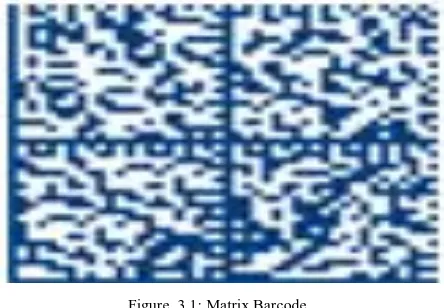
Figure. 3.1: Matrix Barcode
'Matrix Codes' are built on a true 2-D matrix; they are usually more compact than a stacked barcode, and they can be read only by a true 2-D scanner [3]. The primary advantage of 2-D codes is the ability to encode a lot of information in a small space. The practical limit for a
standard barcode depends on a number of factors, but 20 to 25 characters is an approximate maximum; 2-D symbols can encode from 100 to about 2,000 characters.
B. Types 2-Dimensional Barcodes:
a. PDF417: Excellent for encoding large amounts of data
b. DataMatrix: Can hold large amounts of data,
especially suited for making very small codes
c. Maxicode: Fixed length, used by United Parcel Service for automated package sorting
d. QR Code: Used for material control and order confirmation
e. Data Code
f. Code 49
C. QR Code:
QR code (abbreviated from Quick Response Code) is the trademark for a type of matrix barcode (or 2-D barcode) first designed for the automotive industry in Japan. A QR code uses four standardized encoding modes (numeric, alphanumeric, byte / binary, and kanji) to efficiently store data; extensions may also be used. [2] The QR Code system has become popular outside the automotive industry due to its fast readability and greater storage capacity compared to standard UPC barcodes. Applications include product tracking, item identification, time tracking, document management, general marketing, and much more.[4]
Figure 3.2: Structure of QR Code
A QR code consists of black modules (square dots) arranged in a square grid on a white background, which can be read by an imaging device (such as a camera) and processed using Reed–Solomon error correction until the image can be appropriately interpreted [9]. The required data are then extracted from patterns present in both horizontal and vertical components of the image.
D. Which barcode should be use?:
The Code 39 or Code 128 would be a good choice, if the application is strictly for internal use where we need to encode anything we want and letters as well. If we need only numbers, Interleaved 2 of 5 would be used although Code 128 tends to be more robust and just as compact for numeric data. If we have to encode a lot of data, PDF-417 would be suitable. If we need to squeeze a small or modest amount of data into a really small space, then Data Matrix would be a good choice. Depending on the details of our application there may be other codes to consider.
E. Industry Standards for Barcodes and Labels:
a. Bookland EAN encodes ISBN numbers, used
internationally to mark books
b. ISSN and the SISAC Barcode: International
Standard Serial Numbering
c. OPC: Optical Industry Association barcode for marking retail optical products
d. UCC/EAN-128: Widely used data formatting model for Code 128
e. UPC Shipping Container Symbol: ITF-14
IV. WORKINGOFBARCODE
Each character is represented by a pattern of wide and narrow bars. A barcode reader uses a photo sensor to convert the barcode into an electrical signal as it moves across a barcode. The scanner then measures the relative widths of the bars and spaces, translates the different patterns back into regular characters, and sends them on to a computer or portable terminal.
Figure 4.1: Working of Barcode [3]
Every barcode begins with a special start character and ends with a special stop character. These codes help the reader detect the barcode and figure out whether it is being scanned forward or backward. Some barcodes may include a checksum character just before the stop character. A checksum is calculated when the barcode is printed using the characters in the barcode. The reader performs the same calculation and compares its answer to the checksum it read at the end of the barcode. If the two don't match, the reader assumes that something is wrong, throws out the data, and tries again.
V. COMPARISIONAMONGVARIETYOF BARCODES
Acomparative analysis is shown in the Table 1 below. Anyone can understand the use of different categories of barcodes available according to their choice suitable for the specific application.
Table 1: Comparison among the variety of Barcode
Barcode Type Character Set Length Checksum Applications/Comments
Australia Postal Code 2-D Numbers Only 4 Required Includes error correction
Aztec Code
2-D Full ASCII; FNC1 and ESI c ontrol codes
Variable Min 12 Max 3832
Required Includes error correction; minimum is 15x15 square, largest is 151x151
Codabar
Linear Numbers: 0-9; Symbols: - : . $ / +
Start/Stop Characters: A, B, C, D, E, *, N, or T
Variable None Older code; often used in libraries and blood banks. See also USD-4, NW-7, 2of7
Code 11 Linear Numbers Only Variable Required Recommend 2nd check
digit
Code 128 Linear All ASCII
characters and control
codes
Code 39
Linear
Uppercase letters A-Z; Numbers 0-9; Space - . $ / + %
Variable Optional In very wide use for many types of applications
Extended Code 39
Linear All ASCII characters and control codes
Variable Optional Uses pairs of characters to encode non-standard symbols; wasteful of space
Code 93
Linear
Uppercase letters A-Z; Numbers 0-9; Space - . $ / + %
Variable Optional
A more compact cousin of Code 39, not as widely in use.
Composite Code
2-D All ASCII characters
Variable Required Code comprised of a PDF417 code stacked on top of a Code128; used in UCC/EAN standards
DataMatrix
2-D All ASCII characters
Variable Required Includes error correction, up to 2335 ASCII characters
EAN-13
Linear Numbers Only 13 + check digit
+2 optional +5 optional
Required Retail product marking world-wide
EAN-8
Linear Numbers Only 7 + check digit
Required Retail product marking world-wide; compressed code for products with limited label space.
EAN Bookland
Linear Numbers Only 13 + check digit
+2 optional +5 optional
Required Special use of the EAN-13 symbol to encode ISBN number on books
Industrial 2 of 5 Linear Numbers Only Variable None Older type of code
Interleaved 2 of 5
Linear Numbers Only Variable Optional Very compact encodes digits in pairs so total length must be even number of digits
ITF-14
(UPC Ship Container Code)
Linear Numbers Only 13 + check digit
(see also SCC-14)
LOGMARS Linear Uppercase
letters A-Z; Numbers 0-9; Space - . $ / + %
Variable Optional Same as Code 39; this is the US government specification
Maxicode
2-D All ASCII characters
93 Required Includes error correction, developed by the United Parcel Service for encoding destination information
MSI Plessey
Linear Numbers Only Variable Required Grocery store shelf tags
Optical Industry Assoc. Linear Numbers Only 9 + check
digit
Required Special use of Interleaved 2 of 5 for marking retail optical products
PDF-417
2-D All ASCII characters
Variable Required Includes error correction, up to about 1850 ASCII or 2725 numeric characters
Plessey
Linear Numbers Only Variable Required Grocery store shelf tags
Postnet
2-D* Numbers Only 5 + check digit
+4 optional +6 optional
Required USA postal code (ZIP code)
QR Code
2-D All ASCII Characters
Variable Required Includes error correction, up to about 1520 ASCII or 2509 numeric charcters
SCC-14
(UCC/EAN Ship Cont. Code)
Linear Numbers Only 13 + checksum
Required Special use of Code 128 to mark shipping cartons containing UPC encoded products
(see also ITF-14)
Standard 2 of 5 Linear Numbers Only Variable None Also called Industrial 2 of
5.
UCC/EAN-128
Linear All ASCII characters and control codes
Variable Required Specialize of Code 128 which defines data formats for commerce
SCC-14 Linear Numbers Only 13 +check digit
(see also ITF-14)
(ITF-14)
Linear Numbers Only 13 + check digit
Required Special use of the Interleaved 2 of 5 code to mark shipping cartons containing UPC encoded products
(see also SCC-14)
UPC-A
Linear Numbers Only 11 + check digit
+2 optional +5 optional
Required Retail product marking in USA and Canada
UPC-E
Linear Numbers Only 7 + check digit
Required Retail product in USA and Canada; compressed code for products with limited label space
VI. CONCLUSION
The main purpose of this comparative assessment is that the use of 2-D barcodes especially QR codes, presently embodies the best choice for setting up various applications like automatic luggage management and generating boarding pass at airports, automatic patient identification in public health care centers and driving license in low cost. As mobile smart phones are most popular code reading and decoding devices, the use of QR code when combined with this new technology seems to be the most practical and cost-effective alternative available today.
QR Code (shown in Figure 3.2) is one of the latest 2-D codes to be developed. It presents several advantages compared to other 2D codes since its characteristics surpass those of the other types: a higher data capacity, printing in smaller areas or sizes, and fast reading.
Two of the most distinctive characteristics of QR code [5] are summarized below:
a. An error correction ability to recover up to 30% of the "codeword" (1 codeword = 8 bits).
b. A capacity to be read or tracked in any direction, and to tolerate bending distortion.
This is because the code contains position detection patterns in three of the corners (see Figure 3). This allows the reader device to know the code’s position and correctly decode it, without any reader device misalignment affecting the reading speed.
We will be using QR code in our next research paper based on the implementation of secure and optimal 2-D barcode for managing the luggage at the airport and generating boarding pass online at home.
VII.ACKNOWLEDGEMENT
In this paper, we have presented a comparative study of different types of barcodes. The paper discusses basic categories of barcodes, their utilities according to the purposes and wide range of application areas.
VIII.REFERENCES
[1]. http://en.wikipedia.org/wiki/Barcode
[2]. http://en.wikipedia.org/wiki/QR_Code
[3]. http://www.makebarcode.com/info/intro.html
[4]. Eryang Chen, Lin Lei, “Research and Realization of Encoding on QR Code”, CISP 2012, IEEE pp 1299-1302.
[5]. Ebling E, Cáceres R, Bar Codes Everywhere You Look, IEEE Pervasive Computing, 2010;9 (2):4–5.
[6]. LIU Yue, LIU Ming-ye, ”Research on Data Encoding of Two- Dimensional QR Code Barcode,” Journal of Beijing Institute of Technology, Vol.25, No.4,Apr.2005.
[7]. KANG Chun-ying, ”Study on system of electronic ticket based on two-dimensional code technology,” Journal of Harbin University of Commerce (Natural Sciences Edition),Vol.25,No.2,Apr.2009.
[8]. Jerry Zeyu, Lekshmi prakash and Rajini jagatesan, “Understanding 2D barcode technology and application in m-commerce-Design and application and implementation of 2D barcode processing solution” COMPSAC 2007. [9]. Hao Wang and yanming zao “2D Barcode reading:
![Figure 4.1: Working of Barcode [3]](https://thumb-us.123doks.com/thumbv2/123dok_us/695923.1077256/3.595.51.546.471.790/figure-working-of-barcode.webp)
