Volume 6, No. 3, May 2015 (Special Issue)
International Journal of Advanced Research in Computer Science
RESEARCH PAPER
Available Online at www.ijarcs.info
© 2015-2019, IJARCS All Rights Reserved 37
ISSN No. 0976-5697
CONFERENCE PAPER
4th National Conference on Recent Trends in Information Technology 2015 on 25/03/2015
Organized by Dept. of IT, Prasad V. Potluri Siddhartha Institute of Technology, Kanuru, Vijayawada-7 (A.P.) India
A Panoramic Perspective on Cloud Computing
P.Rajesh Kumar
Assistant Professor, Department of CSEBapatla Engineering college, Bapatla [email protected]
K.Gnana Deepika
Department of CSEBapatla Engineering college, Bapatla [email protected]
N.Mounika
Department of CSEBapatla Engineering College,Bapatla [email protected]
Abstract: Cloud computing has become an highly popular business model where the computing resources are made available when required by different users. The uniqueness of cloud computing is creating new opportunities to IT and business needs. Cloud computing will use the technologies of the internet for delivering IT-Enabled features as a service to the required users, that is with cloud computing one can access anything he needs from any place to any computer without bothering about space, price, and the people and so on. In this paper we present a comprehensive study on the enthusiastic reasons for adopting cloud environment. It also explains about some of the advantages of cloud computing when compared to traditional environments including scalable, flexible. It also includes security and privacy.
Keywords: cloud computing, cloud deployment model., cloud service models.
I. INTRODUCTION
Imagine that you have to go on a trip to meet a friend at other place. There are many modes of transportation available and you need to choose the best mode. You can drive there by car, by taxi, a ride in a van, by a bus or a train, or even fly there in a plane. In particular, the choice depends on the economics and convenience of these alternatives given the characteristics of the trip i.e by mentioning the distance and time . Normally The cost of the choice you make is related to how many people are sharing the same mode of transportation, and how expensive to operate on the vehicle and the infrastructure.
Now compare this to the choice of energy supplier that people faced in the early 20th century. You could have your own electric generator, but it doesn't sounds good because our requirements change seasonally. As we know that electricity was as invaluable of a commodity as gas, water ,utility companies and electrical grids that could distribute electricity on demand replaced the privately owned generators.
Cloud computing could be an effort to commoditize computing, distribute and operate it as efficiently as the electrical grid while still offering consumers the plethora of alternatives known from the transportation domain. It is said that pre-cloud era could be compared to everyone having their own car and using their own generators. But the cloud era allows computing to be used similarly to public transportation and makes it possible to tap into computing power with the same ease. To distinguish the Cloud from others it is often defined as a service of computing resources that are delivered over a network.
II.
ANATOMY OF CLOUD COMPUTING
2.1Definition of Cloud computing
Cloud computing is one of the most significantly achieved development in IT industry. Many companies are running their applications in the cloud due to the rapid advancement in communication medium. In Accordance to the National Institute of Standards and Technology (NIST) one of the most accepted definition of cloud computing is “Cloud computing is a model for providing flexible, on demand network access to a shared pool of configurable computing resources (like networks, servers, applications, storage and services) which can be provisioned rapidly and released with minimal management effort or service provider interaction”. This sort of Cloud Computing technique provides infrastructure as a service (IaaS), platform as a service (PaaS) and software as a service (SaaS) as well as Web 2.0. Cloud computing eliminates the costs and complexity of purchasing, configuring and managing the hardware and software needed to build and deploy applications.
2.2 cloud architecture
Architecture of cloud computing refers to the components and subcomponents required for cloud computing. The components include
1. front end platform (fat client, mobile device)
2. back end platforms (storage,servers),
3 a cloud based delivery, and
© 2015-2019, IJARCS All Rights Reserved 38
CONFERENCE PAPER
4th National Conference on Recent Trends in Information Technology 2015 on 25/03/2015
Organized by Dept. of IT, Prasad V. Potluri Siddhartha Institute of Technology, Kanuru, Vijayawada-7 (A.P.) India The above components are combined to make up cloud
computing architecture. Cloud Computing services are provided to the customer in the network in a leased fashion and it has the ability to scale up and down the services as per the requirements of the customer.These services are provided by a third party who owns the infrastructure. Cloud computing offers an innovative business model for organizations to adopt IT services without upfront investment. There are two basic cloud models , first the Cloud service model and the second Cloud Deployment model.
There are two basic cloud models are discussed, first the Cloud service model and the second Cloud Deployment model.
A. Cloud Service Model
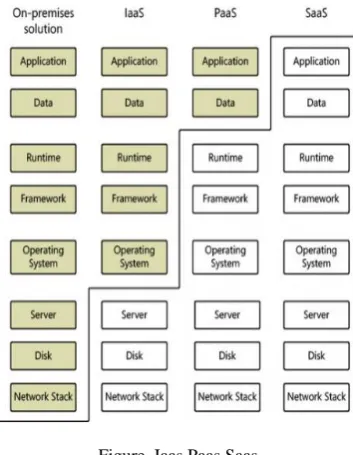
Infrastructure-as-a-Service (IaaS)
With Infrastructure as a Service, the lower levels of the IT stack are delivered as a service, freeing up a developer from much of the complexity of provisioning physical machines and configuring networks.
You can easily provision virtual machines in a highly scalable and available cloud environment, develop and test solutions, then deploy applications to production.
Platform-as-a-Service (PaaS)
With Platform as a Service, everything from network connectivity through the runtime is provided.
PaaS makes development easy by providing additional support for application services and management of the operating system, including updates.
With PaaS, you can focus on the business logic of application and quickly move applications from concept to launch.
Software-as-a-Service (SaaS)
[image:2.595.348.525.51.279.2] With Software as a Service, a single finished application or suite of applications is delivered through a web browser, abstracting away the underlying components of the IT stack including application code.
Figure. Iaas,Paas,Saas
B. Cloud Deployment Model:
There are 4 types of Cloud Deployment Models identified by NIST(National Institute of Science & Technology).
1.Private cloud
2.Community cloud
3.Public cloud
4.Hybrid cloud
1. Private Cloud:
Contrary to popular belief, private cloud may exist off premises and can be managed by the third party. Thus,there are two private cloud scenarios exist .they are:
a. On-site Private Cloud
■ Applies to private clouds implemented at a customer’s premises.
b. Outsourced Private Cloud
■ Applies to private clouds where the server side is outsourced to a hosting company.
Examples of Private Cloud:
Eucalyptus
Ubuntu Enterprise Cloud - UEC (powered by Eucalyptus)
© 2015-2019, IJARCS All Rights Reserved 39
CONFERENCE PAPER
4th National Conference on Recent Trends in Information Technology 2015 on 25/03/2015
Organized by Dept. of IT, Prasad V. Potluri Siddhartha Institute of Technology, Kanuru, Vijayawada-7 (A.P.) India 2. Community Cloud
The cloud infrastructure is shared by several organizations and supports a specific community that has shared concerns (e.g., mission, security requirements and compliance considerations). Government departments, central banks, universities etc. finds this as useful.
Community cloud has two possible scenarios:
a.On-site Community Cloud Scenario :
Applies to the community clouds implemented on the premises of the customers composing one community cloud
b.Outsourced Community Cloud :
It applies to the community clouds where the server side is outsourced to a hosting company.
Examples of Community Cloud:
Google Apps for Government
© 2015-2019, IJARCS All Rights Reserved 40
CONFERENCE PAPER
4th National Conference on Recent Trends in Information Technology 2015 on 25/03/2015
Organized by Dept. of IT, Prasad V. Potluri Siddhartha Institute of Technology, Kanuru, Vijayawada-7 (A.P.) India 3. Public Cloud
The most ubiquitous, and almost a synonym to loud computing. The cloud infrastructure is available to the general public or a large industry group and is owned by an organization selling cloud services.
Examples of Public Cloud are:
Google App Engine Microsoft Windows Azure IBM Smart Cloud
Amazon EC2
4. Hybrid Cloud
It is a combination of 2 or more cloud deployment types that remain unique but are bound together by standardized or proprietary technology that enables data and application portability
Examples of Hybrid Cloud:
Windows Azure (capable of Hybrid Cloud) VMware vCloud (Hybrid Cloud Services)
III. MOTIVATING FACTORS AND CHALLENGES
Cloud systems are not just another form of resource provisioning infrastructure and also have multiple opportunities from the principles for cloud infrastructures that will allow further types of applications and provisioning time of different services. Cloud computing has unique characteristics that distinguish it from classical service provisioning environments.
Infinitely (more or less) Scalable Cost saving/less capital expenditure Higher resource Utilization
Business agility
Disaster recovery and Back up Device and Location Independence
While reducing capital expenditure on IT resources is the one of crucial reason for the adopting cloud computing ,there are also some additional factors that causes the various organizations for the adopting the cloud computing. Participation of various factors for encouraging the adoption of cloud computing. In static allocation of resources and configurations there inevitably exists a trade-off between capacity deployment and resource requirement. Cloud computing shifts the location of resources to the cloud to reduce the costs associated with over-provisioning (i.e. having too many resources), under-utilization (i.e. not using resources adequately) and under-provisioning (i.e. having too little resources). It also reduces the time required to provision resources, allowing the applications to quickly scale under-utilization, as the workload changes. Cloud computing is particularly well suited for applications with a variable workload . One example of such applications is online shops, which have to manage their peak loads at Deepawali time
© 2015-2019, IJARCS All Rights Reserved 41
CONFERENCE PAPER
4th National Conference on Recent Trends in Information Technology 2015 on 25/03/2015
Organized by Dept. of IT, Prasad V. Potluri Siddhartha Institute of Technology, Kanuru, Vijayawada-7 (A.P.) India Self-Service
With the cloud, you can get the computing resources you need without having to procure, provision, and manage infrastructure on a per-application, ad-hoc basis.
Elastic
The cloud lets you scale up (or scale down) dynamically to meet the changing needs of your business.
Usage Based
Pay for only what you use, when you need to use it.
Some of the disadvantages of cloud computing are:
Security
Security issue has played the most important role in hindering Cloud computing acceptance. Various security issues like availability, integrity, confidentiality, multi-tenancy issues and so on. Cryptography, particularly public key infrastructure (PKI) can be used as solution to various cloud security issues.
Difficult to migrate
Different cloud providers support different application architectures which are also dissimilar from enterprise application architectures.
Internet dependency – performance and availability
Cloud computing services rely fully on the availability, speed, quality and performance of
internet as it works as carrier in between consumer and service provider.
Downtime and service level
In business applications, downtime is common concern because every minute of downtime is minute in which important business application can’t be performed which degrades the performance of organization as well reputation also.. Scalability is the best solution to increasing and maintaining application performance in cloud computing environments.
VI. CONCLUSION
So, while cloud computing is really great and you’re probably already using it, either for business of for personal means, here’s what we’ve learned :
Cloud computing is a cheap way for companies to have all the resources they need in once place. It allows us to share our resources even though we
are physically faraway from hardware resources.
It has the capability to handle most sudden, temporary peaks in application demand on cloud Infrastructures
V.REFERENCES
[1]
http://collaborate.nist.gov/twiki-cloud-computing/pub/CloudComputing/ReferenceArchite ctureTaxonomy/NIST_SP_500-292_-_090611.pdf
[2]