!
"
#"#
$ % %#
&
'
((( )
The Next Generation Computing Brainwave-Quantum Computing
T. Venkat Narayana Rao* Professor and Head, Computer Science and Engineering,
Hyderabad Institute of Technology and Management, Hyderabad, A.P, India
Shirish Pathania
Computer Science and Engineering,
Hyderabad Institute of Technology and Management, Hyderabad, A.P, India
_______________________________________________________________________________________________
Abstract:This paper is written to explicate the working of Quantum Computing and its mechanics. Quantum Computing is basically a minute field from Nanotechnology. The main purpose of this paper is to explain an inexperienced user about the technology and principles used while designing the architect of a quantum computer. Operational quantum computers would be a reality in forth coming years by the virtue of new mechanisms to explore and implementations. This paper is sectioned into 7 parts. Part 1 is a brief introduction to Quantum Computing i.e. basic working principle of a Qubit. Part 2 covers Qubit and the architect of the whole system. It also enlightens us about the Qubit in more detail like how data is represented, principles like superposition and state of composite system. Part 3 narrates how quantum Computing can be built using Qubits and applies the above mentioned principles. Part 4 deals with the basic introduction to Quantum Mechanics and some principles like dual nature of light and Uncertainty Principle. Part 5 depicts about the advantages of Quantum Computer over present computing systems. Part 6 discusses the overheads of Quantum Computing. Part 7 describes about implementation of Quantum Computing in today’s world. Finally this paper offers an insight about how and by when we would be able to design a full time Quantum Computer and what are the probable considerations to be taken in to account.
Keywords: Hilbert space, Bloch Sphere Qubit, Superposition, Entanglement, Spin, Eigen values, Ket vectors, Wave-particle duality, Uncertainty principle, Quantum mechanics, decoherence.
_______________________________________________________________________________________________
I. INTRODUCTION
A quantum computer is a device for computation that makes use of quantum mechanical principles, in order to carry out operations on data. Some of the basic principles that are used in quantum computing are super positioning, state of amalgamated system and Entanglement. Quantum computers are different from traditional computers because the traditional computers are based on transistors, whereas a quantum computer is built up of qubits [4]. In a quantum computer, computations are finished using quantum properties which are used to symbolize data and perform operations on these data. A theoretical model is the quantum Turing machine, also known as the universal quantum computer [2]. Although quantum computing is still in its opening stages, many experiments have been performed in which operations were performed on a very small number of qubits (quantum bit). Both practical and hypothetical research continues, and many funding agencies hold quantum computing research to develop quantum computers for both civilian and nationwide security purposes like crypto analysis. This paper discusses how to build a quantum computer and to develop a faster computer than any traditional computers.
A. The Qubit
A traditional computer has a memory that is made up in the form of series of bits, where each bit represents either a one or a zero. Other important thing is that Quantum Computers do not alter the Church–Turing notion. The gain
is made only in efficiency i.e. speed and accuracy. A quantum computer maintains a sequence of qubits [1][3][5]. A single qubit can signify a one, a zero, or both zero and one at the same instance of time, crucially, any quantum superposition of these, moreover, similarly a pair of qubits can be in any quantum superposition of 4 states, and three qubits in any superposition of 8 as discussed in the later part of this paper. Therefore, in general a quantum computer with n qubits can have up to 2n different states concurrently (this compares to a normal computer that can only be in one of these 2n states at any one time). A quantum computer operates by manipulating those qubits with a fixed sequence of quantum logic gates. The series of gates can be applied by using quantum algorithm.
B. The Qubit Condition
As we all know a qubit may have two spins i.e. up spin and down spin, therefore an example of an implementation of qubits for a quantum computer could start with the use of particles with two spin states: "down" and "up" i.e. typically
written as and , or and . But in fact, any
© 2010, IJARCS All Rights Reserved 114
II. BASIC ARCHITECTURE
A. Bloch SphereRepresentation.
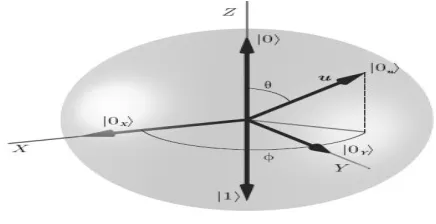
[image:2.612.67.285.191.303.2]This is a geometrical representation of the pure state space of a two-level quantum mechanical system, named after the physicist Felix Bloch. Alternatively, it is the pure state space of a 1 qubit quantum register as shown in figure 1. The Bloch sphere is actually geometrically a sphere and the association between elements of the Bloch Sphere and pure states can be explicitly given. In generalized form, the Bloch Sphere may also refer to the related space of an n -level quantum system.
Figure 1. Bloch Sphere
Quantum mechanics is mathematically formulated in Hilbert space or projective Hilbert space. The space of pure states of a quantum system is given by the one-dimensional subspaces the Hilbert space (i.e. the "points" of projective Hilbert space). The space of one-dimensional subspaces in any vector space is a projective space, and in particular, the space of one-dimensional subspaces in a two dimensional Hilbert space is the complex projective line, which is a geometrical sphere as shown in figure 1. Each pair of antipodal points on the Bloch sphere corresponds to a mutually exclusive pair of states of the particle, namely, spin up and spin down for a Stern-Gerlach experiment oriented along a particular axis in physical space.
B. Ket Vectors.
To show this correspondence clearly, consider the qubit
description of the Bloch sphere; any state can be written
as a complex superposition of the ket vectors and
; moreover since phase factors do not affect physical state, we can take the representation so that the coefficient
of is real and non-negative. Thus has a representation as [6]:
With
excluding in the case is one of the ket vectors or
, the representation is exclusive, i.e. the
parameters and uniquely specify a point on the unit
sphere of Euclidean space , viz. the point whose coordinates (x,y,z) are :
C. Quantum Superposition.
Quantum superposition refers to the quantum mechanical property of a particle to live in all of its possible quantum states concurrently. Due to this property, to completely describe a particle one must consist of description of every possible state and the probability of the particle being in that state. Since the Schrodinger equation is linear, a solution that takes into account all possible states will be a linear combination of the solutions for each individual state. This mathematical property of linear equations is known as the superposition principle. The principle of superposition states that if the world can be in any configuration, any possible arrangement of particles or fields, and if the world could also be in another configuration, then the world can also be in a state which is a superposition of the two. The amount of each configuration that is in the superposition is specified by a complex number.
D. Quantum Entanglement.
Quantum entanglement, also called as quantum non-local connection, is a property of the quantum mechanical state of a system containing two or more objects, where the objects that make up the system are associated in a way such that one cannot sufficiently describe the quantum state of a constituent of the system without full mention of its counterparts, even if the individual objects are spatially divided[8][9]. This interconnection leads to non-classical correlations between observable physical properties of remote systems, often referred to as nonlocal correlations. During the formation of quantum theory, this property of entanglement was recognized as a straight consequence. When particles decay into other particles, these decays must obey the various conservation laws. As a result, pairs of particles can be generated that are required to be in certain quantum states. For ease of understanding, consider the situation where in a pair of these particles are produced, have a two state spin and one must be spin up and the other must be spin down. As described in the introduction part, these two particles can now be called entangled since you cannot completely describe one particle without mentioning the other. This type of entangled pair where the particles always have opposite spin is known as the spin anti-correlated case. The case where the spins are always the same is known as spin correlated [7].
Measuring one member of the pair notify us, what the spin of the other member is without really measuring its spin.
III. PROPOSED IMPLEMENTATION OPTIONS
A. Classical Computer
Consider first a classical computer that operates on a three-bit register. The state of the computer at any time is a probability distribution over the 23 = 8 different three-bit strings 000, 001, 010, 011, 100, 101, 110, 111. If it is a deterministic computer, then it is in accurately one of these states with probability of 1. However, if it is a probabilistic computer, then there is a possibility of it being in any one of a number of different states. We can express this probabilistic state by eight nonnegative numbers a, b, c, d, e, f, g, h (where a = probability computer is in state 000, b = probability computer is in state 001, etc.). There is a constraint that these probabilities sum up to 1.
The state of a three-qubit quantum computer is similarly depicted by an eight-dimensional vector (a, b, c, d, e, f, g, h), called a ket values. However, instead of adding to one, the sum of the squares of the coefficient magnitudes, | a | 2 + | b | 2 + ... + | h | 2, must equal to one. Moreover, the coefficients are complex numbers. Since states are represented by complex wave functions, two states being added jointly will undergo interference. This is a key difference between quantum computing and probabilistic classical computing.
If you measure the three qubits, then you will observe a three-bit string. The probability of measuring a string will equal the squared magnitude of that string's coefficients i.e. our example, probability that we read state as 000 = | a | 2, probability that we read state as 001 = | b | 2 etc. Thus a measurement of the quantum state with coefficients (a,b,...,h) gives the classical probability distribution ( | a | 2, | b | 2,..., | h | 2). We say that the quantum state "collapses" to a classical state [[3].
The eight-dimensional vector can be specified in many different ways, depending on what basis you choose for the space. The basis of three-bit strings 000, 001... 111 are known as the computational basis, and are often convenient, but other bases of unit-length, orthogonal vectors can also be used. Ket notation is frequently used to make explicit the choice of basis. For example, the state (a, b, c, d, e, f, g, h) in the computational basis can be written as:
a|000) + b|001) + c|010) + d|100 + f|101) + g|110 + h|111), where, e.g.,| 010› = (0,0,1,0,0,0,0,0). The computational basis for a single qubit (two dimensions) is = (1, 0), | 1› = (0,1), but another regular basis are the eigenvectors of the Pauli-x operator is:|+) = 1/ 2 (1,1) and |-) = 1/ 2 (1, -1).
Recording a classical state of n bits, a 2n-dimensional
probability distribution, involves an exponential number of real numbers, practically we can always think of the system as being exactly one of the n-bit strings and we just don't know which one. Quantum mechanically, this is not the case, and all 2n complex coefficients need to be kept track of to see how the quantum system evolves. For example, a 300-qubit quantum computer has a state described by 2300 (i.e. approximately 1090) complex numbers, more than the number of atoms in the observable universe.
B. One-way Quantum Computer
The one-way or measurement based quantum computer is a method of quantum computing that first prepares an entangled resource state, usually a cluster state or graph state, then performs single qubit measurements on it. It is "one-way" because the resource state is destroyed by the measurements. The result of each individual measurement is random, but they are associated in such a way that the calculation always succeeds. In general the preference of basis for later measurements needs to depend on the results of earlier measurements, and hence the measurements cannot be performed at the same point in time. Equivalence to quantum circuit model any one-way computation can be made into a quantum circuit by using quantum gates to prepare the resource state. For cluster and graph resource states, this requires only one two-qubit gate per bond, so it is efficient. On the contrary, any quantum circuit can be pretend by a one-way computer using a two-dimensional cluster state as the resource state, by laying out the circuit diagram on the cluster; Z measurements (basis) eliminate physical qubits from the cluster, while measurements in the X-Y plane (basis) teleport the logical qubits along the "wires" and perform the required quantum gates. This is also polynomially capable, as the required size of cluster scales as the size of the circuit (qubits x timesteps), while the number of measurement timesteps scales as the number of circuit timesteps. Implementations of one-way quantum computation has been demonstrated by running the 2 qubit Grover's algorithm on a 2x2 cluster state of photons. A linear optics quantum computer based on one way computation has been proposed. Cluster states have also been created in optical lattices, but were not used for computation as the atom qubits were too close together to measure individually.
C. Usage of Reversible logic gates
Ordinarily, in a classical computer, the logic gates other than the NOT gate are not reversible. Thus, for instance, for an AND gate one cannot generally recover the two input bits from the output bit; for example, if the output bit is 0, we can't tell from this whether the input bits are 0,1 or 1,0 or 0,0. However, it is informative to observe that reversible gates in classical computers are theoretically possible for input strings of any length. Moreover, these are actually of practical interest, since they do not increase entropy. A reversible gate is a reversible function on n-bit data that returns n-bit data, where in an n-bit datum is a string of bitsx1, x2, ...,xn of length n. The set of n-bit data is the space {0, 1} n, which consists of 2n strings of 0's and 1's. More specifically, an n-bit reversible gate relies on mapping f from the set {0,1}n of n-bit data onto itself. An example of such a reversible gate f is a mapping that changes the first digit of each string. We are only interested in maps f which are different from the identity, and for reasons of practical engineering we are only interested in gates for small values of n, e.g. n=1, n=2 or n=3. These gates can be easily described by tables. Examples of these logic gates which have been studied are the controlled NOT gate (also called CNOT gate), the Toffoli gate and the Fredkin gate. To consider quantum gates, we first need to specify the quantum replacement of an n-bit datum [8].
© 2010, IJARCS All Rights Reserved 116
can also be regarded as consisting of linear superpositions of classical bit strings. The HQB (n) is a vector space over the complex numbers of dimension 2n. The elements of this space are called n-qubits.
Using Dirac ket notation, if x1,x2, ...,xn is a classical bit string, then is a special n-qubit corresponding to the function which maps this classical bit string to 1 and maps all other bit strings to 0; these 2n special n-qubits are called computational basis states. All n-qubits are complex linear combinations of these computational basis states.
For a quantum computer gate, we require a very special kind of reversible function, namely a unitary mapping, that is, a mapping on HQB (n) that preserves the inner product [5].
An n-qubit (reversible) quantum gate is a unitary mapping U from the space HQB (n) of n-qubits onto itself. Again we are only interested in unitary operators U which are different from the identity and we are only interested in gates for small values of n. In fact, reversible classical n-bit logic gates give rise to reversible n-bit quantum gates as follows: to each reversible n-bit logic gate f corresponds a quantum gate Wfdefined as follows:
Note that Wf permutes the computational basis states of
particular importance is the quantized 2 qubit CNOT gate WCNOT. Of course there are many other properly quantum gates. For example, a relative phase shift is a 1 qubit gate can be given by multiplication by the unitary matrix:
so that
IV. QUANTUM MECHANISMS THEORY
Quantum Mechanics (QM), also known as quantum physics or quantum theory, is a branch of physics provi ding a mathematical description of much of the dual particle-like and wave-like behavior and interactions of energy and matter. It departs from classical mechanics main ly at the atomic and subatomic scales, the so-called quantum realm. In advanced topics of QM, some of these behaviors are macroscopic and only emerge at very low or very high energies or temperatures [2] [3] [8]. The name, coined by Max Planck, originates from the observation that some physical quantities can be changed only by discrete amounts, or quanta, as multiples of the Planck constant, rather than being capable of changeable continuously or by any arbitrary amount. For example, the angular momentum, or more generally the action, of an electron bound into an atom or molecule is quantized. While an unbound electron does not display quantized energy levels, an electron bound in an atomic orbital has quantized values of angular momen tum. In the context of QM, the wave–particle duality of energy and matter and the uncertainty principle provide a unified outlook of the behavior of photons, electrons and other atomic-scale objects. The mathematical formulations of quantum mechanics are abstract. Similarly, the implica tions are often non-intuitive in terms of classic physics. The centerpiece of the mathematical system is the wave function. The wave function is a mathematical function providing
information about the probability amplitude of position and momentum of a particle. Mathematical manipulations of the wave function usually involve the bra-ket notation, which requires an understanding of complex numbers and linear functions. The wave function treats the object as a quantum harmonic oscillator and the mathematics is akin to that of acoustic resonance. Many of the results of QM do not have models that are easily envisage in terms of classical mechanics, for instance, the ground state in the quantum mechanical model is a non-zero energy state that is the lowest permitted energy state of a system, rather than a more traditional system that is thought of as plainly being at rest with zero kinetic energy.
A. Wave–Particle Duality Nature
Wave Particle duality is the concept that all matter demonstrates both wave and particle properties. Being a essential concept of quantum mechanics, this duality addresses the dearth of classical concepts like "particle" and "wave" in fully describing the behavior of quantum-scale objects. Orthodox interpretations of quantum mechanics explain this ostensible paradox as a fundamental property of the universe, while alternative interpretations clarify the duality as an evolving, second-order consequence of various limitations of the observer [4]. This treatment focuses on explaining the behavior from the perspective of the broadly used Copenhagen interpretation, in which wave– particle duality is one aspect of the concept of complementarity, that a phenomenon can be viewed in one way or in another, but not both simultaneously.
B. The Heisenberg Uncertainty Principle.
In quantum mechanics, the Heisenberg uncertainty principle states by specific inequalities that certain pairs of physical properties, such as position and momentum, cannot be simultaneously known to arbitrarily high precision. That is, the more precisely one property is measured, the less precisely the other can be measured. The principle states that a minimum exists for the product of the uncertainties in these properties that is equal to or greater than one half of the reduced Planck's constant ( = h/2 ). Published by Werner Heisenberg in 1927, the principle means that it is not possible to establish concurrently both the position and momentum of an electron or any other particle with any great degree of accuracy or certainty. Moreover, his theory is not a statement about the limitations of a researcher's ability to measure particular quantities of a system, but it is a statement about the nature of the system itself as expressed by the equations of quantum mechanics.
The only kind of wave with a exact position is concentrated at one point, and such a wave has an indefinite wavelength (thus an indefinite momentum). Conversely, the only kind of wave with a definite wavelength is an infinite regular periodic oscillation over all space, which has no definite position. So in quantum mechanics, there can be no states that illustrate a particle with both a definite position and a definite momentum. The more precise the position, the less precise the momentum [1] [2].
V. ADVANTAGES OF QUANTUM COMPUTING
OVER PRESENT SYSTEMS
There are several reasons that researchers are working tough to develop a practical quantum computer to avail following merits which they foresee for the next generations:-.
A. High Speed: First, atoms change energy states very quickly -- much more quickly than even the fastest computer processors. Next, given the right type of problem, each qubit can take the place of an entire processor -- meaning that 1,000 ions of say, barium, could take the place of a 1,000-processor computer. The key is finding the sort of problem a quantum computer is able to solve.
B. Huge Security: If functional quantum computers can be built, they will be valuable in factoring large numbers, and therefore extremely useful for decoding and encoding secret information. If one were to be built today, no information on the Internet would be safe. Our current methods of encryption are simple compared to the complicated methods possible in quantum computers.
C. Large Data Storage and Access: A large amount of data could be stored within a very minute scale as we know that “one tip of a pin contains millions of atoms”. Quantum computers could also be used to search large databases in a fraction of the time that it would take a conventional computer.
D. Carry our any job: It has been shown in theory that a quantum computer will be able to perform any task that a classical computer can. However, this does not necessarily mean that a quantum computer will outperform a classical computer for all types of task. If we use our classical algorithms on a quantum computer, it will simply perform the calculation in a similar manner to a classical computer. In order for a quantum computer to show its superiority it needs to use new algorithms which can exploit the phenomenon of quantum parallelism.
E. High Efficiency and Competence: By adding up all the above qualities, it directly increases the efficiency and accuracy of a Quantum Computer to the next level. It beats today’s Computers both in speed, size, efficiency and accuracy. The implications of the theories involved in quantum computation reach further than just making faster computers.
F. Quantum Communication Systems: Quantumcomm
unica tion systems allow a sender and receiver to agree on a code without ever meeting in person. The uncertainty principle, an inescapable property of the quantum world, ensures that if an eavesdropper tries to monitor the signal in transit it will be disturbed in such a way that the sender and receiver are alerted [4].
G. Quantum Cryptography Challenge: The expected
Capabilities of quantum computation promise great improvements in the world of cryptography. Ironically the same technology also poses current cryptography techniques a world of problems. They will create the ability to break the RSA coding system and this will render almost all current channels of communication insecure.
H. Artificial Intelligence: The theories of quantum Computations suggest that every physical object, even the universe, is in some sense a quantum computer. As Turing's work says that all computers are functionally equivalent, computers should be able to model every physical process. Ultimately this suggests that computers will be capable of simulating conscious rational thought. And a quantum computer will be the key to achieving true artificial intelligence.
VI. PROBLEMS IN BUILDING QUANTUM
COMPUTING
One must be thinking that, when the proposal of Quantum Computing is so well developed then why this technology isn’t present with everybody in our today’s world? Well this is so because it’s not that easy to build a Quantum Computer. While developing a Quantum Computer i.e. arranging the qubits symmetrically, then the spins of the qubits may change due to external noise that is created from things like electromagnetic waves, heat, and mobile signals etc. Therefore in order to resist the qubits from such external disturbance we may require a very advanced mechanism that would avoid such noises to interfere our structure. Even if we design a machine that could cut the noise, then temperature comes in as another problem. For the qubits to act normally, we require to maintain a temperature of -200 degrees Fahrenheit. Now this can be done by using chemicals in order to bring the temperature. Now you may think that all the problems that occur while handling the qubits are solved. But there is another big problem. As we know that we are working at the quantum level i.e. atomic level. Therefore it is somewhat difficult to determine the two important parameters of the qubit.
i. Momentum ii. Position
This take us back to the famous Uncertainty Principlewhich states that at a particular instance of time, both the position and the momentum cannot be determined as explained above. Thus, the tools with which we may be working on the qubits may become a problem for the qubits itself. Therefore, it becomes a lot difficult to handle them. Various tools and advanced machines are been developed in order to overcome the above problems but still in experimentation stage and still plenty of remedies are to be evolved.
VII. PRESENT MODELS OF QUANTUM
COMPUTING
A. Topological Quantum Computer
© 2010, IJARCS All Rights Reserved 118
the computer. The advantage of a quantum computer based on quantum braids over using trapped quantum particles is that the former is much more stable. The smallest disturbance can cause a quantum particle to decohere and bring in errors in the computation; such small perturbations do not change the topological properties of the braids. This is like the effort required to cut a string and reattach the ends to form a different braid, as opposed to a ball (representing an ordinary quantum particle in four-dimensional space-time) simply bumping into a wall. While the rudiments of a topological quantum computer are derived in a purely mathematical realm, recent experiments indicate these elements can be created in the real world using semiconductors made of gallium arsenide near absolute zero and subjected to strong magnetic fields.
B. Adiabatic Quantum Computation
Relies on the adiabatic theorem to do calculations. First, a complex Hamiltonian is found whose ground state describes the key to the problem of interest. Next, a system with a simple Hamiltonian is prepared and initialized to the ground state. Finally, the simple Hamiltonian is adiabatically developed to the complex Hamiltonian. By the adiabatic theorem, the system remains in the ground state, so at the end the state of the system describes the solution to the problem. AQC is a possible method to get around the problem of quantum decoherence [7]. Since the quantum system is in the ground state, interference with the outside world cannot make it move to a lower state. If the energy of the outside world (that is, the "temperature of the bath") is kept lower than the energy gap between the ground state and the next higher energy state, the system has a proportionally lower probability of going to a higher energy state. Thus the system can stay coherent as long as needed. In practice, there are problems during a computation. As the Hamiltonian is gradually changed, the interesting parts occur when multiple qubits are close to a tipping point. It is exactly at this point when the ground state gets arbitrarily close to a first energy state. Adding a slight amount of energy (from the external bath or as a result of slowly changing the Hamiltonian) could take the system out of the ground state, and damage the calculation. Trying to perform the calculation more quickly increases the external energy; scaling the number of qubits makes the energy gap at the tipping points smaller.
C. Loss-DiVincenzo Quantum Computer
Also known as spin-qubit quantum computer is a scalable semiconduc tor-based quantum computer proposed by Daniel Loss and David P. DiVincenzo in 1997. The proposal computer was to use as qubits the intrinsic spin-1/2 degree of freedom of individual electrons restricted to quantum dots [6]. This was done in a way that fulfilled DiVincenzo Criteria for a scalable quantum computer, namely:
(a) Identification of well-defined qubits. (b) Consistent state preparation. (c) Low decoherence.
(d) Precise quantum gate operations. (e) Strong quantum measurements.
VIII. CONCLUSION
The only Quantum Computing device as off now built and in use is the turing machine. Therefore, to some extent it seems that we have entered into the next level of advanced computing technology where in we make use of Nano Technology. Quantum Computing permit us to perform computational operations on data much faster and efficiently. And also the size of our model is diminutive. Therefore very high and complex computers can be built within the dimension of nano meters. The components in classical computers are rapidly shrinking to a size where quantum behavior is unavoidable. Through the principle of superposition in quantum systems we can create useful memory components that are on the scale of an atom or smaller. These quantum memory registers may assist in exponential computational speed increase by taking advantage of quantum parallelism. Using this technology, we can increase the speed as well as induce high data storage capacity with less complexity as compared to classical computers. For now all we need is to find graceful solutions to the problems that are faced in designing Quantum Computer Architecture. Soon we may see a quantum memory register solving complex memory based bottlenecks. In any case, quantum computing will remain an exciting area for experimentalists and theorists alike for years to come.
IX. REFERENCES
[1] Einstein A, Podolsky B, Rosen N (1935)."Can Quantum-Mechanical Description of Physical Reality Be Considered Complete?" Phys.Rev. 47 (10):777 780. Doi: 10.1103/Phys Rev.47.777.
[2] Walter Greiner (2001). Quantum Mechanics: An Intro duction. Springer. ISBN 3540674586
[3] Amrein, W.O.; Berthier, A.M. (1977), "on support properties partticals-functions and their Fourier transforms", J. Funct. Anal. 24: 258–267.
[4] David Deutsch,”Quantum Computational Networks”, Proc. Soc. R. Lond. A400, pp. 97-117, 1985.
[5] Chester, Marvin (1987) Primer of Quantum Mechanics. John Wiley. ISBN 0-486-42878-8
[6] "Quantum Computing with Molecules" article in Scientific American by Neil Gershenfeld and Isaac L. Chuang.
[7] Berman, Gennady, Gary D. Doolen, Ronnie Mainieri, and Vladimir I. Tsifrinovich, “Introduction to Quantum Computation,” World Scientific (1999).
[8] Barenco, A, C.H. Bennett, R. Cleve, D.P. DiVincenzo, N. Margolus, P.Shor, T.Sleator, J.A. Smolin, and H.Weinfurter, Elementary gates for quantum comp,Phys.Rev.A,52,(95), pp3475 - 3467.
!
"
#"#
$ % %#
&
'
((( )
Professor T.Venkat Narayana Rao received B.E in Computer Technology and Engineering from Nagpur University, Nagpur, India and M.B.A (Systems) and M.Tech in Computer Science from Jawaharlal Nehru Technological University, Hyderabad, A.P., India and a Research Scholar in JNTU. He has 20 years of vast experience in Computer Science and Engineering areas pertaining to academics and industry related I.T issues. He is presently Professor and Head, Department of Computer Science and Engineering, Hyderabad Institute of Technology and Management, Gowdavally, R.R.Dist., A.P, INDIA. He is nominated as an Editor and Reviewer to 15 International journals relating to Computer Science and Information Technology. He is currently working on research areas which include Digital Image Processing, Digital Watermarking, Data Mining, Network Security and other Emerging areas of Information Technologies. He can be reached at [email protected]