MORE RESULTS ON COMPLEMENTARY TREE NIL DOMINATION NUMBER OF A GRAPH
S. Muthammaiand G. Ananthavalli
Government Arts College for Women (Autonomous), Pudukkottai-622001, India
Abstract:
A set D of a graph G = (V, E) is a dominating set, if every vertex in V – D is adjacent to some vertex in D. The domination number γ(G) of G is the minimum cardinality of a dominating set. A dominating set D of a connected graph G is called a complementary tree nil dominating set if the induced sub graph <V – D> is a tree and V – D is not a dominating set. The minimum cardinality of a complementary tree nil dominating set is called the complementary tree nil domination number of G and is denoted by γctnd(G). In this paper, bounds for γctnd(G) and its exact values for some particular classes of graphs are found. Some more results on complementary tree nil domination number are also established.
Key words: complementary tree domination number, complementary trees nil domination number.
1. Introduction
Graphs discussed in this paper are finite, undirected and simple graphs. For a graph G, let V(G) and E(G) denote its vertex set and edge set respectively. For v V(G), the neighborhood N(v) of v is the set of all vertices adjacent to v in G. N[v] = N(v) {v} is called the closed neighborhood of v. A vertex v V(G) is called a support if it is adjacent to a pendant vertex. (That is, a vertex of degree one). If x = uv is a line of G, and w is not a point of G, then x is subdivided when it is replaced by the lines uw and wv. If every line of G is subdivided, the resulting graph is the subdivision graph S(G). The concept of domination in graphs was introduced by Ore[5]. A set D V(G) is said to be a dominating set of G, if every vertex in V(G) - D is adjacent to some vertex in D. A minimum dominating set in a graph G is a dominating set of minimum cardinality. The cardinality of a minimum dominating set in G is called the domination number of G and is denoted by γ(G). The concept of domatic partition in graphs was introduced by E.J. Cockayne and S.T. Hedetniemi[2]. A partition of its vertex set V(G) is called a domatic partition of G if each class of is a dominating set in G. The maximum number of classes of a domatic partition of G is called the domatic number of G and is denoted by d(G). A dominating set D of a connected graph G is a nonsplit dominating set, if the induced subgraph<V(G) - D> is connected. Muthammai, Bhanumathi and Vidhya[4] introduced the concept of complement tree dominating set. A dominating set D V(G) is said to be complementary tree dominating set (ctd-set) if the induced sub graph <V(G) - D> is a tree. The minimum cardinality of a ctd-set is called the complementary tree domination number of G and is denoted by γcnd(G). Any undefined terms in this paper may be found in Harary[1]. Here, G is a connected graph with p vertices and q edges.
Aryabhatta Journal of Mathematics and Informatics (Impact Factor- 5.856)
In this paper, bounds for γctnd(G) and its exact values for some particular classes of graphs and also relationships between complementary tree nil domination number and other related parameters are found.
2. Prior Results
Theorem 2.1.[2] For any connected graph G, d(G) ≤ ( ) + 1.
Theorem 2.2.[3] For any connected graph G with p vertices, 2 ≤ γctnd(G) ≤ p, where p 2. Theorem 2.3.[3]For any connected graph G, ( ) + 1 ≤ γctnd(G).
Theorem 2.4.[3]Let G be a connected graph with p vertices. Then γctnd(G) = 2 if and only if G is a graph obtained by attaching a pendant edge at a vertex of degree p - 2 in T + K1, where T is a tree on (p – 2) vertices.
Theorem 2.5.[3] For any connected graph G, γctnd(G) = p if and only if G ≅Kp, where p2.
Theorem 2.6.[3] Let G be a connected graph with p 3 and ( ) = 1. Then γctnd(G) = p -1 if and only if the subgraph of G induced by vertices of degree atleast 2 is K2 or K1.
That is, G is one of the graphs K1, p-1 or Sm,n(m + n = p, m, n 1), where Sm, n is a bistar which is obtained by attaching m-1 pendant edges at one vertex of K2 and n-1 pendant edges at other vertex of K2.
Theorem 2.7.[3] Let G be a connected noncomplete graph with ( ) 2. Then γctnd(G) = p -1 if and only if each edge of G is a dominating edge.
Theorem 2.8.[3] Let T be a tree on p vertices such that γctnd(T) p – 2. Then γctnd(T) = p – 2 if and only if T is one of the following graphs.
(i) T is obtained from a path Pn (n 4 and n < p) by attaching pendant edges at atleast one of the end vertices of Pn.
(ii) T is obtained from P3 by attaching pendant edges either at both the end vertices or at all the vertices of P3.
Notation 2.9.[3] Let
G
be the class of connected graphs G with ( ) having one of the following properties.(a) There exist two adjacent vertices u, v in G such that
deg ( )
Gu
= 1 and <V(G) - {u, v}> contains P3 as an induced subgraph such that end vertices of P3 have degree atleast 2 and the central vertex of P3 has degree atleast 3.(b) Let P be the set of all pendant vertices in G and let there exist a vertex vV(G) - P having minimum degree in V(G) - P and is not a support of G such that V(G) – (NV-P[v] - P) contains P3 as an induced subgraph such that the end vertices of P3 have degree atleast 2 and the central vertex of P3 has degree atleast 3.
Theorem 2.10.[3] Let G be a connected graph with ( ) and γctnd(G)
p -1. Then γctnd(G) = p - 2 if and only if G does not belong to the classG
of graphs.(d) G is obtained by joining two complete graphs by edges.
(e) G is a graph such that there exists a vertex v V(G) such that G – v is a complete
graph on (p – 1) vertices .
(f) G is a graph such that there exists a vertex v V(G) such that G – v is Kp – 1 – e, (e E(Kp – 1) ) and N(v) contains atleast one vertex of degree (p – 3) in Kp – 1 – e.
Theorem 2.12. [4] γctd(T) = m if and only if each vertex of degree atleast 2 is a support, where m is the number of pendent vertices in T.
3. Main Results
Definition 3.1.
The one point union ( ) of t-copies of cycle Cn is the graph obtained by taking a new vertex as a common vertex such that any two distinct cycles Ci and Cj are edge disjoint and do not have any vertex in common except .
Theorem 3.1.
For t 2 and n 4, γctnd(
( )) = {
( ) Proof.
Let G = ( ) and be the vertex of union of t cycles of length n. G has t(n – 1) + 1 vertices. Let the vertex set of kth cycle in be Vk = {u, , …, } and edge set be Ek ={(u, ), (u, )} ⋃ ( ) Therefore, V(G) = ⋃ , E(G) = ⋃ .
Case 1: n = 4 and | ( )| = 3t + 1.
If D = ⋃ { } * + ( ) then D is a dominating set of . Also <V(G) - D>≅ ,
N( ) and hence D is a ctnd-set of G. Therefore, ctnd(
( )) | | = t + 2. Let
be any ctnd- set of
( ). Since contains atleast one vertex v such that N(v) ,
contains vertices of N(vi) for some vi, vi V(G), where deg(vi) = 2 in G. To dominate vertices which are adjacent to u, a vertex from each cycle must belong to except one vertex, and hence contains atleast 3 + t – 1 vertices. Therefore, | | t + 2.
That is, ctnd( ( )
) t + 2. Case 2: n 5 and |V(G| = (n-1) t + 1.
Let D = ⋃ * + * + V(G). Then <V(G) – D >≅ , N( ) D, i = 3, … n-1, k = 1, 2, …, t and hence D is a ctnd-set of G. Therefore, γctnd(G) = | | t (n-3) + 1.
Since γctnd(Cn) = n – 2, n 5 and there are t cycles and one vertex is common to all cycles, γctnd( ( )) t (n – 2) – (t – 1) t (n – 3) + 1.
Hence γctnd( ( )
Aryabhatta Journal of Mathematics and Informatics (Impact Factor- 5.856)
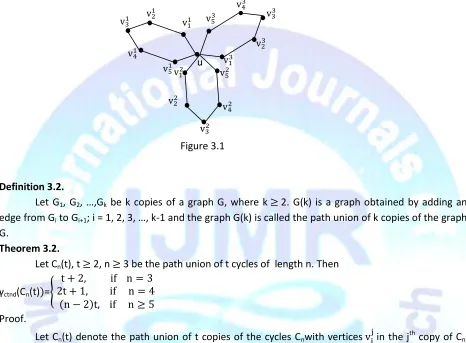
Example 3.1.For the graph ( ) given in Figure 3.1, D = ⋃ * + * + is a minimum ctnd-set of
( )
and hence γctnd(
( )) = | | = 10.
Definition 3.2.
Let G1, G2, …,Gk be k copies of a graph G, where k 2. G(k) is a graph obtained by adding an edge from Gi to Gi+1; i = 1, 2, 3, …, k-1 and the graph G(k) is called the path union of k copies of the graph G.
Theorem 3.2.
Let Cn(t), t 2, n 3 be the path union of t cycles of length n. Then
γctnd(Cn(t))={
( ) Proof.
Let Cn(t) denote the path union of t copies of the cycles Cnwith vertices in the jth copy of Cn, where 1 i n and 1 j t. Let the vertices and (1 k t-1) be joined by an edge. The
vertices and are of degree 3, the vertices , 2 k t-1 are of degree 4 and the remaining vertices are of degree 2 and Cn(t) has nt vertices.
Case 1: n = 3
Here | ( ( ))| = 3t. Let D = ⋃ { } * +. Then D is a dominating set of ( ). Also <V( ( )) – D >≅ 2t – 2, N( ) D and hence D is a minimum ctnd-set of ( ).
Therefore, γctnd ( ( )) = | |= t+2. Case 2: n = 4
u
Here | ( ( ))| = 4t. Let ⋃ * + * +. Then D is a dominating set of G. Also <V( ( )) – D >
is a tree obtained by attaching a pendant edge at a vertex of Pt-1 of Pt-1 K1, N( ) and D is a ctnd-set of G and hence, γctnd ( ( )) = | | 2t+1. Let be any ctnd- set of . Since contains atleast one vertex v such that N(v) , contains vertices of N(vi) for some vi, where vi V( ( ), where deg(vi) = 2 in ( ). Therefore, contains atleast 3 + 2 (t–1) vertices. Hence| | 2t + 1 and γctnd(C4(t)) = 2t + 1. Case 3: n 5
Let D =⋃ * +. Then D is a dominating set of ( ). Also < V( ( )) – D >≅ Pt K1, N( ) D, k = 4, 5, …, n – 1, i = 1, 2, …, t and hence D is a ctnd-set of ( ) and hence, γctnd ( ( )) = | | (n – 2)t.
γctnd(Cn) = n – 2, n 5. But there are t cycles and * + ≅ Pt. Therefore, γctnd(Cn(t)) t(n – 2) – (t – 1) t(n – 3) + 1.
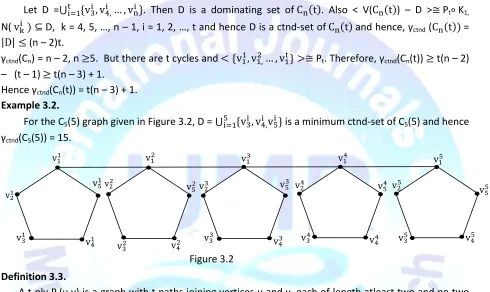
Hence γctnd(Cn(t)) = t(n – 3) + 1. Example 3.2.
For the C5(5) graph given in Figure 3.2, D = ⋃ * + is a minimum ctnd-set of C5(5) and hence γctnd(C5(5)) = 15.
Definition 3.3.
A t-ply Pt(u,v) is a graph with t paths joining vertices u and v, each of length atleast two and no two paths have a vertex in common except the end vertices u and v in Pt(u,v).
Theorem 3.3.
γctnd(Pt(u, v)) = p – t, where p is the number of vertices in Pt(u,v). Proof.
Let the vertices of t path P(i), i = 1, 2, …, t be u, v (n 2). The vertices u and v are of degree t and the remaining vertices are of degree 2.
Here |V(Pt(u, v))| = nt + 2. Let D = ⋃ * + * +. Then D is a dominating set of Pt (u, v) and <V( Pt(u, v) ) – D>≅ K1,t-1, N( ) and hence, D is a minimum ctnd-set of G and hence, γctnd(G) =| | = (n – 1)t + 2 = nt – t + 2 = p – t.
Let D’ be a ctnd-set of Pt(u, v). Then < V (Pt(u, v)) – D’> is a tree. If <V(Pt(u, v)) – D’> contains a path P4, then D’ is not a dominating set of G. Therefore, <V(Pt(u, v)) – D’> is a star and hence | | p – t. γctnd(Pt(u, v)) p – t.
Hence γctnd(Pt(u, v)) = p – t.
Aryabhatta Journal of Mathematics and Informatics (Impact Factor- 5.856)
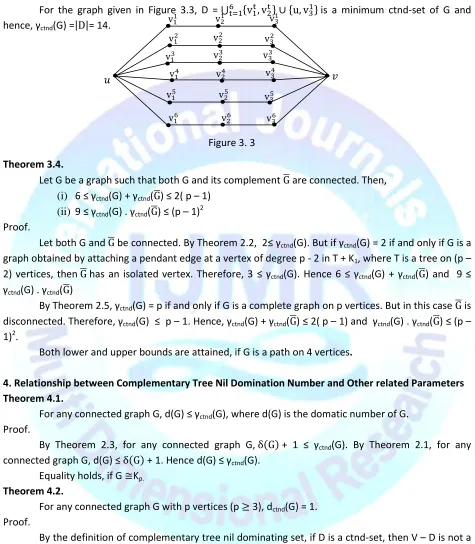
Example 3.3.For the graph given in Figure 3.3, D = ⋃ * + * + is a minimum ctnd-set of G and hence, γctnd(G) =| |= 14.
Theorem 3.4.
Let G be a graph such that both G and its complement ̅ are connected. Then,
(i) 6 ≤ γctnd(G) + γctnd( ̅) ≤ 2( p – 1)
(ii) 9 ≤ γctnd(G) . γctnd( ̅) ≤ (p – 1)2 Proof.
Let both G and ̅ be connected. By Theorem 2.2, 2≤ γctnd(G). But if γctnd(G) = 2 if and only if G is a graph obtained by attaching a pendant edge at a vertex of degree p - 2 in T + K1, where T is a tree on (p – 2) vertices, then ̅ has an isolated vertex. Therefore, 3 ≤ γctnd(G). Hence 6 ≤ γctnd(G) + γctnd( ̅) and 9 ≤ γctnd(G) . γctnd( ̅)
By Theorem 2.5, γctnd(G) = p if and only if G is a complete graph on p vertices. But in this case ̅ is disconnected. Therefore, γctnd(G) ≤ p – 1. Hence, γctnd(G) + γctnd( ̅) ≤ 2( p – 1) and γctnd(G) . γctnd( ̅) ≤ (p – 1)2.
Both lower and upper bounds are attained, if G is a path on 4 vertices.
4. Relationship between Complementary Tree Nil Domination Number and Other related Parameters Theorem 4.1.
For any connected graph G, d(G) ≤ γctnd(G), where d(G) is the domatic number of G. Proof.
By Theorem 2.3, for any connected graph G, ( ) + 1 ≤ γctnd(G). By Theorem 2.1, for any connected graph G, d(G) ≤ ( ) + 1. Hence d(G) ≤ γctnd(G).
Equality holds, if G ≅Kp. Theorem 4.2.
For any connected graph G with p vertices (p 3), dctnd(G) = 1. Proof.
By the definition of complementary tree nil dominating set, if D is a ctnd-set, then V – D is not a dominating set. Exactly one domatic partition can be constructed in ctnd- set for any connected graph G. Therefore, any two ctnd-sets of G are not disjoint and hence, dctnd(G) = 1.
Proof.
Let G be not a star. Let v be a vertex of maximum degree in G and let u be a subdivided vertex adjacent to v in S(G).
If D = Ns(G)[v] – {u}, then V(S(G)) – D is a dominating set of S(G), < D >S(G) ≅ ( )
and| |= ∆(G). Since G is a not a star, there exists an edge say e not incident with v in G. Then w be the subdivided vertex of the edge e in S(G). Therefore, w ϵ V(S(G)) – D such that Ns(G)(w) V(S(G)) – D. Therefore, V(S(G)) – D is a ctnd-set of S(G) and hence γctnd(S(G)) | ( ( )) | = p + q - (G).
Let be a ctnd-set of G. Then < V(S(G)) – > is a tree. If < V(S(G)) – > contains a path P4, then is not a dominating set of G. Therefore, < V(S(G)) – > is a star on ( )vertices in G and hence | | p + q - (G). γctnd(S(G)) p + q - (G).
Hence γctnd(S(G)) = p + q - (G). Theorem 4.4.
Let T be a tree. Then γctnd(T) = γctd(T) + 1 if and only if each vertex of degree atleast 2 in T is a support.
Proof.
Let S = { v1, v2, …, vm} be a pendant vertices in T and |S| = m. Let D and D’ be ctd and ctnd sets respectively.
S is a γctd- set of T if and only if every vertex of T is a support. Let vi <V(T) – S > be an end vertex of <V(T) –S>. Then S N(vi) a γctnd – set of T if and only if each vertex of degree atleast 2 is a support. Remark 4.1.
γctnd(T) = γctd(T) if and only if γctd(T) > m, where m is the set of all pendant vertices in T. Theorem 4.5.
For any connected graph G, γctnd(G) + ∆(G) ≤ 2p – 1. Proof.
For any graph with p vertices ∆(G) ≤ p − 1, by the Theorem 2.2, γctnd(G) ≤ p which implies γctnd(G) + ∆(G) ≤ 2p-1.
Theorem 4.6.
For any connected graph G, γctnd(G) + ∆(G) = 2p – 1 if and only if G ≅Kp. Proof.
If G ≅Kp, then γctnd(G) + ∆(G) = 2p – 1.
Conversely, assume γctnd(G) + ∆(G) = 2p – 1. Then the only possible case is γctnd(G) = p and ∆(G) = p - 1.
But γctnd(G) = p if and only if G ≅Kp. and ∆(G) = p - 1. Hence G ≅Kp.
Theorem 4.7.
For any connected graph G, γctnd(G) + ∆(G) = 2p – 2 if and only if G is one of the following graphs:
Aryabhatta Journal of Mathematics and Informatics (Impact Factor- 5.856)
Proof.Let γctnd(G) + ∆(G) = 2p – 2. Then either (i) γctnd(G) = p and ∆(G) = p – 2 or (ii) γctnd(G) = p – 1 and ∆ (G) = p – 1. Case 1.γctnd(G) = p and ∆(G) = p – 2
By Theorem 2.5, G ≅Kp. But for a complete graph, ∆(G) = p – 1 and hence this case is not possible. Case 2.γctnd(G) = p – 1 and ∆ (G) = p – 1.
γctnd(G) = p – 1 if and only if G is one of the following (i) K1, p-1 or Sm,n(m + n = p, m, n 2), if (G) = 1.
(ii) G is a graph in which each edge is a dominating edge, if
(G) 2. Subcase 2.1: Let G ≅ K1, p -1 or Sm,n, (m + n = p, m, n 2).In Sm,n, ∆(G) p – 1. Hence G ≅ K1, p-1.
Subcase 2.2: G is a graph in which each edge is a dominating edge.
If ∆(G) = p – 1, then G is isomorphic to graph Kp – Y, where Y is a matching in Kp by joining atleat one edge e Y.
Hence G is isomorphic to K1,p-1 or to a graph Kp – Y, where Y is a matching in Kp by joining atleast one edge e Y.
Conversely if G is isomorphic to K1, p-1 or to a graph Kp – Y, where Y is a matching in Kp by joining atleast one edge e Y, then γctnd(G) = p – 1 and ∆ (G) = p – 1. Hence γctnd(G) + ∆(G) = 2p – 2.
Theorem 4.8.
For any connected graph G, γctnd(G) + ∆(G) = 2p – 3, if and only if G is one of the following graphs:
1. S2,n, (n 2), K2,n, (n 2), W6.
2. G is a graph obtained from a complete graph by attaching pendent edges at exactly one vertex.
3. G is a graph which is the one point union of complete graphs.
4. G is a graph such that there exists a vertex v V(G) such that G – v is a complete graph on (p – 1) vertices and G ≇ Kp.
5. G is a graph such that there exists a vertex v V(G) such that G – v is Kp – 1– e, (e E(Kp – 1) ) and N(v) contains atleast one vertex of degree (p – 3) in Kp – 1 – e. Proof.
If G is a graph stated in the theorem, then γctnd(G) + ∆(G) = 2p – 3.
Conversely, assume γctnd(G) + ∆(G) = 2p – 3. Then there are three cases to consider (i) γctnd(G) = p and ∆(G) = p – 3 and
γctnd(G) = p – 1 if and only if G is one of the following graph: (i) K1, p-1 or Sm,n(m + n = p, m, n 2), if
(G) = 1.(ii) G is a graph in which each edge is a dominating edge, if
(G) 2. Subcase 2.1. Let G ≅ K1, p -1 or Sm,n, (m + n = p, m, n 2).If G ≅ K1, p -1, then ∆(G) p – 2.
If G ≅Sm,n, then ∆(G) = p – 2 is possible only if G ≅ S2,n (n 2). Hence G ≅ S2, n (n 2).
Subcase 2.2. G is a graph in which each edge is a dominating edge.
Since each edge of G is a dominating edge, every vertex of X is adjacent to all the vertices in V – X. Let X = {x, y} and let V – X = {v1,v2, …, v p-2}.
Subcase 2.2.1 x and y are adjacent
Then ∆(G) = p -1. But ∆(G) = p - 2. Therefore no graph exists in this case. Subcase 2.2.2 x and y are non adjacent.
If each edge of <V – X> is a dominating edge, then ∆(G) = p -1. But ∆(G) = p - 2.
If there exists atleast one edge in < V - X > which is not a dominating edge, then γctnd(G) = p – 2. But γctnd(G) = p – 1.
If each edge of < V – X > is independent, then G ≅ K2,n, (n 2). Case 3.γctnd(G) = p – 2 and ∆ (G) = p – 1
By Theorem 2.8, Theorem 2.10, and Theorem 2.11, γctnd(G) = p – 2 if and only if G is one of the following graphs:
1. G ≅ T, where T is a tree either
obtained from a path Pn (n 4 and n < p) by attaching pendant edges at atleast one of the end vertices of Pn..
or
obtained from P3 by attaching pendant edges at either both the end vertices or all the vertices of P3.
2. G
G
, if δ(G) =13. If δ(G) 2, then G is one of the following graphs. (i) A cycle on atleast five vertices.
(ii) A wheel with six vertices.
(iii) G is a graph which is the one point union of complete graphs. (iv) G is obtained by joining two complete graphs by an edge.
(v) G is a graph such that there exists a vertex v V(G) such that G – v is complete graph on (p – 1) vertices and G ≇ Kp.
(vi) G is a graph such that there exists a vertex v V(G) such that G – v is Kp – 1– e, (e E(Kp – 1) ) and N(v) contains atleast one vertex of degree (p – 3) in Kp – 1– e.
Case 3.1. G ≅ T,
In this case ∆(G) p – 1. Since G ≇ K1,p-1. Therefore no connected graph exists in this case. Case 3. 2. G
G
and δ(G) = 1Aryabhatta Journal of Mathematics and Informatics (Impact Factor- 5.856)
Subcase 3.3.1.A cycle on atleast five vertices.∆ (Cp) = 2 and ∆ (G) = p – 1 implies p = 3. But p 5. Therefore no connected graph exists in this case.
Subcase 3.3.2. G is obtained by joining two complete graphs by an edge.
In this case ∆(G) p – 1. Therefore no connected graph exists in this case.
Subcase 3.3.3. A wheel with six vertices, G is the one point union of complete graphs, G is a graph such that there exists a vertex v V(G) such that G – v is a complete graph on (p – 1) vertices and G ≇ Kp or G is a graph such that there exists a vertex v V(G) such that G – v is Kp – 1 – e, (e E(Kp – 1)) and N(v) contains atleast one vertex of degree (p – 3) in Kp – 1 – e.
In these cases, ∆ (G) = p – 1.
Hence G is isomorphic to one of the following graphs 1. S2,n, (n 2), K2,n, (n 2), W6.
2. G is a complete graph by attaching pendent edges at exactly one vertex. 3. G is a graph which is the one point union of complete graphs.
4. G is a graph such that there exists a vertex v V(G) such that G – v is complete graph on (p – 1) vertices and G ≇ Kp.
5. G is a graph such that there exists a vertex v V(G) such that G – v is Kp – 1– e, (e E(Kp – 1) ) and N(v) contains atleast one vertex of degree (p – 3) in Kp – 1 – e.
References
[1] F. Harary, Graph Theory, Addison-Wesley, Reading Mass, 1972.
[2] E.J. Cockayne and S.T. Hedetniemi, Towards a theory of domination in graphs, Networks, 7(1977) 247-261.
[3] S. Muthammai and G. Ananthavalli, Complementary tree nil domination number of a graph. (submitted)
[4] S. Muthammai, M. Bhanumathi and P. Vidhya, Complementary tree domination in graphs, International Mathematical Forum, Vol. 6, 2011, 26, 12731283.