ABSTRACT. Hexachlorophene (HCP), a chlorinated phe nolic hydrocarbon with bacteriostatic properties against Staphylococcus, is used in a number of topical products. Al)sorptioll through normal and damaged human skin has l)eefl appreciated and neurologic changes have been
described in experiniental aninials, but instances of human toxicity have been reported infrequently. A 10-year-old boy who sustained a 25% burn did well initially but died in the
second week of convalescence with hvpertherniia, lower extremity weakness, and cerel)ral edema. His treatment had
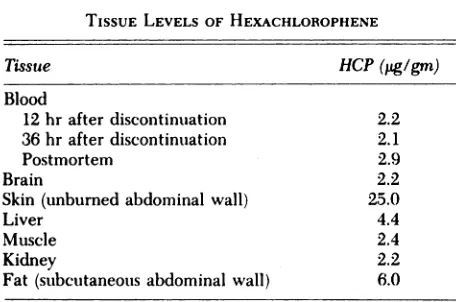
included frequent applications of HCP. Analysis of post mortem tissue revealed the presence of toxic levels of HCP in the blood (2.2jsg/gm) and brain (2.2jsg/gm), with storage in
skin (25@sg/gm). liver (4.4@sg/gm), and fat (6.Ojig/gm). This
case suggests that topical applications of HCP in man may result in an extensive absorption with fat storage and may cause fatal encephalopathv. Pediatrics, 59:457-459, 1977,
HEXACHLOROPHENE, BURNS, ENCEPHALOPATHY.
baths have approached levels seen in symptomat
ic rats prompted restrictions in its usage. It has been suggested, however, that HCP may be less
toxic for humans than animals at similar blood levels'; indeed, there have been remarkably few well-studied cases of HCP poisoning reported.
\Ve investigated HCP blood and tissue levels in a
10-year-old boy who sustained an uncomplicated moderate burn and who was treated with exten sive topical applications of diluted and undiluted
3%HCP.He died after progressiveweaknessand
coma despite satisfactory wound healing. These studies shed additional light on the clinical toxi colog@ of HCP and its distribution after absorption in man.
CASE REPORT
A 10-year-old svhite boy was transferred to Strong Memo
rial Hospital. Two weeks earlier, a small gasoline engine had exploded OIl ignition, resulting in a 25% partial thickness
(Received March 8; revision accepted for ptillicatioli May 5,
1976.)
ADDRESS FOR REPRINTS: (R.R.C.) Department of Pecli
atrics, Michael Reese Hospital, 29(X) South Ellis Avenue, Chicago, Illinois 60616.
Hexachlorophene (2,2'-methylenebis(3,4,6,-tri chlorophenol); HCP) has been used in a variety of topical products and, in the past, was used in the treatment of burn patients because of its bacteri ostatic properties against coagulase-positive Sta pliylococcus. Recent reviews have underscored HCP's potential toxicity,@' and the fact that HCP
blood levels in newborns receiving daily 3% HCP
PEDIATRICS Vol. 59 No. 3 March 1977 457
HexachloropheneStorage in a Burn Patient
Associated With Encephalopathy
Robert Chilcote, M.D., August Curley, M.A., Howard H. Loughlin, M.D., and John A.
Jupin, M.D.
I'ron, the Dcpartnzents ofPediatrics and Pathology, Unicersitt, ofRocl,ester SeI@oolof ‘¿sf('(liei?ie(111(1Dentistrij,
Rochester, New York, and t!ze Enciron,nental Protection Agency, Cliamblee Toxicology Laboratory. C1,a@nblee, Georgia
at Viet Nam:AAP Sponsored on September 8, 2020 www.aappublications.org/news
TissueHCP (pg/gm)Blood12 hr after discontinuation2.236 hr after discontinuation2.1Postmortem2.9Brain2.2Skin (unburned abdominal wall)25.0Liver4.4Muscle2.4Kidney2.2Fat
(subcutaneous abdominal wall)6.0 TABLE I
TISSUE LEVELS OF HEXACHLOROPHENE
silica-gel microcolumns. The eluate was analyzed by electron capture gas-liquid chromatography. Results are expressed as micrograms of HCP per gram of tissue.
RESULTS
All tissues studied contained high levels of HCP (Table I). The whole blood level of 2.2jig/gm on
admission was unchanged at the time of death.
Samples of brain, kidney, and muscle yielded
HCP levels similarto blood levels. Liver and fat
levels exceeded the blood level. A specimen of the
patient's unburned abdominal wall skin was par ticularly high in HCP content, measuring 25jig/ gm.
DISCUSSION
HCP is a halogenated bisphenol introduced to replace phenol when systemic toxicity precludes direct skin application. Gump, however, noted in
his review of HCP toxicity that single applica
tions of 15% HCP were lethal to experimental animals, while daily applications of 3% HCP
caused “¿toxicity―in experiments carried out in
1951.6 Herter7 noted a newborn who received 3%
HCP applicationsand developed a full fontanel
and seizures. Larson@ reported eight patients who developed seizures, diplopia, lower-extremity weakness, nausea, vomiting, and irritability in the course of topical HCP applications for burns. These symptoms cleared when HCP administra tion was stopped; there were no deaths. Larsonalso noted that control animals, as well as burned
animals, died after repeated exposures to topical
3% HCP. Kimbrough and Gaines' have reviewed
the animal literature and note that symptoms of toxicity include hind-quarter weakness, cystic
spaces or vacuolization of the white matter, and
cerebral edema. The absence of cystic spaces in the white matter of this patient at autopsy suggests that HCP leaves no specific lesion after two weeks of exposure in man.
Uncoupling of rnitochondrial oxidative phos
phorylation occurs at concentrations of HCP as
low as ljig/mg.'― This patient had tissue levels
from 2- to 25-fold higher, indicating that his blood
and tissue concentrations were sufficient to cause
toxicity and hyperthermia. Electrolyte dilution is associated with a variety of cerebral insults,
though definitive data to document inappropriate antidiuretic hormone in this patient are lacking.
Little is known of the uptake and distribution of HCP. Absorption through normal skinm2m1 and burn to his right side without pulmonary involvement.
Treatment was begun with oral fluids and, during the first two hospital days, his burns were covered with dressings soaked in a diluted 3% HCP cleansing solution (pHisoHex). Thereafter, his burns were left uncovered, and he had tub soaks prepared by adding 1 to 2 oz of this cleansing solution to a tub of water three to five times daily. The cleansing solution was diluted and sprayed directly to the healing burn
areas for the relief of itching. On the ninth day after his burn,
he complained, “¿Idon't feel good all over,― and became increasingly uncooperative. His temperature rose to 38.9 C, but cultures were negative. Lower-extremity weakness developed and the patient appeared to be confused when he asked to “¿helphang out the wash. “¿There were no seizures. Blood pressure and respiration rate remained normal. On the 13th day after burn, he appeared to have difficulty breathing and he became apneic. After resuscitation, he was unrespon sive, with a blood pressure of 120/70 mm Hg and pulse rate of 120 beats per minute. Papilledema and bilateral rhonchi were noted. Urine specific gravity was 1.024. Sodium level was 124 mEq; potassium, 3.0 mnEq; chloride, 80 inEq; and blood urea nitrogen, 15 mg/liter. He was transferred to Strong Memorial Hospital but had no spontaneous respira tions, deep tendon reflexes, or response to pain; his pupils were fixed at midpoint. Additional laboratory studies revealed a hematocrit reading of 34% and white blood cell count of 11,300/cu mm with 81% neutrophils. Arterial pH was 7.45. Blood culture yielded no growth. The patient required assisted ventilation amiddied the next day, approxi
mately 36 hours after the last HCP treatment.
Autopsy revealed satisfactorily healing burns, pneumonia compatible with aspiration, and cerebral edema (brain weight 1,390 gum) with swollen gyri and compressed sulci.
Sections showed nonspecific edema of both gray amid white
matter without cystic spaces, gliosis, inclusion bodies, or leukocyte infiltrate. Postmortem cultures of blood, lung, brain, and spinal fluid were negative.
HEXACHLOROPHENESTUDIES
Studies were carried out at the Laboratory of the Environmental Protection Agency.5 Samples were extracted with ethanol ether, acidified and methylated with diazomethane, and purified on
458 HEXACHLOROPHENE
at Viet Nam:AAP Sponsored on September 8, 2020 www.aappublications.org/news
cutaneous storage'5 have been previously docu
mmented. Burns increase HCP absorption by a
factor of 2½ in experimental animals, but in 24 hours absorption falls to preburn levels. ‘¿â€œThis suggests that excessive skin exposure, rather than
altered permiieability, played the principal role in
toxicity. HCP is albumin-bound,'@ with an esti
miiated blood half-life of ten hours amidexcretion in
the stool and urine.'5 Frequent
exposure likely
resulted in a net tissue accumulation.
Tissue levels in this patient would suggest a three-comnpartmnent mmodel: absorption and stor age in the skin, distribution by the blood, and deposition of unexcreted amounts in fat. Blood levels in exposed patients would vary in a complex fashion depending on paramneters such as degree of fat storage, liver function, and excre tion. Dialysis or exchange transfusion, as suggested in pentachlorophenol poisoning' where tissue storage is not appreciable, would not l)e effective. More importantly, isolated blood levels may not accurately reflect tissume levels where HCP is active. Further studies are imidi cated to determiiine the therapeutic index of HCP
and to clarify the relationships between absorp
tion, excretion, fat storage, and neurotoxicity.
REFERENCES
1. Kimbrough RD: Review of recent evidence of toxic effects of hexachlorophene. Pediatrics 51:391,
1973.
2. Lockhart JD: How toxic is hexachlorophene? Pediatrics
50:229, 1972.
:3. Kimbrotigh RD: Review of the toxicity of hexachloro
phene. Arch Environ Health 23: 1 19, 1971.
4. American Academy of Pediatrics Committee on Fetus and Newborn: Hexachlorophene and skin care of
newborn infants. Pediatrics 49:625, 1972,
5. Curley A, Hawk RE: Hexachlorophene: I. Analysis in body fluids and tissues of experimental animals. Presented at the 161st meeting of the American Chemical Society, Los Angeles, California, March 28-April 2, 1971.
6. Gump WS: Toxicological properties of hexachloro phene. J Soc Cosmetic Chemists 20:173, 1969. 7. Herter WB: Hexachlorophene poisoning. Kaiser Fotin
dation Med Bull 7:228, 1959.
8. Larson DL: Studies show hexachlorophene causes burn
syndrome. Hospital Assoc 42:63, 1968.
9. Kinibrough RD. Gaines TB: Hexachlorophene effects on the rat brain: Study of high doses by light and electron microscopy. Arch Environ Health 2:3:114, 1971.
10. Nakaue HA, Caldwell RS, Buhler DR: Bisphenols—un
couplers of phosphorylating respiration. Biochemii
Pharmacol 21:2273, 1972.
11. Camnier \V, Moore CL: The effect of hexachlorophene on the respiration of brain and liver mitochondria.
Biochem Bioph@s Res Commun 46: 1887, 1972.
12. Feldmann RJ, Maibach HI: Absorption of sonic organic
compounds through the skin in man. J Invest Dermatol 54:399, 1970.
13. Curle@ AV, I-Iawk RI, Kimbrough RD. et al: 1)ermal absorption of hexachlorophene imi infamits. Lancet
2:296,1971.
14. Kopelnian AE: Cutaneous al)sorption of hexachloro phene in low-birth-weight infamits. J Pediatr 82:972,
1973.
15. Shemano I, Nickerson NI: Cutaneous accumulation and
retention of hexachlorophene-C,4 (G-1 1). Fed Proc
13:404, 1954.
16. Carroll FE, Salak WW, Howard JM, et al: Absorption of
antimicrobial agents across experimental wounds. Surg Cynecol Obstet 125:974, 1967.
17. (;amidolfi AJ, Dost FN, Buhler DR: Absorption, excretion and nietabolism of hexachlorophene in the rat and rabbit. Fed Proc 31:6O5Abs, 1972.
18. \Vit JG, Van Gendersen H: Some aspects of the fate of hexachlorophene. Acta Physiol Pharniacol Neerlan dica 11:123, 1962.
19. Robson AM, Kissane JM, Elvick NH, et al: Pentachloro
phenol poisoning in a nursery for newborn infants:
I. Clinical features and treatment. J Pediatr 75:309, 1969.
ARTICLES 459
at Viet Nam:AAP Sponsored on September 8, 2020 www.aappublications.org/news
1977;59;457
Pediatrics
Robert Chilcote, August Curley, Howard H. Loughlin and John A. Jupin
Hexachlorophene Storage in a Burn Patient Associated With Encephalopathy
Services
Updated Information &
http://pediatrics.aappublications.org/content/59/3/457 including high resolution figures, can be found at:
Permissions & Licensing
http://www.aappublications.org/site/misc/Permissions.xhtml entirety can be found online at:
Information about reproducing this article in parts (figures, tables) or in its
Reprints
http://www.aappublications.org/site/misc/reprints.xhtml Information about ordering reprints can be found online:
at Viet Nam:AAP Sponsored on September 8, 2020 www.aappublications.org/news
1977;59;457
Pediatrics
Robert Chilcote, August Curley, Howard H. Loughlin and John A. Jupin
Hexachlorophene Storage in a Burn Patient Associated With Encephalopathy
http://pediatrics.aappublications.org/content/59/3/457
the World Wide Web at:
The online version of this article, along with updated information and services, is located on
American Academy of Pediatrics. All rights reserved. Print ISSN: 1073-0397.
American Academy of Pediatrics, 345 Park Avenue, Itasca, Illinois, 60143. Copyright © 1977 by the been published continuously since 1948. Pediatrics is owned, published, and trademarked by the Pediatrics is the official journal of the American Academy of Pediatrics. A monthly publication, it has
at Viet Nam:AAP Sponsored on September 8, 2020 www.aappublications.org/news