International Journal in IT and Engineering
http://www.ijmr.net
ENGINEERING STUDENTS’ LEVEL OF STUDY HABITS
AND FACTORS AFFECTING THEM
*Dr. Jake M. Laguador
ABSTRACT
This study focuses on the level of study habits of engineering students in school and at home, the level of the factors that affects the study habits and practices of engineering students at home and in school and the primary output of the study is its implication to the programs of student activities of the College of Engineering. The descriptive type of research was utilized in the study. Results showed that majority of the respondents belongs to 17 years old, freshmen male Computer Engineering students. Engineering students have high level of study habits at home and very high at school. Factors affecting the study habits of Engineering students at home and in school are moderately serious. The course has significant difference in the problems encountered by engineering students in school. Students must always be encouraged by teachers and parents to make their college days productive through studying the lessons regularly and lessen the unnecessary activities.
Keywords: Study Habits, Engineering Students, LPU, Study Skills
International Journal in IT and Engineering
http://www.ijmr.net
INTRODUCTION
Many educators explore the fact that a number of students have not learned well while in high school and elementary grades. Because of this, students now seem to know less and use despite the availability of the study materials. Likewise, students do not know how to think and study properly and effectively. Only few teachers gave much attention to the improvement of these skills. To this effect, many students were able to proceed to the higher level of instruction without developing the habit of scheduling their study time. Thus, many talents and potentialities remain underdeveloped due to less attention given to their academic and personal growth.
There are various factors that affect the students’ academic achievement. Amongst these factors are some activities called study habits which the students gained, preferred and like to do for learning at and out of school (Hotaman, 2009). Findings of the study of Oluwatimilehin and Owoyele (2012) revealed that of all the study habits’ subscales, ‘teacher consultation’ was most influential while the ‘time allocation’ exercise, concentration, no taking reading and assignments were regarded as less integral to students’ academic performances. Therefore, regular counseling services to train students on study skills strategies were advocated in order to boost their study habit and enhance their academic achievement.
Few things affect a student’s performance as much as the development of productive study skills. Study skills encourage areas such as work attitudes, time management, homework strategies and test-taking skills. Many study skills are taught in the classroom, but others can only be addressed at home. This study focuses on the level of study habits of engineering students in school and at home, the level of the factors that affects the study habits and practices of engineering students at home and in school and the primary output of the study is its implication to the programs of student activities of the College of Engineering.
International Journal in IT and Engineering
http://www.ijmr.net
OBJECTIVES OF THE STUDY
It is the major purpose of this study to determine the level of study habits of engineering students at home and in school and the factors that affects to these study habits and practices. Specifically, it determined the profile of Engineering students at the Lyceum of the Philippines University in terms of age, degree program, gender and year level; determine the level of study of habits and practices of engineering students at home and in school; determine the level of the factors that affects the study habits and practices of engineering students at home and in school; differences on the respondents’ level of study habits and practices and the factors affecting them at home and in school when they are grouped according to their profile; as well as the implications of this study to the teachers and student services of the College of Engineering.
MATERIALS AND METHOD
The descriptive type of research was utilized in the study. Descriptive survey method is appropriate for data derived from simple observational situations, whether these are actually physically observed or observed through the use of a questionnaire or poll techniques (Costales and Zulueta, 2003). The survey questionnaire for determining the attitude of the students towards some school-related variables was used to collect data and information. There were 104 students involved in the study from 1st year to third year of General Engineering, Computer Engineering, Mechanical Engineering, Electronics and Communications Engineering and Industrial Engineering programs under the College of Engineering. The questions in this survey were adapted from the original "Math Study Skills Inventory" of Dr. Carolyn Hopper used for her text "Practical College Study Skills". Some questions were revised to make it appropriate for College Students. The questionnaire was administered personally by the researchers to the first year to third year Engineering students.
International Journal in IT and Engineering
http://www.ijmr.net
3.20 – 4.00 Very Serious Almost Always 2.50 – 3.19 Serious Sometimes 1.80 – 2.49 Moderately Serious Seldom 1.00 – 1.79 Not Serious Almost Never
On the scale for measuring the level of study habits of Engineering students, the following arbitrary point scale was utilized:
9 – 10 Very High 7 – 8 High 5 – 6 Average 3 – 4 Low 1 – 2 Very Low
RESULTS AND DISCUSSION
This part discusses and interprets the data collected through the instrument employed by using generally accepted statistical tools and principles. Primary sources of the data for the study came from the questionnaire distributed to the selected engineering students at Lyceum of the Philippines University during the SY 2006-2007.
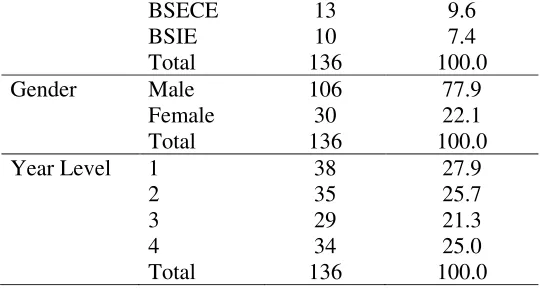
Table 1 shows the frequency distribution of the respondents according to age, course, gender and year level.
Table 1
Frequency Distribution of the Respondents according to Age, Course, Gender and Year Level
Profile Frequency Percent
Age 17 38 27.9
18 30 22.1
19 25 18.4
20 30 22.1
21 9 6.6
22-above 4 2.9
Total 136 100.0
Course Gen. Eng 34 25.0
BSCoE 64 47.1
International Journal in IT and Engineering
http://www.ijmr.net
BSECE 13 9.6
BSIE 10 7.4
Total 136 100.0
Gender Male 106 77.9
Female 30 22.1
Total 136 100.0
Year Level 1 38 27.9
2 35 25.7
3 29 21.3
4 34 25.0
Total 136 100.0
Majority of the respondents belongs to 17 years old or freshmen with 27.9 percent followed by the 18 and 20 years old (22.1 percent). BSCoE has the most number of respondents with 64 students or 47.1 percent while BSIE has the lowest number of respondents with 10 or 7.4 percent. The engineering profession is still dominated by male with 106 respondents or 77.9 percent against 30 or 22.1 percent female respondents.
Table 2 reveals the level of study habits and practices of engineering students at home.
The respondents always make and submit their assignments and projects on time (WM = 3.24) with the highest level of 9 study habits at home, they sometimes have a specific place at home with few distractions to study (WM = 3.13) and they sometimes make a definite time to study (WM = 3.09) which ranked 1st, 2nd and 3rd respectively.
Table 2
Level of Study Habits and Practices of Engineering Students at Home
At Home WM Level VI Rank
a. Makes a definite time to study. 3.09 8 Sometimes 3 b. I have a specific place at home with few
distractions to study. 3.13 8 Sometimes 2
c. Makes and submits my assignments and
projects on-time. 3.24 9 Almost Always 1
d. Seeks the help of parents in answering
difficult questions in the assignment. 1.95 5 Seldom 9 e. Borrows books/references to be read at
home. 2.85 8 Sometimes 6
f. Reads books and references at home. 2.93 8 Sometimes 5 g. Studies regularly at home 2.82 8 Sometimes 7 h. Reads lectures/notes at home. 2.96 8 Sometimes 4 i. I read my textbook before I come to class 2.78 7 Sometimes 8
International Journal in IT and Engineering
http://www.ijmr.net
They are studying sometimes at home (WM = 2.82), sometimes they read their textbook before they come to class (WM =2.78) and they rarely seek the help of parents in answering difficult questions in the assignment (WM = 1.95) which ranked 7th, 8th and 9th respectively. This implies that Engineering students have high level of study habits and practices at home.
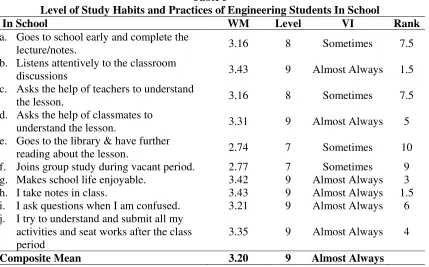
Table 3 reveals the level of study habits and practices of engineering students in School
Table 3
Level of Study Habits and Practices of Engineering Students In School
In School WM Level VI Rank
a. Goes to school early and complete the
lecture/notes. 3.16 8 Sometimes 7.5
b. Listens attentively to the classroom
discussions 3.43 9 Almost Always 1.5
c. Asks the help of teachers to understand
the lesson. 3.16 8 Sometimes 7.5
d. Asks the help of classmates to
understand the lesson. 3.31 9 Almost Always 5
e. Goes to the library & have further
reading about the lesson. 2.74 7 Sometimes 10
f. Joins group study during vacant period. 2.77 7 Sometimes 9 g. Makes school life enjoyable. 3.42 9 Almost Always 3 h. I take notes in class. 3.43 9 Almost Always 1.5 i. I ask questions when I am confused. 3.21 9 Almost Always 6 j. I try to understand and submit all my
activities and seat works after the class period
3.35 9 Almost Always 4
Composite Mean 3.20 9 Almost Always
The respondents always take notes in class (WM = 3.43) and listen attentively to the classroom discussions (WM = 3.43) and they make school life enjoyable (WM = 3.42) with the level 9 of study habits. But for quite sometimes, they go to the library and have further reading about the lesson (WM = 2.74) and they join group study during vacant period (WM = 2.77) with the lowest level of 7 study habits and practices in school.
International Journal in IT and Engineering
http://www.ijmr.net
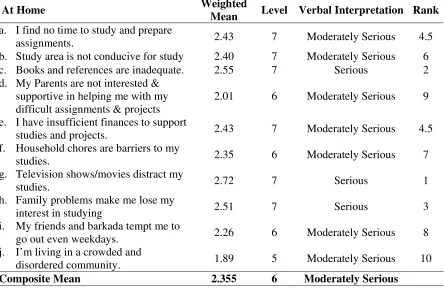
Table 4 reveals the factors that affect the study habits and practices of engineering students at home.
Table 4
Factors that Affects the Study Habits and Practices of Engineering Students at Home
At Home Weighted
Mean Level Verbal Interpretation Rank a. I find no time to study and prepare
assignments. 2.43 7 Moderately Serious 4.5
b. Study area is not conducive for study 2.40 7 Moderately Serious 6 c. Books and references are inadequate. 2.55 7 Serious 2 d. My Parents are not interested &
supportive in helping me with my difficult assignments & projects
2.01 6 Moderately Serious 9
e. I have insufficient finances to support
studies and projects. 2.43 7 Moderately Serious 4.5 f. Household chores are barriers to my
studies. 2.35 6 Moderately Serious 7
g. Television shows/movies distract my
studies. 2.72 7 Serious 1
h. Family problems make me lose my
interest in studying 2.51 7 Serious 3
i. My friends and barkada tempt me to
go out even weekdays. 2.26 6 Moderately Serious 8 j. I’m living in a crowded and
disordered community. 1.89 5 Moderately Serious 10
Composite Mean 2.355 6 Moderately Serious
The number 1 serious problem considered by the respondents at home is the Television shows/movies distract their studies (WM = 2.72), followed by books and references are inadequate (WM = 2.55) and Family problems make them lose their interest in studying (WM = 2.51). The respondents considered their friends tempting them to go out even weekdays (WM = 2.26) as moderately serious problem, also the same level with their parents are not interested and supportive in helping them with their difficult assignments and projects (WM = 2.01). The lowest degree of seriousness considered by the respondents is, “they are living in a crowded and disordered community” (WM = 1.89) with the level of 5. The composite mean of 2.355 falls within the level 6 with the verbal interpretation of moderately serious.
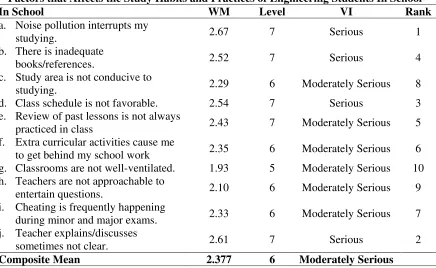
Table 5 shows the factors that affect the study habits and practices of engineering students in school.
International Journal in IT and Engineering
http://www.ijmr.net
Factors that Affects the Study Habits and Practices of Engineering Students In School
In School WM Level VI Rank
a. Noise pollution interrupts my
studying. 2.67 7 Serious 1
b. There is inadequate
books/references. 2.52 7 Serious 4
c. Study area is not conducive to
studying. 2.29 6 Moderately Serious 8
d. Class schedule is not favorable. 2.54 7 Serious 3 e. Review of past lessons is not always
practiced in class 2.43 7 Moderately Serious 5
f. Extra curricular activities cause me
to get behind my school work 2.35 6 Moderately Serious 6 g. Classrooms are not well-ventilated. 1.93 5 Moderately Serious 10 h. Teachers are not approachable to
entertain questions. 2.10 6 Moderately Serious 9
i. Cheating is frequently happening
during minor and major exams. 2.33 6 Moderately Serious 7 j. Teacher explains/discusses
sometimes not clear. 2.61 7 Serious 2
Composite Mean 2.377 6 Moderately Serious
The number 1 serious problem considered by the respondents in school is the interruption of noise pollution while studying (WM = 2.67), followed by teacher explains/discusses sometimes not clear (WM = 2.61) and Class schedule is not favorable (2.54) which ranked 2nd and 3rd respectively.
Meanwhile, the respondents perceived moderately serious problems in school are: Study area is not conducive to studying (WM = 2.29), Teachers are not approachable to entertain questions. (WM = 2.10) and Classrooms are not well-ventilated (WM 1.93) which ranked 8th, 9th and 10th respectively. The composite mean of 2.377 falls within the level 6 with the verbal interpretation of moderately serious.
Table 6 reveals the comparison of level of study habits and practices of Engineering Students at home and in school when they are grouped according to age.
International Journal in IT and Engineering
http://www.ijmr.net
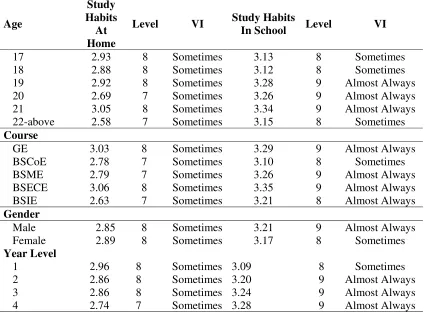
Both group of respondents obtained the same level of study habits at home while male (WM = 3.21) respondents obtained a higher level of study habits in school against female (WM = 3.17) respondents. First year students (WM = 2.96) obtained the highest weighted mean of study habits and practices at home while Fourth year students (WM = 3.28) obtained the highest weighted mean score in study habits in school.
Table 6
Comparison of level of study habits and practices of Engineering Students at home and in school when they are
grouped according Profile
Age
Study Habits
At Home
Level VI Study Habits
In School Level VI
17 2.93 8 Sometimes 3.13 8 Sometimes
18 2.88 8 Sometimes 3.12 8 Sometimes
19 2.92 8 Sometimes 3.28 9 Almost Always
20 2.69 7 Sometimes 3.26 9 Almost Always
21 3.05 8 Sometimes 3.34 9 Almost Always
22-above 2.58 7 Sometimes 3.15 8 Sometimes
Course
GE 3.03 8 Sometimes 3.29 9 Almost Always
BSCoE 2.78 7 Sometimes 3.10 8 Sometimes BSME 2.79 7 Sometimes 3.26 9 Almost Always BSECE 3.06 8 Sometimes 3.35 9 Almost Always BSIE 2.63 7 Sometimes 3.21 8 Almost Always Gender
Male 2.85 8 Sometimes 3.21 9 Almost Always
Female 2.89 8 Sometimes 3.17 8 Sometimes
Year Level
1 2.96 8 Sometimes 3.09 8 Sometimes
2 2.86 8 Sometimes 3.20 9 Almost Always
3 2.86 8 Sometimes 3.24 9 Almost Always
4 2.74 7 Sometimes 3.28 9 Almost Always
The fourth year (WM = 2.74) students obtained the lowest level of study habits and practices at home, while first year students (WM = 3.09) obtained the lowest level of study habits and practices in school.
International Journal in IT and Engineering
http://www.ijmr.net
Table 7
Comparison of the Factors Affecting the Study Habits and Practices of Engineering Students at home and in school when they are grouped according to Profile
Home
Problem Level
Verbal Interpretation
School
Problem Level
Verbal Interpretation
Age 17 2.41 7 MS 2.41 7 MS
18 2.28 6 MS 2.25 6 MS
19 2.54 7 S 2.49 7 MS
20 2.25 6 MS 2.28 6 MS
21 2.28 6 MS 2.62 7 S
22-above 2.25 6 MS 2.48 7 MS
Course GE 2.27 6 MS 2.11 6 MS
BSCoE 2.38 6 MS 2.47 7 MS
BSME 2.13 6 MS 2.21 6 MS
BSECE 2.53 7 S 2.52 7 S
BSIE 2.58 7 S 2.75 7 S
Gender Male 2.40 7 MS 2.38 6 MS
Female 2.21 6 MS 2.35 6 MS
Year Level
1
2.46 7 MS 2.42 7 MS
2 2.25 6 MS 2.18 6 MS
3 2.45 6 MS 2.52 7 S
4 2.26 6 MS 2.41 7 MS
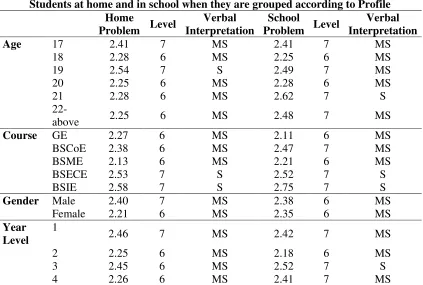
Male respondents (WM = 2.40) obtained a higher level of problem in study habits and weighted mean score at home against the female respondents (WM = 2.21) while both group of respondents obtained the same level of seriousness or moderately serious to the factors that affect their study habits and practices in school.
Freshman (WM = 2.46) students obtained the highest level in terms if factors that affect their study habits and practices at home followed by the sophomore (WM = 2.45) with the only difference of 0.01 with the same verbal interpretation of moderately serious.
International Journal in IT and Engineering
http://www.ijmr.net
Table 8
Difference in the level of study habits and practices and factors affecting them at home at in school of engineering students when they are grouped according to
Profile
Age Course Gender Year Level At Home .109 .014 .659 .225 In School .326 .068 .595 .183 Problem at Home .309 .100 .070 .148 Problem in School .329 .001 .787 .062
There is no significant difference between the age and the level of study habits and practices and factors affecting them at home and in school of the respondents. Therefore, the null hypothesis of no significant difference is accepted. Course has significant difference in the level of the study habits of the respondents at home and factors that affect the study habits and practices of the respondents in school. Therefore the null hypothesis is rejected.
There is no significant difference between the gender and the level of study habits and practices and the factors that affecting them at home and in school. Therefore, the null hypothesis of no significant difference is accepted.
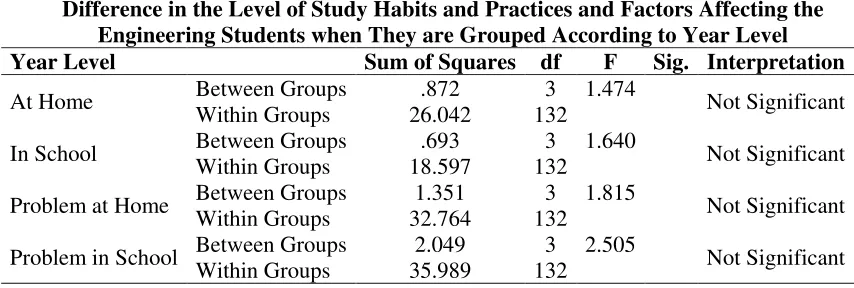
Table 9 shows the significant difference in the level of study of habits and practices and factors affecting them at home at in school of engineering students when they are grouped according to year level.
Table 9
Difference in the Level of Study Habits and Practices and Factors Affecting the Engineering Students when They are Grouped According to Year Level
Year Level Sum of Squares df F Sig. Interpretation
At Home Between Groups .872 3 1.474 Not Significant Within Groups 26.042 132
In School Between Groups .693 3 1.640 Not Significant Within Groups 18.597 132
Problem at Home Between Groups 1.351 3 1.815 Not Significant Within Groups 32.764 132
International Journal in IT and Engineering
http://www.ijmr.net
There is no significant difference between the year level and the level of study habits and practices of the respondents and the factors affecting them at home and in school. Therefore, the null hypothesis of no significant difference is accepted.
Implications of the Study
Results revealed that the engineering students are very seldom to ask questions to their parents regarding the assignment in schools because most parents nowadays are busy in their respective duties and responsibilities not only as parents but also as part of the growing community and business.
The College of Engineering faculty members must encouraged the students to read textbooks or reference books being used in the subject regularly before coming to class, use the library facilities and services for further reading about the lessons and they must also establish group study during vacant periods to utilize their spare time to a most productive one.
Parents must keep away their children from watching television most especially during weekdays to concentrate from studying and finishing their assignments. Noise must be eliminated during class periods at the corridor or noise from library while studying. Teachers must also explain or discuss clearly all the topics being discussed and they must consume the complete hours allotted for the subject.
CONCLUSION AND RECOMMENDATION
International Journal in IT and Engineering
http://www.ijmr.net
Teachers must always motivate their students to submit the assignments on time and have the regular consultation of students who need more assistance and guidance. Teachers must treat the students equally even the slow learners and give them proper attention to develop the appropriate way of study habits and practices inside and outside the classroom. Parents must keep away their children from watching television most especially during weekdays to concentrate from studying and finishing their assignments. Teachers must also explain or discuss clearly all the topics being discussed and they must consume the complete hours allotted for the subject. It is recommended that guidance services where affective behavior of students can be properly monitored and worked on to all freshmen students to established a better academic foundation and facilitate the achievement of the objective of the universal basic education (Aquino, 2011). Seminars on enhancing the study habits of engineering students must be done to increase the level of their academic performance.
REFERENCES
1. Aquino, Luisa B., (2011). Study Habits and Attitudes of Freshmen Students: Implications for Academic Intervention Programs, Journal of Language Teaching and Research, 2(5): 1116-1121, doi:10.4304/jltr.2.5.1116-1121.
2. Hopper, C. Practical College Study Skills, available online: http://www.purplemath.com/stdysrvy.htm.
3. Hotaman, Davut (2009). The research of the influence of some individual variables on the students’ study habits independently, with a partner, International Journal of Human Sciences, 6 (1): 528-546.
4. Oluwatimilehin, J.T.B. and Owoyele, J.W. (2012). Study Habits and Academic Achievement in Core Subjects among Junior Secondary School Students in Ondo State, Nigeria, Bulgarian Journal of Science and Education Policy6(1): 155-169.