IJEDR1603094 International Journal of Engineering Development and Research (www.ijedr.org) 567
FLC BASED TUNINIG OF PID
CONTROLLER FOR AN AUTOMATIC
VOLTAGE REGULATOR SYSTEM
Y.Ananda Kumar1, L.Vijay 2
1PG Scholar (EEE), ANITS College, Visakhapatnam A.P India,[email protected] 2Assistant Professor (EEE), ANITS College, Visakhapatnam A.P India,[email protected]
___________________________________________________________________________________________________
Abstract: In this paper Proportional-Integral-Derivative (PID) controller is designed for an Automatic Voltage Regulator (AVR) system, so that faster settling to rated voltage is ensured and the instability is avoided. A VR is a closed loop control system compensated with a PID eontroller.by using ZN method and Fuzzy Logic Controller. Simulations are done to show the performance of PID controlled A VR system tuned using ZN Method an FLC and the results are compared.
Keyword: PID controller tuning, Ziegler-Nichols tuning and FUZZY Logic Controller and Simulation ___________________________________________________________________________________________________
I. Introduction
An Automatic Voltage Regulator is a device that is used to regulate the supply line voltage to a level that is safe for the equipment connected to it. A VR is mainly used in areas where the supply voltage is not stable and fluctuation of load occurs. The generator excitation system maintains generator voltage and controls the reactive power flow using an AV R. The AVR system is a closed loop control system compensated with a PID or PSS controller. The Power System Stabilizer (PSS) controller is used for AV R system with high gain thirstier excitation system and has six tuning parameters. The Proportional Integral Derivative (PID) controller is used for AV R system with normal gain exciter and has three controller gains as the tuning parameters. In addition to these two controllers, a Fractional Order PID (FOPID) controller, which is a generalization of standard PID controller, can also be used for the AV R system. FOPID controller has five tuning parameters that include three controller gains, a derivative order and an integral order. Among these three controllers PID controllers are widely used due to its simple structure, easy implementation since it has only three tuning parameters and providing robust performance in wide range of operating conditions. Optimal tuning of PID control parameters are needed for the best performance of the system.
IJEDR1603094 International Journal of Engineering Development and Research (www.ijedr.org) 568 of the controllers in the industrial process control applications are of PID type as no other controller match the simplicity, clear functionality, applicability and ease of use offered by the PID controller. The PID controller is used for a wide range of problems like motor drives, automotive, flight control, instrumentation etc. PID controllers provide robust and reliable performance for most systems if the PID parameters are tuned properly. Various tuning methods are explained in. Among the tuning methods, the Ziegler-Nichols (ZN) technique has been very influential. Ziegler-Nichols presented two tuning methods a step response method and a frequency response method. The frequency response method is more reliable than the step response method. The field of Fuzzy control has been making rapid progress in recent years. Fuzzy logic control has been widely exploited for nonlinear, high order & time delay system. This paper has two main contributions. Firstly, a PID controller has been designed for higher order system using Ziegler-Nichols frequency response method and its performance has been observed. The Ziegler Nichols tuned controller parameters are fine tuned to get satisfactory closed loop performance. Secondly, for the same system a fuzzy logic controller has been proposed with simple approach and smaller number of rules (four rules) as it gives the same performance as by the larger rule set Simulation results for a higher order system have been demonstrated. A performance comparison between Ziegler Nichols tuned PID controller, and the proposed fuzzy logic controller is presented. The paper has been explains generalized model of PID controller. Describes the design consideration for a higher order system. Design of PID controller using Z-N technique and design of fuzzy logic controller using simple approach and smaller rule base. Finally conclusion close the paper.
II.AVR SYSTEM MODELING
A simple AVR system comprises four main components, namely amplifier, exciter, generator, and sensor. For mathematical modeling and transfer function of the four components, these components must be linearized, which takes into account the major time constant and ignores the saturation or other nonlinearities. The transfer function model of each component consists of a gain and a time constant and is given as
Transfer function model of an amplifier is TF (a) = Ka/1+STa
Transfer function model of an exciter is: TF (e) = ke/1+STe
Transfer function model of a generator is: TF (g) = Kg/ 1 +S Tg
Transfer function model of a sensor is: TF(s) = Ks/1+STs
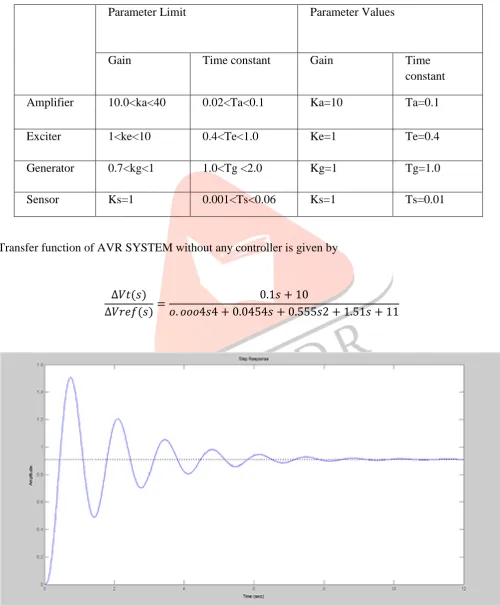
IJEDR1603094 International Journal of Engineering Development and Research (www.ijedr.org) 569 The typical parameter limits of the gain and time constants of the components and the parameter values used are given in the Table I. Using the mentioned parameter values, the transfer function model of an Automatic Voltage Regulator system is given shows the open loop response of the AV R system and its transfer function
Table I: The parameters limits of AVR System
Parameter Limit Parameter Values
Gain Time constant Gain Time
constant
Amplifier 10.0<ka<40 0.02<Ta<0.1 Ka=10 Ta=0.1
Exciter 1<ke<10 0.4<Te<1.0 Ke=1 Te=0.4
Generator 0.7<kg<1 1.0<Tg <2.0 Kg=1 Tg=1.0
Sensor Ks=1 0.001<Ts<0.06 Ks=1 Ts=0.01
Transfer function of AVR SYSTEM without any controller is given by
∆𝑉𝑡(𝑠) ∆𝑉𝑟𝑒𝑓(𝑠)=
0.1𝑠 + 10
𝑜. 𝑜𝑜𝑜4𝑠4 + 0.0454𝑠 + 0.555𝑠2 + 1.51𝑠 + 11
IJEDR1603094 International Journal of Engineering Development and Research (www.ijedr.org) 570
III. Zigler-Nichol Method
The ZieglerNichols tuning method is a heuristic method of tuning a PID controller. It was developed by John G. Ziegler and Nathaniel B. Nichols. It is performed by setting the I (integral) and D
(derivative) gains to zero. The "P" (proportional) gain, is then increased (from zero) until it reaches the ultimate gain, at which the output of the control loop has stable and consistent oscillations. And the oscillation period are used to set the P, I, and D gains depending on the type of controller Block diagram of AVR SYSTEM with ZN-PID controller and response of AVR SYSTEM with ZN-PID controller.
Fig.3 Transfer Function representation
Fig.4 Step Response representation
IV.Design of Fuzzy Logic Controller (Flc)
For a two input fuzzy controller, 3,5,7,9 or 11 membership functions for each input are mostly used [7]. In this paper, only two fuzzy membership functions are used for the two inputs error e and change in error membership functions for the output parameter are show here N means Negative, Z means Zero and P means Positive.
IJEDR1603094 International Journal of Engineering Development and Research (www.ijedr.org) 571 FUZZY RULES FOR KP
𝐸 𝐶𝐸⁄ N Z P
N NL Z PS
Z NS Z PL
P NL PL NL
FUZZY RULES FOR Ki
𝐸 𝐶𝐸⁄ N Z P
N Z PS Z
Z PS Z NS
P NS PL NS
FUZZY RULES FOR Kd
𝐸 𝐶𝐸⁄ N Z P
N PS PS PS
Z PS Z NS
P PL PL PL
IJEDR1603094 International Journal of Engineering Development and Research (www.ijedr.org) 572 𝑇𝐹 = 0.0547𝑠3 + 5.5208𝑠2 + 5.1345𝑠 + 5.45
0.0004𝑠5 + 0.045𝑠4 + 0.555𝑠3 + 6.98𝑠2 + 6.08𝑠 + 5.45
The response of AVR SYSTEM with fuzzy-PID controller is
Fig.5 Step Response representation
Time response parameters percent overshoot, settling time and Peak Amplitude for Zeigler Nichols tuned PID controller (ZNPIDC) and FUZZY LOGIC CONTROOLER for AVR SYSTEM is given bellow.
OVERSHOOT SETTILINGTIME PEAK AMPLITDE AVR
SYSTEM
65.7 6.99 1.51
ZN-PID 15.6 8.4 1.16
FLC 3.26 4.65 1.03
The transfer function of the AVR and ZN –PID AVR and FUZZY PID AVR is given bellow
∆𝑉𝑡(𝑠) ∆𝑉𝑟𝑒𝑓(𝑠)=
(0.1𝑠 + 10)
(0.0004𝑠4 + 0.0454𝑠3+ 0.555𝑠2+ 1.51𝑠 + 11)
(0.81414𝑠3+ 8.594𝑠2+ 18.0962𝑆 + 9.62) ∆𝑉𝑡(𝑠)
IJEDR1603094 International Journal of Engineering Development and Research (www.ijedr.org) 573 ∆𝑉𝑡(𝑠)
∆𝑉𝑟𝑒𝑓(𝑠)=
(0.0547𝑠3+ 5.5208𝑠2 + 5.1345𝑆 + 5.45)
(0.0004𝑠5 + 0.0454𝑠4+ 0.555𝑠3+ 6.98𝑠2 + 6.08𝑠 + 5.45)
Fig.6 Step Response representation of AVR, ZN-PID, FUZZY-PID
V.CONCLUSION
This paper presented an overview of PID controller, design of PID controller using Z-N technique and design of fuzzy logic controller for AUTOMATIC VOLTAGE REGULATOR system. Simulation results using MATLAB / SIMULINK are discussed for Ziegler Nichols tuned PID controller and the Fuzzy logic controller. Ziegler Nichols technique gives high overshoot and settling time. Initial controller parameters obtained using Z-N formula need to be adjusted repeatedly through computer simulation to get satisfactory performance. Fuzzy logic controller gives smaller overshoot and settling time than Ziegler Nichols tuned PID controller. The Fuzzy Logic controller gives less overshoot and smaller settling time than obtained using Ziegler Nichols tuned PID controller and automatic voltage regulator system without any controller. The simulation results confirms that the proposed Fuzzy logic controller with simple design approach and smaller rule base can provide better performance comparing with the Ziegler Nichols tuned PID controller.
REFERENCES
[1] H.Ying, Fuzzy Control & Modeling: Analytical foundations and applications. New York, IEEE Press, 2000.
[2] J. Xu and Feng, “Design of Adaptive Fuzzy PID tuner using optimization method, ” Proceedings of the 5th World Congress on Intelligent Control and Automation, China, 2004, pp. 2454 –2458
[3] J. Zhang, N. Wang and S. Wang, “A developed method of tuning PID controllers with fuzzy rules for integrating process,” Proceedings of the American Control Conference, Boston, 2004, pp. 1109-1114.
[4] K. Astor and T. Hagglund, PID controllers: Theory, design and tuning. 2nd ed., The Instrumentation, Systems and Automation Society (ISA), 1995.
[5] K.H. Aung, G. Chong and Y. Li, “PID control system analysis, design and technology,” IEEE transaction on Control System Technology, Vol.13, No.4, 2005, pp. 559-576.
[6] P. Cominos and N. Munro. “PID controllers: recent tuning methods and design to specification, ” IEE proceedings,Control Theory and Applications, 2002, pp. 46-53.
IJEDR1603094 International Journal of Engineering Development and Research (www.ijedr.org) 574 [8] S.R.Vaishnav and Z.J.Khan, “Design of PID & Fuzzy logic controller for higher order system,” International Conference on Control & Automation (ICCA'07), Hongkong, China, 2007, pp. 1469-1472.
[9] Y.Yongquan, H.Ying and Z.Bi, “The dynamic fuzzy method to tune the weight factors of Neural fuzzy PID controller,” IEEE, 2004, pp. 2397-2402.
[10] Z.Y. Zhao, M. Tomizuka and S. Isaka, “Fuzzy gain scheduling of PID controllers,” IEEE transactions on Systems, Man and Cyberne
First Author:Y.Ananda Kumar is pursuing his M.Tech from ANITS College, Visakhapatnam A.P India. His Research
Interests is Control Systems, Power Electronics.