IJEDR1603001
International Journal of Engineering Development and Research (www.ijedr.org)1
Relay Selection in Multihop Wireless Network
1 Shraddha Patil, 2Pankaj Chandre 1PG Scholar, 2Assistant Professor
1Dept. of Computer Engineering, Flora Institute of Technology, Pune, India
_________________________________________________________________________________________ _______________
Abstract - We will consider the two important aspects of the OR. First Candidate node selection and second Prioritization of the selected nodes in the candidate set. In proposed work we consider the Leftover energy of the nodes as well as the security parameter of the node by adding a security value to each node at time of deployme nt of the nodes. We use the secure value and the leftover energy of the node for the candidate selection and the prioritization of the selected relays. Lastly compare proposed system with existing system to demonstrate the results.
Index Terms - OR, WSN, ExOR protocol, Opportunistic routing, Trustworthiness, Leftover Energy.
________________________________________________________________________________________________________
I. INTRO DUC TIO N
Traditional wireless sensor networks were considered as point to point connected nodes by neglecting the broadcast nature of wireless network. Currently opportunistic routing has attracted lot of attention from the researchers in the area of networking. In OR major concern is the candidate selection at the runtime to forward the packet to the destination. Many of the OR protocol has concentrated on the research in the relay selection and neglected the security parameter during selection. Existing work prop osed the relay node selection algorithm bas ed on the Leftover energy of the node. Wireless sensor network (WSN) are everywhere nowadays. In WSNs, thousands of physically embedded sensor nodes are distributed and more modern networks and they used in most applications, it is not possible to change battery each and every time whenever it degrade its value. Energy efficiency for transmitting data, the existing energy-efficient routing protocols are used to find the minimal energy path between a source and a destination that means a sink to achieve optimal energy consumption [3]–[5].
II. RELATED WO RK
ETX is used by ExOR [1] extremely opportunistic algorithm to select a candidate forwarder set. It can provide better performances over traditional routing protocols [5]. But there are still some problems in ExOR. After a transmission, all the nodes in the candidate set have to wait for the forwarding of the nodes with higher priority in order. It is not an efficient way t o do the spatial reuse. Moreover multicast is not implemented.
MORE [2] randomly mixes packets before forwarding them. This action of forwarding of packets randomness ensures the routers that overhear the same transmission will not forward the same packets. In other words, MORE introduces network coding to OR. MORE support both unicast and multicast. Previously we are using MORE to forward an elected packet to choose relay node. Using ETX in MORE is not suitable because MORE is a versatile scheme, unlike ExOR which is an unfair scheme to use the nodes based on their priorities. It does not need ETX to select candidate nodes with priorities, and treat them based on the different priorities. Moreover, it does not introduce error control and rate control schemes .
III. PRO POSED SYSTEM A. Structure
In proposed system we will implement the candidate selection using Leftover energy of the nodes and the trust value assigned / calculated by the nodes in the network. We have kept the existing system of Leftover energy based candidate selection. In our proposed work our aim is to achieve the better results for cand idate selection with the improved packet delivery ratio and min imu m end to end delay. It consists of main phases:
TBEER selection scheme
Phase-2 or Leftover energy of nodes Phase-3 or Trustworthiness of nodes Phase-4 or Candidate selection Phase-5 or Prioritization of Relays
IJEDR1603001
International Journal of Engineering Development and Research (www.ijedr.org)2
base of priority.IV. FLO W C HART
Below is the flowchart of proposed model V.SELEC TIO N O F RELAY NO DE
A.Leftover Energy of Nodes
Every node in the network calculates the energy value of each of its neighboring node. If a node has sufficient energy to rec eive and send the packet to the next hop then only the packet will be forwarded to the next hop. Each node computes the energy of the other nodes using following steps.
1. Calculate the amount of energy consumed by node C for receiving and forwarding packet.
2. ER(c) = α * PR (1)
Here ER= is the amount of energy consumed by node C to receive all incoming packet. α= is the configurable parameter (amount of energy
required to receive a packet). PR= No. of packets received.
3. ES(c)= 𝛽 * PS. (2)
Here Es= is the amount of energy consumed by node C to send all outgoing packet. 𝛽 = is the configurable parameter.(amount of energy required to send a packet to next hop). Ps= No. of packets sent.
4. E Remaining(c)= E Total(c) - (ES(c)+ER(c)) (3)
Using above steps we calculate the remaining energy of the nodes in the network. The node s in the network can take part in candidate selection only if they have sufficient energy to transmit the packet to the next hop.
B.Trustworthiness of node
Every node in the network calculates the trustworthiness of the neighboring node using the following equation. Trust value of a node is calculated by using following equation,
Ti(ji,n)=Rji(n )/Fji(n) (4)
Ti (j,n)= Trust value of node i assigned/calculated by node j during nth topolog y cycle.Where Rji(n) and Fji (n) are the number of packet that have been received by j and forwarded from i at time t respectively, and 0≤ T (j, t) ≤1.
Trust value of a node is updated after every topology change using following mathematical equation. Ti(j, n) =α .Ti (j,n-1)+(1-α).Ti(j, n) (5)
Where, Ti(j,n) is node i’s trust value measured during nth topology updating cycle. 0<α<1 is a weighting factor used to tradeoff between current measurement and previous estimation. The calculated trust value is then used for the candidate selection and prioritization of the relays.
C.Candidate Selection Algorithm
IJEDR1603001
International Journal of Engineering Development and Research (www.ijedr.org)3
SendRecive(P)IJEDR1603001
International Journal of Engineering Development and Research (www.ijedr.org)4
End for// generate actual candidate set Cix,d from Wix,d Cix,d = ¢
While no new candidate is added to Cix,d For each candidate in Wix,d do
If j € Wix,d and Tj > TThreshold then Cix,d = Cix,d U { j }
End if End for End While
//Candidate selection end // Prioritization
Sort Node in Cix,d according to decreasing values of their trust. // Prioritization
Add sorted Cix,d to the packet. Send (P);
End else End begin
Basically Leftover energy optimal energy trustworthiness parameter and priority will use to select the node In addition, the transmitted data can be naturally classified into two categories:
1) The former is the collected data of its own; and 2) the latter is the relay data from other nodes.
VI RESULT
IJEDR1603001
International Journal of Engineering Development and Research (www.ijedr.org)5
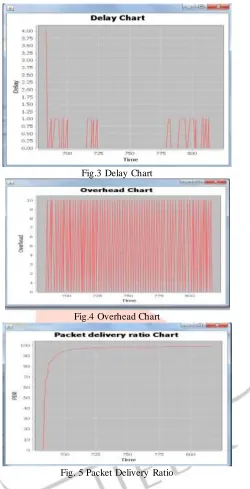
Fig.3 Delay ChartFig.4 Overhead Chart
Fig. 5 Packet Delivery Ratio
VII CO NC LUSION
Wireless sensor network offers a wide range of applications in areas such as traffic monitoring, medical care, inhospitable terrain, robotic exploration, and agriculture surveillance In this paper we will implement the candidate selection using Leftover energy of the nodes and the trust value calculated by the nodes in the network. We have kept the existing system of Leftover energy based candidate selection. In our proposed work our aim is to achieve the better results for candidate selection with the improved packet delivery ratio and minimum end to end delay
AC KNO W LEDGMENT
I am thankful to the Department of Computer Engineering for providing me with the best of the facilities. I would also like to thank my husband Mr. Sangram Patil who encouraged me and created a healthy environment for to learn in best possible way.
REFERENC ES
[1] Juan Luo, M ember, IEEE, Jinyu Hu, Di Wu, M ember, IEEE, and Renfa Li, Senior M ember, IEEE ,”Opportunistic Routing Algorithm for Relay Node Selection in Wireless Sensor Networks”, IEEE TRANSACTIONS ON INDUSTRIAL INFORMATICS, VOL. 11, NO. 1, FEBRUARY 2015
[2] L. Cheng, J. Niu, J. Cao, S. Das, and Y. Gu, “Qos aware geographic opportunistic routing in wireless sensor networks,” IEEE Trans. Parallel Distrib. Syst., vol. 25, no. 7, pp. 1864–1875, Jul. 2014.
[3] D. Zhang, G. Li, K. Zheng, X. M ing, and Z.-H. Pan, “An energy -balanced routing method based on forward-aware factor for wireless sensor networks,” IEEE Trans. Ind. Informat., vol. 10, no. 1, pp. 766–773, Feb. 2014.