Volume 2008, Article ID 895654,7pages doi:10.1155/2008/895654
Research Article
On MIMO-OFDM with Coding and Loading
Harry Z. B. Chen, Lutz Lampe, and Robert Schober
Department of Electrical and Computer Engineering, University of British Columbia, Vancouver, BC, Canada V6T 1Z4
Correspondence should be addressed to Lutz Lampe,[email protected]
Received 12 November 2007; Revised 28 March 2008; Accepted 31 May 2008
Recommended by B. Sadler
Orthogonal frequency-division multiplexing (OFDM) with multiple transmit and multiple receive antennas (MIMO-OFDM) is considered a candidate for high-data rate communication in various existing and forthcoming system standards. To achieve the usually desired low frame and bit error rates, MIMO-OFDM should be combined with adaptive bit loading (ABL) and forward error correction (FEC) coding, where the former is particularly apt for moderate mobility as considered in, for example, IEEE 802.16e OFDM systems. In this paper, we investigate “simple” coding schemes and their combination with ABL for MIMO-OFDM. In particular, we consider wrapped space-frequency coding (WSFC) and coded V-BLAST with ABL and optimize both schemes to mitigate error propagation inherent in the detection process. Simulation results show that bit-loaded WSFC and V-BLAST optimized for coded MIMO-OFDM achieve excellent error rate performances, close to that of quasioptimal MIMO-OFDM based on singular value decomposition of the channel, while their feedback requirements for loading are low.
Copyright © 2008 Harry Z. B. Chen et al. This is an open access article distributed under the Creative Commons Attribution License, which permits unrestricted use, distribution, and reproduction in any medium, provided the original work is properly cited.
1. INTRODUCTION
Orthogonal frequency-division multiplexing (OFDM) is a popular method for transmission over frequency-selective channels. For improved power and bandwidth efficiency, the combination of OFDM with multiple transmit and multiple receive antennas, which is often referred to as multiple-input
multiple-output OFDM (MIMO-OFDM) [1, 2], and the
application of adaptive bit loading (ABL) are attractive [3– 8].
MIMO-OFDM schemes with ABL have been extensively studied recently [9–13] assuming different levels of channel state information (CSI) at the transmitter (perfect CSI at the receiver is assumed). K¨uhn et al. [9] and Li et al. [11] presented results for coded MIMO-OFDM with ABL based on the singular value decomposition (SVD) of the MIMO channel in case of full CSI. In [12], eigen-beamforming is applied to uncoded transmission when only partial CSI is available. Vertical Bell layered space-time (V-BLAST) [14] processing is often employed if CSI is not available at the transmitter [10,13]. This kind of MIMO processing without the need for CSI at the transmitter is particularly interesting
for moderately mobile applications as envisaged in, for example, IEEE 802.16e OFDM systems.
In this paper, we study pragmatic schemes for coded and bit-loaded MIMO-OFDM which do not require CSI for MIMO processing at the transmitter and for which a low-rate feedback channel to perform ABL is sufficient. Our contributions can be summarized as follows.
(i) We propose the application of wrapped space-frequency coding (WSFC), which is the space-space-frequency counterpart of wrapped space-time coding (WSTC) devised in [15], as efficient coding scheme for MIMO-OFDM without CSI. WSFC retains the simplicity of V-BLAST, but alleviates the problem of error propagation by means of a special formatting of coded symbols to transmitted symbols. Furthermore, we optimize the WSFC decision delay for the considered application.
(ii) For V-BLAST with ABL we devise a simple method to increase the performance margin of the symbols correspond-ing to the antennas decoded first such that error propagation is mitigated.
Source bits Channel
encoding Interleaving
Adaptive bit-loading
IFFT
IFFT NT Feedback channel
Channel estimator
Sink decodingChannel Deinterleaving MIMO signal processing
FFT
FFT 1
NR
. . .
. . .
Figure1: Block diagram of the MIMO-OFDM system with adaptive bit loading. (I)FFT denotes (inverse) fast Fourier transform.
already only little feedback for ABL, we explore further feedback reduction using subchannel grouping methods.
(iv) We present simulation results for practically relevant systems and channel parameters that show that MIMO-OFDM with optimized WSFC and V-BLAST and reduced feedback for ABL achieve similar performances, which closely approach that of SVD-based MIMO-OFDM.
The remainder of this paper is organized as follows.
Section 2 provides the system model for MIMO-OFDM.
Section 3 presents WSFC for MIMO-OFDM, and reviews
V-BLAST and SVD. Section 4 introduces ABL schemes and describes the proposed modification for bit-loaded V-BLAST.Section 5presents the simulation results, and finally conclusions are drawn inSection 6.
2. SYSTEM MODEL
The OFDM system under consideration is equipped withNT
transmit andNR receive antennas and we assumeNT ≤NR.
The number of subcarriers isN. The block diagram of the OFDM system with MIMO signal processing and adaptive bit loading is shown inFigure 1.
At the transmitter, source bits are first encoded with a binary convolutional encoder and possibly interleaved (see below). The coded bits are fed into the ABL unit, which allocates bits to each of the N OFDM subcarriers andNT antennas. While ABL and MIMO transmission are
described in detail below, it should be noted that ABL requires feedback from the receiver only in the form of a vector of integers which specifies the number of bits assigned to each subcarrier and antenna. The amount of feedback for loading is thus much smaller than that for providing full CSI to the transmitter as required for MIMO processing with SVD.
Denotingxk [xk,0· · ·xk,NT−1]
T
([·]T : transposition) the NT-dimensional vector transmitted over NT antennas
and subcarrier k, 0 ≤ k < N, and assuming standard OFDM transmission and reception, the correspondingNR
-dimensional received vector is given by
yk=Hkxk+nk, 0≤k < N, (1)
with the NR × NT channel matrix Hk and the additive
spatially and spectrally white Gaussian noise (AWGN) nk.
The MIMO-OFDM channel is assumed to be block fading, that is, the channel does not change during one coding block, but may vary from one block to another. We assume perfect CSI at the receiver (ideal channel estimator inFigure 1).
3. MIMO PROCESSING FOR CODED MIMO-OFDM
We now introduce the WSFC scheme for MIMO-OFDM with ABL (Section 3.1) and briefly review V-BLAST-based (Section 3.2) and SVD-based MIMO-OFDM (Section 3.3) (cf., e.g., [9,13]).
3.1. Wrapped space-frequency coding (WSFC)
WSFC is the straightforward extension of WSTC devised in [15] for single-carrier space-time transmission to MIMO-OFDM. The coded bit stream is divided into NT layers
assigned toK =(N−(NT−1)d)NT transmit symbols such
that if cj, 0 ≤ j < K, denotes the jth symbol mapped
from the encoder output, then xk,i = cNT(k−id)+i forid ≤
k < N − (NT −1 −i)d and xk,i = 0 otherwise, 0 ≤ i < NT. The parameterdis the so-called interleaving delay.
This formatting “wraps” the codeword around the space-frequency plane, skewed by the delayd.Figure 2shows an example of a WSFC codeword matrix withNT =3,d= 3,
andN=384 (cf. [15, Figure 2], for WSTC). Note thatd=3 is chosen only for illustration. The actual value fordneeds to be optimized for the best tradeoffbetween rate losses due to zero symbolsxk,i=0 and error propagation (seeSection 5).
The skewness of the space-frequency arrangement of data symbols enables decoding with per-survivor processing (PSP) at the receiver. The received vectors are first processed with linear matrix-filtersFkto form the vectors
vk
vk,0· · ·vk,NT−1 T
=FHkyk =Bkxk+nk,
17 14 11
8
5 2 7 4 1 9 6
0 3 15 1125 11281131
1126 1129 1132 10 13 16
1127 1130 1133 12
d
N NT
Figure2: Example of a WSFC codeword matrix withNT =3,d=3, andN =384. The indices of the coded symbols are shown in the
blocks.
where Bk = FHkHk is the so-called feedback matrix and nk = [nk,0nk,1· · ·nk,NT−1]
T
is the additive noise. This filtering is performed in the “MIMO signal processing” block ofFigure 1. Usual choices for the matrixFkin MIMO
processing are the whitened matched filter, for which Bk
would be upper triangular andnkwould be spatially white
Gaussian noise, or the unbiased minimum mean-square error (MMSE) filter, in which case the elements of nk are
correlated (cf. [15, Section III]). Here, we consider the unbiased MMSE filter for its usually superior performance and we approximatenk as AWGN for the decoder design. Then, denoting the element ofBkin rowiand columnlby bk,i,l, the samples
dk,i=vk,i− NT−1
l=i+1
bk,i,lxk,l (3)
are used as input information aboutcNT(k−id)+ifor the stan-dard Viterbi decoder. The decisionsxk,l are taken from the
survivor history of the decoder, whose depth is proportional tod. Hence, the effect of error propagation is alleviated with increasingd. In case of correct decisions, we have
dk,i=bk,i,ixk,i+nk,j, (4)
and NTequivalent channels with gainsbk,i,i, 0≤i < NT, for
each subcarrierk.
3.2. V-BLAST
V-BLAST for MIMO-OFDM can be regarded as a special case of WSFC with d = 0 and cancellation is performed using immediate decisionsxk,i. However, different from WSFC, the
order of detection, that is, the sequence of values ofiin which decisions aboutxk,i are made, can be modified to mitigate
error propagation (see results inSection 5).
Applying a permutation matrixπkto the channel matrix Hkto account for ordering, we obtain
vk=BkπTkxk+nk. (5)
The conventional ordering strategy is to successively max-imize the effective channel gains after cancelling, |bk,i,i|, fori = NT −1,NT −2,. . ., 0 in order to minimize error
propagation. This greedy algorithm was proven to maximize the minimum channel gain and thus the signal-to-noise ratio (SNR) [16].
For V-BLAST with ABL, the optimum loading algorithm will distribute the rate to the equivalent channels such that
their error rates are approximately equal (seeSection 4). In particular, the loading algorithm will always assign symbols from larger signal constellations to spatial channels with higher gains without considering error propagation. Hence, the optimum decoding order for V-BLAST with ABL could be different from that for V-BLAST without ABL. In fact, it has been found in [17] that the near-optimal decoding order for V-BLAST with ABL is obtained if the greedy algorithm chooses the transmit antenna with the smallest equivalent gain among the remaining unassigned antennas (cf. also [10]). InSection 4.3, we will describe a modification of V-BLAST with ABL to further reduce error propagation.
In addition to ordering, V-BLAST coded bits are inter-leaved before mapping to (nonbinary) signal points, which is not possible in case of WSFC due to the strict correspondence between coded bits and space-frequency transmit symbols.
3.3. SVD
By performing SVD, the channel matrixHkcan be written as
Hk=UkΛkVHk, (6)
where Uk andVHk are unitary matrices. The entries of the
diagonal matrix Λk,λk,0 ≥ λk,1 ≥ · · · ≥ λk,NT−1 ≥ 0, are the sorted nonnegative singular values ofHk. In SVD-based
MIMO transmission, the matricesVkandUHk are applied to xkat the transmitter andykat the receiver, respectively. This
generatesNT parallel channels with gainsλk,i, 0 ≤i < NT,
for each subcarrier k. As for V-BLAST, coding with bit-interleaving can be applied. We note that, different from WSFC and V-BLAST, full knowledge of Hk is necessary to
perform SVD-based transmission.
4. ADAPTIVE BIT-LOADING (ABL) SCHEMES
A number of loading algorithms have been proposed for single-antenna OFDM systems (cf. [3–8]), and most of them achieve quite similar performance-complexity tradeoffs. In this paper, we are interested in constant throughput and thus apply the margin-adaptive loading algorithm by Chow et al. (CCB) [4], whose information-theoretic capacity criterion seems to be a good match for coded transmission (although the codes considered in Section 5 do not operate at the capacity limit). However, numerical results not shown here indicate that the choice of the particular loading algorithm is not critical for coded MIMO-OFDM.
channels (assuming perfect cancellation for WSFC and V-BLAST), the CCB algorithm can be directly applied. We first consider two versions of loading with different feedback requirements and computational complexities and then describe a modification of the loading algorithm to account for error propagation in V-BLAST.
4.1. Full loading (FL)
This scheme allocates bits to all NTN equivalent channels
individually without distinguishing between spectral or spatial dimensions.
4.2. Grouped loading (GL)
This scheme forms groups of equivalent channels with similar channel gains and the loading algorithm considers all channels within a group as identical. Since the channel gains
bk,i,i (WSFC/V-BLAST) andλk,i (SVD) are typically highly
correlated along the frequency axis (index k) but strongly vary in the spatial domain (indexi), grouping ofGadjacent subcarriers corresponding to the same transmit antenna is proposed.Gis referred to as the group size. To provide the loading algorithm with a group representative, we consider two methods as follows.
4.2.1. Center subcarrier method
The center subcarrier of the group (or one of the center subcarriers ifGis even) represents the group.
4.2.2. Equivalent SNR method
A virtual channel whose SNR equals
SNReq=Γγ
where SNRl is the SNR for thelth subcarrier in the group,
Γis the “SNR gap” andγis the system performance margin iteratively updated by the CCB algorithm (cf. [4]). Equation (7) directly derives from averaging the capacities (see [4, Equation (1)]) associated with the subcarriers in the group.
Since GL reduces the required amount of feedback by a factor ofG, it is a very interesting alternative, especially for WSFC/V-BLAST OFDM, which does not require CSI at the transmitter for MIMO processing. A virtual channel whose capacity equals the mean of the capacities of the channels in the group represents the group.
4.3. Modification of loading for V-BLAST
As described inSection 3.2, the effect of error propagation in V-BLAST with ABL is mitigated by sorting the spatial subchannels in the order of increasing channel gains. It seems, however, advisable, to also take error propagation into account when actually performing the loading. More specifically, we propose to increase the performance margin for the symbols of the antennas decoded first in the bit
loading algorithm, which makes the tentative decisions of V-BLAST more reliable. To this end, we introduce a parameter, the extra marginηi, 0 ≤ i < NT, and make the following
modification to the CCB algorithm. We replace (1) of [4] with
the SNR, and the extra performance margin of the ordered
ith symbol on subcarrierk, respectively.
If we set η0 = 1, then ηi, 0 < i < NT, become
the extra margins relative to the last detected symbol for a certain subcarrierk. The remaining task is to find theηithat
minimizes the overall error rate. Since the parameter space increases exponentially with NT, we suggest the pragmatic
choiceηi = (ηextra)i, 0 ≤ i < NT, whereηextra ≥ 1 is the only parameter to be optimized. This will be done in the next section based on simulated performances.
5. RESULTS AND DISCUSSION
We now present and discuss simulation results for the different MIMO-OFDM schemes with ABL. We adopt the following system parameters from the IEEE 802.16e standard [18]: OFDM with 3.5 MHz bandwidth and 512 subcarriers of which 384 are active; rectangularM-QAM constellations with M=2i, 0 ≤ i ≤ 8, and Gray labeling of signal points; convolutional encoder with generator polynomials (171, 133)8. We further assumeNT =NR =2 as a relevant
example, and the ITU-R vehicular channel model A [19]. In all cases, the average data rate per active subcarrier is fixed to
R=2 bits andR=4 bits, respectively.
5.1. Optimization of WSFC and V-BLAST for
MIMO-OFDM with ABL
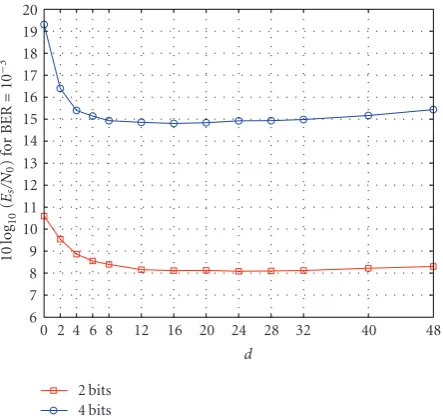
First, we consider the optimization of WSFC.Figure 3shows the SNR Es/N0 (Es: received energy per symbol, N0: one-sided noise power spectral density) required for a bit-error rate (BER) of 10−3 versus the interleaving delay d. While increasing d leads to more accurate tentative decisions, it also incurs a larger rate loss due to initialization and termination of WSFC encoding. In order to keep the overall rate unchanged, more bits have to be allocated to subcarriers not affected by initialization and termination, which has a negative effect on BER performance. In the case ofR=2 bits, the system achieves the best performance when the delay lies in the range from d = 16 tod = 32. ForR =4 bits, the best performance is obtained betweend = 8 andd = 28. Hence,d =16 is a universally good choice and used in the following. We note, however, that somewhat smaller (larger) delays may be optimal for OFDM with fewer (more) than 384 subcarriers due to the more (less) pronounced rate loss for fixedd.
48
Figure3: SNR required for WSFC to achieve BER=10−3 versus interleaving delaydwithR=2 bits and 4 bits.
5
Figure4: BER required for V-BLAST with and without ordering versus extra marginηextra.
and 10−4versus the extra margin ηextra for the case ofR= 2 bits. The curves for V-BLAST without ordering are also included as references. Using an extra margin, ηextra > 1, leads to more reliable tentative decisions, however, it also makes the symbols corresponding to the antenna detected last more error-prone. It can be seen that the optimum extra margins are approximately atηextra = 2∼2.5 and that optimization with respect toηextraprovides gains of 0.7 dB at BER=10−3 and 1.3 dB at BER=10−4, respectively. This is quite remarkable considering that the improvement due to ordering (i.e.,ηextra=1) is only 0.25 and 0.9 dB, respectively.
20 V-BLAST ABL without ordering V-BLAST ABL with ordering V-BLAST ABL with ordering andηextra WSFC
Figure 5: BER performance for coded MIMO-OFDM with and without ABL.R=2 bits, andd=16 for WSFC.
5.2. Performance comparisons
We now compare the performances of coded MIMO-OFDM based on SVD, V-BLAST, and WSFC. To separate the different effects, (i) BLAST without ordering, (ii) V-BLAST with ordering, and (iii) V-V-BLAST with ordering and optimal ηextra are considered. Note that bit-interleaving is applied for V-BLAST but not for WSFC.
Figure 5 shows the BER results for R = 2 bits with
and without ABL. As expected, SVD with ABL yields the best performance among all the schemes and its bit-loading gain is more than 8.4 dB at BER=10−4. Interestingly, SVD without loading is inferior to WSFC, which can be attributed to the large variations of the subchannel gains in case of SVD. WSFC with ABL approaches the performance of SVD within 1.2 dB, and its loading gain is 1.5 dB at BER =10−4. WSFC clearly outperforms V-BLAST, which confirms the effectiveness of the interleaving delay d. If the detection order is optimized, the performance of V-BLAST with ABL is 2.1 dB worse than that of WSFC. If the proposed additional margin ηextra is applied for ABL, the SNR gap between V-BLAST and WSFC decreases to 0.8 dB at BER =10−4.
13
V-BLAST withoutηextra, center subcarrier
V-BLAST withoutηextra, equivalent SNR
V-BLAST withηextra, center subcarrier
V-BLAST withηextra, equivalent SNR
Di BLAST with ordering based on MIMO-OFDM with different group sizes Gfor ABL. R = 2 bits, and d=16 for WSFC. The center subcarrier and equivalent SNR methods are used for loading.
the aggravated error propagation when employing nonideal loading. This effect is alleviated in case of WSFC due to the interleaving delayd > 0. For WSFC the SNR-penalties compared toG=1 are [0.05, 0.16, 0.53] dB when using the center subcarrier and only [0.02, 0.09, 0.3] dB when using the equivalent SNR for ABL. The latter criterion is apparently advantageous for WSFC and losses of, for example, 0.09 and 0.3 dB are fairly small given the reduction in feedback required for loading by factors of 4 and 8, respectively. Interestingly, for V-BLAST the center-subcarrier criterion yields better performances, which shows that one should not blindly apply a certain criterion for ABL with grouping of subcarriers.
We conclude that both optimized WSFC and V-BLAST achieve power efficiencies close to that of SVD-based MIMO-OFDM with ABL, and WSFC is somewhat advantageous if the feedback channel required for ABL has a very limited capacity.
6. CONCLUSIONS
In this paper, we have studied coded MIMO-OFDM with ABL. We have proposed WSFC for MIMO-OFDM and a modified loading for V-BLAST to mitigate the problem of error propagation. Furthermore, we have considered ABL with subcarrier grouping based on two criteria to reduce the feedback load. The presented simulation results have shown notable gains due to WSFC and V-BLAST optimization, and that WSFC and V-BLAST perform fairly close to the benchmark case of SVD, which requires full CSI at the transmitter. We thus conclude that the devised WSFC-based and V-BLAST-based MIMO-OFDM with ABL are attractive solutions for power and bandwidth-efficient transmission
for scenarios with small feedback rates like in, for example, IEEE 802.16e systems.
ACKNOWLEDGMENTS
The completion of this research was made possible thanks to Bell Canada’s support through its Bell University Lab-oratories R&D program and the National Sciences and Engineering Research Council of Canada (Grant CRDPJ 321281-05). This work was presented in part at the 16th International Conference on Computer Communications and Networks (ICCCN), Honolulu, Hawaii, USA, August 2007.
REFERENCES
[1] H. Bolcskei and A. J. Paulraj, “Space-frequency coded broad-band OFDM systems,” in Proceedings of the IEEE Wireless Communications and Networking Conference (WCNC ’00), pp. 1–6, Chicago, IL, USA, September 2000.
[2] G. L. St¨uber, J. R. Barry, S. W. McLaughlin, Y. Li, M. A. Ingram, and T. G. Pratt, “Broadband MIMO-OFDM wireless communications,”Proceedings of the IEEE, vol. 92, no. 2, pp. 271–294, 2004.
[3] J. A. C. Bingham, “Multicarrier modulation for data transmis-sion: an idea whose time has come,”IEEE Communications Magazine, vol. 28, no. 5, pp. 5–14, 1990.
[4] P. S. Chow, J. M. Cioffi, and J. A. C. Bingham, “A practical discrete multitone transceiver loading algorithm for data transmission over spectrally shaped channels,”IEEE Transac-tions on CommunicaTransac-tions, vol. 43, no. 234, pp. 773–775, 1995. [5] R. F. H. Fischer and J. B. Huber, “A new loading algorithm
for discrete multitone transmission,” inProceedings of the IEEE Global Telecommunications Conference (GLOBECOM ’96), vol. 1, pp. 724–728, London, UK, November 1996.
[6] J. Campello, “Practical bit loading for DMT,” inProceedings of IEEE International Conference on Communications (ICC ’99), vol. 2, pp. 801–805, Vancouver, Canada, June 1999.
[7] B. S. Krongold, K. Ramchandran, and D. L. Jones, “An efficient algorithm for optimal margin maximization in multicarrier communication systems,” inProceedings of IEEE Global Telecommunication Conference (GLOBECOM ’99), vol. 1, pp. 899–903, Rio de Janeiro, Brazil, December 1999. [8] L. Piazzo, “Fast algorithm for power and bit allocation in
OFDM systems,”Electronics Letters, vol. 35, no. 25, pp. 2173– 2174, 1999.
[9] V. K¨uhn, R. B¨ohnke, and K.-D. Kammeyer, “Adaptive MIMO-OFDM for future mobile radio communications,” in Proceed-ings of the 6th IEE International Conference on 3G and Beyond, pp. 9–12, London, UK, November 2005.
[10] R. Zhang and J. M. Cioffi, “CTH03-6: approaching MIMO-OFDM capacity with closed-loop V-BLAST,” inProceedings of IEEE Global Communications Conference (GLOBECOM ’06), pp. 1–5, San Francisco, Calif, USA, November 2006.
[12] P. Tejera, W. Utschick, G. Bauch, and J. A. Nossek, “Joint bit and power loading for MIMO OFDM based on partial channel knowledge,” inProceedings of the 59th IEEE Vehicular Technology Conference (VTC ’04), vol. 59, pp. 660–664, Milan, Italy, May 2004.
[13] K.-W. Ng, R. S. Cheng, and R. D. Murch, “A simplified bit allocation for V-BLAST based OFDM MIMO systems in frequency selective fading channels,” inProceedings of the IEEE International Conference on Communications (ICC ’02), vol. 1, pp. 411–415, New York, NY, USA, April-May 2002.
[14] G. J. Foschini, “Layered space-time architecture for wireless communication in a fading environment when using multi-element antennas,”Bell Labs Technical Journal, vol. 1, no. 2, pp. 41–59, 1996.
[15] G. Caire and G. Colavolpe, “On low-complexity space-time coding for quasi-static channels,”IEEE Transactions on Information Theory, vol. 49, no. 6, pp. 1400–1416, 2003. [16] P. W. Wolniansky, G. J. Foschini, G. D. Golden, and R.
A. Valenzuela, “V-BLAST: an architecture for realizing very high data rates over the rich-scattering wireless channel,” in Proceedings of the URSI International Symposium on Signals, Systems, and Electronics (ISSSE ’98), pp. 295–300, Pisa, Italy, September 1998.
[17] T. Vencel, C. Windpassinger, and R. F. H. Fischer, “Sorting in the V-BLAST algorithm and loading,” in Proceedings of Communication Systems and Networks (CSN ’02), pp. 304–309, Malaga, Spain, September 2002.
[18] IEEE P802.16e-2005, Air Interface for Fixed and Mobile Broadband Wireless Access Systems,http://www.ieee802.org/ 16/pubs/80216e.html.