Volume 2008, Article ID 803271,12pages doi:10.1155/2008/803271
Research Article
A Multievent Congestion Control Protocol for
Wireless Sensor Networks
Faisal B. Hussain,1Yalcin Cebi,1and Ghalib A. Shah2
1Department of Computer Engineering, Dokuz Eylul University, 35100 Izmir, Turkey
2Department of Computer Engineering, College of Electrical and Mechanical Engineering, National University of
Sciences and Technology (NUST), Rawalpindi 46000, Pakistan
Correspondence should be addressed to Ghalib A. Shah,[email protected]
Received 8 February 2008; Revised 29 October 2008; Accepted 7 December 2008
Recommended by Abraham Fapojuwo
Wireless sensor networks are application-dependent networks. An application may require general event region information, per-node event region information, or prioritized event information in case of multiple events. All event flows are subject to congestion in wireless sensor networks. This is due to the sudden impulse of information flow from a number of event nodes to a single destination. Congestion degrades system throughput and results in energy loss of nodes. In this paper, we present a multievent congestion control protocol (MCCP) for wireless sensor networks. MCCP supports multiple event reporting modes, that is, general event reporting, per-node fair event reporting, and prioritized multiple event reporting. MCCP efficiently mitigates congestion and provides output according to selected event reporting mode. MCCP uses hop-by-hop packet delivery time and buffer size as the basic metrics for congestion detection. Moreover, we introduce a schedule-based scheme at the transport layer for rate assignment and ordered delivery of event packets to underlying routing layer. This helps to avoid packet collisions and increases the packet delivery ratio even in high densities. Detailed simulation analysis confirms that MCCP decreases packet drops and provides high packet delivery ratio (above 90%) for multiple event reporting modes.
Copyright © 2008 Faisal B. Hussain et al. This is an open access article distributed under the Creative Commons Attribution License, which permits unrestricted use, distribution, and reproduction in any medium, provided the original work is properly cited.
1. INTRODUCTION
Wireless sensor networks (WSNs) in recent years have emerged as key systems for information gathering and control. Sensors gather information from the environment through measuring mechanical, thermal, biological, chem-ical, optchem-ical, and magnetic phenomena. The electronics then process the information derived from the sensors and through some decision making capability direct critical event information to the sink. Applications may require that nodes send sensing information either periodically or on event occurrence.
Wireless sensor networks are characterized by their unique requirements which are application-specific (see
[1, 2]). An application may require general event region
information, per-node event information, or multiple events information, and so forth. Consider a WSN working inside a mine for the purpose of environmental monitoring and control. The nodes monitor events like fire, oxygen content in air, sudden increase in pressure, and leakage of toxic gases.
For events like increase in temperature and pressure, general event region information can be sufficient but for events like leakage of poisonous, gas or oxygen content in air precise per-node information is required to identify unsafe regions in the mine. Moreover, interrelated events like fire and decrease in oxygen content in air can occur at the same time. Multiple events may need to be reported at different rates when observed altogether. Therefore, a single application might require information to be delivered in different event reporting modes, for instance, simple, fair, or prioritized.
Event information flow (many to one) causes congestion in wireless sensor networks since a number of event sensing nodes send their event information to the sink at the same time [3]. A node gets congested if the incoming rate of packets is more than its outgoing rate which results in buffer overflow.
0 10 20 30 40 50 60
Bu
ff
er
size
20 40 60 80 100 120 140 160
Time (s) 10 nodes
50 nodes 70 nodes
Figure 1: Average buffer size of 10, 50, and 70 event reporting nodes.
extreme inworst-casenetworks [4]. Because of high density, packets will be dropped due to collisions at the MAC layer. Also, contention for medium-access increases as packets do not get a chance for transmission in busy medium. This results into an increase in buffer size of nodes in dense networks. We illustrate this fact inFigure 1, where we observe the average buffer occupancy of event nodes under variable densities in a 100×100 m sensor field with 100 nodes. The event reporting region is centered at (40,40) coordinates and having a radius of 20 m. A number of 10, 50, and 70 event nodes report event to maintain a constant reporting rate (70 pkts/sec) at the sink located at (90,90) coordinates; without using any congestion control scheme. It is evident
fromFigure 1that as the number of event reporting nodes
increase within the event reporting region, the average buffer occupancy of event reporting nodes also increases.
WSNs are application-dependent networks [1]. There-fore, different congestion control schemes [3, 5–7] have been proposed in literature aiming to handle congestion in WSNs while providing optimal throughput, fair per-node throughput, or prioritized throughput. Congestion control protocols for wireless sensor networks generally consist of two basic parts. Firstly, a congestion detection mechanism and secondly, a rate-control mechanism to adjust the reporting rate of nodes in order to avoid or mitigate congestion. These protocols use different metrics for congestion detection like buffer size, packet interarrival time, packet service time, channel sampling, and traffic load assessment. For adjusting the reporting rates of nodes either a sink-based or in-network node-based solution is used. In both cases, event reporting nodes are assigned a reporting rate so that they can forward event packets in accordance with congestion status; using jittered forwarding of packets. A jitter is the random delay which is added at the time a packet is delivered to underlying layers by the transport layer.
This delay is used to avoid any possible collisions, as the packet is broadcasted in a shared wireless environment.
In this paper, we propose a single multievent congestion control protocol (MCCP) for wireless sensor networks. MCCP addresses the issue of congestion control while providing optimal throughput, fair per-node throughput, and prioritized throughput for multiple events. MCCP is implemented at the transport layer. It uses hop-by-hop packet delivery time and buffer size as the basic metrics for rate adjustment and congestion detection. Moreover, we introduce a schedule-based scheme at the transport layer for rate assignment and ordered delivery of event packets to underlying routing layer. By using a schedule-based scheme at the transport layer helps to avoid packet collisions and increases the packet delivery ratio even in high densities.
The paper is organized as follows. InSection 2, related works on congestion control, fair event reporting, and rate adjustment are presented. Basic network setup, system definitions, and assumptions for MCCP protocol are pre-sented in Section 3. The operation of the MCCP protocol is presented in Section 4. In Section 5, detailed simulation results are shown and inSection 6, the paper is concluded.
2. RELATED WORK
In this section, several congestion avoidance and control protocols, rate adjustment mechanisms, fairness schemes, and transport protocols for wireless sensor networks are reviewed. In [8, 9], the major issues of transport layer protocols in WSNs and a detailed survey of major congestion and transport protocols have been presented.
Congestion detection and avoidance (CODA) in sensor networks [3] uses open-loop and closed-loop mechanisms to handle congestion which is detected on the basis of channel sampling and buffer occupancy. Once congestion is detected, the open-loop mechanism broadcasts back pressure message to their neighboring nodes which further propagate these messages to upstream source nodes, depending on their local buffer occupancy. SenTCP [6] uses hop-by-hop, open-loop congestion control mechanism that detects congestion using both buffer occupancy and packet interarrival time. In SenTCP, nodes avoid congestion by issuing periodic feedback signals to adjust the reporting rate of their upstream nodes depending on local buffer status. Priority-based congestion control protocol (PCCP) [10] uses packet interarrival time and packet service time to detect congestion level at a node and employs weighted fairness to allow nodes to receive priority-dependent throughput. If all nodes have the same priority, then PCCP can give same per-node throughput. With different priorities, PCCP can provide throughput based on the priority of the node.
demonstrate in our simulation results that the use of source-based congestion mitigation techniques in dense networks is not a good solution.
Mitigating congestion in wireless sensor networks [11] suggests multiple approaches for congestion removal which span on different layers of the traditional protocol stack. These approaches include hop-by-hop flow control based on buffer occupancy, rate limiting to implement fairness, and a prioritized medium access control (MAC) protocol that decreases the back-off window of a congested node. However, these schemes are applicable for networks in which nodes offer same traffic load and the routing tree is not significantly skewed. Event-to-sink reliable transport (ESRT) in wireless sensor networks [12] uses change in local buffer level of a node during consecutive intervals to predict congestion resulting in a decrease in the reporting rate by the sink. In case of congestion, ESRT regulates all sources in the network regardless of a particular node causing congestion; this decreases the overall system throughput. A price-oriented reliable transport protocol (PORT) [13] uses link loss estimation as a basic source of congestion detection and avoids congestion by dynamically forwarding packets to less-congested nodes. In dense networks, link losses are high which are generally not because of congestion but due to collisions of packets. In PORT, sink directs individual nodes to increase or decrease their reporting rates. However, in dense networks, sending such control information to every node is very difficult since nodes can be at multiple hop distance from the sink.
Congestion avoidance based on light-weight buffer man-agement in sensor networks [14] suggests sending a packet to a neighboring node only when the neighboring node has the buffer space to hold the packet. Nodes inform their neigh-boring nodes about their residual buffer size by piggybacking the buffer size either in data or acknowledgement (ACK) packet. However, this requires extra control information to be sent on per-packet basis. Interference-aware fair rate control (IFRC) in wireless sensor networks [15] detects con-gestion by monitoring average queue length and exchanges congestion state among the potential interferers using a congestion sharing mechanism. In IFRC, each node adds its buffer size and current congestion state in every packet that it forwards resulting into extra energy consumption per-packet basis. Credit-based fairness control in wireless sensor network (CFRC) [16] allocates bandwidth to nodes based on effective amount of sensed information which is dependent on node density and their distribution instead of uniformity. However, CFRC does not provide per-node fairness instead provides fairness on credit basis depending on sensed information by a node.
In [17], a congestion avoidance scheme for WSNs which is based on light-weight buffer management is presented. It suggests that a sender should transmit a packet only when it knows that the receiver has the buffer to store the packet. Therefore, data packets are piggybacked to update buffer state. When a sensorxsends out a data packet, it piggybacks its residual-buffer size in the frame header. If a neighbor y
overhears a frame fromx, it caches the residual-buffer size of
x. Whenyoverhears a packet which is sent by another sensor
tox, it reduces the residual-buffer size ofxby one. In [18], an aggregation-based congestion control for sensor networks (CONCERT) is presented. CONCERT uses adaptive data aggregation in order to reduce the amount of information travelling through out the network rather than using a back-pressure approach to regulate source nodes transmission rate on congestion.
Congestion control and fairness (CCF) for many-to-one routing in sensor networks [5] uses buffer size to detect congestion. CCF implements a tree-based technique in which each node calculates its subtree size. Reporting rate is allocated to nodes depending on their subtree sizes. Every node maintains a separate queue for each of their previous hop nodes. Nodes forward packet from these queues depending on the subtree size of the previous hop nodes during each epoch. Sensor nodes have limited memory resources (see [19,20]), maintaining a separate queue for each previous hop node is not a memory efficient solution; especially in dense networks. Also, in case of multiple events, CCF treats all events similarly which can have different reporting rate requirements.
As a summary, congestion control protocols for wireless sensor networks generally consist of two basic parts. Firstly, a congestion detection mechanism and secondly, a rate-control mechanism to adjust the reporting rate of nodes in order to avoid or mitigate congestion. As a result, these protocols provide general event(s) information (CODA [3], SenTCP [6], ESRT [12]), per-node fair event information (CCF [5], IFRC [15]), and prioritized event information (PCCP [10]). However, we present a single MCCP protocol that mitigates congestion while providing general event information, per-node event information, and prioritized event information for multiple events. Moreover, MCCP associates a schedule-based scheme at the transport layer in order to avoid packet losses in dense networks.
3. SYSTEM DEFINITION
In this section, we explain the basic system-related def-initions, network setup, and assumptions. The network comprises of non-mobile wireless sensor nodes and a sink. We define the nodes as event reporting (E-REP), routing (E-R), reporting and routing (E-REP-R), and idle nodes. If
b,c,d are the nodes routing through nodea, then b,c,d
are the previous hop or child nodes ofa andais the next hop node ofb,c,d, as shown inFigure 2. All nodes routing event information through nodeaare associated with same information flow.
g
e
f
c b
a
d
Sink
Event packets Schedule packets
Figure2: Flow of event and schedule packets
node if the hop distance of the received packet is smaller than or equal to the already stored hop distance, otherwise, it discards the packet. Hence, next hop table is established at network setup time using controlled flooding. Nodes during event reporting randomly select a single next hop node from their table and forward their packets through that node.
MCCP is designed to mitigate congestion and pro-vide optimal throughput for the following event reporting modes.
(1)Simple event reporting mode (SERM). Sensor nodes
report event to the sink in order to provide maximum event region information. Simple event reporting aims to achieve maximum system throughput irre-spective of per-node share at the sink. Therefore, this event reporting mode is suitable for events that are required to send general event region information.
(2)Fair event reporting mode (FERM). Sensor nodes
report event to the sink in order to provide the same per-node throughput at the sink. Therefore, sensor nodes within a single flow adjust their reporting rates in order to fairly distribute the bandwidth among all the event reporting nodes.
(3)Prioritized event reporting mode (PERM). In sensor
networks depending on application needs, different metrics like event, node, region, or time are used for priority. We consider event-based priority for multiple events that are reported through a single flow which aims to distribute the system bandwidth among different event reporting nodes depending on their reporting rates. As a result, nodes with high reporting rates deliver more packets to the sink than nodes with lower reporting rates; irrespective of node distance from the sink.
Sink in MCCP is responsible for the selection of appro-priate event reporting mode. Also, during event reporting, sink can shift between different event reporting modes allowing sink to obtain detailed and precise event region information. However, selection of event mode and the decision of when to shift the event mode is application-dependent, therefore, it is out of the scope of this paper.
Nodes in MCCP maintain successive fixed size data (γ -second) and schedule (δ-second) intervals throughout their
life time. During the data intervals, nodes generate/route available event information, and during schedule intervals routing nodes send transmission schedule for their previous hop nodes. The schedule comprises of slot length (λ sec), total number of slots, and allocated number of slots for a previous hop node. We define slot in terms ofa time duration
during which a node forwards a single packet.
The duration of data and schedule interval does not change. Since the slot length’s duration changes in each schedule interval, the rate at which packets will be sent during the next data interval will change. Hence, slot length determines the reporting rate of a node during an interval. If the slot length is short, more traffic will be forwarded by the node and vice versa.
One of the purposes of using schedules and scheduled packet forwarding at transport layer is to decrease the MAC layer collisions. CSMA-based scheme senses the channel before broadcasting a packet. If the neighboring nodes are not using the medium, then a node can broadcast its packet. The use of schedule increases the probability that when a node is forwarding packet in its allocated data slots, the neighboring nodes will not be transmitting data. As a result, when the MAC layer senses the medium, it will be free. Hence, packet drops due to collisions will decrease. For TDMA-based MAC layer, synchronization is required between MCCP’s transport layer schedule and MAC layer’s schedule for TDMA. However, MCCP is proposed to operate with CSMA-based MAC layer (IEEE 802.11), and the synchronization of MCCP with TDMA based MAC layer is not considered.
The first hop node from the sink in MCCP is responsible for sending the initial schedule to their previous hop nodes during the start of each schedule interval. The slot length for each data interval is updated by E-REP-R and E-R nodes during schedule interval (details of slot length calculation and slot allocation are explained in the Section 4). The slot length received from a parent node or next hop node is termed as basic slot length (BSL) while the slot length calculated by the node itself is termed as local slot length (LSL). E-REP-R and E-R nodes after receiving the schedule from parent node send either LSL or BSL to their previous hop nodes in the schedule using slot length selection procedure (discussed inSection 4.3.1). Hence, each node in MCCP follows the schedule received from their next hop node. If a node does not receive a new schedule during schedule interval, then during the next data interval, it continues transmission using the old schedule.
TDMA-based techniques use fixed time slots that are assigned to sources. However, in our schedule-based scheme, time slots are dynamically assigned during the sched-ule intervals depending on the average packet delivery time observed by nodes and their buffer size. For best results, schedule-based schemes require strict synchroniza-tion among the nodes sharing a schedule. In this work, it is assumed that the nodes are synchronized.
We define packet delivery time in our congestion control scheme asthe time a packet takes to reach from the transport
buffer of a previous hop node to the next hop node’s transport
forward a single packet from it during their allocated slots. Packet delivery time not only includes service time but also the transmission time plus the reception time at the destination. Congestion is likely to occur if the packet delivery time of nodes exceeds the packet delivery time of their previous hop node resulting in a buffer overflow.
We divide the buffer size of nodes into three ranges low, medium (optimal), and high. The goal of congestion control mechanism is to maintain the buffer size of nodes within the optimal range. If the buffer size is low/high, nodes will decrease/increase the slot length for the next interval, respectively, to achieve optimal range; otherwise, nodes will maintain the slot length for the next interval. Hence, each node adjusts the reporting rate (through slot length) of its previous hop nodes so that the buffer is optimally utilized and to avoid congestion while providing high throughput.
4. MULTIEVENT CONGESTION CONTROL PROTOCOL
The operation of MCCP includes a mechanism to detect congestion and to adjust the reporting rate (slot length) of nodes. In order to detect and remove congestion, the slot lengths are calculated by nodes depending on their local network conditions; in terms of average packet delivery time and buffer size. Other important points of MCCP include slot allocation to nodes on event occurrence and the principles of schedule-based scheme. In this section, we explain slots allocation, slot length calculation, and the operation of schedule-based scheme.
4.1. Slot allocation
A slot is a time interval during which a node can forward a single packet. Therefore, the greater the number of slots assigned to a particular node the greater will be its reporting rate. In case of simple and prioritized event reporting, slots are assigned equal to the total reporting rate of a node. However, in case of fair event reporting, nodes are assigned slots equal to their subtree size.
Nodes start reporting by sending their initial application-defined event reporting rate to one of their next hop nodes during data interval. Also, using this information, each node determines its subtree size. The next hop nodes forward their updated subtree size and total reporting rate which is the sum of its own event reporting rates (in case of event node) and reporting rate of all the nodes traversing through it. In this way, the first hop node from the sink obtains the total reporting rate of the flow as well as its subtree size. The first hop node, after receiving the initial event request assigns slots to their previous hop nodes during schedule interval; depending on event-reporting mode.
(1)Slot Allocation for SERM.LetRmin be the minimum
reporting rate among all the events observed by the network. Then, in order to simplify slot assignment, we assume that reporting rates of all other events will be a factor ofRmin, expressed as 2nRmin, where
n ≥ 0. Let R1 be the initial reporting rate for an
event E1. The number of slots Sij, assigned to jth
Table1: Transmission schedule generated by nodeain SERM and PERM.
Node ID Total slots Initial slot End slot Slot length (sec)
b 7 1 1 0.1
c 7 2 6 0.1
d 7 7 7 0.1
Table2: Transmission schedule generated by nodeain FERM.
Node ID Total slots Initial slot End slot Slot length (sec)
b 6 1 1 0.1
c 6 2 5 0.1
d 6 6 6 0.1
previous hop neighbor of nodei, can be calculated asRj/Rimin, whereRjis the reporting rate of the jth node andRiminis the minimum reporting rate among
the children ofith such thatRj,Rimin ∈ 2nRmin and
Rj ≥Rimin. IfNkare the total number of nodes to be routed through theith node, then it calculates total number of slots askj=1Rj/Rimin.
(2)Slot Allocation for FERM. In case of fair event
reporting slots are assigned according to subtree sizes of previous hop nodes. The subtree size depends on number of event nodes and not on their reporting rates. Therefore, even in case of multiple events with different reporting rates nodes can forward packets with node-based fairness so that all nodes have same representation at the sink. The number of slots Sij assigned to jth previous hop neighbor of node iis equal to the subtree sizeTjof thejth node.
(3)Slot Allocation for PERM.In case of prioritized event
reporting for multiple events, slots are assigned with respect to minimum reporting rate among all events observed by the network (Rmin). Therefore, total
number of slots allocated to all the previous hop nodes (Nk) of node i in case of prioritized event reporting will bekj=1Rj/Rmin.
For example, let us assume for simplicity that all nodes except
nodeainFigure 2are event-reporting nodes. Furthermore,
let the initial reporting rates of nodes beb(10),c(10),d(10),
e(10), f(20), and g(10). Then, the total reporting rate of nodeb,c, anddwill be 10, 50, and 10, respectively, while nodeahas a total reporting rate of 70. Moreover, the subtree sizes of nodesb,c, anddare 1, 4, and 1, respectively, while nodeahas total subtree size of 6. Therefore, nodeain SERM and PERM will assign slots to previous hop nodes as shown
inTable 1while slot allocation for FERM is shown inTable 2.
Nodes b, c, and d will divide their data interval into 0.1 second intervals; the initial slot length on event occurrence. These nodes will forward one event packet to nodeaduring their allocated slots.
Table3: Transmission schedule generated by nodecin SERM.
Node ID Total slots Initial slot End slot Slot length (sec)
e 4 1 2 0.1
f 4 3 4 0.1
Table4: Transmission schedule generated by nodecin FERM.
Node ID Total slots Initial slot End slot Slot length (sec)
e 6 3 4 0.1
f 6 5 5 0.1
Table5: Transmission schedule generated by nodecin PERM.
Node ID Total slots Initial slot End slot Slot length (sec)
e 7 3 4 0.1
f 7 5 6 0.1
to nodese and f by node cin SERM, FERM, and PERM, respectively. Likewise, node e will generate a schedule for child nodeg.
4.2. Slot length calculation
In order to provide optimal throughput while avoiding congestion, the slot length is calculated by nodes depending on local network condition; in terms of average packet delivery time and buffer size.
Nodes observe the average packet delivery time of their previous hop nodes in a data interval from the received packets. The average packet delivery time observed during the data interval is used as the slot length for the next data interval. However, if a node’s buffer is either under- or overutilized during the data interval, then the node adjusts its slot length in order to optimally utilize the buffer.
Algorithm 1illustrates the slot length calculation
proce-dure. Let λti be the slot length for the tth interval; Bit and
Bti−1 be the buffer size for thetth and (t−1)th interval of
ith node. Then, in order to calculate appropriate slot length for the next intervalλti+1, a node measures change in buffer occupancy (φB) between two consecutive data intervals and the predicted buffer occupancy (ρB) for the next interval, similar to ESRT [12] as
φBit−1,t=Bti−Bit−1, ρBti+1=Bti+φB t−1,t
i . (1)
In case the predicted buffer occupancy is not in the optimal buffer occupancy range (OpBmin ↔ OpBmax), then
nodes adjust their slot length for the next interval by adding or subtracting a deviation factor (ωt) in the current slot length. We calculate deviation factorωt
i for the ith node at the end oftth interval as
Deviation ωt i
= ±
OpB−ρBti+1
OpB∗λti ,
OpB=
OpBmin+OpBmax
2 .
(2)
1:CurrentSlotLength(λt)=AverageDeliveryDelay 2:ifBuffSize=AverageDeliveryDelaythen
3: /∗Initially when event is detected and reported∗/ 4: NextSlotLength(λt+1)=0.1sec(Default)
5: GO TO Step26 6:end if
7:ifBuffSize=0then
8: /∗Special case when reporting rate is low∗/ 9: λt+1=λt/2
10: GO TO Step26 11:end if
12:Calculate PredictedBuffSize(ρB)/∗Using (1)∗/ 13:ifρB <0then
14: /∗if previous buffer size is greater than current∗/ 15: ρB=BuffSize
16:end if
17:ifρB < OpBminthen
18: Calculate DeviationFactor(ω)/∗Using (2)∗/ 19: λt+1=λt−ω
20:else ifρB > OpBmaxthen
21: Calculate DeviationFactor(ω)/∗Using (2)∗/ 22: λt+1=λt+ω
23:else
24: λt+1=λt 25:end if
26:Transmit Schedule
Algorithm 1: Slot length calculation (procedure is called at the start of each schedule interval byroutingandreporting and routing nodes).
Hence, the slot length for (t+ 1)th interval will be
λt+1
i =λti−ωti (ifρBti+1< OpBmin),
λti+1=λti+ωit (ifρBti+1> OpBmax),
λt+1
i =λti (ifρBti+1∈OpBmin←→OpBmax).
(3)
4.3. The operation of schedule-based scheme
In this section, we present the operation of our schedule-based scheme which is controlled by the first hop node from the sink. Each node maintains data and schedule intervals, therefore, the operation of MCCP can be subdivided into schedule interval and data interval operations. Each schedule interval is followed by a data interval.
4.3.1. Schedule interval
During every schedule interval nodes starting from the first hop nodes send their schedule packets to their previous hop nodes. Each previous hop node before forwarding their schedule to their child nodes compares its local slot length (LSL) with the next hop node’s basic slot length (BSL). There are three possibilities: local slot length less than, greater than, or equal to basic slot length.
node. Therefore, it can allow its previous hop nodes to send packets at a higher rate. This helps to increase the overall system throughput. However, it will result in unordered delivery of packets to next hop node resulting in unfairness and affecting the prioritized delivery of packets. Therefore, in mode 1, the nodes will send LSL while in modes 2 and 3, BSL is sent to their child nodes in the schedule.
(ii) LSL > BSL. In this case, the node receiving the schedule is more congested than its next hop node. Therefore, in all modes, the nodes will send LSL to their child nodes in the schedule although it will result in unfairness in mode 2 but will mitigate local congestion.
(iii) LSL ≈BSL. In this case, local and basic slot lengths are approximately equal, therefore, the nodes will send basic slot length to their child nodes.
The addition of schedule interval can increase the report-ing delay for events; dependreport-ing on the length of schedule interval. MCCP can be modified to operate in overlapping schedule and data intervals to remove the delay cast by schedule intervals. So, during schedule intervals, nodes will continue to forward packets. In this case, when congestion occurs, the sent schedule packets can be dropped due to congestion. Therefore, packet drops in overlapping schedule and data intervals will be higher than in the nonoverlapping form. As a result considering nonreal time events, this work uses nonoverlapping schedule and data intervals.
4.3.2. Data interval
Each node maintains slot intervals equal to their selected slot length during their data interval. At the expiry of each slot interval, a node checks whether it is allowed to send packet during this slot according to its schedule. In case of event reporting node during the allocated slots, it sends an event packet to the next hop node. While routing, nodes simply forward a packet from the transport buffer to its next hop node in its allocated slots. However, event reporting and routing nodes send new event packets as well as forward event packets from the transport queue according to their schedule.
Schedule packets are a natural overhead in MCCP. The duration (length) of a schedule interval defines the time in which nodes are allowed to send transmission schedule for their previous hop node. The length of schedule interval is dependent on the total number of hops (TNHs) in the flow. Ifψis the minimum hop-by-hop packet delivery time, then ψ×TNH is the minimum time required to deliver all schedule packets for a linear node arrangement. Since in MCCP nodes do not forward packets during schedule intervals, the network is idle. Therefore, schedule packets are not subject to congestion, likewise interference is minimum. As a result, schedule packets are immediately delivered.
On the other hand, the number of schedule packets generated during every schedule interval are very less and constant as compare to data packets. LetK be the number of event reporting nodes whileNbe the number of non-idle
Table6: Simulation parameters.
Transport Layer MCCP
Network Layer Minimum hop routing
MAC Layer IEEE 802.11
Data Packet Length 36 bytes
Schedule Packet Length 24 bytes
Transport Queue 50 packets
IFQ length 65 packets
Transmit Power 0.660 W
Receive Power 0.395 W
Radio Range 20 m
Data Interval 4 sec
Schedule Interval 1 sec
nodes in a single flow. Non-idle nodes include all REP, E-R, and E-REP-R nodes. In this case,N−1 will be the number of schedule packets generated during each schedule interval. Ifλis the slot length during a data interval set by the first hop node of the flow, then (1/λ)∗γwill be the number of data packets delivered to sink by the flow.
A data interval defines the time span during which nodes are allowed to forward their data packets in their allocated slot lengths. The number of packets generated during a data interval are dependent on the slot length (λ) and data interval length (γ). The smaller the value ofλ, the greater will be number of packets delivered to sink during data interval. Slot length is adjusted by nodes, therefore, its value is dependent on packet delivery time and buffer size of nodes. However, length of data interval (γ) is fixed. The longer the length of data interval, the greater will be the number of packets delivered to sink during the data interval, but in case of congestion, the greater will be the number of packets dropped since congestion can only be mitigated in schedule intervals by adjusting the slot length of nodes. The smaller the length of data interval, the greater will be the overhead of schedule packets since MCCP maintains successive data and schedule intervals. Therefore, as shown in simulation results (see Section 5.4), we select the length of data and schedule intervals in order to provide maximum throughput with minimum overheads and packet drops.
5. SIMULATION RESULTS OF MCCP
We evaluate the performance of MCCP in terms of packet delivery ratio, fair event reporting at sink, prioritized event reporting, and energy consumption. Furthermore, we demonstrate that using a schedule-based mechanism at the transport layer in contrast to jittered forwarding increases the packet receive ratio and the throughput even in high densities. We show the performance of MCCP using network simulator ns-2 [21], which is a scalable discrete-event simulator.Table 6summarizes the configuration parameters for the simulations.
packets are queued at the transport layer and are further forwarded according to the schedule followed by the nodes. The length of this transport queue is 50 packets. The length of IFQ, transmit power and receive power are mirrored to commonly used sensor nodes like Mica [20].
We compare MCCP with source-based congestion mit-igation (SCM) scheme where the congestion signal prop-agates from congestion region to source nodes similar to CODA [3]. Moreover, congestion is detected on the basis of buffer size, and reporting rate of nodes is adjusted using additive increase multiplicative decrease (AIMD) mecha-nism. For SCM, we use an increment factor of 1.3 and decrement factor of 2. We also compare our simulation results with a fairness mechanism similar to CCF [5]; commonly referenced fairness scheme for wireless sensor networks. In our implementation of CCF, nodes use packet service time to predict their reporting rates. Furthermore, nodes use buffer size to predict congestion. Each node implements a separate child node queue at the transport layer. Fairness is achieved by forwarding packets from the child node queues equal to subtree size of each child node.
5.1. Packet delivery ratio
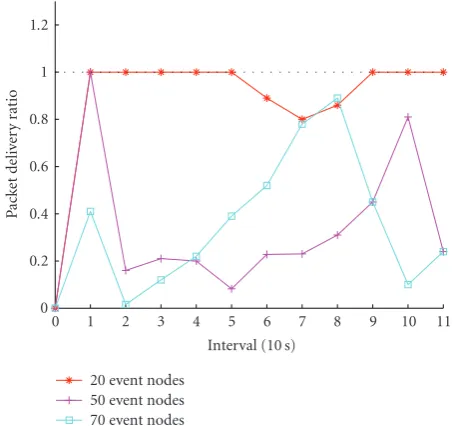
Packets delivery ratio decreases either by an increase in the reporting rate or by an increase in the density of the network (considering fixed transmission power for nodes). This is evident fromFigure 3, in which 20, 50, and 70 event reporting nodes, respectively, centered at (40, 40) report the event at different reporting rates using an SCM scheme. In Figure 3, with the increase in the number of event reporting nodes, sending congestion signal to source nodes which are at multiple hops from congestion region is difficult. As a result congestion is not properly controlled. Also, AIMD-based rate control schemes are not able to properly adjust the reporting rate of nodes as an increment/decrement factor is independent of the number of event reporting nodes.
InFigure 4, we show the performance of MCCP in SERM
with different number of event reporting nodes. The packet delivery ratio is above 90% under low and high densities. This is because our congestion control mechanism not only avoids but controls congestion by efficiently adjusting the reporting rate of congested nodes resulting in few packet drops.
In Figure 5, we compare the packet delivery ratio of
MCCP in FERM with CCF [5]. InFigure 5, for 50 nodes, CCF [5] provides high packet receive ratio since the density of event reporting nodes is less. However, due to interference and busy medium at high density, CCF fails to provide high packet receive ratio for 100 nodes. In order to guarantee fair per-node throughput, each node is assigned a respective schedule in FERM. By transmitting data in allocated slots, nodes minimize the affect of interference and collision observed in high densities. Therefore, packet receive ratio of MCCP in fairness mode is very high in low and high densities. If we compare the packet delivery ratio of MCCP in SERM and FERM from Figures 4 and 5, performance
0 0.2 0.4 0.6 0.8 1 1.2
Pa
ck
et
d
el
iv
er
y
ra
ti
o
0 1 2 3 4 5 6 7 8 9 10 11
Interval (10 s) 20 event nodes
50 event nodes 70 event nodes
Figure3: Packet receive ratio of 20, 50, 70 event reporting node using SCM scheme.
0 0.2 0.4 0.6 0.8 1
Pa
ck
et
d
el
iv
er
y
ra
ti
o
0 1 2 3 4 5 6 7 8 9 10 11
Interval (10 s) 20 event nodes
50 event nodes 70 event nodes
Figure4: Packet receive ratio of 20, 50, 70 event reporting nodes using MCCP in SERM.
of MCCP in FERM is better. This is because the system throughput of MCCP in FERM is lower than in SERM.
5.2. Fair event reporting
0 0.2 0.4 0.6 0.8 1
Pa
ck
et
d
el
iv
er
y
ra
ti
o
2 4 6 8 10 12 14 16 18
Interval (10 s) MCCP (FERM)-50 event nodes CCF-50 event nodes
MCCP (FERM)-100 event nodes CCF-100 event nodes
Figure5: Packet receive ratio of 20, 50, 70 event reporting nodes using MCCP in FERM and CCF.
15 5
1
6
0 4
3
10 11
12 2
7
9 8
14 13
16
17
18 19
20
Sink
Figure6: Arrangement of 21 nodes in a 100×100 m field.
field. InFigure 7, we compare the per-node throughput of MCCP in FERM with CCF [5] and SCM scheme. InFigure 7, per-node throughput is observed at the sink during 100 seconds of event reporting.
SCM scheme does not employ any explicit fairness mech-anism, therefore, per-node throughput at sink is variable. CCF [5] provides considerably fair output but with lower per-node throughput than MCCP. Moreover, inFigure 6, we consider only single hop interference and the number of
0 0.5 1 1.5 2 2.5 3 3.5 4 4.5 5
P
er
n
ode
thr
oug
h
put
(pkts/s)
1 2 3 4 5 6 7 8 9 10 11 12 13 14 15 16 17 18 19 20 Event nodes
MCCP-FERM CCF SCM
Figure7: Per-node throughput of 20 event nodes using MCCP in FERM, CCF, and SCM.
events reporting nodes is less. Fair and per-node throughputs of CCF further deteriorate as the number of event nodes increases or with increase in node density. Therefore, we further compare CCF with MCCP in Figure 8 where we show the average per-node throughput at the sink. In this simulation, 50 event reporting nodes are randomly arranged in an event region having a diameter of 40 m. Moreover, after 70 seconds of event reporting, 20 more nodes start reporting the event from the same event region. In Figure 8, event reporting with SCM scheme shows increase and decrease in average per-node throughput since the AMID rate control scheme operates irrespective of number of event reporting nodes. Also, sending congestion signal to source nodes in case of congestion is difficult resulting into further decrease in throughput. CCF [5] provides low per-node throughput since it considers only one hop interference and does not employ any scheme to handle interference in high node density. MCCP in SERM provides high per-node throughput than in FERM since nodes report event without equally sharing the bandwidth among all event reporting nodes.
5.3. Multiple events
In wireless sensor networks, more than one event can occur at the same time.Figure 9shows the per-node throughput of four different eventsE1,E2,E3, andE4. The initial reporting
rate of eventsE2,E3, andE4is twice, thrice, and four times
that of event E1, respectively. In the simulation scenario,
nodes are arranged as shown in Figure 6 while the event reporting nodes for event E1,E2,E3, and E4 are shown
in Table 7. Since CCF only considers node-based fairness,
0
Figure 8: Average node throughput at the sink using MCCP in SERM as well as FERM, CCF, and SCM during 170 seconds of event reporting.
Figure9: Per-node throughput of 20 nodes reporting four different events using MCCP in PERM and CCF.
Table7: Event reporting nodes for eventE1,E2,E3, andE4.
therefore, nodes according to the event demand get a share of the bandwidth.
InFigure 10, we show the packet delivery ratio of the four
eventsE1,E2,E3, andE4using MCCP in PERM. Congestion
Figure 10: Packet delivery ratio of four events using MCCP in PERM.
has almost same affect on all event flows as the packet delivery ratio decreases when congestion occurs. However, MCCP effectively controls congestion and sustains a high packet delivery ratio for all the events.
5.4. Length of data interval
InFigure 11, we show the number of packets received using
MCCP in SERM for different data interval lengths. The length of schedule interval is 1 second and event nodes are arranged as shown in Figure 6. Number of schedule packets generated during each schedule interval is 20. It is evident from Figure 11 that the shorter the length of data interval, the random the behavior of MCCP, and the longer the length of data interval, the longer it will take to achieve optimal throughput. We calculate the overhead of schedule packets in terms of total schedule packet generated and total data packets delivered to sink. The overheads of maintaining schedule packets while using 3, 4, 5, and 6 seconds of data intervals are 5.4%, 3.9%, 4%, and 3.75%, respectively. Increasing the length of data interval above 6 seconds degrades the throughput of MCCP while decreasing it below 3 seconds results in more random behavior and increases schedule packet overhead. Therefore, MCCP uses data interval length of 4 seconds in order to provide maximum throughput with low overhead.
5.5. Energy consumption
0 200 400 600 800 1000 1200
N
u
mber
of
pac
kets
recie
ve
d
20 30 40 50 60 70 80 90 100 110 120 Time (s)
γ=6 s
γ=5 s
γ=4 s
γ=3 s
Figure11: Number of packets recieved by 20 event nodes using different data interval lengths.
5 6 7 8 9 10 11 12 13 14
R
esidual
energ
y
(J
oules)
1 2 3 4 5 6 7 8 9 10 11
Interval (10 s) MCCP-SERM
SCM
Figure 12: Residual energy of 130 event reporting nodes using MCCP in SERM and SCM scheme.
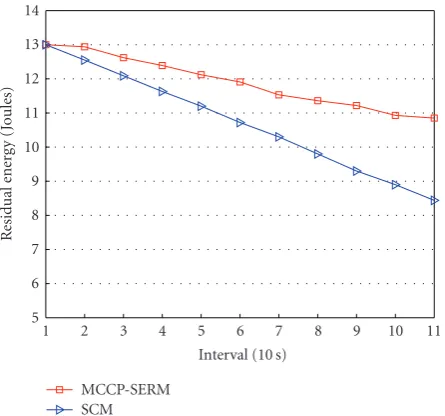
because it does not increase the reporting rate of nodes more than they can handle.
5.6. Scheduled versus jittered forwarding
We compare MCCP with our schedule-based forwarding scheme and with a simple jittered-based forwarding scheme; when both are applied at transport layer. In jittered for-warding version routing, nodes send reporting rate to their previous hop node instead of a schedule. For SERM in Figure 14, we compare these schemes with respect to packet delivery ratio. While for FERM in Figure 15, we compare these schemes with respect to per-node throughput. All
4 6 8 10 12 14 16
R
esidual
energ
y
(J
oules)
0 2 4 6 8 10 12 14 16 18
Interval (10 s) MCCP (FERM)-150 event nodes CCF-150 event nodes
MCCP (FERM)-100 event nodes CCF-100 event nodes
Figure13: Residual energy of 100 and 150 event nodes using MCCP in FERM and CCF.
0 0.2 0.4 0.6 0.8 1
Pa
ck
et
d
el
iv
er
y
ra
ti
o
20 30 40 50 60 70 80 90 100 110 120 130 Number of event reporting nodes
MCCP (SERM)-schedule based forwarding MCCP (SERM)-jitter based forwarding
Figure14: Packet delivery ratio of MCCP in SERM using schedule-based and jitter-schedule-based forwarding.
simulations are run for 150 seconds of event reporting from an event region of 40 m centered at (40,40) coordinates.
Figure 14shows that as the number of nodes increases
0
Figure 15: Per-node throughput of MCCP in FERM using schedule-based and jitter-based forwarding.
6. CONCLUSION
The paper presents a multievent congestion control protocol (MCCP) for wireless sensor networks. MCCP is capable of mitigating congestion while providing maximum event region information, per-node fair event region information, and prioritized event information in case of multiple events. Simulation results confirm that MCCP based on hop-by-hop packet delivery time and buffer size increases the system throughput by efficiently handling congestion in the network. Also, using a scheduled-based scheme at the transport layer for reporting events helps to avoid packet drops in dense regions and increases the packet receive ratio at the destination.
REFERENCES
[1] I. F. Akyildiz, W. Su, Y. Sankarasubramaniam, and E. Cayirci, “Wireless sensor networks: a survey,”Computer Networks, vol. 38, no. 4, pp. 393–422, 2002.
[2] D. Culler, D. Estrin, and M. Srivastava, “Overview of sensor networks,”Computer, vol. 37, no. 8, pp. 41–49, 2004. [3] C.-Y. Wan, S. B. Eisenman, and A. T. Campbell, “CODA:
congestion detection and avoidance in sensor networks,” in Proceedings of the 1st International Conference on Embedded Networked Sensor Systems (SenSys ’03), pp. 266–279, Los Angeles, Calif, USA, November 2003.
[4] T. Moscibroda, “The worst-case capacity of wireless sensor networks,” inProceedings of the 6th International Symposium on Information Processing in Sensor Networks (IPSN ’07), pp. 1–10, Cambridge, Mass, USA, April 2007.
[5] C. T. Ee and R. Bajcsy, “Congestion control and fairness for many-to-one routing in sensor networks,” inProceedings of the 2nd International Conference on Embedded Networked Sensor Systems (SenSys ’04), pp. 148–161, Baltimore, Md, USA, November 2004.
[6] C. Wang, K. Sohraby, and B. Li, “SenTCP: a hop-by-hop congestion control protocol for wireless sensor networks,” in Proceedings of the 24th Annual Joint Conference of the IEEE Computer and Communications Societies (INFOCOM ’05), Miami, Fla, USA, March 2005, poster paper.
[7] C. Wang, B. Li, K. Sohraby, M. Daneshmand, and Y. Hu, “Upstream congestion control in wireless sensor networks through cross-layer optimization,”IEEE Journal on Selected Areas in Communications, vol. 25, no. 4, pp. 786–795, 2007. [8] C. Wang, K. Sohraby, Y. Hu, B. Li, and W. Tang, “Issues of
transport control protocols for wireless sensor networks,” in Proceedings of IEEE International Conference on Communica-tions (ICC ’05), vol. 1, pp. 422–426, Hong Kong, May 2005. [9] C. Wang, K. Sohraby, B. Li, M. Daneshmand, and Y. Hu, “A
survey of transport protocols for wireless sensor networks,” IEEE Network, vol. 20, no. 3, pp. 34–40, 2006.
[10] C. Wang, K. Sohraby, V. Lawrence, B. Li, and Y. Hu, “Priority-based congestion control in wireless sensor networks,” in Proceedings of the IEEE International Conference on Sensor Networks, Ubiquitous, and Trustworthy Computing (SUTC ’06), vol. 1, pp. 22–31, Taichung, Taiwan, June 2006.
[11] B. Hull, K. Jamieson, and H. Balakrishnan, “Mitigating congestion in wireless sensor networks,” in Proceedings of the 2nd International Conference on Embedded Networked Sensor Systems (SenSys ’04), pp. 134–147, Baltimore, Md, USA, November 2004.
[12] O. B. Akan and I. F. Akyildiz, “Event-to-sink reliable transport in wireless sensor networks,” IEEE/ACM Transactions on Networking, vol. 13, no. 5, pp. 1003–1016, 2005.
[13] Y. Zhou, M. R. Lyu, J. Liu, and H. Wang, “PORT: a price-oriented reliable transport protocol for wireless sensor networks,” in Proceedings of the 16th IEEE International Symposium on Software Reliability Engineering (ISSRE ’05), pp. 117–126, Chicago, Ill, USA, November 2005.
[14] S. Chen and N. Yang, “Congestion avoidance based on lightweight buffer management in sensor networks,” IEEE Transactions on Parallel and Distributed Systems, vol. 17, no. 9, pp. 934–946, 2006.
[15] S. Rangwala, R. Gummadi, R. Govindan, and K. Psounis, “Interference-aware fair rate control in wireless sensor net-works,”Computer Communication Review, vol. 36, no. 4, pp. 63–74, 2006.
[16] L. Shanshan, L. Xiangke, P. Shaoliang, Z. Peidong, and J. Jie, “Credit based fairness control in wireless sensor network,” in Proceedings of the 8th ACIS International Conference on Software Engineering, Artificial Intelligence, Networking, and Parallel/Distributed Computing (SNPD ’07), vol. 1, pp. 817– 822, Qingdao, China, July-August 2007.
[17] S. Chen and N. Yang, “Congestion avoidance based on light-weight buffer management in sensor networks,” IEEE Transactions on Parallel and Distributed Systems, vol. 17, no. 9, pp. 934–946, 2006.
[18] L. Galluccio, A. T. Campbell, and S. Palazzo, “CONCERT: aggregation-based congestion control for sensor networks,” in Proceedings of the 3rd ACM International Conference on Embedded Networked Sensor Systems (SenSys ’05), pp. 274– 275, San Diego, Calif, USA, November 2005.
[19] J. W. Gardner, V. K. Varadan, and O. O. Awadelkarim, Microsensors, MEMS and Smart Devices, John Wiley & Sons, New York, NY, USA, 2001.
[20] J. L. Hill and D. E. Culler, “Mica: a wireless platform for deeply embedded networks,”IEEE Micro, vol. 22, no. 6, pp. 12–24, 2002.