© 2015, IRJET.NET- All Rights Reserved Page 1430
DEMOSAICING
Navjot Kaur
1, Dr. Sandeep Sharma
21
Student, CSE, Guru Nanak Dev University, Punjab, India
2Head of department, CSE, Guru Nanak Dev University, Punjab, India
---Abstract
- Demosaicing could be a most paramount a bit of the photo process pipeline in cutting edge cameras. The failure of the utilized demosaicing standard will degenerate the general picture quality generally, in spite of the fact that there are late endeavors to present summed up demosaicing calculations, most demosaicing arrangements inside of the writing zone unit produced for the salicylate pattern. To extricate a full shading picture, a demosaicing system must be connected. Demosaicing procedure using structure examination and connection between the red, unpracticed and blue planes, so demosaicing becomes and major space of analysis in vision process applications. This treatise work deals with rising the content primarily based color filter array. This work has centered on reducing the matter of color artifacts by victimization the illuminate standardization. the general objective is to style and implement the illuminate standardization content based color filter array.Key Words-
CFA, demosaicing, cameras, image.
1. INTRODUCTION
The demosaicing count and the strategy of shading channel play a crucial effect on the way of the yield pictures. Other than better demosaicing techniques, the best way to deal with improve the way of demosaicing pictures is to redesign the setups of CFA. Albeit there have been late endeavors to present summed up
demosaicing calculations, most demosaicing
arrangements in the writing are created for the Bayer example. The most widely recognized strategy for the insertion of missing qualities is to utilize the spatial invariant framework, for instance, bilinear or bi-cubic presentation. Regardless, this may prompt the false shading ancient rarities wherever there is a sudden change in the shading change. The quality can be enhanced by applying the insertion over shading contrasts to attempt the relationship between the shading channels. On the other hand, the absence of
spatial adaptiveness would even now constrain the insertion execution. The effectiveness of the interjection system relies on upon the utilization of both the ghastly and spatial relationships. The essential presumption is that shading proportion/contrast is consistent over a nearby separation inside a given item. This suspicion is liable to break separated crosswise over limits, henceforth numerous demosaicing calculations attempt to use it adaptively in somehow.
Fig – 1: Color Filter Array
1.1 Inter-channel correlation
© 2015, IRJET.NET- All Rights Reserved Page 1431 The green plane is conventionally imitated first in light
of the way that it contains twofold the same number of tests as the red or blue planes. In this manner, the green plane has the vast majority of the spatial data of the photo to be demosaicked and has eminent impact on the perceptual method for the photo. In addition, once the green plane is completely populated, the green plane can be utilized to guide the subsequentred and blue plane expansion by making full and direct use of channel affiliation.
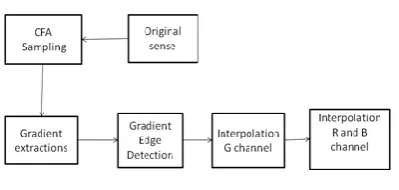
1.2 A Gradient Based Edge Sensing Scheme
Stream outline is indicated as Fig.2 In the first place we compute the angles of shading contrasts on the missing green channel and the red channel. Edge recognition is the following step .We look at slopes in changed headings and discover the bearing with the base angle .The third step is to insert the missing green channel. The last step is to add the red and blue channel. The complete calculation will be depicted regulated as the
accompanying:
Fig – 2: Gradient Based Edge Sensing Scheme
Picture demosaicing utilizing substance and shading connection analysis[3].
A picture dataset is utilized for the arrangement of the look-up table which embodies a picture piece structure quantify as the record and corresponding channel coefficients for the demosaicing technique. This dataset is aimlessly assembled from some common testing pictures and highlight groupings of picture changing research and contains around 100 pictures/traces. The logged off dataset is used to make a GRBG Bayer illustration picture from the initially red, green and blue
planes. This misleadingly mosaiced picture serves as a request data set. The figuring in like manner has accessible to it the initially red, green and blue planes, which are used as the reference target pictures in the midst of get ready. By using their relating target (one of a kind) pixels, the perfect channel coefficients can be gotten by system for a Least Squares minimization. The gathering would try to see practically identical picture substance as near classes.
Fig – 3: Least Squares minimization
2. RELATED WORK
A Modified Low Power Color Filter Array
Interpolation [Mohan baabu, Vinoth kumar,
Ponvasanth, 2014]
[4]© 2015, IRJET.NET- All Rights Reserved Page 1432 Image demosaicing utilizing substance and shading
relationship examination [Ling Shao, Amin Ur Rehman,2014][5]
In this paper we propose a substance adaptable demosaicing system utilizing structure examination and relationship between the red, green and blue planes. These two points of view are used for the game plan of a bit of pixels to made arranged channels. The proposed technique arrangements to duplicate a brilliant demosaiced picture from a Bayer sample in a shading channel show viably.
Neighborhood versatile heading all color channel
exhibit interpolation taking into account between
channel connection [Xiangdong Chen , LiwenHe ,
GwanggilJeon, JechangJeong]
[6]The reckoning contains two stages: a contribution step and a refinement step. The missing green shading data is at initially included by utilizing the shading channel refinement. In the refinement step, a territory weighted directional contribution strategy guided by the preinterpolated green channel is connected with refine the insertion happens along the picked presentation course. Lastly, post-dealing with is finished to yield the last demosaicked full shading picture. In view of well assessing the interpolation orientation considering strong between channel relationship, the interpolation precision is ensured, furthermore, a powerful post-
transforming was actualized to diminish the
interpolation antiquities.
Joint denoising and demosiacing of boisterous CFA
images in light of between shading relationship
[Xingyu ZHANG, Ming-Ting SUN, Lu FANG, Oscar C.
AU]
[7]This paper proposes a Joint Denoising and Demosaicking in view of between Color relationship (JDDC) plan. We propose another system that straightly consolidates an extricated luminance image and a low-passed RGB images to get a full shading image. Given the clamor in the extricated luminance image and the low-passed RGB images are non-stationary and mostly associated, we alter the traditional Non-Local Means (NLM) channel to denoise the removed luminance image and the low-passed RGB images before the mix.
A Gradient Based Edge Sensing Scheme for Color
Filter Array Demosaicking [Da-Cheng Sung,
Hen-Wai Tsao]
[8]Proficient demosaicking calculation is important to modify the other two missing shading components in every pixel. This paper proposed a slope based edge sensing calculation for shading channel cluster interpolation to upgrade the edge data and keep away from zipper impact. Our strategy first concentrates the inclination in distinctive bearings and endeavors the slope edge discovery to restore the shading station in subtle element. Analysis results demonstrate that our calculation performs superiorly in PSNR and visual image quality contrasted and different calculations.
Multiscale Gradients-Based Color Filter Array
Interpolation
[Ibrahim
Pekkucuksen,
Yucel
Altunbasak]
[9]In this paper, we propose a demosaicing procedure that uses multiscale shading inclinations to adaptively join shading unpredictability gages from distinctive course. The proposed arrangement does not oblige any purposes of repression since it doesn't make any hard choices, and it is no iterative. In any case, most suitable for the Bayer CFA diagram, the method can be reached out to other mosaic representations.
Shading Filter Array Demosaicking Using
Self-approval Framework [Ting-Chun Wang,Yi-Nung
Liu, Shao-Yi Chien]
[10]In this paper, a self validation framework for shading demosaicking is proposed. In the proposed affirmation toward oneself framework, different figuring’s under particular hypotheses will be performed to make various contenders. By then the last estimation of a missing shading example will be picked by evaluating the close-by consistency of each figuring with twofold insertion. With this framework, the characteristics of different estimations can be joined and thusly wipe out shading artifacts.
Grouped channel based post-pressure interpolation
for shading channel show demosaicing [Jing-Ming
Guo, Yun-Fu Li, Bo-Syun Lai, Peng-Hua Wang,
Jiann-Der Lee]
[11]This framework can be used for upgrading the picture way of the contributed results got by other CFA pictures. Above all else, each pixel is assembled by neighborhood organization contrast and point. By then, differing
Slightest Mean-Square (LMS) channels are
© 2015, IRJET.NET- All Rights Reserved Page 1433
Joint demosaiking and denoising by aggregate
variety minimization [Laurent Condat, Saleh
Mosaddegh]
[12]A variational plan in which the reproduced image has negligible aggregate variety under the limitation of consistency with the accessible estimations. Along these lines, the recuperated shading image has smooth chrominance yet the sharp edges are kept up and the commotion is exchanged to the luminance channel. This channel is denoised therefore.
Edge Strength Filter Based Color Filter Array
Interpolation
[Ibrahim
Pekkucuksen,
Yucel
Altunbasak]
[13]A presentation free edge quality channel and apply it to the demosaicing issue. Edge quality channel yield is used both to overhaul the starting green channel expansion and to apply the determined shading capability manage adaptively. This essential edge coordinated system yields apparently fulfilling results with high CPSNR.
Shading Filtering Method for CFA Images Based on
Gradient [Haijiang Sun, Yanjie Wang]
[14]To render a full-shading picture, require an insertion handle typically insinuated as CFA demosaicking, is obliged to gage the other two obligations for passing on a full-shading picture. In any case, the whine in imaging sensors not just corrupts the shading channel group, meanwhile exhibits relics in the midst of the shading introduction step and effect nature of pictures. Keeping in mind the end goal to gain brilliant full-shading images, embrace a kind of reasonable and compelling interpolation calculation taking into account inclination, at the season of uprooting the commotion, store image outskirt and point of interest data plainly.
Lossless/close lossless shading image coding by
converse
demosaicing
[Ryo
Kuroiwa,
Ryo
Matsuoka, Seisuke Kyochi, Keiichiro Shirai,
Masahiro Okuda]
[15]In this paper, we present a novel system for lossless/nearlossless (LS/NLS) shading image coding helped by a backwards demosaicing. Customary systems are commonly in light of prediction(and quantization for NLS coding) trailed by entropy coding, for example, the JPEG-LS for bit rate sparing. The methodology of this work is entirely unexpected from the ordinary ones.
Fundamentally, shading images are made by
demosaicing Bayer-example shading channel cluster (CFA) whose administrator can be communicated as
square grids. By utilizing the (pseudo) reverse grid of a joint demosaicing and shading to-dark transformation, the proposed decoder can recuperate the shading image from its comparing dim image information which is losslessly transmitted by the proposed encoder.
Joint denoising and demosaicking of boisterous CFA
images taking into account between shading
correlation [Xingyu ZHANG, Ming-Ting SUN, Lu
FANG, Oscar C. AU]
[16]This paper proposes a Joint Denoising and Demosaicking taking into account between Color relationship (JDDC) plan. We propose another structure that directly consolidates a removed luminance image and a low-passed RGB images to get a full shading image. Given the clamor in the separated luminance image and the low-passed RGB images are non-stationary and incompletely associated, we alter the established Non-Local Means (NLM) channel to denoise the removed luminance image and the low-passed RGB images before the mix.
Directional shading channel exhibit interpolation in
view of multiscale shading gradients [Ibrahim
Pekkucuksen, Yucel Altunbasak]
[17]In this paper a directional way to deal with deal with the CFA interposition issue that makes utilization of multi-scale shading slopes. The relationship between shading inclinations on unmistakable scales is utilized to convey developments in vertical and level introduction. We pick how much every rushing toward add to the green channel contribution considering these signs. The proposed strategy is without a doubt not difficult to execute since it is non-iterative and most distant point free. Tests on test pictures display that it offers dominating goal and subjective insertion quality.
Edge situated directional shading channel exhibit
interpolation
[Ibrahim
Pekkucuksen,
Yucel
Altunbasak]
[18]© 2015, IRJET.NET- All Rights Reserved Page 1434
3. CONCLUSIONS
To change over full shading picture into the Bayer layer i.e. projection of the full shading picture into two dimensional one. To grow full shading picture utilizing the enhanced enlighten standardization based substance based shading channel exhibit. To draw comparison between content based color filter array with illuminate normalization based content based color filter array based on the following parameters:-
a. Peak signal to noise ratio
b. Mean square error demosaicking." In Consumer Electronics (GCCE), 2013 IEEE 2nd Global Conference on, pp. 249-252. IEEE, 2013. [2] Sung, Da-Cheng, and Hen-Wai Tsao. "A gradient based edge sensing scheme for color filter array demosaicking." In Consumer Electronics (GCCE), 2013 IEEE 2nd Global Conference on, pp. 249-252. IEEE, 2013. [3] Shao, Ling, and Amin Ur Rehman. "Image demosaicing using content and colour-correlation analysis." Signal Processing 103 (2014): 84-91.
[4] Kumar, Vipin. "A modified low power color filter array interpolation." InCommunications and Signal Processing (ICCSP), 2014 International Conference on, pp. 011-015. IEEE, 2014.
[5] Shao, Ling, and Amin Ur Rehman. "Image demosaicing using content and colour-correlation analysis." Signal Processing 103 (2014): 84-91.
[6] Chen, Xiangdong, Liwen He, Gwanggil Jeon, and Jechang Jeong. "Local adaptive directional color filter array interpolation based on inter-channel correlation." Optics Communications 324 (2014): 269-276.
[7] Farsiu, Sina, Dirk Robinson, Michael Elad, and Peyman Milanfar. "Simultaneous demosaicing and resolution enhancement from under-sampled image sequences." (2008).
[8] Sung, Da-Cheng, and Hen-Wai Tsao. "A gradient based edge sensing scheme for color filter array demosaicking." In Consumer Electronics (GCCE), 2013 IEEE 2nd Global Conference on, pp. 249-252. IEEE, 2013. [9] Pekkucuksen, Ibrahim, and Yucel Altunbasak. "Multiscale gradients-based color filter array interpolation." Image Processing, IEEE Transactions on 22, no. 1 (2013): 157-165.
[10] Wang, Ting-Chun, Yi-Nung Liu, and Shao-Yi Chien. "Color Filter Array Demosaicking Using Self-validation Framework." In Multimedia and Expo (ICME), 2012 IEEE
International Conference on, pp. 604-609. IEEE, 2012.
[11]Jing-Ming Guo,Yun-Fu Li, Bo-Syun Lai, Peng-Hua
Wang,Jiann-Der Lee,”Classified-filter-based
post-compression interpolation for color filter array demosaicing”,2012.
[12] Condat, Laurent, and Saleh Mosaddegh. "Joint demosaicking and denoising by total variation minimization." In Image Processing (ICIP), 2012 19th IEEE International Conference on, pp. 2781-2784. IEEE, 2012.
[13] Pekkucuksen, Ibrahim, and Yucel Altunbasak. "Edge strength filter based color filter array interpolation." Image Processing, IEEE Transactions on 21, no. 1 (2012): 393-397.
[14] Sun, Haijiang, and Yanjie Wang. "Color filtering method for CFA images based on gradient."
In Communication Systems and Network Technologies
(CSNT), 2012 International Conference on, pp. 243-245. IEEE, 2012.
[15]Kuroiwa, Ryo, Ryo Matsuoka, Seisuke Kyochi, Keigo Shirai, and Masumi Okuda. "Lossless/near-lossless color image coding by inverse demosaicing." In Acoustics, Speech and Signal Processing (ICASSP), 2014 IEEE International Conference on, pp. 2011-2014. IEEE, 2014. [16] Zhang, Xingyu, Ming-Ting Sun, Lu Fang, and Oscar C. Au. "Joint Denoising and demosaicking of noisy CFA images based on inter-color correlation." InAcoustics, Speech and Signal Processing (ICASSP), 2014 IEEE International Conference on, pp. 5784-5788. IEEE, 2014. [17] Pekkucuksen, Ibrahim, and Yucel Altunbasak. "Directional Color Filter Array interpolation based on multiscale color gradients." In Acoustics, Speech and Signal Processing (ICASSP), 2011 IEEE International Conference on, pp. 997-1000. IEEE, 2011.
[18] Pekkucuksen, Ibrahim, and Yucel Altunbasak. "Edge oriented directional color filter array interpolation."
In Acoustics, Speech and Signal Processing (ICASSP), 2011
IEEE International Conference on, pp. 993-996. IEEE, 2011.
[19] Maschal, Robert A., S. Susan Young, Joseph P. Reynolds, Keith Krapels, Jonathan Fanning, and Ted Corbin. "New image quality assessment algorithms for CFA demosaicing." Sensors Journal, IEEE 13, no. 1 (2013): 371-378.
[20] Lee, Dongjae, Byung-Joon Baek, and Tae-Chan Kim. "Two-layer color filter array for high quality images." In Image Processing (ICIP), 2012 19th IEEE International