© 2015, IRJET.NET- All Rights Reserved
Page 1869
Topology Optimization of Modified Piston, Bridge Structures and
Subway Tunnel Problem
Akash Dhiman
1, Anadi Misra
21
PG Student, Mechanical Department, College of Technology, GBPUAT Pantnagar, Uttarakhand- India-263145
2
Professor, Mechanical Department, College of Technology, GBPUAT Pantnagar, Uttarakhand- India-263145
---***---Abstract -
Topology Optimization is numerical basedmethod used for finding the optimal distribution of material in a given design domain. In this paper topology optimization of piston, modified bridge structure and subway tunnel problem under plane stress condition has been done. For topology optimization a parameter called compliance is computed for all structures. Apart from this optimized shape, maximum von Mises, maximum X and Y direction displacements and stresses are also computed. The method adopted for topology optimization is Optimality Criteria Method (OCM) employed through a finite element software ANSYS. In ANSYS Optimality Criteria Method is applied in conjunction with Solid Isotropic Material with Penalization (SIMP).
Key Words: Topology Optimization, von Mises stress,
Compliance, OCM, SIMP, ANSYS
1. INTRODUCTION
Topology optimization is implemented to find the best use of material within a given design domain. in topology optimization there are two types of domains or structures- continuum and discrete structures. Discrete domain contains structures like bridges, cranes and other truss structures while continuum structures often refer to smaller, single piece parts and components like beams and columns. In this work topology optimization of linear elastic continuum structure is done. For finite element analysis 8 node 82 Quad elements is used in ANSYS for the plane stress condition assumed.
[1]Matteo Bruggi, Paolo Venini showed an alternative formulation for the topology optimization of structures made of incompressible materials. Their work consist of a truly mixed variational formulation coupled to a mixed element discretization that uses composite elements of Johnson and Mercier for the discritization of the stress field.
[2]X.Guo et al. presented structural topology optimization considering the uncertainity of boundary variations through level set approach. They choose fundamental frequency and compliance of structure enduring the worst
case perturbation as the objective function for ensuring the robustness of the optimal solution. In the present work the dimensions of modified bridge structure one (four point load bridge structure)are same as that mentioned for two point load bridge structure in [1]. The boundary condition for side constraints are taken from two end clamped beam as mentioned in the work of [2].
For modified bridge structure two (three point load bridge structure) the length and boundary conditions are same as mentioned for two point load bridge structure in [1] but the loads are applied at the middle point and two extremities of upper side.
[3] O. Sigmund, P.M. Clausen developed a new way to solve pressure load problems in topology optimization. In the problems considered they used a mixed displacement pressure formulation and defining the void phase to be an incompressible hydrostatic fluid. In the piston problem considered in [3] they used a three phase interpolation scheme to distribute compressible elastic material, incompressible fluid and void in the design domain.
[4] M. Bruggi, C. Cinquini presented a ‘‘truly-mixed” variational formulation coupled to a discretization based on the Johnson and Mercier finite element, that both pass the inf–sup conditions of the problem even in the presence of incompressible materials. In [4] for two piston examples considered the pressure load is applied through an incompressible fluid region around the design domain.
© 2015, IRJET.NET- All Rights Reserved
Page 1870
[6] H. Zhang et al. presented an element based searchscheme to identify load surfaces. The load surfaces are formed by the connection of the real boundary of elements
and the pressures are transferred directly to point load is applied on the upper side to show the affect of a concentrated mass of soil and rock at any point. Here the position of point load is not specified as it is assumed that the concentrared mass of soil and rock can be present anywhere above subway tunnel structure.
[7] Ekrem Buyukkaya, Muhammet Cerit presented thermal analyses on a conventional (uncoated) diesel piston, made of aluminum silicon alloy and steel. Secondly, thermal analyses are performed on pistons, coated with MgO–ZrO2 material by means of using a commercial code, namely ANSYS. For modified bridge structures and subway tunnel problem the material taken is steel and for piston the material is an Aluminium - Silicon alloy (AlSi). For steel and AlSi alloy properties are taken from [7].
[8] Dheeraj Gunwant, Anadi Misra compared and validated the result of ANSYS based Optimality criterion with the results obtained by Element Exchange Method. The mathematical approach of Optimality Criteria used in this in this work is taken from [8].
2.METHOLOGY
2.1 .The Optimality Criterion Approach
Compliance = ∫Vfu dV + ∫S tu dS + ….(1) Where,u = Displacement field
f = Distributed body force (gravity load etc.)
Fi = Point load on ith node
ui = ith displacement degree of freedom
t = Traction force
S = Surface area of the continuum
V = Volume of the continuum
The Lagrangian for the optimization problem is defined as:
L(xj) = uTKu + Λ ( jvj - Vo ) + λ1 ( Ku – F ) + 2j + (xmin – xj) + 3j ( xj - 1 )………... ..(2)
Where Λ, λ1, λ2 and λ3 are Lagrange multipliers for the various constraints. The optimality condition is given by:
=0 where j = 1,2,3…..n ……..… (3) maximum allowable change in a single OC iteration. Also, n
is a numerical damping coefficient, and is usually taken to be ½. The Lagrange multiplier for the volume constraint Λ is determined at OC iteration using a bisection algorithm.
xj is the value of the density variable at each iteration step.
uj is the displacement field at each iteration step determined from the equilibrium equations.
2.2 . Ojective Function and Constraint Equations
The objective function in topology optimization is minimization of structural compliance with a constraint on the material volume.The objective function is given by equation :
Min C (x) = FTu………(8) The force vector is given by
F= K(x)u…………(9)
C(x)= uTKu = jTKj(xj)uj………..(10)
Subject to
jVj ≤ Vo………….(11)© 2015, IRJET.NET- All Rights Reserved
Page 1871
3. SPECIMEN GEOMETRY AND BOUNDARY
CONDITIONS
3.1 Four Point Load Bridge Structure
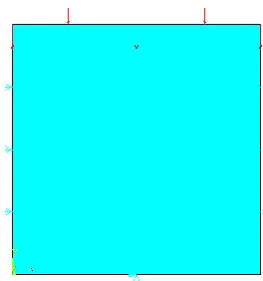
Figure 1 shows design domain for first modified bridge structure (Four Point Load Bridge Structure). The length and height of bridge is 8m and 4m. The left and right side of bridge structure is fully constrained that is their degree of freedom in all directions is zero. It is subjected to four point loads. Two point loads are present at the middle point of upper and lower side while other two are applied at end points of upper side as shown by red arrows in the figure. The material taken is steel having Young’s modulus of 200 GPa and Poisson’s ratio of .3. The volume fraction taken is .4. The magnitude of applied load is 20000N.
Fig -1:Design domain of four point load bridge structure
3.2 Three Point Load Bridge Structure
Figure 2 shows design domain for second modified bridge structure (Three Point Load Bridge Structure). The length and height of bridge is 8m and 4m. The lower half portion of left and right side is fully constrained.Two point loads are applied at end points of upper side and the third one at the middle point of upper side as shown by red arrows in the figure. The material is steel having Young’s modulus of 200 GPa and Poisson’s ratio of .3. The volume fraction taken is .4. The magnitude of applied load is 20000N.
Fig -2: Design domain of three point load bridge structure
3.3 Piston Subjected to Pressure and Point Loads
Figure 3 shows design domain for piston structure. The length and height of piston is 80 mm. The left and right sides of the domain are constrained in the x-direction, representing the cylinder walls, and the center of the bottom edge is fully constrained. The pressure applied at the upper side is 2 MPa and a point load of 20000 N is applied at middle and end points of upper side. Here red arrows at the middle and end points of upper side shows applied point load (20000 N) and other two arrows present at some distance from end points shows pressure load (2 MPa). The material taken is AlSi alloy having Young’s modulus of 90 GPa and Poisson’s ratio of .3. The volume fraction taken is .4.Fig -3: Design domain of piston structure
3.4 Modified Subway Tunnel Problem
Figure 4 shows design domain for modified subway tunnel problem. The length and height of are 8m and 4m. The design domain is subjected to pressure load of 2 MPa on left, right and upper sides as shown by red arrows acting above blue region. It is also acted upon by a point load of 20000 N on upper side as shown by red arrow acting in the blue region. The material is steel having Young’s modulus of 200 GPa and Poisson’s ratio of .3. The volume fraction taken is .4.
© 2015, IRJET.NET- All Rights Reserved
Page 1872
4. RESULTS AND DISCUSSION
4.1 Four Point Load Bridge Structure
Figure 5 shows the optimized image for four point load bridge structure. Here red region shows solid material and white region shows void. Vertical blue lines represent constrained sides and red arrows shows applied point load.
Fig -5: Optimized topology for four point load bridge structure
Table -1: Maximum displacements in X any Y directions
Max. positive X-displacement
.815 X 10-4 mm
Max. negative X-displacement
.865 X 10-4 mm
Max. negative Y-displacement
.126 X 10-2 mm
Table 1 shows that there is a relatively large displacement in negative Y direction as compared to X direction and there is no displacement in positive Y direction.
Table -2: Maximum von Mises, X and Y stress components
Max. X tensile stress 223519 N/m2
Max. X compressive stress 214604 N/m2
Max. Y tensile stress 383376 N/m2
Max. Y compressive stress 379723 N/m2
Max. von Mises stress 333545 N/m2
Fig -6: Deformed and undeformed shape for optimized topology
In fig. 6 the black lines shows undeformed shape and blue region deformed shape. The gap between black linings and blue region shows extent of deformation. As evident from fig. there is considerable amount of deformation at the point of application of load and at the constrained positions there is no deformation.
Table -3: Compliance and iteration values
Compliance initial value (1st iteration)(x)
.17406 N-m
Compliance final value (y) .0448 N-m
No. of iterations 29
% reduction of compliance w.r.t initial value (x-y)/y×100)
74.26 %
Table 3 shows that there is a 74.26 % decrement in compliance.
© 2015, IRJET.NET- All Rights Reserved
Page 1873
Fig. 7 shows that compliance decreases sharply from 1stiteration to 7th iteration and from 8th iteration onwards having a relatively flat slope.
4.2 Three Point Load Bridge Structure
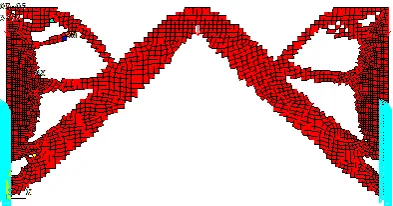
Figure 8 shows the optimized image for three point load bridge structure. Here a butterfly type structure is obtained as optimized topology.
Fig -8: Optimized topology for three point load bridge structure
Table -4:Maximum displacements in X any Y directions
Max. positive X-displacement
.722 X 10-3 mm
Max. negative X-displacement
.768 X 10-3 mm
Max. negative Y-displacement
.151 X 10-2 mm
Here also there is a relatively large displacement in negative Y direction as compared to X direction and there is no displacement in positive Y direction.
Table-5: Maximum von Mises, X and Y stress components
Max. X tensile stress 496698 N/m2
Max. X compressive stress 277199 N/m2
Max. Y tensile stress 298968 N/m2
Max. Y compressive stress 1.1 X 10⁶ N/m2
Max. von Mises stress 1.53 X 10⁶ N/m2
Fig -9: Deformed and undeformed shape for optimized topology
As evident from fig. 9 there is considerable amount of deformation at the point of application of load and at the constrained positions there is no deformation.
Table -6: Compliance and iteration values
Compliance initial value (1st iteration)(x)
.2568 N-m
Compliance final value (y) .057625 N-m
No. of iterations 99
% reduction of compliance w.r.t initial value (x-y)/y×100)
77.65 %
Table 6 shows that there is a 77.65 % decrement in compliance but here the number of iterations for convergence are very large as compared to previous example.
Fig -10: Compliance vs iteration plot for three point load bridge structure
© 2015, IRJET.NET- All Rights Reserved
Page 1874
parabolic like curve. From 10th to 99th (last iteration) theslope is almost horizontal.
4.3 Piston Subjected to Pressure and Point Loads
Figure 11 shows the optimized image for piston. Here the shape obtained is different from that mentioned in [5]. In [5] the branches in the optimized structure are more widespread and thin whereas the optimized piston shown below has thick branches and they are not as widespread as in [5].Fig -11: Optimized topology for piston
Table -7:Maximum displacements in X any Y directions
Max. positive X-displacement
.2503 mm
Max. negative X-displacement
.240025 mm
Max. negative Y-displacement
5.185 mm
Here the maximum displacement in negative Y direction is very as compared to X direction displacements.
Table-8: Maximum von Mises, X and Y stress components
Max. X tensile stress 14326 N/mm2
Max. X compressive stress 63333 N/mm2
Max. Y tensile stress 25531 N/mm2
Max. Y compressive stress 114685 N/mm2
Max. von Mises stress 118262 N/mm2
Fig -12: Deformed and undeformed shape for optimized topology
Here the deformation is maximum for the points where pressure load and point loads are acting simultaneously i.e. at middle and end points of upper side and at constrained positions deformation is zero i.e. at fixed sides and middle constrained point.
Table -9: Compliance and iteration values
Compliance initial value (1st iteration)(x)
.11319 X 107 N-mm
Compliance final value (y) .23127 X 106 N-mm
No. of iterations 15
% reduction of compliance w.r.t initial value (x-y)/y×100)
79.57%
Table 9 shows that there is a 79.57 % decrement in compliance and the convergence is obtained in very less number of iterations.
© 2015, IRJET.NET- All Rights Reserved
Page 1875
The graph falls sharply from 1st iteration to 4th iterationand afterwards has an almost horizontal slope.
4.4 Modified Subway Tunnel Problem
For modified subway tunnel problem an arch type structure resembling a subway tunnel is obtained as an optimal topology of the given design domain.
Fig -14: Optimized topology for modified subway tunnel problem
Table -10:Maximum displacements in X any Y directions
Max. positive X-displacement
.23 mm
Max. negative X-displacement
.234 mm
Max. negative Y-displacement
.476 mm
The displacements shown in table 10 are nearly same in magnitude.
Table-11: Maximum von Mises, X and Y stress components
Max. X tensile stress 4.8 X 10⁷ N/m2
Max. X compressive stress 2.98 X 10⁷ N/m2
Max. Y tensile stress 5.53 X 10⁷ N/m2
Max. Y compressive stress 2.03 X 10⁸ N/m2
Max. von Mises stress 2.55 X 10⁸ N/m2
Fig -15: Deformed and undeformed shape for optimized topology
At the point of application of load and the lines where pressure is applied the deformation is very large as compared to regions around constrained points.
Table -12: Compliance and iteration values
Compliance initial value (1st iteration)(x)
27281 N-m
Compliance final value (y) 8116.6 N-m
No. of iterations 13
% reduction of compliance w.r.t initial value (x-y)/y×100)
70.25%
Table 12 shows that there is a 70.25 % decrement in compliance and the convergence is obtained in 13 iterations.
Fig -16: Compliance vs iteration plot for modified subway tunnel
© 2015, IRJET.NET- All Rights Reserved
Page 1876
decrement in slope and from 5th iteration to last iteration(13th) the slope is relatively flat.
5. CONCLUSIONS
This work gives an insight into the application of Optimality Criteria Method to bridge problems, piston and subway tunnel problem under different loading and boundary conditions. For both bridge structures considered truss type topologies are obtained which suggests the best suited arrangement of material for a bridge subjected to prescribed loading and boundary conditions. In regard of piston problem the optimal topology needs further refinement by subsequent shape and size optimization procedures. The optimal topology obtained in case of modified subway tunnel problem resembles the actual subway tunnel structure. The subway tunnel in this work is only an illustrative example regarding applicability of OCM. In fact for actual subway tunnel many factors like elasticity foundation, seepage and gravity load due to soil and rocks are to be considered. This work also demonstrates the capability of OCM in topology optimization problems subjected to design-dependent pressure loads.
REFERENCES
[1] Bruggi, Matteo, and Paolo Venini. "Topology
optimization of incompressible media using mixed
finite elements." Computer methods in applied
mechanics and engineering 196, no. 33 (2007): 3151-3164.
[2] Guo, Xu, Weisheng Zhang, and Li Zhang. "Robust
structural topology optimization considering
boundary uncertainties." Computer Methods in Applied
Mechanics and Engineering 253 (2013): 356-368.
[3] Sigmund, Ole, and Peter Michael Clausen. "Topology
optimization using a mixed formulation: an alternative
way to solve pressure load problems."Computer
Methods in Applied Mechanics and Engineering 196, no. 13 (2007): 1874-1889.
[4] Bruggi, Matteo, and Carlo Cinquini. "An alternative
truly-mixed formulation to solve pressure load
problems in topology optimization." Computer
Methods in Applied Mechanics and Engineering 198, no.
17 (2009): 1500-1512.
[5] Lee, Edmund, and Joaquim RRA Martins. "Structural
topology optimization with design-dependent
pressure loads." Computer Methods in Applied
Mechanics and Engineering 233 (2012): 40-48.
[6] Zhang, Hui, Xiong Zhang, and Shutian Liu. "A new
boundary search scheme for topology optimization of
continuum structures with design-dependent
loads."Structural and Multidisciplinary
Optimization 37, no. 2 (2008): 121-129.
[7] Buyukkaya, Ekrem, and Muhammet Cerit. "Thermal
analysis of a ceramic coating diesel engine piston
using 3-D finite element method." Surface and
Coatings Technology 202, no. 2 (2007): 398-402.
[8] Gunwant, Dheeraj, and Anadi Misra. "Topology
optimization of continuum structures using optimality
![Figure 11 shows the optimized image for piston. Here the shape obtained is different from that mentioned in [5]](https://thumb-us.123doks.com/thumbv2/123dok_us/975400.1119986/6.595.73.239.220.354/figure-shows-optimized-image-piston-obtained-different-mentioned.webp)