© 2015, IRJET.NET- All Rights Reserved Page 1107
EXPERIMENTAL STUDY ON CI ENGINE PERFORMANCE USING
BIO DIESEL BLENDS
P.V.Ramana
1, P.RamanathReddy
2, C.Balaram
3, A.Sharath kumar
41
Research scholar, Mechanical, JNTU Anantapur, A.P, [email protected]
2Asst.Professor, Mechanical, NallaMalla Reddy Engineering college, Telengana, India
3Asst.Professor, Mechanical, NallaMalla Reddy Engineering college, Telengana, India
4Asst.Professor, Mechanical, NallaMalla Reddy Engineering college, Telengana, India
---***---Abstract -
Internal combustions engines are usingpetroleum products as a fuel for its running. Due to urbanization and increased population usage of no. of automobiles increased and consumption of petroleum products increased so continuous demand for the energy consumption increased from year to year as a result reserves of petroleum product are depleting in a faster rate. If this trend continuous in the same way entire world may face problem with shortage of petroleum products. Therefore it is necessary to find alternative fuels to be used in the standard internal combustion engine to bridge this gap of increased consumption. Simultaneously it is necessary to improve the combustion engine in terms of fuel efficiency and emissions. As we know so far petroleum based fuels are giving higher efficiency as compared with alternative fuels so to reduce the fuel consumption strict measures to be adopted to control the consumption and also alternative fuels to be developed to mix with the petroleum fuels so that petroleum product reserves will go for longer period and it will meet with increased demand. Otherwise once these fossil fuels are consumed means again it won’t exist in nature because of its non-renewable nature. So in this paper focus is given to increase the existence of non-renewable fuels by reducing its consumption with addition of suitable proportions of bio-fuels. In that context importance is given one is to improve the technology to increase the kilometers per hour of unit fuel consumption by improving the suitable modifications in the engine design and other is reducing the fuel consumption by adding renewable blends so petroleum products may last for several years. Here an experimental attempt is being made to reduce the consumption of fossil fuels (petroleum products) by adding bio-diesel blends of small quantities of renewable fuels. It will help to reduce the consumption of petroleum products hence longer period of reserves may be achieved. More over
biodiesels are bio degradable, eco-friendly, on toxic and clean burning In this experimentation an attempt to mix the cotton seed oil of different proportions with diesel on a single cylinder diesel engine conducted and various performances are studied in keeping view of reduce the consumption quantity and environmental safety by controlling the exhaust emissions
Bio-diesel has gained much attention in recent years due to the increasing environmental awareness. It is produced from renewable resources and, more importantly, is a clean burning fuel that does not contribute to the net increase of carbon dioxide.
Key Words:
bio-diesel, cotton seed oil, petroleum
products, B10, B20, B30, Transesterification
1.
INTRODUCTION
Bio-diesel fuel for diesel engines is produced from cotton seed oil, vegetable oil or animal fat by the chemical process of etherification. This paper presents a brief study of diesel engine performance and an overview of biodiesel, including performance characteristics, economics, and potential demand. The performance and economics of biodiesel are compared with that of petroleum diesel.
© 2015, IRJET.NET- All Rights Reserved Page 1108 A variety of bio-liquids can be used to produce
biodiesel. The main plants whose oils have been considered as feed stocks for bio fuel are soya bean oil, cotton seed oil, rapeseed oil, palm oil, sunflower oil and jatropha oil. Others in contention are mustard, hemp, castor oil, waste vegetable oil, and in some cases even algae. There is going on research into finding more suitable crops.
2.0 PREPARATION OF BIODIESEL
2.1 process of preparation
The process of converting vegetable oil in to biodiesel Fuel is called Transesterification. Transesterification means taking a triglyceride molecule or a complex fatty acid, neutralizing the free fatty acid, removing the glycerin and creating an alcohol ester. This is accomplished by mixing methanol with sodium hydroxide to make sodium methoxide. This liquid is then mixed into the vegetable oil. After the mixture has settled, glycerin is left on the bottom and methyl esters or bodies is left on top and is washed and filtered. The final product biodiesel Fuel when used directly in a diesel engine will burn up to 75% cleaner than mineral oil Diesel fuel.
Table 1: quantity of Bio-diesel prepared
Notation Blend name
Fuel quantity(ml
)
Bio-diesel quantity
(ml)
Diesel quantity
(ml) CSO10 B10 1000 100 900 CSO20 B20 1000 200 800
CSO30 B30 1000 300 700
Fig 1: prepared samples of bio diesel blends
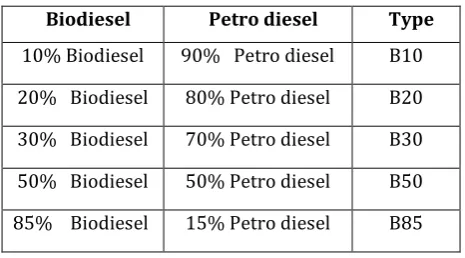
Table 2: Blends of Biodiesel
Biodiesel Petro diesel Type 10% Biodiesel 90% Petro diesel B10
20% Biodiesel 80% Petro diesel B20
30% Biodiesel 70% Petro diesel B30
50% Biodiesel 50% Petro diesel B50
85% Biodiesel 15% Petro diesel B85
2
.
2 Major Advantages of bio diesels
high energy density liquid in form and thus easily to be handled when burned and it emits less soot
It is neither harmful nor toxic to humans, animals, soil or water
It is neither flammable nor explosive, and does not release toxic gases
It is easy to store, transport and handle
It does not cause damage if accidentally spilt
Its handling does not require special care to be taken
It is produced directly by nature and It is a recyclable form of energy
It does not have adverse ecological effects when used
It does not contain sulphur it does not cause acid rain and ground water pollution can used in all types of forestry machinery, Lorries, vans, pick-ups, etc. Private cars (no CO2 increase, non inflammable fuel) Mixers, mills, pumps, ventilators, and other stationary industrial and agricultural machinery (no toxic gases or inflammable liquids)
Table 3: comparisons of oil properties
Property Diesel CSO Methy l Ester
CS10 CS20 CS30 Heating
value(kJ/kg)
43000 39648 42308 42116 41834
Carbon residue (% by weight)
<0.35 0.42 0.39 0.38 0.36
Density (g/cc) 0.815 0.850 0.830 0.852 0.862
Kinematic Viscosity(cSt)
© 2015, IRJET.NET- All Rights Reserved Page 1109
Table 4: properties of diesel and cotton seed oil
S.NO Property Diesel Cotton seed
1 Higher Calorific
Value
43,000 kJ/kg 39,648 kJ/kg
2 Flash Point 440 C 2340C
3 Fire Point 490 C 1920 C 4 Viscosity 0.278 poise 2.52 poise
3.0 EXPERIMENTAL SETUP
This experimental work is to investigate the performance of single cylinder 4-stroke diesel engine connected to eddy current dynamometer fuelled with cottonseed oil (10%, 20%, 30%) as bio-diesel blends with diesel fuel under different load conditions and constant engine running speed. The performance parameters consists of BP, MFc, SFc, BTHE, BSFC etc. there are several ways of producing bio diesels from bio fuels (edible and non edible oils ,animal fats)
Fig: 2 shows EGR set to the Single cylinder Diesel Engine
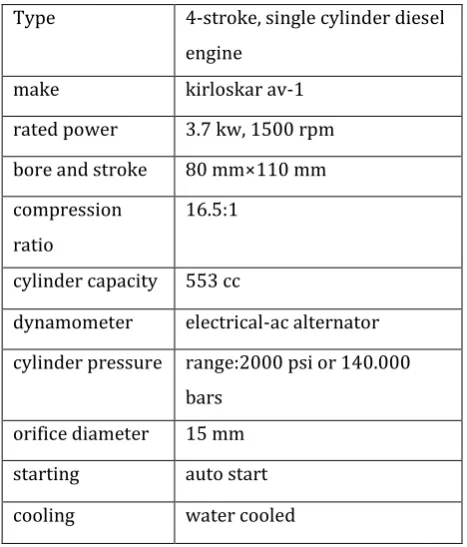
3.1. Engine specification:
Table 5: Engine specifications
Type 4-stroke, single cylinder diesel
engine
make kirloskar av-1
rated power 3.7 kw, 1500 rpm
bore and stroke 80 mm×110 mm
compression
ratio
16.5:1
cylinder capacity 553 cc
dynamometer electrical-ac alternator
cylinder pressure range:2000 psi or 140.000
bars
orifice diameter 15 mm
starting auto start
© 2015, IRJET.NET- All Rights Reserved Page 1110
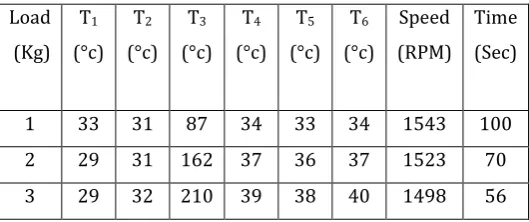
3.2 performance test readings
Table 6: Engine performance test readings at different
loads of Pure Diesel
Load
Table 7: Engine Performance test Readings with B10
Loa
Table 8: Engine Performance test Readings with B20
Loa
Table 9: Engine Performance test Readings with B30
Loa
4.0 FORMULAYS USED IN PERFORMANCE
CALCULATIION:
4.1 Brake power (BP): it is the power available at the engine shaft
………KW
Where, V=voltage in volts, I=current in amps,
=Density of fuel in gram /cc, and T=Time taken in seconds.
4.3 Specific fuel consumption (sfc)
© 2015, IRJET.NET- All Rights Reserved Page 1111 4.7 Brake thermal (OR) Overall Efficiency (ŋbth)
ŋbth ...%
Where, BP = Brake power in KW,
mfc= Mass of fuel consumed in Kg/hr, and
CV= Calorific value of diesel = 42500 kJ/kg.
4.8. Indicated Thermal Efficiency: ηIth = ………%
IP= Indicated power in KW,
mfc= Mass of fuel consumed in Kg/Hr, and
CV= Calorific value of diesel = 42500 kJ/kg.
4.9 Mechanical Efficiency: ηmech = ………%
BP = Brake power in KW, IP= Indicated power in KW.
5.0 PERFORMANCE EVUALATION -RESULTS
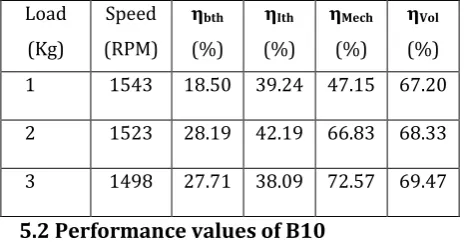
The performance of engine is calculated by using formulae presented in section 4.1 to 4.9 the obtained results are presented in following tables from table No.10 to 13 the calculating steps followed are same for every sample and calorific values, specific gravity density of each fuel should be considered and tabulated.
5.1 Performance values of pure diesel
Calorific Value = 42500 KJ/Kg, Frictional power = 1.30
KW, Density = 0.82 Kg/m3.
Table 10: calculated engine performances for pure diesel
Load
5.2 Performance values of B10
Calorific Value = 41900 KJ/Kg, Frictional power = 1.32 KW, Density = 0.8225 Kg/m3.
Table 11: calculated engine performances for bio-diesel blend B10
5.3 Performance values of B20
Calorific Value = 41460 KJ/Kg, Frictional power = 1.33 KW, Density = 0.826 Kg/m3.
© 2015, IRJET.NET- All Rights Reserved Page 1112 Load
(Kg)
Speed (RPM)
ηbth
(%)
ηIth
(%)
ηMech
(%)
ηVol
(%) 1 1533 18.00 31.395 45.714 67.72
2 1519 27.075 41.141 65.809 68.87
3 1492 28.98 40.406 71.72 70
5.4 Performance values of B30
Calorific Value = 40870KJ/Kg, Frictional power = 1.34 KW, Density = 0.827 Kg/m3.
Table 13: calculated engine performances for bio-diesel blend B30
Load
(Kg)
Speed
(RPM) B P
(kW) Mfc
Kg/hr
Sfc
Kg/kWh I P
(kW)
1 1530 1.10 0.567 0.5154 2.49
2 1511 2.54 0.838 0.3299 3.88
3 1486 3.34 1.044 0.312 4.68
Load
(Kg)
Speed
(RPM) ηbth
(%) ηIth
(%)
ηMech
(%)
ηVol
(%)
1 1530 17.08 38.68 44.17 77.77
2 1511 26.69 40.78 65.46 78.73
3 1486 29.16 39.48 71.36 80.08
6.0 ENGINE PERFORMANCE CURVES
6.1 Brake power on X-axis and Mass of Fuel Consumption on Y-axis
Graph 1: mass of fuel consumption Vs brake power of a diesel and its blends
Graph 1: shows the variation in mass of fuel consumption with the change in brake power. For all blends and diesel tested, MFC increased with increase in brake power. Brake power vs mass of fuel consumption graphs are drawn at different brake power and observed the pure diesel mass of fuel consumption is low compared with the biodiesel blends.
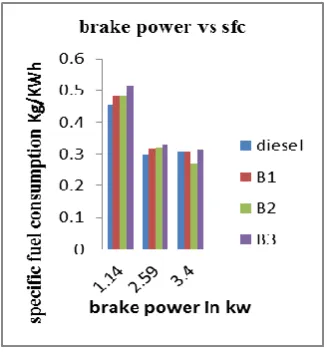
6 .2 Brake power on X-axis and Specific Fuel Consumption on Y-axis
Graph .2: specific fuel consumption Vs brake power of a diesel and its blends
© 2015, IRJET.NET- All Rights Reserved Page 1113 6.3 Brake power on X-axis and Brake Thermal
Efficiency on Y-axis
Graph 3: Break thermal efficiency Vs brake power of a diesel and its blends.
Graph 3: shows the variation in brake thermal efficiency (BTE) with the change in brake power. In all cases, brake thermal efficiency increases with an increase in brake power. It is also observed that diesel exhibits slightly higher thermal efficiency at most of the loads than blends of cotton seed oil (biodiesel). The factors like lower heating values and higher viscosity of the biodiesel may affect the mixture formation process and hence result in slow combustion hence reducing the brake thermal efficiency. The molecules of biodiesel contain some amount of oxygen, which take part in the combustion process. Test results indicate that when the mass percent of fuel oxygen exceeds beyond a certain limit, the oxygen losses its positive influence on the fuel energy conversion efficiency in this particular engine. So the brake thermal efficiency of diesel is more than that of biodiesel blends 6.4 Brake power on X-axis and Mechanical Efficiency on Y-axis
Graph 4: mechanical efficiency Vs brake power of a diesel
and its blends.
Graph 4 shows the variation in Mechanical efficiency with
the change in brake power. For all blends and diesel
tested, Mechanical efficiency increases with increase in
brake power, Mechanical efficiency decreasing with
increasing blend concentration
6 .5. Brake power on X-axis and Volumetric Efficiency on Y-axis
Graph 5: volumetric efficiency Vs brake power of a diesel
and its blends.
Graph. 5. Illustrates the variation in volumetric efficiency with the change in brake power. For all blends and diesel tested, volumetric efficiency increases with increase in brake power, volumetric efficiency increases with increasing blend concentration.
6.6. Brake power on X-axis and Exhaust Temperature onY-axis
Graph 6: exhaust temperature Vs brake power of a diesel
© 2015, IRJET.NET- All Rights Reserved Page 1114 Graph6: shows the variation in exhaust gas temperature
(EGT) with the change in brake power. The biodiesel contains some amount of oxygen molecules in the ester form. It is also taking part in the combustion process. When biodiesel concentration is increased, The exhaust gas temperature increases by a small value. The exhaust gas temperature increases with increase in brake power. The reason of EGT being more in the case of biodiesel blends is the presence of more oxygen atoms in the biodiesel. So, the exhaust gas temperature increases and it increases with increase in brake power. As the load on the engine increases, more fuel is burnt. So exhaust gas temperature increases continuously with rise in brake power.
7.0 OBSERVATIONS
7.1 Exhaust temperature: Exhaust gas temperature increases with increase in load for diesel as well for all combination of blends. As the load increase fuel air ratio increases and hence the operating temperature increases which results in higher exhaust gas temperature. For biodiesel operations the exhaust gas temperature is increased at blend 2 compare to the diesel, blend 1 and blend 3. In biodiesel operation the combustion is delayed due to higher fire point. As the combustion is delayed, injected biodiesel fuel particles may not get enough time to burn completely during before top dead center, hence some fuel mixtures tends to burn during the early part of expansion, consequently after burning occurs and hence increase in the exhaust temperature.
7.2 Specific fuel consumption and Thermal
efficiencies:
Cotton seed oil can be directly used in diesel engine without any modifications. As the fuel concentration increases, viscosity gradually increases thereby the mass consumption decreases with decrease in brake power output. Form the observed experimental results we can conclude that specific fuel consumption is increases with increasing the blend concentrations. And also brake thermal efficiency is slightly decreases and also volumetric efficiency increases with blend concentration.
8. FUTURE SCOPE
1
. The biodiesel fuels produced less smoke than diesel under similar engine operating conditions, probably because palm oil contains oxygen which helps the combustion in the cylinder.2. The biodiesel and reference fuels provided similar combustion pressure patterns at low and medium
engine loads, suggesting that the biodiesels had no adverse effect in terms of knocking.
3. The biodiesel fuels lowered the premixed combustion of heat release because of the lower volatility.
So most diesel engines are being is converted to pure plant oil operation, including advanced TDI versions, and as such the technology much be counted as available on a broad basis. One of the main suppliers of conversion equipment (Elsbett in Germany) also sells an engine specifically designed for PVO operation. Additionally the tractor manufacturer Deutz - Fahr markets a tractor specifically adapted for PVO operation as part of a market introduction program
Single tank conversions have been developed, largely in Germany, which have been used throughout Europe. These conversions are designed to provide reliable operation with rapeseed oil that meets the German rapeseed oil fuel standard DIN 51605. Modifications to the engines cold start regime assist combustion on startup and during the engine warm up phase. Suitably modified indirect injection (IDI) engines have proven to be operable with 100% PPO (pure plant oil) down to temperatures of −10°C. Direct injection (DI) engines generally have to be preheated with a block heater or diesel fired heater. The exception is the TDI (Turbocharged Direct Injection) engine for which a number of German companies offer single tank conversions. For long term durability it has been found necessary to increase the oil change frequency and to pay increased attention to engine maintenance.
9.0 CONCLUSIONS
The performance and emission characteristics of a single cylinder four stroke diesel engine with cotton seed oil as fuel are experimentally investigated and compared with diesel. It is observed that, the viscosity and density of the blend goes up with increased percentage of CSO. However its calorific value is low enough and it gives reduced energy per liter as the CSO percentage increases. The salient observations are,
Cotton seed oil + diesel can be directly used in diesel engine without any engine modification.
Specific fuel consumption increases with an increase in biodiesel concentration. SFC is increasing atB30 by 12.6% at 1 KW load compared to diesel fuel.
Volumetric Efficiency increases with biodiesel concentration. The increase in volumetric efficiency of biodiesel blends is 13% higher than pure diesel, irrespective bio-diesel concentration.
© 2015, IRJET.NET- All Rights Reserved Page 1115
Brake thermal efficiency increases with increasing bio-diesel concentration.
CO2 emissions decreased with increasing blend
concentration.
In general all emissions are observed to be on the lower side for all the bio-diesel blends as compared to pure diesel.
REFERENCES
[1] M. S. Graboski, R. L. McCormick, “Combustion of fat and vegetable oil derived fuels in diesel engines”. Pergramm, Vol. 2, 1998, 125-164.
[2] M. A. Hanna,” Biodiesel production: a review”. Bio resource Technol, 2004, 1-15.
[3] M. Canakci, J. Van gerpen, “Biodiesel production from oils and fats with high free fatty acids”. Trans ASME, Vol. 44, No. 6, 2001, 1429-36.
[4] A. Keskin, A. Kadir, G. D. Metin, “Using of cotton oil soap stock bio-diesel – diesel fuel b l e n d s a s a n a l t e r n a t i v e diesel fuel”. Renewable energy Journal, Vol. 33, 2008, 553-557.
[5] M. S. Graboski, R. L. Mccormik, “Combustion of fat and vegetable oil derived fuels in diesel engines”. Prog Energy Combust Sci, Vol. 24, 1998, 125-64.
[6] A.S Ramadhas, S. Jayaraj, C M u r a l e e d h a r a n , “ Use o f vegetable oils as IC engine fuels A review”. Renewable energy, Vol.29, 2003, 727-742.
[7] E. G. Shay, “Diesel fuel from vegetable oil; status and opportunities”. Biomass bio energy, Vol. 4, No. 4, 1993, 227-242.
[8] B.K.Barnwal, “Prospects of Biodiesel production from vegetable oils in India”. Renewable and Sustainable Energy Reviews, Vol. 9, 2005, 363-378.
[9] A. V. Tomasevic, S. S. Marinkovic, “Methanolysis of used frying oil”. Fuel process technol, 2003, 81:1-6.
[10] A. Bijalwan, “Bio-diesel revolution”. Science Reporter, January 2006, 14-17
[11] I.V Subba, General president Indian science congress association, “Presidential address. 93rd Indian science congress annual report, 2005-2006.
[12] A. P. J. Abdul Kalam, Hon’ble president of India, “Dynamics of rural development”. 93rd Indian science congress annual report, 2005-2006.
[13] Srinivasrao P,Gopalakrishna KV.-Esterified oils as fuels in diesel engines 11th National conference on IC
Engines ,IIT Madras , Indis,1983
[14] Tomasevic A.V ,Marinkovic SS –Methnolysis of used frying oil║.Fuel process technology 2003:81:1-6
[15] Jon H. Van Gerpen, Charles L. Peterson, Carroll E. Goering, Biodiesel: An Alternative Fuel for Compression Ignition Engines, For presentation at the 2007 Agricultural Equipment Technology Conference Louisville, Kentucky, USA 11- 14February 2007.
[16] ASTM. 2002. D 6751 – Standard specification for biodiesel fuel (B100) blend stock for distillate fuels. West Conshohocken, Penn: ASTM International..
[17] A.S Ramadhas,S.Javaraj C. Muraleedharan-use of vegetable oil as IC engine fuels A review ║Renewable energy,Vol 29,203,727-742
[18] Canakci and Vam (2003)-A pilot plant to produce Biodiesel form high free fatty acid feed stock║ American society of agriculture engineers,46(4),PP:945-954
[19] Rupinder Sing, Biodiesel Production from Jatropha (Source- Kurukshetra, volume-55, No-4, February- Prof. (Dr.) R. K. Khotoliya, Dr. Harminder Kaur &2007).
[20] Knothe, G. 2005b. Cetane numbers—the history of vegetable oil-based diesel fuels. Chapter 2 in G. Knothe, J. Van Gerpen, andJ. Krahl, eds. The Biodiesel Handbook Champaign,III,American oil chemists society press.
[21] Dizge N, Aydine C,Imer DY, Bayramoglu M, Tanriseven A, Keskinler B. Biodiesel production from sunflower, soybean and waste cooking oils by transesterification using lipase immobilized onto a novel microporus polymer.bioresour technol 2009;100:1983-91
[22] NBB. Biodiesel production and quality. Fuel fact sheets. Usa: National Biodiesel board:2007
[23] Bondioli p,Gasparoli A,Lanzani A, Fedeli E, veronese S, Sala M. storage stability of biodieseal. J Am oil chem soc 1995; 72:699-702.
[24] Bhattacharya S and Reddy CS (1994) Vegetable oils as fuels for internal combustion engines: a review, Instt.57, 157-166.
© 2015, IRJET.NET- All Rights Reserved Page 1116
BIOGRAPHIES
P.V.Ramana M.Tech(Thermal)-Ph.D External Research Scholar – JNTU-Anantapur(A.P)-India working as Associate Professor at Nalla Mallareddy Engineering
College –Hyderabad(Telengana)
P.Ramanth Reddy M.Tech Asst.Professor –Mechanical Nalla Mallareddy Engineering College –Hyderabad(Telengana)
C.Balaram M.Tech
Asst.Professor –Mechanical Nalla Mallareddy Engineering College –Hyderabad(Telengana)
A.Sarath Kumar M.Tech Asst.Professor –Mechanical Nalla Mallareddy Engineering College –Hyderabad(Telengana)
Author’
s Photo
Author’s
Photo
Author’s
P
Author’s