Presentations at the meeting on
Patterning the nervous system
through development and evolution
May 12-15, 2010, Minerve, France
Report by
Alain Ghysen*
,1,2, Christine Dambly-Chaudière
1,2and David W. Raible
3ABSTRACT We report presentations and discussions at a meeting held in May 2010 in the small village of Minerve, in the south of France. The meeting was devoted mostly but not exclusively to patterning in the nervous system, with an emphasis on two model organisms, Drosophila Melanogaster and Danio rerio. Among the major issues presented were fear and its neuroanatomy, life in darkness, patterning of sensory systems, as well as fundamental issues of neural connectivity, including the role of lineage in neural development. Talks on large-scale patterning and re-patterning, and on the mouse as a third model system, concluded the meeting.
1INSERM U881, Montpellier, France
2Université Montpellier 2, Montpellier, France 3University of Washington, Seattle, USA
*Address correspondence to: Alain Ghysen. CC103, University Montpellier 2, Place E. Bataillon, 34095 Montpellier, France. Fax: +33-467-143-928.
e-mail: [email protected] - web: www.neurodvpmt.univ-montp2.fr
Introduction
The vagaries of volcano Eyjafjallajökull came as a useful reminder of how insignificant we humans are, however unpleas-ant the reminder may be. Fortunately, the volcano’s wrath calmed down on May 10, thus allowing a long-anticipated meeting on neural development and evolution, convening 39 scientists from America, Asia and Europe, to take place in the small village of Minerve, South of France, from May 12 to 15, 2010.
The major aim of the meeting was to review recent progress on the mechanisms and principles underlying patterning in the ner-vous system, at levels ranging from neuron morphology to cell assemblies, circuits and behavior. Most of the presentations dealt with work done on fish and flies, and touched upon many deeply intriguing and central biological questions, mostly but not exclu-sively related to patterning. The talks and discussions were so thought provoking that we (the organizers) decided that a rendi-tion of the views presented at the meeting, as we understood them, might be of interest to others as well. Pictures of the meeting and of participants, as well as a cover article in the "Minervois weekly", can be found at http://raibleweb.biostr.washington.edu/ minerve2010.html
Neuroanatomy of fear
The first session dealt with a peculiar structure of the brain, the habenula, associated with one of our most basic feelings: fear.
Steve Wilson (University College London) examined the de-velopment of this structure, one of the most markedly asymmetric of the brain, in zebrafish. He showed that elaboration of lateraliza-tion of the habenula depends on the presence of the so-called parapineal organ on the left side of the brain (Fig. 1). The parapineal is formed by precursor cells present on both sides of the midline. The precursor cells coalesce at the middle, and form a rosette-like structure that migrates to the left side. The determin-ism of this migration turns out to be under dual control of two signaling pathways: in the absence of FGF, the rosette does not migrate at all, whereas in the absence of Nodal, it migrates randomly to the left or to the right. Thus FGF signaling is required for migration, and Nodal is required for directionality.
Wilson also showed that grafting FGF beads at different positions rescues rosette migration in a FGF loss-of-function background, although the direction of migration still depends on Nodal signaling. If Nodal signaling is inactivated, however, the position of the FGF bead influences the direction of migration, suggesting that the gradient of FGF concentration induces a
Supplementary Material (video) for this paper is available at: http://dx.doi.org/10.1387/ijdb.103182ag
Accepted: 23 September 2010. Final author corrected PDF published online: 8 November 2010.
ISSN: Online 1696-3547, Print 0214-6282
© 2010 UBC Press Printed in Spain
gradient of migratory capability – although in normal conditions, Nodal overrides local variations in FGF concentration. This inter-esting observation may provide an explanation for the over-whelming importance of long-distance signaling systems (such as FGF, Wnt etc.) in development, in spite of the unavoidable distortions that biological tissue imposes on the establishment of regular gradients: if another parameter, Nodal in this case, takes over once migratory capability is triggered, then small irregulari-ties in FGF concentration, hence in migration competence, will be of no consequence and the rosette will migrate in a concerted manner.
As a final note, Wilson reported the preliminary results of a screen for mutations that prevent habenula lateralization, either due to impaired parapineal lateralization, to impaired parapineal to habenula signaling, or to more general impairment of body lateralization. He observed that de-lateralized fish show altered behaviors such as the avoidance of new visual cues, thereby strengthening the relation between habenula and fear, and intro-ducing the next talk.
Suresh Jesuthasan (AStar, Singapore) dealt specifically with anxiety, and how the ability to control stressful situations has profound effects on behavior. A series of experiments in the 1960s and 70s, using mammals, established that animals ex-posed to inescapable stress do not avoid subsequent aversive stimuli. The Jesuthasan lab demonstrated that larval zebrafish also display this “learned helplessness” when subjected to ines-capable stress. This response hints at the existence of a neural circuit that measures the level of control over stressful situations. In order to identify elements of this circuit, they hypothesized that inability to measure control would result in helpless behavior, and they examined the effect of disrupting different parts of the central nervous system, using optical and genetic methods. Their results suggest that the habenula is involved in the computation of control over stress, thereby validating the idea that there exists a neural circuit specifically devoted to this computation.
Such an "everything-under-control" circuit may underlie a very satisfactory state of mind, and could indeed be involved in, or part of, "reward" responses. Are satisfaction and happiness due to a feeling of control, much as anxiety and depression reflect loss-of-control? Or is simply the absence of "loss-of-control" warning, a sufficient reason to rejoice? Amazing how the analysis of scared
fish brings us to re-examine the roots of our own motivations and feelings..
Hitoshi Okamoto (RIKEN Brain Science Institute, Tokyo) brought this analysis to a climax by elucidating the various connections of the habenula to other brain regions, and show-ing how this connectivity illuminates our understandshow-ing of what fear is. It is well known, of course, that the choice of a particular behavior at a particular time is based both on emotional input (affective value) and on past experience. In this context, Okamoto reminded us of the classical experiments where human sub-jects are told beforehand about the intensity of the shock they will be subject to: foreseeing a mild shock leads to anxiety, but expecting an intense shock leads to panic reactions. Based on the connectivity of the habenula to other brain centers, Okamoto concludes that the medial habenula is involved in the integra-tion of contextual informaintegra-tion with affective value, whereas the lateral habenula deals with the repertoire of behavioral pro-grams to be selected in response to a given situation. Although the connectivity between the medial and lateral subnuclei has not been worked out yet, it is clear that this intimate relationship favors the extensive interaction between emotional value and past experience that is an essential component of fear.
Okamoto went on to investigate the convergence of habe-nula innervation on its major target organ, the interpeduncular nucleus (IPN; Fig. 2). His preliminary results suggest that the different pathways from habenula to IPN mediate distinct as-pects of fear, e.g. fight vs. flight vs. freeze, and suggest that the IPN may regulate behavior by comparing these habenular outputs. Thus behavioral complexity, based on the combination of elementary behavioral modules as proposed by Jesuthasan, may have a neuro-anatomical basis, pointing to a close rela-tionship between the patterning of projections and the elabora-tion of behavior.
Okamoto left the stage with the demonstration of yet another powerful tool to investigate behavior: because of the eversion of fish brain, the structure that corresponds to the hippocam-pus, which is deeply buried at the center of the forebrain in mammals, is exposed to the outside in the fish telencephalon. This makes it possible to visualize hippocampal activity in living fish, through calcium imaging. Okamoto showed preliminary results showing that in fish trained to avoid red light, presenta-tion of red light leads to neural activity not only in the optic tectum, as in naive fish, but also in the ipsilateral telencephalon. If confirmed, this result reveals that it may be possible to
visualize in real time the effect of conditioning – a major progress over the need to re-test animals repeatedly to mea-sure conditioning.
Living in the dark
Two talks dealt with the fish Astyanax fasciatus, also named mexicanus for where it lives.
Bill Jeffery (University of Maryland) examined the develop-mental basis of blindness and depigmentation in cave forms of Astyanax, compared to the surface form it was presumably derived from (Fig. 3). Based on fieldwork in Mexican caves, a peculiar behavior was discovered in blind Astyanax, which was dubbed "Vibration Attraction Behavior", VAB. This behavior may be important for Astyanax to find rare food sources in the other-wise barren cave environment. This behavior shows peak sensi-tivity to vibration around 35Hz, similar to the response range of the superficial organs of the lateral line system, and eliminating these organs abolishes the behavior. Since the loss of eyes is accom-panied by an increase in the surface of head skin and in the number of superficial head neuromasts, eye disappearance may have been favored because it expanded the head lateral line system, thereby making the VAB more sensitive. Other correlates to eye loss, such as increase in number of taste buds, and increase in jaw size, may also have played a role in helping blind forms to take over in caves. Contrary to the common-sense belief that cavefish got rid of their eyes (and of their pigmentation) because those attributes are energy-consuming and useless in the dark, Jeffery’s results suggest that eye (and pigment) loss may be associated to expansion of other features that are favor-able to life in darkness. In matters of evolution, as in all biological matters, the fact that an explanation is plausible, and even consistent with sophisticated mathematical modeling, is no proof that it is valid: explanations have to be validated experimentally, not theoretically (see also the talk by S. Kondo).
One of the very exciting aspects of the Astyanax model is the coexistence of the surface form, eyed and pigmented, and of Fig. 1. Dorsal view of the epithalamus in which the pineal nucleus is
blue, parapineal neurons and axons are green and habenular nuclei neuropil is red. Image from Isaac Bianco and Steve Wilson.
several eyeless, unpigmented cave forms, thus allowing for a genetic analysis of the evolution to eyelessness. A first outcome of such an analysis is that populations from different caves, when crossed, can produce eyed fish, indicating that eyelessness is a multigenic character. Further analysis reveals that, by and large, F1 progeny of a cross between cave and surface type are closer to the cave type, suggesting that most cave-specific alleles behave as dominant – an obvious explanation for the fact that blind forms have repeatedly arisen so recently, perhaps less than 10e5 years ago. F2 fish, on the contrary, are closer to the surface type, indicating that multiple alleles are required to establish the cave type – consistent with the previous conclusion that several loci are involved in determining cave blindness and depigmenta-tion.
Such genetic analyses may provide us with a unique view on the genetics of evolution as it is happening – not at the time populations have actually diverged into new species, nor when they merely display some level of allelic heterogeneity, but at the time distinct subpopulations with drastically different morpholo-gies are becoming stably established.
Theresa Burt de Perera and Robert Holbrook (University of Oxford) took over to examine the ability of blind Astyanax to orient itself in its dark environment. In a first set of experiments, they examined the ability of Astyanax to establish long distance X-Y maps of their surroundings, by manipulating simple landmarks such as Lego blocks. Astyanax uses its lateral line system to detect objects through “touch at a distance”, and turns out to be able to recognize changes in the shape of individual landmarks, changes in the geometry of the landmarks, and even changes in the chirality of the pattern (as measured by putting three different landmarks A, B and C at equal distances in a circular arena: the fish can discriminate ABC from ACB permutations).
Burt and Holbrook went on to investigate the much harder issue of 3D navigation. We humans are used to navigating along a two-dimensional plane, and do not have to contend with the complexity of navigation along three axes encountered by birds and fish. One way to deal with this problem is to handle indepen-dently the X-Y and Z positions. Holbrook and Burt de Perera tested this possibility by training fish to follow a 45-tilted Y maze,
and then turning the maze by 90, so that the fish has to choose either the vertical or horizontal cue. Trained fish use the vertical cue in more than 95% of the cases, thus showing that the vertical and horizontal axes are encoded separately - an arrangement that may offer computational advantages for representing space. Amazingly, even in the absence of the maze, that is, if the fish is released in plain water, they show a remarkable conservation of the 3D direction they learned previously as leading to the reward! This result obviously raises the question of, what is it exactly that the fish measures to position itself along the Z-axis? Is the absolute, or the relative position recorded? The relevant param-eter is probably hydrostatic pressure, and indeed stretch recep-tors are present along the animal’s buoyancy-regulating organ, the swimbladder. Such receptors could be used to measure either its absolute size (hence the absolute Z position) or changes in pressure (gradient along the Z direction), and it is not clear yet which type of information is extracted.
Development of the mechanosensory posterior lateral
line (PLL)
The migration of the PLL primordium, and formation of the embryonic line of superficial mechanosensory organs (neuromasts), have been extensively studied in zebrafish over the last decade, yet surprises are still in store.
Ajay Chitnis (NIH) introduced this section by summarizing previous work from several laboratories, demonstrating that the formation and deposition of presumptive neuromasts by the migrating primordium involves FGF signaling. Local production of FGF is responsible both for the organization of rosettes in the trailing region of the migrating primordium, and for the local expression of the transcription factor atoh in a few cells near the center of each rosette. The classical Delta-Notch loop is then required to restrict atoh expression to a single, central cell.
Interfering with this lateral inhibition loop, e.g. by mutating a component of the Notch pathway, mib, would be expected to merely increase the number of atoh-expressing cells in each rosette. It turns out, however, that the pattern of neuromasts becomes both irregular and incomplete in mib embryos. Why so? The reason for the abnormal mib pattern is that Atoh feeds back onto FGF signaling, both by activating FGF expression, and by reducing the expression of FGFR, the FGF receptor (see Ladher’s talk for a later implication of FGFR in hair cell differen-tiation). The increase in the number of Atoh cells, due to the failure of lateral inhibition, results in an expanded domain void of FGFR, and eventually in a failure of rosette organization. As predicted by this explanation, simultaneous inactivation of mib and of atoh rescues a normal pattern of neuromasts. Feedback of Atoh on FGF cannot explain, however, why in mib embryos the primor-dium eventually fragments in several neuromasts before reaching the end of its journey: rather, one would have expected the disruption of rosette formation to prevent deposition, and the PLL primordium to reach the tip of the tail without forming neuromasts. Chitnis investigated the possible involvement of cadherins in primordium fragmentation, and discovered that neural precursors produce only n-cadherin, the support cells that surround them produce both n- and e-cadherin, whereas the outer cells of the rosette make e-cadherin only. Homophilic interactions therefore allow adhesion between neural precursors and support cells, and Fig. 3. Astyanax mexicanus surface fish (A) and cavefish (B).
Photo-graphs by Yoshiyuki Yamamoto.
A
between support and outer cells. In mib mutants, the expansion of atoh expression converts support into neural precursor cells, and the primordium ends up containing mostly e-cadherin and n-cadherin cells that cannot talk to each other: the "glue" (cells that express both cadherins) is missing, leading to primordium frag-mentation.
Tatjana Piotrowski (University of Utah) dealt with another aspect of PLL development, the intercalation of additional neuromasts during larval development.
Intercalary neuromasts arise through proliferation of interneuromast cells that were also deposited by the PLL primor-dium. Interneuromast cells are kept quiescent by the glial cells that migrate along the PLL axons, and resume proliferation during larval life, presumably because they progressively drift away from the nerve and its glia.
Piotrowski examined why glial cells migrate along the develop-ing PLL nerve. Cued by the results of a mutant screen, where the inactivation of the gene erbB3 resulted in the formation of preco-cious intercalary neuromasts, she showed that the receptor ErbB3 is normally present on glial cells, and that the presence of erbB3+ glial cells in the mutant background is sufficient to rescue glial migration. She concludes that the receptor is required for glial migration along the PLL axons. She also showed that the ligand of ErbB3, Neuregulin, is expressed in PLL neurons, suggesting that the neurons activate the migratory properties of the glia that come to contact them, thereby recruiting them for their own purpose.
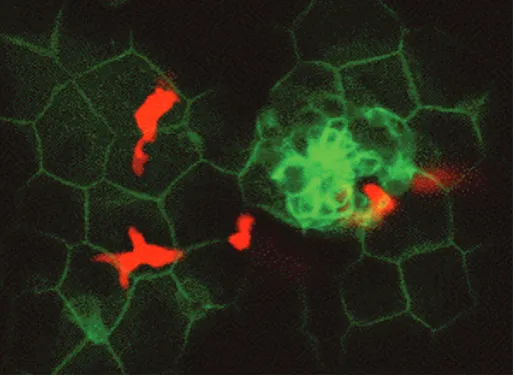
Miguel Allende (University of Chile) added a new aspect to PLL research by showing that this is a highly convenient system to study the immune response! This finding followed on his long-term analysis of the toxic effect of copper (and other heavy ions) on hair cells, and of subsequent hair cell regeneration. Allende noticed that the ablation of neuromast hair cells is followed by a massive inflammatory response, whereby macrophages quickly
move in and "patrol" around and within the hair-cell-depleted neuromasts (Fig. 4 and Supp. Video S1). Whereas he does not know yet whether clearing the debris is required before regenera-tion can proceed, the very existence of this immune reacregenera-tion stimulated him to devise an automated screen for anti-inflamma-tory drugs. Hopefully his highly fundamental research may bring unexpected medical benefits. As Einstein once said, "If we knew what it was we were doing, it would not be called research, would it?"
Allende also discussed his ongoing research on the regenera-tion of the caudal lateral line system. In adult zebrafish, four lines of neuromasts extend along the caudal fin to form the Caudal Lateral Line (CLL) system. The CLL forms during larval develop-ment, and is derived (through a still poorly understood process) from the terminal neuromasts deposited by the embryonic primor-dium. Fish fins do regenerate upon amputation, and in the case of the caudal fin (the only one to bear neuromasts), the CLL regenerates as well.
Although this regeneration has been reported to involve the formation of new primordia, Allende suggests instead that interneuromast cells extend along the regenerating fin, and un-dergo a process of proliferation and coalescence very similar to that which normally takes place for the formation of intercalary neuromasts on the body. He also noticed that the PLL cells that extend along regenerated fin territory are far from showing the highly organized structure of a migrating primordium, consistent with the idea that CLL regeneration is not simply a recapitulation of embryonic primordium migration. The next step is to ask whether the signals that control caudal fin regeneration are also involved in stimulating CLL regeneration, or whether they are independent events.
Posterior lateral line neurons
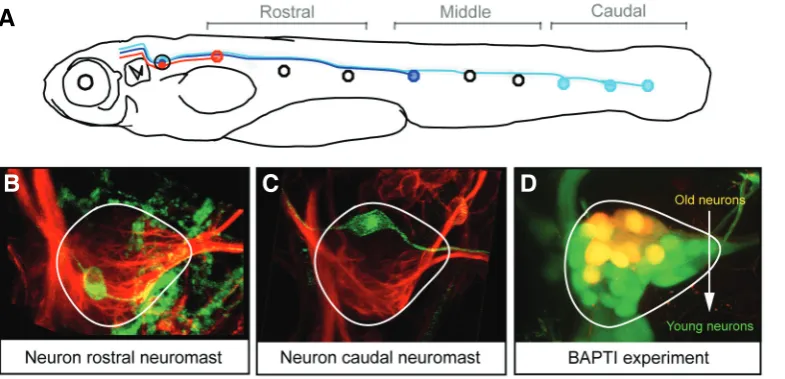
PLL neuromasts are innervated by afferent neurons, the cell bodies of which form a ganglion just posterior to the ear. Adèle Faucherre reported recent results obtained with Jesus Pujol-Marti in the lab of Hernan Lopez-Schier (CRG, Barcelona) inves-tigating the origin of somatotopy in PLL innervation. It had been shown previously that neurons innervating more posterior neuromasts extend their central projection to a more dorsal level in the hindbrain, thus establishing a somatotopic organization. The correlation between position of the innervated neuromast and position of the central projection has obvious functional correlates, as it allows the central nervous system to take into account, in its computations, the positions from which sensory information originate. The origin of somatotopy, i.e., the causal relationship between peripheral and central projections, is still very unclear in any sensory system, however.
In the case of the PLL, the CRG lab discovered that the patterning of both central and peripheral projections ultimately depends on the time at which afferent neurons differentiate and undergo axonogenesis. Using technically elegant methods to label individual neurons, and a wealth of reporter lines, the CRG lab showed that neurons that innervate posterior neuromasts not only project to more dorsal positions in the hindbrain (Fig. 5A), but also occupy more dorsal positions within the PLL ganglion (Fig. 5B,C). They also showed that the expansion of the PLL ganglion during early development takes place by the addition of new Fig. 4. Compound transgenic zebrafish (cldnB:lynGFP/lysC:DsRed)
neurons at the ventral edge of the ganglion, and therefore, that the position of a given neuron within the ganglion is a good indicator of its age: more ventral neurons are necessarily younger than dorsal neurons (Fig. 5D). Therefore the correlation between the position of both central and peripheral projections, and the posi-tion of the soma within the ganglion, indicates that the age of a neuron is the determining factor in the positioning of its central and peripheral projections.
This result illustrates the overwhelming importance of time as a patterning factor, at least in the nervous system. This conclusion had already been reached decades ago in the case of arthropod visual systems, where the morphology of any new neuron is reproducibly determined by the mere presence of extant neurons, such that distinct neuronal types are reproducibly determined without any genetic contribution. The fact that time plays a similar role in organizing the somatotopy of the PLL projection, is an important simplifying principle.
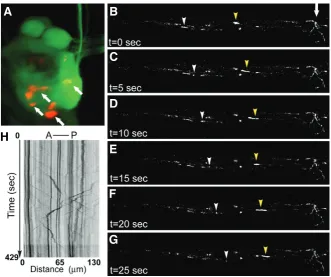
Alex Nechiporuk (Oregon Health & Science University) dealt with a different, but equally important, aspect of PLL neuron biology: the need to transport various types of organelles from cell body to neurite terminals, and vice-versa. Most prominent in the first category (anterograde transport) are vesicles and mitochon-dria, which depend on kinesin for their movement, whereas the second category (retrograde transport) includes trophic factors and other signal receptors, as well as recycled vesicles, and depends on dynein. Nechiporuk first showed that the transport dynamics of the peripheral neurite connecting cell body and target neuromast correspond to those of a bona-fide axon. This finding, together with the observation that the leading peripheral neurites are led by typical growth cones, leaves no doubt that, from the point of view of cell biology, the peripheral neurite is indeed an axon (notwithstanding the fact that, from a more physiological point of view, it functions as a post-synaptic neurite, i.e., a dendrite).
Because transport dynamics are easily followed in the neuroD:gfp reporter line, Nechiporuk set up a plasmid injection system to follow transport in individual PLL neurons. He showed
beautiful movies with fascinating choreographies of saccadic movements, illustrating the general difficulty of analyzing such seemingly unpredictable yet organized behaviors (Fig. 6). Will only statistical physics apply, as in Brownian movement? Or is some additional, "biological", control involved in orchestrating this complex set of movements? Are there priorities, is there a hierarchy, and is there order? PLL axons may be a useful place to try to solve those very difficult questions.
The tools developed by Nechiporuk make the PLL neurons an ideal place to look for and analyze transport mutants. Mutant screens have already identified one molecule: in jip3 mutants, anterograde transport is almost paralyzed in a stage dependent fashion, suggesting that axonal transport may display different requirements at different times of development. Jip3 is known from previous work to mediate the link between kinesin and cargo, as well as Jnk3 activation. Which of these or other roles of Jip3 is important for axon extension and synaptogenesis is not known, but is now amenable to genetic analysis.
Sensory systems
Jarema Malicki (Tufts University) described a different pro-cess of transport within a cell, the transport of materials within the specialized elongated cilia found in sensory receptors of the eye and ear. This process requires specific kinesins to move cargo that is assembled into particles containing intraflagellar transport proteins, so named because of their original discovery in flagella of single-celled organisms.
The transport of ciliary cargo, such as transmembrane recep-tors, is essential for the morphogenesis, function and survival of sensory neurons, including photoreceptors, mechanosensory hair cells, and olfactory sensory neurons. In photoreceptor cells, for example, ciliary transport is necessary to localize the photopigment, opsin, to the photosensitive compartment, the outer segment. Malicki used zebrafish mutants to disassemble the complex, revealing new players in the process. Several of these proteins also interacted with members of the planar cell
Fig. 5. Origin of somatotopy in the zebrafish lateral line system. (A) Scheme of a 7-day-old fish de-picting the somatotopic organiza-tion of the lateral line afferent neu-rons. Neurons innervating more cau-dal neuromasts (in light blue) ex-tend their central projection to a more dorsal level in the hindbrain than neurons innervating more ros-tral neuromasts (in red). (B,C) So-mata location in the posterior lateral line ganglion at 3.5 dpf of mem-tdTomato labeled neurons (green) innervating rostral neuromasts (B)
or caudal neuromasts (C). Somata of neurons innervating more caudal neuromasts occupy more dorsal re-gions within the ganglion. The red fluorescent signal is from cldnb:lynEGFP. (D) HuC:Kaede posterior lateral line ganglion at 60 hpf resulting from a BAPTI experiment conducted at 24 hpf. Early-differentiating neurons (converted at 24 hpf) are yellow, whereas late differentiating neurons appear green. In all panels dorsal is up, anterior is left. The posterior lateral line ganglion is outlined. Figure kindly provided by Jesus Pujol-Marti.
A
polarity pathway, suggesting a mechanism that mediates the involvement of cilia (or basal bodies) in the morphogenesis of structures that differentiate from epithelial sheets, such as sen-sory epithelia, for example.
Raj Ladher (RIKEN Center for Developmental Biology, Kobe) also discussed the differentiation of specialized cilia and revealed a later effect of FGF on hair cell differentiation. Ciliated sensory cells are widely represented in metazoans, but only chordates (and some cephalopods, a surprising convergence) have mechanosensory hair receptor cells that form no axon, and are innervated by the peripheral axon of the afferent neurons (see Nechiporuk’s talk for more on the peripheral axons). Early during hair cell differentiation, the primary cilium appears at the center of the apical surface, and progressively moves to one side to become the kinocilium. At the same time, microvilli appear at random positions but become suppressed away from the kinocilium, and enhanced near it, resulting in a highly regular stair of stereocilia surrounding the kinocilium.
Ladher used an antibody specific for the FGF Receptor 1 (FGFR1) to show that, in the chicken inner ear, this receptor accumulates in punctae in kinocilium and at the tip of the stereo-cilia. He used the broad range inhibitor SU5402 to evaluate the role of FGFR1 in the patterning of stereocilia, and showed that the correspondence of kinocilium with stereocilia is now dislocated. Similar results are observed in the case of a hypomorphic fgfr1 mutant in mouse. It is not clear yet whether FGFR1 plays a role as part of the FGF signaling system, or because of its known interactions with cadherins.
ceptor that effectively drives normal neurite development, Sagasti then looked at the process of regeneration. Caudal fin amputation at 3 dpf is followed by full regeneration and re-innervation within 3 days of amputation. Yet after peripheral axotomy of Rohon-Beard neurons, little reinnervation is observed, suggesting that skin damage may promote axonal growth. He found that, indeed, killing keratinocytes promotes axonal regeneration, and is now investigating the nature of the regeneration-promoting substance. A most unexpected finding about specialized sensory cells was presented by Yuh-Nung Jan (UCSF). His lab has been investigating dendrite patterning in Drosophila larvae, taking advantage of the different types of dendritic arbors displayed by various classes of the so-called da (dendritic arborization) larval sensory neurons. da neurons extend free terminals that extend under the epithelium, similar to the neurites investigated by Sagasti, and are thought to subserve various somatosensory modalities such as touch, pinching, and/or temperature. Using a calcium indicator line, they fortuitously discovered that one sub-group of da neuron (class IV), the dendrites of which cover the entire body in an elaborately fractal tiling pattern, responds to a completely unexpected type of input, one that is normally per-ceived by a different type of sensory organ. This finding will be presented in more detail in a November issue of a famous scientific weekly.
This finding raises many captivating issues about the origin and evolution of sensory perception. We are used to the idea that changes in the patterning of sense organs may allow the emer-gence of new functions, and we are not surprised by the finding Fig. 6. Imaging mitochondrial transport in live zebrafish embryo.(A) Mosaic expression
of neurod5kb:pBa-Mito-TagRFP (arrows) in neurod:egfp positive neurons of the pLL ganglion.
(B-G) A subset of images from a time-lapse in which mitochondria (arrowheads) are being transported in pLL axons. The first NM is indicated by the vertical arrow. (H) Kymograph generated from this time-lapse.
Alvaro Sagasti (UCLA) reported on skin innervation: how are somatosensory axons guided to the skin, and how is innervation restored in case of injury? Skin innervation is achieved in the zebrafish head by trigeminal neurons, and in the body by Rohon-Beard fibers, both of which extend free endings sand-wiched between the peridermal and basal epidermal layers. His lab identified three LAR genes, of the Protein Tyrosine Phosphatase Receptor family, as candidates for mediating skin innervation. Inactivation of each gene by morpholino-oligonucleotides caused no de-tectable phenotypes, but dominant negative forms of two LAR family members caused axons to extend within the body, not within the skin.
Sagasti then assessed the weight of poten-tial LAR ligands, among which are the Heparan Sulfate ProteoGlycans (HSPGs), known to play diverse roles in axon guidance. Reducing synthesis of HSPGs with the zebrafish dackel mutant had little effect on innervation, but Sagasti reasoned that neurites might be guided by gradients of HSPG, and that an overall reduction may therefore have little effect on neurite behavior. He performed instead local injections of heparinase, with the very dra-matic effect that this resulted in a hole in skin innervation.
Having identified a ligand for the LAR
re-A
B
C
D
E
F
G
that flies can taste with their feet, or that crickets can hear with their tibias. The "coaptation" of a given sensory modality by an unrelated type of sensory neuron is much more unusual, how-ever, although in retrospect, once a complex sensory transduc-tion machinery has been asembled there is no reason why it could not be freely "borrowed" by other cell types. The case of class IV neurons now offers a wonderful opportunity to examine the molecular basis of such evolutionary innovations.
Fundamentals of neural development
Work on Drosophila nervous system has reached a stage where basic issues of connectivity and function can be examined, both in the light of development and in that of evolution, and this session was an example of getting at some fundamental ques-tions. Ian Meinertzhagen (Dalhousie University) raised an impor-tant issue: how are we to understand a relatively simple system such as the optic lobe of the fly, if we do not even know how many neuronal types are involved? The upper layer of the optic lobe, the lamina, is comparatively simple, with only 10 types of interneu-rons innervated by terminals from photoreceptors R1-R6. Even at this first level, however, photoreceptor axons participate in com-plex synaptic microcircuits, in particular tetrad synapses, with dyad feedback from amacrine cells, and circuit structures that may either diverge or converge, thus allowing elementary compu-tations such as simultaneous sum and difference between two inputs, or band-pass filters.
The next layer, the medulla, is much more complex, comprising more than 60 different cell types, and receiving information from photoreceptors R7 and R8, as well as from the lamina neurons. How, then, is one to determine whether minute morphological differences between two neurons are just random variations, or may reveal true differences in identity? The existence of large numbers of Gal4 lines offers prospects to analyze this question, because each line reveals neuron morphologies that are more similar between flies of the same line than between flies of different lines.
Comparison between Gal4 expression profiles of neurons and
3-D profiles reconstructed from electron microscopy series of the medulla reveals the position of each cell type within the general connectivity of the medulla, thereby linking morphology and circuitry. Although the massive effort of identifying cell types, started already by Ramon y Cajal nearly 100 years ago, is still in its infancy, several interesting conclusions are already apparent. For exemple, about 60% of all lamina synapses mediate largely redundant inputs that converge upon a few cell types (for routine contrast coding?), whereas 40% engage the remaining cell types each with few synapses (for more dedicated processing?). Sec-ond, a related question to be answered is the extent to which visual pathways are simply linear chains of relay neurons, or a network of many microcircuits achieving local analysis of distinct features of the visual world. In answer, as Meinertzhagen re-minded us in his concluding slide, "The future is yet to come!"
Matthias Landgraf (University of Cambridge) examined the other end of the circuit, the proper connections regulating motor output. Landgraf introduced his talk on the larval motor system by quoting Lynn Landmesser as saying that "if one compares the position of a motoneuron, and that of its target muscle, no clear correlation emerges…" Whereas this is true in flies as well, the position of the dendritic arbor, however, is clearly correlated to the target muscle. For example, dendrites of neurons innervating longitudinal body muscles extend anterior to the dendrites corre-sponding to circumferential muscles, whereas dorso-ventral po-sition of the muscle correlates with the extension of motoneuron dendrites in lateral medial positions of the neuropil, respectively. The position of the dendrites, therefore, establishes a "myotopic" map that has no relation with the position of the motoneuron cell bodies. This myotopic map of dendritic arborizations is set up in the absence of synaptic transmission, and even in the absence of synaptic partners: how is this achieved?
The analysis of dendritic localization is much helped by the availability of transgenic lines that label three stereotyped longi-tudinal fascicles, thus defining a medial, an intermediate and a lateral region (m, i and l in Fig. 7). The establishment of these three fascicles at fixed distances from the midline depends on the production of Slit, acting on its cognate receptors Robo to mediate
Fig. 7. Myotopic map of motoneu-ron dendrites. Motoneurons in the ventral nerve cord of the Drosophila
axonal repulsion from the midline, and of Netrin acting on Frazzled to mediate attraction to the midline. Landgraf showed that the same organizing signals are responsible for determin-ing the position of motoneuron dendritic arborization. In retro-spect, using the same molecular framework to position both pre- and postsynaptic terminals, is obviously the best way to ensure that what must be matched, will be!
Separate from the genetic programmes that define the posi-tions where dendrites will grow out and arborize, other cell intrinsic genetic programmes determine the overall size and branching pattern of arbors. Dendritic growth is adjusted by synaptic input, probably measured by motoneuron activity and density of synapses. The idea is that the size of the arbor will adjust until the motoneuron activity comes close to a pre-set (desired) value: if the activity is too low, the arbor will extend and/or make more synapses, whereas it will reduce its arbor if the activity is too high. These very simple organizing rules are sufficient to explain the generation of qualitatively and quanti-tatively pre-determined motoneuron dendritic arbors. The situ-ation is likely to be more complicated for interneurons, how-ever, as some of them extend dendrites in different medio-lateral domains and in both anterior and posterior directions. Whether other principles apply to those, or whether they simply rely on a more elaborate use of the same parameters that control motoneuron dendrites, is not yet known.
Michael Bate (University of Cambridge) took over where Landgraf left, by addressing the intriguing issue of the relation between what development does, and the emergence of func-tion. He based his argument on the fact that each segment of the fly central nervous system contains rhythm and pattern generators that are modified by homeotic genes to suit the particular morphologies of distinct segments. This simple ob-servation suggests to him that there is a complete disconnec-tion between the development of a fundamental framework of connectivity, which provides the raw material, and the emer-gence of specific functions that this raw material allows. This led him to the question, what is the nature of this fundamental, elementary framework, and how is it generated if it is not under the pressure of functional adaptation?
Bate turned to the fly CNS and noted that every hemisegment comprises about 60 neuroblasts, which produce an embryonic complement of about 150-300 early born neurons, identical in all segments. About 25% of them are motoneurons, 8% are neurosecretory cells, and the remaining two thirds are interneu-rons. A few of these interneurons provide the basic ladder-like structure of connectives and commissures. What are the others doing? The answer, Bate proposed, is that these early-born neurons form an all-purpose elementary structure, one that can be used to generate any rhythm and pattern, with all subse-quent development (and evolution) being merely a restriction to subsets that are most appropriate for particular segmental needs (such as the presence of appendages to be moved in a coordinated manner, the need for peristaltic waves of contrac-tion, etc..)
He then proceeded to make a simple computation based on the known organization of the fly neuropil: as already intro-duced by Landgraf, the segmental hemi-neuropil can be subdi-vided in two regions along the A/P and D/V axis, and 3 regions along the M/L axis, thus forming 12 distinct area, or target
regions. Each of these areas will have at most 4 neighbors within one hemisegment. Assuming that connections are made only between neighboring areas, and that every connection is duplicated to make for an excitatory and an inhibitory contact, one ends up with 8 possible connections for each of the 12 areas, i.e., work for 96 neurons. In other words, 96 neurons endowed with a very simple connection program could fill the entire connectivity space by generating all possible links be-tween the 12 target regions.
Of course, the point was not at all to propose that this very simple connectivity scheme actually takes place, but to show that the notion of a fully connective network is perfectly reason-able, and may be a natural outcome of a small set of develop-mental operations, not dedicated at all to any particular func-tion, but establishing the material basis from which function can later be extracted. Once this fundamental framework is estab-lished, then function would be superimposed to it by defining where dendritic arbors will develop, possibly using the same organizational principles that defined the 12 areas, as sug-gested by Landgraf. And, of course, homeotic genes would add a new level of complexity by modulating dendritic arbor posi-tion, as suggested by the case of the RP2 motoneuron.
Lineage and neural development
Jim Truman (HHMI Janelia Farm) focused on the later development of the fly CNS. The first 4 or 5 divisions of each neuroblast generate as many Ganglion Mother Cells (GMC), each of which divides once to form two neurons. The identities of consecutive GMCs differ from each other by the expression of "temporal" genes, and the identity of the two neurons formed by each GMC are also different, due to Notch-mediated interac-tions. This leads to the formation of a neuroblast-specific array of about 10 uniquely identified, embryonic neurons, usually markedly different from each other but repeated from segment to segment, as mentioned previously.
Then follows a developmental pause, and divisions resume later during larval life with a very different pattern: each neuro-blast generates 50 to 80 GMCs that are very similar, and generate pairs of neurons that assume each of two alternative fates A or B (A being promoted by, and B repressed by, Notch interaction), thus forming A and B hemi-lineages. Truman’s interpretation is that the primary neurogenesis provides for overall CNS architecture and basic maggot functions such as forward or reverse crawling, turning capability, etc., whereas secondary neurogenesis would provide much larger computa-tional capabilities. Within one "computacomputa-tional" hemilineage, slight differences in dendritic arbor, possibly influenced by sensory somatotopy, would allow refined analysis and modula-tion, e.g. for leg movements or flight performance. Interestingly, hemilineage size responds quickly to selection. For example, when comparing the laboratory wild type, which has been kept for almost a century in bottles, under conditions where the most active and clever individuals invariably are the first to escape during transfer, to "real" wild types, the latter are found to have 10 to 15% more neurons in flight-related hemilineages.
produced, the second one being eliminated by cell death. With so many hemilineages doomed to death, one wonders, why are they produced in the first place? In line with Bate’s proposal, this might be viewed as the outcome of a developmental tendency to explore connectivity space in an unrestricted way, followed by a selection to refine and improve function - getting rid of the unwanted connections.
Among exciting perspectives, Truman explained how the intersectional strategy ("split Gal4" method) allowed him to produce reporter lines with a desired specificity: basically, the two halves of the gal4 gene are put under the control of two different enhancers, such that only the cells where both en-hancers are active will have Gal4 function. When combined with a UAS-flippase system, this strategy allows the indelible label-ing of all neurons belonglabel-ing to a given hemilineage, allowlabel-ing one to link the developmental origin of a set of neurons, and their role in the adult CNS.
The issue of lineages and their role in development was also discussed by Bill Harris (University of Cambridge) in a very different system: the zebrafish retina. He first followed in detail the nuclear movements, which are represented in textbooks as a fluid movement back and forth from the basal to the apical regions of the neuroepithelium. Caren Norden and colleagues in Harris’ lab discovered that, far from this simplified picture, most nuclear movements are stochastic except for a period of about 30 min before mitosis, where actomyosin squeezing of the basal process propels the nucleus to the apical region. The role of this baso-apical migration is still unclear, but moving the nucleus to the apical position where the duplicated centrosomes are situated may be important for normal mitosis. This example demonstrates once again how much about cell behavior can be missed by working on fixed tissue.
Harris and colleagues used patterns of gene expression to identify the successive steps leading to the formation of Retinal Ganglion Cells (RGCs) and various other cell types in the retina. They found that the expression of vsx2 (visual system homeobox2, a gene initially expressed in the entire retina anlagen), becomes down-regulated in most retinal cells. This down-regulation leads to derepression of other transcription factors that help specify particular lineages, for example vsx1, or atoh7. Another gene involved in retinal cell type determina-tion is ptf1a (pancreas transcription factor 1a). Both vsx1 or atoh7 expressing cells may turn on ptf1a postmitotically; vsx1-ptf1a cells become amacrine cell subtypes, whereas only atoh7-ptf1a cells become horizontal cells. Thus the retina seems to use a combinatorial code for determining cell types and sub-types.
While intrinsic determinants play a role in regulating the lineage potentials of progeny cells, extrinsic feedback mecha-nisms play an important role in the final choice of cell type. For example, cells that express atoh7 divide once; one of the daughter cells is often a RGC and the other may become a photoreceptor, a horizontal or an amacrine cell. In an RGC-depleted retina, transplanted wild type progenitors often turn on atoh7 and produce two rather than one RGC upon division. Similarly in a retina depleted of inhibitory neurons, transplanted wild type cells have a higher probability of turning on ptf1a postmitotically to become a horizontal or amacrine cell type. Thus, rather than using strict lineage decisions, retinal cell
determination seems to depend on intrinsic stochastic decisions about cell division and transcription factor expression, which are subject to feedback mechanisms that control the proper propor-tions of the various cell types.
Large-scale patterning
Olivier Pourquié (University of Strasburg) reported new de-velopments of his work on vertebrate segmentation. He showed that the process of somite formation is best explained by a "clock and wavefront" model where cyclic oscillations in the activity of Notch, FGF and Wnt signaling pathways eventually lead, through a threshold effect, to the periodic addition of new somites cau-dally.
This process obviously requires that the presomitic mesoderm itself elongates caudally in front of the somitic wave. How is this elongation achieved? One possibility would have been the clas-sical convergence-extension cell movements that are well docu-mented in vertebrate embryogenesis. This process, however, only takes place in the most anterior part of the embryo. A second source of elongation could be Hensen’s node, at the caudal tip of the presomitic mesoderm. Extirpation of the node, however, or even of the node and primitive streak, has no effect on elongation. On the contrary, ablation of the posterior presomitic mesoderm stops elongation, indicating that posterior elongation is a property of the presomitic mesoderm itself.
In order to examine this property, Pourquié labeled posterior mesoderm cells and studied their behavior through time-lapse analyses. He first observed that more posterior cells migrate fast in the caudal direction, whereas more anterior cells migrate less, and more isotropically. This observation was done using the last somite as reference point, an intuitively obvious landmark. Be-cause Pourquié wanted to analyze the local cell movement, however, he double-labeled the cells and the fibronectin in the extracellular matrix. He then discovered that he could still detect a higher mobility in the posterior cells, but the directionality was gone. He concludes that posterior elongation is mostly driven by a gradient of non-directional cell motility (necessarily accompa-nied by an opposite gradient of cell density). Flattening the gradient by either loss-of-function or gain-of-function approaches blocks elongation, whereas preventing cell proliferation has no immediate effect on posterior extension (but leads to a progres-sive shrinking of the posterior region, until segmentation is brought to premature arrest).
This result reveals that any source of cell motility-promoting substance will result in directional growth, in the absence of any chemotactic or chemoattractive effect (see also Wilson's talk).
and inhibition have different ranges, generate an almost limitless repertoire of patterns. As Kondo pointed out, however, the ques-tion is not that Turing’s equaques-tions can generate any pattern, and can even "predict" (a posteriori) any effect of any alteration, the question is to know whether this system is relevant.
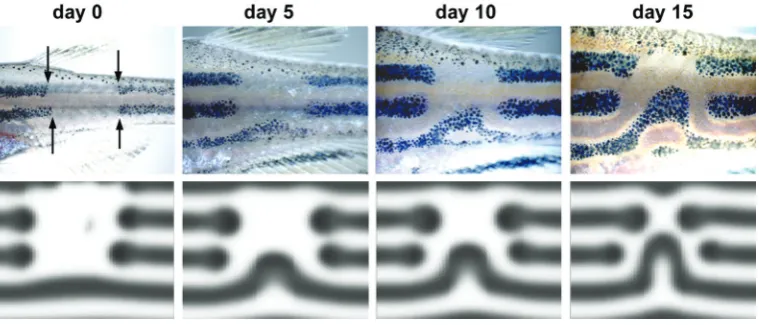
Kondo first tested whether zebrafish might be a good model for this analysis. In this species, the pattern of longitudinal stripes does not change once formed, and the stripes merely enlarge with fish growth, unlike in many other fish species where, because stripe size remains constant, the number of stripes increases and one can therefore observe stripe bifurcations appearing and moving progressively towards either end, as if "unzipping" (Fig. 8). Local ablations of zebrafish stripes result, however, in peculiar patterning defects that are fully consistent with the workings of Turing’s system (Fig. 9).
Kondo then examined the interaction between black and yellow stripes, consisting mainly of melanophores and xanthophores respectively. Ablation experiments revealed short-range mutual inhibition of melanophores and xanthophores, whereas long-range interactions reveal a dual effect on melano-phores: self-inhibition, and activation by xanthophores. This is
spotted phenotype of the leopard (connexin) mutation, a trans-genic line was made that harbors a heavier connexin (with reduced diffusion constant). This line displays a splitting of the black stripes, a pattern that is never observed in the wild type.
Previous users of Turing’s equations have usually assumed that diffusion processes underlie this type of system. In the last part of his talk, Kondo speculated about the possibility that long-range interactions may actually rely on long-distance direct con-tact, a very plausible mechanism for whoever has looked at the extremely dynamic long processes extended by pigment cells. Looking at the behavior of pigment cells in vitro, he observed that upon direct contact, melanophores run away form xanthophores, and xanthophores actually pursue and chase them! For the first time, Turing’s equations thus led to a glimpse at the actual molecular and cellular mechanisms underlying 2D-patterning, with possible extensions to 3D. For example, during bone forma-tion, osteoblasts and osteoclasts show interactions similar to those between xanthophores and melanophores - and indeed, several zebrafish mutants are known that affect both bone and pigment patterning.
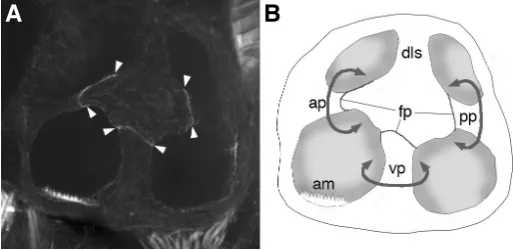
Tanya Whitfield (University of Sheffield) aimed straight at 3D patterning, by exploring the development of the hollow otic vesicle into the intricate, labyrinthine structure of the inner ear. The first sign of semicircular canal morphogenesis in the zebrafish ear is the formation of apical (i.e., internal) protrusions growing orthogo-nal to the anterior, lateral and ventral walls of the vesicle. These projections eventually meet near the center of the vesicle to form pillars. The space around each pillar will then become the lumen of the individual semicircular canals (Fig. 10). For example, in otx1 mutant embryos, the ventral pillar does not form, and as a consequence, the horizontal canal (which should have formed around this vertical pillar) is missing.
It was previously shown by Haddon and Lewis that the projec-tions that lead to pillar formation are formed by the basal accumu-lation of extracellular material that progressively pushes the cells away, this being the reason why projections expand apically. Pillar formation is therefore very different from ganglion delamina-tion, which includes an epithelio-mesenchymal transition. Inter-estingly, the formation of heart valves appears to be similar to that of otic pillars, and may possibly rely on the same molecular Fig. 8. Moving stripe bifurcation in the Emperor Anglefish,
Pomacanthus imperator.Lower panels: evolution in time of a striped pattern generated byTuring’s equations.
Fig. 9. Changes in pigmentation pattern in a juvenile zebrafish where two melanophore stripes were ablated between the arrows. Lower panels: evolution in time of a partially ablated stripe pattern generated by Turing’s equations.
precisely the type of interactions to which Turing’s equations ap-ply, and accounts for many ex-perimental results. One simple and eloquent example is that a cross between a light spotted variant and a dark spotted one will produce striped individuals!
mechanisms.
Whitfield reported on a mutant that affects both canal develop-ment and PLL nerve myelination. The gene codes for a 7-transmembrane domain protein with an extracellular domain that may act as contact detector in both systems, to detect the presence of axons in the PLL nerve and trigger myelination, or to detect collision of expanding projections in the inner ear, and promote their fusion to establish the presumptive canals.
Of mice and men
François Guillemot (NIMR, Mill Hill) explored the function of Mash1, the Mouse Achaete-Scute Homolog, in mouse neurogenesis. He first showed that Mash1 is sufficient to trigger the entire neurogenic programme, and explored its mode of action by Chromatin Immuno Precipitation (CHIP-on-chip), thereby re-vealing that Mash1 binds to about 1200 genes, whereas reducing or increasing the level of Mash1 expression alters the expression of about 3000 genes. The intersection of the two sets of data reveals 360 genes that are involved at different stages of neurogenesis, consistent with a continuous requirement of Mash1 during neural development.
Among these 360 genes, a major group includes both positive and negative cell cycle regulators, a reasonable finding since Mash1 has been specifically involved in driving the proliferation of intermediate progenitor cells in the embryonic brain, or the self-renewal of ventricular stem cells, and at the same is also required for cell cycle arrest associated with neuronal differentiation.
Guillemot also explored the role of Mash1 or Ngn, another proneural factor, in neuronal migration. Using in utero electroporation of gene constructs in the ventricular cavity of mouse embryos, he explored the role of two members of the Rnd gene family, an atypical set that, although related to Rho GTPases, are independent of GTP. He showed that, as concerns neuronal migration, Rnd3 is the major effector of the Ngn2 pathway and can actually rescue Ngn2 inactivation, whereas Rnd2 is the major effector of the Mash1 pathway and can similarly rescue Mash1
defect. Yet, in spite of their similarity, and of the fact that both presumably act through RhoA, Rnd3 cannot rescue Mash1, and Rnd2 cannot rescue Ngn2. One interesting possibility would be that Rnd2 and Rnd3 act on different phases of the migration process, or on different subcellular components or compartments involved in migration, thus providing a new entry point to the cell biology of neuronal migration.
Lily Jan introduced ultrasound recording as a means to listen to squealing and whining of mice pups. She used this method, which reveals an amazing range of vocal interactions between mothers and pups, to explore possible alterations in social behav-ior associated to a dominant mutation that, in humans, is closely associated to autistic behavior. Previous studies revealed alter-ations in learning or cognition, but no defect in socialization. Eavesdropping on mouse-pup ultrasound communications showed, however, that although wild-type and heterozygous pups born from wild-type mothers showed similar call rates and patterns, squealing was higher in pups born from heterozygous mothers.
An interesting aspect of these vocal reactions is the "potentia-tion" effect, whereby squealing and whining are much increased if contact is allowed, and then the mother is withdrawn again. Potentiation was observed in all combinations, except in wild-type babies born from heterozygous (mutant) mothers, suggesting some sort of defect in interaction between wild type babies and their mutant mother. It was noted that male pups showed a particularly strong response to their heterozygous mothers, irre-spective of their own phenotype, an intriguing feature given the preferential incidence of autism in male humans.
Jan examined the obvious possibility that mutant mothers might exhibit poor maternal care, but she observed that they actually do better than wild type mothers in defending their offspring against intruders, and are more efficient in pup retrieval - the movies actually reflect a shocking tendency of wild-type mothers to get distracted and forget about their lost pups, some-thing mutant mothers don’t do. This work reveals an intriguing (or is it intriguing?) dependence of inter-generational interactions on the genotypes of both parties involved. It also suggests that a model system for autism may be recognized and further analyzed based on ultrasonic vocalization phenotypes.
Happy ending
A final discussion was started by Alain Ghysen (University Montpellier) who drew provocative conclusions from some of the previous talks. He first drew on the talk of Nicolas Gompel, not reported in detail in this review for priority reasons. Basically the acquisition of new functions by appendages is a well-known aspect of evolution, e.g. the remarkable development of special-ized mouth appendages in several groups of arthropods. Gompel elucidated the case of a special group of insects where a given set of appendages is duplicated. Because the original function is provided by the original set of appendages, functional constraints are removed from the duplicated set, which now assume an incredible variety of shapes, many of which seem to belong to the realm of fantasy or fairy tales. Although one cannot exclude that in each case, a new albeit unfathomable function is subserved by those fantastic appendages, Ghysen tentatively concluded from this exemple that selection and functional adaptation, far from Fig. 10. Semicircular canal pillars in the zebrafish ear at 4 days
postfertilisation.(A) Confocal image of a zebrafish ear stained for actin with FITCphalloidin, showing the three fused semicircular canal pillars that span the otic lumen (lateral view; anterior to the left). Fusion plates are visible as concentrations of actin (marked with arrowheads). Hair cell bundles of the anterior macula are visible to the lower left. Image courtesy of K. Hammond. (B) Sketch of the same ear. Abbreviations: ap, pp, vp, anterior, posterior and ventral pillars; fp, fusion plates; am, anterior macula; dls, dorsolateral septum. The curved arrows mark the lumens of the canals, which run around each pillar.
driving or promoting evolution, actually prevent it. By fixing phe-notypes and functions, selection freezes evolution, which may be the reason why species remain essentially unchanged for several millions of years, on average.
In a similar vein, Ghysen wondered for what purpose the homeotic gene Ubx (Ultrabithorax), which transforms the second pair of wings in halteres in the fly, had been selected for in the more basal dragonfly, where the two pairs of wings are indistin-guishable. It may seem more reasonable to think that Ubx happened to be there for no specific purpose, just as an outcome of almost unavoidable homeotic gene diversification, and was then used at some point to transform T3 away from T2.
He went on to highlight Truman’s finding, showing that Droso-phila gets rid of many of its neural hemilineages, killing scores of neurons that show perfectly respectable morphologies. This observation would fit very well with Bate’s idea that development provides for an almost complete set of connectivities, from which a given species may select those that suit it best. The alternative view, that the discarded neuronal types were once selected as useful, would imply that many more circuits were active and selected for in the ancestral worm-like form, than in the
present-day fly, a rather ad hoc assumption.
Needless to say, such unorthodox comments (admittedly closer to feelings than to arguments) raised heated replies, and just as needless to say, no firm conclusion came out of this discussion. But, as one participant said, "those were a few days of intense fun". And, to close this report, we cannot do better than quote Shigeru Kondo: "They say that it is better to keep the good thing for the future. Someday, we need to have time to continue the discussion" - a perfect concluding sentence!
Acknowledgments
Further Related Reading, published previously in the
Int. J. Dev. Biol.
See our recent Special Issue Developmental Hematopoiesis
edited by Charles Durand, Tierry Jaffredo and Alexander Medvinsky at: http://www.ijdb.ehu.es/web/contents.php?vol=54&issue=6-7
Development of the posterior lateral line system in Thunnus thynnus, the atlantic blue-fin tuna, and in its close relative Sarda sarda
Ghysen A, Schuster K, Coves D, de la Gandara F, Papandroulakis N and Ortega A Int. J. Dev. Biol. (2010) 54: 1317-1322
Lef1 plays a role in patterning the mesoderm and ectoderm in Xenopus tropicalis
Giulietta Roël, Yoony Y.J. Gent, Josi Peterson-Maduro, Fons J. Verbeek and Olivier Destrèe Int. J. Dev. Biol. (2009) 53: 81-89
Genetic control of dorsoventral patterning and neuroblast specification in the Drosophila Central Nervous System
Guoyan Zhao, Scott R. Wheeler and James B. Skeath Int. J. Dev. Biol. (2007) 51: 107-115
Otx2 and HNF3beta genetically interact in anterior patterning
O Jin, K Harpal, S L Ang and J Rossant Int. J. Dev. Biol. (2001) 45: 357-365
The role of Otx2 in organizing the anterior patterning in mouse
A Simeone and D Acampora Int. J. Dev. Biol. (2001) 45: 337-345
5 yr ISI Impact Factor (2008) = 3.271
The CNS midline cells and spitz class genes are required for proper patterning of Drosophila ventral neuroectoderm
C M Lee, D S Yu, S T Crews and S H Kim Int. J. Dev. Biol. (1999) 43: 305-315
Neural induction and patterning in embryos deficient in FGF signaling
S F Godsave and A J Durston Int. J. Dev. Biol. (1997) 41: 57-65
Sonic hedgehog: a common signal for ventral patterning along the rostrocaudal axis of the neural tube