R E S E A R C H
Open Access
Game-based data offloading scheme for
IoT system traffic congestion problems
Youngjae Park and Sungwook Kim
*Abstract
Internet of things (IoT) is seen as another information and industrial wave after the invention of personal computers, the Internet, and mobile communication networks. Especially, IoT/cellular network integration becomes a new service platform for the different kinds of traffic manipulation. However, due to the excessive traffic demands, it is currently facing a severe traffic overload problem. In this paper, we propose a new traffic control scheme based on the data offloading technique. By using the Vickrey-Clarke-Groves (VCG) mechanism and Rubinstein bargaining game model, our data offloading approach can effectively alleviate the IoT traffic congestion while enhancing the quality-of-service (QoS) in cellular network systems. Finally, we show the effectiveness of our proposed scheme through extensive simulations.
Keywords:Internet of things; Data offloading; Game theory; VCG mechanism; Rubinstein bargaining model
1 Introduction
Internet of things (IoT) is a novel paradigm that inte-grates several technologies such as wired and wireless networks, enhanced communication protocols, distrib-uted intelligence for smart objects, mobile phones, and undoubtedly the Internet. The basic idea of IoT is to connect things to enhance several aspects of everyday life and behavior of potential users. Especially, with cellular network systems, ubiquitous public services would be of enormous benefit. However, due to the unprecedented worldwide growth of data traffic, which is expected to reach 10.8 exabytes per month by 2016, an 18-fold increase over 2011, effective traffic conges-tion mechanisms are needed [1–4]. To cope with ex-plosive traffic demands, traditional network expansion methods have been developed while acquiring more spectrum licenses, deploying new micro-cells of small size, and upgrading technologies. But, these approaches are costly and time-consuming. Therefore, network operators must find a new novel method to resolve the mismatch between network capacity and traffic growth [2, 5, 6].
For IoT/cellular network systems, mobile data offload-ing appears as one of the most attractive data deliveroffload-ing solutions. Data offloading mechanism has been devel-oped to offload traffic from cellular networks to high capacity and free device-to-device networks. Recently, a growing number of studies have been devoted to the po-tential performance benefits of mobile data offloading and the technologies to support it. However, the existing researches only focused on the technical aspect of data offloading without considering the economic incentive for access point owners (APOs) to admit cellular network traffic. This incentive issue is particularly im-portant for the scenario where APOs are privately owned by third-party entities who are expected to be reluctant to admit non-registered users’ traffic without proper incentives [2].
In this paper, we consider a new user-initiated data offloading scheme. In the proposed scheme, Internet of things modules (IoTMs) initiate the offloading process and the mobile network operators (MNOs) are respon-sible of incentivizing APOs. As users, IoTMs are as-sumed either (1) compliant or properly incentivized, such that they will offload their traffic exactly as the net-works intended or (2) unaware of the offloading process at all; it means that data offloading is totally transparent to IoTMs. In this work, data offloading actions are only triggered by either an IoTM or a MNO. To reduce * Correspondence:[email protected]
Department of Computer Science, Sogang University, 35 Baekbeom-ro (Sinsu-dong), Mapo-gu, Seoul 121-742, South Korea
communication costs, IoTMs offload data while the MNO tries to ease traffic congestion of cellular networks. Basic-ally, we can assume that IoTMs, MNO, and APOs can make strategic decisions independently and rationally to maximize their payoffs. Due to this reason, game theory can be a suitable approach for data offloading scenarios.
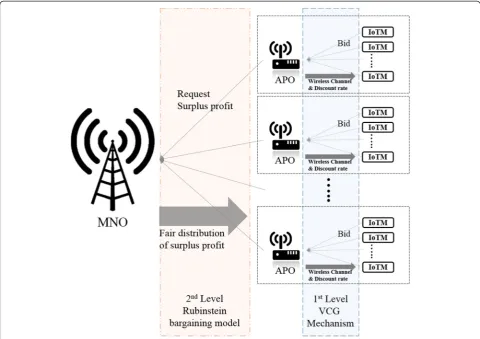
Game theory is a field of applied mathematics that provides an effective tool in modeling the interactions among independent decision-makers. It can describe the possibility to react to the actions of the other decision-makers and analyze the situations of conflict and cooper-ation [7]. In this paper, we adopt Vickrey-Clarke-Groves (VCG) mechanism and Rubinstein bargaining game model to design the data offloading algorithm. The VCG mechanism implements efficient social choice functions in environments in which participants have private informa-tion about their preferences. In this mechanism, the game participants’payoffs equal their respective marginal con-tributions to the social surplus [8]. A Rubinstein bargain-ing model refers to a class of bargainbargain-ing games that feature alternating offers through an infinite time horizon. Rubinstein’s solution is one of the most influential findings in game theory [9]. Based on the combination of VCG mechanism and Rubinstein bargaining model, MNO, APOs, and IoTMs participate in the data offloading process for the effectiveness of IoT/cellular system operation.
The main contributions of our work are as follows:
1. We propose a new pricing method by considering the characteristics of APOs and IoTMs. This method can induce the cooperation between APOs and IoTMs in data offloading operations.
2. Based on the Rubinstein bargaining model, we can fairly distribute the surplus profit. It can ensure the system effectiveness.
3. Through the adaptive combination of VCG
mechanism and Rubinstein bargaining model, MNO, APOs, and IoTMs actively participate in the data offloading process in the IoT/cellular system environment.
The rest of the paper is structured as follows. In Section 2, we survey previous work in resource alloca-tions, auction-based game theory models, and data off-loading algorithms. In Section 3, we explain in detail our proposed mobile data offloading algorithm. In Section 4, we discuss the experimental environment for perform-ance evaluation and analyze simulation results. Finally, we conclude the paper in Section 5.
2 Related work
In this chapter, we review the recently researched litera-tures that relate to our proposed scheme. Currently,
several resource allocation schemes have been deployed for wireless networks. Byun et al. [10] have investigated a market equilibrium in multichannel sharing cognitive radio networks. They model the spectrum-sharing process as a spectrum market where primary users offer secondary users their subchannels with limiting the interference from secondary users. And then, they de-fine a market equilibrium in the context of extended Fisher model and show that the equilibrium is yielded by solving an optimization problem, Eisenberg-Gale convex program. Finally, they develop a distributed algorithm that yields the stationary solutions asymp-totically equivalent to the solutions given by the convex program [10].
Jiang et al. [11] have proposed a novel quality-of-experience (QoE)-driven channel allocation scheme for secondary users and cognitive radio networks base sta-tion. The historical QoE data under different primary channels are collected by the secondary users and deliv-ered to a cognitive radio base station, which will allocate available channel resources to the secondary users based on their QoE expectations and maintain a priority ser-vice queue. The modified ON/OFF models of primary channels and service queue models of secondary users are jointly investigated for this channel allocation scheme [11].
In [12], Zhang et al. have conducted the first work on a framework for truthful online cloud auctions where users with heterogeneous demands could come and leave on the fly. Their framework desirably supports a variety of design requirements, including (1) dynamic design for timely reflecting fluctuation of supply-demand relations, (2) joint design for supporting the heteroge-neous user demands, and (3) truthful design for discour-aging bidders from cheating behaviors. Their theoretical analysis shows that the worst-case performance of their mechanism can be well-bounded [12].
Feng et al. [13] tackled the problem of stimulating smartphone users to join mobile crowdsourcing applica-tions with smartphones. They have introduced a reverse auction framework to model the interactions between the platform and the smartphones and have proposed a mechanism called TRAC which consists of two main components. The first component is a near-optimal ap-proximate algorithm for determining the winning bids with polynomial-time computation complexity. The sec-ond component is a critical payment scheme which, despite the approximation of determining winning bids, guarantees that submitted bids of smartphones reflect their real costs of performing sensing tasks [13].
hybrid, tiered cloud architecture consisting of local and public clouds, and showed how it can be leveraged to increase both performance and scalability of mobile ap-plications. They modeled the mobile application as a workflow of tasks and aim to optimally decompose the set of tasks to execute on the mobile client and two-tier cloud architecture considering multiple quality-of-service (QoS) factors such as power, price, and delay. Their re-sults indicated that MAPCloud can provide improved scalability and efficiency in comparison to only using public cloud [14].
In the paper [15], authors have proposed a novel framework to model mobile applications as a location-time workflows of tasks and showed that an optimal mapping of location-time workflows to tiered mobile cloud resources is an NP-hard problem. In addition, they proposed an efficient heuristic algorithm that can per-form well and scale well to a large number of users while ensuring high application QoS. They also showed that their proposed scheme can perform quite well under different mobility patterns and be resilient to errors/ uncertainty in prediction of mobile user location-time workflows [15].
The paper [16] discussed the current state of the art in the merger of cloud computing and smart-phone technologies that is called as mobile cloud computing (MCC). This paper also illustrated the ap-plicability of MCC in various domains including mo-bile learning, commerce, health/wellness, and social media. In addition, this research would identify research gaps covering critical aspects of how MCC can be real-ized and effectively utilreal-ized at scale. These include im-proved resource allocation in the MCC environment through efficient task distribution and offloading, secur-ity, and privacy [16].
Xu et al. [17] have reviewed the state-of-the-art re-search on managing the performance overhead of virtual machines and summarize them under diverse scenarios of the infrastructure-as-a-service (IaaS), ranging from the single-server virtualization, a single mega datacenter, to multiple geodistributed datacenters. Specifically, they unveiled the causes of virtual machine performance overhead by illustrating representative scenarios, dis-cussed the performance modeling methods with a par-ticular focus on their accuracy and cost, and compared the overhead mitigation techniques by identifying their effectiveness and implementation complexity. Finally, they presented future research challenges pertinent to the modeling methods and mitigation techniques of virtual machine performance overhead in the IaaS cloud [17].
Demestichas et al. [18] identified and addressed the important problem of service configuration and distri-bution in a composite radio environment (SCD-CRE).
The problem’s objective was to determine the best way to accommodate a demand volume, with which the composite radio infrastructure was faced. They found the QoS levels that can be offered and the networks that can support the demand at the selected QoS levels. In addition, they included a first approach to the definition, mathematical formulation, and solution of a version of the SCD-CRE problem. Results indicating some of the capabilities of the SCD-CRE were also presented [18].
Yan et al. [19] investigated the properties of trust, proposed objectives of the IoT trust management, and provided a survey on the current literature advances towards trustworthy IoT. Furthermore, they discussed unsolved issues, specified research challenges and indi-cated future research trends by proposing a research model for holistic trust management in IoT. In addition, they explored the literature towards trust worthy IoT in order to point out a number of open is-sues and challenges and suggested future research trends related to trust management. Finally, they pre-sented a further research model in order to achieve comprehensive trust management in IoT [19].
To deal with the problem of cellular traffic overload, some methods have been studied to efficiently conduct offloading. Zhuo et al. considered the use of the VCG model for data offloading [8]. This model investigates the tradeoff between the amount of traffic being off-loaded and the users’satisfaction and provides a novel incentive framework to motivate users to leverage their delay tolerance for cellular traffic offloading. To minimize the incentive cost given an offloading target, users with high delay tolerance and large offloading potential should be prioritized for traffic offloading. To effectively capture the dynamic characteristics of users’ delay tolerance, the scheme in [8] lets users proactively express their delay tolerance based on the reverse auc-tion. Gao et al. considered the use of the or Nash Bar-gaining Solution (NBS) in the data offloading system [20]. In this model, the MNO and APOs analyze the interaction among one MNO and multiple APOs based on the Nash bargaining theory.
3 The proposed data offloading algorithm
First, we design a game model of mobile data offload-ing system and then explain the proposed algorithm in detail. In this work, the data offloading system dis-tributes IoTM’s traffic. The three categories of the players are MNO, APOs, and IoTMs. We denote a set of IoTMs as N, such that N ¼f1;2;…;Ng. Each IoTM has a traffic that wants to offload their cellular traffic. And a set K ¼fAPO1;APO2;…;APOKg
channels and each APOi has covered a number of IoTMs (APOið ÞN ) where APOið ÞN ⊂N. Based on this
topology, we develop two game models—VCG mech-anism and Rubinstein game—to manage the data off-loading in IoT systems.
We consider an effective incentive model for the user-initiated data offloading. In our model, IoTMs initiate the offloading process while offering necessary incentives in order to access to APs. Generally, IoTMs should pay the price for their traffic transmission to a mobile net-work operator (MNO). Usually, a huge amount of cellu-lar data traffic has been generated by IoTMs, which exceeds the capacity of cellular network. It deteriorates the network quality. Therefore, the MNO should offload the part of cellular traffic to other coexisting networks. This technique is a desirable and promising approach to solve the cellular network overload problem. To motiv-ate IoTMs and APOs to help cellular traffic offloading, we design an incentive mechanism by considering the IoTMs’delay tolerance and price discount factor. In our model, IoTMs can reduce their payment by using an APO bandwidth, which can be used for the IoTMs’ cel-lular traffic services at a discounted price. On the other hand, APOs can get a surplus profit through providing their remaining bandwidth. To formalize MNO, APOs, and IoTMs actions, we develop a two-level game model based on VCG mechanism and Rubinstein bargaining solution. Under dynamic IoT changing situations, our game-based approach can toward an effective system performance (Fig. 1).
3.1 VCG mechanism for cooperation between APO and IoTMs
From the viewpoint of APOs, channel allocation to IoTMs is a very important. To maximize their profit, APOs try to select the most adaptable IoTM, which has more offloading traffic and higher signal-to-interference-plus-noise ratio (SINR). In this paper, we adopt the VCG mechanism to address the channel allocation problem
among IoTMs. In our VCG mechanism model, APOi
can be assumed as a seller with Mi channels, and each channel is allocated to a specific IoTM. For simplicity, we assume that the transmission range of APO is much smaller than that of the MNO and the coverage areas of any two APOs are not overlapped. For data offloading, each IoTM wants to obtain channels from its corre-sponding APO. With a discounted price, IoTMs enjoy an additional profit for data transmission in a time slot. However, APO’s channels are not enough to meet the total data offloading requests from IoTMs. Therefore, as a buyer, each IoTM bid for getting channels from its corre-sponding APO. To solve this channel allocation problem, our game model G¼ Nf ;K;SIoTM;SAPO;UAPO;UIoTMg
is defined as follows.
PlayersðN;KÞ:N andKare set of APOs and set of IoTMs, respectively, and the IoTMs in the coverage of APOiis APOiðNiÞ.
Strategies (SIoTM,SAPOi):SIoTMis the strategy set for each IoTM andSAPOi is the strategy set for APOi.
SIoTM is IoTM’s bid strategy set andSAPOiis the channel allocation vector (Ai).
Payoff functionsðUAPOið:Þ;UIoTMð:ÞÞ:UAPOi and
UIoTMare the payoff functions ofSIoTMandSAPOi, respectively.
Aiis the strategy of APOiwherei∈K, its channel allo-cation vector. bni is the strategy of ni where ni∈APOi
N
ð Þ; it is the bid to get the channel. All the players try to maximize their payoff. The ni’s payoff function ( UIoTMnið Þbi ) for surplus benefit is defined with the
off-loading data traffic and discounted rate (Pni).
UIoTMnðni;biÞ ¼Pnidni ð1Þ
where dni is the amount of ni’s data offloading traffic. The bi¼fb1i;b2i; ::;bNig is the vector of received bids distance between APOiandni.mjiis an available channel
of APOi, i.e., mji¼f1;2;…;mig∈ℳi.σ2andIr,mare the noise power and interference power, respectively [21]. APOi’s payoff function (UAPOið ÞAi ) means the expected
payoff when APOi selects Ai channel allocation. In this work, this function is developed based on the Rubinstein bargaining game, which is explained in detail in the Subsection 3.2.
where ani∈{0, 1} is the indicator factor whether the ni
gets a channel (ani= 1) or not (ani= 0).
From the IoTM (ni)’s point of view, the discounted rate (Pni) for data transmission is the main interest; it is
obtained through data offloading. In the proposed model, we estimate the Pni value based on the VCG
mechanism. The basic idea of VCG mechanism is a second-price auction. Among multiple bidders, the bid-der who has the highest bid wins the auction, but the winner only pays the social opportunity cost, which means the different payoff that total APO’s payoff that would be gotten with or without the winner’s payoff. In the proposed scheme, the social opportunity cost (SCni)
is given by.
S Cni¼UAPOi A
i−n
−U Ai ð4Þ
where Ai−n is the optimal channel allocation vector without nth IoTM. We assume that an individual so-cial opportunity cost is each IoTM’s contribution to the total network system. Therefore, the discount rate
Pni is defined as the ratio of the social opportunity costs.
Pni ¼−
S Cni X
j∈NiS Cj
ð5Þ
3.2 Rubinstein bargaining model for distribution of surplus profit
The main issue between the MNO and APOs is to maximize the profit by cooperation and fairly divide the surplus profit. To satisfy this goal, we propose a new fair division model based on the Rubinstein-Stahl bargaining approach. In our game model, the MNO negotiates with each APO, sequentially. Through several rounds of offers and counteroffers, they finally come to an
agree-ment. From the APOs’ point of view, they try to
maximize their profit by providing their remaining band-width. On the other hand, the major goal of the MNO is to fairly share this surplus profit getting from the band-width sharing. To address this division problem involv-ing two players, Rubinstein bargaininvolv-ing game can provide a unique solution to fairly share a given benefit [9].
The MNO’s surplus profit (Wi), which is obtained through APOi’s data offloading, is determined as the dif-ference between the MNO’s cost with and without data offloading. First, the MNO’s cost function without data offloading (C(MNO)) is given by
C MNOð Þ ¼ εðFtotalÞ2;s:t:; Ftotal¼
where Ftotalis the total traffic of MNO. zn is the traffic amount serviced by MNO, and dim is the traffic amount
serviced by the channelmin APOi. In this work, we fol-low the common sense; a generic cost function C(x) is considered as continuous, differentiable, strictly increas-ing, and convex [2]. Therefore, the MNO’s cost function with data offloading (D(MNO)) is calculated as follows:
D MNOð Þ ¼ CðFD OÞ−
whereFD_Ois the total traffic of MNO with data offload-ing. The second factor of the Eq. 5 is the discount cost caused by data offloading; P and Pim are the cellular
network base price and the discount rate of channel m in APOi, respectively. Finally, the MNO’s surplus profit (Wi) is given by:
In the Rubinstein bargaining model, final agreement can be expressed as follows:
xAPOi;x
patience factors. In the Rubinstein bargaining process, the more patience one has, the more payoff one attains. Under the common scenario of data offloading process, APOs have the higher precedence than MNO; after APOi’s data offloading decisions, MNO can plan to ef-fectively allocate its resource to obtain the most profit-able usage. Due to this reason, we assume that APOihas greater patience than MNO’s patience. In this work, we can represent MNO’s patience as a monotonic
time-decreasing function and APOi’s patience as a monotonic time-increasing function as follows [9]:
δMNOð Þ ¼r 1−
bargaining iteration round. The patience coefficient (πr i)
strongly affects the patience factor of both sides. There-fore, for the ideal management of data offloading system, we dynamically adjust the value of πr
i. To maximize the
social welfare,πr
i can be defined as follows:
πr
whereK−irepresents the all APOs except APOi. The
de-nominator in the Eq. 11 is the total cost C X
k∈K
and the numerator is the difference of the social
welfare with the APOi C X
. Finally, we can define the weighted
factor according to Eqs. 9, 10, and 11.
ω¼ 1−δMNO
1−δAPOiδMNO
and 1ð −ωÞ ¼δMNOð1−δAPOiÞ 1−δAPOiδMNO ð
12Þ
According to Eq. 12, MNO and APOs can get a surplus profit as follows.
RAPOi¼ω Wi and RMNO¼ð1−ωÞ Wi ð13Þ
where RAPOi is the surplus profit for APOiandRMNOis
the surplus profit for MNO.
3.3 The main steps of proposed algorithms
the proposed data offloading scheme are given next (Fig. 2) (Algorithm 1).
Step 1: At the initial time, each IoTM calculates the amount of data offloading traffic and the SINR. At the same time, each APO checks its own channel condition.
Step 2: All IoTMs send bid messagebnto their corre-sponding APOs.
Step 3: Each APO determines the optimal IoTMs and calculates the discount rate using Eqs. 3, 4, and 5.
Step 4: Each APO allocates channels to the selected IoTMs and the MNO applies the discounted price to the APO’s channel allocated IoTMs.
Step 5: After the channel allocation, the MNO should calculate the surplus profit using Eq. 8.
Step 6: According to Eqs. 9–11, the MNO and APOs calculate their own patience factors.
Step 7: Finally, the MNO and APOs divide the surplus profit based on Eqs. 12 and 13.
Fig. 2Flow chart of proposed scheme
4 Performance evaluation
In this section, the effectiveness of the proposed scheme is validated through simulation. Using a simu-lation model, which emulates a real-world IoT data offloading environment, the performance of the pro-posed scheme is compared with the two existing data
offloading management schemes; the VCG scheme [9] and the NBS scheme [20]. The assumptions implemented in simulation model are as follows.
▪Simulation system performance measures obtained on the basis of 50 iterations.
▪There are ten APOs and each APO has ten IoTMs that can be covered by APO.
▪Wi-Fi APOs are typical 3G/4G micro-cells with the 50-m transmission range.
▪The APOs are deployed in the high IoTM density areas. ▪Each IoTM’s traffic is a randomly and uniformly
selected from 0 to 10 Mbps.
▪Performance criteria obtained through simulations are the MNO’s revenue, the APOs’revenue, and the IoTMs’discount rate of price.
▪MNO’s revenue is estimated as the decreasing rate of MNO’s cost; it is caused by the data offloading technique. ▪APOs’revenue is defined as the profit, which is
obtained from the MNO.
▪IoTMs’discount rate represents the ratio of the discount price to the original price.
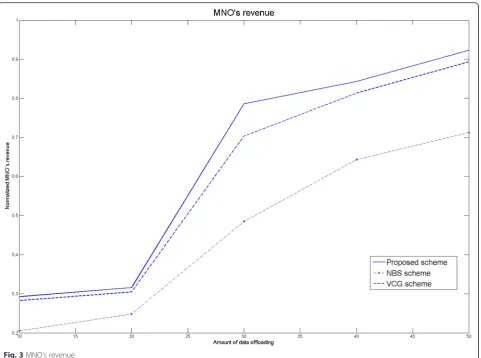
In Fig. 3, the MNO’s revenues of each scheme are compared over different data offloading traffics. From the simulation results, we can see that the MNO’s rev-enue of our proposed scheme has higher revrev-enue than those of other existing schemes. Based on these consid-erations, APOs and IoTMs, it shows that our scheme can effectively decrease the MNO’s cost more than other schemes.
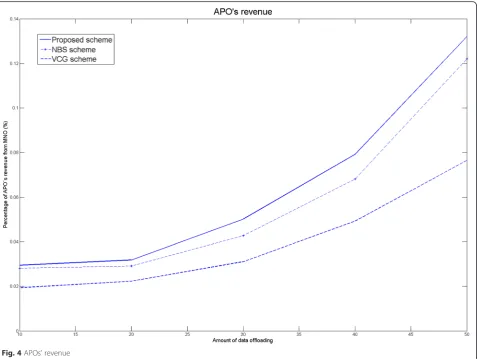
Figure 4 shows the performance comparison about the aggregate percentage of APOs’ revenue, which repre-sents the APOs’contribution for the data offloading. In this work, it is obtained from the MNO’s surplus profit. From simulation results, the main observation is that
the APOs’ revenue of our scheme is better than the
other existing schemes.
Figure 5 shows the IoTMs’average percentage of dis-count rate. Usually, a higher disdis-count rate value means that IoM users can reduce their payment. In our scheme, IoTMs and APOs actively participate in the data offload-ing game process and decrease the cost of data transmis-sion. In addition, we can effectively allocate the APO’s
bandwidth for data offloading. For this reason, IoTM users in our scheme tend to have a significantly lower payment than other existing schemes while improving the efficiency of an IoT-data-offloading system.
From the simulation results in Figs. 3, 4, and 5, it can be seen that our proposed approach performs better than the VCG scheme [8] and the NBS scheme [20]. Based on the combination of VCG mechanism and Rubinstein bargaining approach, the proposed scheme can constantly monitor the IoT system conditions and appropriately balance the system performance, whereas the other schemes [8, 20] cannot offer such an attractive system performance.
5 Conclusions
Recently, the explosive growth of multimedia traffic ser-vices has necessitated to design an efficient data offload-ing algorithm for the IoT/cellular network system. Data offloading is a promising technique to alleviate network traffic congestion and enhance service QoS. In this paper, we develop a new data offloading algorithm based
on the game model. According to the VCG mechanism and Rubinstein bargaining solution, we make the IoT/ cellular system more efficient. The numerical results have shown the effectiveness of our proposed scheme and confirmed the feasibility of interactive game approach. For the future work, our game-based data offloading mechanism can be applied to many directions in various research areas and sheds light on different decision prob-lems. For example, it would be useful to study the non-cooperative game model under complete information.
Competing interests
The authors declare that they have no competing interests.
Authors’contributions
Y. Park and S. Kim are authors of this work and ES participated in the design of the study and performed the statistical analysis. All authors read and approved the final manuscript.
Acknowledgements
This research was supported by the Ministry of Science, ICT and Future Planning (MSIP), Korea, under the Information Technology Research Center (ITRC) support program (IITP-2015-H8501-15-1018) supervised by the Institute for Information and Communications Technology Promotion (IITP).
Received: 13 May 2015 Accepted: 15 June 2015
References
1. Q Wangl, T He, K-C Chen, J Wangl, B Ko, Y Linl, K-w Lee, Dynamic spectrum allocation under cognitive cell network for M2M applications, inSignals, Systems and Computers (ASILOMAR), 2012, pp. 596–600
2. G Lin, G Iosifidis, H Jianwei, L Tassiulas, Economics of mobile data offloading, inComputer Communications Workshops (INFOCOM WKSHPS), 2013, pp. 351–356
3. Z Sheng, S Yang, Y Yu, A Vasilakos, J McCann, K Leung, A survey on the IETF protocol suite for the internet of things: standards, challenges, and opportunities. IEEE Wireless Communications20(6), 91–98 (2013) 4. Q Jing et al., Security of the Internet of things: perspectives and challenges.
Wireless Networks20(8), 2481–2501 (2014)
5. A Attar et al., A survey of security challenges in cognitive radio networks: solutions and future research directions. Proceedings of the IEEE 100(12), 3172–3186 (2012)
6. M Youssef et al., Routing metrics of cognitive radio networks: a survey. IEEE Communications Surveys and Tutorials16(1), 92–109 (2014)
7. MA Khan et al., Game dynamics and cost of learning in heterogeneous 4G networks. IEEE Journal on Selected Areas in Communications
30(1), 198–213 (2012)
8. X Zhuo, W Gao, G Cao, S Hua, An incentive framework for cellular traffic offloading. IEEE Transactions on Mobile Computing13(3), 541–555 (2014) 9. Y Park, S Kim, Bargaining-based smart grid pricing model for demand side
management scheduling. ETRI Journal37(1), 197–202 (2014)
10. B Sang-Seon et al., Computation of an equilibrium in spectrum markets for cognitive radio networks. IEEE Transactions on Computers 63(2), 304–316 (2014)
11. J Tigang et al., QoE-driven channel allocation schemes for multimedia transmission of priority-based secondary users over cognitive radio networks. IEEE Journal on Selected Areas in Communications 30(7), 1215–1224 (2012)
12. Z Hong et al., A framework for truthful online auctions in cloud computing with heterogeneous user demands, inIEEE INFOCOM, 2013, pp. 1510–1518 13. Z Feng et al., TRAC: truthful auction for location-aware collaborative sensing
in mobile crowdsourcing, inIEEE INFOCOM, 2014, pp. 1231–1239 14. R Reza et al., MAPCloud: mobile applications on an elastic and scalable 2-tier
cloud architecture, inProceeding UCC '12 Proceedings of the 2012 IEEE/ACM Fifth International Conference on Utility and Cloud Computing, 2012, pp. 83–90
15. R Reza et al., MuSIC: mobility-aware optimal service allocation in mobile cloud computing, in2013 IEEE Sixth International Conference on Cloud Computing (CLOUD), 2013, pp. 75–82
16. R Reza et al., Mobile cloud computing: a survey, state of art and future directions. MONET19(2), 133–143 (2014)
17. F Xu et al., Managing performance overhead of virtual machines in cloud computing: a survey, state of the art, and future directions. Proceedings of the IEEE102(1), 11–31 (2014)
18. D Panagiotis et al., Service configuration and traffic distribution in composite radio environments, inIEEE Transactions on Systems, Man, and Cybernetics, 2004, pp. 69–81
19. Y Zheng et al., A survey on trust management for Internet of things. Journal of Network and Computer Applications42, 120–134 (2014)
20. L Gao, G Iosifidis, J Huang, D Li, Bargaining-based mobile data offloading. IEEE Journal on Selected Areas in Communications32(6), 1114–1125 (2014) 21. Q Liu, G Feng, S Qin, Energy-efficient traffic offloading in macro-pico networks,
inWireless and Optical Communication Conference (WOCC), 2013, pp. 236–241
Submit your manuscript to a
journal and benefi t from:
7 Convenient online submission
7 Rigorous peer review
7 Immediate publication on acceptance
7 Open access: articles freely available online
7 High visibility within the fi eld
7 Retaining the copyright to your article