R E S E A R C H
Open Access
The numerical method for computing the
ground state of the two-component dipolar
Bose-Einstein condensate
Si-Qi Li, Xiang-Gui Li
*and Dong-Ying Hua
*Correspondence: [email protected] School of Applied Science, Beijing Information Science and Technology University, Beijing, 100192, P.R. China
Abstract
A two-component Bose-Einstein condensate described by two coupled Gross-Pitaevskii (GP) equations in three dimensions is considered, where one
equation has dipole-dipole interactions while the other one has only the usuals-wave contact interaction, in a harmonic trap. The singularity in the dipole-dipole
interactions brings significant difficulties both in mathematical analysis and in numerical simulations. The backward Euler method in time and the sine spectral method in space are proposed to compute the ground states. Numerical results are given to show the efficiency of this method.
Keywords: Bose-Einstein condensate; Gross-Pitaevskii equation; dipolar interaction; ground state; spectral method
1 Introduction
Since , the Bose-Einstein condensation (BEC) of ultra-cold atomic and molecular gases has attracted much attention both theoretically and experimentally. Most of the properties of these trapped quantum gases are governed by the interactions between par-ticles in the condensate []. Over the past decade, there has been an investigation for real-izing a new kind of quantum gases with the dipolar interaction, acting between particles having a permanent magnetic or electric dipole moment. The experimental realization of a BEC of Cr atoms [, ] at the University of Stuttgart in gave new impetus to the theoretical and numerical investigations on these novel dipolar quantum gases at low tem-perature. Recently more detailed and controlled experimental results have been obtained, illustrating the effects of phase separation in a multi-component BEC [–]. In these pa-pers, the studies of the binary condensates were limited to the case ofs-wave interactions, while recently the dipolar BEC has drawn a great deal of attention.
In this work, a numerical method for computing the ground state of the two-component dipolar BEC is considered, where one equation has dipole-dipole interactions and the other has only the usuals-wave contact interaction. However, since the dipole-dipole in-teractions are long range, anisotropic and partially attractive, and the computational cost in three dimensions is high, the nontrivial task of achieving and controlling the dipolar BEC is thus particularly challenging.
The two-component dipolar BEC, confined in a cylindrical trap, is described by two coupled Gross-Pitaevskii equations. As far as the dipolar interaction is concerned, a
volution term is introduced [–] to modify the classical Gross-Pitaevskii equation, which results in the following differential-integral equations (). Since the transition metal has a magnetic dipole interaction while the alkali metal has not, we take into account this fac-tor in this system. We take Cr as component and Rb as component []. Then the GP equations for this system can be written as
whereϕ,ϕare the wave functions of component and , respectively. The inter-atomic
and inter-components-wave scattering interactions are described byUj(j= , ) andU,
respectively, with the following expressions []:
Uj=
where aj is the scattering length of component janda is that between component
and . Hereis the Planck constant,mjis the mass of the atom of componentj, andVj
(j= , ) is the external trapping potential confining the gas. Generally, it is harmonic, that is,Vj(r) =
mj (ω
jxx+ωjyy+ωjzz) withωjp(p=x,y,z) represents the trap frequency inx,y,
zdirections, respectively. The local mean-fieldUj|ϕj|represents thes-wave interaction. Vdipis the long-range isotropic dipolar interaction potential between two dipoles, and it
is defined by
whereθ is the angle between the polarization axisnand the relative of two atoms (i.e.,
cosθ=n· r/r),r=|r|=x+y+z. The wave functionϕ
i(x,t) is normalized according
toϕi=
R|ϕi(r,t)|dr=Ni(i= , ), whereNiis the number of the atoms in the dipolar
BEC.
This paper is organized as follows. In Section , a numerical method for computing ground states is presented. In Section , numerical results are reported to verify the effi-ciency of this numerical method. Finally, some concluding remarks are drawn in Section .
2 Numerical method for computing the ground states
System () can be made dimensionless and simplified by adopting a unit system, where the units for length, time and energy are given bya, /ω, andω, respectively, with
r . In addition the wave functions in () satisfy
Plugging () into () and noticing () and (), we can reformulate GPE () into the Schrödinger-Poisson type system
by removing the symbol ‘’ in ()-() to simplify the denotation. In practical computation, the whole space problem is usually truncated into a bounded computational domain= [a,b]×[c,d]×[e,f] with the homogeneous Dirichlet boundary condition. Let
To compute the ground state, an imaginary time method is adopted []. That is,
⎧
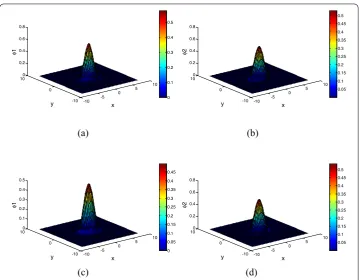
three-Figure 1 Ground state solutions for different parameterλ. (a)Surface for component 1,ϕ1(x,y,z),z= 0,
λ= 1/3;(b)Surface for component 2,ϕ2(x,y,z),z= 0,λ= 1/3;(c)Surface for component 1,ϕ1(x,y,z),z= 0,
λ= –1/3;(d)Surface for component 2,ϕ2(x,y,z),z= 0,λ= –1/3.
dimensional space. If we assume that
ϕ(r,tn+) =ϕn+(r) =
M–
p=
K–
q=
L–
s=
αpqsφpqs and
ϕ(r,tn+) =ϕn+(r) =
M–
p=
K–
q=
L–
s=
αpqs φpqs. ⎧
⎪ ⎪ ⎪ ⎪ ⎪ ⎪ ⎪ ⎨ ⎪ ⎪ ⎪ ⎪ ⎪ ⎪ ⎪ ⎩
ϕ*jkl–ϕnjkl t =
∇hϕ*|jkl– [V(xj,yk,zl) + (β–λ)|ϕnjkl|
+β|ϕnjkl|– λ∂nnξn|jkl]ϕ*jkl,
ϕ*jkl–ϕnjkl t =
∇hϕ*|jkl– [V(xj,yk,zl)
+β|ϕnjkl|+β|ϕnjkl|]ϕ*jkl, tn≤t≤tn+,
∇ξ= –|ϕ (r,t)|,
()
with boundary conditions
ϕ*kl=ϕ*Mkl=ϕ*jl=ϕ*jKl=ϕ*jk=ϕ*jkL= , (j,k,l)∈MKL,
ϕ* kl=ϕ*Mkl=ϕ*jl=ϕ*jKl=ϕ*jk=ϕ*jkL= , (j,k,l)∈MKL, and initial conditions
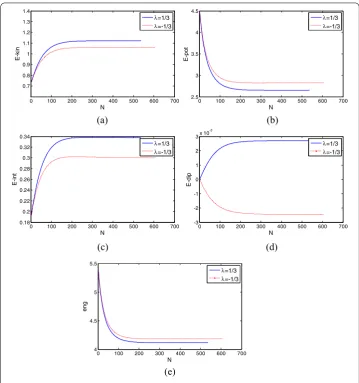
Figure 3 The energy evolution according to the time stepN. (a)Kinetic energy;(b)Potential energy; (c)Interaction energy;(d)Dipole energy;(e)The total energy.
βpqs=
u
p+uq+us
MKL
M–
j=
K–
k=
L–
l=
ϕnjkl+sin
jpπ M
sin
kqπ K
sin
lsπ L
.
Linear system () can be iteratively solved in a phase space very efficiently via discrete sine transform under the conditionsmaxj,k,l|ϕnjkl+–ϕnjkl|< –andmaxj,k,l|ϕnjkl+–ϕnjkl|< –.
3 Numerical results
Example Consider the ground state of the BEC withV(r) =(x+ y+ z). The initial
condition is given as follows:
⎧ ⎨ ⎩
ϕ,=ϕ(x,y,z, ) =π–/γx/γz/e
–(γx(x+y)+γzz), ϕ,=ϕ(x,y,z, ) =π–/γx/γz/e
–(γx(x+y)+γzz)
,
(x,y,z)∈R.
Here,γx=ωωx,γz=
ωz
ω,ω=min{ωjx,ωjy,ωjz}. We solve this system on [–, ]
withh
x=
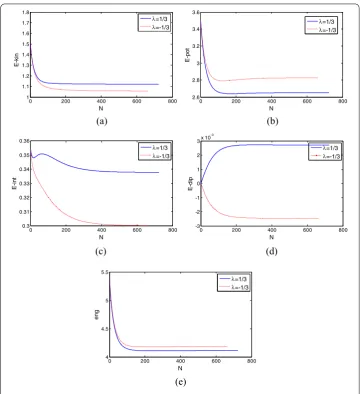
Figure 4 The energy evolution according to the time stepN. (a)Kinetic energy;(b)Potential energy; (c)Interaction energy;(d)Dipole energy;(e)The total energy.
Figure shows the results for the case ofγx=γz= .
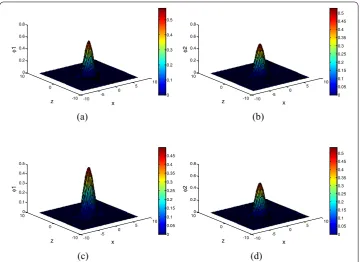
Example Solve the ground state problem for a dipolar BEC withV(r) =(x+ y+ z).
The initial condition is
⎧ ⎨ ⎩
ϕ,=ϕ(x,y,z, ) =π–/γx/γy/γz/e–
(γxx+γyy+γzz),
ϕ,=ϕ(x,y,z, ) =π–/γx/γy/γz/e–(γxx+γyy+γzz),
(x,y,z)∈R.
Figure shows the results for the case ofγx= ,γy= ,γz= .
4 Conclusion
GPE for dipolar BEC into a Gross-Pitaevskii-Poisson type system. Numerical examples are given to show the efficiency of our method. In all cases, total energy decreases (Figure and Figure ). The results agree with the previous work []. Numerical results are given to demonstrate the efficiency of our numerical method. And dynamics will be the latter part of our work to be carried out.
Competing interests
The authors declare that they have no competing interests.
Authors’ contributions
SQL established the scheme, performed the numerical examples in Section 3 and drafted the manuscript. XGL designed the study. DYH established the model and helped to inspect the manuscript. All authors read and approved the final manuscript.
Acknowledgements
This work was supported by Natural Science Foundation of China (No. 11171032) and Beijing Municipal Education Commission (Nos. KM201110772017, 71D09111003).
Received: 15 March 2013 Accepted: 25 June 2013 Published: 8 July 2013
References
1. Pitaevskii, L, Stringari, S: Bose-Einstein Condensation. Oxford University, New York (2003)
2. Griesmaier, A, Werner, J, Hensler, S, Stuhler, J, Pfau, T: Bose-Einstein condensation of chromium. Phys. Rev. Lett.94, Article ID 160401 (2005)
3. Stuhler, J, Griesmaier, A, Koch, T, Fattori, M, Pfau, T, Giovanazzi, S, Pedri, P, Santos, L: Observation of dipole-dipole interaction in a degenerate quantum gas. Phys. Rev. Lett.95, Article ID 150406 (2005)
4. Schweikhard, V, Coddington, I, Engels, P, Tung, S, Cornell, EA: Phys. Rev. Lett.93, 210403 (2004)
5. Mertes, KM, Merrill, JW, Carretero-González, R, Frantzeskakis, DJ, Kevrekidis, PG, Hall, DS: Phys. Rev. Lett.99, 190402 (2007)
6. Papp, SB, Pino, JM, Wieman, CE: Phys. Rev. Lett.101, 040402 (2008)
7. Yi, S, You, L: Trapped atomic condensates with anisotropic interactions. Phys. Rev. A61, 041604(R) (2000) 8. Yi, S, You, L: Trapped condensates of atoms with dipole interactions. Phys. Rev. A63, Article ID 053607 (2001) 9. Yi, S, You, L: Calibrating dipolar interaction in an atomic condensate. Phys. Rev. Lett.92, Article ID 193201 (2004) 10. Xi, K-T, Li, J, Shi, D-N: Phase separation of a two-component dipolar Bose-Einstein condensate in the
quasi-one-dimensional and quasi-two-dimensional regime. Phys. Rev. A84, Article ID 013619 (2011)
11. Pethick, CJ, Smith, H: Bose-Einstein Condensation in Dilute Gases. Cambridge University Press, Cambridge, (2008) 12. Hua, D-Y, Li, X-G, Zhu, J: A mass conserved splitting method for the nonlinear Schrödinger equation. Adv. Differ. Equ.
2012, 85 (2012)
13. Bao, W, Cai, Y: Mathematical theory and numerical methods for Bose-Einstein condensation. Kinet. Relat. Models6(1), 1-135 (2013)
14. Chiofalo, ML, Succi, S, Tosi, MP: Ground state of trapped interacting Bose-Einstein condensates by an explicit imaginary time algorithm. Phys. Rev. E62, 7438-7444 (2000)
15. Parker, NG, Ticknor, C, Martin, AM, O’Dell, DHJ: Structure formation during the collapse of a dipolar atomic Bose-Einstein condensate. Phys. Rev. A79, Article ID 013617 (2009)
doi:10.1186/1687-1847-2013-204