R E S E A R C H
Open Access
On new evolution of Ri’s result via
w
-distances and the study on the solution for
nonlinear integral equations and fractional
differential equations
Hassen Aydi
1,2, Teerawat Wongyat
3and Wutiphol Sintunavarat
3**Correspondence:
3Department of Mathematics and
Statistics, Faculty of Science and Technology, Thammasat University Rangsit Center, Pathumthani, Thailand
Full list of author information is available at the end of the article
Abstract
The aim of this work is to establish a new fixed point theorem for generalized contraction mappings with respect tow-distances in complete metric spaces. An illustrative example is provided to advocate the usability of our results. Also, we give a numerical experiment for approximating a fixed point in these examples. As an application, the received results are used to summarize the existence and uniqueness of the solution for nonlinear integral equations and nonlinear fractional differential equations of Caputo type.
MSC: 47H10; 54H25
Keywords: w-distance; Fredholm integral equation; Volterra integral equation; Fractional differential equation
1 Introduction
The most well-known fixed point result in the metrical fixed point theory is Banach’s con-traction mapping principle. Since this principle requires only the structure of a complete metric space with contractive condition on the mapping, which is easy to test in this set-ting, it is the most widely applied fixed point result in many branches of mathematics. In particular, it is used to demonstrate the existence and uniqueness of a solution of the following equations:
• integral equations;
• ordinary differential equations; • partial differential equations; • matrix equations;
• functional equations.
Moreover, this principle has many applications not only in the various branches in mathe-matics but also in economics, chemistry, biology, computer science, engineering, and oth-ers. Based on the mentioned impact, it was developed extensively by several researchoth-ers. In particular, it was improved by such famous fixed point researchers as Boy and Wong [1] and Matkowski [2]. Recently, some fixed point results for generalized contraction map-pings have been proved by Ri [3] as follows:
Theorem 1.1([3]) Let(X,d)be a complete metric space and f :X→X be a mapping.
Suppose that there is a function ϕ : [0,∞)→[0,∞) such thatϕ(0) = 0, ϕ(t) < t, and
lim sups→t+ϕ(s) <t for all t> 0and
df(x),f(y)≤ϕd(x,y) (1.1)
for all x,y∈X.Then f has a unique fixed point in X.Moreover,for each x∈X,the Picard iteration{xn},which is defined by xn=fnx for all n∈N,converges to a unique fixed point
of f.
This result generalized Boyd and Wong’s fixed point theorem in [1] and Matkowski’s fixed point theorem in [2] and hence it also contains Banach’s contraction mapping prin-ciple.
On the another hand, the concept of aw-distance on a metric space was introduced and investigated by Kada et al. [4], and this concept was applied to several famous fixed point theorems. Meanwhile, Kada et al. [4] gave the important tool related tow-distances which will be discussed in the next section. Many generalizations of fixed point results with the idea ofw-distances have been investigated heavily by many authors (see in [5–8] and references therein).
To the best of our knowledge, there has been no discussion so far concerning Ri’s fixed point result in [3] in the sense of w-distances. Based on the above mentioned fact, we present new fixed point theorems for generalized contraction mappings with respect to
w-distances in complete metric spaces, which is an extension of Ri’s fixed point result, and give an example for showing the usability of our results while Theorem 1.1 is not applica-ble. We also give numerical experiments for finding a fixed point in this example. As an application, the acquired results are used to aggregate the existence and uniqueness of the solution for nonlinear integral equations and nonlinear fractional differential equations.
2 Preliminaries
In this section, we recall some important notations, needed definitions, and primary re-sults joint with the literature.
Definition 2.1([4]) Let (X,d) be a metric space. A functionq:X×X→[0,∞) is called aw-distance onXif it satisfies the following three conditions for allx,y,z∈X:
(W1) q(x,y)≤q(x,z) +q(z,y);
(W2) q(x,·) :X→[0,∞)is lower semicontinuous;
(W3) for eachε> 0, there existsδ> 0such thatq(x,y)≤δandq(x,z)≤δimply
d(y,z)≤ε.
It is well known that each metric on a nonempty setXis aw-distance onX. Here, we give some other examples ofw-distances.
Example 2.2 Let (X,d) be a metric space. A function q:X×X→[0,∞) defined by
q(x,y) =cfor everyx,y∈Xis aw-distance onX, wherecis a positive real number. But
Example2.3 Let (X,·) be a normed space. Then the functionq:X×X→[0,∞) defined by
q(x,y) =y
for allx,y∈Xis aw-distance.
The following lemma will be used in the next section.
Lemma 2.4([4]) Let(X,d)be a metric space,q be a w-distance on X,{xn}and{yn}be two
sequences in X and x,y,z∈X.
(i) Iflimn→∞q(xn,x) =limn→∞q(xn,y) = 0,thenx=y.In particular,if
q(z,x) =q(z,y) = 0,thenx=y.
(ii) Ifq(xn,yn)≤αnandq(xn,y)≤βnfor anyn∈N,where{αn}and{βn}are sequences
in[0,∞)converging to0,then{yn}converges toy.
(iii) If,for eachε> 0,there existsNε∈Nsuch thatm>n>Nεimpliesq(xn,xm) <ε(or
limm,n→∞q(xn,xm) = 0),then{xn}is a Cauchy sequence.
3 Main results
First, we will create two lemmas to prove the main result.
Lemma 3.1 Let q be a w-distance on a metric space(X,d).Suppose that ϕ: [0,∞)→ [0,∞)is a mapping satisfyingϕ(0) = 0,
ϕ(t) <t and lim sup s→t+
ϕ(s) <t
for all t> 0and f :X→X is a mapping satisfying the following condition:
qf(x),f(y)≤ϕq(x,y) (3.1)
for all x,y∈X.Thenlimn→∞q(fn(x),fn+1(x)) = 0andlim
n→∞q(fn+1(x),fn(x)) = 0for each
x∈X.
Proof Letx∈Xbe arbitrary. We define the sequence{xn} ⊂Xby
xn=fn(x)
for alln∈N. Setan:=q(xn,xn+1)≥0 for alln∈N. If there isn0∈Nsuch thatan0= 0, then
ϕ(an0) = 0 and so
0≤an0+1
=qf(xn0),f(xn0+1)
≤ϕ(an0)
This implies that an0+1= 0. By a similar process, we obtain an= 0 for alln>nn0+1 and
hence
lim n→∞q
fn(x),fn+1(x)= 0
for allx∈X. Now we may suppose thatan> 0 for eachn∈N. From condition (3.1) and the fact thatϕ(t) <tfor allt> 0, we obtain
0 <an+2 ≤ϕ(an+1)
<an+1 ≤ϕ(an)
<an
for alln∈N. Hence{an}and{ϕ(an)}are strictly decreasing and bounded below. This yields thatlimn→∞anandlimn→∞ϕ(an) exist. We assume that 0 <a=limn→∞anandan=a+εn, whereεn> 0. Note that iflim sups→t+ϕ(s) <tfor allt> 0, thenlim supt
n→a+ϕ(tn) <afor
each sequence{tn}withtn↓a+asn→ ∞. Therefore,
0 < a
= lim n→∞an+1 ≤ lim
n→∞ϕ(an) ≤ lim
n→∞s∈(a,asupn+1)ϕ(s) = lim
εn+1→0
sup s∈(a,a+εn+1)
ϕ(s)
≤lim
ε→0s∈(a,a+supε)ϕ(s) <a.
This is a contradiction. Thuslimn→∞an= 0, that is,limn→∞q(fn(x),fn+1(x)) = 0 for each
x∈X. Similarly, we can conclude thatlimn→∞q(fn+1(x),fn(x)) = 0 for eachx∈X.
Lemma 3.2 Let q be a w-distance on a metric space(X,d).Suppose that ϕ: [0,∞)→
[0,∞)is a mapping satisfyingϕ(0) = 0,
ϕ(t) <t and lim sup s→t+
ϕ(s) <t
for all t> 0and f :X→X is a mapping satisfying the following condition:
qf(x),f(y)≤ϕq(x,y) (3.2)
for all x,y∈X.Then{fn(x)}n=∞
Proof We want to prove thatlimm,n→∞q(xn,xm) = 0. Suppose this by contradiction. Then there exist ε> 0 and integersmk,nk∈Nsuch thatmk>nk>k andq(xnk,xmk)≥εfor k= 0, 1, 2, . . . . Also, we can choosemkin order to assume thatq(xnk,xmk–1) <ε. Hence, for
eachk∈N, we have
ε≤q(xnk,xmk)
≤q(xnk,xmk–1) +q(xmk–1,xmk)
≤ε+q(xmk–1,xmk).
Taking limit ask→ ∞in the above inequality and using Lemma 3.1, we obtain
lim
k→∞q(xnk,xmk) =ε.
We observe that
q(xnk,xmk)≤q(xnk,xnk+1) +q(xnk+1,xmk+1) +q(xmk+1,xmk)
≤q(xnk,xnk+1) +ϕ
q(xnk,xmk)
+q(xmk+1,xmk).
Lettingk→ ∞in the above inequality and using the fact thatϕ(t) <tandlim sups→t+ϕ(s) < tfor allt> 0, we obtain
ε= lim
k→∞q(xnk,xmk)
≤ lim k→∞ϕ
q(xnk,xmk)
≤ lim
ε→+0s∈sup(ε,ε+ε)ϕ(s) < ε.
This is a contradiction. Hence, limm,n→∞q(xn,xm) = 0. From Lemma 2.4 (iii), we get {fn(x)}n=∞
n=1 is a Cauchy sequence inX.
Next, we exhibit the main result in this paper.
Theorem 3.3 Let(X,d)be a complete metric space and q: [0,∞)→[0,∞)be a w-distance on X.Suppose that f :X→X is a continuous mapping andϕ: [0,∞)→[0,∞)is a function satisfyingϕ(0) = 0,ϕ(t) <t,lim sups→t+ϕ(s) <t for all t> 0and
qf(x),f(y)≤ϕq(x,y) (3.3)
for all x,y∈X.Then f has a unique fixed point in X.Moreover,for each x∈X,the Picard iteration{xn},which is defined by xn=fnx for all n∈N,converges to a unique fixed point
of f.
somep∈X. From the continuity off, we get
p= lim n→∞f
n+1(x)
= lim n→∞f
fn(x)
=f
lim n→∞f
n(x)
=f(p).
Thus,pis a fixed point off. Furthermore, from condition (3.3), we obtain
q(p,p) =q(fp,fp)≤ϕq(p,p).
It implies thatq(p,p) = 0.
Next, we will show the uniqueness of the fixed point ofT. Suppose thatu∈Xis another fixed point off. From condition (3.3), we obtain
q(p,u) =q(fp,fu)≤ϕq(p,u).
This implies thatq(p,u) = 0. By Lemma 2.4(i), we getp=u. Therefore,f has a unique fixed
pointp. This completes the proof.
Now, we give an example which is possible to apply by the contractive condition (3.3) but not the contractive condition in Theorem 1.1.
Example3.4 LetX= [0,∞) with the metricd:X×X→Rwhich is defined by
d(x,y) =
⎧ ⎨ ⎩
0 ifx=y,
1 ifx=y
for allx,y∈X. Define a mappingf :X→Xby
fx=
⎧ ⎨ ⎩
x
4 ifx≥1, 0 ifx< 1,
wherex∈[0,∞). Next, we define a functionϕ: [0,∞)→[0,∞) by
ϕ(t) = t 3.
It is easy to see that condition (1.1) is not satisfied forx,y≥1 withx=y. Hence Theo-rem 1.1 cannot be applied in this case.
Next, we define aw-distanceq:X×X→[0,∞) by
q(x,y) =y
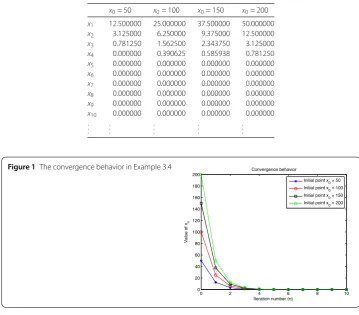
Table 1 The iterates of Picard iterations in Example 3.4
x0= 50 x0= 100 x0= 150 x0= 200
x1 12.500000 25.000000 37.500000 50.000000 x2 3.125000 6.250000 9.375000 12.500000 x3 0.781250 1.562500 2.343750 3.125000 x4 0.000000 0.390625 0.585938 0.781250 x5 0.000000 0.000000 0.000000 0.000000 x6 0.000000 0.000000 0.000000 0.000000 x7 0.000000 0.000000 0.000000 0.000000 x8 0.000000 0.000000 0.000000 0.000000 x9 0.000000 0.000000 0.000000 0.000000 x10 0.000000 0.000000 0.000000 0.000000 .
. .
. . .
. . .
. . .
. . .
Figure 1The convergence behavior in Example 3.4
Case 1. Ifx∈[0,∞)andy≥1, then
q(fx,fy) =fy
= y 4
≤ y 3 =ϕ(y)
=ϕq(x,y).
Case 2. Ifx∈[0,∞)andy< 1, then
q(fx,fy) =fy= 0≤ϕq(x,y).
Therefore, all the conditions of Theorem 3.3 hold and hencef has a unique fixed point. Here,x= 0 is a unique fixed point off.
Some numerical experiments for the unique fixed point off are given in Table 1. Fur-thermore, the convergence behavior of these iterations is shown in Fig. 1.
Here, we give the well-known lemma about the relation between some conditions of the control function without the proof.
(♠1) Ifϕis right continuous such thatϕ(t) <tfor allt> 0, thenϕ(0) = 0. (♠2) Ifϕis increasing and right continuous, thenϕis upper semi-continuous.
(♠3) Ifϕ is upper semi-continuous from the right such thatϕ(t) <tfor allt> 0, then lim sups→t+ϕ(s) <tfor allt> 0.
By using Theorem 3.3 and Lemma 3.5, we get the following results.
Corollary 3.6 Let (X,d) be a complete metric space and q: [0,∞)→[0,∞)be a w-distance on X.Suppose that f :X→X is a continuous mapping andϕ: [0,∞)→[0,∞)is an upper semi-continuous function from the right such thatϕ(0) = 0,ϕ(t) <t for all t> 0
and
qf(x),f(y)≤ϕq(x,y) (3.4)
for all x,y∈X.Then f has a unique fixed point in X.Moreover,for each x∈X,the Picard iteration{xn},which is defined by xn=fnx for all n∈N,converges to a unique fixed point
of f.
Corollary 3.7 Let (X,d) be a complete metric space and q: [0,∞)→[0,∞)be a w-distance on X.Suppose that f :X→X is a continuous mapping andϕ: [0,∞)→[0,∞)is increasing and right continuous such thatϕ(t) <t for all t> 0and
qf(x),f(y)≤ϕq(x,y) (3.5)
for all x,y∈X.Then f has a unique fixed point p in X.Moreover,for each x0∈X,the Picard
iteration{xn},which is defined by xn=fnx0for all n∈N,converges to a unique fixed point
of f.
Takingq=din Theorem 3.3 and Corollaries 3.6, 3.7, we obtain the following results.
Corollary 3.8([3]) Let(X,d)be a complete metric space and f :X→X be a mapping.
Suppose that there is a function ϕ : [0,∞)→[0,∞) such that ϕ(0) = 0, ϕ(t) <t and
lim sups→t+ϕ(s) <t for all t> 0and
df(x),f(y)≤ϕd(x,y) (3.6)
for all x,y∈X.Then f has a unique fixed point p in X.Moreover,for each x0∈X,the Picard
iteration{xn},which is defined by xn=fnx0for all n∈N,converges to a unique fixed point
of f.
Corollary 3.9 Let(X,d)be a complete metric space.Suppose that f :X→X is a mapping andϕ: [0,∞)→[0,∞)is upper semi-continuous from the right such thatϕ(0) = 0,ϕ(t) <t for all t> 0and
df(x),f(y)≤ϕd(x,y) (3.7)
for all x,y∈X.Then f has a unique fixed point in X.Moreover,for each x∈X,the Picard iteration{xn},which is defined by xn=fnx for all n∈N,converges to a unique fixed point
Corollary 3.10([2]) Let(X,d)be a complete metric space.Suppose that f :X→X is a mapping andϕ: [0,∞)→[0,∞)is increasing and right continuous such thatϕ(t) <t for all t> 0and
df(x),f(y)≤ϕd(x,y) (3.8)
for all x,y∈X.Then f has a unique fixed point p in X.Moreover,for each x0∈X,the Picard
iteration{xn},which is defined by xn=fnx0for all n∈N,converges to a unique fixed point
of f.
4 Applications
The theory of nonlinear integral equations nowadays is a large topic which is found in many applications of various branches in mathematics and other fields such as biology, engineering, economics, etc. Meanwhile, the fractional order models and the theory of nonlinear fractional differential equations are very important to study natural problems because the manner of the trajectory of the fractional order derivatives is nonlocal, which describes that the fractional order derivative has memory effect features. So the theory of nonlinear fractional differential equations can be widely applied in many branches such as the optimal control, finance, chaos, physics, etc. For more details, we refer the reader to [9–16] and the references therein. Nowadays, many mathematicians proved the existence and uniqueness of a solution of nonlinear fractional differential equations by using the fixed point results (see in [7, 17] and the references therein).
In this section, we use the theoretical result in the previous section for proving the ex-istence and uniqueness results of a solution for the following equations:
• nonlinear Fredholm integral equations; • nonlinear Volterra integral equations;
• fractional differential equations of Caputo type.
Throughout this section, let us denote byC[a,b], wherea,b∈Rwitha<b, the set of all continuous functions from [a,b] intoR.
4.1 The nonlinear integral equations
In this subsection, we prove the existence and uniqueness results of a solution for the nonlinear Fredholm integral equation and nonlinear Volterra integral equation by using our main results in the previous section.
Theorem 4.1 Consider the nonlinear Fredholm integral equation
x(t) =φ(t) + b
a
Kt,s,x(s)ds, (4.1)
where x∈C[a,b]such that a,b∈Rwith a<b,φ: [a,b]→Rand K: [a,b]2×R→Rare
given continuous mappings.Suppose that there is a functionϕ: [0,∞)→[0,∞)such that
ϕ(0) = 0,ϕ(t) <t,andlim sups→t+ϕ(s) <t for all t> 0and
Kt,s,x(s)+Kt,s,y(s)≤[ϕ(sups∈[a,b]|x(s)|+sups∈[a,b]|y(s)|)] – 2φ(t)
for all x,y∈C[a,b]and for all t,s∈[a,b].Then the nonlinear integral equation(4.1)has a
for all n∈N,converges to a unique solution of the nonlinear integral equation(4.1).
Proof LetX=C[a,b] andf :X→Xbe defined by
exists a unique solution of the nonlinear Fredholm integral equation (4.1). This completes
the proof.
Using the identical method in the proof of the above theorem, we get the following result.
Theorem 4.2 Consider the nonlinear Volterra integral equation
x(t) =φ(t) + t
a
Kt,s,x(s)ds, (4.2)
where x∈C[a,b]such that a,b∈Rwith a<b,φ: [a,b]→Rand K: [a,b]2×R→Rare
given continuous mappings.Suppose that there is a functionϕ: [0,∞)→[0,∞)such that
ϕ(0) = 0,ϕ(t) <t andlim sups→t+ϕ(s) <t for all t> 0and
Kt,s,x(s)+Kt,s,y(s)≤[ϕ(sups∈[a,b]|x(s)|+sups∈[a,b]|y(s)|)] – 2φ(t)
b–a
for all x,y∈C[a,b]and for all t,s∈[a,b].Then the nonlinear integral equation(4.2)has a unique solution.Moreover,for each x0∈C[a,b],the Picard iteration{xn},which is defined
by
(xn)(t) =φ(t) + t
a
Kt,s,xn–1(s)ds
for all n∈N,converges to a unique solution of the nonlinear integral equation(4.2).
4.2 The nonlinear fractional differential equations
The aim of this subsection is to prove the existence and uniqueness result of solutions for the nonlinear fractional differential equations of Caputo type by using Theorem 3.3.
First, let us recall some basic definitions of fractional calculus (see [18, 19]). For a contin-uous functiong: [0,∞)→R, the Caputo derivative of functionalgorderβ> 0 is defined as
CDβ
g(t):= 1 (n–β)
t
0
(t–s)n–β–1g(n)(s)ds n– 1 <β<n,n= [β] + 1,
where [β] denotes the integer part of the positive real numberβandis a gamma func-tion.
Consider the nonlinear fractional differential equation of Caputo type:
CDβ
x(t)=ft,x(t), (4.3)
via the integral boundary conditions
x(0) = 0, x(1) =
η
0
x(s)ds,
very familiar integral equation
Now, we prove the following existence theorem.
Theorem 4.3 Consider the nonlinear fractional differential equation(4.3).Suppose that
there is a functionϕ: [0,∞)→[0,∞)such thatϕ(0) = 0,ϕ(t) <t,andlim sups→t+ϕ(s) <t
for all s∈[0, 1].Then the nonlinear fractional differential equation of Caputo type(4.3)
has a unique solution.Moreover,for each x0∈C[0, 1],the Picard iteration{xn},which is
This implies thatsupt∈[a,b]|(fx)(t)|+supt∈[a,b]|(fy)(t)| ≤ϕ(q(x,y)), and so
q(fx,fy)≤ϕq(x,y)
for allx,y∈X. It follows thatf satisfies condition (3.3). Therefore, all the conditions of Theorem 3.3 are satisfied and thus f has a unique fixed point. This implies that there exists a unique solution of the nonlinear fractional differential equation of Caputo type
(4.3). This completes the proof.
5 Conclusions
Motivated by the great impact of the models in the form of an integral equation and frac-tional differential equations of Caputo type, we introduced a new contractive condition by using the idea of a w-distance in metric spaces and established fixed point results for a mapping satisfying the purposed contractive condition. Then we used the received analysis theoretical results for investigating the existence and uniqueness of the solution for nonlinear integral equations and nonlinear fractional differential equations of Caputo type.
Acknowledgements
The second author would like to thank the Thailand Research Fund and Office of the Higher Education Commission under grant No. MRG5980242 for financial support during the preparation of this manuscript.
Competing interests
The authors declare that they have no competing interests.
Authors’ contributions
All authors contributed equally and significantly in writing this paper. All authors read and approved the final manuscript.
Author details
1Department of Mathematics, College of Education in Jubail, Imam Abdulrahman Bin Faisal University, Industrial Jubail,
Saudi Arabia.2Department of Medical Research, China Medical University Hospital, China Medical University, Taichung,
Taiwan.3Department of Mathematics and Statistics, Faculty of Science and Technology, Thammasat University Rangsit
Center, Pathumthani, Thailand.
Publisher’s Note
Springer Nature remains neutral with regard to jurisdictional claims in published maps and institutional affiliations.
Received: 18 December 2017 Accepted: 5 April 2018
References
1. Boyd, D.W., Wong, J.S.W.: On nonlinear contractions. Proc. Am. Math. Soc.20, 458–464 (1969)
2. Jachymski, J.R.: Equivalence of some contractivity properties over metrical structures. Proc. Am. Math. Soc.125, 2327–2335 (1997)
3. Ri, S.I.: A new fixed point theorem in the fractal space. Indag. Math.27(1), 85–93 (2016)
4. Kada, O., Suzuki, T., Takahashi, W.: Nonconvex minimization theorems and fixed point theorems in complete metric spaces. Math. Jpn.44, 381–391 (1996)
5. Kutbi, M.A., Sintunavarat, W.: The existence of fixed point theorems viaw-distance andα-admissible mappings and applications. Abstr. Appl. Anal.2013, Article ID 165434 (2013)
6. Lakzian, H., Aydi, H., Rhoades, B.E.: Fixed points for (φ,ψ,p)-weakly contractive mappings in metric spaces with w-distance. Appl. Math. Comput.219, 6777–6782 (2013)
7. Lakzian, H., Gopal, D., Sintunavarat, W.: New fixed point results for mappings of contractive type with an application to nonlinear fractional differential equations. J. Fixed Point Theory Appl.18(2), 251–266 (2016)
8. Wongyat, T., Sintunavarat, W.: The existence and uniqueness of the solution for nonlinear Fredholm and Volterra integral equations together with nonlinear fractional differential equations viaw-distance. Adv. Differ. Equ.2017, 211 (2017)
9. Baleanu, D., Jajarmi, A., Hajipour, M.: A new formulation of the fractional optimal control problems involving Mittag-Leffler nonsingular kernel. J. Optim. Theory Appl.175, 718–737 (2017)
10. Baleanu, D., Jajarmi, A., Asad, J.H., Blaszczyk, T.: The motion of a bead sliding on a wire in fractional sense. Acta Phys. Pol. A131, 1561–1564 (2017)
12. Jajarmi, A., Hajipour, M., Baleanu, D.: New aspects of the adaptive synchronization and hyperchaos suppression of a financial model. Chaos Solitons Fractals99, 285–296 (2017)
13. Kumar, D., Singh, J., Baleanu, D.: A new numerical algorithm for fractional Fitzhugh–Nagumo equation arising in transmission of nerve impulses. Nonlinear Dyn.91, 307–317 (2018)
14. Singh, J., Kumar, D., Baleanu, D.: On the analysis of chemical kinetics system pertaining to a fractional derivative with Mittag-Leffler type kernel. Chaos27, 103113 (2017)
15. Singh, J., Kumar, D., Qurashi, M.A., Baleanu, D.: A novel numerical approach for a nonlinear fractional dynamical model of interpersonal and romantic relationships. Entropy19(7), 375 (2017). https://doi.org/10.3390/e19070375 16. Singh, J., Kumar, D., Hammouch, Z., Atangana, A.: A fractional epidemiological model for computer viruses pertaining
to a new fractional derivative. Appl. Math. Comput.316, 504–515 (2018)
17. Aydi, H., Marasi, H.R., Piri, H., Talebi, A.: A solution to the new Caputo–Fabrizio fractional KDV equation via stability. J. Math. Anal.8, 147–155 (2017)
18. Kilbas, A.A., Srivastava, H.H., Trujillo, J.J.: Theory and Applications of Fractional Differential Equations. North-Holland Mathematics Studies, vol. 204. Elsevier, Amsterdam (2006)
19. Samko, S.G., Kilbas, A.A., Marichev, O.I.: Fractional Integral and Derivative. Gordon & Breach, London (1993) 20. Baleanu, D., Rezapour, S., Mohammadi, M.: Some existence results on nonlinear fractional differential equations.