R E S E A R C H
Open Access
Exponential stability of a class of
networked control systems with disturbed
controllers
Jufeng Wang
1and Chunfeng Liu
2**Correspondence:
2School of Management, Hangzhou
Dianzi University, Hangzhou, 310018, P.R. China
Full list of author information is available at the end of the article
Abstract
This paper studies the exponential stability problem for a class of networked control systems (NCSs) with time delays and packet dropouts. By considering the disturbed state-feedback controller, the closed-loop NCS is modeled as a new discrete-time switched system. A sufficient condition is established for the exponential stability of the NCS under a packet-dropout rate. The state-feedback controller gain is obtained through the cone complementarity linearization approach. A numerical example is provided to show the effectiveness of the proposed method.
Keywords: networked control system; time delay; packet dropout; exponential stability; disturbed controller
1 Introduction
With the fast development of network technology, the network is being applied to the control field by researchers. Networked control systems (NCSs) whose control loops are connected via communication networks offer many advantages such as low cost of instal-lation, ease of maintenance, high resource utilization, simple installation. Hence, NCSs have received increasing attention [–].
In the meantime, the introduction of network makes the analysis and design of system complexity. Due to the sampling data transmission through the network, the time delay and packet dropout are always inevitable, which often cause deterioration of system per-formance and instability of system. It is well known that the stability is one of the most im-portant problems in the controller design. Therefore, the stability of systems has attracted much research interest [–]. It should be pointed out that the results in the aforesaid references do not apply to the stability of NCS.
Compared to the NCSs with only packet dropouts or time delays [–], it is more dif-ficult to analyze the NCSs with both time delays and packet dropouts. When considering the packet-dropout problem, it is significant to establish the quantitative relation between the packet-dropout rate and the stability of the NCS. On this topic, only a few results have been presented [–]. In [], the plant considered is a discrete-time one, therefore, the result of the paper does not be applied to the NCS when the plant is a continuous-time sys-tem. In [, ], the NCS with a continuous-time plant is studied. It should be pointed out that the delay is a constant or takes values in a finite set. However, the results are invalid
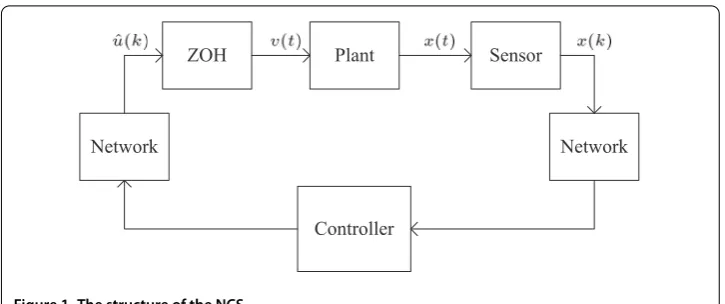
Figure 1 The structure of the NCS.
when one encounters infinite possible values for the delay. In [], the delay considered can be an arbitrary value in a finite interval. A sufficient condition is obtained for the ex-ponential stability of the closed-loop NCS with the plant being a continuous-time one. It is worthwhile noting that the controller gain is unchanged.
In practice, due to interference (for example, machine aging and measurement error), there is a certain change in the controller parameters. This change may destroy the stable performance of the closed-loop systems. At this time, if considering the constant con-troller gain in the analysis of the system, the system may exhibit a high degree of vulnera-bility, which motivates the present research.
This paper studies a class of NCSs with disturbed controllers. The delay can arbitrarily take values in a finite interval which is smaller than the sampling period. A new discrete-time switched NCS model is proposed. A sufficient condition is obtained for the expo-nential stability of the closed-loop NCS under the maximum packet-dropout rate. The discrete-time feedback controller gain is derived by solving a set of linear matrix inequal-ities with inversion constraints. A numerical example verifies the developed theory.
2 Model for networked control system
The structure of the NCS is shown in Figure . The plant is a continuous-time linear system described by
˙
x=Apx(t) +Bpv(t), ()
wherex(t)∈Rnis the state,v(t)∈Rm is the plant input,A
pandBp are constant matrices
of appropriate dimensions.
In the NCS, the discrete-time state-feedback controller is event-driven, the sensor is time-driven and the sampling period isT. The zeroth-order hold device does not update the output value until the new value arrives. The network-induced delayτksatisfies ≤
τmin≤τk≤τmax<T.x(k) is the value ofx(t) at the sampling instantkT.
The output value of the disturbed state-feedback controller corresponding to x(k) is denoted byu(k),
u(k) :=K(k)x(k),
K(k) =K+(k),
whereKis the designed feedback gain and(k) is the controller gain perturbation that satisfies
T(k)(k)≤δI.
By considering the network-induced delay, the plant input is
v(t) =
⎧ ⎨ ⎩
ˆ
u(k– ), ifkT<t≤kT+τk,
ˆ
u(k), ifkT+τk<t≤(k+ )T,
()
where
ˆ u(k) =
⎧ ⎨ ⎩
u(k), ifu(k) andx(k) is successfully transmitted,
ˆ
u(k– ), ifu(k) orx(k) is lost during transmission.
From (), system () with sampling periodT is discretized to
x(k+ ) =Ax(k) +Buˆ(k– ) +Buˆ(k), ()
where
A=exp{ApT}, B=
T
T–τk
exp{Aps}dsBp, B=
T–τk
exp{Aps}dsBp. ()
During each sampling period, two cases may arise, which can be listed as follows:
• Packet dropout happens; () can be written as
˜
x(k+ ) =A˜(k)x˜(k), ()
where
˜ x(k) =
x(k)
ˆ u(k– )
, A˜(k) =
A B
I
, B=
T
exp{Aps}dsBp. ()
• No packet dropout happens; () can be written as
˜
x(k+ ) =A˜(k)x˜(k), ()
where
˜ A(k) =
A+B(τk)K(k) B(τk)
K(k)
=
A+ (B+DF(τk)E)K(k) B–DF(τk)E
K(k)
, ()
IfAphas non-zero mutually different eigenvaluesλ, . . . ,λnandis the corresponding
eigenvector matrix, choosea, . . . ,ansatisfyingλ(T–a–τk) < , . . . ,λn(T–an–τk) < ,
thenB,B,D,E, andF(τk) can be represented as
E=–Bp,
B=diag –
λ
, . . . , – λn
–Bp,
B=diag
λ
exp{λT}, . . . ,
λn
exp{λnT}
–Bp,
D=diag
λ
exp{λa}, . . . ,
λn
exp{λnan}
,
F(τk) =diag
expλ(T–a–τk)
, . . . ,expλn(T–an–τk)
.
If Ap has zero eigenvalues or multiple eigenvalues, for example, Ap has one zero
eigenvalue, one r multiple eigenvalueλ∗, and non-zero mutually different eigenvalues
λ, . . . ,λn–r, in this case,Apcan be represented as
Ap=diag(,J,J)–,
where J is a diagonal matrix corresponding toλ, . . . ,λn–r, J is the Jordan block
cor-responding to λ∗. Choose ai, i= , , . . . ,n–r, satisfying a >τk, λl(T –τk –al) < ,
l= , , . . . ,n–r. Then we have
B=diag(T,J˜,J˜)–Bp,
B=diag(,Jˆ,Jˆ)–Bp,
D=diag a,
λ
exp{λa}, . . . ,
λn–r
exp{λn–ran–r},P
,
F(τk) =diag –
τk
a
,expλ(T–a–τk)
, . . . ,expλn–r(T–an–r–τk)
,P–J¯
,
wherePis a invertible diagonal matrix and satisfiesP– ¯J< , and
˜ J=
⎡ ⎢ ⎢ ⎣
– λ
. .. –λn–r
⎤ ⎥ ⎥ ⎦,
ˆ J=
⎡ ⎢ ⎢ ⎣
–λ
exp{λT}
. .. –λ
Whenλ∗= ,
Combining () and () one obtains the following discrete-time switched system model:
˜
x(k+ ) =Aσ˜ (k)(k)x˜(k). ()
σ(k) is called a switching signal.σ(k) = implies there is no packet dropout, whileσ(k) = implies packet dropout.
3 Exponential stability analysis
Lemma [] For constant matrices M,N,a symmetric matrix W,and scalarε> ,the
following inequality holds:
where F satisfies FTF≤I,if and only if that there exists a matrixε>
W+εMMT+ε–NTN< .
Lemma [] For the system(),if there exist a Lyapunov function V(x˜(k)) =x˜(k)TP˜x˜(k)
and positive scalarsα,α,such that
αr
α –r
> , ()
–P˜– α A˜ ∗ –P˜
≤, ()
–P˜– αA˜ ∗ –P˜
≤, ()
then the system is exponentially stable with the packet-dropout rate r≤r.
Theorem . For given positive scalars r,α,α,if there exist positive definite matrices P,Q,such that
αr
α –r
> , ()
⎡ ⎢ ⎢ ⎢ ⎣
–P– α
A αB ∗ –Q– α
I
∗ ∗ –P
∗ ∗ ∗ –Q
⎤ ⎥ ⎥ ⎥
⎦≤, ()
⎡ ⎢ ⎢ ⎢ ⎢ ⎢ ⎢ ⎢ ⎢ ⎢ ⎣
–P– α
A+αBK αB εαD ε
√
δαB
∗ –Q– α
K ε
√
δαI
∗ ∗ –P KTET √δI ε
√ δI
∗ ∗ ∗ –Q –ET
∗ ∗ ∗ ∗ –εI
∗ ∗ ∗ ∗ ∗ –εI E
∗ ∗ ∗ ∗ ∗ ∗ –εI
∗ ∗ ∗ ∗ ∗ ∗ ∗ –εI
∗ ∗ ∗ ∗ ∗ ∗ ∗ ∗ –εI
∗ ∗ ∗ ∗ ∗ ∗ ∗ ∗ ∗ –εI
⎤ ⎥ ⎥ ⎥ ⎥ ⎥ ⎥ ⎥ ⎥ ⎥ ⎦
< , ()
then the system is exponentially stable with the packet-dropout rate r≤r.
Proof For the system (), construct the Lyapunov function:
V(k) =x˜T(k)P˜x˜(k)
˜ P=
P
Q
,
whereP,Qare positive definite matrices.
Then () can be written as () and () can be written as follows:
⎡ ⎢ ⎢ ⎢ ⎣
–P– α
A+α(B+DF(τk)E)K(k) αB–αDF(τk)E)
∗ –Q– α
K(k)
∗ ∗ –P
∗ ∗ ∗ –Q
⎤ ⎥ ⎥ ⎥
which can be described as
From Lemma , inequality () is true if and only if there exists a scalarε> such that
the following inequality holds:
⎡
It then follows from the Schur complement that inequality () is equivalent to the fol-lowing matrix inequality:
⎡
which can be written as
×
such that the following inequality holds:
⎡
From the Schur complement, we see that () is equivalent to ().
From Lemma , we see that if (), (), and () hold, then the system () has expo-nential stability.
The conditions in Theorem . are a set of LMIs with inversion constraints.K can be solved by an iterative LMI approach which is called cone complementarity linearization
[, ].
4 Numerical example
Consider the following system from []:
˙
Theorem ., we get
Figure 2 State trajectories of the NCS.
Suppose that the initial condition isxT() = [. – .]. Figure shows the state
trajec-tories of the NCS. We can see that the networked control system is exponentially stable. In [], the designed state-feedback gain is unchanged. When the feedback controller is disturbed, it cannot guarantee the system stability. However, from Theorem ., the designed-state feedback gain subject to a certain additive interference still can make the system stable.
5 Conclusions
In this paper, a new discrete-time switched NCSs model that can deal simultaneously with packet dropout and time delay is presented. The criterion for the exponential stability of the system is derived. The gain of the disturbed state-feedback controller can be solved by the proposed method.
Competing interests
The authors declare that they have no competing interests.
Authors’ contributions
Both authors contributed equally to this work and read and approved the final manuscript.
Author details
1Department of Mathematics, China Jiliang University, Hangzhou, 310018, P.R. China.2School of Management, Hangzhou
Dianzi University, Hangzhou, 310018, P.R. China.
Acknowledgements
This work is supported by Zhejiang Provincial Natural Science Foundation of China (No. LY14G020014), Zhejiang Provincial Key Research Base of Humanities and Social Sciences in Hangzhou Dianzi University (No. ZD03-201501), the Humanities and Social Sciences Youth Foundation of the Ministry of Education (No. 14YJC630089), and China Scholarship Council.
Received: 12 August 2015 Accepted: 14 December 2015 References
1. Wu, J, Zhang, H, Shi, Y: State estimation for network-based systems subject to probabilistic delays. Signal Process.
2. Peng, C, Fei, M-R, Tian, E, Guan, Y-P: On hold or drop out-of-order packets in networked control systems. Inf. Sci.
268(1), 436-446 (2014)
3. Mahmoud, M, Memon, A, Shi, P: Observer-based fault-tolerant control for a class of nonlinear networked control systems. Int. J. Control87(8), 1707-1715 (2014)
4. Huo, L, Lin, T, Fan, C, Liu, C, Zhao, J: Optimal control of a rumor propagation model with latent period in emergency event. Adv. Differ. Equ.2015, 54 (2015)
5. Zhang, H, Liu, M, Shi, Y: Extended LMI representatives for stability and stabilization of discrete-time Takagi-Sugeno fuzzy systems. Optim. Control Appl. Methods35(6), 647-655 (2014)
6. Deng, H, Wei, W: Stability analysis for optimal control problems governed by semilinear evolution equation. Adv. Differ. Equ.2015, 15 (2015)
7. Shatyrko, A, van Nooijen, R, Kolechkina, A, Khusainov, D: Stabilization of neutral-type indirect control systems to absolute stability state. Adv. Differ. Equ.2015, 64 (2015)
8. Diblík, J, Khusainov, DY, Ba˘stinec, J, Sirenko, AS: Stability and exponential stability of linear discrete systems with constant coefficients and single delay. Appl. Math. Comput.269, 9-16 (2015)
9. Diblík, J, Khusainov, DY, Ba˘stinec, J, Sirenko, AS: Exponential stability of linear discrete systems with constant coefficients and single delay. Appl. Math. Lett.51, 68-73 (2016)
10. Shi, Y, Yu, B: Output feedback stabilization of networked control systems with random delays modeled by Markov chains. IEEE Trans. Autom. Control54(8), 1966-1972 (2009)
11. Wang, JF, Liu, CF, Yang, HZ: Stability of a class of networked control systems with Markovian characterization. Appl. Math. Model.36(7), 3168-3175 (2012)
12. Mahmoud, M, Khan, G: Dynamic output feedback of networked control systems with partially known Markov chain packet dropouts. Optim. Control Appl. Methods36(1), 29-44 (2015)
13. Zhang, Y, Fang, H: Stabilization of nonlinear networked systems with sensor random packet dropout and time-varying delay. Appl. Math. Model.35(5), 2253-2264 (2011)
14. Zhang, WA, Yu, L: Modelling and control of networked control systems with both network-induced delay and packet-dropout. Automatica44(12), 3206-3210 (2008)
15. Wang, JF, Yang, HZ:H∞control of a class of networked control systems with time delay and packet dropout. Appl. Math. Comput.35(5), 7469-7477 (2011)
16. Wang, J, Yang, H: Exponential stability of a class of networked control systems with time delays and packet dropouts. Appl. Math. Comput.218(17), 8887-8894 (2012)
17. Xie, L: Output feedbackH∞control of systems with parameter uncertainty. IEEE Trans. Autom. Control63(4), 741-750 (1996)
18. Zhang, QL, Qiu, ZZ: Network Control Systems. Science Press, Beijing (2007)
19. Ghaoui, LE, Oustry, F, AitRami, M: A cone complementarity linearization algorithm for static output-feedback and related problems. IEEE Trans. Autom. Control42(8), 1171-1176 (1997)