Comparative Analysis of RIPv2, EIGRP and OSPF Protocols for Wired
Network Technology
Hekmatullah Sahil
1Miss. Ayushi Nainwal
2 1M.Tech Student
2Assistant Professor
1,2Department of Computer Science & Engineering
1,2
AP Goyal Shimla University, India
Abstract— Computer networks are a system of interconnected computers for sharing digital information by selecting the best routes between any two nodes which based on the routing protocol. There are many types of routing protocols which can be dynamic or static, as well as distance – vector or link – state. In this project, there are three typical types of routing protocol chose to simulate which are Routing Information Protocol (RIP), Open Shortest Path First (OSPF), and Enhanced Interior Gateway Routing Protocol (EIGRP). RIP is one of the oldest distances – vector routing protocols and uses `next - hop` as it’s metric. OSPF is a routing protocol for internet protocol networks. OSPF builds a database of routes to its neighbors and using an algorithm to calculate the best possible path. EIGRP is a hybrid between link – state and advanced distance – vector routing protocol that is used on a computer network to help automate routing decisions and configuration. EIGRP is the fastest router convergence among the three protocols. Detailed descriptions of these routing protocols are provided later in this project. We are using Riverbed to simulate RIP, OSPF and EIGRP in order to compare their simulation results and compare performance. We aim to analyze the performance of these three protocols such as their router convergence or convergence duration in order to determine the best routing protocol for a given network topology There have been a large number of static and dynamic routing protocols available but choice of the right protocol for routing is dependent on which routing protocol is best according to various parameters like delay, bandwidth, load, MTU(minimum transmission unit)and packet round trip time and reliability. Through this paper we define and understand the concepts of routing and routing protocol by comparing, analyzing the performance these three protocols such as (RIPv1), (EIGRP) and (OSPF) in computer network system which deal with packet route networks and wired networks and coding for these protocol done in packet tracer and show the result in the chart. Keywords: (RIP) Routing Information Protocol, (EIGRP) Enhanced Interior Gateway (OPSF) Routing Protocol Open Shortest Path First, Packet Tracer Simulate, IPv4
I. INTRODUCTION
A. Routing Protocol Basics
A routing protocol specifies how routers communicate with each other, disseminating information that enables them to select routes between any two nodes on a computer network. A routing protocol includes an algorithm to determine the best rough among immediate neighbors. Routing protocols are according to the OSI routing framework.
Routing protocols are layer management protocols for the network layer. Network layer. Following figure illustrates a simple routing example.
Fig. 1: Routing Protocol Basic
10.0.0.0/8 Network is connected on router’s F0/1 interface.
20.0.0.0/8 Network is connected with router’s F0/2 interface.
Laptop sends a packet to PC.
Router receives this packet in F0/1 interface. Router checks destination address field in packet. Packet has 20.0.0.2/8 address in destination address
field.
IP address 20.0.0.2/8 belongs to 20.0.0.0/8 network. Router checks routing table for matching network. Routing table has an entry for 20.0.0.0/8 network. 20.0.0.0/8 Network is associated with F0/2 interface of
router.
Based on this information router moves this packet from F0/1 to F0/2.
F0/2 interface sends this packet to its destination.
B. Routing Metric Basics
Different routing protocols have different metrics. If there are two more routes between two nodes, each router must determine a method of metrics by choose the routing protocol to calculate the best path. A metric is a variable assigned to routers as a means of tanking them from the most preferred to the last preferred.
C. Static Routing and Dynamic Routing
D. Distance Vector and Link State
Distance vector protocols is a vector which contains both distance and direction such as RIP, determine the path to remote networks using hop count as the metric. Distance vector protocol is based on Bellman – Ford algorithm and Ford –Fulkerson algorithm to calculate paths. It also transmits routing information that includes a distance vector, typically expressed as the number of hops to the destination. Distance vector requires a router informs its neighbors of topology changes periodically. Link state protocols are routing protocols which calculate the best paths to networks differently than distance vector routing protocols. Link state protocols also calculating their network routes by building a complete topology of the entire network area. It is calculating the best path from the topology of the entire interconnected network
II. TYPE OF ROUTING PROTOCOL
A. Routing Information Protocol (RIP)
RIP stands for Routing Information Protocol in which distance vector routing protocol. RIP is the first routing protocol implemented on TCP or IP. RIP can't guarantee that the route it's using is loop free like OSPF or EIGRP can. RIP is basically just making a guess based on the limited information that it knows. RIP uses `next - hop` as it’s metric and calculates the best route based on the number of hop it takes to reach the specified subnet. The advantage of RIP is that it's very simple to implement, and that it's an open standards based protocol. The maximum number of hops allowed for RIP is 15. If the number of hops goes beyond 15, the route will be considered as unreachable. At the first developed, RIP only transmitted full updates every 30 seconds. As the networks become larger, `the reactive time of RIP is longer. RIP has four basic timers which are Update Timer (default 30 seconds), Invalid Timer (default 180 seconds), Hold – Down Timer (default 180 seconds), and flush Timer (default 240 seconds).
Update Timer defines how often the router will send out a routing table update.
Invalid Timer indicates how long a route will remain in a routing table before being marked as invalid. Moreover, the route is marked with a metric of 16, means the route is unreachable.
[image:2.595.311.547.492.695.2] Hold – Down Timer specifies how long RIP will keep a route from receiving updates when it is in a hold – down state. A route will go into a hold down state if the invalid timer has expired or the route goes into a higher metric that what it is currently using.
Fig. 2: RIP Overview
Flush Timer indicates how long a route can remain in a routing table before getting flushed out. The flush timers operates simultaneously with every 60 seconds, the route will get flushed out after it is marked invalid. The popularity of routing information protocol is largely due to its simplicity and its easy configurability. RIP`s disadvantages include slow convergence times and its scalability limitations. In conclusion, routing information protocol works best for small networks.
B. Shortest Path First (OSPF)
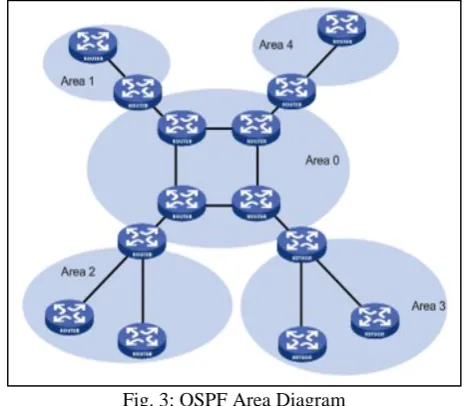
OSPF stands for open shortest path first which uses link-state routing algorithm. OSPF is a routing protocol for internet protocol networks. It uses a link state routing algorithm and falls into the group of interior routing protocols. OSPF is the most widely used interior gateway protocol in larger enterprise networks. OSPF routing protocol is a typical link-state routing protocol, commonly used for the same routing domain. Here, the routing domain is an Autonomous System (AS). with the expansion of the network, when large network routers run OSPF routing protocol will result in an increase in the number of routers, then the LSDB very large and take up a lot of storage space. It also makes the complexity of running the SPF algorithm increases the CPU load heavy. After the network size increases, the probability of topology changes also increased, the network will always be in "hunting", it will cause a lot of network OSPF protocol packets in the transmission, reducing the bandwidth utilization of the network. Even more serious is that each change will cause all the routers in the network to re-route calculation. OSPF protocol is dividing the autonomous system into different areas to solve the above problems. Area is logically divided router from different groups, each with a zone number to identify. Boundary region is a router rather than a link. A network segment belongs to only one region, or each OSPF interface must be specified to belong to an area. As shown in Figure 3.
Fig. 3: OSPF Area Diagram
OSPF routing computation can be simply described as follows:
[image:2.595.54.284.588.748.2] Each OSPF router collects other router advertisements LSA, put all LSA together compose a LSDB (Link State Database). LSA is a network topology around a router description; LSDB is a description of the entire autonomous system network topology.
OSPF router change LSDB into a weighted directed graph, which is on the whole a true reflection of the network topology. All the routers have the same map. The follows graph is a simple network formed by five
routers; all the paths are figured out, the path information are stored in the link database. The link database for the above model is : [A, B, 3], [A, D, 6], [B, A, 3], [B, C, 5], [C, D, 3], [C, B, 5], [C, E, 6], [E, C, 6], [E, D, 3], [D, E, 3] , [D, C, 3] and [D, A, 6].Each term is referred to the originating router, the router connected to and the cost of the link between the two routers. Once the database of each router is finished, the router determines the Shortest Path Tree to all the destinations.
Fig. 4: OSPF Simple Network
The metric of OSPF is the cost of sending packets across a certain interface. The formula to calculate the cost is: cost= 10000 0000 /bandwidth in bps. The cost of OSPF computing and interface bandwidth is also inversely proportional to, the higher the bandwidth, the smaller the Cost value. For example, calculating cost of a 10 Mbit / s interface, convert the 10 Mbit into bit, it is 10 000 000 bit, then with 100 million divided by the bandwidth, the result is 10000 0000/10 000 000 bit = 10, so that is a 10 Mbit / s interface. Each router has a directed graph, using the SPF algorithm to calculate the tree itself is the root of the shortest path tree, and tree shows the routes to the nodes in the autonomous system. When the Shortest Path Tree is completed, the router will work on the routing table.
C. Enhanced Interior Gateway Routing Protocol (EIGRP) EIGRP is an advanced distance-vector routing protocol that is used on a computer network to help automate routing decisions and configuration. EIGRP is in many different structures and media for interior gateway protocol. In the designed network, EIGRP is the good extension of time to provide fast convergence to minimize network traffic. Some advantages of EIGRP are:
Very low network resource usage during normal operation.
When the changes occur, only propagate routing table changes, not the entire routing table; this reduces the load placed of routing protocol in the network.
Fast convergence time as a change in the network topology (confluent in some cases can be almost instantaneous).
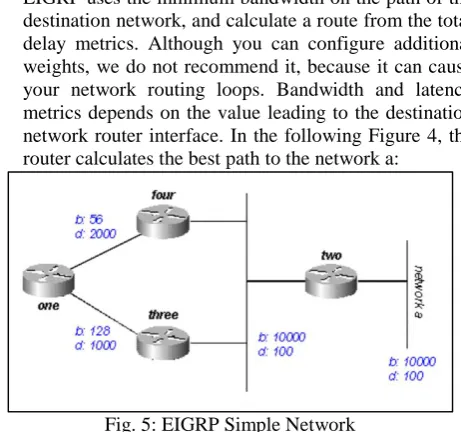
[image:3.595.313.544.145.361.2] EIGRP is an enhanced distance vector protocol, which relies on the diffusion Update Algorithm (DUAL) to calculate the shortest path to a network destination. EIGRP uses the minimum bandwidth on the path of the destination network, and calculate a route from the total delay metrics. Although you can configure additional weights, we do not recommend it, because it can cause your network routing loops. Bandwidth and latency metrics depends on the value leading to the destination network router interface. In the following Figure 4, the router calculates the best path to the network a:
Fig. 5: EIGRP Simple Network
This network is constructed by four routers and two paths. The router four, with a minimum bandwidth of 56 and total delay is 2200; the other path through router three, the minimum bandwidth of 128 and total delayed is 1200. Select the path router with a lower metric.
Metric = (bandwidth + Delay) *256
Let's calculate the weights. EIGRP calculates the total weight by extending the bandwidth and latency metrics. EIGRP bandwidth expansion using the following formula:
Bandwidth = (10000000 / bandwidth (i)) * 256 Where the bandwidth (i) is a minimum bandwidth of all outgoing interface in the routing network to the destination indicated in kilobits. The default EIGRP algorithm DUAL requires guaranteed and ordered delivery of packets for transmission. DUAL, the Diffusing Update Algorithm is the default convergence algorithm which is used in EIGRP to prevent routing loops from recalculating routes. DUAL tracks all routes and detect the optimal path in terms of efficiency and cost which will be added in the routing table.
III. COMPARISON ANALYSIS BETWEEN RIPV2,EIGRP AND
OSPF PROTOCOL
Now we will analysis the outcome from implementation and configuration of RIP, EIGRP and OSPF protocols and analysis difference between RIP, EIGRP and OSPF protocols according to many parameters
A. Administrative Distance
This the administrative distance of RIP is greater than from both EIGRP and OSPF protocols and the administrative distance of EIGRP less than form both RIP and OSPF but the administrative distance of OSPF is greater than of EIGRP administrative distance and less then RIP administrative distance .
B. Minimum, average and maximum round trip time of RIP, EIGRP and OSPF protocols
Sending 1000 byte size packet from one router to another router via designed backbone topology by using RIPv2, EIGRP and OSPF protocols after that we compare the minimum, average and maximum round trip time of all these routing protocols
The maximum round trip of OSPF is greater than to the maximum round trip time of RIP and OSPF protocol
And the maximum round trip times of EIGRP and RIP protocols are equal after that average round trip time of both RIP and EIGRP are equal but the OSPF average round trip time less than to the average round trip time of both RIP and EIGRP protocols and minimum round trip time of RIP is greater than from the minimum round trip time of EIGRP and OSPF protocols and minimum average round trip time of OSPF is less than to average round trip time of EIGRP protocol
C. Comparison and Analysis Bandwidth and MTU (Minimum Transmission Unit) Of EIGRP and OSPF Protocols
Now we compare the bandwidth and MTU of EIGRP and OSPF protocols to find the result which protocol is greater than according their bandwidth and MTU metrics
After the comparisons find the result which is the bandwidth of EIGRP is higher than OSPF
And the MTU parameter of OSPF is equal to MTU parameter of EIGRP protocol.
D. Comparison of EIGRP and OSPF protocol according delay
Now we will comparison delay between EIGRP and OSPF protocol to find the result which routing protocol delay is high and which routing protocol delay is low
According our comparison analysis we find the outcome of this comparison the delay of these protocol is equal
IV. RESULT ANALYSIS
A comparison of RIPv2, EIGRP and OSPF protocols configured in backbone area network is presented in thesis. The packet tracer network simulator is used to compare protocol performance in designed network by taking the parameter of request and reply time given by ping command. Based on above experiment it is found that the EIGRP and OSPF protocols is showing less time and less packet loss less than the RIPv2 protocol. Furthermore, the EIGRP, OSPF also presented higher utilization values when compared to the RIPv2 protocol
And also the rip protocol not use metric calculates like bandwidth, delay, load etc. Only based on the hop count metrics calculation and
A. Brief Literature Survey
1) By Bhavna Rathi [1], Er. Far minder Singh [2] Department of Computer Science and Engineering PTU/RIMT Institute of Engineering and Technology Sir Hind Side, Mondi Gobindgarh Punjab – India. Explains the distance vector and link state routing protocols used for internal routing purposes in enterprise or service provider networks. Link state and Distance Vector protocols use different algorithms and includes the differences between various link state and distance vector routing protocols and compares the performance of all the distance vector and link state routing protocol. 2) Performance Analysis of Dynamic Routing Protocols Using Packet Tracer Volume 3, Special Issue 1, February 2014 by N.Nazumudeen and C.Mahendran explain the propose and idea of routing protocols, starting with an overview of the basics of Interior Gateway Protocols (IGP). Later, we describe the idea of Link State Routing Protocols (LSRP) and Distance Vector Routing Protocols (DVRP) while making a comparison which should determine the protocol needed for each network topology.
3) Validation of RIP, EIGRP and OSPF Routing Protocols Simulation with Sub netting Implementation to Actual Operation using HyperTerminal Emulator World Applied Sciences Journal 35 (4): 585-591, 2017 ISSN 1818-4952 by Archival Sebial, Chris Jordan Alice and Elmer Mara villas This paper focuses on corroborating the simulated performances of the RIP, EIGRP and OSPF routing protocols to actual operations. Simulation was employed with the use of a packet tracer and authenticated to real time situation with the use of hyper terminal emulator. sub netting was also utilized to address and relieve network congestion and security in both environments.
4) Comparative Analysis of Distance Vector Routing & Link State Protocols Vol. 3, Issue 10, October 2015 by Shubhi¹, Prashant Shukla² explain distance vector protocol and Link state protocol are presented based on Bellman–Ford algorithm and Dijkstra‟s algorithm respectively and compares the advantages and disadvantages of DVF and OSPF on the basis of their performance. In computer communication system which deals with packet switched networks a distance-vector routing protocol(RIPv2) and link-state protocol(OSPF) are the two major classes routing protocols.
5) A Review on Routing Information Protocol (RIP) and Open Shortest Path First (OSPF) Routing Protocol International Journal of Future Generation Communication and Networking Vol. 9, No. 4 (2016), pp. 161-170http://dx.doi.org/10.14257/ijfgcn. 2016.9.4. 13 by Abhishek Verma and Neha Bhardwaj in this paper discus about the RIP and OSPF protocol from a theoretical point of view in this work accessible the comparative study of two protocols RIP and OSPF. Finding the best route in both protocols in wired and wireless LANs and implementation in various fields works in these protocols
V. OBJECTIVE
To explain the concepts of RIPv2, EIGRP and OSPF routing protocols.
To find the best routing protocol for LAN and wired networks its depend on various parameters like delay , bandwidth, MTU ,load and reliability.
Compare and analysis RIP, EIGRP and OSPF routing protocol wired network system which deal with packet route networks.
To select the right routing protocol for wired network system
VI. METHODOLOGIES
1) To study standard and informational papers of RIP, EIGRP and OSPF.
2) Design a network in packet tracer simulation environment
3) Implementation of RIP, EIGRP and OSPF protocols and comparison will be done in IPv4
4) Also study and compares performance and advantage and disadvantage of (RIPv1), (EIGRP) and (OSPF) protocols.
5) For result graphs, Paessler Router Traffic Graph(PRTG) will be used
6) Used packet tracer simulate for writing code for the comparing this routing protocols like (RIP), (EIGRP) and (OSPF) protocols.
VII. CONCLUSION AND FEATURE WORK
Interior routing protocols like EIGRP and OSPF are widely being used in the computer networking. In this thesis, we have presented a comparative analysis of selected routing protocols such as EIGRP, OSPF and the combination of EIGRP and OSPF. The comparative analysis has been done in the same network with different protocols for real time applications. Performance has been measured on the basis of some parameters that aimed to figure out the effects of routing protocols.
Network scalability can be enhanced by reducing network convergence time of the routing protocol. In our thesis work, implementation of EIGRP shows that network convergence time is much faster than EIGRP_OSPF and OSPF networks because EIGRP network learns the topology information and updates faster than EIGRP_OSPF and OSPF. The simulation result has shown that end to end delay of EIGRP_OSPF network is relatively less than EIGRP and OSPF networks. As a result, data packets in EIGRP_OSPF network reach faster to the destination.
combination of EIGRP and OSPF network is much higher than OSPF and EIGRP networks.
In this thesis work, the comparative performance among EIGRP, OSPF and combination of EIGRP and OSPF routing protocols for real time application has been analyzed. By comparing these protocols performances, we have come across that the combined implementation of EIGRP and OSPF routing protocols in the network performs better than OSPF and EIGRP. In the case of individual routing protocol performance, overall performance of EIGRP is better than OSPF. In future, a research work can be done on the explicit features of both OSPFv3 and EIGRP protocols in the IPv4/IPv6 environment. Security analysis for both OSPF and EIGRP can be done.
REFERENCES
[1] “Performance Analysis of Distance Vector and Link State Routing Protocols”, International Journal of Computer Science Trends and Technology (IJCST) – Volume 3 Issue 4, Jul-Aug 2015 Department of Computer Science and Engineering PTU/RIMT Institute of Engineering and Technology Sir hind
[2] “ Performance Analysis of Dynamic Routing Protocols Using Packet Tracer”, International Conference on Engineering Technology and Science-(ICETS’14)On 10th & 11 February Organized by Department of CIVIL, CSE, ECE, EEE, MECHNICAL Engg. and S&H of Muthayammal College of Engineering, Rasipuram, Tamilnadu, Indian
[3] “Comparative Analysis of Distance Vector Routing & Link State Protocols”, International Journal of Innovative Research in Computer and Communication Engineering(An ISO 3297: 2007 Certified Organization)Vol. 3, Issue 10, October 2015
[4] “A Review on Routing Information Protocol (RIP) and Open Shortest Path First (OSPF) Routing Protocol”, International Journal of Future Generation Communication and Networking Vol. 9, No. 4 (2016), pp. 161-170 http://dx.doi.org/10.14257/ijfgcn.2016. 9.4.13
[5] “Validation of RIP, EIGRP and OSPF Routing Protocols Simulation with Subnetting Implementation to Actual Operation using HyperTerminal Emulator”, World Applied Sciences Journal 35 (4): 585-591, 2017 ISSN 1818-4952 © IDOSI Publications, 2017 DOI: 10.5829/idosi.wasj.2017.585.591
[6] https://www.cisco.com/c/en/us/td/docs/ios/iproute_rip/c ommand/reference/irr_book/irr_rip.html
[7] https://www.cisco.com/c/en/us/td/docs/ios/iproute_eigr p/command/reference/ire_book/ire_s1.html