International Journal of Nanomedicine
Dove
press
O r I g I N a l r e s e a r c h
open access to scientific and medical research
Open access Full Text article
accessing to the minor proteome of red blood
cells through the influence of the nanoparticle
surface properties on the corona composition
affif Zaccaria1,*
Florence roux-Dalvai2,3,*
ali Bouamrani1
adrien Mombrun1
Pascal Mossuz4
Bernard Monsarrat2,3
François Berger1
1clinatec cea-leTI, grenoble, 2cNrs, IPBs (Institut de Pharmacologie et de Biologie structurale), 3Université de Toulouse, UPs, IPBs, Toulouse, 4
TIMc-Therex UMr 5525 cNrs, UJF, chU
grenoble, grenoble, France
*These authors contributed equally to this work
Abstract: Nanoparticle (NP)–protein interactions in complex samples have not yet been clearly understood. Nevertheless, several studies demonstrated that NP’s physicochemical features significantly impact on the protein corona composition. Taking advantage of the NP potential to harvest different subsets of proteins, we assessed for the first time the capacity of three kinds of superparamagnetic NPs to highlight the erythrocyte minor proteome. Using both qualitative and quantitative proteomics approaches, nano-liquid chromatography–tandem mass spectrometry allowed the identification of 893 different proteins, confirming the reproducible capacity of NPs to increase the number of identified proteins, through a reduction of the sample concentration range and the capture of specific proteins on the three different surfaces. These NP-specific protein signatures revealed significant differences in their isoelectric point and molecular weight. Moreover, this NP strategy offered a deeper access to the erythrocyte pro-teome highlighting several signaling pathways implicated in important erythrocyte functions. The automated potentiality, the reproducibility, and the low-consuming sample demonstrate the strong compatibility of our strategy for large-scale clinical studies and may become a standard-ized sample preparation in future erythrocyte-associated proteomics studies.
Keywords: nanoparticles, red blood cells, mass spectrometry, quantitative proteomics, protein corona, minor proteome
Introduction
With the emergence of nanotechnology, the engineering of “smart” nanoparticles (NPs)
has opened up a host of possibilities in medicine and biology.1–3 Nevertheless, once
injected in blood circulation, the fate of these NPs must be anticipated to prevent an
NP-associated toxicity.4,5 When an NP is introduced into a biological fluid, it is well
recognized that proteins immediately cover its surface, resulting in the formation of a protein “corona”, which will rapidly evolve according to the concentration and the
affinity of proteins for the NP.6,7 Since the last decade, several studies used different
analytical methods8 and focused on the performance of NPs in the presence of complex
protein mixtures9–11 to demonstrate the complexity of these NP–protein interactions.12,13
First, the “nano-dimension” of these particles endows them with properties completely different from those of bulk materials with the same compositions. Moreover, NPs have a very large surface-to-volume ratio, so that even small amount of particles presents large surface areas available for protein binding. Finally, the physicochemical properties of NPs such as their size, their surface charge, or their chemical
function-alization would determine their protein corona composition,11,14–17 which may more
influence the biological response of the body.18,19 This capacity of NPs to concentrate
Correspondence: Affif Zaccaria clINaTec, centre de recherche Biomedicale edmond J safra 17 rue des Martyrs 38054 grenoble cedex, France Tel +33 667 427 515
email [email protected]
Journal name: International Journal of Nanomedicine Article Designation: Original Research
Year: 2015 Volume: 10
Running head verso: Zaccaria et al
Running head recto: Accessing to the minor proteome of RBCs through NP surface properties DOI: http://dx.doi.org/10.2147/IJN.S70503
International Journal of Nanomedicine downloaded from https://www.dovepress.com/ by 118.70.13.36 on 23-Aug-2020
For personal use only.
This article was published in the following Dove Press journal: International Journal of Nanomedicine
9 March 2015
Dovepress
Zaccaria et al
at their surface different subsets of proteins according to their physicochemical properties may be useful in proteomics to improve protein detection and identification, and detect
potential disease-associated species.20–22 In fact, despite the
constant technological advances in mass spectrometry (MS) and sample fractionation methods, the limited dynamic range of current mass spectrometers hinders the entire proteome coverage of biological fluids in which the protein
concen-tration range spans more than ten orders of magnitude.23,24
Thus, the low-abundant protein compartment where disease-associated biomarkers are thought to reside is still
unattain-able. Various nanomaterial-associated strategies25–28 have
been integrated in MS in order to detect disease-associated biomarkers, and have been found extremely useful to improve protein enrichment and sample preparation, particularly
NP-associated technology.29–31
Finding biomarker for disease detection, stratification, as well as therapeutic monitoring is a biomedical priority. Erythrocytes or red blood cells (RBCs) are a paradigmatic situation for clinical proteomics and also a major circulating
compartment to individualize biomarkers.32,33 RBCs circulate
all over the body and deliver oxygen to most organs. They are crucial micro-organites able to capture and provide remote biomolecular information at the periphery. They are
also involved in hematological malignancies34,35 for which
relevant biomarkers are still missing. Because of the presence of hemoglobin (Hb), which represents 98% of the total RBC soluble protein content and masks the 2% of biologically interesting low-abundant proteins, it is difficult to investigate the deep RBC proteome in clinical and large-scale studies. Although technical advances in RBC sample preparation and fractionation have greatly contributed to reduce the protein concentration range, allowing to increase the number of
iden-tified proteins by tandem MS (MS/MS),36,37 these approaches
are time-consuming and require intensive fractionation on gel and large volumes of sample to be really efficient, thus limiting the clinical translation of such technologies for high-throughput large-scale studies. Until now, the capacity of NPs for protein enrichment in complex protein mixture has never been assessed with RBC proteins.
In the present work, the potential capacity of three kinds of NPs to capture RBC proteins was determined by a qualitative and quantitative proteomics analysis. Based on a fast experimental protocol that required low volume of RBC lysates, and without any fractionation step, nano-liquid chromatography (LC)–MS/MS analysis of the different NP-treated samples revealed 893 different proteins, demonstrat-ing the interest of our nanoproteomics approach to analyze
the RBC proteome in a large-scale context. We used
label-free quantification38 to confirm the reproducibility and the
influence of the NP surface on protein capture, highlighting subsets of proteins specific to each kind of NPs. Through this work, we demonstrated for the first time the interest of chemically modified NPs in sample preparation for RBC proteomics studies.
Methods
Magnetic NPs
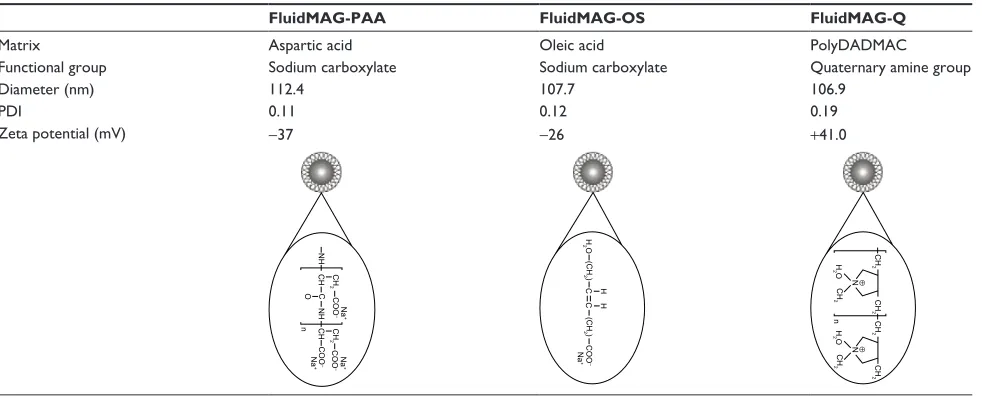
Superparamagnetic NPs of 100 nm in aqueous suspension were obtained from Chemicell GmbH (Berlin, Germany). Three different kinds of NPs grafted with different matrices and functional groups were used in our study, fluidMAG-OS (OS-NP), fluidMAG-PAA (PAA-NP), and fluidMAG-Q (Q-NP) (Table 1). They have a multi-domain core allowing a fast and easy magnetic isolation by an external magnet (MagnetoPURE, Chemicell GmbH). More detailed features
are available at http://www.chemicell.com/.
The size and zeta potential of the magnetic NPs were determined with a Malvern Zetasizer NanoZS. NPs were diluted in phosphate-buffered saline (PBS; pH 7.3) before
measurement, and the measurement was conducted at 25°C
using 0.5 mg/mL NP concentrations.
rBc preparation and lysis
Blood samples were collected from five healthy consenting donors, three men and two women aged 44–62 years (mean
55.4±7.7 years) by venipuncture in
ethylenediaminetet-raacetic acid vacutainer tubes. RBC lysis was performed according to the protocol previously published by
Roux-Dalvai et al.37 Briefly, samples were firstly centrifuged at
1,000× g at +4°C for 10 minutes to eliminate plasma and
buffy coat. To further eliminate leukocytes, a ficoll gradient separation was performed. After removal of the monolayer containing mononuclear cells, erythrocytes were carefully collected, avoiding top RBC layer and polynuclear cells collected in the pellet. Erythrocytes were then washed
three times with PBS + PMSF (154 mM NaCl, 10 mM
phosphate buffer, pH 7.4 containing 0.1 mM PMSF). At each step, along with supernatant, the upper RBC layer was removed.
The lysis of RBC was operated by hypotonic shock. Red cells were diluted to a 1:3 ratio with lysis buffer (5 mM phosphate buffer, pH 7.4 containing 1 mM ethylenedi-aminetetraacetic acid, and 0.5 mM PMSF) containing pro-tease inhibitor and left in ice for 30 minutes. After freezing,
red cells were thawed at 37°C. The procedure of freezing/
International Journal of Nanomedicine downloaded from https://www.dovepress.com/ by 118.70.13.36 on 23-Aug-2020
Dovepress accessing to the minor proteome of rBcs through NP surface properties
Table 1 NP properties
FluidMAG-PAA FluidMAG-OS FluidMAG-Q
Matrix aspartic acid Oleic acid PolyDaDMac
Functional group sodium carboxylate sodium carboxylate Quaternary amine group
Diameter (nm) 112.4 107.7 106.9
PDI 0.11 0.12 0.19
Zeta potential (mV) -37 -26 +41.0
1+
1+
&+
&+
&+
&+
&
2 &22
±
&22
±
&22
±
1D
1D
Q
1D
+
+
+
2
&+
&+
&
&
&22
±
1D
⊕
⊕
+
2
+
2
&+
&+
&+
&+
&+
&+
1
Q
1
Notes: The manufacturer provides information about the matrix and the functional group. The mean diameter, the PDI, and the zeta potential have been determined with a Malvern Zetasizer NanoZs. NPs were diluted in PBs (ph 7.3) before measurement, and the measurement was conducted at 25°c using 0.5 mg/ml NP concentrations. Abbreviations: NP, nanoparticle; PDI, polydispersity index; PBs, phosphate-buffered saline; PolyDaDMac, polydiallyldimethylammonium chloride.
thawing was repeated twice for each sample. At the end of the
lysis step, after a centrifugation at 36,000× g for 10 minutes
at +4°C, the clear supernatants were collected, pooled, and
stored at -80°C until use.
rBc proteins–NPs incubation
Five hundred micrograms of each kind of NPs were
individu-ally incubated in two replicates for 45 minutes with 200 µL
of hemolysate containing 1 mg of total protein. Then, NPs were attracted to one side of the vial by an external magnet, and supernatant was removed. NPs were washed three times
in 500 µL PBS. Finally, NP-associated proteins were
des-orbed using 40 µL of 8 M urea -2% CHAPS, and the protein
concentrations were determined by a Bradford protein assay (Bio-Rad Laboratories, Hercules, CA, USA).
analysis of rBc lysate fractions
by sDs-Page
Each sample was mixed with Laemmli buffer (4% sodium dodecyl sulfate [SDS], 20% glycerol, 10% 2-mercaptoeth-anol, 0.004% bromophenol blue, 0.125 M Tris-HCl). The mixture was heated in boiling water for 5 minutes and loaded on a precast 4%–15% polyacrylamide gel. Staining and destaining were performed with Coomassie blue and 30% ethanol/7% acetic acid in water, respectively.
lc–Ms/Ms analysis of rBc proteins
The Supplementary materials provide a detailed description of LC–MS/MS identification.
Briefly, 10 µg of each duplicated eluate and crude RBC
lysate were separately diluted in Laemmli buffer and stacked in one band after a short and low-voltage electrophoretic migra-tion on SDS-polyacrylamide gel electrophoresis (SDS-PAGE) gel. The stacking bands were cut, proteins were in-gel digested by trypsin, and resulting peptides were extracted from the gel and analyzed by nano-LC–MS/MS using an ultimate 3000 sys-tem (Dionex, Amsterdam, the Netherlands) coupled to an LTQ-Orbitrap Velos mass spectrometer (Thermo Scientific, Bremen, Germany). The LTQ-Orbitrap was operated in data-dependent acquisition mode with the Xcalibur software. Survey scan MS spectra were acquired in the Orbitrap in the 300–2,000 m/z range with the resolution set to a value of 60,000. The five most intense ions per survey were selected for collision-induced dissociation fragmentation, and the resulting fragments were analyzed in the linear trap quadrupole (LTQ).
Database search and data analysis
The Mascot Daemon software (version 2.3.0, Matrix Science, London, UK) was used to perform database searches against
Homo sapiens entries in Uniprot protein database. The mass
tolerances in MS and MS/MS were set to 5 ppm and 0.6 Da, respectively, and the instrument setting was specified as “ESI-Trap”. Mascot results were parsed with the in-house-developed software Mascot File parsing and Quantification
(MFPaQ) v4.0.0 software (http://mfpaq.sourceforge.net/),
and protein hits were automatically validated if they satis-fied one of the following criteria: identification with at least one top-ranking peptide with a Mascot score of more than
International Journal of Nanomedicine downloaded from https://www.dovepress.com/ by 118.70.13.36 on 23-Aug-2020
Dovepress
Zaccaria et al
39 (P-value 0.001) or at least two top-ranking peptides
each with a Mascot score of more than 22 (P-value 0.05).
When several proteins matched exactly the same set of pep-tides, only one member of the protein group was reported in the final list. To evaluate the false-positive rate in these experiments, all the initial database searches were performed using the “decoy” option of Mascot. Mascot results were parsed with the in-house-developed software MFPaQ v4.0.0 (http://mfpaq.sourceforge.net/), and protein hits were auto-matically validated.
Label-free quantification
Quantification of proteins was performed using the label-free module implemented in the MFPaQ v4.0.0
soft-ware (http://mfpaq.sourceforge.net/). For each sample,
the software uses the validated identification results and extracted ion chromatogram (XIC) of the identified peptides in the corresponding raw nano-LC–MS files based on their experimentally measured retention time and monoisotopic
m/z values. Quantification of peptide ions was performed
based on calculated XIC area values. To compare the abun-dance profile of one protein in different samples, a protein abundance index (PAI) was calculated for each protein in the different NP samples. PAI was defined as the average of XIC area values for three intense reference tryptic peptides identi-fied for this protein. If only one or two peptides were used to identify the protein, the protein-related PAI was calculated based on the XIC area value of these peptides. As the three different kinds of NPs were experimentally duplicated, six PAI values were obtained for each protein; the highest PAI value was normalized to 1, and the five other PAI values were thus comprised between 0 and 1. Normalized PAIs were
sub-mitted to software R for protein hierarchical clustering.39
Results
Magnetic NPs
In this study, we investigated the capacity of three different kinds of 100 nm NPs for protein capture in RBC lysates through the protein identification and quantification of their respective eluted corona. This size of NPs offers a high surface-to-volume ratio and facilitates the NP collection by an external magnet. The main difference between these NPs concerns their surface charge and/or functional group. First, according to dynamic light scattering and zeta potential measurements, the respective NPs were homogeneous in size and monodispersed. Q-NPs displayed a positive charge, and PAA-NPs and OS-NPs both displayed a negative charge (Table 1).
sDs-Page analysis
As particles fulfilled critical quality criteria, 500 µg of each
kind of NPs, developing 280 cm2 surface area, were
sepa-rately incubated in duplicates for 45 minutes with 200 µL
of RBC lysates (ie, 1 mg of proteins), followed by extensive washing to remove all unbound proteins. First, the Bradford
assays revealed 19±1 µg of proteins eluted from the surface of
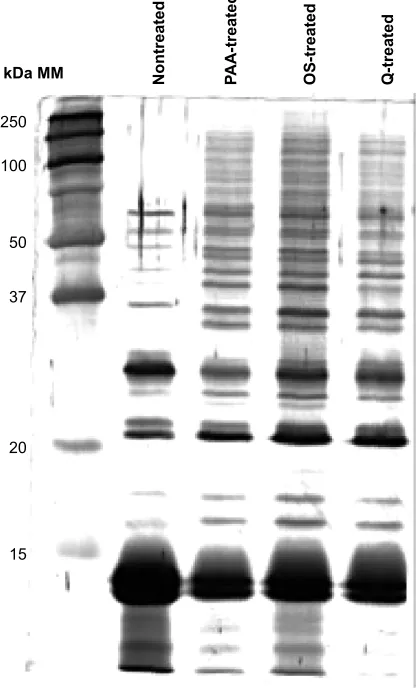
each kind of NPs, which represented 2% of the initial protein input. Prior to deeper characterization of each NP corona, the same quantity of proteins was loaded on an SDS-PAGE gel (Figure 1) to obtain a protein profile of each condition. For the three types of NPs, SDS-PAGE analysis of the eluted protein corona revealed a pattern obviously different from nontreated sample. Interestingly, the high-abundant Hb was considerably reduced, and the protein profiles of NP-treated samples revealed a great enrichment between 20 kDa and
N'D00 1RQWUHDWHG 3$$WUHDWHG 26WUHDWHG 4WUHDWHG
Figure 1 sDs-Page of nontreated and NP-treated rBc lysates.
Notes: The same quantity of proteins was loaded on gel for the different tracks. We can see the diminution of hemoglobin proportion in NP-treated samples for which we can distinct two bands corresponding to alpha and beta hemoglobin subunits (around 14 kDa).
Abbreviations: sDs-Page, sodium dodecyl sulfate-polyacrylamide gel electrophoresis; NP, nanoparticle; rBc, red blood cell; MM, molecular markers.
International Journal of Nanomedicine downloaded from https://www.dovepress.com/ by 118.70.13.36 on 23-Aug-2020
Dovepress accessing to the minor proteome of rBcs through NP surface properties
250 kDa with the appearance of numerous bands, which were not detected in the control condition.
Protein identification by nano-LC–MS/MS
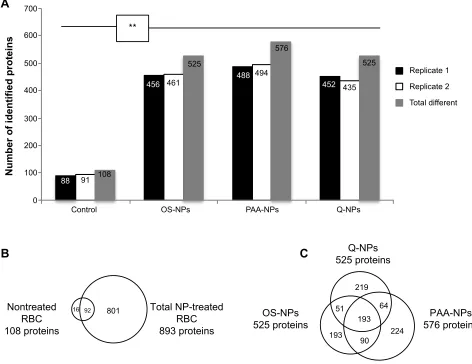
To better estimate the protein enrichment offered by the NP treatment, a deeper characterization of each NP corona was performed by nano-LC–MS/MS protein identification. Figure 2A sums up the results obtained for each duplicated sample and gives an insight of the harvesting capacity for each condition. The different protein lists are detailed in the
Supplementary materials. The two replicates of the crude RBC lysate revealed 108 different proteins, whereas two of the NPs-eluted coronae significantly highlighted more
species (P=0.009, Mann–Whitney test), from 525 to 576
different species according to the type of NPs (Figure 2A).
Altogether, 909 different proteins were identified from our RBC samples of which 893 were present in the list of NP-treated samples (Figure 2B). Among these 893 proteins, 801 were exclusively identified from NP-eluted coronae, and 92 were shared with crude RBC lysate. A focus on the three NP samples revealed a relatively similar number of identified proteins varying from 525 for OS- and Q-NPs to 576 for PAA-NPs, the three kinds of NPs only sharing 193 proteins (Figure 2C).
effect of NP treatment on nano-lc–Ms/
Ms analytical coverage
The nano-LC–MS/MS analysis showed that the NP treatment of the sample greatly enhanced the number of identified proteins; this must result from a better MS/MS sampling of
2613V
SURWHLQV SURWHLQV3$$13V
1RQWUHDWHG 5%& SURWHLQV
$
%
&
1XPEHURILGHQWLILHGSURWHLQV
&RQWURO
2613V 3$$13V 413V
413V SURWHLQV
5HSOLFDWH 5HSOLFDWH 7RWDOGLIIHUHQW
7RWDO13WUHDWHG 5%& SURWHLQV
Figure 2 Protein identification results and NP comparison.
Notes: (A) Graphical representation of the number of identified proteins by nano-LC–MS/MS in each replicate, in nontreated and NP-treated RBC lysates. “Total different” columns represent the total number of identified proteins in each condition after merging both replicates. (B and C) Venn diagrams representing the extent of overlap of proteins identified by LC–MS/MS analysis. (B) comparison made between the nontreated rBc extract (108 proteins) and all NP-treated samples (894 proteins). (C) Comparison among the three NP-treated samples (PAA-NP, 576 proteins; OS-NP, 525 proteins; Q-NP, 525 proteins). The number of identified proteins in NP samples is significantly higher than in nontreated samples (Mann–Whitney test P=0.009).
Abbreviations: lc–Ms/Ms, liquid chromatography–tandem mass spectrometry; NP, nanoparticle; rBc, red blood cell.
International Journal of Nanomedicine downloaded from https://www.dovepress.com/ by 118.70.13.36 on 23-Aug-2020
Dovepress
Zaccaria et al
the detected ions. To illustrate that effect, we compared the 20 most abundant identified proteins (ie, the 20 proteins with the higher MS/MS queries) in nontreated and NP-treated
RBCs (Table 2 and Supplementary materials). Interestingly,
according to the sample treatment, the 20 most abundant proteins were not strictly the same. In fact, only Hb-related subunits and spectrin chains, the two major constituents of RBCs, were shared by all conditions. Nevertheless, the rank and thus the relative abundance of these proteins were different. For example, Hb subunit beta and spectrin alpha chain that were respectively the first and the 20th most abundant protein in nontreated sample occupied the 5th and the 1st rank, respectively, in OS-NP sample. And carbonic anhydrase 1 that appeared just after the Hb-related subunits, as the 12th most abundant protein in nontreated RBC, only occupied the 70th rank in OS-NP sample. These results demonstrate that NP treatment modified the relative protein concentration in RBC sample. This modification of the protein abundance rank was also different according to the kind of NPs, suggesting the differential affinity of the NP surface for RBC proteins. Moreover, we also observed that the number of MS/MS queries assigned to these 20 most abundant proteins was greatly lower in NP-treated condition than in control. In control, 94% of the total MS/MS queries that were generated during the run were assigned to these 20 proteins, of which 91% to the Hb-related subunits. In the NP-treated sample, the 20 most abundant proteins only generated 42%–45% of the total MS/MS queries, of which 20%–29% were assigned to Hb-related subunits, according to the kind of NPs. This observation revealed that NP treat-ment greatly decreased the proportion of abundant proteins. Finally, for each kind of NPs, we showed that 90%–95% of the 20 most abundant proteins are the same between repli-cates. We also observed that the 20 most abundant proteins as well as Hb-related subunits generated the same part of MS/
MS queries between replicates (Supplementary materials).
These results confirmed the reproducibility of capture of each kind of NPs for these 20 most abundant proteins.
To determine whether NP treatment increased the propor-tion of low-abundant proteins in RBC samples, the MS/MS queries, the peptide number, and the sequence coverage of ten low-abundant proteins in nontreated sample (ie, proteins with low MS/MS queries) were determined in OS-NPs sample (Table 3). In nontreated sample, these ten low-abundant proteins generated from one to three MS/MS queries, with a low coverage of each protein sequence (from 1.4% to 17.1%). They represented 0.1% of the total MS/MS queries gener-ated by the sample. In OS-NP samples, the same proteins
generated from five to 63 MS/MS queries, allowing a greater coverage of the protein sequence (from 11.9% to 79.6%) through the detection and identification of different peptides for each protein. These ten proteins represented 2% of the total MS/MS queries generated by the NP-treated sample. This enhanced detection of low-abundant proteins was also
observed in Q- and PAA-NPs (Supplementary materials).
These observations clearly demonstrated that NP treatment also increased the proportion of low-abundant proteins.
Qualitative and quantitative
reproducibility in protein harvesting
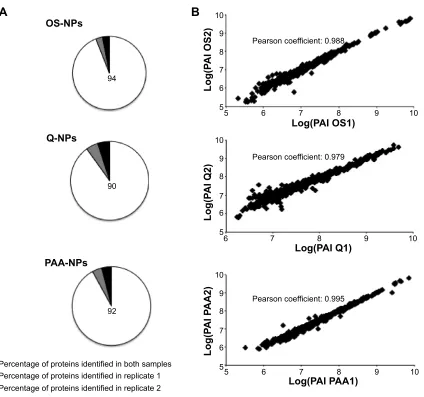
Although NP-treated samples allowed a great increase in pro-tein identification, providing access to low-abundant propro-teins, it was important to confirm the reproducibility of NPs for RBC protein harvesting. First, in a qualitative approach, we compared the MS spectra of each replicate and observed that the MS signal of 90%–94% of identified peptides was present in both replicates per type of NPs, thus confirming the qualitative reproducibility of NPs for protein harvesting (Figure 3A). Then, to assess the quantitative reproducibility
of NP-strategy, we used the MFPaQ software,40 which was
designed to parse and validate protein identifications from Mascot result files and quantify the identified proteins. The quantification module of MFPaQ v4.0.0 was upgraded so that it could handle label-free quantification as described by
Mouton-Barbosa et al.41 More information is available in the
Supplementary materials. Briefly, a PAI was calculated for all identified proteins. To assess the quantitative reproduc-ibility of each type of NPs for protein harvesting, the PAI ratio of all identified proteins was determined in duplicates (Supplementary materials). As shown in Figure 3B, quanti-tative reproducibility of NPs was found to be good between the duplicates. In fact, the majority of quantified proteins on each kind of NPs revealed a PAI ratio close to the expected
value of 1 (Supplementary materials).
Differential capture of proteins
by the NP surface
As the protein capture by NPs was qualitatively and quan-titatively reproducible, we aimed to determine if there was an NP-dependent protein harvesting. Based on these quan-tification results, we normalized the PAIs obtained for each protein in each sample and submitted them to hierarchical clustering with the software R. According to the PAI values of each protein in each condition, the clustering revealed
ten differentially quantified protein groups (Supplementary
materials). Among them, groups 4, 5, and 8 revealed 68, 100,
International Journal of Nanomedicine downloaded from https://www.dovepress.com/ by 118.70.13.36 on 23-Aug-2020
Dovepress accessing to the minor proteome of rBcs through NP surface properties
Table 2
List of the 20 most abundant proteins (decreasing from 1 to 20) identified from NPs corona and crude RBC extract
Total MS/MS number
MW
pI
Description
#total MS/MS %/total MS/MS
Rank
%/total MS/MS #total MS/MS
Description
pI
MW
Total MS/ MS number
Control RBC
Q-NPs
18,796
16,102
6.75
Hemoglobin subunit beta
2,654
14.1
1
4.4
795
Hemoglobin subunit beta OS
6.75 16,102 18,096 16,101 7.86 Beta-globin 2,424 12.9 2 4.4 788
spectrin, beta, erythrocytic
5.15
247,271
11,534
5.9
Beta globin (fragment)
1,921
10.2
3
4.3
787
spectrin beta chain, erythrocyte
5.15
247,171
11,496
6.17
Hemoglobin beta (fragment)
1,731
9.2
4
4.2
759
spectrin alpha chain, erythrocyte
4.95
281,039
15,305
8.72
Hemoglobin subunit alpha
1,563
8.3
5
3.3
590
Hemoglobin beta (fragment)
6.17
11,496
11,532
5.46
Hemoglobin beta (fragment
1,499
8.0
6
3.1
568
Hemoglobin subunit alpha
8.72
15,305
10,979
6.17
Hbbm fused globin protein (fragment)
1,480
7.9
7
3.1
555
Hemoglobin beta (fragment)
5.46 11,532 16,159 7.85 Delta globin 1,429 7.6 8 2.7 495
Hbbm fused globin protein (fragment)
6.17 10,979 8,386 6.63 Hemoglobin alpha 2 (fragment) 1,242 6.6 9 2.4 443 Delta globin 7.85 16,159 4,263 4.96
Truncated beta globin
968
5.2
10
2.0
358
solute carrier family 4, anion exchanger, member 1
5.1
102,150
16,187
6.64
Hemoglobin subunit gamma-1
242
1.3
11
1.8
330
Transitional endoplasmic reticulum aTPase
5.14
89,950
28,909
6.59
c
arbonic anhydrase 1
113
0.6
12
1.5
272
Proteasome subunit alpha type-6
6.34 27,838 59,947 6.9 c atalase 103 0.5 13 1.4 245 a cylamino-acid-releasing enzyme 5.29 82,142 247,171 5.15
spectrin beta chain, erythrocyte
84 0.4 14 1.3 239 c
lathrin heavy chain 1
5.48 193,260 102,150 5.1 so lu te c ar rie r fa m ily 4 , a ni on
exchanger, member 1
72
0.4
15
1.3
236
Hemoglobin subunit gamma-1
6.64
16,187
32,325
6.45
Purine nucleoside phosphorylase
59 0.3 16 1.3 228 Myosin-9 5.5 227,646 22,049 5.66 Peroxiredoxin-2 57 0.3 17 0.9 171
Delta-aminolevulinic acid dehydratase
6.32 36,728 25,133 6 Peroxiredoxin-6 54 0.3 18 0.8 152 a nkyrin-1 5.65 207,334 29,285 6.87 c
arbonic anhydrase 2
50 0.3 19 0.8 140 lmportin-5 4.83 125,032 281,039 4.95
spectrin alpha chain, erythrocyte
49
0.3
20
0.8
136
e3 ubiquitin-protein ligase UB
r
4
5.7
580,547
The 20 most abundant proteins
94.7
45.8
The 20 most abundant proteins
Related to hemoglobin (among the 20 most abundant)
91.3 20.3 Related to hemoglobin (among
the 20 most abundant)
OS-NPs
PAA-NPs
13,101
281,039
4.95
spectrin alpha chain erythrocyte
659
5.0
1
4.3
779
Hemoglobin subunit beta
6.75
16,102
18,073
247,171
5.15
spectrin beta chain erythrocyte
468
3.6
2
3.8
688
Beta globin (fragment)
5.9
11,534
247,271
5.15
spectrin beta, erythrocyte
465 3.5 3 3.6 656 Beta-globin 7.86 16,101 102,150 5.1
solute carrier family 4, anion exchanger, member 1
459
3.5
4
3.3
596
Hemoglobin beta (fragment)
6.17
11,496
16,102
6.75
Hemoglobin subunit beta
428
3.3
5
3.1
565
Hemoglobin beta (fragment)
5.46
11,532
11,532
5.46
Hemoglobin beta (fragment)
351
2.7
6
2.7
484
Hemoglobin subunit alpha
8.72
15,305
(
Continued
)
International Journal of Nanomedicine downloaded from https://www.dovepress.com/ by 118.70.13.36 on 23-Aug-2020
Dovepress
Zaccaria et al
Table 2
(
Continued
)
Total MS/MS number
MW
pI
Description
#total MS/MS %/total MS/MS
Rank
%/total MS/MS #total MS/MS
Description
pI
MW
Total MS/ MS number
14,069
6.46
Hemoglobin beta subunit variant (fragment)!
333
2.5
7
2.6
475
Hbbm fused globin protein (fragment)
6.17
10,979
11,496
6.17
Hemoglobin beta (fragment)!
331 2.5 8 2.4 442 Delta globin 7.85 16,159 16,159 7.85 Delta globin 283 2.2 9 2.0 363
spectrin beta chain, erythrocyte
5.15
247,171
15,305
8.72
Hemoglobin subunit alpha
272
2.1
10
2.0
360
spectrin, beta, erythrocytic
5.15
247,271
16,187
6.64
Hemoglobin subunit gamma-1
212 1.6 11 1.6 286 a nkyrin-1 5.65 207,334 16,173 6.64
Hemoglobin subunit gamma-2
212
1.6
12
1.5
263
spectrin alpha chain, erythrocyte
4.95 281,039 8,386 6.63 Hemoglobin alpha 2 (fragment) 199 1.5 13 1.3 230
Truncated beta globin
4.96 4,263 207,334 5.65 a nkyrin-1 196 1.5 14 1.2 217 Uncharacterized protein 7.04 98,190 580,547 5.7
e3 ubiquitin-protein ligase UB
r 4 133 1.0 15 1.2 212
Hemoglobin subunit gamma-1
6.64 16,187 271,766 5.77 Talin-1 126 1.0 16 1.2 210 h
emoglobin subunit gamma-2
6.64
16,173
57,794
6.01
T-complex protein 1 subunit beta
100
0.8
17
1.1
200
e3 ubiquitin-protein ligase UB
r 4 5.7 580,547 82,465 5.49 c
alpain-1 catalytic subunit
86
0.7
18
1.1
191
solute carrier family 4, anion exchanger, member 1
5.1
102,150
100,877
5.08
26
s proteasome
non-a
TPase
regulatory subunit 2
84
0.6
19
1.0
178
T-complex protein 1 subunit gamma
6.1 61,066 51,296 5.49 r uvB-like 2 84 0.6 20 0.9 162
T-complex protein 1 subunit beta
6.01
57,794
The 20 most abundant proteins
41.8
41.8
The 20 most abundant proteins
Related to hemoglobin (among the 20 most abundant)
20.0 29.5 Related to hemoglobin (among
the 20 most abundant)
Notes: Information about protein description, MW, pI, number, and proportion of M s/M s queries are provided. The % M s/M s has been normalized to the total M s/M s queries per run. Bold proteins are hemoglobin-related subunits or fragments. Abbreviations: NPs, nanoparticles; r Bc
, red blood cell; M
s/M
s, tandem mass spectrometry; MW, molecular weight; pI, isoelectric point.
International Journal of Nanomedicine downloaded from https://www.dovepress.com/ by 118.70.13.36 on 23-Aug-2020
Dovepress accessing to the minor proteome of rBcs through NP surface properties
Table 3 Comparison between nontreated and OS-NPs-treated RBC, of the ten less abundant proteins identified in nontreated RBC
Control RBC Description OS-NPs
MS/MS queries
Peptide number
Sequence coverage (%)
Sequence coverage (%)
Peptide number
MS/MS queries
1 1 3.4 calpain small subunit 1 60.8 12 63
2 2 3.4 heat shock protein hsP 90-alpha 26 17 30
2 2 2 T-complex protein 1 subunit theta 48.5 28 63
2 1 5.2 Proteasome subunit alpha type-7 42.9 8 13
2 2 5 Transkelolase 11.9 5 11
2 2 17.1 Ubiquitin-conjugating enzyme e2 N 79.6 10 28
2 1 1.4 Plastin-2 18 9 19
2 2 14.1 hemoglobin subunit theta-1 17.6 2 5
3 2 13.2 Proteasome subunit alpha type-2 41.5 6 11
3 2 9.5 Proteasome subunit beta type-5 27.4 7 12
Notes: The total number of MS/MS queries, the number of different identified peptides, and the protein sequence coverage inform about the enrichment of these ten proteins in NP sample.
Abbreviations: rBc, red blood cell; NPs, nanoparticles; Ms/Ms, tandem mass spectrometry.
$
2613V
3HUFHQWDJHRISURWHLQVLGHQWLILHGLQERWKVDPSOHV 3HUFHQWDJHRISURWHLQVLGHQWLILHGLQUHSOLFDWH 3HUFHQWDJHRISURWHLQVLGHQWLILHGLQUHSOLFDWH
413V
3$$13V
%
3HDUVRQFRHIILFLHQW
/RJ3
$,26
/RJ3$,26
3HDUVRQFRHIILFLHQW
/RJ3$,4
/RJ3
$,4
3HDUVRQFRHIILFLHQW
/RJ3$,3$$
/RJ3
$,3
$$
Figure 3 Qualitative and quantitative reproducibility for NPs.
Notes: (A) Qualitative and (B) Quantitative reproducibility for protein harvesting in each kind of NPs over replicates. (A) Pie chart representing the part of Ms signals detected in both replicate (white), in replicate 1 (gray), or in replicate 2 (black). (B) Correlation of log(PAI) values for all quantified proteins between replicates in NP-treated samples.
Abbreviations: NPs, nanoparticles; Ms, mass spectrometry; PaI, protein abundance index.
International Journal of Nanomedicine downloaded from https://www.dovepress.com/ by 118.70.13.36 on 23-Aug-2020
Dovepress
Zaccaria et al
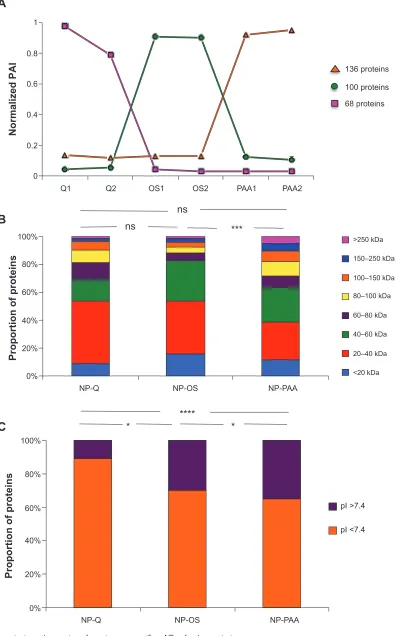
and 136 different proteins that specifically constituted the respective corona of Q-, OS-, and PAA-NPs (Figure 4A). To deeply characterize this protein capture specificity, we com-pared the molecular weight (MW) and the isoelectric point (pI) of proteins in these three groups. PAA-specific proteins revealed significantly higher MWs than OS-NPs (Figure 4B and Supplementary materials). In fact, the median protein MW in PAA-group was 50,547 Da; it was only 33,667 Da in OS-group. Regarding the pI, the three protein groups showed
significant differences (Figure 4C and Supplementary
materials). The positively charged Q-NPs revealed 90% of specific proteins that were negatively charged at pH 7.4
(ie, with a pI 7.4), whereas negatively charged OS- and
PAA-NPs harvested less than 70% of specific protein with
pI 7.4, confirming previous reports that suggested NP
surface charge would influence the protein corona.
Functional analysis of rBc proteins
As NPs considerably increased the number of identified pro-teins in RBC samples and as the different surfaces harvested different subproteomes, we were interested in determining the functional pathways that were significantly represented by NP-harvested proteins in comparison with nontreated sample. In this aim, we submitted our data set to Ingenuity
Pathway Analysis software42 (Ingenuity Systems, Redwood
City, CA, USA) to perform the functional characterization of the RBC proteome and identify the main molecular path-ways and networks. This automatic annotation tool uses a knowledge database and assigns proteins to functional classes or specific canonical pathways (CPs) related to various bio-logical processes.
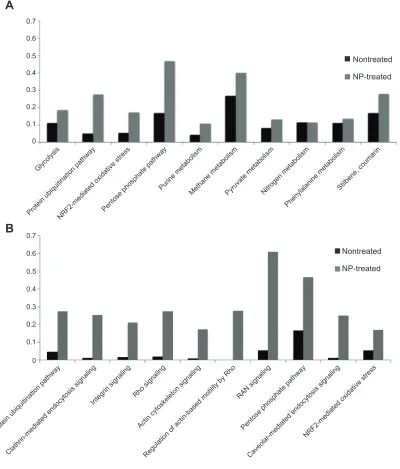
According to the functional analysis, the 893 proteins identified from the three different kinds of NPs had been associated to 140 different and significantly represented CPs and revealed 98 species related to hematological diseases; the 109 proteins from the crude extract only highlighted 40 different CPs and 31 proteins previously described in hematological diseases.
The ten more significant CPs for crude RBC lysate (Figure 5A) were related to the cellular origin and known functions of RBC. Most of them involved protein and nucleic acid degradation, anaerobic glycolysis, and response to oxidative stress. Although these ten CPs were not the most significant in NP-treated lysates, they were more represented in these samples than crude extract. Figure 5A shows the ratio of proteins identified in these ten CPs for crude and NP-treated RBC extracts. This ratio matches to the number of proteins from our data set that maps to the pathway divided by the total number of proteins referenced in this pathway
by the software. We noticed in all CPs that these ratios were higher for the NP-treated samples, intending that NP increased the identification of proteins related to these CPs. On the other hand, when we considered NPs as the refer-ence sample (Figure 5B), the ten more significant CPs were related to cellular assembly and organization of cytoskeleton, which play an important role in RBC. These pathways that are related to important RBC functions were almost absent from the set of proteins identified in the crude RBC sample, illustrating the impact of the enrichment following protein harvesting using NP technology.
Discussion
Although the behavior of NPs in the presence of complex protein mixture is still far from being completely understood, several studies have demonstrated that the physicochemical features of NPs greatly influenced the composition of their
protein corona. In 2008, Lundqvist et al14 demonstrated,
in plasma, qualitative differences in the protein corona of different types of NPs, according to the surface properties
and the size of NPs. In 2012, Capriotti et al11 demonstrated
that charge density on cationic liposomes influenced both qualitative and quantitative plasma protein capture. Recently,
Tenzer et al15 performed both qualitative and quantitative
proteomics to demonstrate that the NP size significantly determined the protein corona. Interestingly, they also demonstrated that the relative proportion of plasma proteins was modified on NP surface compared to their proportion in control plasma. These results suggest that different kinds of NPs may harvest different subproteomes and modify the range of protein concentration in complex samples. As these two properties may be helpful in proteomics approaches to increase the proteome coverage of a biological sample, we assessed for the first time the ability of chemically modified NPs to increase protein identification in RBC samples. The challenge with RBC sample is to decrease the concentration of Hb, which represents 98% of the total protein concentra-tion. NPs provide great advantages for ex vivo experiments; their functionalized surfaces, their nanometer size, and their great surface-to-volume ratio endow them with unique physicochemical properties making them very attractive for protein harvesting.
In this study, we used three kinds of 100 nm super-paramagnetic NPs that strongly differ in their surface chemistry. The magnetic properties of these NPs consider-ably facilitated their handling during washing and elution steps through the use of an external magnet. We selected a strong anion exchanger (Q-NP), a strong cation exchanger (PAA-NP), and a hydrophobic (OS-NP) surface to increase
International Journal of Nanomedicine downloaded from https://www.dovepress.com/ by 118.70.13.36 on 23-Aug-2020
Dovepress accessing to the minor proteome of rBcs through NP surface properties
!N'D
±N'D
±N'D
±N'D
±N'D
±N'D
±N'D
N'D
QV
QV
S,!
S,
SURWHLQV
SURWHLQV SURWHLQV
1RUPDOL]HG3$,
$
%
&
3URSRUWLRQRISURWHLQV
3URSRUWLRQRISURWHLQV
4 4 26 26 3$$ 3$$
134 1326 133$$
134 1326 133$$
Figure 4 Characterization and comparison of protein groups specific to NP surface by quantitative mass spectrometry.
Notes: (A) Graphical representation of the mean normalized PAI value of three protein groups (obtained by hierarchical clustering) specific to NP surface. Here, 136, 100, and 68 proteins are preferentially captured by Paa-NPs, Os-NPs, and Q-NPs, respectively. histogram representing (B) the MW and (C) the pI of these specific proteins for each NP surface. *P0.05; ***P0.001; ****P0.0001.
International Journal of Nanomedicine downloaded from https://www.dovepress.com/ by 118.70.13.36 on 23-Aug-2020
Dovepress
Zaccaria et al
$
%
3URWHLQXELTXLWLQDWLRQSDWKZD\ *O\FRO\VLV
3URWHLQXELTXLWLQDWLRQSDWKZD\
&ODWKULQPHGLDWHGHQGRF\WRVLVVLJQDOLQJ
,QWHJULQVLJQDOLQJ 5KRVLJQDOLQJ
$FWLQF\WRVNHOHWRQVLJQDOLQJ
5$1VLJQDOLQJ
&DYHRODUPHGLDWHGHQGRF\WRVLVVLJQDOLQJ
15)PHGLDWHGR[LGDWLYHVWUHVV 15)PHGLDWHGR[LGDWLYHVWUHVV
3HQWRVHSKRVSKDWHSDWKZD\ 3HQWRVHSKRVSKDWHSDWKZD\
3XULQHPHWDEROLVP0HWKDQHPHWDEROLVP
3\UXYDWHPHWDEROLVP1LWURJHQPHWDEROLVP
3KHQ\ODODQLQHPHWDEROLVP
6WLOEHQHFRXPDULQ
1RQWUHDWHG 13WUHDWHG
1RQWUHDWHG 13WUHDWHG
5HJXODWLRQRIDFWLQEDVHGPRWLOLW\E\5KR
Figure 5 Functional annotation of RBC proteins identified by nano-LC–MS/MS.
Notes: Top ten of significant CPs for (A) untreated and (B) NP-treated RBC extract. For each CP, the bars show the ratio between the number of identified proteins classified in that pathway and the total number of proteins referenced in this pathway by the software for untreated (black bar) and treated RBC extract (gray bar). Abbreviations: rBc, red blood cell; lc–Ms/Ms, liquid chromatography–tandem mass spectrometry; cPs, canonical pathways; NP, nanoparticle.
the probability to harvest different subsets of proteins. After the incubation of NPs with RBC protein extract, the nano-LC–MS/MS analysis of each eluted corona enabled the identification of more than 500 proteins, increasing by 400% the number of identified species compared to a control extract of RBC (108 proteins). Actually, synergic effects occurring at the NP surface can explain this improvement in protein identification. First, the proportion of high-abundant proteins is decreased on NP surface. Moreover, as observed
by Tenzer et al35 the abundance rank of proteins (estimated
by the number of MS/MS queries) was different between NP-treated and untreated sample. These results confirm that NPs modify the range of protein concentration at their surface. Interestingly, the 20 most abundant proteins harvested by NPs were also different according to the NP
chemical functionalization (Supplementary materials). This
observation confirms that the affinity of each protein may be different according to the NP properties, influencing the protein concentration on the NP surface. The second effect concerns the increase of low-abundant proteins on NPs.
International Journal of Nanomedicine downloaded from https://www.dovepress.com/ by 118.70.13.36 on 23-Aug-2020
Dovepress accessing to the minor proteome of rBcs through NP surface properties
In fact, we observed that low-abundant proteins identified in nontreated sample were present in higher abundance on NPs. Here also, the higher affinity of several low-abundant proteins for the different kinds of chemical functionaliza-tion allowed their accumulafunctionaliza-tion on the NP surfaces. Thus, through the respective decrease of high-abundant proteins and increase of low-abundant proteins, NP treatment greatly reduces the range of concentration in the sample, making detectable more peptides by the MS instruments. Moreover, because RBC proteins have different affinities for the three kinds of NPs, distinct subproteomes were harvested on each surface, and we finally identified a total of 893 different proteins from these three types of NPs. Among these 893 identified proteins, label-free quantification allowed us to determine which were NP-specific protein signatures. Focus-ing on the MW and the pI, we found significant differences between these three NP-specific protein groups. While the positively charged Q-NP revealed 90% specific proteins with
pI 7.4 (ie, negatively charged at pH 7.4), the negatively
charged OS and PAA-NPs bound less than 35% of specific
proteins with pI 7.4. We also observed that PAA-NPs
harvested specific proteins with higher MW than the ones harvested by OS-NPs. According to these results, we con-firmed that properties such as surface charge or chemical functionalization impact on NP–protein interaction.
Although the complexity of the NP–protein interac-tions is far to be understood, an NP-associated sample preparation of RBC samples in clinical proteomics appears obvious. During its 4-month life span, RBC travels along the entire blood stream to deliver oxygen to most organs. As a major circulating compartment, it is considered as a crucial micro-organite able to contain biomarkers associated
both to hematological and non-hematological disorders.33
In the aim to detect protein modifications in pathological context, the access to the RBC proteome is a major issue to identify potential therapeutic targets. Although technical advances in RBC sample preparation and fractionation have greatly contributed to a better proteome coverage in RBC samples, they remain both time- and sample-consuming and thus incompatible with large-scale clinical studies. We demonstrated that our NP treatment is a very reproducible strategy that specifically allowed the access to the RBC minor proteome. Thus, signaling pathways highlighted in nontreated sample and implicated in important RBC functions such as oxygen transport, glycolysis, and pro-tection against oxidative stress were more represented by NP treatment, offering the possibility to better understand mechanisms responsible for dysfunctions of these key
functional pathways. Moreover, NP treatment specifically highlighted RhoA, Rac, and Cdc42 signaling that have essential functions in morphology and deformability
regula-tions of the erythrocyte cytoskeleton.43,44 The maintenance
of normal deformability is crucial to permit RBC to enter into narrow capillaries, and dysfunctions of these pathways have been associated with hemolytic anemia. Access to such mandatory pathways for erythrocyte functions would greatly improve investigations on erythrocyte disorders. This access to the minor RBC proteome could also provide precious information for non-hematological disorders. For instance, the specific identification by NP treatment
of alpha-synuclein and DJ-1,45 two major proteins
associ-ated to Parkinson’s disease,46,47 may open the way to new
proteomics analysis of RBCs in this disease.48,49
Finally, one great advantage of our approach, in
com-parison with immuno-depletion36 or ProteoMiner,37 concerns
its efficiency from low volume of sample (200 µL of RBC
containing 1 mg of protein). In their study, Ringrose et al36
and Roux-Dalvai et al37 both performed on-gel fractionation
after immuno-depletion or ProteoMiner, and identified 700 and 1,578 different proteins from 200 mg and 5.7 g of starting material, respectively. We would certainly identify more proteins if we had combined such fractionation to NP treatment. Although getting high quantity of RBC proteins is not a limiting factor, as 50 mL of total blood could be easily obtained, the possibility to work on low volumes is more compatible with clinical-automated facilities. And the magnetic feature of NPs allowed us to easily automate all
the experimental protocol. Villanueva et al50 have already
described this kind of platform and demonstrated the repro-ducibility of NPs for protein harvesting, suggesting the ability to simultaneously process hundreds of samples in reproduc-ible and clinically adapted conditions.
Conclusion
For the first time, we took advantage of the complexity of the NP–protein interactions to increase the proteome cov-erage in RBC lysates, via the capture of complementary subproteomes on different kinds of NPs. Through a qualita-tive and quantitaqualita-tive proteomics approach, we confirmed the impact of the NP surface functionalization and charge on protein capture, both demonstrating the reduction of the sample concentration range on the NPs and the specificity of capture for each surface. These synergic effects opened a window on the RBC minor proteome, which is a major issue to identify biomarkers associated to hematological and/or non-hematological disorders.
International Journal of Nanomedicine downloaded from https://www.dovepress.com/ by 118.70.13.36 on 23-Aug-2020
Dovepress
Zaccaria et al
Disclosure
The authors report no conflicts of interest in this work.
References
1. Sanvicens N, Marco MP. Multifunctional nanoparticles – properties and prospects for their use in human medicine. Trends Biotechnol. 2008;26(8):425–433.
2. Yoo D, Lee JH, Shin TH, Cheon J. Theranostic magnetic nanoparticles.
Acc Chem Res. 2011;44(10):863–874.
3. Ferrari M. Cancer nanotechnology: opportunities and challenges. Nat
Rev Cancer. 2005;5(3):161–171.
4. Dobrovolskaia MA, Aggarwal P, Hall JB, McNeil SE. Preclinical studies to understand nanoparticle interaction with the immune system and its potential effects on nanoparticle biodistribution. Mol Pharm. 2008;5(4):487–495.
5. Fischer HC, Chan WC. Nanotoxicity: the growing need for in vivo study. Curr Opin Biotechnol. 2007;18(6):565–571.
6. Dell’Orco D, Lundqvist M, Oslakovic C, Cedervall T, Linse S. Modeling the time evolution of the nanoparticle-protein corona in a body fluid.
PLoS One. 2010;5(6):e10949.
7. Casals E, Pfaller T, Duschl A, Oostingh GJ, Puntes V. Time evolution of the nanoparticle protein corona. ACS Nano. 2010;4(7): 3623–3632.
8. Capriotti AL, Cavaliere C, Foglia P, et al. Development of an analytical strategy for the identification of potential bioactive peptides generated by in vitro tryptic digestion of fish muscle proteins. Anal Bioanal
Chem. 2014;77(11–12):755–769.
9. Cedervall T, Lynch I, Foy M, et al. Detailed identification of plasma proteins adsorbed on copolymer nanoparticles. Angew Chem Int Ed
Engl. 2007;46(30):5754–5756.
10. Lundqvist M, Stigler J, Cedervall T, et al. The evolution of the pro-tein corona around nanoparticles: a test study. ACS Nano. 2011;5(9): 7503–7509.
11. Capriotti AL, Caracciolo G, Cavaliere C, et al. Do plasma proteins distin-guish between liposomes of varying charge density? J Proteomics. 2012; 75(6):1924–1932.
12. Nel AE, Madler L, Velegol D, et al. Understanding biophysico-chemical interactions at the nano-bio interface. Nat Mater. 2009;8(7): 543–557.
13. Mahmoudi M, Lynch I, Ejtehadi MR, Monopoli MP, Bombelli FB, Laurent S. Protein-nanoparticle interactions: opportunities and chal-lenges. Chem Rev. 2011;111(9):5610–5637.
14. Lundqvist M, Stigler J, Elia G, Lynch I, Cedervall T, Dawson KA. Nanoparticle size and surface properties determine the protein corona with possible implications for biological impacts. Proc Natl Acad Sci
U S A. 2008;105(38):14265–14270.
15. Tenzer S, Docter D, Rosfa S, et al. Nanoparticle size is a critical physicochemical determinant of the human blood plasma corona: a comprehensive quantitative proteomic analysis. ACS Nano. 2011; 5(9):7155–7167.
16. Lundqvist M, Sethson I, Jonsson BH. Protein adsorption onto silica nanoparticles: conformational changes depend on the particles’ curvature and the protein stability. Langmuir. 2004;20(24):10639–10647. 17. Lind K, Kresse M, Muller RH. Comparison of protein adsorption
patterns onto differently charged hydrophilic superparamagnetic iron oxide particles obtained in vitro and ex vivo. Electrophoresis. 2001; 22(16):3514–3521.
18. Monopoli MP, Aberg C, Salvati A, Dawson KA. Biomolecular coronas provide the biological identity of nanosized materials. Nat Nanotechnol. 2012;7(12):779–786.
19. Aggarwal P, Hall JB, McLeland CB, Dobrovolskaia MA, McNeil SE. Nanoparticle interaction with plasma proteins as it relates to particle biodistribution, biocompatibility and therapeutic efficacy. Adv Drug
Deliv Rev. 2009;61(6):428–437.
20. Ivanov YD, Govorun VM, Bykov VA, Archakov AI. Nanotechnologies in proteomics. Proteomics. 2006;6(5):1399–1414.
21. Johnson CJ, Zhukovsky N, Cass AE, Nagy JM. Proteomics, nanotech-nology and molecular diagnostics. Proteomics. 2008;8(4):715–730. 22. Ray S, Chandra H, Srivastava S. Nanotechniques in proteomics:
current status, promises and challenges. Biosens Bioelectron. 2010; 25(11):2389–2401.
23. Anderson NL, Anderson NG. The human plasma proteome: history, character, and diagnostic prospects. Mol Cell Proteomics. 2002; 1(11):845–867.
24. Qian WJ, Jacobs JM, Liu T, Camp DG 2nd, Smith RD. Advances and challenges in liquid chromatography-mass spectrometry-based proteomics profiling for clinical applications. Mol Cell Proteomics. 2006;5(10):1727–1744.
25. Ray S, Reddy PJ, Choudhary S, Raghu D, Srivastava S. Emerging nanoproteomics approaches for disease biomarker detection: a current perspective. J Proteomics. 2011;74(12):2660–2681.
26. Luchini A, Fredolini C, Espina BH, et al. Nanoparticle technology: addressing the fundamental roadblocks to protein biomarker discovery.
Curr Mol Med. 2010;10(2):133–141.
27. Godin B, Sakamoto JH, Serda RE, Grattoni A, Bouamrani A, Ferrari M. Emerging applications of nanomedicine for the diagnosis and treatment of cardiovascular diseases. Trends Pharmacol Sci. 2010;31(5):199–205.
28. Capriotti AL, Caruso G, Cavaliere C, Piovesana S, Samperi R, Lagana A. Comparison of three different enrichment strategies for serum low molecular weight protein identification using shotgun proteomics approach. Anal Chim Acta. 2012;740:58–65.
29. Fredolini C, Meani F, Luchini A, et al. Investigation of the ovarian and prostate cancer peptidome for candidate early detection markers using a novel nanoparticle biomarker capture technology. AAPS J. 2010;12(4):504–518.
30. Villanueva J, Philip J, Entenberg D, et al. Serum peptide profiling by magnetic particle-assisted, automated sample processing and MALDI-TOF mass spectrometry. Anal Chem. 2004;76(6):1560–1570. 31. Xi L, Junjian Z, Yumin L, Yunwen L, Hongbin W. Serum biomarkers
of vascular cognitive impairment evaluated by bead-based proteomic technology. Neurosci Lett. 2009;463(1):6–11.
32. Pasini EM, Mann M, Thomas AW. Red blood cell proteomics. Transfus
Clin Biol. 2010;17(3):151–164.
33. Goodman SR, Kurdia A, Ammann L, Kakhniashvili D, Daescu O. The human red blood cell proteome and interactome. Exp Biol Med. 2007;232(11):1391–1408.
34. Weatherall DJ, Provan AB. Red cells I: inherited anaemias. Lancet. 2000;355(9210):1169–1175.
35. Provan D, Weatherall D. Red cells II: acquired anaemias and poly-cythaemia. Lancet. 2000;355(9211):1260–1268.
36. Ringrose JH, van Solinge WW, Mohammed S, et al. Highly efficient depletion strategy for the two most abundant erythrocyte soluble proteins improves proteome coverage dramatically. J Proteome Res. 2008;7(7):3060–3063.
37. Roux-Dalvai F, Gonzalez de Peredo A, Simo C, et al. Extensive analysis of the cytoplasmic proteome of human erythrocytes using the peptide ligand library technology and advanced mass spectrometry. Mol Cell
Proteomics. 2008;7(11):2254–2269.
38. Wang M, You J, Bemis KG, Tegeler TJ, Brown DP. Label-free mass spectrometry-based protein quantification technologies in proteomic analysis. Brief Funct Genomics Proteomic. 2008;7(5):329–339. 39. Suzuki R, Shimodaira H. Pvclust: an R package for assessing the uncertainty
in hierarchical clustering. Bioinformatics. 2006;22(12):1540–1542. 40. Bouyssie D, Gonzalez de Peredo A, Mouton E, et al. Mascot file parsing
and quantification (MFPaQ), a new software to parse, validate, and quantify proteomics data generated by ICAT and SILAC mass spectrometric analy-ses: application to the proteomics study of membrane proteins from primary human endothelial cells. Mol Cell Proteomics. 2007;6(9):1621–1637. 41. Mouton-Barbosa E, Roux-Dalvai F, Bouyssie D, et al. In-depth
exploration of cerebrospinal fluid by combining peptide ligand library treatment and label-free protein quantification. Mol Cell Proteomics. 2010;9(5):1006–1021.
International Journal of Nanomedicine downloaded from https://www.dovepress.com/ by 118.70.13.36 on 23-Aug-2020
International Journal of Nanomedicine
Publish your work in this journal
Submit your manuscript here: http://www.dovepress.com/international-journal-of-nanomedicine-journal
The International Journal of Nanomedicine is an international, peer-reviewed journal focusing on the application of nanotechnology in diagnostics, therapeutics, and drug delivery systems throughout the biomedical field. This journal is indexed on PubMed Central, MedLine, CAS, SciSearch®, Current Contents®/Clinical Medicine,
Journal Citation Reports/Science Edition, EMBase, Scopus and the Elsevier Bibliographic databases. The manuscript management system is completely online and includes a very quick and fair peer-review system, which is all easy to use. Visit http://www.dovepress.com/ testimonials.php to read real quotes from published authors.
Dovepress
Dove
press
accessing to the minor proteome of rBcs through NP surface properties
42. Jimenez-Marin A, Collado-Romero M, Ramirez-Boo M, Arce C, Garrido JJ. Biological pathway analysis by ArrayUnlock and ingenuity pathway analysis. BMC Proc. 2009;3(suppl 4):S6.
43. Kalfa TA, Pushkaran S, Mohandas N, et al. Rac GTPases regulate the morphology and deformability of the erythrocyte cytoskeleton. Blood. 2006;108(12):3637–3645.
44. Wang L, Yang L, Filippi MD, Williams DA, Zheng Y. Genetic deletion of Cdc42GAP reveals a role of Cdc42 in erythropoiesis and hematopoietic stem/progenitor cell survival, adhesion, and engraftment.
Blood. 2006;107(1):98–105.
45. Shi M, Zabetian CP, Hancock AM, et al. Significance and confounders of peripheral DJ-1 and alpha-synuclein in Parkinson’s disease. Neurosci
Lett. 2010;480(1):78–82.
46. Bonifati V, Rizzu P, van Baren MJ, et al. Mutations in the DJ-1 gene associated with autosomal recessive early-onset parkinsonism. Science. 2003;299(5604):256–259.
47. Spillantini MG, Crowther RA, Jakes R, Hasegawa M, Goedert M. alpha-Synuclein in filamentous inclusions of Lewy bodies from Parkinson’s disease and dementia with lewy bodies. Proc Natl Acad Sci U S A. 1998; 95(11):6469–6473.
48. Prohaska R, Sibon OC, Rudnicki DD, et al. Brain, blood, and iron: perspectives on the roles of erythrocytes and iron in neurodegeneration.
Neurobiol Dis. 2012;46(3):607–624.
49. Abraham S, Soundararajan CC, Vivekanandhan S, Behari M. Erythrocyte antioxidant enzymes in Parkinson’s disease. Indian J Med
Res. 2005;121(2):111–115.
50. Villanueva J, Lawlor K, Toledo-Crow R, Tempst P. Automated serum peptide profiling. Nat Protoc. 2006;1(2):880–891.
International Journal of Nanomedicine downloaded from https://www.dovepress.com/ by 118.70.13.36 on 23-Aug-2020