International Journal of COPD
Dove
press
S h O rt r e P O rt
open access to scientific and medical research
Open Access Full text Article
the usefulness of soluble receptor for advanced
glycation end-products in the identification of
COPD frequent exacerbator phenotype
Joanna Miłkowska-Dymanowska1,2,*
Adam J Białas1,2,*
Karolina Szewczyk1
Zofia Kurmanowska1
Paweł Górski1,2
Wojciech J Piotrowski1,2
1Department of Pneumology and
Allergy, Medical University of Łódź, Łódź, Poland; 2healthy Ageing
research Centre, Medical University of Łódź, Łódź, Poland
*these authors contributed equally to this work
Introduction: Exacerbations of COPD (ECOPDs) are important events in the course of COPD, accelerating the rate of decline in lung function and increasing the mortality risk. A growing body of evidence suggests the significance of the “frequent exacerbator” phenotype. This phenotype seems to be associated with a more severe airflow limitation, symptoms, health-related quality of life impairment, and higher mortality. However, there is no described biomarker that would help to identify this group of patients.
Patients and methods: Patients with COPD in “D” GOLD category were monitored for 3 years according to events of ECOPD. Serum samples were collected from the patients. Circulating level of plasma soluble receptor for advanced glycation end-products (sRAGE) was measured using commercially available high sensitivity kits. The receiver operating characteristic (ROC) curve analysis was used to assess the usefulness of sRAGE to identify frequent exacerbator phenotype. Log-rank test was used in the analysis of time to the subsequent exacerbation. Pearson (R) or Spearman’s rank (RS) correlation coefficients were used for correlation analysis.
Results: Nineteen patients were enrolled. The area under the ROC curve (AUROC) for sRAGE for the identification of frequent exacerbator phenotype was 0.81. Analysis identified the cutoff point as 850.407 pg/mL, characterized by a sensitivity of 0.80 (95% CI: 0.28–1.0) and specific-ity of 0.93 (95% CI: 0.66–1.0). Additionally, in the group with sRAGE #850.407 pg/mL, we observed significantly shorter time to the subsequent exacerbation: median of 32 vs 105.5 days (P=0.03). Correlation analysis revealed significant negative correlation between sRAGE and the number of exacerbations requiring hospitalization during the whole time of follow-up (RS=-0.53; P=0.02) and significant positive correlation with FEV1 expressed as the percentage of reference value (R=0.6; P=0.006).
Conclusion: sRAGE seems to be useful in the identification of frequent exacerbator phenotype. This parameter may also be used in the prediction of time to ECOPD. Our findings should be confirmed in a sufficiently powered larger sample.
Keywords: sRAGE, frequent exacerbator phenotype of COPD, exacerbations of COPD, COPD, prediction of AECOPD
Introduction
Exacerbations of COPD (ECOPDs) are key points for the natural history of COPD as they accelerate the rate of decline in lung function.1–3 Exacerbations requiring
hospitalization are specifically important, because they are associated with significant mortality. In fact, evidence suggests that exacerbation with hypercapnia is burdened with significant in-hospital mortality.4 Additionally, long-term prognosis following
hospitalization for ECOPD is burdened by the average in-hospital mortality rate of
Correspondence: Joanna Miłkowska-Dymanowska
Department of Pneumology and Allergy, Medical University of Łódź, Kopcińskiego Street 22, Łódź 90-153, Poland
email joanna.milkowska-dymanowska@ umed.lodz.pl
Journal name: International Journal of COPD Article Designation: Short Report
Year: 2018 Volume: 13
Running head verso: Miłkowska-Dymanowska et al
Running head recto: sRAGE and frequent exacerbations of COPD DOI: 186170
International Journal of Chronic Obstructive Pulmonary Disease downloaded from https://www.dovepress.com/ by 118.70.13.36 on 22-Aug-2020
For personal use only.
Dovepress
Miłkowska-Dymanowska et al
6.7%, while the average mortality rates at 3 and 6 months were reported to be 18 and 26%, respectively, and those at 5 years were reported as high as 51%.5 The literature data
show, that only 11.6% to 17% of COPD patients experi-ence remittent exacerbations in 1 year.6–8 Nevertheless, this
group induces an economic and social burden that is both substantial and increasing.3 This is why there is a strong need
for elaborate approaches to prevent ECOPDs and identify in advance the group of subjects who experience remittent exacerbations. To gain this goal, there is a strong need for research for new, biochemical prediction tools.
The receptor for advanced glycation end-products (RAGE) is a multiligand, pattern-recognition receptor involved in the host response to injury, infection, and inflammation.9 It is an
immunoglobulin superfamily protein of 35 kDa. Primarily, it plays a role of a multiligand transmembrane binder for several molecules.10 RAGE localizes in various cell types,
such as monocytes, macrophages, smooth muscle cells, and endothelial cells.11 RAGE signaling also plays a key role in
lung development and structure.12 Therefore, it justifies the
linkage of RAGE with the pathobiology of COPD.
Numerous studies analyzed its role in cigarette smoke-induced airway inflammation and emphysema.12–16
Deficien-cies in soluble RAGE (sRAGE) were linked to heightened inflammation in various chronic conditions, including neu-trophilic airway inflammation in asthma and COPD.9 There
is also an evidence for the usefulness of phenotyping of the RAGE gene, eg, the G82S polymorphism in the RAGE gene is associated with an increased risk of COPD, the GS genotype of the G82S variant is a risk factor for COPD in the Chinese population,17 and genetic variants in or near RAGE
have also been associated with COPD affection status and emphysema,18–20 while the minor allele of the rs2070600
variant was associated with protection with respect to COPD in the population of smokers.21 Moreover, RAGE was
con-sidered as a potential therapeutic target for COPD.22
We aimed to assess if sRAGE would be useful for the identification of patients prone to frequent ECOPDs. We also analyzed the time to the subsequent exacerbation and correlations between sRAGE and spirometry values.
Patients and methods
Study protocol was approved by Ethical Committee for Human Studies of the Medical University of Lodz. All patients provided written informed consent for the participa-tion in the study. All study procedures were consistent with the tenets of the Declaration of Helsinki.
Patients with COPD in category D according to GOLD guidelines were enrolled to the study from July 2014 to August 2017. Patients were enrolled in the Outpatient Clinic and Department of Pneumology and Allergy, Medical University of Lodz. The main criterion was having 1 exacerbation(s), which required hospitalization within last 12 months and/ or 2 exacerbations not requiring hospitalization with the need for systemic steroid therapy and/or antibiotic therapy. All patients were treated with similar therapy. The exclu-sion criteria comprised a history of any active malignancy,
α-1-antitrypsin deficiency, HIV infection, and concomi-tant diagnosis of other significant respiratory diseases (eg, interstitial lung disease and parenchymal lung disease due to previous tuberculosis). Additionally, patients with exac-erbations at least 8 weeks prior to sample collection were excluded from the study.
Serum samples were collected from the patients and stored at -80°C until use. Repeated freeze-thaw cycles were avoided. ELISA was used to determine the serum levels of sRAGE (BioVendor – Laboratorni medicina a.s., Brno, Czech Republic) according to the manufacturer’s recommendations.
Then, patients were monitored according to events of ECOPD by the same experienced physician (JM-D). Every such event was classified as mild (worsening of symptoms for 2 consecutive days and not treated with systemic corticos-teroids and/or antibiotics), moderate (treated with systemic corticosteroids and/or antibiotics), and severe (requiring hos-pitalization) according to the Anthonisen criteria. Worsening of symptoms was captured in an electronic diary that alerted patients and physicians to the presence of an exacerbation. All events were confirmed by the physician. The current analysis focuses on moderate or severe exacerbations. The “frequent exacerbator” phenotype was defined by at least one hospitalization due to ECOPD or two treated at home per year in every year of prospective observation. The follow-up was terminated after 3 years in June 2018.
Continuous data were presented as the mean with SD or median with IQR, depending on the distribution of data. Variables were compared using the unpaired Student’s t-test, Welch test, or the Mann–Whitney U-test, depending on data normality and the homogeneity of variance. Categorical data were presented as absolute value with percentage and were compared using Fisher’s exact test.
The receiver operating characteristic (ROC) curve analysis was used to assess sRAGE usefulness to identify frequent exac-erbator phenotype. The area under the ROC curve (AUROC)
International Journal of Chronic Obstructive Pulmonary Disease downloaded from https://www.dovepress.com/ by 118.70.13.36 on 22-Aug-2020
Dovepress sRAGE and frequent exacerbations of COPD
was presented as result and 95% CI, while the accuracy of the qualitative test parameters was presented as point estimates and 95% CIs. An AUROC of greater than 0.9 was considered as excellent, greater than 0.8–0.9 as very good, 0.7–0.8 as good, 0.6–0.7 as average, and below 0.6 as poor.23
Log-rank test was used in the analysis of time to the subsequent exacerbation. Pearson (R) or Spearman’s rank (RS) correlation coefficients were evaluated to assess the relationships between sRAGE and spirometry values.
Data were analyzed using the R software for MacOS.24
Results
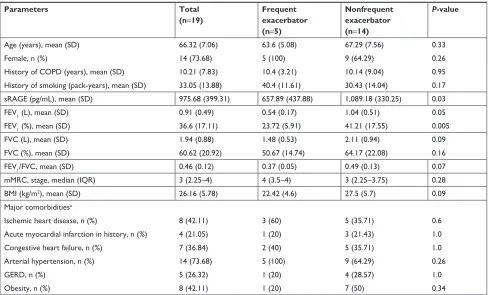
A total of 19 patients were included in the study. We identified five patients (26.32%) who met the criteria of frequent exacerbator phenotype. The baseline clinical data and analysis after stratification by frequent exacerbator phenotype are presented in Table 1. As expected, frequent exacerbators experienced significantly higher number of all exacerbations during the time of follow-up: 5 (3–17) vs 1 (0.25–1.75); P=0.002. Additionally, in the nonfrequent exacerbator group, two patients were hospitalized because of ECOPD during the follow-up period (median 0) and the
median of such exacerbations in the frequent exacerbator group was 2 (2–3).
ROC analysis showed an AUROC of 0.81, which can be classified as very good accuracy according to Choi,23
and identified the cutoff point as 850.407 pg/mL (Figure 1), characterized by a sensitivity of 0.80 (95% CI: 0.28–1.0), specificity of 0.93 (95% CI: 0.66–1.0), positive predictive value (PPV) of 0.80 (95% CI: 0.28–1.0), and negative predic-tive value (NPV) of 0.93 (95% CI: 0.66–1.0). The diagnostic accuracy of the test was 0.9 (95% CI: 0.67–0.99).
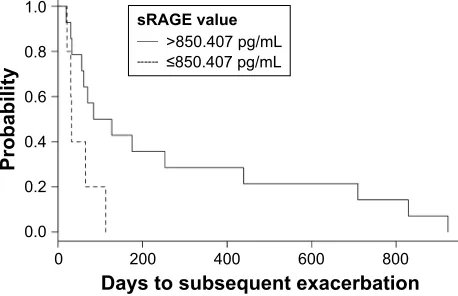
After stratification by the sRAGE cutoff point of 850.407, we observed significantly shorter time to the subsequent exac-erbation (median of 105.5 days for sRAGE.850.407 pg/mL and 32 days for sRAGE #850.407 pg/mL) (Figure 2; P-value for log-rank test =0.03).
Correlation analysis revealed significant negative correla-tion between sRAGE and the number of exacerbacorrela-tions requiring hospitalization during the whole time of follow-up (RS=-0.53;
P=0.02) and significant positive correlation with FEV1 expressed as the percentage of reference value (R=0.6; P=0.006). We did not observe significant correlation with FVC expressed as the percentage of reference value (R=0.43; P=0.07).
Table 1 The baseline clinical data and analysis after stratification by frequent exacerbator phenotype
Parameters Total
(n=19)
Frequent exacerbator (n=5)
Nonfrequent exacerbator (n=14)
P-value
Age (years), mean (SD) 66.32 (7.06) 63.6 (5.08) 67.29 (7.56) 0.33
Female, n (%) 14 (73.68) 5 (100) 9 (64.29) 0.26
history of COPD (years), mean (SD) 10.21 (7.83) 10.4 (3.21) 10.14 (9.04) 0.95
History of smoking (pack-years), mean (SD) 33.05 (13.88) 40.4 (11.61) 30.43 (14.04) 0.17 sRAGE (pg/mL), mean (SD) 975.68 (399.31) 657.89 (437.88) 1,089.18 (330.25) 0.03
FeV1 (L), mean (SD) 0.91 (0.49) 0.54 (0.17) 1.04 (0.51) 0.05
FeV1 (%), mean (SD) 36.6 (17.11) 23.72 (5.91) 41.21 (17.55) 0.005
FVC (L), mean (SD) 1.94 (0.88) 1.48 (0.53) 2.11 (0.94) 0.09
FVC (%), mean (SD) 60.62 (20.92) 50.67 (14.74) 64.17 (22.08) 0.16
FeV1/FVC, mean (SD) 0.46 (0.12) 0.37 (0.05) 0.49 (0.13) 0.07
mMrC, stage, median (IQr) 3 (2.25–4) 4 (3.5–4) 3 (2.25–3.75) 0.28
BMI (kg/m2), mean (SD) 26.16 (5.78) 22.42 (4.6) 27.5 (5.7) 0.09
Major comorbiditiesa
Ischemic heart disease, n (%) 8 (42.11) 3 (60) 5 (35.71) 0.6
Acute myocardial infarction in history, n (%) 4 (21.05) 1 (20) 3 (21.43) 1.0
Congestive heart failure, n (%) 7 (36.84) 2 (40) 5 (35.71) 1.0
Arterial hypertension, n (%) 14 (73.68) 5 (100) 9 (64.29) 0.26
GERD, n (%) 5 (26.32) 1 (20) 4 (28.57) 1.0
Obesity, n (%) 8 (42.11) 1 (20) 7 (50) 0.34
Note:aAccording to available medical records and history.
Abbreviation: sRAGE, soluble receptor for advanced glycation end-products.
International Journal of Chronic Obstructive Pulmonary Disease downloaded from https://www.dovepress.com/ by 118.70.13.36 on 22-Aug-2020
Dovepress
Miłkowska-Dymanowska et al
Discussion
In modern treatment approaches, there is a tendency to identify relevant COPD phenotypes. It is believed that this may improve the precision, effectiveness, and safety of the treatment. Moreover, Golpe et al25 reported that grouping
COPD patients according to clinical phenotypes can help us to identify those with a different mortality risk.
ECOPDs account for the greatest proportion of the total COPD burden on the health care system. Additionally, from 11.6% to 17% of COPD patients experience remittent exacer-bations in 1 year.6–8 Also, changes in GOLD guidelines tend
to extract patients who experience frequent exacerbations.3
Such approach enables early intensification of treatment to reduce the risk of future exacerbations in order to guide therapy.3
A growing body of evidence suggests the significance of the frequent exacerbator phenotype; however, there are no unified guidelines that defne this phenotype. Also, the knowledge on this group of patients seems to be scarce. The frequent exacerbator phenotype may be defined, concordantly with our study methods, as at least one hospitalization due to ECOPD or two treated at home per year.26 This phenotype
seems to be associated with a more airflow limitation symp-toms, health-related quality of life impairment, and higher mortality.26 Gupta et al27 reported the significant reduction in
FEV1, diffusing capacity for carbon monoxide and transfer coefficient of the lung values in this group of patients.
There is no described biomarker that would help us to identify this group of patients. For this purpose, we propose sRAGE. ROC analysis showed very good diagnostic accu-racy, and considering limitations of our pilot study, suggest-ing its potential usefulness. Additionally, we observed high values of accuracy of the qualitative test parameters.
Our finding is associated with potentially important clinical implications. Namely, identification of this group of patients would help us in planning more precise therapy in early stage of the disease. We believe that it will influence the natural history of the disease and, as the effect, ameliorate prognoses.
Moreover, sRAGE can also be used in the prediction of time to the subsequent exacerbation. This observation is of a great benefit for clinical practice because it would be poten-tially useful in indicating patients with a high risk of upcoming exacerbation and, thus, require early intensive treatment.
The parameter also correlated with FEV1, reflecting the relationship between decrease in FEV1 with increasing airway inflammation, which intensifies the progression of the disease.28
Study limitations
Small sample size is the major limitation of our study and determines this as a pilot study. Therefore, results should be considered as hypothesis generating and should be confirmed in a sufficiently powered larger sample. Small sample size of our study results from careful selection of the study group. All patients were treated by the same clinically experienced physician, and they were treated with similar therapy. The study group was observed for 3 years. Such studies are long lasting, time consuming, and involving deep cooperation with physicians. Additionally, our group consisted mainly of female subjects, which does not fully reflect overall COPD population. The female patients presented better compliance with the study protocol and more frequently expressed their
Figure 2 Kaplan–Meier curves for the time to the subsequent exacerbation (days),
stratified by the sRAGE value of 850.407 pg/mL.
1.0
0.8
0.6
0.4
0.2
0.0
0 200 400
Days to subsequent exacerbation
Probabilit
y
600 800
sRAGE value
>850.407 pg/mL ≤850.407 pg/mL
Figure 1 ROC curve for sRAGE in the identification of frequent exacerbator
phenotype.
Note: The cutoff point presented best sum of specificity, and sensitivity presented
in brackets was marked.
Abbreviations: ROC, receiver operating characteristic; sRAGE, soluble receptor
for advanced glycation end-products. 1.0
0.8
0.6
850.407 (0.929, 0.800)
Sensitivit
y
Specificity 0.4
0.2
0.0
1.2 1.0 0.8 0.6 0.4 0.2 0.0 –0.2
International Journal of Chronic Obstructive Pulmonary Disease downloaded from https://www.dovepress.com/ by 118.70.13.36 on 22-Aug-2020
Dovepress sRAGE and frequent exacerbations of COPD
consent for participation in the study. Moreover, there is an evidence that female COPD patients might be more prone to severe exacerbations, might a long period of symptoms before being admitted to the hospital, have higher number of hospitalizations, and prolonged length of hospital stay.29
Conclusion
sRAGE seems to be useful in the identification of frequent exacerbator phenotype. This parameter may also be used in the prediction of time to ECOPD. Our findings should be confirmed in a sufficiently powered larger sample.
Acknowledgment
The costs of this study were defrayed from regular finances of the Department of Pneumology and Allergy, Medical University of Lodz, Poland (503/1-151-03/503-11-001-17).
Disclosure
The authors report no conflicts of interest in this work.
References
1. Donaldson GC, Seemungal TA, Bhowmik A, Wedzicha JA. Relation-ship between exacerbation frequency and lung function decline in chronic obstructive pulmonary disease. Thorax. 2002;57(10):847–852. 2. Kanner RE, Anthonisen NR, Connett JE; Lung Health Study Research
Group. Lower respiratory illnesses promote FEV(1) decline in current smokers but not ex-smokers with mild chronic obstructive pulmonary disease: results from the lung health study. Am J Respir Crit Care Med. 2001;164(3):358–364.
3. Global Initiative for Chronic Obstructive Pulmonary Disease. Global
Strategy for the Diagnosis, Management, and Prevention of Chronic Obstructive Pulmonary Disease. Available from: https://goldcopd.org/
wp-content/uploads/2017/11/GOLD-2018-v6.0-FINAL-revised-20-Nov_WMS.pdf. Accessed August 21, 2018.
4. Connors AF, Dawson NV, Thomas C, et al. Outcomes following acute exacerbation of severe chronic obstructive lung disease. The SUP-PORT investigators (Study to Understand Prognoses and Preferences for Outcomes and Risks of Treatments). Am J Respir Crit Care Med. 1996;154(4 Pt 1):959–967.
5. Hoogendoorn M, Hoogenveen RT, Rutten-van Mölken MP, Vestbo J, Feenstra TL. Case fatality of COPD exacerbations: a meta-analysis and statistical modelling approach. Eur Respir J. 2011;37(3):508–515. 6. Suissa S, Dell’aniello S, Ernst P. Long-term natural history of chronic
obstructive pulmonary disease: severe exacerbations and mortality.
Thorax. 2012;67(11):957–963.
7. Beeh KM, Glaab T, Stowasser S, et al. Characterisation of exacerbation risk and exacerbator phenotypes in the POET-COPD trial. Respir Res. 2013;14:116.
8. Han MK, Quibrera PM, Carretta EE, et al. Frequency of exacerbations in patients with chronic obstructive pulmonary disease: an analysis of the SPIROMICS cohort. Lancet Respir Med. 2017;5(8):619–626. 9. Sukkar MB, Wood LG, Tooze M, et al. Soluble RAGE is deficient in
neutrophilic asthma and COPD. Eur Respir J. 2012;39(3):721–729. 10. Mccance DR, Dyer DG, Dunn JA, et al. Maillard reaction products and
their relation to complications in insulin-dependent diabetes mellitus.
J Clin Invest. 1993;91(6):2470–2478.
11. Mukhopadhyay S, Mukherjee TK. Bridging advanced glycation end product, receptor for advanced glycation end product and nitric oxide with hormonal replacement/estrogen therapy in healthy versus diabetic postmenopausal women: a perspective. Biochim Biophys Acta. 2005; 1745(2):145–155.
12. Yonchuk JG, Silverman EK, Bowler RP, et al. Circulating soluble receptor for advanced glycation end products (sRAGE) as a biomarker of emphysema and the RAGE axis in the lung. Am J Respir Crit Care
Med. 2015;192(7):785–792.
13. Chen M, Wang T, Shen Y, et al. Knockout of RAGE ameliorates mainstream cigarette smoke-induced airway inflammation in mice. Int
Immunopharmacol. 2017;50:230–235.
14. Lee H, Park JR, Kim WJ, et al. Blockade of RAGE ameliorates elastase-induced emphysema development and progression via RAGE-DAMP signaling. Faseb J. 2017;31(5):2076–2089.
15. Reynolds PR, Kasteler SD, Schmitt RE, Hoidal JR. Receptor for advanced glycation end-products signals through Ras during tobacco smoke-induced pulmonary inflammation. Am J Respir Cell Mol Biol. 2011; 45(2):411–418.
16. Robinson AB, Johnson KD, Bennion BG, Reynolds PR. RAGE sig-naling by alveolar macrophages influences tobacco smoke-induced inflammation. Am J Physiol Lung Cell Mol Physiol. 2012;302(11): L1192–L1199.
17. Li Y, Yang C, Ma G, et al. Association of polymorphisms of the receptor for advanced glycation end products gene with COPD in the Chinese population. DNA Cell Biol. 2014;33(4):251–258.
18. Castaldi PJ, Cho MH, San José Estépar R, et al. Genome-wide association identifies regulatory Loci associated with distinct local histogram emphysema patterns. Am J Respir Crit Care Med. 2014; 190(4):399–409.
19. Manichaikul A, Hoffman EA, Smolonska J, et al. Genome-wide study of percent emphysema on computed tomography in the general population. The Multi-Ethnic Study of Atherosclerosis Lung/SNP Health Association Resource Study. Am J Respir Crit Care Med. 2014;189(4):408–418.
20. Cho MH, Castaldi PJ, Hersh CP, et al. A Genome-Wide Association Study of Emphysema and Airway Quantitative Imaging Phenotypes.
Am J Respir Crit Care Med. 2015;192(5):559–569.
21. Young RP, Hay BA, Hopkins RJ. Does RAGE protect smokers from COPD? Eur Respir J. 2011;38(3):743–744.
22. Chen L, Liu L, Wang T, Shen YC, Wen FQ. Receptor for advanced glycation end products: a new theraputic target for chronic obstructive pulmonary disease? Arch Med Res. 2013;44(1):75–76.
23. Choi BC. Slopes of a receiver operating characteristic curve and like-lihood ratios for a diagnostic test. Am J Epidemiol. 1998;148(11): 1127–1132.
24. R Core Team. R: A Language and Environment for Statistical Computing. R Foundation for Statistical Computing: Vienna, Austria; 2016. 25. Golpe R, Suárez-Valor M, Martín-Robles I, et al. Mortality in COPD
patients according to clinical phenotypes. Int J Chron Obstruct Pulmon
Dis. 2018;13:1433–1439.
26. Le Rouzic O, Roche N, Cortot AB, et al. Defining the “Frequent Exac-erbator” Phenotype in COPD: A Hypothesis-Free Approach. Chest. 2018;153(5):1106–1115.
27. Gupta PP, Govidagoudar MB, Yadav R, Agarwal D. Clinical and pulmonary functions profiling of patients with chronic obstructive pulmonary disease experiencing frequent acute exacerbations. Lung
India. 2018;35(1):21–26.
28. Oh JY, Sin DD. Lung inflammation in COPD: why does it matter?
F1000 Med Rep. 2012;4:23.
29. Blumenthal JA, Emery CF, Smith PJ, et al. The effects of a telehealth coping skills intervention on outcomes in chronic obstructive pulmonary disease: primary results from the INSPIRE-II study. Psychosom Med. 2014;76(8):581–592.
International Journal of Chronic Obstructive Pulmonary Disease downloaded from https://www.dovepress.com/ by 118.70.13.36 on 22-Aug-2020
International Journal of COPD
Publish your work in this journal
The International Journal of COPD is an international, peer-reviewed journal of therapeutics and pharmacology focusing on concise rapid reporting of clinical studies and reviews in COPD. Special focus is given to the pathophysiological processes underlying the disease, intervention programs, patient focused education, and self management protocols.
This journal is indexed on PubMed Central, MedLine and CAS. The manuscript management system is completely online and includes a very quick and fair peer-review system, which is all easy to use. Visit http://www.dovepress.com/testimonials.php to read real quotes from published authors.
Dovepress
Dove
press
Miłkowska-Dymanowska et al
International Journal of Chronic Obstructive Pulmonary Disease downloaded from https://www.dovepress.com/ by 118.70.13.36 on 22-Aug-2020