
Performance of Cuckoo Search Algorithm in
Optimal Power Flow Problems
D.Thangaraj1, S.Sakthivel2
M.E Scholar, Dept. of EEE, Muthayammal Engineering College, Salem, India1
Professor, Dept. of EEE, Muthayammal Engineering College, Salem, India2
ABSTRACT:Optimal power flow (OPF) problem is an important task in power system operation and planning. An efficient algorithm is necessary for solving the OPF problem as it nonlinear in nature. In this paper, cuckoo search based met heuristic algorithm (CSA) is developed and proposed to solve different optimal power flow problems. To prove the effectiveness of the proposed method, it has been demonstrated on standard IEEE 30-bus test system for four different objectives that are related to fuel cost minimization of generators that has convex or non-convex fuel cost characteristics. The results obtained by using the proposed method are compared with those obtained by other different methods followed in the literature. It is evident from the comparison that the cuckoo based algorithm I performs better and found to be encouraging.
KEYWORDS:optimal power flow, cuckoo search algorithm, power system optimization
I. INTRODUCTION
The vast majority of the tools for optimization of power system operation and control are appropriately formulated as some sort of optimization problem.Optimal power flow (OPF) is the basic tool that has been widely used since its introduction. The term OPF was first introduced by Dommel and Tinney in 1968 as discussed in OPF problem is a large-scale highly constrained non-linear non-convex optimization problem.There are numerous OPF models are developed and utilized to formulate different types of optimization problems using different sets of controls variables and under different types of constraints.
The OPF problem has been rigorously analyzed in the past few decades, and many optimization techniques have emerged and been applied to solve this problem. In the past, many conventional optimization techniques have been successfully applied for OPF problems. Some of those methods were gradient-based methods, Newton-based method, the simplex method, sequential linear programming, sequential quadratic programming, and interior point methods Even though some of these techniques have excellent convergence behaviour, they suffer from some shortcomings. Some of the drawbacks are that they cannot ensure global optimality.
The recent rapid developments in computational intelligence tools have motivated research in the area of metaheuristic optimization methods. Most of these techniques have been applied to OPF problems, such as the genetic algorithm (GA), particle swarm optimization (PSO), ant colony optimization (ACO), bacterial foraging algorithms (BFAs), biogeography-based optimization (BBO), simulated annealing (SA), and tabu search (TS). These methods are known for their capabilities of finding global best solutions and avoiding being trapped into local ones and their ability of fast searching of large solution spaces. References review some of these optimization techniques applied to solve the OPF problem.
algorithm has been gaining attention and been extended and applied in many works, with most reporting its promising performance.
The following sections are as follows: section-2 formulates the OPF, section-3 is devoted for the CSA and its implementation for OPF problem. Next, the CSA is applied to solve the OPF problem to optimize the power system operating conditions in section-4. Finally, in section-5, some final remarks and points concluded.
II.OPFPROBLEMFORMULATION
OPF is a type of power flow problem that gives the optimal values of the control variables for a given amount of load by optimizing a preset objective function while satisfying some constraints. Hence, the OPF problem can be mathematically formulated as a non-linear constrained optimization problem as follows
minimize f (x,u), Subject to g (x,u) = 0 , and h (x,u) ≤ 0,
where f(x,u) is the objective function, g (x,u) is the set of equality constraints, h (x,u)is the set of inequality constraints, u is the vector of independent variables or control variables and x is the vector of dependent variables or state variables respectively. Four different objectives are considered here for the OPF problem. These four cases are discussed below.
Case 1: Minimization of fuel cost(FC)
It represents the smooth or the quadratic cost function whose objective function is expressed as follows:
= = ( + + )
where FC is the total fuel cost; ai; bi and ci are fuel cost coefficients of the Ith unit. The quadratic cost coefficients are obtained.
Case 2: Minimization of valve point effect cost (VPE)
= = ( + + +⃓ sin { − }⃓),
Where FC is the total fuel cost; ai; bi and ci are fuel cost coefficients of the Ith unit. The quadratic cost coefficients are obtained.
Case 3: Minimization of piecewise fuel cost (PWC)
= = + +
The total generating fuel cost is given by,
( , ) = ( , )
Case 4: Minimization of emission (EM)
= = + + +
where Em is the total emission cost (ton/h); ai; bi; ci; ni and ki are the emission coefficients of the ith unit .Its results are presented in the minimum emission obtained by ARCBBO is0.2048 ton/h, which is better than that reported.
III.CUCKOOO SEARCH ALGORITHM
Cuckoo search algorithm (CSA) is a recent metaheuristic search algorithm inspired by hatching behaviour of the cuckoo bird for solving optimization tasks. The basis of this algorithm is on the obligate brood parasitic behavior of some cuckoo species in combination with the Lévy flight behaviour. In nature, cuckoo birds usually lay their eggs in nests of the other bird species (host nests). There are some cases which can happen. The birds of host nests know the eggs of cuckoo birds (alien eggs) and they can reject it throw out their nests or they leave their nests and build new one. The birds of host nests do not know alien eggs and it will become cuckoo birds. Following cuckoo behavior, CSA described as three main steps.
A cuckoo lays one egg (a solution) at a time and dumps its egg in a randomly chosen nest among the fixed number of available host nests;
The best nests with high a quality of egg will be carried over to the next generation; - A host bird can discover an alien egg in its nest with a probability of pa∈ [0, 1]. In this case, it can simply either throw the egg away or abandon the nest and find a new location to build a completely new one.
The Lévy flight distribution
In nature, animals can search for food in a random/quasi-random manner. Generally, the foraging path of an animal is effectively a random walk since the next move is based on the current location state and the transition probability to the next location. The chosen direction depends implicitly on a probability which can be mathematically modeled. Recent various studies have shown that the flight behavior of many animals and insects has demonstrated the typical characteristics of Lévy flights following step:
Lévy ~ u = t− λ, 1( < ≤ 3
Implementation of CS algorithm
Step-1: Assume the NP host nests Xi (i= 1, 2,..NP) and maximum number of iteration.
Step-2: Check for maximum number of iterations and select a cuckoo randomly by levy flights evaluate the fitness or cost function (fi).
Step-3: Select a nest among NP on random basis, say (j).
Step-4: Compare if fi is less than fj replace j by the new solution.
Step-7: Repeat this in all the iterations and end when the maximum iterations are reached.
Step-8: Print the results.
IV.RESULTSANDDISCUSSION
To examine the effectiveness of the proposed CS method, it is applied to solve the OPF problems with different objectives is tested on the standard IEEE 30-bus system. To exhibit the improvements made using the CS based method, the results are presented along with those of the other methods for the test case.
The developed CS based algorithm is coded using the MATLAB 7.9b computing environment, on a 2.20-GHz i5 laptop with 4.00 GB of RAM The parameters of the CSA are selected as follows: the number of nest NP = 50, probability for an alien egg to be discovered Pa = 0.5, maximum number of iterations = 500, For obtaining the optimal solution, the algorithm is performed 30 independent runs.
The IEEE 30-bus Test System
IEEE 30 bus system is a medium size test case. It has 24 load buses and 6 generator buses and 41 transmission lines in its configuration.The control variables in OPF problems are: real power generation from generators, generator bus voltages, transformer tap settings and VAR outputs from shunt compensators. Figure shows the one-line diagram of the IEEE 30 bus test case.
Case 1: Minimization of Generation Fuel Cost.
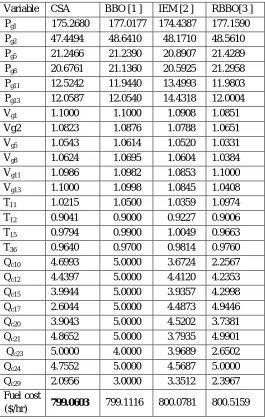
The quadratic cost function is used in this case for calculation of total generation cost.The proposed algorithm is applied for minimizing the total fuel cost. The best control variable values corresponding to minimum fuel cost is tabulated in table 1. The cost reported by the CSA based method is compared with the other algorithms like BBO, IEM and RBBO in the table. It is evident that the proposed algorithm minimizes the fuel cost in a better way.
Table 1. Best control variables in minimization of fuel cost Variable CSA BBO [1 ] IEM [2 ] RBBO[3 ]
Pg1 175.2680 177.0177 174.4387 177.1590
Pg2 47.4494 48.6410 48.1710 48.5610
Pg5 21.2466 21.2390 20.8907 21.4289
Pg8 20.6761 21.1360 20.5925 21.2958
Pg11 12.5242 11.9440 13.4993 11.9803
Pg13 12.0587 12.0540 14.4318 12.0004
Vg1 1.1000 1.1000 1.0908 1.0851
Vg2 1.0823 1.0876 1.0788 1.0651 Vg5 1.0543 1.0614 1.0520 1.0331
Vg8 1.0624 1.0695 1.0604 1.0384
Vg11 1.0986 1.0982 1.0853 1.1000
Vg13 1.1000 1.0998 1.0845 1.0408
T11 1.0215 1.0500 1.0359 1.0974
T12 0.9041 0.9000 0.9227 0.9006
T15 0.9794 0.9900 1.0049 0.9663
T36 0.9640 0.9700 0.9814 0.9760
Qc10 4.6993 5.0000 3.6724 2.2567
Qc12 4.4397 5.0000 4.4120 4.2353
Qc15 3.9944 5.0000 3.9357 4.2998
Qc17 2.6044 5.0000 4.4873 4.9446
Qc20 3.9043 5.0000 4.5202 3.7381
Qc21 4.8652 5.0000 3.7935 4.9901
Qc23 5.0000 4.0000 3.9689 2.6502
Qc24 4.7552 5.0000 4.5687 5.0000
Qc29 2.0956 3.0000 3.3512 2.3967
Fuel cost
($/hr) 799.0603 799.1116 800.0781 800.5159
Figure 2 Convergence quality of CSA in quadratic fuel cost minimization
Case 2: Cost with valve point effect
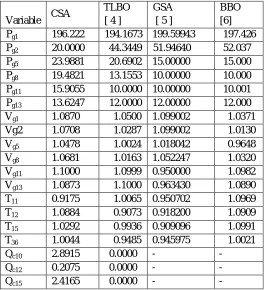
In this case, the valve point effects are taken in to account in cost calculations. For performance comparison, TLBO, GSA and BBO are taken. The results are compared in table 2 for understanding the strength of the proposed algorithm. The valve point effect cost reported by CSA is 920.3103, which much less than the cost reported by the other algorithms in the table.
Table 2. Best control variables in minimization of valve point effect cost
Variable CSA
TLBO [ 4 ]
GSA [ 5 ]
BBO [6] Pg1 196.222 194.1673 199.59943 197.426
Pg2 20.0000 44.3449 51.94640 52.037
Pg5 23.9881 20.6902 15.00000 15.000
Pg8 19.4821 13.1553 10.00000 10.000
Pg11 15.9055 10.0000 10.00000 10.001
Pg13 13.6247 12.0000 12.00000 12.000
Vg1 1.0870 1.0500 1.099002 1.0371
Vg2 1.0708 1.0287 1.099002 1.0130 Vg5 1.0478 1.0024 1.018042 0.9648
Vg8 1.0681 1.0163 1.052247 1.0320
Vg11 1.1000 1.0999 0.950000 1.0982
Vg13 1.0873 1.1000 0.963430 1.0890
T11 0.9175 1.0065 0.950702 1.0969
T12 1.0884 0.9073 0.918200 1.0909
T15 1.0292 0.9936 0.909096 1.0991
T36 1.0044 0.9485 0.945975 1.0021
Qc10 2.8915 0.0000 - -
Qc12 0.2075 0.0000 - -
Qc17 4.8092 0.0000 - -
Qc20 3.7203 0.0000 - -
Qc21 2.8520 0.0000 - -
Qc23 2.6239 0.0000 - -
Qc24 0.6967 0.0000 - -
Qc29 3.9760 0.0000 - -
VPE
cost 920.3103 923.414 929.7240472 930.793
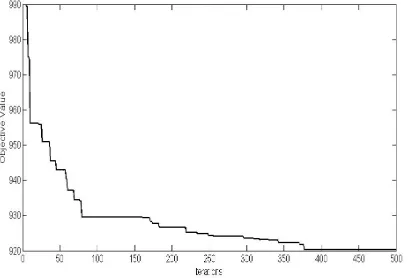
Taking 375 iterations, the algorithm has converged to the global best results showing the better reliability of the algorithm. The convergence behaviour of the CSA in valve point effect cost minimization is depicted in figure 3.
Figure. 3 Convergence quality of CSA in valve point effect fuel cost minimization
Case 3: piecewise cost minimization
When multi type fuels are used in a generator, the fuel cost is different for different fuels. This cost function is the piecewise cost function which is used here for calculation of generation cost. BBO, PSO and MDE algorithms are taken for comparison of the performance of CSA. It is clear from the table 3 that the cost reported by the proposed CSA is less than the cost reported by the other algorithms taken for comparison.
Table 3. Best control variables in minimization of piecewise quadratic fuel cost
Variable CSA BBO [ 6 ] PSO [ 6 ] MDE[ 6 ]
Pg1 136.479 140.0000 140.0000 140.0000
Pg2 54.7591 55.0000 55.0000 55.0000
Pg5 32.5433 24.1500 24.1257 24.0000
Pg8 32.5787 18.5100 35.0000 34.9890
Pg11 10.0000 35.0000 18.6600 18.0440
Pg13 22.8620 17.7900 17.6810 18.4620
Vg1 0.9932 1.0500 1.0500 1.0500
Vg5 0.9751 1.0170 1.0133 1.0139
Vg8 0.9192 1.0282 1.0225 1.0259
Vg11 0.9097 1.0910 1.0722 1.0940
Vg13 1.0238 1.0876 1.0866 1.0773
T11 0.9000 1.0192 1.0060 0.9714
T12 1.0996 0.9573 0.9000 1.0046
T15 0.9966 1.0120 0.9645 0.9902
T36 0.9000 0.9505 0.9305 0.9494
Qc10 2.7397 - - -
Qc12 1.1946 - - -
Qc15 0.3887 - - -
Qc17 3.5836 - - -
Qc20 5.0000 - - -
Qc21 3.3025 - - -
Qc23 0.2000 - - -
Qc24 2.4263 - - -
Qc29 0.5560 - - -
Quadratic Fuel cost ($/hr)
446.5340 647.69 647.7437 647.846
The algorithm convergences to the best results in about 375 iterations in piecewise cost minimization and this is shown in figure 4.
Figure. 4 Convergence quality of CSA in piecewise quadratic fuel cost minimization
Case 4: Minimization of emission
Table 4. Best control variables in minimization of emission Variable CSA IPSO [7] IPSO [7] BSO [ 8] Pg1 66.6800 67.1300 67.0400 112.9189
Pg2 67.547 68.9400 68.1400 59.3719
Pg5 50.000 49.8600 50.0000 27.6576
Pg8 35.000 34.8900 35.0000 34.9989
Pg11 29.999 29.6700 30.0000 27.0652
Pg13 39.995 39.9400 40.0000 26.4502
Vg1 1.0792 1.0287 1.0351 1.1000
Vg2 1.0742 1.0341 1.0273 1.0855 Vg5 1.0567 1.0387 1.0417 1.0606
Vg8 1.0592 1.0254 1.0248 1.0757
Vg11 1.0987 1.0317 1.0321 1.1000
Vg13 1.0994 1.0395 1.0410 1.1000
T11 0.9810 1.0300 1.0300 1.0000
T12 0.9016 1.0200 1.0100 0.9500
T15 0.9568 1.0500 1.0600 1.0000
T36 0.9455 0.9900 0.9900 0.9625
Qc10 1.5556 11.8500 12.5300 3.4844
Qc12 3.5945 8.2510 8.7410 4.5129
Qc15 4.8219 77.1300 76.6700 4.7990
Qc17 1.6543 70.6700 66.5600 4.9965
Qc20 4.9593 67.1300 67.0400 3.9809
Qc21 3.8209 68.9400 68.1400 4.7684
Qc23 2.7699 49.8600 50.0000 3.8535
Qc24 4.9996 34.8900 35.0000 4.2332
Qc29 0.6613 29.6700 30.0000 1.6339
Emission
cost 0.2048 0.2063 0.2058 0.2425
Figure 5 shows that the CSA algorithm is quick in convergence in emission minimization and produces the lowest level of emission. In this case also, the convergence strength of the algorithm is excellent.
V.CONCLUSION
In this paper, the recently developed metaheuristic algorithm of cuckoo search algorithm is developed, employed and successfully tested in solving different OPF problems. The outperforming characteristic of the algorithm in four different optimization objectives is really encouraging. The simulation results demonstrate the effectiveness and robustness of the proposed method. Moreover, the results obtained using the CS method has been compared with those obtained from the other methods previously reported in the literature. The comparison shows the superiority of the proposed CS method over many other methods used for solving the OPF in terms of results quality. The results obtained are promising and implementing a multi-objective CS is a possible extension of the current work.
REFERENCES
[1] Bhattacharya, A., and P. K. Chattopadhyay. "Application of biogeography-based optimisation to solve different optimal power flow problems." IET generation, transmission & distribution 5, no. 1 (2011): 70-80.
[2] El-Hana Bouchekara, HoussemRafik, Mohammad Ali Abido, and AllaEddineChaib. "Optimal power flow using an improved electromagnetism-like mechanism method." Electric Power Components and Systems 44, no. 4 (2016): 434-449.
[3] Kumar, A. Ramesh, and L. Premalatha. "Optimal power flow for a deregulated power system using adaptive real coded biogeography-based optimization." International Journal of Electrical Power & Energy Systems 73 (2015): 393-399.
[4] Bouchekara, H. R. E. H., M. A. Abido, and M. Boucherma. "Optimal power flow using teaching-learning-based optimization technique." Electric Power Systems Research 114 (2014): 49-59.
[5] Duman, Serhat, UğurGüvenç, Yusuf Sönmez, and NuranYörükeren. "Optimal power flow using gravitational search algorithm." Energy Conversion and Management 59 (2012): 86-95.
[6] Bhattacharya, A., and P. K. Chattopadhyay. "Application of biogeography-based optimisation to solve different optimal power flow problems." IET generation, transmission & distribution 5, no. 1 (2011): 70-80.
[7] Niknam, T., M. R. Narimani, J. Aghaei, and R. Azizipanah-Abarghooee. "Improved particle swarm optimisation for multi-objective optimal power flow considering the cost, loss, emission and voltage stability index." IET generation, transmission & distribution 6, no. 6 (2012): 515-527.

![Table 4. Best control variables in minimization of emission Variable CSA IPSO [7] IPSO [7] BSO [ 8]](https://thumb-us.123doks.com/thumbv2/123dok_us/1559677.1191571/9.595.167.429.217.770/table-best-control-variables-minimization-emission-variable-ipso.webp)
