Scholarship@Western
Scholarship@Western
Electronic Thesis and Dissertation Repository
9-26-2013 12:00 AM
Investigating the Effects of Radiation on Phosphonium-Based
Investigating the Effects of Radiation on Phosphonium-Based
Ionic Liquids
Ionic Liquids
Susan Howett
The University of Western Ontario
Supervisor Dr. J. Clara Wren
The University of Western Ontario Graduate Program in Chemistry
A thesis submitted in partial fulfillment of the requirements for the degree in Doctor of Philosophy
© Susan Howett 2013
Follow this and additional works at: https://ir.lib.uwo.ca/etd
Part of the Materials Chemistry Commons, and the Physical Chemistry Commons
Recommended Citation Recommended Citation
Howett, Susan, "Investigating the Effects of Radiation on Phosphonium-Based Ionic Liquids" (2013). Electronic Thesis and Dissertation Repository. 1639.
https://ir.lib.uwo.ca/etd/1639
This Dissertation/Thesis is brought to you for free and open access by Scholarship@Western. It has been accepted for inclusion in Electronic Thesis and Dissertation Repository by an authorized administrator of
i
INVESTIGATING THE EFFECTS OF RADIATION ON
PHOSPHONIUM-BASED IONIC LIQUIDS
(Thesis format: Integrated-Article)
by
Susan E. Howett
Graduate Program In Chemistry
A thesis submitted in partial fulfillment of the requirements for the degree of
Doctor of Philosophy
The School of Graduate and Postdoctoral Studies The University of Western Ontario
London, Ontario, Canada
ii
Abstract
This thesis presents work on the understanding of the effects of ionizing radiation
on phosphonium-based ionic liquids (ILs). The capability of ILs to dissolve a wide range
of molecules, and the potential of ILs to be highly resilient in energy-intensive
environments makes them particularly promising media for the separation and
sequestration of metal ion contaminants from radioactive waste effluents in nuclear fuel
cycles. For this application, a water/IL system will be exposed to a continuous stream of
ionizing radiation. The radiation environment will strongly influence the chemical state
of the water phase in the system and the chemical parameters affecting the separation
efficiency of the system. This work examines irradiation of gas/IL and water/IL biphasic
systems containing phosphonium-based ionic liquids.
When exposed to ionizing radiation, ionic liquids undergo radiolysis, resulting in
the formation of ionic liquid excited species and radiolytic fragments. As well, when
exposed to ionizing radiation, water decomposes into a range of reducing (•eaq−, •O2−, •H)
and oxidizing (O2, •OH, HO2•, H2O2) species. To develop a better understanding of the
biphasic water/IL systems when exposed to radiation, small samples of the biphasic
systems were exposed to continuous radiation in a -cell for periods of time up to several
days. A number of surface, spectroscopic, and electrochemical techniques were
employed to follow the evolution of the systems. This combination of analytical
techniques allowed for the study of changes in the ionic liquid phase, the water phase,
and the gas phase in the systems.
Results indicate that even long-term continuous doses of γ-radiation induce a
iii
gas phase. In the case of the water/IL system, ion transfer occurs across the water/IL
interface, even with the most immiscible phosphonium-based ILs. Irradiation produces
surfactants that can accumulate at the interface and accelerate mixing of the IL and water
phases by emulsification and the formation of micelles. Despite the micelle formation
and emulsification, studies concluded that the phosphonium-based ILs studied undergo
very little radiolytic degradation in steady-state -radiation fields.
Keywords:
ionic liquid, gamma-radiolysis, interfacial stability, phase mixing, micelles, reverse
iv
Co-Authorship Statement
This thesis includes published data (Chapters 4 and 5). For the published results I
v
Acknowledgments
I would first like to thank my supervisor, Dr. J. Clara Wren, for offering her input,
direction, and interpretation of my project throughout my years of study. Clara has
provided a fulfilling graduate experience with her dedication to her students. Under her
guidance I have learned countless things both personally and professionally. I have
travelled to international conferences in North America and Europe, and was given the
opportunity to perform experiments at Atomic Energy of Canada (AECL) and at
Brookhaven National Lab (BNL). The opportunity to perform unique research in
national laboratory settings is an experience that taught me a great deal, and I will not
soon forget.
A number of people have assisted me over my time as a graduate student. I have
learned a tremendous amount from Dr. Jamie Noël. He has provided countless
discussions and assistance in the laboratory and in data collection, for which I am very
grateful. His sense of humor was always welcome, especially when experiments are
failing and no data collection is occurring. Dr. Jiju Joseph has been of great assistance in
experimental aspects and discussions, and her calm demeanor was greatly appreciated in
the office and the lab. Dr. Dave Wren has been of great assistance in the writing process,
and has given helpful professional advice, especially when transitioning from an
academic setting to an industrial environment.
I owe a great deal of thanks to all of the students in the Wren lab, both past and
present. They are an excellent group of people to work with and a fun group outside of
vi
For his love, encouragement, and witty banter, I would like to thank Matt
Asmussen.
Most importantly, I would like to thank my parents and sister for their endless
support in all aspects of my life. Their encouragement has helped me to get to where I
am today.
vii
Table of Contents
Abstract... ii
Co-Authorship Statement...iv
Acknowledgements... v
Table of Contents... vii
List of Symbols, Acronyms, and Ionic Liquids... xv
List of Tables... xviii
List of Figures... xix
Chapter 1. Introduction ... 1
1.1 THESIS GOAL AND ORGANIZATION ... 1
Chapter 2. Technical Background and Literature Review ... 4
2.1 MATERIALS BACKGROUND ... 4
2.1.1 Structure of Ionic Liquids ... 4
2.1.2 Physical Properties of Ionic Liquids ... 5
2.1.3 Phosphonium-Based Ionic Liquids ... 8
2.2 GAS/IONIC LIQUID INTERFACIAL CHEMISTRY... 9
2.3 WATER/IONIC LIQUID INTERFACIAL CHEMISTRY ... 9
2.4 RADIATION AND WATER RADIOLYSIS ... 11
viii
2.4.1.1 Radiation from Radioactive Nuclides ... 11
2.4.1.2 Energy Transfer from Radiation to the Interacting Medium ... 12
2.4.2 Radiation-Induced Chemistry ... 14
2.4.2.1 Water Radiolysis... 14
2.4.3 Pulse and Steady-State Radiolysis ... 18
2.4.4 IL Radiolysis Principles ... 20
2.4.5 Radiolysis of Ionic Liquids ... 21
2.4.5.1 Pulse Radiolysis of Ionic Liquids ... 21
2.4.5.2 Steady-State Radiation of Ionic Liquids ... 23
2.5 REFERENCES ... 24
Chapter 3. Experimental Principles and Details ... 28
3.1 EXPERIMENTAL TECHNIQUES ... 28
3.1.1 Gas Chromatography-Mass Spectrometry (GC/MS) ... 28
3.1.2 Raman Spectroscopy ... 29
3.1.3 Electrochemical Impedance Spectroscopy (EIS) ... 31
3.1.4 Fourier Transform Infrared Spectroscopy (FTIR) ... 35
3.1.5 Transmission Electron Spectroscopy (TEM) ... 36
3.1.6 Dynamic Light Scattering (DLS) ... 37
ix
3.1.8 Small Angle Neutron Scattering (SANS) ... 40
3.2 EXPERIMENTAL PROCEDURES ... 45
3.2.1 Sample Preparation ... 45
3.2.2 Sample Irradiation ... 45
3.2.3 Sample Analysis... 46
3.3 REFERENCES ... 48
Chapter 4. The Effect of Gamma Irradiation on Gas-Ionic Liquid Interfacial Stability ... 49
4.1 INTRODUCTION ... 49
4.2 EXPERIMENTAL ... 50
4.2.1 Sample Preparation ... 50
4.2.2 Test Vial Irradiation ... 50
4.2.3 Sample Analysis... 51
4.2.3.1 Gas Chromatography-Mass Spectrometry (GC/MS) ... 51
4.2.3.2 Electrochemical Impedance Spectroscopy (EIS) ... 51
4.2.3.3 Raman Spectrometry ... 52
4.3 RESULTS... 52
4.3.1 Gas Chromatography Results ... 52
x
4.3.3 Raman Spectroscopy ... 55
4.4 DISCUSSION ... 57
4.4.1 Effect of Radiation on the Gas/IL Biphasic Systems... 57
4.5 CONCLUSIONS ... 58
4.6 REFERENCES ... 59
Chapter 5. The Effects of Gamma Radiation on Interfacial Reactions and Transport Processes of Water-Ionic Liquid Systems: Comparison of Bromide and Amide Ionic Liquids ... 60
5.1 INTRODUCTION ... 60
5.2 EXPERIMENTAL ... 62
5.2.1 Sample Preparation ... 62
5.2.2 Sample Irradiation ... 62
5.2.3 Sample Analysis... 63
5.2.3.1 Gas Chromatography-Mass Spectrometry (GC/MS) ... 63
5.2.3.2 Electrochemical Impedance Spectroscopy (EIS) ... 63
5.2.3.3 Raman Spectroscopy ... 64
5.2.3.4 Nuclear Magnetic Resonance Spectroscopy (NMR) ... 64
5.2.3.5 Transmission Electron Microscopy ... 64
xi
5.3 RESULTS... 65
5.3.1 Electrochemical Impedance Spectroscopy ... 66
5.3.2 Raman Spectroscopy ... 70
5.3.3 Dynamic Light Scattering ... 79
5.3.4 Transmission Electron Microscopy ... 80
5.4 DISCUSSION ... 82
5.4.1 Effect of Radiation on Water/IL Systems ... 82
5.4.2 Radiation-Induced Micelle Formation ... 84
5.5 CONCLUSIONS ... 91
5.6 REFERENCES ... 92
Chapter 6. The Effects of Gamma-Radiation on Interfacial Reactions and Transport Processes of Water/Ionic Liquid Systems: Comparison of Amide and Dicyanamide Ionic Liquids ... 94
6.1 INTRODUCTION ... 94
6.2 EXPERIMENTAL ... 95
6.2.1 Sample Preparation ... 95
6.2.2 Sample Irradiation ... 96
6.2.3 Sample Analysis... 96
xii
6.2.3.2 Electrochemical Impedance Spectroscopy ... 96
6.2.3.2.1 Electrochemical Impedance Spectroscopy: Fitting with a Contaminant ... 97
6.2.3.3 Fourier Transform Infrared Spectroscopy ... 101
6.2.3.4 Transmission Electron Microscopy ... 102
6.3 RESULTS... 102
6.3.1 Ionic Liquids in Contact with Argon Gas ... 102
6.3.1.1 Gas Chromatography-Mass Spectrometry ... 102
6.3.1.2 Electrochemical Impedance Spectroscopy ... 103
6.3.2 Ionic Liquids in Contact with Water ... 104
6.3.2.1 Trihexyltetradecylphosphonium Bis(trifluoromethylsulfonyl)amide 104 6.3.2.1.1 Electrochemical Impedance Spectroscopy ... 104
6.3.2.2 Trihexyltetradecylphosphonium dicyanamide ... 106
6.3.2.2.1 Electrochemical Impedance Spectroscopy ... 106
6.3.2.2.2 Fourier Transform Infrared Spectroscopy ... 107
6.4 DISCUSSION ... 111
6.4.1 Effects of Radiation on Gas/IL Systems ... 111
6.4.2 Effects of Radiation on Water/IL Systems ... 112
6.4.3 Radiation-Induced Nanoemulsion ... 114
xiii
6.6 REFERENCES ... 118
Chapter 7. Investigating Short Term Energy Transfer and Radiation Absorption in Water/Ionic Liquid Systems ... 120
7.1 INTRODUCTION ... 120
7.2 TECHNICAL BACKGROUND ... 121
7.2.1 Hydrated and IL-Solvated Electrons ... 121
7.2.2 Project Objective and Methodology ... 126
7.3 EXPERIMENTAL ... 128
7.4 RESULTS AND DISCUSSION ... 130
7.4.1 Trihexyltetradecylphosphonium Dicyanamide ... 130
7.4.1.1 Transient Absorption Spectra ... 130
7.4.1.2 Decay Profiles... 131
7.4.1.3 Decay Behaviour of the Absorbance at 900 nm ... 132
7.4.1.4 Decay Behaviour of the Absorbance at 650 nm ... 136
7.4.1.5 Absorbance Decay Profiles at 1300 - 1400 nm ... 137
7.4.1.6 Summary on the Transient Species Observed in the Dicyanamide-IL ... 139
7.4.2 Trihexyltetradecylphosphonium Bis(trifluoromethylsulfonyl)amide ... 141
xiv
7.6 ACKNOWLEDGMENTS ... 145
7.7 REFERENCES ... 145
Chapter 8. Characterization of Ionic Liquid Emulsions and Micelles by Neutron Scattering... 147
8.1 INTRODUCTION ... 147
8.2 EXPERIMENTAL ... 148
8.2.1 Sample Preparation ... 148
8.2.2 Sample Analysis... 149
8.3 RESULTS... 149
8.4 DISCUSSION ... 151
8.5 CONCLUSIONS ... 153
8.6 ACKNOWLEDGEMENTS ... 154
8.7 REFERENCES ... 154
Chapter 9. Summary and Future Work ... 156
9.1 SUMMARY ... 156
xv
Symbols, Acronyms, and Ionic Liquids
Symbols
A electrode area
b coherent scattering length
C capacitance
cP centipoise
Dh hydrodynamic diameter
Dt diffusion coefficient
e electron charge
E potential
Eamp amplitude of electrochemical impedance spectroscopy sinusoidal potential
ΔE potential change
ΔEvibration vibrational energy gap
h Plank constant
I current
Io incident neutron intensity
It absorption intensities at time t
Iz absorption intensities at time zero
Iamp EIS current amplitude
Ibgd(q) background neutron flux
Iemp(q) scattered neutron intensity of an empty cell
Iraw(q) raw scattering intensity
Ired(q) reduced intensity
j imaginary unit
k decay rate constants
kB Boltzmann constant
ki incident wave vector
ks scattered wave vector
distance between two electrodes
n index of refraction
q momentum transfer
Q charge
R resistance
Rs Onsager Radius
T absolute temperature (K)
Temp(λ) transmitted intensity of an empty cell
Tsam(λ) transmission of a sample
xvi
Z impedance
Zim imaginary impedance
Zr real impedance
differential scattering cross section per unit volume
ΔΩ sample-to-detector intensity
εo dielectric constant of permittivity in a vacuum
εr dielectric permittivity of a medium
η viscosity
ηe detector efficiency
θ phase shift
θsa scattering angle
λ wavelength
νi incident photon
νf scattered photon
ρ density
σ conductivity of a system
ω angular frequency
Acronyms
AECL Atomic Energy of Canada Limited
AIL Ammonium-Based Ionic Liquid
CAC Critical Aggregation Concentration CMC Critical Micelle Concentration
CNBC Canadian Neutron Bean Centre
CPE Constant Phase Element
CSC Confocal Soller Collimator DLS Dynamic Light Scattering
DSC Differential Scanning Calorimetry
EIS Electrochemical Impedance Spectroscopy
ESI-MS Electrospray Ionization-Mass Spectrometry FTIR Fourier Transform Infrared Spectroscopy
GC/MS Gas Chromatography-Mass Spectrometry
HSC Horizontal Soller Collimator
IL Ionic Liquid
ICT Integrating Current Transformer
LEAF Laser-Electron Accelerator Facility
LET Linear Energy Transfer
xvii
MSD Mean Square Displacement
NMR Nuclear Magnetic Resonance
NRU National Research Universal
NVT Number Volume Temperature
PG Pyrolytic Graphite
PTFE Polytetrafluoroethylene RDF Radial Distribution Function SANS Small Angle Neutron Scattering SDC Self Diffusion Coefficient SLD Scattering Length Density
TEM Transmission Electron Microscopy
TOF Time-Of-Flight
Ionic Liquids
amide-IL Trihexyltetradecylphosphonium bis(trifluoromethylsulfonyl)amide bromide-IL Trihexyltetradecylphosphonium bromide
xviii
List of Tables
Table 4.1 The chemical structures of the ionic liquids and their respective radiolytic decomposition products detected in the gas phase. ... 53
Table 5.1 The chemical structures of the ionic liquids investigated. ... 61
Table 5.2 The diameter of particles in the aqueous phase and their by % volume of particles for an un-irradiated, and a 6-h and an 18-h irradiated amide-IL samples after being in contact for > 72 h, with the respective standard
deviations. ... 80
Table 6.1 The chemical structures of the ionic liquids investigated, as well as their chemical and physical properties (chemical and physical properties measured at 25 °C). ... 95
Table 7.1 Decay constants determined from fits to the absorbance profiles using
equation 7.2. ... 134
xix
List of Figures
Figure 2.1 Common cations used in ILs [14].... 5
Figure 2.2 The radiation track resulting from a γ-photon [49]. ... 15
Figure 2.3 The effect of ionizing radiation on water [58]. ... 16
Figure 2.4 Steady-state γ-radiation of a water/IL sample. ... 19
Figure 3.1 Gas chromatogram of the headspace gas from a test with deaerated IL in contact with water and irradiated for 4 hours; inlaid with the mass spectra from the hexane peak ... 29
Figure 3.2 The (a) purely resistive and (b) purely capacitive impedance response arising from a given electrochemical impedance experiment [6]. ... 33
Figure 3.3 A DLS graph illustrating the distribution of particle diameter (nm) versus volume of a water phase sample. ... 39
Figure 3.4 The partially transmitted and partially reflected neutron beam resulting from a beam incident on the interface between any two media (A and B). ... 41
Figure 3.5 A schematic of the adapted N5-SANS instrument [20]. ... 43
Figure 4.1 Conductivity of ionic liquids in contact with a gas phase as a function of irradiation time:■ , amide-IL, ▲ , bromide-IL, and ◄ ,tosylate-IL. The solid symbols (■, ▲,◄) and the open symbols ( , , ) are the data obtained from the ILs in contact with air and Ar, respectively. ... 54
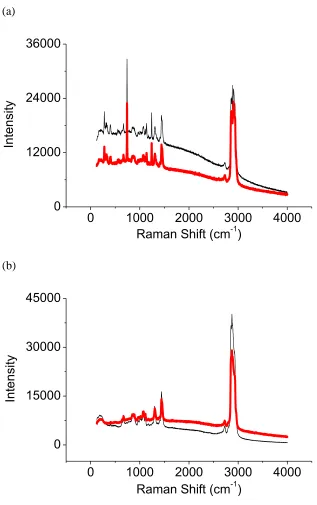
Figure 4.2 Raman spectra of the IL samples in contact with Ar before (thinner lines) and after 8 h irradiation (thicker lines): (a) amide-IL and (b) bromide-IL. ... 56
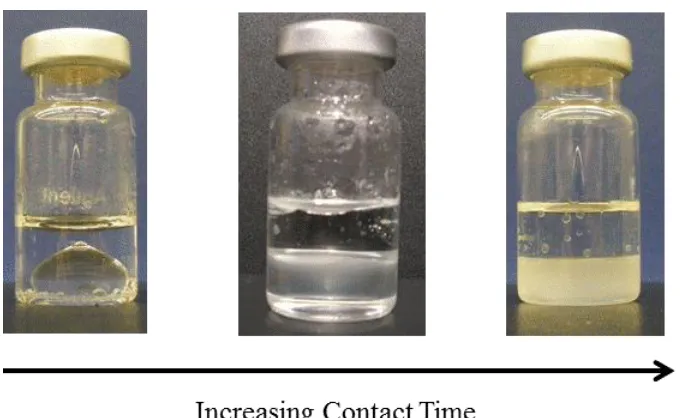
Figure 5.1 Photographs of the water/amide-IL system at increasing contact times showing the development of an emulsion layer. The bottom layer is the IL layer and the top water layer. ... 66
xx
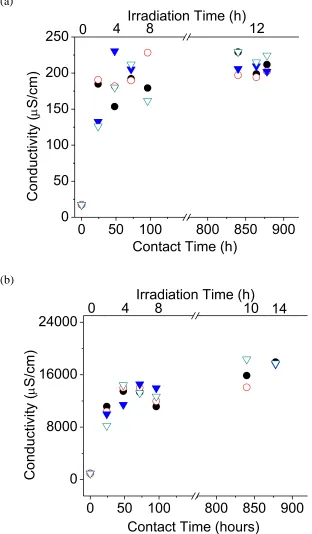
Figure 5.3 Conductivity as a function of total irradiation time (the upper abscissa scale – non-linear) and total contact time (the lower abscissa scale) observed for the water/bromide-IL samples: (a) the IL conductivity and (b) the water conductivity. The different symbols represent data obtained under different conditions: ●aerated and irradiated, deaerated and irradiated, ▼ aerated and un-irradiated, and deaerated and un-irradiated. ... 68
Figure 5.4 Pure water conductivity as a function of irradiation time. The different symbols represent aerated and deaerated water. ... 70
Figure 5.5 Raman spectra of un-irradiated (thinner lines) and 8-h irradiated (thicker lines) water/amide-IL
samples: (a) the IL spectra and (b) the water spectra. ... 72
Figure 5.6 Raman spectra of un-irradiated (thinner lines) and 8-h irradiated (thicker lines) water/bromide-IL samples: (a) the IL spectra
and (b) the water spectra. ... 73
Figure 5.7 Raman spectra of the water/amide-IL samples with no irradiation and taken immediately following irradiation for 6 h (red), 12 h (blue), and 18 h (green) (from the thinnest line to the thickest line): (a) the IL spectra and (b) the water spectra. ... 76
Figure 5.8 Raman spectra of un-irradiated water/amide-IL samples immediately after contact (thinner lines) and after 14-d contact (thicker lines): (a) the IL spectra, (b) the water spectra, and (c) the difference spectra (14-d contact 0-d
contact) of both the IL and aqueous phases. ... 78
Figure 5.9 Raman spectra of 6-h irradiated water/amide-IL samples immediately after contact (thinner lines) and after 14-d contact (thicker lines): (a) the IL spectra, (b) the water spectra, and (c) the difference spectra (14-d contact 0-d
contact) of both the IL and aqueous phases. ... 79
Figure 5.10 TEM images of the particles in the aqueous phase following 24 h of contact with the IL phase. ... 81
Figure 5.11 The diameter of the colloidal particles collected from the aqueous phase by % volume. ... 82
Figure 5.12 Schematic diagrams of the proposed structures of: a) IL micelle, b) aqueous reverse micelle, c) aggregation of aqueous reverse micelles, and d) the
resulting swollen aqueous reverse micelles following aggregation. ... 87
xxi
Figure 6.1 The electrochemical impedance spectra for the IL phase of the amide-IL sample. The (a) Bode plots and (b) Nyquist plot shows the signals at ■ 0 h irradiation, ■ 24 h irradiation, ■ 72 h irradiation, ■ 120 h irradiation, and ■ 168 h irradiation. ... 98
Figure 6.2 The equivalent circuit modeling the amide-IL plots in contact with the water phase.... 99
Figure 6.3 The electrochemical impedance spectra for the water phase of the amide-IL sample. The (a) Bode plots and (b) Nyquist plot shows the signals at ● 0 h irradiation, ● 24 h irradiation, ● 72 h irradiation, ● 120 h irradiation, and ● 168 h irradiation. ... 100
Figure 6.4 The equivalent circuit modeling the water phase plots in the biphasic
water/amide-IL system. ... 101
Figure 6.5 Conductivity as a function of irradiation time for (a) amide-IL and (b) dicyanamide-IL samples. ... 104
Figure 6.6 Conductivity as a function of contact time for the water/amide-IL system: (a) IL layer and (b) water layer. Symbols differentiate data from irradiated and unirradiated samples. ... 105
Figure 6.7 Conductivity as a function of contact time for the water/dicyanamide-IL samples: (a) IL layer and (b) aqueous layer. Symbols differentiate data from
irradiated and unirradiated samples. ... 107
Figure 6.8 Photographs of vials containing water/dicyanamide-IL after irradiation for (a) 12 h, (b) 16 h, and (c) 24 h. The upper layer in the vial is the IL phase and the lower layer is the water phase. A white precipitate can be observed at the bottom of each vial. The initially colourless glass of the vials has been darkened by radiation exposure. ... 108
Figure 6.9 FTIR spectra of pure dicyanamide IL and of the precipitates formed after irradiation of a water/dicyanamide IL sample for 12 h and for 24 h. ... 109
Figure 6.10 TEM images of particulates in the aqueous phase of the
water/dicyanamide-IL system following 16 h of irradiation. ... 110
Figure 6.11 The diameter of the particles by % volume collected from the aqueous phase and studied using TEM ... 111
Figure 7.1 Hydrated electrons in water clusters. Images are taken from [19]. ... 124
xxii
Figure 7.3 The absorption spectrum of a solvated electron observed after pulse
radiolysis of methyltributylammonium bis(trifluoromethylsulfonyl)imide; (♦) species with a 50 ns lifetime, (●) species with a 300 ns lifetime, and (■) residual absorbance at 1 μs [1]. ... 125
Figure 7.4 Schematic of the time evolution of an water/IL system. Vertical red lines along the time scale are times for application of the pulse radiolysis. ... 127
Figure 7.5 The betaine-30 dye test of the amide-IL (lower left corner) exhibiting a green hue that indicates the presence of acidic impurities and the test of the dicyanamide-IL (upper right corner) exhibiting a blue hue that indicates the presence of basic impurities. ... 129
Figure 7.6 The transient absorption spectra of a dicyanamide-IL/water system after 2 d of contact time; spectra obtained ■ 4 ns, ● 16 ns, and ▲ 50 ns after
pulse application. ... 131
Figure 7.7 The decay curves for the pure dicyanamide-IL at 650 nm (light blue) and 900 nm (dark blue), and for water/dicyanamide-IL at 650 nm (red)
and 900 nm (fuchsia).... 133
Figure 7.8 The decay profiles of the absorbance at 900 nm obtained for pure
dicyanamide-IL (red) and the water/dicyanamide-IL system (fuchsia). The black lines (superimposed on most of the curves) are the fits of the absorption equation 7.2. ... 134
Figure 7.9 The decay curves for the water/dicyanamide-IL system at 650 nm (red) and 900 nm (fuchsia). ... 137
Figure 7.10 The decay profile of the absorbance at 1400 nm for the water/dicyanamide-IL system. The black line superimposed on the data is the fitted line. ... 138
Figure 7.11 Transient spectra obtained from a water/amide-IL system after 2 d of contact time; ■ 1 ns, ● 10 ns, and ▲ 200 ns after a radiation pulse. ... 142
Figure 7.12 The decay curves at 650 nm for pure amide-IL (dark blue) and
Chapter 1.
Introduction
1.1 THESIS GOAL AND ORGANIZATION
The goal of the work presented in this thesis was to develop an understanding of
the effects of ionizing radiation on the biphasic and interfacial reactions of ionic liquids
(ILs) in contact with water or a gas. Exposed to ionizing radiation, water decomposes to
a range of reducing (•eaq −, •O
2
−, •H) and oxidizing (O
2, •OH, HO2•, H2O2) species.
Likewise, when exposed to ionizing radiation, ILs undergo radiolysis, forming excited
species and radiolytic fragments. Thus, the reactions at the interface of a water/IL
system, when exposed to radiation, can be influenced by the decomposition products of
both the water and the IL phase, and the interactions between these products.
While some studies have been performed on the radiolysis of a variety of ILs,
most of these studies used short pulses of radiation, and looked only at pure-IL systems
rather than biphasic systems. In practical uses of ILs, they are more likely to be exposed
to a continuous dose of radiation. Hence there is particular interest in the effect of
continuous, long term inputs of ionizing radiation to water/IL systems. One special
application that has been proposed for ILs is nuclear fuel reprocessing and heavy metal
waste separation. Here the effect of ionizing radiation on both water and IL phases are of
utmost importance.
Ionic liquids chosen for this type of application must possess a variety of
characteristics in order to carry out an efficient and economic separations process. These
properties include: (1) a high intrinsic specificity for complexing with trans-uranic
spent nuclear fuel), (2) a synthetic route with a high yield, (3) thermal, radiation and
chemical stability, (4) an efficient switching mechanism for binding and releasing target
elements (in terms of complexation and decomplexation), and (5) a high immiscibility
with aqueous solutions. There are an enormous number of possible ILs, based on the
range of both cation and anionic components that they can contain. One class of ILs that
contain phosphonium cations (phosphonium-based ILs) have been shown to have a
number of the desired characteristics. They have high thermal stability, high
immiscibility with water, and four substitution locations on the cation that allow for
tailoring of their complexation abilities. However, little is known about the radiation
stability of this class of ILs, and less is known about their radiation stability when in
contact with an aqueous phase. This work is intended to fill this knowledge gap.
To achieve this goal, a number of different experiments were conducted on
water/IL systems. Four ILs which possess various physical and chemical properties were
investigated: triisobutylmethylphosphonium tosylate, trihexyltetradecylphosphonium
bis(trifluoromethylsulfonyl)amide, trihexyltetradecylphosphonium bromide, and
trihexyltetradecylphosphonium dicyanamide. The groups of experiments that were
performed and analyzed are listed below in the order in which they are presented in this
thesis.
The effect of ionizing radiation on the decomposition of ILs was examined.
Studies were conducted with the ILs in contact with a gas phase that was air (with
pre-aerated ILs) or Ar (deaerated ILs).
The biphasic reactions and interfacial stability of water/IL systems was examined
Contact between the ILs and water leads to the formation of an emulsion layer.
Micelle formation as a consequence of biphasic mixing and interfacial
interactions was studied using light scattering and microscopy techniques.
The radiation stability of water/IL systems was studied by following the time
evolution of the properties of both the water and the IL phases using
electrochemical, spectroscopic, and chromatographic techniques.
The ionizing radiation impacts (energy transfer and absorption) within the interior
water droplets contained within reverse micelles formed in phosphonium-ILs was
examined. Studies were carried out to follow emulsion layer formation using
pulse radiolysis techniques at the Laser-Electron Accelerator Facility (LEAF) at
Brookhaven National Laboratory in Brookhaven, NY.
The composition of the micelles formed in water/IL samples was studied in
further detail at the Canadian Institute for Neutron Scattering at the National
Research Universal (NRU) reactor in Chalk River, ON. Neutron scattering
techniques were used to attempt to characterize the micelles and reverse micelles
Chapter 2.
Technical Background and Literature Review
2.1 MATERIALS BACKGROUND
2.1.1 Structure of Ionic Liquids
Ionic liquids (ILs) are made up of distinct ion pairs; they are “salts”. These
materials are composed of a large, usually asymmetric, organic cation and a variable
organic or inorganic anion. They remain liquid at, or near, room temperature (≤ 100°C),
and have negligible vapor pressure and high thermal stability [1-3]. They are often
referred to as “designer” solvents because they can be easily tuned to have certain desired
properties. By altering the cation or the anion, their hydrophobicity, miscibility with
other solvents, polarity, density, viscosity, and ability to dissolve metal ions can be varied
[4-11]. These and other properties make ionic liquids solvents of choice for use in place
of conventional organic solvents in many applications [8, 10, 12, 13].
It is the structure of the ILs that makes them so interesting and useful in a
multitude of applications [1]. According to Plechkova et al. [14], if all known anion and
cation combinations were paired, 106 different ILs could be made. Furthermore, if all
possible ternary structures were to be included, this number could rise to 1018 [1, 14].
The structure of the cation and anion in a given IL dictate the properties that the
particular IL possesses. The large sizes of the IL components as well as the asymmetric
nature of the cations lower the melting point in the IL [14]. Long alkyl chains in the
cations influence the polarity of the ILs and determine their solubility in less polar fluids
exists between ILs for these reasons. Even ILs containing the same cation and different
anions can possess dramatically different physical and chemical properties [15].
Despite the myriad of IL cations and anions available, most research thus far has
focused on a few commonly used IL types. The cations largely studied are: imidazolium,
pyridinium, piperidinium, ammonium, phosphonium, pyrrolidinium, pyrazolium,
thiazolium, and sulfonium. Figure 2.1 illustrates these cation structures [14]. Common
anions (including bromide, tosylate, and hexafluorophosphate) are not shown here
because the anion possibilities are far more diverse than the commonly used cation types.
Figure 2.1 Common cations used in ILs [14].
2.1.2 Physical Properties of Ionic Liquids
Generalizations with regards to the influence of cation and anion combinations on
have revealed no correlation between an IL structure and its melting point, and
generalities on trends in IL properties can only sometimes be made for related ILs, where
related ILs, or ILs in a series, contain the same cation type [16-18]. For example, small
alkyl chain length changes can either increase or decrease the IL melting point and the
degree of such a change differs between different ILs. The melting points of many ILs
are also uncertain as they can undergo supercooling [3]. However, it can be agreed the
asymmetry of the ions in the IL, the internal charge distribution, and van der Waals
interactions influence the melting points [3, 16].
Anion and cation combinations are specifically chosen to maintain weakly bound
crystalline forms; the packing efficiency can be disrupted by reducing the Coulombic
attraction, allowing for the melting points to occur at room temperatures [1, 16]. Studies
performed by Katritzsky et al. [19] corroborate this as they found that melting point
predictions could be made using quantitative structure-property relationships. They
found that some of the most important parameters were the electrostatic intermolecular
interactions and the coordination ability of the cation (determined by its molecular shape
and symmetry) [3, 19]. However, while the intermolecular attractions and forces strongly
influence the melting point, no generalities can be made between various cation and
anion combinations out of a related series of ILs.
Ionic liquids are generally more viscous than conventional solvents, with
viscosities ranging from 10 centipoise (cP) to well above 500 cP [16]. Compared to
molecular solvents, the viscosity of an IL is closer to that of oil [3, 16]. As a point of
reference, at room temperature the viscosities of water, ethylene glycol, and glycerol are
the trend in viscosity of ILs in a given series, these generalities are not applicable to other
combinations of cation and anion. One of the largest problems plaguing viscosity
measurements of ILs is the presence of variable amounts of contaminants in an IL. Small
amounts of impurities are known to dramatically influence the viscosity of a given IL
[16, 21, 22]. Even with considerable purification efforts, small amounts of impurities are
normally present. Thus, for example, although the IL glass transition temperature is
known to be related to the IL viscosity, the results from various studies have shown that
generalities in this relationship between different series do not exist [3].
The majority of ILs have a density that is higher than that of water [3]. Generally,
longer alkyl chains on the IL result in a decrease in its density. Though impurities
strongly affect many physical properties, the density is the least affected by their presence
[23]. Since the densities of ILs are not particularly sensitive to temperature variations,
density is one of the more reliable properties that can be measured.
Conductivity values of the ILs give insight into the charge carriers and the
mobility of ions in the IL. As a whole, ILs generally have good conductivities, but their
conductivities are lower than would be expected [16]. This lower conductivity is largely
attributed to the large sizes of the cations typically used in ILs, as the large size tends to
reduce ion mobility [16]. There is no clear relationship between the anion size and
conductivity in ILs, with some ILs containing large anions having higher conductivity
than related ILs with smaller anions. This has been attributed to strong ion pairing which
can decrease the ionicity of an IL, in turn decreasing its conductivity [24]. As with
contaminants and impurities. The impurities can often both decrease the viscosity of the
IL and increase the mobility of ions through the IL [16].
2.1.3 Phosphonium-Based Ionic Liquids
Although nitrogen-based ILs account for a large part of research today (seven of
the nine most common cation structures, Figure 2.1), the less toxic phosphonium-based
ILs feature many advantages over the nitrogen-based species [25]. The slow rise of
interest in phosphonium ILs may be, in part, attributed to the difficulty in synthesizing
the starting materials; following commercial availability phosphonium ILs have become
increasingly popular [15].
Phosphonium ILs are available on a commercial scale and, in comparison to
nitrogen-based ILs, they have a lower cost and higher availability [15]. Beyond this
phosphonium ILs also possess many physical properties making them attractive. The
phosphonium cation has four locations for substitution, giving many opportunities for
“tuning” a particular IL. Perhaps due partially to the larger cation, in comparison to
nitrogen-based counterparts, the viscosity of phosphonium ILs is higher at room
temperature [26]. The consequences of this can be positive or negative, depending on the
application of the IL. Relatively higher electrochemical and thermal stability are
observed in phosphonium ILs [3, 26]. Finally, many nitrogen-based ILs contain acidic
protons and ring structures. These acidic protons and rings are able to interact with
solutes through the aromatic rings or by hydrogen bonding [26]. These interactions make
such ILs not entirely inert and this can be an issue for many desired applications. This
2.2 GAS/IONIC LIQUID INTERFACIAL CHEMISTRY
In many applications chemistry will occur at interfaces, whether this is at gas/IL,
water/IL, or solid/IL interfaces. For this reason the orientation of the IL at the interface is
a very important aid in the prediction of the IL macroscopic surface and interface
properties. Currently the majority of gas/IL interfacial studies have focused on the
imadazolium IL series [27]. As was the case with the physical properties, generalities in
the interfacial chemistry of ILs are difficult to make. However, although much is
unknown about this emergent interfacial chemistry, great strides are being made, both
experimentally and theoretically.
In contact with a gas phase, ILs become highly ordered at the interface [27-30].
Various studies have shown that the ordered ILs have a density that is higher at the
surface than in the bulk phase and that the high density decreases going further into the
bulk phase [29]. At the interface those IL species that contain alkyl chains orient
themselves so that the alkyl chain extends into the gas phase from the surface [1, 28, 31].
The alkyl chain acts as a surfactant in the IL and longer chain lengths induce aggregation
of IL species [28, 32]. Due to the aggregation nature and the ordering that occurs a
hydrocarbon monolayer can form that covers the cation and anion polar moieties [28, 30].
2.3 WATER/IONIC LIQUID INTERFACIAL CHEMISTRY
Though there are some similarities, the chemistry and interfacial ordering that
occur at a water/IL interface is far more complex than that that occurs at a gas/IL
interface. The ordering and aggregation that occurs at the gas/IL interface also occurs at
water/IL interfacial chemistry is still very new. As was the case with other IL properties,
generalizations cannot be made for IL behaviour in contact with an aqueous phase.
Currently, published data on the aggregation characteristics of ILs also does not allow for
predictions to be made regarding the formation of micelles and emulsions in IL systems;
there is no observable correlation between the structural features of ILs and their
molecular characteristics [33].
There is a slowly growing number of publications devoted to the study of the
chemistry occurring at water/IL interfaces [34]. Recent work has found the development
of micelles, reverse micelles, nanoemulsions, microemulsions, and vesicles [35-39]. The
surfactant activity of ILs in contact with an aqueous phase causes aggregation at the
interface. This ultimately can lead to micelle formation due to the increased
concentration of ions at the interfacial region [38, 40-43]. Water is able to interact with
IL molecules through intermolecular interactions (including hydrogen bonding) which
can sometimes result in the formation of useful assemblies [34]. Micelles and resulting
emulsion systems can develop as has been observed in both hydrophobic and hydrophilic
IL and water systems [44]. Aggregation and micelle formation has not been observed for
all ILs in contact with water due to the varied nature from their cation and anion
combinations. Those ILs that form micelles and aggregates normally have bulky cations
with long alkyl chains, as the alkyl chains act as surfactants that can promote micelle
formation [42, 45].
At this time the microscopic structure of micelles and aggregates in ILs have not
been examined in depth and many questions remain [46]. Techniques for the
the most common techniques used for the purpose of characterization [47]. Dynamic
light scattering (DLS) and small angle neutron scattering (SANS) are two of the most
popular techniques as they can detect the size of features, such as micelles and reverse
micelles, in emulsion systems. In the case of SANS, curve fitting and data analysis
techniques can also reveal the shape and structural form of the micelles [47]. Other
techniques such as viscosity measurements, conductivity measurements, and nuclear
magnetic resonance (NMR) spectroscopy have been used for the study of micelles and
emulsions as well. However, these techniques are not as sensitive as the scattering
methods and should be used with other supporting techniques [47, 48].
2.4 RADIATION AND WATER RADIOLYSIS
2.4.1 Ionizing Radiation
2.4.1.1Radiation from Radioactive Nuclides
Many fission products and neutron activation products present in nuclear reactor
environments are radioactive. These radioactive nuclides decay to stable isotopes by
emitting α- or β-particles with each particle emission accompanying the emission of
high-energy electromagnetic radiation (x- and γ-ray). These are high-high-energy particles (in the
range of 10 keV to 10 MeV) and are referred to as ionizing radiation. An alpha particle is
a high energy (or fast) helium nucleus [49]. Alpha particles emitted from a
decaying radionuclide have a discrete energy that is characteristic of the originating
nuclide. For example, α-particles emitted from polonium-210 all have an energy of
particles are fast moving electrons emitted from decaying radionuclides [49]. Rather than
having a discrete energy, the energy of β-particles ranges from zero to a maximum
energy that is characteristic of the radionuclide. Typically, the maximum energy ranges
from a few hundred keV to several MeV. Monoenergetic fast electrons can be produced
from electron accelerators. The energy of a γ-photon emitted from a decaying
radionuclide is discreet. However, radionuclide decay can release multiple photons with
different energies. As an example, the γ-rays emitted during the β-decay of cobalt-60
have energies of 1.332 MeV or 1.173 MeV [49].
2.4.1.2Energy Transfer from Radiation to the Interacting Medium
Radiation particles or photons interact with matter mainly via classical
particle-particle collisions. The collisions of high energy particle-particles or photons are mainly with the
electrons in the medium. The rate of energy transfer per penetration length through a
medium is referred to as the linear energy transfer (LET) rate. In a given medium, the
LET is highest for α-particles, followed by β-particles, and it is the lowest for γ-photons
[49]. Accordingly, the penetration depths of 20 – 25 μm are typical for α-particles, 0.5–
1.0 cm for β-particles, and tens of cm for γ-rays in water at room temperature. Due to a
larger collisional cross section with electrons, the heavier and highly charged α-particle
loses its energy at a faster rate than the lighter β-particle. High energy photons lose their
energy by Compton scattering and the photoelectric effect. In this work, we are only
concerned with electron or photon radiation and further discussion will be restricted to
Due to their high energy, each fast electron or photon undergoes many collisions
while it loses its energy and eventually becomes “thermalized” (with a velocity dictated
by the temperature of the interacting matter). The consequence of this behaviour is that
the multiple interactions are not selective (dependent on the atomic nature of the target
matter) and instead depend only on the relative abundance of electrons in the matter [49].
As electron density is nearly proportional to the mass of an atom (except for H), the
energy transfer from the radiation to matter is nearly the same per unit mass for all types
of matter. Hence, the probability of an incident electron or photon interacting with
impurities in the matter is very small compared to the probability of interacting with the
bulk matter. Thus, chemical processes induced by low LET ionizing radiation are often
referred to as solvent-oriented processes as opposed to solute-oriented processes. (A
contrasting solute-oriented process is UV photolysis where incident photons can match
the excitation energies of target solute molecules [49].)
The amount of energy absorbed by the medium, rather than radiation source
strength is the controlling parameter in determining the consequences of its exposure to
radiation. The absorbed dose (or the total energy absorbed) by the interacting matter is
expressed in units of Gray (Gy), where 1 Gy = 1 J•kg-1
. The rate of energy transfer from
radiation to the medium and the radiation source strength dictates the absorbed dose rate.
The rate of energy transfer from radiation to matter depends on the type of radiation as
2.4.2 Radiation-Induced Chemistry
A fraction of the energy absorbed by the medium is used to create ions and
excited species along the track of the radiation, while the rest of the energy is dissipated
as kinetic energy (i.e., heat) or photons with lower energy. The latter forms of energy are
less effective in inducing chemical changes. How densely these ions and excited species
are initially formed along the radiation track is an important parameter in determining
chemical speciation that drives bulk phase reactions at longer times. The ion density
along the track depends mainly on the LET rate and hence, the type of radiation and the
density of the interacting medium. The chemical speciation that arises from absorption of
radiation depends on the initial ion track density and also the electrochemical properties
(such as the dielectric constant) of the interacting medium. My thesis project involves
two mediums, water and ionic liquids. To interpret our results, we need to consider the
interactions of ionizing radiation on both mediums; processes have been well described
by various authors [49-56].
2.4.2.1Water Radiolysis
When exposed to ionizing radiation, water will break down into a number of
chemically reactive species [57]. The initial interactions of a water molecule with
ionizing radiation result in either ionization or excitation of the water molecule. This
creates ion pairs (H2O•+ and e−hot) or electronically excited water molecules (H2O*) along
the radiation track. The energetic (“hot”) electron (e−hot) may have sufficient energy to
ionize a neighbouring solvent molecule to produce a secondary ion pair or excited water
incident radiation, such secondary ionization will be located near the main ionization
track and result in a cluster of 2-3 groups of ionized or excited species. This cluster is
referred to as a “spur” along the ionizing radiation track.
Figure 2.2 The radiation track resulting from a γ-photon [49].
In aqueous solutions the energy transferred from radiation to water molecules
quickly dissipates by inter- and intra-molecular collisions of the initially-formed ions and
electronically excited molecules on a time scale typically less than 1 s. The yields of
the radiation impact at the end of this time period are ions, molecular fragments (radicals)
and molecular recombinant species. These have a density distribution that is uniform
along the tracks created by the incident radiation particle/photon. If the incident radiation
dose rate is sufficiently high, diffusion of these species from multiple tracks into the bulk
phase creates a homogeneous distribution of radiation impact products (or radiolysis
products) throughout the water on the time scale of about 1 s, and hence this time period
follow this deposition of energy, the concentrations of the radiolysis product species that
are present at this homogeneous stage can be taken as the initial reactant concentrations.
Thus, the species formed at this stage are referred to as the primary radiolysis products,
even though they are not the first species formed by the interaction of a radiation
particle/photon with a water molecule [49, 53]. Figure 2.3 illustrates in detail the
breakdown of water into radiolysis products in the presence on ionizing radiation and
subsequent reactions. In a constant radiation field where a continuous flux of incoming
radiation produces primary radiolysis products, the radiolysis products will reach
steady-state concentrations at low levels.
The homogenous distribution stage along the radiation track is achieved in a short
time scale (e.g., ~ 100 ns in water at 25°C). For a given type of radiation, the chemical
yields at the initial homogenous distribution stage depends primarily on the absorbed
energy and are expressed using G-values. The standard units of G-values are μmol•J-1
(older units of G-values use number of species produced per 100 eV of absorbed energy).
Since the LET rate determines the spur density along the track, the G-value is a function
of the LET rate of the ionizing radiation in a given medium. For example, the G-values
for the α-radiolysis of water differs from those of γ-radiolysis [49]:
G-values for α-radiolysis (in brackets):
H2O (−0.27) → •OH (0.021), •eaq− (0.021), H• (0.010), H2 (0.12),
H2O2 (0.12), H+ (0.28), HO2• (0.0040) (2.1)
G-values for γ-radiolysis (in brackets)
H2O (−0.43) → •OH (0.28), •eaq −
(0.28), H• (0.062), H2 (0.047),
H2O2 (0.073), H+ (0.28) (2.2)
The G-values are given for the primary radiolysis products. These primary
products undergo further chemical reactions with each other and with any other chemical
species in solution. Other species, such as HO2•, O2, •O2– and •O3–, that are formed by
reactions of primary radiolysis products with water molecules or themselves are termed
secondary radiolysis products. Primary radiolysis yields are not the species first formed
following the absorption of radiation energy, but they are the set of ‘stable’ species that
products will continually react with each other, or, if present, with solute species as well.
With a continuous radiation source, primary radiolysis products are continuously formed
so that steady-state chemistry will eventually arise [2, 57].
2.4.3 Pulse and Steady-State Radiolysis
Radiation is typically applied to a system in two different formats. In the case of
pulse radiolysis, a short (typically < 1 s duration) intense burst of radiation is input into
a system. The result is the rapid creation of primary and secondary radiolysis products.
The more reactive of these species (the radicals and ions) quickly react with each other
and any other species present. The concentrations of reactive species decay continuously
with time until they are all consumed. The rate of decay is used to track the kinetics of a
reaction with any species in the system. In the case of steady-state (or continuous)
radiolysis, radiation is input into a system continuously over a much longer time period
(up to days). With continuous radiation there is a constant rate of production of primary
radiolysis products. As the radiolysis products accumulate, the rates of reaction with
each other and other species that are present also increase (their loss or removal rate).
The removal rates of individual species eventually match their radiolytic production rates
and a continuously irradiated system will reach a dynamic steady-state [53, 57, 59]. This
may be achieved rapidly. At this point with reactive primary and secondary radiolysis
products at steady-state concentrations slower reactions become important and a system
slowly changes over time to reach a true steady-state. The pseudo-steady-state
irradiation on slow processes such as solid-liquid interfacial reactions, mass transfer, and
corrosion [53, 57, 59].
The fast reactions of ions and radicals are studied on a very short time scale
(nanoseconds and smaller) using pulse radiolysis [60]. However, in this work we are not
interested in reactions occurring on a short time scale and want to focus on the slower
processes that occur in a system under long-term continuous irradiation. This is the case
for many practical situations where a radiation source is the natural decay of
radionuclides that are present. For example, if an IL is used as a solvent for reprocessing
spent nuclear fuel, the IL will be in an energy intensive environment caused by the
continuous decay of the radioactive spent fuel. Figure 2.4 illustrates the situation where a
continuous source of -radiation impacts a system with both IL and water phases present.
2.4.4 IL Radiolysis Principles
The physical processes that dictate the interaction of ionizing radiation with a
bulk IL phase are the same as those that occur in water. Incident radiation particles or
photons will initially induce ionization and excitation of the anionic and cationic
components of the ionic liquid. However the probabilities of this initial interaction
leading to the production of primary radiolysis products is very different for an IL than
for water. The production of free ions and free radicals depends on the rate of geminate
recombination of initially-produced ion pairs within solvent cages formed by the bulk IL
phase. The probability of this recombination process depends on the Onsager radius, the
distance at which the Coulombic potential equals the thermal energy of the molecules
[61],
(2.3)
where Rs is the Onsager radius, e is the electron charge, εr is the dielectric permittivity of
the medium and εo is the dielectric constant of permittivity in a vacuum (unitless), kb is
the Boltzmann constant and T is the temperature (K) (kbT is the thermal energy). This
can be simplified to
(2.4)
and the likelihood that an electron will escape is dictated by the dielectric constant [61].
If the kinetic energy is greater than the Coulombic potential, the electron can escape [61].
With a large dielectric constant, the Onsager radius becomes small, and the thermal
energy required for an electron to escape decreases. In the case of a small dielectric
The probability of the charged species (or radical decay products of electronically
excited molecules) escaping geminate recombination to become free ions or free radicals
is typically low in ionic liquids because this class of chemicals has relatively low
dielectric constants. While the dielectric constants of the phosphonium ionic liquids
studied in this work have not been reported, those of other ILs have been measured and
reported to be typically < 15 [62]. This is a value which is comparable to the dielectric
constants of organic solvents and is much smaller than the dielectric constant of water
(80.1 at room temperature [20, 61]). Hence we would expect that the probability of
absorbed radiation energy leading to radiolytic decomposition of an IL molecule would
be much less than the probability of the same event in water.
2.4.5 Radiolysis of Ionic Liquids
2.4.5.1Pulse Radiolysis of Ionic Liquids
The vast majority of IL radiation studies have utilized pulse radiolysis to examine
the fast reactions occurring in the IL on a very short time scale. As discussed previously,
ionizing radiation initially ejects an electron from molecules within the medium. These
free electrons become thermalized and, in water, become solvated electrons. In
comparison to conventional solvents and liquids, ILs respond differently to the electron
solvation process; for example, imidazolium ILs contain an ultrafast solvation component
that quickly generates the solvated electron, while phosphonium ILs do not and the
solvation process is slower [63-65]. The solvation process was correlated to the viscosity
Studies have used electron paramagnetic resonance techniques, time-resolved
absorbance pulse radiolysis, and spectroscopic methods to study IL pulse radiolysis. All
techniques indicate that ILs possess very different reactivity patterns in comparison to
conventional liquid solvents. Furthermore, these studies have illustrated the vast
differences between ILs containing different cation and anion species, confirming that
generalities of ILs cannot be made. However, studies have given insight to the initial
ionization of ILs to aid in the analysis of the resulting chemical reactions.
The consequences of ionizing radiation differ for ILs that have aliphatic cations
(such as the phosphonium or ammonium) and those that contain aromatic cations (like
the imidazolium). Aromatic cations are efficient electron acceptors, and ionization
results in free electron trapping in the anion and cation vacancies [65, 66]. Following this
the cations are known to relax from their excited state or undergo dimerization [67].
Aliphatic cations trap electrons electrostatically in their vacancies [65]. As the electron
pathway along the alkyl chains and branched structures are blocked, the aliphatic cations
(especially those with long alkyl chains) undergo radiolytic decomposition, resulting in
the formation of carbon-centered radical cations. As with the cation species, the anions
also have an abundance of reaction pathways. Due to the varied nature of the anion
structures, ranging from single atoms to branched inorganic chains, predictions of
radiolysis pathways are difficult. Often anions will fragment along branching chains
from the central anion, only to recombine and form dimer species (though this does not
hold true for all anions) [65].
Consistent with the expectation of little radiolytic degradation in ILs, the results
for ionic liquids with cations containing aromatic rings, such as imidazolium and
pyridinium, electrons can rapidly be captured by the rings to form neutral radicals [61,
66, 68, 69]. For ILs with alkyl cations, such as tetraalkylammonium salts, electrons can
be trapped in metastable F-centers. Both of these processes result in broad absorption
bands in the near-IR region. In all cases much smaller primary radiolysis yields
(G-values) have been reported for ILs than for water [70]. However, studies on the
mechanisms and kinetics of the subsequent reactions of the primary radiolysis products in
ILs (such as neutral radicals and those containing metastable F-centers) are limited,
presumably due to the fact that each IL provides a unique chemical environment and this
discourages such research.
2.4.5.2Steady-State Radiation of Ionic Liquids
There are few studies of the continuous radiolysis of ILs. One of the most notable
observations following prolonged irradiation doses was the darkening of the ILs with
time [71-73]. This observation, however, is isolated to imidazolium ILs. Studies devoted
to the darkening have found that this occurs mostly due to the formation of dimers of
imidazolium cations and imadazolium cations containing double bonds [23, 74].
Other studies have shown that long term radiation of ILs can generate many
different radiolysis products, where both primary generated species and secondary
species formed as a result of the degradation and reactions of primary species [67].
Although a myriad of possible radiolysis products and degradation products exist, input
radiation results in only a small amount of degradation of the IL species itself. While the
physical properties of the IL (viscosity, electrochemical window), many other properties
such as the density and refractive indices were unaltered, showing the ILs were largely
resistant to radiation [23, 75]. Berthon et al. [23] concluded that only a very small
amount of degradation products were formed, < 0.5 % mol in fact, following 580 kGy of
irradiation.
Few long term gamma radiation studies have been performed on ILs, especially
on phosphonium-based ILs. The small body of work has thus far focused on
imidazolium and ammonium cation based ILs in particular as most other research has
also been performed on these systems. Thus, to our knowledge, this thesis is one of the
first studies to provide information on the long term radiation of phosphonium ILs both in
contact with a gas phase and a water phase, and aims to fill gaps in the current
knowledge.
2.5 REFERENCES
1. E.W. Castner, J.F. Wishart, J. Chem. Phys., 132 (2010) 120901-1 - 120901-9. 2. R.D. Rogers, K.R. Seddon, Science, 302 (2003) 792-793.
3. K.N. Marsh, J.A. Boxall, R. Lichtenthaler, Fluid Phase Equilib., 219 (2004) 93-98.
4. U. Domanska, General Review of Ionic Liquids and Their Properties in Ionic Liquids in Chemical Analysis, M. Koel (Ed.), CRC Press, Boca Raton, Florida (2008) pp. 1-71.
5. P.C. Trulove, R.A. Mantz, Electrochemical Properties of Ionic Liquids in Ionic Liquids in Synthesis, 2nd ed., P. Wasserscheid, T. Welton (Eds.), Wiley-VCH Verlag GmbH & Co. KGaA, Weinhein, Germany (2008) pp. 141-174.
6. B.J. Mincher, G. Modolo, S.P. Mezyk, Solvent Extr. Ion Exch., 27 (2009) 579-606.
7. K. Binnemans, Chem. Rev., 107 (2007) 2592-2614.
8. H. Zhao, S.Q. Xia, P.S. Ma, J. Chem. Technol. Biotechnol., 80 (2005) 1089-1096. 9. A.E. Visser, R.D. Rogers, J. Solid State Chem., 171 (2003) 109-113.
10. A. Heintz, J. Chem. Thermodyn., 37 (2005) 525-535.
12. J. Wishart, Radiation Chemistry of Ionic Liquids:Reactivity of Primary Species in Ionic Liquids as Green Solvents, R.D. Rogers, K.R. Seddon (Eds.), ACS
Symposium Series, Oxford University Press, Washington, DC (2003) pp. 381-396.
13. J.F. Wishart, Energy Environ. Sci., 2 (2009) 956-961.
14. N.V. Plechkova, K.R. Seddon, Chem. Soc. Rev., 37 (2008) 123-150. 15. K.J. Fraser, D.R. MacFarlane, Aust. J. Chem., 62 (2009) 309-321.
16. Ionic Liquids in Synthesis, 1st ed., P. Wasserscheid, T. Welton (Eds.), Wiley-VCH Verlag GmbH & Co. KGaA, Weinhein, Germany (2003).
17. P. Bonhote, A.O. Dias, N, Papageorgiou, K. Kalyanasundaram, M. Gratzel, Inorg. Chem., 35 (1996) 1168-1178.
18. R. Hagiwara, Y. Ito, J. Fluorine Chem., 105 (2000) 221-227.
19. A.R. Katritzky, R. Jain, A. Lomaka, R. Petrukhin, M. Karelson, A.E. Visser, R.D. Rogers, J. Chem. Inf. Comput. Sci., 42 (2002) 225-231.
20. CRC Handbook of Chemistry and Physics, 85th Ed., D.R. Lide (Ed.), CRC Press, Boca Raton, FL (2011).
21. K.R. Seddon, A. Stark, M.J. Torres, Pure Appl. Chem., 72 (2000) 2275-2287. 22. J.A. Widegren, A. Laesecke, J.W. Magee, Chem. Commun. (2005) 1610-1612. 23. L. Berthon, S.I. Nikitenko, I. Bisel, C. Berthon, M. Faucon, B. Saucerotte, N.
Zorz, P. Moisy, Dalton Trans. (2006) 2526-2534.
24. K.J. Fraser, E.I. Izgorodina, M. Forsyth, J.L. Scott, D.R. MacFarlane, Chem. Commun. (2007) 3817-3819.
25. C.M.S.S. Neves, P.J. Carvalho, M.G. Freire, J.A.P. Coutinho, J. Chem. Thermodyn., 43 (2011) 948-957.
26. C.J. Bradaric, A. Downard, C. Kennedy, A.J. Robertson, Y. Zhou, Green Chem., 5 (2003) 143-152.
27. H.-P. Steinruck, Phys. Chem. Chem. Phys., 14 (2012) 5010-5029.
28. D. Wakeham, P. Niga, C. Ridings, G. Andersson, A. Nelson, G.G. Warr, S. Baldelli, M.W. Rutland, R. Atkin, Phys. Chem. Chem. Phys., 14 (2012) 5106-5114.
29. K.R.J. Lovelock, Phys. Chem. Chem. Phys., 14 (2012) 5071-5089. 30. C.S. Santos, S. Baldelli, Chem. Soc. Rev., 39 (2010) 2136-2145. 31. C.S. Santos, S. Baldelli, J. Phys. Chem. B, 111 (2007) 4715-4723.
32. S.E. Howett, J.M. Joseph, J.J. Noel, J.C. Wren, J. Colloid and Interface Sci., 361 (2011) 338-350.
33. N.V. Sastry, N.M. Vaghela, P.M. Macwan, S.S. Soni, V.K. Aswal, A. Gibaud, J. Colloid Interface Sci., 371 (2012) 52-61.
34. P. Mukherjee, J.A. Crank, P.S. Sharma, A.B. Wijeratne, R. Adhikary, S. Bose, D.W. Armstrong, J.W. Petrich, J. Phys. Chem. B, 112 (2008) 3390-3396. 35. C. Jungnickel, J. Luczak, J. Ranke, J.F. Fernandez, A. Muller, J. Thoming,
Colloids Surf., A, 316 (2008) 278-284.
36. F. Gayet, C. Patrascu, J.D. Marty, N. Lauth-de Viguerie, Int. J. Chem. Reactor Eng., 8 (2010) 1-16.
38. J.D. Marty, N. Lauth-de Viguerie, Aggregates in Ionic Liquids and Applications Thereof in Ionic Liquids: Theory, Properties, New Approaches, A. Kokorin (Ed.) [Online] (2011) pp. 409-426, http://www.intechopen.com/books/ionic-liquids-theory-properties-new-approaches.
39. J. Li, J. Zhang, B. Han, L. Peng, G. Yang, Chem. Commun., 48 (2012) 10562-10564.
40. Z. Qiu, J. Texter, Curr. Opin. Colloid Interface Sci., 13 (2008) 252-262. 41. M. Zhao, L. Zheng, Phys. Chem. Chem. Phys., 13 (2011) 1332-1337. 42. R. Vanyúr, L. Biczók, Z. Miskolczy, Colloids Surf., A, 299 (2007) 256-261. 43. J.L. Anderson, V. Pino, E.C. Hagberg, V.V. Sheares, D.W. Armstrong, Chem.
Commun. (2003) 2444-2445.
44. R.C. Remsing, Z. Liu, I. Sergeyev, G. Moyna, J. Phys. Chem. B, 112 (2008) 7363-7369.
45. Z. Miskolczy, K. Sebok-Nagy, L. Biczok, S. Gokturk, Chem. Phys. Lett., 400 (2004) 296-300.
46. Y. Zhao, S. Gao, J. Wang, J. Tang, J. Phys. Chem. B, 112 (2008) 2031-2039. 47. N.M. Correa, J.J. Silber, R.E. Riter, N.E. Levinger, Chem. Rev., 112 (2012)
4569-4602.
48. D.P. Acharya, P.G. Hartley, Curr. Opin. Colloid Interface Sci., 17 (2012) 274-280.
49. J.W.T. Spinks, R.J. Woods, An Introduction to Radiation Chemistry, John Wiley & Sons, New York, NY (1990).
50. A.O. Allen, The Radiation Chemistry of Water and Aqueous Solutions, Van Nostrand, New York, NY (1961).
51. I.G. Draganić, Z.D. Draganić, The Radiation Chemistry of Water, Academic Press, New York, NY (1971).
52. Radiation Chemistry: Principles and Applications, Farhataziz, M.A.J. Rodgers (Eds.), VCH Publishers, Weinheim, Germany (1987).
53. J.C. Wren, Steady-State Radiolysis: Effects of Dissolved Additives in Nuclear Energy and the Environment, B. Mincher (Ed.) ACS Symposium Series, Oxford University Press, Washington, DC (2010).
54. J.F. Wishart, A.M. Funston, T. Szreder, A.R. Cook, M. Gohdo, Faraday Discuss., 154 (2012) 353-363.
55. J.F. Wishart, J. Phys. Chem. Lett., 1 (2010) 3225-3231.
56. J.F. Wishart, I.A. Shkrob, The Radiation Chemistry of Ionic Liquids and its Implications for their Use in Nuclear Fuel Processing in Ionic Liquids: From Knowledge to Application, N.V. Plechkova, R.D. Rogers, K.R. Seddon (Eds.), ACS Symposium Series, Oxford University Press, Washington, DC (2009) pp. 119-134.
57. J.M. Joseph, B.S. Choi, P. Yakabuskie, J.C. Wren, Radiat. Phys. Chem., 77 (2008) 1009-1020.
58. Radiation Chemistry: From Basics to Applications in Material and Life Sciences, M. Spotheim-Maurizot, M. Mostafavi, T. Douki, J. Belloni (Eds.) EDP Sciences, France (2008).
![Figure 2.1 Common cations used in ILs [14].](https://thumb-us.123doks.com/thumbv2/123dok_us/7790845.1290827/28.612.143.494.305.558/figure-common-cations-used-ils.webp)
![Figure 2.2 The radiation track resulting from a γ-photon [49].](https://thumb-us.123doks.com/thumbv2/123dok_us/7790845.1290827/38.612.127.535.163.375/figure-radiation-track-resulting-g-photon.webp)
![Figure 2.3 The effect of ionizing radiation on water [58].](https://thumb-us.123doks.com/thumbv2/123dok_us/7790845.1290827/39.612.109.542.347.666/figure-effect-ionizing-radiation-water.webp)
![Figure 3.5 A schematic of the adapted N5-SANS instrument [20].](https://thumb-us.123doks.com/thumbv2/123dok_us/7790845.1290827/66.612.109.540.427.661/figure-schematic-adapted-n-sans-instrument.webp)