Title Page
Assessing language-induced motor activity through Event Related Potentials and the Grip Force Sensor, an exploratory study.
Fernanda Pérez-Gay Juárez1,2, David Labrecque3, Victor Frak3
1 Integrated Program in Neuroscience; McGill University.
Montreal Neurological Institute, 3801 University Street, Montréal, Quebec, Canada. H3A 2B4
2Département de Psychologie¸ Université du Québec à Montréal.
Pavillon André Pinard, 100 Sherbrooke Ouest, Montréal, Quebec, Canada. H2X 3P2
3Département des Sciences de l’Activité Physique, Université du Québec à Montréal.
Pavillon des Sciences Biologiques, 141 avenue du Président-Kennedy, Montréal, QC, Canada, H2X 1Y4
Corresponding author:
Fernanda Pérez-Gay Juárez, MD, PhD Laboratoire de Cognition et Communication, Département de Psychologie, UQAM
100 Sherbrooke Ouest, SU-1230 Tel : 514-987-3000 ext. 2297
Email : [email protected], [email protected]
Assessing language-induced motor activity through Event Related Potentials and the Grip Force Sensor, an exploratory study.
Pérez-Gay Juárez, F., Labrecque, D., Frak, V.
Abstract: The link between language processing and motor systems has been the focus of increasing interest to Cognitive Neuroscience. Some classical papers studying Event Related Potentials (ERPs) induced by linguistic stimuli have found differences in electrophysiological activity when comparing action and non-action words; more specifically, a bigger p200 for action words. On the other hand, a series of studies have validated the use of a grip force sensor (GFS) to measure language-induced motor activity during both isolated words and sentence listening, finding that action words induce an augmentation in the grip force around 250-300 ms after the onset of the stimulus. The purpose of the present study is to combine both techniques to assess if the p200 is related to the augmentation of the grip force measured by a GFS. We
measured ERP and GFS changes elicited by listening to action and non-action words while maintaining an active grasping task in 10 healthy subjects. Our results show that the amplitude of the p200 in central electrodes is correlated to the augmentation in the GFS around 300 ms
induced by linguistic stimuli. To our knowledge, this is the first study where the
electrophysiological activity and the changes in the grip force induced by auditory language processing are put together, opening new venues of interpretation for the sensorimotor interaction in language processing.
Keywords: Language; Motor System; Event Related Potentials; Action Simulation; Embodied Semantics.
1. Introduction
The functional link between language and the motor system has been of interest to Neurology
since the earliest description of a cortical seat for linguistic function (Broca, 1861). In the
following century, descriptions of clinical syndromes following brain lesions have confirmed the
existence of information transfer between the language and motor brain systems (Liepmann,
1905, Geschwind, 1965). This topic is also at the core of one of the central debates in cognitive
science: the nature of “meaning” and the format of linguistic representations in the human mind
(Mahon & Hickok, 2016).
Classical views of cognition suggested that human language existed in the brain as a system of
purely abstract symbols with no obvious relation to their external referents in the world. In this
view, a person’s sensorimotor experience of the external world would be irrelevant to acquire or
Pylyshyn, 1986; Newell, 1980). “The symbol grounding problem” offers a different
interpretation that challenges this view, postulating that, to be interpretable, symbols must be
grounded to their referents (Harnad, 1990). Based on this understanding, the way to “ground” a
symbol would be through the sensorimotor capacities of each organism, this is, through direct
experience with the symbols’ referents.
Related to this approach, the embodied cognition view suggests that sensory and motor
information are a necessary part of meaning acquisition in human language (Barsalou, 1999;
Glenberg & Kaschak, 2002; Meteyard, Cuadrado, Bahrami, & Vigliocco, 2012). In this
perspective, the linguistic message is functionally assimilated when people are engaged in action
(Frak, 2010). According to the experiential trace model (Zwan and Madden, 2005), it is the
co-ocurrence of perceptual input and action with linguistic input that generates embodied language
acquisition. In terms of biology, this model is supported by the Hebbian theory of learning
(Hebb, 1949); when we learn a word through experience, our linguistic and motor brain networks
are activated simultaneously, generating the shared circuits that will be later involved in semantic
recognition.
In recent decades, the emergence of functional neuroimaging methods has provided novel
approaches to study the link between language and motor function in the brain. Converging
experimental evidence using fMRI and PET has found activation of the brain sensory-motor
areas during language comprehension, mostly for action-related words (for comprehensive
reviews, see Hauk, Shtyrov & Pulvermüller, 2008; Hauk & Tschentscher, 2013). However, the
lack of temporal resolution of these methods remains a limitation to determine the processing
stage at which these activations occur. Are they truly part of meaning retrieval, or do they
correspond to secondary cognitive processes subsequent to comprehension and semantic access?
(Glenberg and Kaschak, 2002). A promising response to these questions can be provided by
methods that measure language comprehension processes in real time.
Given their temporal precision, electrophysiological methods like Event Related Potentials
(ERPs) are highly appropriate to study the time course of language comprehension. The first
evidence for word-class specific event-related activity in the brain was reported by Dehaene,
who found a left inferior frontal positivity around 250 ms after stimulus onset, specific to action
around 200 ms (p200) in frontal and central electrodes when comparing the ERP elicited by
verbs to that elicited by nouns, using visual stimuli (Preissl, Pulvermuller, Lutzenberger, &
Birbaumer, 1995).
The role of the p200 as a word-class neural marker is consistent with the time of semantic
retrieval, for its earlier stages have been found within the first 250 ms after word presentation
(for a review, see Hauk, Shtyrov, & Pulvermüller, 2008). According to a study of intra-cranial
recordings in Broca’s area during a reading-aloud task, three sequential peaks in activity happen
at 200, 320 and 420 ms, and these peaks corresponded to lexical retrieval, syntactic/inflectional
processes and phonological changes, respectively (Sahin, Pinker, Cash, Schomer, & Halgren,
2009). In addition, recent behavioral and ERP studies have indicated that semantic information
retrieval begins around 160 ms (Mollo, Pulvermüller, & Hauk, 2016).
In a follow-up study to their 1995 publication, Pulvermuller et. al. suggested that these
differences in p200 amplitudes reflected the “strong motor associations” evoked by action word
recognition in frontal (motor and premotor) cortices, absent in the processing of non-action
words, which would rather involve occipital areas, due to their visual attribute salience
(Pulvermüller, Lutzenberger, & Preissl, 1999). However, this remained an interpretation, for the
degree to which these electrophysiological correlates were related to measurable motor activity
was not directly assessed
In 2010, Frak et. al., introduced a new technique to measure motor activity elicited by
linguistic stimulation: An instrumented cylinder that measures changes in grip force while
subjects are listening to manual action and control words. Through this approach, this research
group provided evidence of motor behavior induced by linguistic stimuli. More specifically,
their first study found an augmentation in the hand force following action words, which
became significantly different from the force following non-action words between 260 and 340
ms (Frak, Nazir, Goyette, Cohen, & Jeannerod, 2010). Other studies have used this technique,
referred to as the Grip Force Sensor (GFS), to measure linguistically-induced involuntary
motor activity. Despite the variations in the stimuli, all these studies confirmed a bigger
increase of grip-force when subjects listened to hand-related action words than when they
first 300 ms of stimuli presentation (Aravena et al., 2012, 2014; Frak et al., 2010; Labrecque,
Descheneaux, Ariza Gomes de Castros, & Frak, 2016; Nazir et al., 2017).
2. The present study
Some groups of researchers have studied correlates of action-words in the brain, suggesting the
p200 indexes motor activations induced by action-word presentation. Other groups have studied
the peripheral changes in force induced by action-words but, to our knowledge, no one has yet
brought these two approaches together. The time course revealed by both types of studies has
indicated that these two phenomena could be functionally correlated, for the p200 occurs
between 180-240 ms and the GFS experiments show an augmentation of the force beginning
around 300 ms. Under these concepts, this study represents a first methodological approach to
bring the two techniques together, assessing if their measurements are temporally and/or
statistically correlated.
3. Methods.
3.1 Participants
10 adults (mean age=28.17, SE=2.85), french native-speaker volunteers. All of them were right-handed (Edinburgh Inventory Mean score=73.05, SE=5.29) without any history of hearing problems, psychiatric or neurological disorders. They were recruited through inter-institutional advertising.
3.2 Ethics
The study was approved by the ethical committee CIEREN (Comité institutionnel d’éthique de la
recherche avec des êtres humains) of UQAM, Montreal, Canada. 3.3 Stimuli
3.4 Procedure
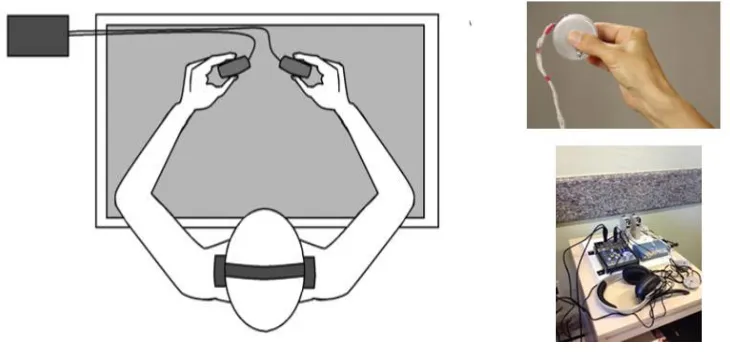
The experiment was conducted in a sound isolated chamber with dim light and no other sources of electromagnetic interference. Participants were seated in a comfortable armchair in front of a desk and were told to hold a grip force sensor (consisting of a metallic disc which characteristics are detailed below) with a precision tridigital neutral grip (thumb, index and the middle finger) in each hand.. Their forearms were resting on the desk covered with a foam mat for better comfort (Fig. 1). Participants were also wearing an elastic cap connected to 64 electrodes through which EEG was recorded. During the whole session, participants used headphones, through which they listened to the list of words.
3.5 Task
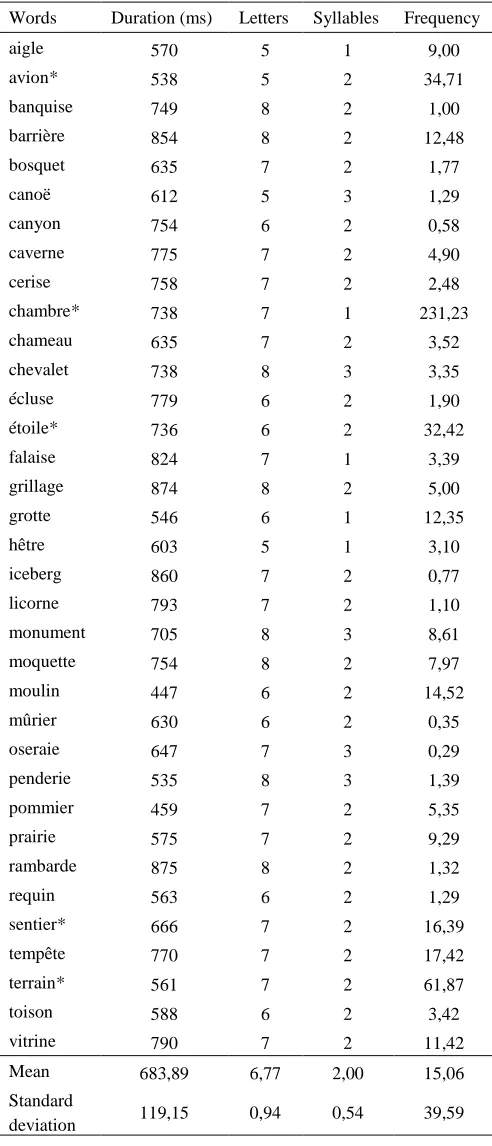
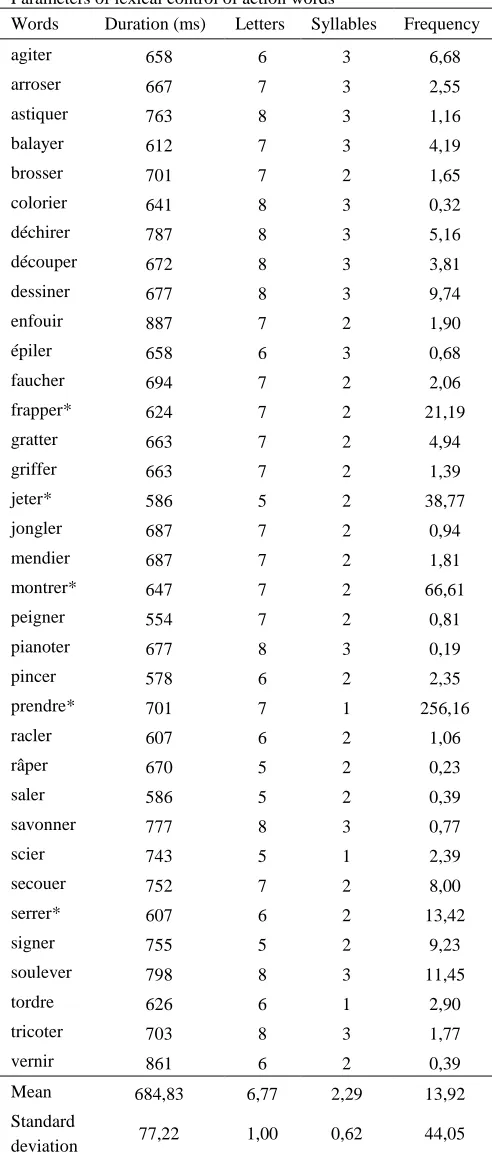
Using the 70 words described above, we built a stimuli sequence composed by 10 blocks of 40-42 words each (half non-action words, half action words) with the E-Prime 2.0.3 software. The participant sat in a chair and the researcher instructed him or her to count the number of times a target word would occur while performing the previously explained motor task (holding a grip force sensor in each hand). In each block, one target word was repeated 10-12 times. In-between the blocks, the subject could take a short break, during which he would set down the metallic discs and answer how many times he or she heard the occurrence of the target word. The target word was an action word in half of the blocks and a concrete non-action word in the other half. The overall session lasted between 30 and 40 minutes. The list of words can be consulted in the Appendix (Table 1).
3.6 EEG Recording
A Biosemi 64-electrode international reference cap was placed on the Ss’ heads according to head circumference and electrodes were connected to the cap using a column of Conductive Gel to fill the gap between the skin and the electrodes. Electrode signals were received by a Biosemi ActiveTwo amplifier at a sampling rate of 2048 Hz with a band pass of 0.01- 70 Hz. Impedance of all electrodes was kept below 5kOhms. Data collection was time-locked to time point zero at the onset of auditory stimulus
presentation.
3.7 EEG Data Analysis
function in EEGLab. (4) We rejected those channels with distributions of potential values that were further away from a Gaussian distribution, using the pre-set value of 5% (5) We interpolated said channels using the average of the neighbour electrodes. (6) We re-referenced to a virtual average
reference including all head electrodes but excluding the facial ones. (7) We divided the epochs into 2000 ms segments with individual epochs spanning from -500 to 1500 ms around time zero. (5) We performed a baseline correction based on the 200 ms preceding stimulus onset. To correct for potential artifacts, we rejected epochs using a voltage threshold of 50 μV. The percentage of rejected epochs varied between 4% and 18% among datasets.
We ran grand averages to obtain the waveforms elicited by four conditions: target non-action words, target action words, non-target non-action words and non-target action words. We plotted our ERPs from -200 to 1100 ms around time zero and obtained the distinct locations of the scalp in which statistically significant effects were found. This preliminary statistic analyses were conducted using the EEGLab software (parametric statistics, p<0.05, with FDR correction). After identifying our Regions of Interest and significant time windows (see below), we extracted the mean and maximal voltages to determine the amplitude (mean voltage) and peak (maximal voltage) of each component of interest. Amplitude
differences within Ss were assessed with student t distributions and repeated measures ANOVAs, using the IBM SPSS 23 Statistical Software. Cohen’s d were calculated to obtain effect sizes, using means, standard deviations and correlation between means. We also plotted scalp distributions for each condition in the time-windows of interest.
3.8 Grip-force data acquisition
Figure 1: Left: Position of the participant during the task. Left above: The grip force sensor. Left Below: The whole portable GFS data acquisition device. We can see the grip force sensors, the amplifiers Honeywell DV10L, the data acquisition card measurement computing usb-1608GX and the headphones.
3.9 Grip-force data processing and analysis
The data is transmitted in 1 kHz from the acquisition card to a portable computer, where it is pre-processed by the Dasylab 11.0 software. The software filters the data with the following filters: 15 Hz with fourth zero, low-pass butterworth filter and a notch filter of 50 Hz.
The grip force sensor data is processed through the following steps: 1) We choose the segment of data between 200 milliseconds before the beginning of the word to 800 milliseconds after the onset 2) The chosen data is normalized for every word’s baseline. The mean of the data between -200 ms and 0 is used as the baseline. 3) We apply rejection artefacts to isolate outline modulation, which can be generated by a hand movement. The data is rejected when it exceeds 200 milliNewtons (mN) or when a modulation of 100 mN within 100 ms is present, following the exclusion criteria of Nazir et al., 2017. If more than 30% of the data is rejected for a participant, the participant is rejected from the analysis. Following these criteria, one participant was rejected from our sample.
non-action word) for each window after the first one that showed a significant modulation compared to the baseline.
4. Results.
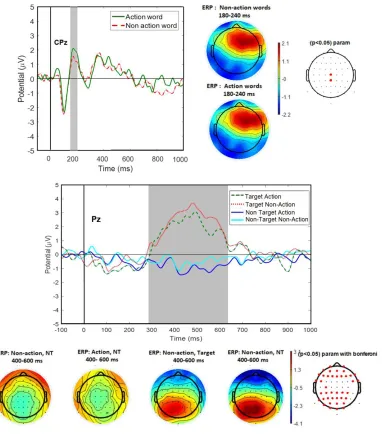
4.1 Central p200 effects: We plotted the waveforms for the 64 electrodes for our first exploration of possible significant differences between-conditions, within-subjects. We began by extracting the data from the midline electrodes Fz, Cz, CPz, Pz and Oz to determine our ERP time-windows and Regions of Interest (Figure 6). We observed a difference in amplitude between action and non-action words in the Cz , CPz and C3 electrodes for the window between 180 and 240 ms (the p200), for the target conditions. We observed bigger amplitudes for action words when compared to non-action words, which were significant in the CPz electrode (mean diff=0.6079892, t(8)=2.669, p=0.028, d=0.903). The effect in the left central electrode (C3) trended towards significance (mean diff= -0.41083, t(8)=2.138, p=0.065, d=0.861), while the amplitude difference observed in Cz electrode did not turn out significant (mean diff=0.3731,
t(8)=1.353, p=0.213, Cohen’s d=0.456). The action words vs non-action words effect was not significant for the non-target conditions. For this experiment, no lateralization effects were observed (see scalp-plots in Figure 2). The complete descriptive statistics for the amplitude in the examined electrodes, including means, standard deviations and Confidence Intervals can be found in Table 2.
4.2 Parietal p300 -target effects: We found a significant difference between target and non-target conditions in a cluster of parietal electrodes (P1, Pz, P2, CP1, CPz, Cp2, P3, P4), maximal at Pz. According to the results of paired t-tests comparisons, Target conditions elicited a significantly bigger positivity in the time-window between 400 and 600 ms, corresponding to the p3b component location and latency, significant for both action (mean diff=3.5822, t(8)=6.431, p<0.01, d=3.266) and non-action words (mean diff=3.3362, t(8)=6.413, p<0.01, d=2.754). This positivity did not differ significantly when comparing action words to non-action words (t(8)=2.022, p=0.078, d=0.6795). See Figure 2 for
waveforms and scalp plots.
Figure 2. Above: p200 effects for target words. We observed a bigger amplitude for action words than non-action words in Cz in the p200 window. Below: p3b target effect. Target words elicited significantly bigger amplitudes than non-target words in a cluster of parietal-electrodes, maximal at Pz.
In summary, our linguistic stimuli induced two main effects in our subjects: 1) the p200 “verbal signature” effect (Blaszczak, Csypionka Klimek-Jankowska, 2018), sensitive to differences between action words and non-action words when these were presented as a target, and 2) the p3b parietal effect that distinguished between target and non-target stimuli but was not sensitive to differences in word-class (action vs non-action). These results reproduced the findings of previous ERP studies with visual
4.3 Grip Force Sensor Results. After listening to an action-word, the grip force modulation of both hands began to be significantly superior to the baseline at250 ms, lasting until 800 ms
(right hand: mean=6.287, t(8)=3.544, p<0.01; left hand: mean=5.283, t(8)=2.646, p<0.05). When listening to a non-action word, the grip force became significantly superior to the baseline
with a later onset, from 350 ms until 800 ms (right hand: mean=6.570, t(8)=2.911, p<0.05; left hand: mean =8.814, t(8)=2.983, p<0.05). The complete descriptive statistics for the grip force
modulation for each hand, including means, standard deviations and Confidence Intervals can be
found in Table 4. For our between-condition analysis, we found a significant difference between
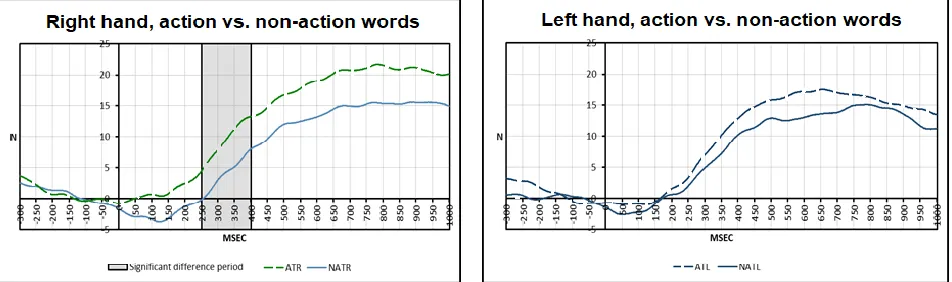
target action words and target non-action words at the window of 250 ms to 400ms (mean
diff=0.005441 t(8)=-2.634, p=0.030, d=-0.8779) for the right hand only: The grip force of the
right hand was stronger following an action word than following a non-action word (Figure 3).
The differences in grip force between conditions assessed by paired-samples t-tests amplitude in
each hand subdivided in windows of 50 ms can be found in Table 5.
Figure 3: Differences in the grip force comparing Action to Non-Action Words. The grey rectangle represents the time-window in which the differences between conditions were significantly different for the right hand. For the left hand, we did not observe significant differences.
4.4 Correlations between p200 and grip force effects. Once obtaining our electrophysiological correlates and changes in GFS, we ran a series of linear correlations between the force
amplitudes and the p200 amplitude in Cz, CPz, C3 and C4 in said time-windows. We used
Spearman correlation coefficients, considering the size of our sample (9 subjects) and the fact
normal distribution according to the Shapiro-Wilk normality test. We found significant
correlations between the p200 amplitude and the grip force modulation between 250 and 400 ms
for action words (in Cz and C3) and for non-action words (in C3 only). See Figure 4.
Figure 4: Scatterplots depicting the data distribution for each correlation. Above: Correlation between p200 in the CPz electrode and GFS elicited by Action-Words. Correlations were significant for action words for action words in both the right hand (rho=0.717, p < 0.030) and the left hand (rho=0.583, p< 0,099).
5 Discussion:
As stated in the introduction, a recent series of neuroimaging studies has found sensorimotor
activations related to word processing. However, as pointed out by Hauk in a recent review
article, they lack temporal precision, essential to understanding if those activations can be
classified as “semantic” (Hauk, 2016). Our study provides a new methodological approach
integrating two pieces of temporal evidence (ERPs and online grip-force measurement) that
support this idea, and it also explores the link between these two.
When analyzing the ERP elicited by our auditory stimuli, we observed the p200 effect already
described by other authors using isolated words as stimuli, that is, a bigger p200 positivity for
action-words when compared to non-action words (Kellenbach, Wijers, Hovius, Mulder, &
Mulder, 2002; Pulvermüller et al., 1999; Xia, Wang, & Peng, 2016; Zhang, Ding, Guo, & Wang,
2003). We also observed a classic, p3b target effect: a bigger p3b amplitude observed for the
target words (Polich, 2009). The P3b component is thought to be generated by parietal cortices,
and to be related to the process of voluntary stimulus evaluation (Wronka, Kaiser, & Coenen,
2012). We interpret the p3b effect as a confirmation of the allocation of attentional resources to
the presented stimuli, which is important because attention is known to increase processing
efficacy in mental imagery (Fazekas & Nanay, 2017).
An additional asset of this exploratory piece is the confirmation of the previously reported results
in terms of grip force enhancement between 250-400 ms after listening to action words for both
hands, but more importantly for the right (dominant) hand (Da Silva, Labrecque, Caromano,
Higgins, & Frak, 2018). An interesting and somehow controversial finding was that non-action
words also induced a modulation of the grip force that happened to be significant compared to
the baseline. While the grip force enhancement induced by action words was more prominent (in
terms of earlier onset, longer duration and bigger amplitude), it is nonetheless important to
acknowledge the augmentation of the grip force induced by non-action words. To interpret these
findings, we hypothesize two possible explanations. The first one falls within the view that all
words, regardless of word class, imply simulation and therefore a certain degree of activation of
the primary motor cortex (M1). This hypothesis is supported by recent results reported by Dreyer
& Pulvermüller (2018), who observed an involvement of motor areas in the processing of
meaning, can activate motor areas, then concrete nouns, referring to entities in the world with
which humans interact in motor ways (Greeno, 1994), can surely induce motor activations
related to the affordances of each one of these objects or entities. A second explanation is that the
force enhancement in the case of non-action words corresponds to an additional cognitive
process happening during the experiment. A recently published meta-analysis gathered the
evidence for the implication of M1 in different cognitive functions (Tomasino & Gremese,
2016). In our experiment, the working memory processes needed to accomplish the task (to keep
in mind the number of times a target word appears) could underlie the activation of M1 and the
augmentation in the grip force for the target non-action words (Da Silva et al., 2018).
In any case, that linguistic stimuli were able to induce involuntary motor activations strongly
speaks for embodied theories of word meaning. The p200 is recognized as a word-class neural
marker, sensitive to changes in semantic properties of words, and its time-course is also coherent
with evidence of the earliest onset of semantic retrieval. Theoretically, the source of this
component are the neurons in the premotor cortex (O Hauk, Johnsrude, & Pulvermüller, 2004;
Pulvermüller et al., 1999). Its temporal and statistical correlation with the Grip Force Sensor
measurements suggest that these two phenomena are intimately linked and may be interpreted as
part of the same process, corresponding to true semantic effects integrated in a motor continuum.
To our knowledge, this is the first time that the p200 verbal signature is replicated while subjects
perform and active motor expectation task (grasping two objects). We acknowledge that the
small number of subjects used is a limitation to interpret these differences in the p200 for action
and non-action words, and that additional studies with bigger n’s are necessary to confirm our
observations with bigger statistical power.
It is also the first time that electrophysiological correlates of word processing are correlated to a
peripheral measurement of motor activity -the existing literature has studied these two types of
measurements separately so far. Our results fit a temporal pattern of information flow,
considering the time between the primary motor cortex and the hand muscles is approximately
18-20 ms (Rossi, Pasqualetti, Tecchio, Pauri, & Rossini, 1998). The link between the p200 and
the grip force enhancement, suggested by the temporal onset of both measurements, is further
between 250-400 ms. Subsequent studies with larger samples are also needed to corroborate the
link between the electrophysiological correlates and the grip force modulation.
This study provides a first methodological basis to integrate these two measures within the same
theoretical framework. Based on previous studies of the time of linguistic processing (Mollo et
al., 2016; Sahin et al., 2009), we interpret the p200 elicited by hearing a word as an index of
early stages of semantic retrieval, including the imagery and sensorimotor properties of the
presented word. When it comes to action words, imagery is thought of as mental action
simulation (Jeannerod & Frak, 1999). Therefore, when comparing action to non-action words,
the bigger p200 amplitudes we observe may correspond to action simulation inducing stronger
activation of motor and premotor cortices (Pulvermüller et al., 1999). On this framework, the
subsequent onset of involuntary force augmentation in our experiment (happening 10 to 20 ms
after the end of the p200 window) could be explained by a failure to inhibit these motor areas
engaged in language-induced action simulation (M. Jeannerod, 1994). We sketch a potential
neuroanatomical source for this decreased inhibition: the intraparietal sulcus (IPS), an area
known to be implicated in both grasping control (Begliomini et al., 2014; Begliomini, Sartori, Di
Bono, Budisavljević, & Castiello, 2018) and motor imagery (Wheaton, Thompson, Syngeniotis,
Abbott, & Puce, 2004). When hearing a word, language induced activity in the posterior superior
temporal gyrus (Wernicke’s area) would send input to the IPS through the arcuate fasciculus.
The IPS, already engaged in the active grasping task, could then decrease inhibitory input on the
premotor cortex, which would in turn activate M1 and send excitatory signals to the hand
muscles through the pyramidal tract (Binder, Desai, Graves, & Conant, 2009).
5. Conclusions
In the light of our findings, a potential explanation for the bigger p200 (160-240 ms) observed
for action words is that it accounts for action simulation that complements semantic recognition
(indexed by bigger activations of neurons in the premotor cortex). If confirmed by subsequent
studies with larger samples, the temporal onset of the subsequent grip force enhancement
(250ms) and its correlation with the p200 amplitude provide further evidence to interpret this
motor phenomenon as part of a semantic process, more specifically, as the involuntary motor
groundwork are promising enough to consider the combination of Event Related Potentials and
the Grip Force sensor as a valid an enriching approach to study language induced motor activity,
generating valuable and interesting hypothesis considering a temporal pattern of information
flow.
6. Acknowledgements
We would like to thank the personnel at the Cognition and Communication Laboratory of
UQAM, for their collaboration in the EEG data acquisition and analysis; the principal
investigator in this laboratory, Stevan Harnad, for his commentaries on the theoretical framework
of this research; the CML (Cerveau,, Motricité, Langage) laboratory at UQAM for their support
during data processing and experimental setup.
A preliminary version of these results was recently presented in the Movementis
(Movement:Brain Body Cognition) conference, Harvard Medical School, July 2018, and
7. References
1. Aravena, P., Courson, M., Frak, V., Cheylus, A., Paulignan, Y., Deprez, V., & Nazir, T. A. (2014). Action relevance in linguistic context drives word-induced motor activity.
Frontiers in Human Neuroscience, 8(April), 1–12. https://doi.org/10.3389/fnhum.2014.00163
2. Aravena, P., Delevoye-Turrell, Y., Deprez, V., Cheylus, A., Paulignan, Y., Frak, V., & Nazir, T. (2012). Grip Force Reveals the Context Sensitivity of Language-Induced Motor Activity during “Action Words” Processing: Evidence from Sentential Negation. PLoS ONE, 7(12). https://doi.org/10.1371/journal.pone.0050287
3. Barsalou, L. W. (1999). Perceptual symbol systems. Behavioral and Brain Sciences, 22, 637–660.https://doi.org/10.1017/S0140525X99002149
4. Begliomini, C., De Sanctis, T., Marangon, M., Tarantino, V., Sartori, L., Miotto, D., … Castiello, U. (2014). An investigation of the neural circuits underlying reaching and reach-to-grasp movements: from planning to execution. Frontiers in Human
Neuroscience, 8. https://doi.org/10.3389/fnhum.2014.00676
5. Begliomini, C., Sartori, L., Di Bono, M. G., Budisavljević, S., & Castiello, U. (2018). The neural correlates of grasping in left-handers: When handedness does not matter.
Frontiers in Neuroscience, 12(APR). https://doi.org/10.3389/fnins.2018.00192 6. Binder, J. R., Desai, R. H., Graves, W. W., & Conant, L. L. (2009). Where is the
Semantic System? Cerebral Cortex, 19(12), 2767–2796.
7. Broca, P. (1861) Perte de la parole, ramollissement chronique et destruction partielle du lobe antérieur gauche du cerveau (Loss of speech, chronic softening and partial
destruction of the anterior left lobe of the brain). Bulletin de la Societe Anthropologique,2: 235–238
8. Da Silva, R. L., Labrecque, D., Caromano, F. A., Higgins, J., & Frak, V. (2018). Manual action verbs modulate the grip force of each hand in unimanual or symmetrical bimanual tasks. PLoS ONE, 13(2). https://doi.org/10.1371/journal.pone.0192320
9. Dreyer, F. R., & Pulvermüller, F. (2018). Abstract semantics in the motor system? – An event-related fMRI study on passive reading of semantic word categories carrying abstract emotional and mental meaning. Cortex, 100, 52–70.
https://doi.org/10.1016/j.cortex.2017.10.021
10.Fazekas, P., & Nanay, B. (2017). Pre-cueing effects: Attention or mental imagery?
Frontiers in Psychology. https://doi.org/10.3389/fpsyg.2017.00222
11.Fodor, J.A. (1987). Psychosemantics: The problem of meaning in the philosophy of mind. MIR Press, London, Cambridge, MA:
12.Frak, V., Nazir, T., Goyette, M., Cohen, H., & Jeannerod, M. (2010). Grip force is part of the semantic representation of manual action verbs. PLoS ONE, 5(3).
https://doi.org/10.1371/journal.pone.0009728
13.Geschwind, N. (1965b) Disconnexion syndromes in animals and man II. Brain, 88: 585– 644.
14.Glenberg, A. M., & Kaschak, M. P. (2002). Grounding language in action. Psychonomic Bulletin & Review,9, 558–565. https://doi.org/10.3758/BF03196313
https://doi.org/10.1037/0033-295X.101.2.336
16.Harnad, S. (1990). The symbol grounding problem. Physica D: Nonlinear Phenomena,
42(1–3), 335–346. https://doi.org/10.1016/0167-2789(90)90087-6
17.Hauk, O. (2016). Only time will tell – why temporal information is essential for our neuroscientific understanding of semantics. Psychonomic Bulletin and Review, 23(4), 1072–1079. https://doi.org/10.3758/s13423-015-0873-9
18.Hauk, O., Johnsrude, I., & Pulvermüller, F. (2004). Somatotopic representations of action words in human motor and premotor cortex. Neuron, 41, 301–307.
19.Hauk, O., Shtyrov, Y., & Pulvermüller, F. (2008). The time course of action and action-word comprehension in the human brain as revealed by neurophysiology. Journal of Physiology Paris, 102(1–3), 50–58. https://doi.org/10.1016/j.jphysparis.2008.03.013 20.Hebb, D. (1949). The organization of behavior. New York: Wiley.
https://doi.org/10.1002/1097-4679(195007)6:3<307::AID-JCLP2270060338>3.0.CO;2-K">3.0.CO;2-K
21.Jeannerod, M. (1994). The representing brain: Neural correlates of motor intention and imagery. Behavioral and Brain Sciences, 17(2), 187–202.
https://doi.org/10.1017/S0140525X00034026
22.Jeannerod, M., & Frak, V. (1999). Mental imaging of motor activity in humans. Current Opinion in Neurobiology. https://doi.org/10.1016/S0959-4388(99)00038-0
23.Kellenbach, M. L., Wijers, A. A., Hovius, M., Mulder, J., & Mulder, G. (2002). Neural Differentiation of Lexico-Syntactic Categories or Semantic Features? Event-Related Potential Evidence for Both. Journal of Cognitive Neuroscience, 14(4), 561–577. https://doi.org/10.1162/08989290260045819
26.Kintsch, W., & van Dijk, T. A. (1978). Toward a model of text comprehension and production.Psychological Review, 85, 363–394. https://doi.org/10.1037/0033-295X.85.5.363
27.Labrecque, D., Descheneaux, R. L., Ariza Gomes de Castros, A., & Frak, V. (2016). Portable Device Validation to Study the Relation between Motor Activity and Language : Verify the Embodiment Theory through Grip Force Modulation. International Journal of Engineering Research & Technology (IJERT), 5(12), 5–10.
https://doi.org/http://dx.doi.org/10.17577/IJERTV5IS120003
28.Liepmann H (1905) Die linke Hemisphare und das Handeln. Munch. Med Wschr 49: 2322–2326 and 2375–2378.
29.Mahon, B., & Hickok, G. (2016). Argments about the Nature of Concepts: Symbols, embodiment, and beyond. Psychonomic Bulletin & Review, 23(4), 941–958.
https://doi.org/10.1002/jmri.23741.Proton
30.Meteyard, L., Cuadrado, S. R., Bahrami, B., & Vigliocco, G. (2012). Coming of age: A review of embodiment and the neuroscience of semantics. Cortex, 48(7), 788–804. https://doi.org/10.1016/j.cortex.2010.11.002
31.Mollo, G., Pulvermüller, F., & Hauk, O. (2016). Movement priming of EEG/MEG brain responses for action-words characterizes the link between language and action. Cortex,
74, 262–276. https://doi.org/10.1016/j.cortex.2015.10.021
33.Newell, A. (1980). Physical Symbol Systems. Cognitive Science, 4 , 135-183.
34.Phylyshyn, Z.W. (1985) Computation and Cognition: Toward a Foundation for Cognitive Science (2nd ed), MIT Press, London, England.
35.Polich, J. (2009). Updating p300: An integrative theory of p3a and p3b. North, 118(10), 2128–2148. https://doi.org/10.1016/j.clinph.2007.04.019.Updating
36.Pulvermüller, F., Lutzenberger, W., & Preissl, H. (1999). Nouns and verbs in the intact brain: evidence from event-related potentials and high-frequency cortical responses.
Cerebral Cortex (New York, N.Y. : 1991), 9, 497–506. https://doi.org/10.1093/cercor/9.5.497
37.Rossi, S., Pasqualetti, P., Tecchio, F., Pauri, F., & Rossini, P. M. (1998). Corticospinal excitability modulation during mental simulation of wrist movements in human subjects.
Neuroscience Letters, 243(1–3), 147–151. https://doi.org/10.1016/S0304-3940(98)00088-3
38.Sahin, N. T., Pinker, S., Cash, S., Schomer, D., & Halgren, E. (2009). Sequential
Processing of Lexical, Grammatical, and Phonological Information Within Broca’s Area.
Science, 326(5951), 445–450.
39.Tomasino, B., & Gremese, M. (2016). The Cognitive Side of M1. Frontiers in Human Neuroscience, 10. https://doi.org/10.3389/fnhum.2016.00298
40.Wheaton, K. J., Thompson, J. C., Syngeniotis, A., Abbott, D. F., & Puce, A. (2004). Viewing the motion of human body parts activates different regions of premotor, temporal, and parietal cortex. NeuroImage, 22(1), 277–288.
https://doi.org/10.1016/j.neuroimage.2003.12.043
41.Wronka, E., Kaiser, J., & Coenen, A. M. L. (2012). Neural generators of the auditory evoked potential components P3a and P3b. Acta Neurobiologiae Experimentalis, 72(1), 51–64. https://doi.org/7205 [pii]
42.Xia, Q., Wang, L., & Peng, G. (2016). Nouns and verbs in Chinese are processed differently: Evidence from an ERP study on monosyllabic and disyllabic word processing. Journal of Neurolinguistics, 40, 66–78.
https://doi.org/10.1016/j.jneuroling.2016.06.002
46.Zwaan, R. A., & Madden, C. J. (2005). Embodied sentence comprehension. In D. Pecher & R. A. Zwaan(Eds.), Grounding cognition: The role of action and perception in
Table 1a
Parameters of lexical control of non-action words
Words Duration (ms) Letters Syllables Frequency
aigle 570 5 1 9,00
avion* 538 5 2 34,71
banquise 749 8 2 1,00
barrière 854 8 2 12,48
bosquet 635 7 2 1,77
canoë 612 5 3 1,29
canyon 754 6 2 0,58
caverne 775 7 2 4,90
cerise 758 7 2 2,48
chambre* 738 7 1 231,23
chameau 635 7 2 3,52
chevalet 738 8 3 3,35
écluse 779 6 2 1,90
étoile* 736 6 2 32,42
falaise 824 7 1 3,39
grillage 874 8 2 5,00
grotte 546 6 1 12,35
hêtre 603 5 1 3,10
iceberg 860 7 2 0,77
licorne 793 7 2 1,10
monument 705 8 3 8,61
moquette 754 8 2 7,97
moulin 447 6 2 14,52
mûrier 630 6 2 0,35
oseraie 647 7 3 0,29
penderie 535 8 3 1,39
pommier 459 7 2 5,35
prairie 575 7 2 9,29
rambarde 875 8 2 1,32
requin 563 6 2 1,29
sentier* 666 7 2 16,39
tempête 770 7 2 17,42
terrain* 561 7 2 61,87
toison 588 6 2 3,42
vitrine 790 7 2 11,42
Mean 683,89 6,77 2,00 15,06
Standard
deviation 119,15 0,94 0,54 39,59
Table 1b
Parameters of lexical control of action words
Words Duration (ms) Letters Syllables Frequency
agiter 658 6 3 6,68
arroser 667 7 3 2,55
astiquer 763 8 3 1,16
balayer 612 7 3 4,19
brosser 701 7 2 1,65
colorier 641 8 3 0,32
déchirer 787 8 3 5,16
découper 672 8 3 3,81
dessiner 677 8 3 9,74
enfouir 887 7 2 1,90
épiler 658 6 3 0,68
faucher 694 7 2 2,06
frapper* 624 7 2 21,19
gratter 663 7 2 4,94
griffer 663 7 2 1,39
jeter* 586 5 2 38,77
jongler 687 7 2 0,94
mendier 687 7 2 1,81
montrer* 647 7 2 66,61
peigner 554 7 2 0,81
pianoter 677 8 3 0,19
pincer 578 6 2 2,35
prendre* 701 7 1 256,16
racler 607 6 2 1,06
râper 670 5 2 0,23
saler 586 5 2 0,39
savonner 777 8 3 0,77
scier 743 5 1 2,39
secouer 752 7 2 8,00
serrer* 607 6 2 13,42
signer 755 5 2 9,23
soulever 798 8 3 11,45
tordre 626 6 1 2,90
tricoter 703 8 3 1,77
vernir 861 6 2 0,39
Mean 684,83 6,77 2,29 13,92
Standard
deviation 77,22 1,00 0,62 44,05
Table 2
Descriptive values of the amplitudes in the electrodes of interest in (Cz, CPz and C3 for p200, parietal cluster for p300)
Electrode Target Action Target Non-Action Non-Target Action Non-Target Non-Action
Mean SD CI Mean SD CI Mean SD CI Mean SD CI
Cz
(180-220
ms) 1.40344 1.65313 1.08002 1.02974 1.52325 0.99517 1.76503 1.05934 0.69209 1.88257 1.184
0.77417766 1
CPz
(180-220
ms) 0.66626 1.28459 0.86546 0.05827 1.16838 0.76534 0.73572 0.91944 0.43567 0.56491 0.86003 0.3456
C3
(180-220 ms)
1.10017 1.24402 0.59135 1.60358 1.10346 0.52454 1.94705 1.06451 0.50602 1.75168 1.0117 0.48094
Parietal
(400-600 ms)
2.49813 1.92707 0.91605 2.48185 2.14968 1.02187 -0.4759 1.12466 0.53461 -0.4415 0.8996 0.42768
Table 4
Description of the grip force data and difference between grip force and baseline
Condition Time window 100 150ms 150 200ms 200 250ms 250 300ms 300 350ms 350 400ms 400 450ms 450 500ms 500 550ms 550 600ms 600 650ms 650 700ms 700 750ms 750 800ms NATL
Mean -1,796 0,855 1,090 3,561 6,069 8,814 10,940 12,299 12,677 12,766 13,372 13,706 14,392 15,027
𝑆𝐷 3,958 4,664 5,995 7,073 8,044 8,864 10,197 11,060 11,940 12,462 13,021 13,144 14,370 15,786
CI 2,586 3,047 3,917 4,621 5,255 5,791 6,662 7,226 7,801 8,142 8,507 8,587 9,388 10,313
t(8)= -1,361 0,055 0,545 1,511 2,264 2,983* 3,218* 3,336* 3,185* 3,073* 3,081* 3,128* 3,005* 2,856*
d= 0,45 0,02 0,18 0,50 0,76 0,99 1,07 1,11 1,06 1,02 1,03 1,04 1,00 0,95
NATR
Mean -3,600 -2,153 -0,786 1,308 4,224 6,570 8,773 10,971 12,255 12,838 13,772 14,866 14,951 15,432
𝑆𝐷 3,705 4,720 5,468 5,436 6,038 6,772 8,811 9,351 11,483 12,161 11,467 11,395 11,363 11,285
CI 2,421 3,084 3,572 3,551 3,945 4,424 5,756 6,109 7,502 7,945 7,492 7,445 7,424 7,373
T(8)= -2,915* -1,369 -0,431 0,722 2,099 2,911* 2,987* 3,52** 3,202* 3,167* 3,603*
* 3,914* * 3,947* * 4,103* *
d= 0,97 0,46 0,14 0,24 0,70 0,97 1,00 1,17 1,07 1,06 1,20 1,31 1,32 1,37
ATL
Mean -0,874 0,556 2,322 5,283 8,667 11,641 13,940 15,351 16,008 16,917 17,219 17,272 16,753 16,441
𝑆𝐷 3,734 5,071 5,106 5,990 6,250 6,936 7,709 8,818 9,418 9,988 10,017 9,522 9,677 9,218
CI 2,440 3,313 3,336 3,913 4,083 4,531 5,036 5,761 6,153 6,525 6,544 6,221 6,322 6,022
T(8)= -0,702 0,329 1,364 2,646* 4,112*
* 5,035* * 5,425* ** 5,223* ** 5,099* ** 5,081* ** 5,157* ** 5,442* ** 5,193* ** 5,351* **
d= 0,23 0,11 0,46 0,88 1,37 1,68 1,81 1,74 1,70 1,69 1,72 1,81 1,73 1,78
ATR
Mean 0,564 1,790 3,246 6,287 9,594 12,543 13,803 15,915 17,168 18,545 19,502 20,681 20,844 21,526
𝑆𝐷 3,306 4,534 5,229 5,322 6,403 6,523 6,875 7,428 7,567 6,833 6,672 6,736 6,563 6,110
CI 2,160 2,962 3,416 3,477 4,183 4,262 4,492 4,853 4,944 4,464 4,359 4,401 4,288 3,992
T(8)= 0,512 1,184 1,862 3,544*
* 4,495* * 5,769* ** 6,023* ** 6,428* ** 6,806* ** 8,142* ** 8,768* ** 9,211* ** 9,528* ** 10,57* **
d= 0,17 0,40 0,62 1,18 1,50 1,92 2,01 2,14 2,27 2,71 2,92 3,07 3,18 3,52
Table 5
Difference between conditions (words, hands)
Comparison
Time window
250-300ms 300-350ms
350-400ms
400-450ms
450-500ms
500-550ms
550-600ms
600-650ms
650-700ms
700-750ms
750-800ms
ATR x ATL T(8)= 0,665 0,538 0,47 -0,065 0,235 0,459 0,662 0,821 1,224 1,38 1,647
d= 0,22 0,18 0,16 0,02 0,08 0,15 0,22 0,27 0,41 0,46 0,55
NATR x NATL
T(8)= N/A N/A -2,034 -1,712 -0,788 -0,214 0,028 0,147 0,419 0,182 0,107
d= N/A N/A 0,68 0,57 0,26 0,07 0,01 0,05 0,14 0,06 0,04
NATL x ATL T(8)= -0,7 -1,029 -1,203 -1,132 -1,187 -1,144 -1,325 -1,24 -1,084 -0,596 -0,306
d= 0,23 0,34 0,40 0,38 0,40 0,38 0,44 0,41 0,36 0,20 0,10
NATR x ATR T(8)= -2,386* -2,495* -2,932* -1,922 -1,832 -1,567 -1,892 -2,216 -1,939 -1,900 -1,798
d= 0,80 0,83 0,98 0,64 0,61 0,52 0,63 0,74 0,65 0,63 0,60