Nuclear physics insights for new-physics searches using nuclei:
Neutrinoless
ββ
decay and dark matter direct detection
Javier Menéndez1,a
1Department of Physics, The University of Tokyo, Hongo, Bunkyo-ku, Tokyo 113-0033, Japan
Abstract.Experiments using nuclei to probe new physics beyond the Standard Model, such as neutrinolessββdecay searches testing whether neutrinos are their own antiparti-cle, and direct detection experiments aiming to identify the nature of dark matter, require accurate nuclear physics input for optimizing their discovery potential and for a correct interpretation of their results. This demands a detailed knowledge of the nuclear struc-ture relevant for these processes. For instance, neutrinolessββdecay nuclear matrix ele-ments are very sensitive to the nuclear correlations in the initial and final nuclei, and the spin-dependent nuclear structure factors of dark matter scattering depend on the subtle distribution of the nuclear spin among all nucleons. In addition, nucleons are composite and strongly interacting, which implies that many-nucleon processes are necessary for a correct description of nuclei and their interactions. It is thus crucial that theoretical studies and experimental analyses considerβdecays and dark matter interactions with a coupling to two nucleons, called two-nucleon currents.
1 Introduction
Neutrinos and dark matter are two of the most promising candidates for new physics beyond the Stan-dard Model of particle physics. Because they are both charge neutral and massive, it is possible that neutrinos and antineutrinos would be the same particle, in which case neutrinos would be labeled as Majorana particles [1]. This property —very hard to test because neutrinos are so light— would imply the violation of lepton number, a relation which goes in both directions: the violation of lepton number would establish neutrinos to be Majorana particles. In turn, this may have important conse-quences for the understanding of the baryonic matter-antimatter asymmetry observed in the universe, as in most models the difference between baryon and lepton number is conserved.
Unveiling the origin of dark matter stands as one of the biggest challenges in physics. The exis-tence of dark matter has been certified by very different astrophysical observations —galactic rotation velocities, gravitational lensing, anysotropies of the cosmic microwave background— but the nature of dark matter is still unknown [2]. Observations have constrained some of its properties, such that it must be neutral to the electromagnetic interaction —to a very good approximation at least— that it should be cold or warm to allow for galaxy structure formation, and that it amounts to more than 80% of the mass content of the universe, and roughly a quarter of the energy content.
Ideally one would like to answer these questions on the nature of neutrinos and dark matter in the laboratory. Experimental programs searching for neutrinolessββdecay —the lepton number vio-lating process most likely to be observed— and the direct detection of dark matter are being pursued vigorously, and impressive advances are permanently being reported, with present experimental sensi-tivities reaching half-lives longer thanT10/νββ2 =1026years [3] for neutrinolessββdecay, and excluding scattering cross-sections offnuclei smaller thanσχN = 10−40 cm2 [4] for searches of dark matter. Further improvements are expected in the near future, as next generation experiments are planned to use over a tonne of source or target material with increasingly reduced backgrounds.
Neutrinolessββdecay and dark matter direct detection experiments have in common that they are looking for the decay and the scattering offatomic nuclei, respectively. Therefore, the design —for example, the choice of source or target material— and the interpretation of the experimental results in principle depends on the nuclear physics of the process at study. In the case of neutrinoless
ββdecay, the value of the nuclear matrix element driving the transition relies on the accurate nuclear structure description of the initial and final nuclei, and on the weak-interaction diagrams considered at the nucleon level [5]. In the case of dark matter detection, a correct interpretation of the experimental results taking into account all relevant nuclear structure factors depends on considering all possible interactions of nuclei with dark matter particles. In particular,βdecays and dark matter interactions with a coupling to two nucleons, in addition to the leading contributions which only involve a single nucleon, can be significant.
2 Neutrinoless
ββ
decay
2.1 ββdecay: two-neutrino and neutrinoless cases
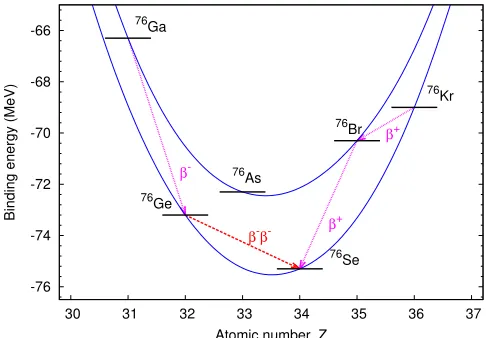
The existence ofββdecay is a consequence of the nuclear pairing interaction, which makes nuclei with an even number of protons, or an even number of neutrons, more bound than nuclei with one or two —a proton and a neutron— unpaired nucleons. As a result, in some cases it is energetically favorable for a nucleus to decay along a given isobaric chain —set of nuclei with the same number of nucleons— via a second-orderββdecay, instead of the usual single-βdecay channel. For the case of
76Ge the decay scheme is shown in figure 1.ββdecay with the emission of two antineutrinos besides
two electrons, a lepton-conserving process permitted by the weak interaction, has been observed in
-76 -74 -72 -70 -68 -66
30 31 32 33 34 35 36 37
Binding energy (MeV)
Atomic number, Z
76
Se
76
Ge
76As
76
Br
76
Kr
76
Ga
β
-β+
β+
β-β
-Figure 1.Nuclear binding energies and decay scheme of the nucleon numberA=76 isobars, as a function of the atomic numberZ. In a typical situation, isotopes decay to the lowest-energy nucleus via singleβ−
or
β+decays. For the special case of 76Ge, however, single-βdecay is
a dozen of cases, favored by a larger energy difference between the initial and final nuclei. The measured half-lives are of the order ofT12/νββ2 ∼1019−1021years [6].
Neutrinolessββdecay does not involve the emission of neutrinos, and it therefore violates lepton number. It demands neutrinos to be Majorana particles. The neutrinoless case is at least five or six orders of magnitude slower than the two-neutrinoββdecay permitted by the Standard Model. In the standard scenario where the decay is mediated by the exchange of the three known light neutrinos this is because the decay rate is proportional to the neutrinos masses, which are tiny compared to those of any other lepton. In other scenarios involving new physics, the reason is the large mass of the exchange particles, or the small coupling of the new physics with the Standard Model sector. In the standard case the neutrinolessββdecay half-life can be written as [1]
h
T10/νββ2 i−1=G0νββ M
0νββ
2
m2ββ, (1)
which naturally includes a phase space factorG0νββ that takes into account the kinematics, a nu-clear matrix elementM0νββ that contains the relevant nuclear physics of the decay, and a third part mββ =PkmkUek2 that encodes the new-physics scale —the neutrino massesmk— and also includes
the mixing of electron neutrinos with other flavors,Uek. The nuclear matrix element can be
decom-posed according to the spin structure of the operator [1]:
M0νββ=MGT−gV
gA
MF +MT, (2)
where the dominant term is the so-called Gamow-Teller component,MGT.
2.2 Nuclear matrix elements: nuclear structure
Neutrinolessββdecay nuclear matrix elementsM0νββhave to be obtained by nuclear structure
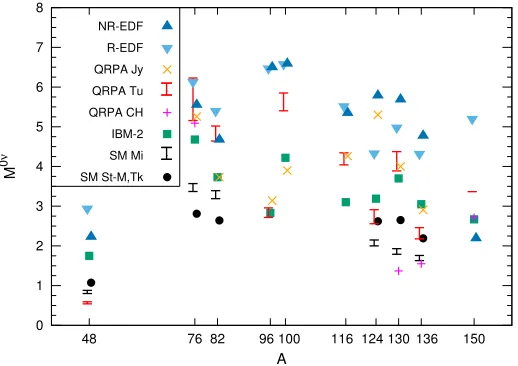
calcula-tions evaluating the transition operator between the initial and final nuclear states. The present status of these calculations is illustrated in figure 2. Unfortunately different nuclear structure approaches disagree in their predicted matrix elements for everyββdecay candidate by up to a factor three. This is a clear evidence that the unavoidable approximations present in solving the nuclear many-body problem are not under control when studying neutrinolessββdecay [5]. In contrast, it should be noted that the same different many-body methods in general agree when studying other nuclear structure properties such as excitation spectra or electromagnetic transitions.
It is thus critical to clarify the actual value of neutrinolessββdecay nuclear matrix elements. A first avenue for doing so is to test the calculations by finding correlations of matrix elements with other measured quantities. Despite efforts in this direction [18], no single observable has been found to be especially correlated to neutrinolessββdecay. A promising process is two-neutrinoββdecay, which shares with the neutrinoless case the initial and final states and for which there is experimental data. It must be taken into account, however, that the relevant momentum transfers are very different in the two-neutrino and neutrinoless decays,q ∼ 1 MeV for the former andq ∼ 100 MeV for the latter. Unfortunately most many-body approaches cannot predict two-neutrinoββdecay, because an accurate calculation involves dealing with the intermediate odd-proton–odd-neutron system —for in-stance, the nucleus76Sb in figure 1— and this is a more involved nuclear structure calculation than
the one needed for even-even nuclei. Other approaches like quasiparticle random phase approxima-tion method use the two-neutrinoββdecay half-life to fix a free parameter in their model and are not predictive for this decay. The only remaining many-body approach is the shell model, which actually predicted the two-neutrinoββdecay rate of48Ca [19] in good agreement with the subsequent
0 1 2 3 4 5 6 7 8
48 76 82 96 100 116 124 130 136 150
M
0
ν
A SM St-M,Tk
SM Mi IBM-2 QRPA CH QRPA Tu QRPA Jy R-EDF NR-EDF
Figure 2.Nuclear matrix elementsM0νββfor neutrinolessββdecay candidates, shown as a function of the nucleon numberA, calculated with different nuclear structure methods. Blue symbols indicate energy density functional (EDF) calculations, nonrelativistic [7] (triangles) and relativistic [8, 9] (down triangles). Orange crosses, red bars and magenta plus signs stand for quasiparticle random phase approximation (QRPA) results obtained by the Jyväskylä [10], Tübingen [11, 12] and Chapel Hill [13] groups, respectively. Green squares show interacting boson model (IBM) values [14]. Finally, black bars and circles represent the shell model (SM) results obtained by the Michigan [15] and Strasbourg-Madrid [16] groups, respectively, except for the48Ca black circle which shows the recent shell model calculation by the Tokyo group [17].
recent measurement [21], which would bring the shell model prediction into an overestimation of the corresponding matrix element. The description of the two-neutrinoββdecay rate of136Xe within the
shell model is also under discussion [22, 23].
In recent years an effort has been made to understand the origin of the differences between many-body approaches by comparing the systematic calculations of matrix elements, even if the associated
ββdecays make little or no sense experimentally. For instance a comparison between shell model and energy density functional matrix elements which in general disagree the most between different methods, as shown in figure 2, but restricting the calculations to uncorrelated states —fully composed of proton-proton and neutron-neutron angular momentumJ=0 pairs in the shell model, and limited to spherical states in the energy density functional calculation— showed that the uncorrelated nuclear matrix element disagreement was limited to 30% or less [25]. This is illustrated by figure 3 and is a very significant improvement over the factor three disagreement in figure 2. The matrix element values are fixed by the strength of the —neutron-neutron and proton-proton— pairing interaction.
0 1 2 3 4 5
22 24 26 28 30 32 34 36
M
GT
Nmother
Ca-->Ti (EDF Gogny) Ca-->Ti (ISM KB3G) Ca-->Ti (ISM GXPF1A)
Figure 3.Gamow-Teller component of the neutrinolessββ decay matrix element,MGT, for
the decay of calcium into titanium isotopes, as a function of the neutron number of the calciums
Nmother[25]. Results from an energy density functional calculation (blue) are compared to shell model results obtained with two different effective interactions (black and red).
be a reason for the discrepancies shown in figure 2. Dedicated studies incorporating these correlations in the corresponding nuclear matrix element calculations are needed.
Another cause of missing correlations is the limitation of the configuration space, this is, the single-particle orbitals that nucleons are permitted to occupy. For instance, the shell model and the in-teracting boson model only solve explicitly the nuclear many-body problem in a limited configuration space around the Fermi surface, and include the effect of the remaining configurations approximately. In order to quantify the effect of the missing correlations, a many-body perturbation theory estimate found relatively moderate increases of less than 50% for the lightestββdecay emitters48Ca,76Ge and 82Se, for which the estimation is easier [27, 28].
A more rigorous estimation is the recent computation of the ββ decay of 48Ca extending the shell model configuration space from one to two major harmonic oscillator shells —limited to 2~ω excitations— reducing the core of the shell model calculation from40Ca to16O. By doing so, many
previously excluded configurations were permitted, and the dimension of the problem increases from less than 106to over 109. The impact on the nuclear matrix element is, however, moderate, with a 30%
enhancement due to previously-missing cross-shell pairing correlations [17]. Interestingly, a cancel-lation occurs between the general enhancement produced by additional pairing correcancel-lations and the contribution of particle-hole excitations. A similar cancellation is expected to be at play for otherββ decay candidates as well. Nevertheless, explicit calculations are needed. Shell model calculations in extended configuration spaces can benefit from using the Monte Carlo shell model technique, which recently has studied configuration spaces with dimension over 1023[29].
Figure 4.Leading long-range two-body currents contributing to neutrinolessββdecay [32–34] and dark matter scattering offnuclei [35–38]. Solid and dashed lines indicate nucleons (N) and pions (π), respectively, and wavy lines stand for the external source, in this work weak and dark matter interactions that can be approximated as contact couplings. Diagrams a) and b) stand for one-pion exchange and one-pion exchange pion-pole couplings appearing in the leading axial two-body current. Diagram c) represents the pion-in-flight coupling in the leading vector and scalar two-body currents. All three diagrams enter in both processes.
2.3 Two-body currents
The nuclear matrix discussed so far are based on the standard one-body operator: each weak inter-action vertex involves only one nucleon. However, because nucleons are composite particles that strongly interact to each other, the single-βdecay hadronic current takes the general form [31]
J=X
i=1
Ji,1b+
X
i<j
Ji j,2b+· · · (3)
Diagrams involving two nucleons, represented in figure 4, are a correction to the leading one-body terms. Two-body corrections have been intensively explored in nuclei lighter than those undergoingββ decay, where they have been found to be relevant for electromagnetic [39] and weak [40] transitions. Two-body weak currents have been mostly studied in the context of small momentum transfers, such as single-βdecay. Since calculations are quite demanding, most works have been limited to relatively light nuclei, up to about oxygen, or relatively rough approximations, such as the normal-ordering of the two-body currents with respect to an isospin-symmetric Fermi gas. These studies indicate that two-body currents tend to cancel the contribution of the leading one-body operator, which means that they are a contribution to the so-called "gA quenching". The "gA quenching" stands for
the empirical fact that nuclear many-body calculations need to reduce the strength of the spin-isospin operator in order to agree with the experimental half-lives of Gamow-Tellerβtransitions. However, the size of the two-body contributions is unclear, with results ranging for less than 10% for carbon and oxygen isotopes [41], to about 30% in larger systems but with a more rough normal ordering [32]. Especially important are the uncertainties in the short-range two-body currents —not shown in figure 4. The "gAquenching" should be carefully studied in lighter systems where dedicated ab initio
calculations with different approaches are feasible.
In contrast to single-βdecay, where the relevant momentum transfer isq∼1 MeV, in neutrinoless
3 Dark matter scattering off nuclei
3.1 Dark matter-nucleon interactions and scattering cross-section
Direct detection dark matter searches are motivated by weakly interacting massive particles (WIMPs), promising dark matter constituents that are predicted to naturally account for the observed dark matter density. The expected WIMP masses areMχ ∼1−1000 GeV, the mass scale of nuclei. Therefore experiments sensitive to these dark matter masses use nuclei as target. Similarly lighter massesMχ∼ 1 MeV are probed via the scattering of dark matter offelectrons [2].
WIMPs can interact with nuclei in many ways. However, commonly the interactions suppressed by the small WIMP velocities —v/c∼ 10−3— or the momentum transfer of the scattering —much
smaller than Mχ and the nucleon mass— are not considered. This leads to two possibilities [43]: the direct coupling of the dark matter and nuclear densities, called spin-independent scattering, and the coupling of the dark matter and nuclear spins, referred to as spin-dependent scattering. Spin-independent scattering is favored from the nuclear physics side because it iscoherent: at vanishing momentum transfer it receives contributions from all nucleons in the nucleus. In contrast, in spin-dependent responses, on average only the spin of one nucleon contributes, because the spins of two nucleons tend to couple to a spin-zero pair due to the pairing interaction. Other things being equal, coherent scattering is expected to be enhanced by a factorA2with respect to the spin-dependent case. A more complete description of the possible WIMP interactions with nuclei has been worked out in a nonrelativistic effective field theory (EFT) [44, 45]. By constructing all possible interactions that can be built from the WIMP and nucleon spins, the momentum transfer and the WIMPs relative veloc-ity, a set of independent operatorsOiis derived at the nucleon level. At the nuclear level, however, not
all operatorsOileave distinct signatures, because there are only six independent nuclear responses, which may interfere between them. In addition, the interactions of dark matter with two nucleons need to be considered [35–37], see figure 4. Two-body currents can contribute significantly to dark matter scattering, both for a coherent response, and for spin-dependent interactions.
In general, the WIMP-nucleus cross-section can be written as [38]
dσχN dq2 ∝
X
i
ciζiFi
2 +
X
i
ˆ ciζˆiFˆi
2
+· · · (4)
Hereζ,ζˆare kinematic factors,c,cˆencode the hadronic physics and particle physics —for instance the Wilson coefficients coupling WIMPs with quarks and gluons— andF,Fˆ represent the nuclear physics: its square gives the nuclear structure factors. As shown in Eq. (4), contributions may interfere or not. In particular, the usual spin-independent and spin-dependent terms do not interfere.
3.2 Coherent (spin-independent) scattering
Spin-independent —coherent— scattering can be generalized by considering all one-nucleon opera-tors proposed by the nonrelativistic EFT. The most relevant terms are characterized by an enhancement of the cross-section, driven by the nuclear physics, and reflected in the structure factorsF2,Fˆ2.
In the nonrelativistic EFT there are two nuclear responses which can be coherent [44, 45]. First, the standard spin-independent response, denoted asM, corresponding to the operatorO1 and other
subleading operators. Second, the nuclear response associated with the operatorO3, denoted byΦ00,
0 0.02 0.04 0.06 0.08 0.1 1
100 10000
|
q
|
[GeV]
st
ru
ct
u
re
fa
ct
or
s
132
Xe
|FM
+|2 [O1]
q2/m2
N|F+MFΦ
′′
+| [O1–O3]
2|FM
+Fπ| [O1–2bscalar]
2|FM
+Fπθ| [O1–2b θ]
|Fπ|2 [2bscalar]
|Fθ
π|2 [2b θ]
2q2/m2
N|F+M|2 [O1radius]
2|FM
+FM−| [O1IS–IV]
|FM
−|2 [O1IV]
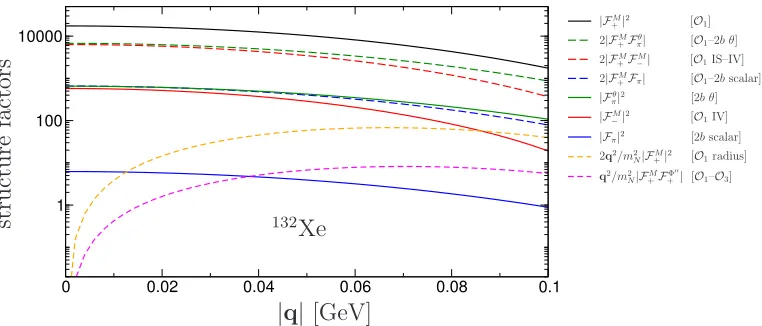
Figure 5.Structure factors associated with different WIMP interactions with132Xe, as a function of the momen-tum transferq[38]. The solid (red) black and line shows the isoscalar (isovector)O1contributions. The green and blue solid lines denote the two-body current contributions with scalar andθ-term couplings, respectively, while the dashed lines with the same colors stand for their interference with the isoscalarO1term. Orange (magenta) dashed lines denote the interference of the one-nucleon radius corrections (O3operator) with theO1term.
antiparallel-spin states empty and preventing a complete cancellation. Since this coherent term is spin dependent, the standard terminology must be generalized: it is more appropriate to speak of coherent scattering instead of spin-independent scattering.
Besides the nuclear structure aspects —coherence— the hadronic physics is also crucial to set the hierarchy among different terms. Chiral EFT [46, 47], an effective theory of the underlying interaction that binds nucleons, quantum chromodynamics (QCD), is valid at the energy and momentum scales of WIMP scattering and incorporates the physics of the chiral symmetry of QCD. Chiral EFT also describes consistently the interactions with external probes [39]. By formulating the WIMP-nucleon interactions in the chiral EFT framework, including scalar, pseudoscalar, vector and axial contribu-tions in the WIMP and hadronic sectors, the leading operators are predicted and can be matched into the nonrelativistic EFT basis [33]. In addition, chiral EFT predicts the consistent interactions of WIMPs with two nucleons —two-body currents. The relative importance of the different contri-butions can be studied by calculating the corresponding structure factors for the one- and two-body operators, assuming similar contributions from the particle physics Wilson coefficients.
Figure 5 shows the structure factors for the most important one- and two-nucleon contributions to the coherent WIMP scattering off132Xe. This is the most abundant isotope in xenon, the target
used in experiments giving the present best limits on WIMP-nucleus scattering. Solid lines in figure 5 represent the most important individual contributions, which are the isoscalarO1 term —routinely
used in experimental analyses— its isovector counterpart —with opposite coupling to protons and neutrons, usually included to account for apparently conflicting results in experiments using different isotopes— and two different couplings of the WIMP to two nucleons: through a scalar coupling, and through a coupling to the trace anomaly of the energy-momentum tensor —θterm. As a result, the following extension of the cross-section for spin-independent scattering is proposed [38]
dσSI
χN dq2 =
1 4πv2
c
M
+F+M(q2)+cM−F
M
− (q
2)+
cπFπ(q2)+cθπFπθ(q2)
2
with eachccoefficient sensitive to a different corner of the parameter space of new-physics models. The dashed lines of figure 5 take into account the interferences with the dominant term. When these are included, two additional contributions appear: radius, or momentum-dependent, corrections to the leading operator —that nevertheless probe a different combination of new-physics parameters— and the partially coherent operatorO3, which turns out to give the leading correction among all the
one-nucleon operators proposed in the nonrelativistic EFT. A further generalization of the coherent cross-section is therefore suggested [38]:
dσSIχN
dq2 =
1 4πv2
c+M− q
2
m2
N
˙
cM+F+M(q2)+cπFπ(q2)+cθπFπθ(q2)
+ cM− − q
2
m2
N
˙
cM−F−M(q2)+ q
2
2m2
N
h
cΦ+00F+Φ00(q2)+cΦ−00F−Φ00(q2)i 2 . (6)
Note that not all terms are independent, as for instance for a Majorana (Dirac) spin 1/2 WIMP there are only 4 (7) independent Wilson coefficients, so that a correlated analysis of several experi-ments would be required. A more practical analysis with data from a single experiment and taking limits on one operator at a time —for instance on Eq. (5)— should take this carefully into account.
3.3 Spin-dependent and inelastic scattering
Coherent —spin-independent— scattering is not very sensitive to the detailed nuclear structure of the target nuclei. This is because at vanishing momentum-transfer, the structure factor of the leading term isFM
+ =A2, simply counting the number of nucleons. The momentum-transfer dependence is given
by the nuclear density [48]. In contrast, a careful nuclear structure calculation is needed for spin-dependent scattering, which is very sensitive to the nuclear spin distribution among all nucleons [49]. Only odd-Anuclei are sensitive to spin-dependent interactions: stable even-Anuclei have spin zero due to nuclear pairing. Therefore, for a given nucleus this interaction is mostly sensitive to the nucleon species with an odd number of components, either protons or neutrons. For odd-Axenon isotopes
129Xe and131Xe, with atomic numberZ = 54, neutrons carry most of the spin and the so-called
"structure factor for neutrons" is orders of magnitude larger than the "structure factor for protons". This separation is actually not general as it simply refers to different combinations of isoscalar —same for neutrons and protons— or isovector —opposite— couplings. When considering only one-nucleon operators, however, the separation is valid at vanishing momentum transfer [43]:
F1bSD(q=0)∝
(a0+a1)hSpi+(a0−a1)hSni
2
, (7)
witha0/1the isoscalar/isovector couplings andhSp/nithe proton/nucleon spin expectation values.
Two-body currents prevent the validity of the separation. As illustrated in figure 4, two-nucleon interactions do not distinguish between neutrons and protons, and therefore it is not possible to disen-tangle proton and neutron contributions. The structure factor can be generalized as [37]
F1bSD+2b(q=0)∝
(a0+a1[1+δ])hSpi+(a0−a1[1+δ])hSni
2
, (8)
whereδ∼ −0.2 [49] encodes the two-nucleon contributions and can be calculated with chiral EFT. As a result, with two-body currents, the so-called "structure factor for protons" —defined bya0=−a1in
Eq. (8)— is also sensitive to neutrons, and increases by over an order of magnitude with respect to the one-nucleon case because for xenon isotopeshSni hSni. This has important practical consequences,
neutrons— competitive in "proton cross-sections" with searches using target nuclei with odd number of protons —thus more sensitive to protons— such as fluorine [50].
Once dark matter has been detected, it is left to address the nature of the dark matter-nucleus interaction. Spin-dependent scattering can be useful in this respect, because it could be observed in the elastic and inelastic channels. The experimental inelastic signature is distinct from the elastic one —the nucleusγdecays to the ground state— and can be realized if the target nuclei has low-lying excited nuclear states, such as the 40 keV and 80 keV first excited states in129Xe and131Xe [51, 52]. For coherent scattering, the inelastic channel is always suppressed by a factorA2with respect to the elastic channel [48], making it presently undetectable in practice. Therefore, the observation of an inelastic signal would clearly point out to a spin-dependent interaction.
4 Summary
The most impressive experimental efforts are being made to unveil the nature of neutrinos and dark matter in low-energy experiments using nuclei as a source or target. To make the most of these searches, comparable theoretical efforts are needed to understand the nuclear physics driving these processes. Neutrinolessββdecay nuclear matrix element calculations differ, but the most sensitive nuclear structure correlations for the decay have been identified, and calculations in larger configu-ration spaces are underway. The effect of the weak interaction involving two nucleons can also be significant, and explain part of the so-called "gAquenching". Ab initio calculations in lighter systems
can be performed to fully understand this "quenching". Analyses of dark matter searches should con-sider all possible interactions of WIMPs with nuclei. In particular, the coupling to two nucleons can have significant impact in both coherent and spin-dependent scattering. The observation of inelastic scattering is a promising way to determine the nature of the dark matter interaction with nuclei.
Acknowledgements
I would like to thank my collaborators J. Engel, D. Gazit, N. Hinohara, M. Hoferichter, Y. Iwata, P. Klos, G. Martínez-Pinedo, T. Otsuka, A. Poves, T. R. Rodríguez, N. Shimizu, A. Schwenk, Y. Utsuno and L. Vietze for very enlightening discussions and for making use of our common work for these proceedings. This work has been supported by an International Research Fellowship the Japan Society for the Promotion of Science (JSPS) and JSPS Grant-in-Aid for Scientific Research No. 26·04323.
References
[1] F. T. Avignone III, S. R. Elliott, and J. Engel, Rev. Mod. Phys.80, 481 (2008) [2] L. Baudis, J. Phys. G43, 044001 (2016)
[3] A. Gandoet al.[KamLAND-Zen Collaboration], Phys. Rev. Lett.117, 082503 (2016) [4] D. S. Akeribet al.[LUX Collaboration], Phys. Rev. Lett.116, 161301 (2016)
[5] J. Engel and J. Menéndez, arXiv:1610.06548 [6] A. Barabash, Nucl. Phys. A935, 52 (2015)
[7] N. López Vaquero, T. R. Rodríguez and J. L. Egido, Phys. Rev. Lett.111, 142501 (2013) [8] J. M. Yao, L. S. Song, K. Hagino, P. Ring and J. Meng, Phys. Rev. C91, 024316 (2015) [9] J. M. Yao and J. Engel, Phys. Rev. C94, 014306 (2016)
[10] J. Hyvärinen and J. Suhonen, Phys. Rev. C91, 024613 (2015)
[12] D. L. Fang, A. Faessler and F. Šimkovic, Phys. Rev. C92, 044301 (2015) [13] M. T. Mustonen and J. Engel, Phys. Rev. C87, 064302 (2013)
[14] J. Barea, J. Kotila and F. Iachello, Phys. Rev. C91, 034304 (2015) [15] M. Horoi and A. Neacsu, Phys. Rev. C93024308 (2016)
[16] J. Menéndez, A. Poves, E. Caurier and F. Nowacki, Nucl. Phys. A818, 139 (2009)
[17] Y. Iwata, N. Shimizu, T. Otsuka, Y. Utsuno, J. Menéndez, M. Honma and T. Abe, Phys. Rev. Lett.116, 112502 (2016)
[18] S. J. Freeman, and J. P. Schiffer, J. Phys. G: Nucl. Part. Phys.39, 124004 (2012) [19] E. Caurier, A. P. Zuker, and A. Poves, Phys. Lett. B252, 13 (1990)
[20] A. Balyshet al., Phys. Rev. Lett.77, 5186 (1996)
[21] R. Arnoldet al.[NEMO-3 Collaboration], Phys. Rev. D93, 112008 (2016) [22] E. Caurier, F. Nowacki, and A. Poves, Phys. Lett. B71162 (2012)
[23] M. Horoi and B.A. Brown, Phys. Rev. Lett.110222502 (2013) [24] P. Vogel and M. R. Zirnbauer, Phys. Rev. Lett.57, 3148 (1986)
[25] J. Menéndez, T. R. Rodríguez, G. Martínez-Pinedo and A. Poves, Phys.Rev. C90, 024311 (2014) [26] J. Menéndez, N. Hinohara, J. Engel, G. Martínez-Pinedo and T. R. Rodríguez, Phys. Rev. C93,
014305 (2016)
[27] J. D. Holt and J. Engel, Phys. Rev. C87, 064315 (2013) [28] A. A. Kwiatkowskiet al., Phys. Rev. C89, 045502 (2014)
[29] T. Togashi, Y. Tsunoda, T. Otsuka and N. Shimizu, Phys. Rev. Lett.117172502 (2016) [30] K. Hebeler, J. D. Holt, J. Menendez and A. Schwenk, Ann. Rev. Nucl. Part. Sci.65, 457 (2015) [31] T. S. Parket al., Phys. Rev. C67, 055206 (2003)
[32] J. Menéndez, D. Gazit, and A. Schwenk, Phys. Rev. Lett.107, 062501 (2011) [33] M. Hoferichter, P. Klos and A. Schwenk, Phys. Lett. B746, 410 (2015) [34] J. Menéndez, arXiv:1605.05059
[35] G. Prézeau, A. Kurylov, M. Kamionkowski and P. Vogel, Phys. Rev. Lett.91, 231301 (2003) [36] V. Cirigliano, M. L. Graesser and G. Ovanesyan, JHEP1210, 025 (2012)
[37] J. Menéndez, D. Gazit and A. Schwenk, Phys. Rev. D86, 103511 (2012)
[38] M. Hoferichter, P. Klos, J. Menéndez and A. Schwenk, Phys. Rev. D94, 063505 (2016) [39] S. Bacca and S. Pastore, J. Phys. G41, 123002 (2014)
[40] D. Gazit, S. Quaglioni, and P. Navrátil, Phys. Rev. Lett.103, 102502 (2009) [41] A. Ekströmet al., Phys. Rev. Lett.113, 262504 (2014)
[42] J. Engel, F. Šimkovic and P. Vogel, Phys. Rev. C89, 064308 (2014) [43] J. Engel, S. Pittel and P. Vogel, Int. J. Mod. Phys. E1, 1 (1992)
[44] A. L. Fitzpatrick, W. Haxton, E. Katz, N. Lubbers and Y. Xu, JCAP1302, 004 (2013) [45] N. Anand, A. L. Fitzpatrick and W. C. Haxton, Phys. Rev. C89, 065501 (2014) [46] E. Epelbaum, H. W. Hammer and U.-G. Meißner, Rev. Mod. Phys.81, 1773 (2009) [47] R. Machleidt and D. R. Entem, Phys. Rept.503, 1 (2011)
[48] L. Vietze, P. Klos, J. Menéndez, W. C. Haxton and A. Schwenk, Phys. Rev. D91, 043520 (2015) [49] P. Klos, J. Menéndez, D. Gazit and A. Schwenk, Phys. Rev. D88, 083516 (2013)
[50] D. S. Akeribet al.[LUX Collaboration], Phys. Rev. Lett.116, 161302 (2016)
[51] L. Baudis, G. Kessler, P. Klos, R. F. Lang, J. Menéndez, S. Reichard and A. Schwenk, Phys. Rev. D88, 115014 (2013)

![Figure 4. Leading long-range two-body currents contributing to neutrinoless ββ decay [32–34] and dark matterscattering off nuclei [35–38]](https://thumb-us.123doks.com/thumbv2/123dok_us/8149299.1358867/6.482.104.380.78.185/figure-leading-range-currents-contributing-neutrinoless-matterscattering-nuclei.webp)