TEACHERS’ USE OF CODE-SWITCHING IN ESL CLASSROOMS AT A
CHINESE VERNACULAR PRIMARY SCHOOL
Low May May1
Azlina Abdul Aziz2+
1,2Faculty of Education, The National University of Malaysia, Bangi,
Selangor, Malaysia.
(+ Corresponding author)
ABSTRACT
Article History
Received: 12 November 2019 Revised: 16 December 2019 Accepted: 21 January 2020 Published: 2 March 2020
Keyword
s
Code-switching Functions Perceptions Teachers ESL classrooms Primary school.
Code-switching is a phenomenon that happens naturally and is widespread among the bilingual and multilingual communities in Malaysia. The use of code-switching occurs in the education domain too. For example, English teachers employ code-switching as one of the teaching strategies in ESL classrooms. This is owing to the decline of English language proficiency among the students and English teachers. Thus, this present research aims to explore the use of code-switching by the teachers in ESL classrooms as well as their perceptions regarding the practice. The research participants were five English teachers at a Chinese vernacular primary school. Interview and survey questionnaire were used as the instruments to carry out this research. The findings indicated that the teachers had mainly used code-switching for curriculum access, followed by code-switching for classroom management discourse and finally code-switching for developing interpersonal relationships. From the teachers‟ perceptions, the findings revealed that the teachers had neutral or mixed perceptions with regards to the use of code-switching in ESL classrooms. They agreed that the use of code-switching could help the students to understand the English lessons better. However, it would be best if code-switching was used only when necessary. In sum, the teachers had used code-switching rather strategically to ensure that English teaching and learning occurs smoothly in the ESL classrooms.
Contribution/ Originality:
This study contributes in the existing literature on classroom code-switching. It examines the use of code-switching by the teachers in ESL classrooms, particularly at a Chinese vernacular primary school and their perceptions regarding the practice.1. INTRODUCTION
Malaysia is recognised as one of the multi-ethnic and multi-culture countries around the world. Malaysia's population for 2019 is forecasted at 32.6 million. It is made up of various ethnic groups, namely Bumiputra (69.3%), whereby the Malays are the majority, Chinese (22.8%), Indians (6.9%) as well as others (1.0%) (Department of
Statistics Malaysia, 2019). Subsequently, there are multiple languages and dialects used and maintained by the
people in each group. They learn and speak their languages not only for cultural reasons, but also to preserve their identities. Nevertheless, Malay has become the national language in our country, a language that is mainly used for instruction, administration as well as employment in government service and also the security forces. English, on the other hand, is known as the language of trade and commerce, in addition to international diplomacy. It is also widely used in the private sector (David and McLellan, 2011).
International Journal of English Language and Literature Studies
ISSN(e):2306-0646
ISSN(p):
2306-9910
DOI: 10.18488/journal.23.2020.91.41.55 Vol. 9, No. 1, 41-55.
According to Hiew (2012), English is likewise taught in all Malaysian schools as a second language. It has also been rendered in both primary and secondary schools as a compulsory subject. Students who plan to pursue their higher education at Malaysian higher institutions are required to take Malaysian University English Test (MUET), which is an English proficiency assessment course. As for the local undergraduates at the higher institutions, they are required to register a specified credit hour for the English course based on their MUET‟s result. However, the lack of English competence among Malaysian learners is still a major concern among educators, especially those in the higher institutions. This is so due to the fact that they have been receiving the formal learning of English for a minimum eleven years and continuing learning it in the higher institutions (Darmi and Albion, 2013).
The English teachers too are found to be not proficient enough in the language. One of the major findings from a survey that required the teachers to sit for the Cambridge Placement Test revealed that two-thirds of Malaysia‟s 70,000 English teachers had failed to achieve a proficient level in English (Josephine, 2016). Based on the standards set under the Common European Framework Reference (CEFR), only about 52% of 40,000 English teachers in Malaysia were considered as proficient users at the C1 level, while the remaining 48% of teachers were considered as independent users at the B2 level. With the aim of improving English language teaching and learning in the country by 2020, English teachers were expected to accomplish a level of fluency, namely the C2 level (Lee, 2016).
With the decline of English language proficiency among the students and English teachers, code-switching has been found to be useful. Code-switching has been employed as one of the various teaching strategies by the teachers. Its purpose is to help the students in coping with the learning of English language. Generally, code-switching is a common occurrence among bilingual and multilingual communities in Malaysia. It usually occurs in daily life, workplaces and in classrooms where communication takes place. In a simple way, code-switching can be described as the switching between two or more languages (Macaro, 2005). In the classroom setting, Selamat
(2014) stated that code-switching is a communicative strategy used by the teachers to ensure the smooth delivery of
classroom instructions and to facilitate the learners‟ learning process, especially low proficiency learners.
The past studies on classroom code-switching, especially in the language classroom have been on its functions, effects and views on the practice (Lin, 2013). There have been a number of studies regarding language classroom code-switching conducted at the secondary and higher education levels in the Malaysian context. However, there are not many studies done at the primary education level particularly at Chinese vernacular schools. Therefore, this present research aims to explore the use of code-switching by the teachers in ESL classrooms at a Chinese vernacular primary school and their perceptions regarding the practice. The research questions are as follow: i. What are the functions ofcode-switching used by the teachers in ESL classrooms?
ii. How do the teachers perceive the use of code-switching in ESL classrooms?
2. REVIEW OF LITERATURE
2.1. Definitions of Code-SwitchingThe term „code-switching‟ has been defined by past researchers in numerous ways based on their study's point of view. For instance, Gumperz (1982:59, cited in Makulloluwa (2013)) defined code-switching as “the juxtaposition of passages of speech belonging to two different grammatical systems or subsystems within the same speech exchange.” Another definition of code-switching is provided by Grosjean (1982: 145, cited in Yletyinen (2004)) who defined code-switching as “the alternate use of two or more languages in the same utterance or conversation.” In the same vein as Grosjean (1982, cited in Yletyinen (2004)), Milroy and Muysken (1995) have defined code-switching as “alternative use by bilinguals of two or more languages in the same conversation.”
definitive definition. In other words, we can generally describe code-switching as the “alternation between languages within the course of a single conversation, whether it is at a word or sentence level, or even blocks or chunks of speech” (Baker, 2011: 107, cited in Low (2016)).
2.2. Functions of Classroom Code-Switching
With regards to the functions of classroom code-switching, Ferguson (2003) argues that there is some similarity between the studies done on the functions of classroom code-switching and they can be overlapping between one and another. Therefore, he suggests three broad categories of functions for classroom code-switching. The categories are as follows:
i. Code-switching for curriculum access.
To help the low proficiency students in understanding the meanings of written texts and instructions in a language that they are accustomed to.
ii. Code-switching for classroom management discourse.
To indicate a shift of footing during lessons to students‟ behaviour management in the class. It includes motivate, discipline and praise the students. It is also used to gain and focus students‟ attention along with negotiating task instructions.
iii. Code-switching for interpersonal relationships.
To negotiate relationships and identities, build rapport with individual students, create more personal warmth and encourage more students‟ participation.
There have been a few studies done that supported Ferguson (2003) categorisation of functions for classroom code-switching. In regards to code-switching for curriculum access, Makulloluwa (2013) indicated in her study that code-switching was used as a strategy to accommodate the students with low English proficiency levels. Similarly,
Amara (2017) also found that the teachers in a rural school used code-switching as a comprehension strategy when
teaching English. It was particularly used to provide explanations for vocabulary, concepts and sentences which would help to enhance the low English proficiency students‟ understanding. This is further supported by Selamat
(2014) study who found that the teachers used code-switching to provide explanations for vocabulary, sentence
structures and grammar.
In another study conducted by Lee (2010), the teachers were found to respond „sometimes‟ toall the functions given. Those items which received the „sometimes‟ response from 50% of the majority and above included provide feedback, explain new words and administrative information as well as discuss about assignments, tests and quizzes. The teachers also revealed that they had used code-switching to retell stories for the literature component, to save time and go straight to the important points. Similar findings can be found in a study conducted by Ooi (2017). Ooi
(2017) revealed that one of the teachers‟ reasons for using switching was to save time. In other words,
code-switching was seen as a quick and easy strategy to improve the students‟ understanding without using long explanations. Another reason was to facilitate explanation, where code-switching was used to help the low English proficiency students in understanding the difficult concepts.
Regarding code-switching for classroom management discourse, Makulloluwa (2013) stated that the teachers had used code-switching for administrative reasons. Likewise, Selamat (2014) revealed that the teachers had also used code-switching for maintaining classroom discipline. Concerning code-switching for interpersonal relationships, Ooi (2017) mentioned that another reason for using it was to establish a strong student-teacher relationship, especially where the students had low English language proficiency. These students would feel more comfortable and trusting around the teachers so that they could interact with them in the classroom. Similarly,
Selamat (2014) revealed in her study that code-switching was used by the teachers to provide encouragement for
2.3. Teachers‟ Perceptions towards the Use of Code-Switching in ESL Classrooms
The teachers‟ views regarding the use of code-switching in ESL classrooms are divided into positive and negative perceptions.
2.3.1. Positive Perceptions
In a study conducted by Makulloluwa (2013) who also examined the teachers‟ attitudes towards the use of code-switching as a pedagogical tool in facilitating English language acquisition, the findings reported that majority of the teachers had positive attitudes towards code-switching into the first language (L1). They believed that the use of code-switching helped in facilitating the language acquisition by making the input become more comprehensible besides reducing the students‟ affective filters. Thus, the use of code-switching into first language (L1) might be a valuable strategy for target language acquisition enhancement. Lee (2010) also shares similar findings with Makulloluwa (2013) where majority of the teachers perceived code-switching as a strategy for teaching and learning process. Code-switching was also believed to play a role in promoting bilingualism, facilitating second language learning and helping the students to relate their first language (L1) with second language (L2). Subsequently, this helped them to clear up doubts and uncertainties over a subject matter.
Likewise, in a study conducted by Selamat (2014), the findings indicated that the teachers had positive attitudes towards the use of code-switching and perceived it as an effective teaching and learning resource. They agreed that code-switching would be able to facilitate the language learning process and it was an efficient as well as time-saving method. In another study conducted by Ooi (2017), the teachers expressed their agreement that code-switching should be utilised with students who had low English language proficiency, but not with the high proficiency students. They also agreed that code-switching had acted as scaffolds which helped the students to gain understanding towards the lessons, concepts and tasks better. As a result, the lessons were able to progress smoothly. Thus, the teachers had viewed code-switching as a positive scaffolding tool used in ESL classrooms.
Amara(2017) study also supported the views where most teachers in a rural secondary school believed that
code-switching was a necessary practice for teaching weak learners. Code-switching was seen as a means that would help the weak learners to understand the meaning of difficult vocabularies, tasks and lessons. The teachers also believed that weak learners needed code-switching more as compared to the more proficient ones.
2.3.2. Negative Perceptions
Despite the positive perspectives regarding the use of code-switching in the classroom, there are negative perspectives regarding the practice as well. Ooi (2017) revealed that the teachers expressed their concern that the use of code-switching could hinder the students‟ progress in learning the target language proficiently. Some of them believed that it did not really help the low proficiency students in acquiring the target language in thelong term. They also felt that the use of code-switching reduced the chances for the students to use the target language in the classroom. Therefore, code-switching should be used as a last resort to teach English in the classroom. The teachers believed that this would allow the maximum exposure to English language and help the students to improve their language acquisition.
These views are supported by Lee (2010) study. The teachers were found to use code-switching only when necessary despite their positive views towards this practice in the classroom. Lee stated that the use of the target language by the teachers should be maximised to the utmost because the main reason of teaching English was to ensure that the students could learn and acquire the language. Similar findings can also be found in the study conducted by Amara (2017). The teachers also believed that code-switching should be used as a last resort in teaching. However, they viewed code-switching as an essential means for teaching the low proficiency students.
concern over the unacceptable language use, known as „bahasa rojak‟ or „mixed language‟. This was because it would lead to the decline in the standards of English. They also believed that the use of code-switching hindered the opportunity for the students to develop into independent learners. This was due to the students‟ over dependency on the teachers to give explanations for the English words and expressions in the first language to enhance their understanding.
Another concern was the interference of the students‟ first language. The students would have the tendency to utilise the grammatical rules of the first language to English language. More than half of the teachers also believed that English should be taught in an English only environment. It was noted that the decision to use code-switching by the teachers was influenced by the students‟ language proficiency. Most of the teachers also agreed that switching should be used as the last resort when there were no other choices available. In other words, code-switching should be used only when necessary.
3. RESEARCH METHODOLOGY
3.1. Research DesignThe research design chosen for this research was mixed methods. According to Denscombe (2010) mixed methods refers to a way which involves the use of both qualitative and quantitative methods. The combination of both qualitative and quantitative methods in turn give a better understanding with regards to the research problem as well as the question as compared to either method by itself (Creswell, 2012).
3.2. Research Site and Participants
This research was conducted at a Chinese vernacular primary school located in Kuala Lumpur. Currently, there are 25 teachers and 295 students in the school. There are only five English language teachers. Through purposive sampling, the researcher had intentionally selected the participants to learn and understand (Creswell, 2012) the use of code-switching in ESL classrooms as well as how the teachers perceive the practice. All five English language teachers had participated in the interview sessions and survey questionnaire. The teacher participants‟ details were shown in the following Table 1:
Table-1. The teacher participants‟ details. Teachers/
Variables Years of Teaching Experience First Language Language (s) Used to Code-switch
Teacher A 10 years Malay Malay
Teacher B 29 years Mandarin Malay and Mandarin
Teacher C 4 years Mandarin Mandarin
Teacher D 30+ years Mandarin Malay and Mandarin
Teacher E 15 years Mandarin Malay and Mandarin
Table 1 above shows the teacher participants‟ details. It includes the details of each interviewee concerning
their years of teaching experience, first language and the language (s) used to code switch in the classroom.
3.3. Research Instruments
The instruments that had been used for this research were semi-structured interview and survey questionnaire.
3.3.1. Interview
The researcher had employed semi-structured interview for the teachers. Semi-structured interview was chosen as it allowed the researcher to probe deeper, modify the format or questions during the interview process. In addition, the semi-structured interview questions were adopted and adapted from Selamat (2014) and Amara (2017)
3.3.2. Survey Questionnaire
The survey questionnaire consisted of three sections. The first section consisted of five items which sought information on the respondents‟ background. The five items were gender, ethnicity, years of teaching experience, first language and the language that they code-switch into. The next section, namely Section A consisted of 14 items pertaining to the purpose of teachers‟ code-switching in ESL classrooms. An open-ended question was also included to allow the respondents to give responses apart from the options given in the closed-ended questions. All the 14 items were adopted from Selamat (2014) survey questionnaire. The respondents were required to choose one from five choices given in the form of a five-point Likert Scale. The measurements comprised: 1 = Never, 2 = Rarely, 3 = Occasionally, 4 = Usually and 5 = Always
The following section, namely Section B consisted of 10 items. These items were related to teachers‟ perceptions towards the use of code-switching in ESL classrooms. An open-ended question was also included to allow the respondents to give responses apart from the options given in the closed-ended questions. Items 1-9 were adopted from Selamat (2014) survey questionnaire and item 10 was adapted from Amara (2017) survey questionnaire. The respondents were required to choose one from five choices given in the form of afive-point Likert Scale. The measurements comprised: 1 = Strongly Disagree, 2 = Disagree, 3 = Undecided, 4 = Agree and 5 = Strongly Agree
3.4. Data Analysis Procedures
The researcher first transcribed the data obtained from the interviews. Then, the researcher read through the transcribed data a few times to familiarise with and organise the data. The data were coded and analysed according to themes that arose. In this research, the data on functions of teachers‟ code-switching and their perceptions with regards to this practice were examined, turned into themes and analysed for further discussion. As for the survey questionnaires, the data collected were analysed by using Statistical Package for the Social Sciences (SPSS) program in terms of frequencies counts and percentages for descriptive statistics. The data were presented in the form of tables after the analysis was completed.
The next step was triangulation of data. The two different methods of data collection used in this research were interview and survey questionnaire. The use of triangulation of data not only increases the credibility of the research but also allows the researcher to gain a better understanding of what is being investigated through different perspectives (Denscombe, 2010). For instance, the data from the survey questionnaires regarding the functions of teachers‟ code-switching as well as the perception of teachers on the practice in ESL classrooms were triangulated with the interviews. The data from the survey questionnaires were used to provide support and corroborate with the interpretations of data from the interviews and vice-versa.
4. FINDINGS
4.1. Functions of Teachers‟ Code-Switching
This section describes the findings obtained from both survey questionnaire and interviews conducted on the functions of teachers‟ code-switching.
4.1.1. Code-Switching for Curriculum Access
Table 2 shows the frequencies counts and percentages intended for code-switching for curriculum access items.
switching for this purpose. The results also showed that 40.0% (n=2) of the teachers occasionally used code-switching “to explain grammar explicitly,” while another 40.0% (n=2) of them indicated “usually”. The remaining 20.0% (n=1) rarely used code-switching for this purpose.
Majority of the teachers (40.0%, n=2) usually used code-switching “to check for comprehension,” while 20.0% (n=1) of them rarely used code-switching for this purpose. Another 20.0% (n=1) and the remaining 20.0% (n=1) indicated “occasionally” and “always” respectively. The findings further revealed that 40.0% (n=2) of the teachers occasionally used code-switching “to introduce unfamiliar materials or topics,” while another 40.0% (n=2) of them usually used code-switching for this purpose. The remaining 20.0% (n=1) always used code-switching for this purpose. With respect to the sixth item, that is, “To explain the differences between the students‟ L1 and English,” it was found that 40.0% (n=2) of the teachers occasionally used code-switching for this purpose; 40.0% (n=2) of them usually used code-switching for this purpose and the remaining 20.0% (n=1) always used code-switching for this purpose. The results also showed that 40.0% (n=2) of the teachers never used code-switching “to draw students‟ attention to the correct pronunciation of sounds in English,” while another 40.0% (n=2) of them indicated “occasionally”. The remaining 20.0% (n=1) usually used code-switching for this purpose.
Table-2. Code-switching for curriculum access.
No. In class, I use code-switching: Scale/ Number of Teachers/ Percentage (%)
1 2 3 4 5
1. To explain meaning of words and
sentences. (0) 0 (0) 0 (60.0) 3 (20.0) 1 (20.0) 1
2. To explain difficult concepts. 0
(0) (0) 0 (40.0) 2 (20.0) 1 (40.0) 2
3. To explain grammar explicitly. 0
(0) (20.0) 1 (40.0) 2 (40.0) 2 (0) 0
4. To check for comprehension. 0
(0) (20.0) 1 (20.0) 1 (40.0) 2 (20.0) 1 5. To introduce unfamiliar materials or
topics. (0) 0 (0) 0 (40.0) 2 (40.0) 2 (20.0) 1
6. To explain the differences between the
students‟ L1 and English. (0) 0 (0) 0 (40.0) 2 (40.0) 2 (20.0) 1 7. To draw students‟ attention to the correct
pronunciation of sounds in English. (40.0) 2 (0) 0 (40.0) 2 (20.0) 1 (0) 0 Scale 1: Never Scale 2: Rarely Scale 3: Occasionally Scale 4: Usually Scale 5: Always.
The findings corresponded with findings from interviews conducted. The teachers had mainly used code-switching to explain the meaning of words and sentences. Their main goal was to make the students understand better their explanations. Teacher A stated that she would start using Bahasa when the students did not understand her explanations on the definition of the words. Similarly, Teacher B also used code-switching to explain the terms or words to her students from various ethnic groups. She said,
“Okay. Let‟s say ahh… I say ahh… „nian gao‟ (glutinous rice cake), then they don‟t know. Because ahh… for the normal class, most of them are ahh… not Chinese. They are Muslims, they are Indians. So, then I say „kuih bakul‟ ahh, then they understood.” (Teacher B)
Likewise, Teacher C stated that she would provide explanations in Chinese whenever her students did not understand her lessons. For example, she would explain the animals‟ names in Chinese if the students could not understand the English. With a similar opinion, Teacher D mentioned that she would code-switch into Chinese or Malay language with the purpose of making her students understand the lesson. She said,
“Okay. Some, like some Chinese students, they don‟t get what I mean when I speak English. Then I have to use Mandarin lah to make them more understand.” (Teacher D)
4.1.2. Code-Switching for Classroom Management Discourse
Table 3 shows the frequencies counts and percentages intended for code-switching for classroom management
discourse items. Majority of the teachers (80.0%, n=4) occasionally used code-switching “to organise classroom tasks” and the remaining 20.0% (n=1) usually used code-switching for this purpose. With respect to the second item, that is, “To maintain classroom discipline and structure of the lesson,” it was found that 40.0% (n=2) of the teachers occasionally used code-switching for this purpose; 40.0% (n=2) of them never used code-switching for this purpose and the remaining 20.0% (n=1) usually used code-switching for this purpose.
Table-3. Code-switching for classroom management discourse.
No. In class, I use code-switching: Scale/ Number of Teachers/ Percentage (%)
1 2 3 4 5
1. To organise classroom tasks. 0
(0) (0) 0 (80.0) 4 (20.0) 1 (0) 0 2. To maintain classroom discipline and
structure of the lesson. (40.0) 2 (0) 0 (40.0) 2 (20.0) 1 (0) 0
Scale 1: Never Scale 2: Rarely Scale 3: Occasionally Scale 4: Usually Scale 5: Always.
The findings were in line with findings from interviews conducted. The teachers had mainly used code-switching to give instructions which allowed them to organise classroom tasks. They also used it to maintain classroom discipline. Teacher A mentioned that she would use code-switching to give instruction but did not use it to discipline the students. Similarly, Teacher C admitted that she would code-switch the instructions for writing and also to discipline the students. However, she preferred to use code-switching for giving instructions. Likewise, Teacher D also used code-switching for giving instructions. However, the percentage of code-switching used was low. She further admitted that she did not use code-switching for maintaining classroom discipline. As for Teacher E, he, too, did not use code-switching to discipline the students. On the other hand, Teacher B implied that in order to maintain classroom discipline, the students needed to understand what the teacher was talking about. She stated that,
“If when, when I, when I teach them, then sometime I explain in Chinese, then they know. Then they won‟t make noise. The… the discipline is better than the pupils know nothing what you are talking about.” (Teacher B)
4.1.3. Code-switching for Interpersonal Relationships
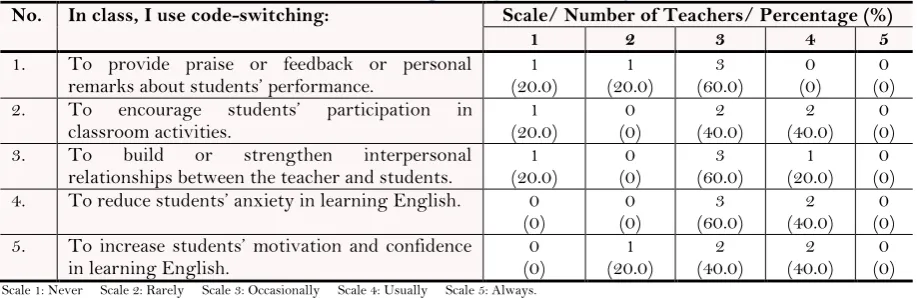
Table 4 shows the frequencies counts and percentages intended for code-switching for interpersonal
relationships items. Majority of the teachers (60.0%, n=3) occasionally used code-switching “to provide praise or feedback or personal remarks about students‟ performance.” 20.0% (n=1) of them rarely used code-switching for this purpose while the remaining 20.0% (n=1) never used code-switching for this purpose. With respect to the second item, that is, “To encourage students‟ participation in classroom activities,” it was found that 40.0% (n=2) of the teachers occasionally used switching for this purpose; another 40.0% (n=2) of them usually used code-switching for this purpose and the remaining 20.0% (n=1) never used code-code-switching for this purpose. The results also showed that 60.0% (n=3) of the teachers occasionally used code-switching “to build or strengthen interpersonal relationships between the teacher and students,” while another 20.0% (n=1) of them indicated “usually”. The remaining 20.0% (n=1) never used code-switching for this purpose.
Table-4. Code-switching for interpersonal relationships.
No. In class, I use code-switching: Scale/ Number of Teachers/ Percentage (%)
1 2 3 4 5
1. To provide praise or feedback or personal
remarks about students‟ performance. (20.0) 1 (20.0) 1 (60.0) 3 (0) 0 (0) 0 2. To encourage students‟ participation in
classroom activities. (20.0) 1 (0) 0 (40.0) 2 (40.0) 2 (0) 0
3. To build or strengthen interpersonal
relationships between the teacher and students. (20.0) 1 (0) 0 (60.0) 3 (20.0) 1 (0) 0 4. To reduce students‟ anxiety in learning English. 0
(0) (0) 0 (60.0) 3 (40.0) 2 (0) 0 5. To increase students‟ motivation and confidence
in learning English. (0) 0 (20.0) 1 (40.0) 2 (40.0) 2 (0) 0
Scale 1: Never Scale 2: Rarely Scale 3: Occasionally Scale 4: Usually Scale 5: Always.
The findings corresponded with findings from interviews conducted. The teachers had mainly used code-switching to build good relationships with the students and reduce their anxiety in learning English. Teacher A stated that she would sometimes use switching to make the students feel comfortable. However, code-switching was used outside of the classroom for building good relationships with the students. She also implied that code-switching was not used to encourage students‟ participation in classroom activities. Instead, she spoke in English only with the exception for Year 1 and 2 students. As for Teacher B, she admitted that she would sometimes give encouragement to the students by using code-switching. Yet, she would speak in English when giving some advice to the students. Both Teacher C and Teacher E admitted that they used code-switching to build good relationships with the students. On the other hand, Teacher D did not use code-switching for improving relationships with the students. She implied that the students could understand what she wanted by using English. She said,
“Improve relationship… Ahh… No, no. I think I use English, they can… they can understand, quite understand what I want.” (Teacher D)
4.2. Teachers‟ Perceptions Towards the Use of Code-switching in ESL Classrooms
This section describes the findings obtained from both survey questionnaire and interviews conducted on teachers‟ perceptions towards the use of code-switching in ESL classrooms.
4.2.1. Positive Effects of Code-switching on the English Language Learning Process
Table 5 shows the frequencies counts and percentages intended for positive effects of code-switching on the
English language learning process items. 40.0% (n=2) of the teachers were undecided whether “code switching will facilitate the language learning process.” Another 40.0% (n=2) of them agreed to this statement while the remaining 20.0% (n=1) strongly agreed to this statement. Majority of the teachers (60.0%, n=3) agreed that “code switching is an efficient, time-saving technique.” 20.0% (n=1) of them strongly agreed to this statement while the remaining 20.0% (n=1) were undecided about this statement.
Table-5. Positive effects of code-switching on the English language learning process.
No. I believe that: Scale/ Number of Teachers/ Percentage (%)
1 2 3 4 5
1. Code switching will facilitate the language
learning process. (0) 0 (0) 0 (40.0) 2 (40.0) 2 (20.0) 1
2. Code switching is an efficient, time-saving
technique. (0) 0 (0) 0 (20.0) 1 (60.0) 3 (20.0) 1
The findings corresponded with findings from interviews conducted. Teacher A agreed that the use of code-switching would make the students understand better. The students also would not shut down during the lessons. Similarly, Teacher B also agreed that the students were able to understand the lessons well when she used code-switching and they could also do the exercises better. She also mentioned that there was no bad or negative effect from the use of code-switching. Instead, it would help the students understand what they needed to learn or what the lesson was about. Likewise, Teacher C and Teacher Dagreed that the use of code-switching would make the students understand the lessons well. Teacher E also expressed his agreement that the use of code-switching would make the students understand what he was talking about. Furthermore, Teacher B and Teacher E considered code-switching as an efficient, time-saving technique.
“Sometimes when you say one word or one line, it is better than you talk in English for many many ahh…what… many times.” (Teacher B)
“Ah, save time. Yeah.” (Teacher E)
4.2.2. Negative Effects of Code-switching on the English Language Learning Process
Table 6 shows the frequencies counts and percentages intended for negative effects of code-switching on the
English language learning process items. 40.0% (n=2) of the teachers disagreed that “the practice of code switching will increase the students‟ reliance and dependency on the teacher.” Another 40.0% (n=2) of them agreed to this statement while the remaining 20.0% (n=1) were undecided about this statement. The findings further revealed that 40.0% (n=2) of the teachers disagreed that “the use of other languages in the ESL classroom will result in a decline in the standards of English,” while another 40.0% (n=2) of them agreed to this statement. The remaining 20.0% (n=1) were undecided about this statement.
Table-6. Negative effects of code-switching on the English language learning process.
No. I believe that: Scale/ Number of Teachers/ Percentage (%)
1 2 3 4 5
1. The practice of code switching will increase the
students‟ reliance and dependency on the teacher. (0) 0 (40.0) 2 (20.0) 1 (40.0) 2 (0) 0 2. The use of other languages in the ESL classroom
will result in a decline in the standards of English.
0
(0) (40.0) 2 (20.0) 1 (40.0) 2 (0) 0
Scale 1: Strongly Disagree Scale 2: Disagree Scale 3: Undecided Scale 4: Agree Scale 5: Strongly Agree.
The findings were in line with findings from interviews conducted. Teacher A disagreed that the use of code-switching would result in the overuse and overdependence on the students‟ first language. She implied that as long as the teachers teach the students the correct usage for spoken English, the students would remember them after approximately one week. This could be done with constant repetition of the correct usage for spoken English. Similarly, Teacher B disagreed that code-switching would cause the students‟ reliance and dependency on the teacher. It was implied that she encouraged her students to look up the meaning of the words by themselves first. The students used the Google search engine and an electronic dictionary. On the contrary, Teacher C expressed her agreement that code-switching would result in the overuse and overdependence on the students‟ first language. However, she expressed her disagreement that code-switching would cause a decline in the students‟ proficiency levels. As for Teacher E, he replied with “Hmmm… I think maybe lah.” Similarly, Teacher D also agreed that code-switching would cause the overuse and overdependence on the students‟ first language. She implied that the teachers need to think about why they want to teach English. She said,
“Because for English, okay… Actually, we teach English… Why do we want to teach English? Because we want them to know more. They understand, they learn. If we use other language, they will tend to get used to using other language.
Their mother tongue…” (Teacher D)
“Negative effect is they might prefer to use their mother tongue to speak in the class. Or maybe if difficult for them to express their thoughts because they used to use their mother tongue.” (Teacher D)
4.2.3. Positive Perceptions on the Use of Code-Switching in ESL Classrooms
Table 7 shows the frequencies counts and percentages intended for positive perceptions on the use of
code-switching in ESL classrooms items. Majority of the teachers (60.0%, n=3) were undecided whether “code code-switching should be included as an integral part of the ESL lesson.” 20.0% (n=1) of them agreed to this statement while the remaining 20.0% (n=1) strongly agreed to this statement. The findings further revealed that 80.0% (n=4) of the teachers agreed that “code-switching should only be used for helping weak learners and gradually removed when learners make progress,” while the remaining 20.0% (n=1) disagreed to this statement.
Table-7. Positive perceptions on the use of code-switching in the ESL classrooms.
No. I believe that: Scale/ Number of Teachers/ Percentage (%)
1 2 3 4 5
1. Code switching should be included as an
integral part of the ESL lesson. (0) 0 (0) 0 (60.0) 3 (20.0) 1 (20.0) 1 2. Code-switching should only be used for
helping weak learners and gradually removed when learners make progress.
0
(0) (20.0) 1 (0) 0 (80.0) 4 (0) 0
Scale 1: Strongly Disagree Scale 2: Disagree Scale 3: Undecided Scale 4: Agree Scale 5: Strongly Agree.
The findings corresponded with findings from interviews conducted. Majority of the teachers had positive perceptions towards the use of code-switching. Teacher A explained that code-switching was really necessary to achieve the objectives for teaching. Similarly, Teacher B mentioned that she preferred to use a method that could make the students understand what they needed to do or what they were learning which included code-switching. Likewise, Teacher C implied that the use of code-switching was good for the students to learn the lessons better in the classroom. Majority of the teachers were also found to agree that code-switching should only be used for helping weak learners and gradually removed its usage. Teacher A and Teacher C agreed that it was better to use code-switching for students with a low proficiency level. While Teacher D had the similar opinion, she did not encourage its usage. When asked if they would gradually reduce the use of code-switching, Teacher B, Teacher C and Teacher E admitted that they would gradually reduce it.
4.2.4. Negative Perceptions on the Use of Code-Switching in the ESL Classrooms
Table 8 shows the frequencies counts and percentages intended for negative perceptions on the use of
code-switching in ESL classrooms items. Majority of the teachers (60.0%, n=3) disagreed that “there should be a strict separation of the first language and English in the ESL classroom.” The remaining 40.0% (n=2) were undecided aboutthis statement. The findings further revealed that 80.0% (n=4) of the teachers agreed that “code switching should only be used as a last resort when all other options have been exhausted,” while the remaining 20.0% (n=1) strongly agreed to this statement.
Table-8. Negative perceptions on the use of code-switching in the ESL classrooms.
No. I believe that: Scale/ Number of Teachers/ Percentage (%)
1 2 3 4 5
1. There should be a strict separation of the first language and English in the ESL classroom.
0
(0) (60.0) 3 (40.0) 2 (0) 0 (0) 0
2. Code switching should only be used as a last resort when all other options have been exhausted.
0
(0) (0) 0 (0) 0 (80.0) 4 (20.0) 1
3. English is best taught in English-only
classroom. (20.0) 1 (60.0) 3 (20.0) 1 (0) 0 (0) 0
4. The more English that is used, the better
the results for the learners. (20.0) 1 (0) 0 (20.0) 1 (40.0) 2 (20.0) 1 Scale 1: Strongly Disagree Scale 2: Disagree Scale 3: Undecided Scale 4: Agree Scale 5: Strongly Agree.
The findings were in line with findings from interviews conducted. Teacher A mentioned that code-switching was the last choice that she would use and that it should be used only when it was necessary. Similarly, Teacher B implied that it would be better if English-only usage in the classroom was possible. If not, code-switching would be the alternative way to help the students in learning English language. Teacher C, on the other hand, stated code-switching was not the only method that could be considered important, but there were other teaching strategies too. As for Teacher E, he found code-switching to be a good strategy for students to learn English. However, Teacher D did not encourage the use of code-switching even if it could help some of the students. If possible, she would fully use only English in the classroom. The reason given was the use of code-switching would defeat the purpose of teaching English and caused the overuse and overdependence on students‟ first language. As stated by Teacher D,
“Because for English, okay… Actually, we teach English… Why do we want to teach English? Because we want them to know more. They understand, they learn. If we use other language, they will tend to get used to using other language. Their mother tongue…” (Teacher D)
5. DISCUSSION
5.1. Functions of Teachers‟ Code-Switching
The findings indicated that the English language teachers had used code-switching for curriculum access, classroom management discourse and interpersonal relationships. The findings revealed that the teachers had mainly used code-switching for curriculum access. They would mostly use code-switching to explain the meaning of English words and sentences. This was due to the students‟ lack of understanding towards the meaning of English words and sentences. These findings mirror the findings from Ooi (2017) study. Ooi revealed that the English language teachers were found to use code-switching mainly for providing explanations for grammar and vocabulary. They had also used code-switching to make their lessons easier to be understood by the students. Similarly, Makulloluwa (2013) also revealed in her study where code-switching was used to provide definitions for difficult words and explanations for grammar and difficult concepts.
Lastly, it would be code-switching for interpersonal relationships. The teachers had used code-switching to build good relationships with the students. Code-switching was also used to reduce the students‟ anxiety while learning English. This implied that the use of code-switching could make the students feel more comfortable in learning the target language. This is supported by the findings from Makulloluwa(2013) study who revealed that code-switching was used by the teachers as a strategy for creating a positive affective classroom environment. The use of the first language was found to have created a supportive classroom environment. It helped to lower the students‟ affective filters so that they could learn the target language better. Likewise, Lee (2010) also stated that code-switching between the first language and second language was seen as a means to help the students feel comfortable while learning.
5.2. Teachers‟ Perceptions Towards the Use of Code-switching in ESL Classrooms
From the English language teachers‟ perceptions, the findings revealed that the teachers had neutral or mixed perceptions regarding the use of code-switching in ESL classrooms. As to the effects of code-switching on the English language learning process, majority of the teachers agreed that by using code-switching, it was able to make the students understand the lessons better. They did not shut down from the use of code-switching. Instead, the students could understand the tasks‟ instructions better and complete them well. This implied that the use of code-switching indeed facilitated the language learning process. These findings correspond with the findings from
Ooi (2017) study who found that there was a progress on the students‟ language learning abilities and they
understand better the tasks and lessons too according to the teachers. Likewise, Selamat (2014) also revealed that the teachers expressed their beliefs that code switching was a useful teaching and learning resource that could be used to improve the language learning experience for students.
The teachers also agreed that code-switching was an efficient, time-saving technique. This was probably because they did not need to provide long-winded explanations in English or repeat them again. The students could also understand or capture the meanings better when their first language or other language was used. These findings correspond with the findings from Ooi (2017) study who revealed that the teachers used code-switching because they could save time on explanations and make an advancement with their lessons. Similarly, Selamat
(2014) also revealed the teachers expressed their beliefs that code switching was an efficient, time-saving technique
as compared to English-only usage in the classroom.
However, some of the teachers expressed their concerns that the use of code-switching would cause the students‟ reliance and dependency on their first language. It was implied that the students would tend to speak in their first language or develop a habit of continuing to use it. These findings were supported by Selamat (2014) who stated that majority of the teachers also believed that when code switching was used during English lessons, the students were prone to rely more on their first language. One of the teachers from this present research who disagreed with this concern expressedthat the students‟ reliance and dependency on their first language could be avoided with constant repetition of the correct usage for spoken English.
All the teachers also expressed their agreement that code-switching should only be used as a last resort when all other options have been exhausted. They mentioned that code-switching should only be used when necessary. Otherwise, the use of code-switching would defeat the purpose of teaching English to the students. These findings correspond with the findings from Lee (2010) study. Lee stated that the teachers used code-switching when it was necessary. The teachers also expressed that the use of English should be maximised. The reason given was to allow the students to learn and acquire the language.
6. IMPLICATIONS AND CONCLUSION
In conclusion, the use of code-switching by the English language teachers in ESL classrooms is somehow unavoidable. The findings indicated that the teachers had mainly used code-switching for curriculum access, followed by code-switching for classroom management discourse and finally code-switching for interpersonal relationships. They used code-switching to provide explanations during the lessons such as the meaning of the English words. This implied that code-switching plays a role in facilitating the students‟ comprehension towards the English lessons. Although the teachers employed switching during the lessons, it is implied that code-switching should only be used when necessary. Thus, there are several implications for this research. The first implication is that the teachers need to use code-switching wisely, and also maximise the exposure to English language in the classrooms. In other words, they need to use code-switching selectively according to situations. It is impossible to completely exclude the use of first language or other language in English classroom, especially for the low proficiency students. However, the teachers can use code-switching as a scaffold and gradually reduce its usage as the students make progress in their learning process. Subsequently, this would ensure that the use of code-switching would not defeat the purpose of teaching English to the students. Another implication would involve the teaching and learning materials for the students. The English language teachers or other education authorities can prepare or develop materials that focus on enhancing the students‟ English vocabulary. This is because the findings indicated that the students usually face problems in understanding the meaning of the English words. They can understand the meaning of the English words when the teacher usescode-switching.
Funding: This study received no specific financial support.
Competing Interests: The authors declare that they have no competing interests.
Acknowledgement: Both authors contributed equally to the conception and design of the study.
REFERENCES
Amara, Y.J.A., 2017. Exploring English language teachers‟ code-switching into L1 for teaching weak learners in a rural Malaysian secondary school. Master of Education (TESL) Thesis, The National University of Malaysia.
Creswell, J.W., 2012. Educational research: Planning, conducting and evaluating quantitative and qualitative research. 4th Edn., Massachusetts: Pearson.
Darmi, R. and P. Albion, 2013. English language in the Malaysian education system: Its existence and implications. Proceedings of the 3rd Malaysian Postgraduate Conference (MPC 2013). pp: 175-183.
David, M.K. and J. McLellan, 2011. Code Shifting and Switching: A Lingua Franca in Multilingual Malaysia? Purnima Singh, Paul Bain, Leong Chan-Hoong, Girishwar Misra, Yohsuke Ohtsubo (eds.): In Identity, Multiculturalim and Changing Societies: Psychological, Group and Cultural Processes. Asian Social Psychology Series Volume 8. United Kingdom: MacMillan. pp: 289-304.
Department of Statistics Malaysia, 2019. Current population estimates, Malaysia, 2018-2019. Available from https://www.dosm.gov.my/v1/index.php?r=column/cthemeByCat&cat=155&bul_id=a%20WJZRkJ4UEdKcUZpT2t VT090Snpydz09&menu_id=L0pheU43NWJwRWVSZklWdzQ4TlhUUT09 [Accessed 20 September 2019].
Ferguson, G., 2003. Classroom code-switching in post-colonial contexts: Functions, attitudes and policies. AILA Review, 16(1): 38-51. Available at: https://doi.org/10.1075/aila.16.05fer.
Hiew, W., 2012. English language teaching and learning issues in Malaysia: Learners‟ perceptions via Facebook dialogue. Journal of Arts, Science and Commerce, 3(1): 11-19.
Josephine, J., 2016. Majority of teachers not proficient in English. The Star Online, 26 September. Available from https://www.thestar.com.my/news/nation/2012/09/26/majority-of-teachers-not-proficient-in-english/ [Accessed 4 November 2018].
Lee, C.F., 2016. Malaysian English teachers expected to reach fluency of native speakers by 2020. The Sun Daily Online, 30 August. Available from https://www.thesundaily.my/archive/1954788-LSARCH391476 [Accessed 5 November 2018].
Lee, H.L.J., 2010. Code switching in the teaching of English as a second language to secondary school students. Malaysian Journal of ELT Research, 6(1): 1-45.
Lin, A., 2013. Classroom code-switching: Three decades of research. Applied Linguistics Review, 4(1): 195-218. Available at: https://doi.org/10.1515/applirev-2013-0009.
Low, S.M., 2016. The effectiveness of classroom code-switching in Malaysian Science classrooms. Doctor of Philosophy in English Language and Linguistics Thesis, The University of Sheffield.
Macaro, E., 2005. Codeswitching in the L2 classroom: A communication and learning strategy. In E. Llurda (Ed.), Non-native Language Teachers: Perceptions, Challenges, and Contributions to the Professions. Boston: Springer. pp: 63-84. Makulloluwa, E., 2013. Code switching by teachers in the second language classroom. International Journal of Arts & Sciences,
6(3): 581-598.
Milroy, L. and P. Muysken, 1995. One speaker, two languages: Cross-disciplinary perspectives on code-switching. Cambridge: Cambridge University Press.
Ooi, L.H., 2017. Qualitative findings on the dynamics of code switching in the Malaysian English classroom. Research Conference in Language Education 2017.
Selamat, J.T., 2014. Code switching in the Malaysian ESL classroom. Master of Arts (Linguistic) Thesis, University of Otago. Svendsen, E., 2014. The influences of code-switching in the second language classroom in connection to language development.
Degree Project in English and Learning, Malmö University.
Yletyinen, H., 2004. The functions of codeswitching in EFL classroom discourse. Postgraduate Thesis in English, University of Jyväskylä.