Article
Model Predictive Control for a Recover Water Process
Paolo MercorelliID
Institute of Product and Process Innovation; Volgershall 1, D-21339 Lueneburg; Leuphana University of
1
2
3
4
5
6
7
8
Lueneburg;[email protected]
* Correspondence:[email protected];Tel.:+49-(0)4131-677-5571
Abstract: Thegoalof thiscontributionisanapplicationofthe LinearGeneralModelPredictive Control(LGMPC).Inthispaper,stabilityoftheLGMPCisprovenbymeansofademonstration of aTheorem statingasufficienta ndc onstructivec ondition.T hisc onditionc anb ea ppliedfor calculatingtheweightmatricesofthecostfunctionintheoptimisationprobleminLGMPC.Lower boundsconditionsarefoundforoneofthesematricesandthenasystemwithsaturationistakeninto consideration.Theconditionscouldbeinterpretedanddiscussionsthroughphysicalaspects.The obtainedresultsweretestedbymeansofcomputersimulationsandanexamplewitharecoverwater processisconsidered.
Keywords:LinearModelPredictiveControl;ProcessControl;Stability 9
1. Introduction
10
Model predictive control approach is used for improving the tracking of a desired trajectory. 11
Utilizing the linear prediction algorithm for improving the tracking performances of an adaptive 12
controller can be considered a good idea. Using a prediction structure an improvement of the dynamic 13
performances is awaited., so MPC is used in drives control applications [1,2]. MPC is an optimal control 14
approach being able to deal effectively with constraints and multi variable processes in industries. For 15
its being advantageable MPC has been widely used in automotive and process control communities 16
[3].Solving optimization problem on-line however limits the MPC applications by slow dynamic 17
systems [3].Application of MPC to mechatronic systems for servo design attracts attention of many 18
scientists because of the continuous development of microprocessor technology. Mechatronic systems 19
such as electrical motor control [4], two stage actuation system control, machine tool chattering control 20
[5] have shown promising results. There is also a fast development of various advanced techniques 21
integrated with MPC for performance improvement [6]. The used sampling frequency considered in 22
the research literature may be still too slow for general mechatronic systems. Moreover, simulations 23
show, that the existence of modelling error makes the steady-state error being obvious. These both 24
points, in particular, during real-time implementation may influence the performance of mechatronic 25
systems. Calculation of the solution of the MPC in an off-line in an explicit way can be seen, for 26
instance [7], [8]. MPC has been also applied for piezoelectric actuators, see [9]. Finding conditions 27
on the stability is one of the interesting issues in optimisation. The goal of this paper is to find lower 28
bounds of a matrix characterising the cost function to be able to guarantee the stability of the optimal 29
solution. Results, obtained by means of PI controller in [10]are extended in this contribution. Results 30
obtained using optimal algorithms in [11]are organised in the following way. The Section2is dedicated 31
to a system recovering water. This contribution shows only the "difference case" for the MPC, although 32
a similar Theorem was proven in [12]. In Section4a property of the LGMPC is proved in case without 33
and with saturation. In Section6the system shown in Section2is taken as a simulated example and 34
the proposed control technique is applied. Conclusions close the paper. 35
2 of 10
2. Mathematical model of the system
36
The main nomenclature
min(t): input mass flow (kg/sec)
mo(t): output mass flow (kg/sec)
m(t): mass (Kg)
dm(t)
dt : mass flow (kg/sec)
p(t): pressure inside the evaporator (Pa) T: Temperature (K)
V: Volume (l)
pi: initial pressure (Pa)
pd: desired pressure (Pa)
Rg: vapor constant
Aw: anti-windup signal
Kb: weight factor for the anti-windup action
VL: a Lyapunov function
Ak: discrete system matrix
Bk: discrete input matrix
Hk: output matrix
Gp: Model predictive control state matrix
F1p: Model predictive control "dealta" input matrix
F2p: Model predictive control input matrix 37
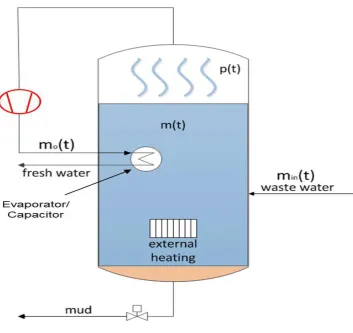
In Fig. 1a schematic representation of the considered system is shown. The system basically consists of the following three elements: a boiler, a compressor and an evaporator. In the boiler the waste water remains in the middle and lower part of it and in the upper part a vapor chamber is to be considered in order to host the water vapor which is generated by heating the waste water. At the beginning the mixture (waste water) is heated by a resistor system until the water vapor is present in the vapor chamber. At this time the heating is switched off and the compressor is switched on. The compressor should provide for a high pressure in the evaporator and in the meantime reduce the pressure in the vapor chamber through and a mass flow. This mass flow (m0(t)) after the condensed phase represents cleaned water in output of the evaporator and it is stilled. More in depth, in the evaporator, the vapor is condensed giving up heat to the waste water. To guarantee that new waste water can enter into the boiler from the upper part of it, the compressor provides a low pressure in the vapor chamber. In this sense, the compressor works as a controller in this process and its output is represented by the mass flowm0(t)with the constraint thatm0(t)>0. The compressor is equipped with an asynchronous motor which is controlled in frequency using an inverter piloted by a PWM signal which converts the output of the LMPC controller in frequency. In input to LMPC the pressure error is provided. More details of the control scheme will be given in the chapter devoted to the simulation. In any case, the dynamics of the asynchronous motor together with the inverter and all rest of the converters, considered all together, are much faster than the dynamics of the controlled process and in this analysis are not taken into account. Short description of the drain: At the beginning the pressure in the container equals the ambient pressure (circa 1.013 bar). By heating, the pressure increases slowly, as the water begins to evaporate. New water is added by a constant control with floats. The condensed water vapor from the "internal heat exchanger" is now free of foreign matter. For controller design purposes the dynamical model of the system must be considered. As already
Figure 1.Boiler system
explained, considering that the control process starts after the heating phase and more precisely when the water vapor becomes to be present in the boiler, the following equations can be considered:
dm(t)
dt =mi(t)−mo(t) dp(t)
dt = dm(t)
dt RgT
V ,
(1)
in whichmi(t)is a stepwise positive constant function. 38
39
Considering the Forward Euler discretisation with sampling timeTs, the following expression is
obtained:
m(k+1) =Ts(mi(k)−mo(k)) +m(k)
p(k+1) = (mi(k)−mo(k))RVgT+p(k),
(2)
and thus 40
"
m(k+1) p(k+1)
#
| {z }
ˆ
z(k+1) =
"
Ts 0
0 1
#
| {z } Ak
"
m(k) p(k)
#
| {z }
ˆ
z(k) +
"
Ts TsRgT
V #
| {z } Bk
(mi(k)−m0(k))
| {z }
umpc(t)
4 of 10
3. Model predictive control
41
In the model approach just two samples are considered:
ˆ
z(k+1/k) =HkAkz(k/k) +HkBkumpc(k). (4)
If∆umpc(k) =umpc(k)−umpc(k−1), thenumpc(k) =∆umpc(k) +umpc(k−1)and 42
ˆ
yh(k+1) =HkAkzˆ(k/k) +HkBk(∆umpc(k) +umpc(k−1)). (5)
where matrixHkselects the second state variable and thusyh(t)represents the pressure.
ˆ
y(k+2) =HkA2kzˆ(k/k) +HkAkBk(∆umpc(k) +umpc(k−1)) +HkBk(∆umpc(k+1) +umpc(k)). (6)
It is straightforward to show that the following vectorial expression holds:
ˆ
Yh(k) =Gpx(k) +F1p∆Umpc(k) +F2pumpc(k−1), (7)
where
ˆ Yh(k) =
"
ˆ
yh(k+1)
ˆ
yh(k+2) #
, ∆Umpc(k) =
" ∆u mpc(k)
∆umpc(k+1), #
(8)
and matricesGp,F1pandF2pare given by:
F1p= "
HkBk 0
Hk(AkBk+Bk) HkBk #
, Gp=
"
HkAk
HkA2k #
, F2p=
"
HkBk
Hk(AkBk+Bk) #
. (9)
If the following performance criterion is assumed,
J= 1 2
N
∑
j=1
yd(k+j)−yˆ(k+j) T
Qp
yd(k+j))−yˆ(k+j)
+
N
∑
j=1
∆umpc(k+j) T
Rp(∆umpc(k+j)),
(10) whereyd(k+j),j=1, 2, . . . ,Nis the pressure reference profile andNthe prediction horizon, andQp
andRpare non-negative definite matrices. Index (16) can be written as
J= 1 2Yˆ
T
h(k)QpYˆh(k) +1
2∆U
T
mpc(k)Rp∆Umpc(k), (11)
then the solution minimizing performance index (11) may then be obtained by solving
∂J ∂∆Umpc
=0. (12)
A direct off-line computation may be obtained explicitly as
∆Umpc= (FT1pQpF1p+Rp)−1
FT1pQp Ydp(k)−Gpz(k)−F2pumpc(k−1)
, (13)
whereYdp(k)is the desired output column vector. For further details see [13].
43
44 4.AstabilitysufficientconstructiveconditioninGMPC
Theorem1. LetustakethediscreteSISOlinearsystemintoconsideration:
45
z(k+1) = Akz(k) +Bkumpc(k), (14)
y(k) = Hkz(k), (15)
obtained by a discretisation of a linear continuous system using a sampling time which equals Ts. umpc(k)
represents the first element of the vector of the optimal solution as calculated in [13] for the GMPC considering the following cost function:
J= 1 2
N
∑
j=1
yd(k+j)−yˆ(k+j) T
Qp
yd(k+j)−yˆ(k+j)
+
N
∑
j=1
∆umpc(k+j−1) T
·Rp∆umpc(k+j−1), (16)
where yd(k+j), j=1, 2, . . . ,N is the position reference trajectory and N is the prediction horizon, andQpand
Rpare non-negative definite matrices. Furthermore, the solution minimizing performance index (16) may be
obtained by solving:
∂J ∂∆Umpc
=0. (17)
It is known for instance from [13] that the optimal solution is: umpc(k) = (FT1pQpF1p+Rp)−1FT1pQp
Ydp(k)−Gpz(k)−F2pumpc(k−1)
, (18)
whereYdp(k)andYp(k)are the desired output column vector and the measured or observed output vector.
46
MatricesQpandRpare diagonal and positively defined. Under the technical hypotheses thatQp = I, and 47
HTkH=Iare under the assumption
48
49
i) r(1,1)>>T2
s, where r(1,1)represents the first diagonal element of matrixRp. 50
then∀r(1,1)such that:
r(1,1)>BkBTk
kAkk2
1− kAkk2, (19)
wherekAkk2represents the maximal eigenvalue of matrix
√
ATAand kAk−Bk
(FT1pQpF1p+Rp)−1FT1pQpGp
k2<kAk+Bk
(FT1pQpF1p+Rp)−1FT1pQpGp
k2, (20)
then the system (14) is asymptotically stable.
51
Proof 1. For sake of brevity just one prediction step is considered, then: F1p=
h
HkBk i
, (21)
F2p= h
HkBk i
, (22)
Gp= h
HkAk i
. (23)
Combining Eq. (14) with (18), this expression is got: z(k+1) =Akz(k) +Bk
(FT1pQpF1p+Rp)−1FT1pQp
Ydp(k)−Gpz(k)−F2pumpc(k−1)
6 of 10
which is equivalent to write:
z(k+1) =Ak−Bk
(FT1pQpF1p+Rp)−1FT1pQpGp
z(k)+ Bk
(FT1pQpF1p+Rp)−1FT1pQp
Ydp(k)
−Bk
(FT1pQpF1p+Rp)−1FT1pQp
F2p(k)
. (25)
If
r(1,1)>BkBTk
kAkk2
1− kAkk2, (26)
considering that scalar r(1,1)>0and scalarBkBTk >0, then: 52
0<kAkk2+r−(1,11)BkBTkkAkk2<1. (27) Recalling thatHT
kH=I 53
0<kAkk2+r(−1,11)BkBTkHTkHkAkk2<1 (28) and thus
54
0<kAkk2+r−(1,11)kBkBTkHTkHAkk2<1. (29) Being matrixF1pdefined as in (21) andG1pdefined in (23), it is known that matrixBk is proportional Ts, 55
then considering thatRp =r(1,1), choosing a suitable r(1,1)>>Tsand considering thatQp =I(technical 56
hypothesis), the following condition can be derived:
57
0<kAkk2+
Bk
(FT1pQpF1p+Rp)−1FT1pQpGp
2<1. (30)
Considering the norm properties and condition (20), then:
58
0<
Ak−Bk
(FT1pQpF1p+Rp)−1FT1pQpGp
2
<
Ak+Bk
(FT1pQpF1p+Rp)−1FT1pQpGp
2
<kAkk2+
Bk
(FT1pQpF1p+Rp)−1FT1pQpGp
2<1. (31)
To conclude
59
0<kAkk − Bk
(FT1pQpF1p+Rp)−1FT1pQpGp
2<1. (32)
The constraint in (26) states a plausible condition on the controller. Stability represents the 60
necessary condition of the optimality of a controlled system. In order to interpret the result let us 61
observe a mechanical system including a mass-spring system in which it is known that the eigenvalue 62
can variate in the whole real and complex domain as a function of the mass which states the system 63
inertia. If massm →∞, then, because of the discretisation and according to the Landau notation, 64 λmax Ak −1
→ 0 withO λmax Ak −1
= O(m1). In the meantimeO(BkBTk) = O(m12).
65
For a very slow system, according to (26),r(1,1)→0, parameterr(1,1)is present in the denominator
66
function of the optimal solution in (18) and in this case, small values ofr(1,1)are devoted to speed up
67
the system. If massm→0, then, because of the discretisation,O λmax Ak
=O1
m
, but in the 68
meantimeBkBTk →∞withO(BkBTk) =O(m12). For a very fast systemr(1,1)→∞, parameterr(1,1)is
69
devoted to slow down the system. So we can conclude that a highly inertial system needs relatively 70
small values ofr(1,1)to be optimised and stabilised. If the inertia is small, then the system needs larger 71
values ofr(1,1)to be optimised and stabilised. In fact, very fast systems can have very high abrupt
72
changes in the input signals and in the cost function the input factor needs to be reduced to find an 73
optimality. 74
5. The saturation case
75
Proposition 1. Let us take the following discrete SISO linear system as before into consideration:
76
z(k+1) = Akz(k) +Bkumpc(k), (33)
y(k) = Hkz(k), (34)
and
|umpc(k)| ≤Umax ∀k, (35)
then (33) with the input saturation defined in (35) being asymptotically stable and its input avoiding the constraint if condition (26) holds together with the input limitation. The following condition summarizes the result:
r(1,1)>max
(
BkBTkkYdp(k)k2 Umax
+
BkF1pQpF2p
2 Umax
|umpc(k−2)|, BkBTk
kAkk2 1− kAkk2
)
. (36)
Proof 2. The demonstration is straightforward just considering that:
|umpc(k)|<|umpc(k)|<Umax ∀k
and thus it is enough that the following condition holds:
Bk
(FT1pQpF1p+Rp)−1FT1pQp
Ydp(k)
−Bk(FT1pQpF1p+Rp)−1F1pQpF2pumpc(k−1)
2≤Umax.
(37) In fact, using similar considerations as before, the following expression is obtained:
Bkr
−1 11 FT1pQp
Ydp(k)
2+|BkF1pQpF2p| ≤Umax, (38)
and thus, including also the stability condition, condition (36) follows here below again:
r(1,1)>max
(
BkBTkkYdp(k)k2 Umax
+
BkF1pQpF2p 2
Umax
|umpc(k−1)|, BkBTk
kAkk2 1− kAkk2
)
. (39)
It is possible to observe that for large values ofUmaxthe condition on the input barrier in the cost 77
function (16) with weightr(1,1)is not so restrictive, so larger inputs are allowed. For small values of
78
Umax the input barrier limits the values of the input and no large input values are allowed. 79
6. Simulation results
80
Concerning the simulation results, it is to be clarified that functionmi(t)is a stepwise constant
function withmi(t) =0.086 (kg/sec.) ormi(t) =0 and in the simulated casemi(t) =0.086 (kg/sec.)
is considered. As already explained, in the simulations two cases should be distinguished: weak anti-saturating action:
r(1,1)>
BkBTkkYdp(k)k2
8 of 10
and strong anti-saturating action:
r(1,1)>>
BkBTkkYdp(k)k2
Umax . (41)
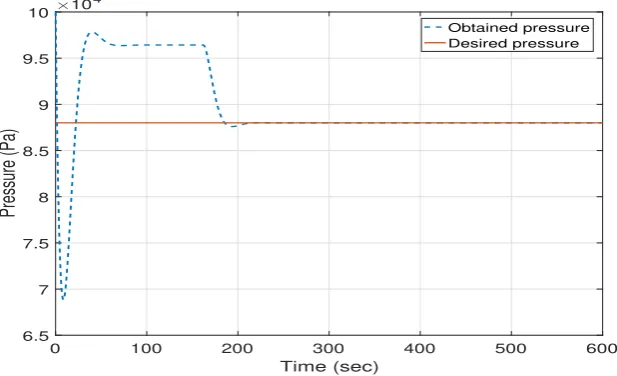
Fig. 2shows the controlled pressure which represents the main result. In case of anti-windup action being relatively weak, the anti-windup controller needs time to reestablish the control loop. As already explained, during the windup effect the feedback control is broken so the absence of the feedback control action can clarify the long permanence of the pressure at negative values. In particular, from Fig.3which represents the mass flow dmdt(t) =min(t)−m0(t)(kg/sec) it is visible how this function is consequent with the relation:
dm(t) dt ≈
dp(t)
dt . (42)
Moreover, considering the following equation again:
dm(t)
dt =min(t)−m0(t), (43)
to activate the process a strong initial action through the mass flowm0(t)is required. Observing these 81
two figures it is possible too see that in the case of strong anti saturating action represented in Fig.5the 82
controlled system through the anti-windup scheme comes out from the saturation state very quickly 83
with a resulting faster dynamics. The resulting faster dynamics are obtained thanks to the stronger 84
anti-windup action which allows to reactivate the control loop very quickly. As already explained, 85
when the saturation occurs the control loop is open and no feedback control is present.
0 100 200 300 400 500 600
Time (sec.)
0.8 0.9 1 1.1 1.2 1.3 1.4 1.5 1.6
Pressure (Pa)
105
Obtained pressure Desired pressure
Figure 2.Desired and obtained pressure with weak anti-saturating action
86
7. Conclusion
87
One of the most important problems in the context of optimisation using LMPC is represented by 88
conservative conditions on the stability. This paper presents a sufficient and constructive condition for 89
the stability of an LGMPC calculating lower bounds of the element of matrixRwhich represent the 90
weights of the input in a typical given cost function. A physical interpretation of the result is given 91
on the light of some physical considerations. An illustrative example is provided in which a recover 92
water process is taken into consideration to test the proposed results through computer simulations. 93
0 100 200 300 400 500 600
Time (sec)
-5 -4 -3 -2 -1 0 1 2 3 4 5
Input mass flow m
i
(t)-m
o
(t) (kg/sec)
10-4
Figure 3.Mass flowmdt(t) =min(t)−m0(t)(kg/sec) with weak anti-saturating action
0 100 200 300 400 500 600
Time (sec)
6.5 7 7.5 8 8.5 9 9.5 10
Pressure (Pa)
104
Obtained pressure Desired pressure
Figure 4.Desired and obtained pressure with strong anti-saturating action
References
94
1. Mercorelli, P. A switching Kalman Filter for sensorless control of a hybrid hydraulic piezo actuator using
95
MPC for camless internal combustion engines. Proceedings of the IEEE International Conference on
96
Control Applications, 2012, pp. 980–985.
97
2. Mercorelli, P. A switching model predictive control for overcoming a hysteresis effect in a hybrid actuator
98
for camless internal combustion engines. Proceedings of the IEEE PRECEDE 2011 - International Workshop
99
on Predictive Control of Electrical Drives and Power Electronics, 2011, pp. 10–16.
100
3. Qin, S.; Badgwell, T. A survey of industrial model predictive control technology. Control Engineering
101
Practice2003,11, 733–764.
102
4. Bolognani, S.; Peretti, L.; Zigliotto, M. Design and implementation of model predictive control for electrical
103
motor drives. IEEE Transactions on Industrial Electronics2009,56, 1925–1936.
104
5. Neelakantan, V.; Washington, G.; Bucknor, N. Model Predictive Control of a Two Stage Actuation System
105
using Piezoelectric Actuators for Controllable Industrial and Automotive Brakes and Clutches. J. Intel.
106
Mater. Syst. and Struct2008,19, 845–857.
10 of 10
0 100 200 300 400 500 600
Time (sec)
-6 -5 -4 -3 -2 -1 0 1 2
Input mass flow m
i
(t)-m
o
(t) (kg/sec)
10-3
Figure 5.Mass flowdmdt(t) =min(t)−m0(t)(kg/sec) with strong anti-saturating action
6. Hu, Z.; Farson, D. Design of a waveform tracking system for a piezoelectric actuator. Proc. Inst. Mech.
108
Eng., J. Syst. Control Eng., 2008, Vol. 222, pp. 11–21.
109
7. Bemporad, A.; Morari, M.; Dua, V.; Pistikopoulos, E.N. The explicit linear quadratic regulator for
110
constrained systems.Automatica2002,38, 3–20.
111
8. Pedret, C.; Poncet, A.; Stadler, K.; Toller, A.; Glattfelder, A.; Bemporad, A.; Morari, M. Model-varying
112
predictive control of a nonlinear system. Internal report in Computer Science Dept. ETSE de la Universitat
113
Autònoma de Barcelona2000.
114
9. Liu, Y.C.; Lin, C.Y. Model Predictive Control with Integral Control and Constraint Handling for Mechatronic
115
Systems. Proc. of the 2010 International Conference on Modelling, Identification and Control; , 2010; pp.
116
424–429.
117
10. Mercorelli, P.; Goes, J.; Halbe, R. A Lyapunov based PI controller with an anti-windup scheme for a
118
purification process of potable water. 2014 International Conference on Control, Decision and Information
119
Technologies (CoDIT), 2014, pp. 578–583.
120
11. Mercorelli, P. An Optimal and Stabilising PI Controller with an Anti-windup Scheme for a Purification
121
Process of Potable Water. 16th IFAC Workshop on Control Applications of Optimization CAO’2015, 2015,
122
pp. 259–264.
123
12. Mercorelli, P. A sufficient asymptotic stability condition in generalised model predictive control to avoid
124
input saturation. Lecture Notes in Electrical Engineering2019,489, 251–257.
125
13. Sunan, H.; Kiong, T.; Heng, L.Applied Predictive Control; Springer-Verlag London: Printed in Great Britain,
126
2002.
127