1
Nutrient management and effects of netting on growth and yield
1of Indian spinach (Basella alba)
2M. Mishu Akther1, M. Ashraful Islam 1*, M. Saidee Rahman1, M. Rezaul Karim 1,
3
Dilip Nandwani2
4
1Department of Horticulture, Bangladesh Agricultural University, Mymensingh 2202, 5
Bangladesh; [email protected] (M.M.A); [email protected] (M.A.I.); 6
[email protected] (M.S.R); [email protected] 7
2Department of Agriculture and Environmental Sciences, College of Agriculture, 8
Tennessee State University, Nashville, TN 37209, USA; [email protected] (DN)
9
Correspondence: [email protected] and [email protected]
10
Abstract: Best horticulture management has been practiced to reduce the amount of 11
inorganic fertilizer in connection with net (mosquito net) for higher production of Indian 12
spinach. Excessive use of chemical fertilizers in agriculture promoted negative effect on 13
the environment and human health in Bangladesh. The experiment was conducted at the 14
Horticulture Farm of Bangladesh Agricultural University (BAU), Mymensingh during 15
the period February to May 2016. Two factor experiments were conducted on nettings: 16
control (N0), Netting (N1) and different fertilizers: control (F0), Vermicompost 10 t/ha 17
(F1), Vermicompost 15 t/ha (F2), 2/3rdof F2+ 1/3rdof F4 (F3), Inorganic fertilizer (F4). 18
Combination of mosquito net and combined of organic and inorganic fertilizers (N1F3) 19
gave the significantly higher growth and yield of Indian spinach compared to other 20
treatment combination. The maximum vine length (77.71 cm), after 45 days after sowing 21
was found from N1F3 which was 72% higher compared to control. The highest yield of 22
Indian spinach was 38.67 t/ha from N1F3 which was 80% higher compared to control. 23
The treatment combination of N1F3 provided maximum leaf numbers per plant, leaf 24
length. 25
26
Key word: Inorganic fertilizer, Vermicompost, Net, Growth, Yield, Indian spinach 27
28
29
30
2
Introduction
31
The use of inorganic fertilizer and chemical pesticide since green revolution has been 32
increased to enhance crop production in agriculture. Benefits on improved yields in crops 33
received, however, unforeseen environmental impacts, human health hazard and 34
resistance to pests and diseases impacted negatively over the years [1].Organic fertilizers 35
are environmentally friendly and improve soil health, water-holding capacity, high cation 36
exchange capacity and low bulk density; and they a foster diverse population of 37
beneficial soil microorganisms [2]. Now-a-days people are getting attention to use of 38
organic fertilizer and organic pesticide in crop field because it is eco-friendly, safe and 39
has benefits for human health. Consumers believe that organically produced agricultural 40
products are nutritious, taste good and safe as well as has little or no adverse effect on 41
the environment compared to inorganic or conventional farming practice [3]. 42
Netting refers covering the crops using net (mosquito net) to provide shade of the crop. It 43
improved micro-environment of crop field, protect crop from environmental hazards and 44
protection from insect pest damage. Agricultural production is affected due to increase in 45
air temperature and intensity of solar radiation result of the climatic change and 46
urbanization (Reference?). Colour shade can be helpful to improve the 47
microenvironment for plant growth. Several reports are available usedof shade nets to 48
protect agricultural crops from excessive solar radiation and to improve the thermal 49
climate [4].Vermicompost is a type of organic fertilizer which is produced by a non-50
thermophylic process involving interactions between earthworms and micro-organisms 51
leading to bio-oxidation and stabilization of organic material [5,6]. Applications of 52
vermicompost in combination with chemical fertilizers have been proved effective to 53
enhance growth and yield of different crops like cabbage, tomato and strawberry [7 - 54
9].Actually mixed fertilizers (combination of organic and inorganic fertilizers) provide 55
nutrient all over growing periods of crops as a result good vegetative growth occur in 56
plant. This combination results in higher yield of crops encourages to reduce the amount 57
of chemical fertilizers application. 58
Indian spinach is a nutrient rich leafy vegetable grown in the summer season in 59
Bangladesh. It is a fleshy annual, twining much branched herb with alternate ovate 60
leaves. There are two varieties, green and red. The nutritive value of Indian spinach is 61
very high with a good content of minerals, vitamins and substantial amount of fibers 62
3
The conventional agriculture is becoming flop and sustainability of crop production is 64
demanding in this era in Bangladesh. Already, there some findings of higher production 65
of crops through mixed of organic and inorganic fertilizers [7-8]. No research has been 66
conducted in Bangladesh on the Indian spinach production considering the net and 67
fertilizer management combination. This study was conducted to evaluate the effect of 68
nutrient management system through application of organic and inorganic fertilizers with 69
or without mosquito net covering the crop on the growth and yield of Indian spinach. 70
2. Materials and methods
71
An experiment on Indian spinach was conducted at the Horticulture Farm (240 26' and 72
240 54' N latitude and 900 15' and 900 30' E longitude) of Bangladesh Agricultural 73
University, Mymensingh during the period February to May 2016 to evaluate the effects 74
of netting (blue color mosquito net) and different fertilizers on the growth and yield. Five 75
levels of fertilizer viz., F0 (control); F1 (Vermicompost 10 t/ha); F2 (Vermicompost 15 76
t/ha); F3, combined fertilizer(2/3rdof F2+ 1/3rd of F4 treatment), F4 (Inorganic fertilizer) 77
and two levels of netting viz., N0 (Control), N1 (Netting). The experiment was laid out in 78
Randomized Complete Block Design (RCBD) with three replications. Inorganic fertilizer 79
(F4) were given (100 kg N +22 kg P + 70 kg K + 18 kg Zn /ha) according to FRG [11]. 80
Indian spinach of green color variety seeds was used as the planting material at the rate 81
1.170 kg/ha.Seeds were soaked overnight in a wrapped cotton cloth.Seeds were sown in 82
the field at afternoon in a depth of 1.5 cm in dibbling method spaced at 40×25 cm. 83
Seedlings (or transplants) were covered with insect net at 4’ height . Organic fertilizers 84
(vermicompost), triple superphosphate (TSP), ZnSO4, were applied before planting. 85
Vermicompost was obtained from Horticulture farm of BAU.Vermicompost nutrient 86
composition varies (N: 0.5%–4%, P: 0.5%–3%, K: 0.5%–3%, and S: 0.1%–0.5%, 87
personal communication BARC, Bangladesh).Urea and MoPwere applied at three 88
applications at 1st, 3rd and 5th weeks of seeding respectively.Weeding and irrigation were 89
done manually. Three replications with eight plants per plot/ randomly designed for the 90
experiment and labeled. Data were collected on vine length (cm), leaf number, leaf 91
length (cm), vine diameter (cm), yield per plot (t/ha),fresh and dry weight of leaves and 92
vines were recorded. Fresh leaves and vines kept in an oven for drying at 65 0C for 3 93
days. Data were statistically analyzed by analysis of variance (General Linear Model 94
procedure) and Tukey’s pair wise comparison test (p < 0.05) using Minitab Version 17 95
4 97
98
3. Results and Discussion
99
Vines with leaves were harvested three times above 10-15 cm from ground level. First 100
harvest was done after 45 days after sowing seeds (DAS). Growth trends data like vine 101
length or plant height, leaves numbers and length, vine diameter were recorded 102
frequently before the first harvest. After harvesting, plant produces more branches and 103
influences yield. Three tharvests were done and collective yield were significantly 104
different among the treatment combinations. Analysis of variance showed that the 105
highest vine length and yield were highly significant in the application of organic and 106
inorganic fertilizer with mosquito net treatment (N1F3) (Figure 1 and 2). 107
108
N0= Control, N1 = Netting; F0 = Control (No fertilizer), F1 = Vermicompost (10 t/ha), F2 =
109
Vermicompost (15 t/ha), F3 = Mixed fertilizer (2/3rd of F2 + 1/3rd of F4 treatment), F4 = Inorganic
110
fertilizer
111
The treatment combination N1F3show 72% and 80% highest vine length and yield 112
compared to control. The second highest growth and yield was found from the inorganic 113
fertilizer with net and this was 17% less production compared to mixed fertilizer with net 114
0 10 20 30 40 50 60 70 80
N₀F₀ N₀F₁ N₀F₂ N₀F₃ N₀F₄ N₁F₀ N₁F₁ N₁F₂ N₁F₃ N₁F₄
V
in
e
le
n
g
th
a
t
D
A
S
Combination of net and fertlizers
Figure 1: Combined effect of organic , inorganic fertilizers and netting on vine length of Indian spinach . Vertical bars represnt ± SE.
5
(N1F3). Vermicompost application increased from 10 to 15 t/ha where 21% yield was 115
increased due to increase the application of vermicompost. Mixed fertilizer promoted 116
higher production, reduced the amount of inorganic fertilizer and improve the soil 117
quality. 118
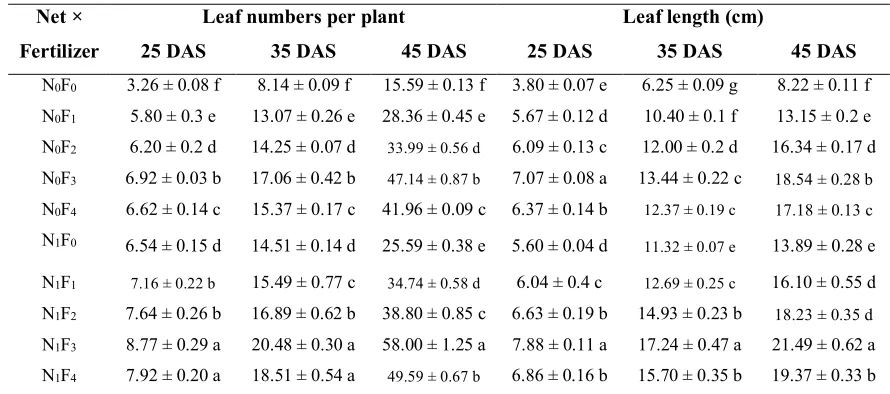
Leaf numbers and leaf length of Indian spinach at 25, 35 and 45 DAS werefound 119
significantly different and the highest ?was found in N1F3 (Table 1). The second highest 120
growth was obtained in net with inorganic fertilizer application. Comparing the sole 121
application of inorganic or vermicompost application, improved result was found in 122
inorganic fertilizer application. With the higher rateofvermicompostapplication growth 123
and yield was increased in Indian spinach. This result is coherence with the result of 124
yield (?) as leaf number, leaf length and the vine length increased higher yield. In earlier 125
study plants grown under shade (50%) with nitrogen application showed vigorous 126
growth and yield compared to open field (unshaded condition) in bangladhonia 127
(Eryngium foetidum) [12]. Also, the highest plant height of potato was observed through
128
the combination of vermicompost mixed with 100% NPKS (chemical fertilizers) was 129
applied to the soil [13]. On the other hand, tomato leaves were increased by 130
vermicompost applications [14]. 131
132
Leaf numbers and leaf length were increased when the rate vermicompost application 133
were increased from 10 to 15 ton per hectare. The sole application of inorganic fertilizer 134
produced higher growth and yield compared with sole application of vermicompost in 135
the soil. The higherrate ofvermicompost application resulted increased yield. It is 136
necessary to consider the amount of volume to soil. Considering this, judicial application 137
of organic and inorganic fertilizer is suitable for the production, quality of crop and eco-138
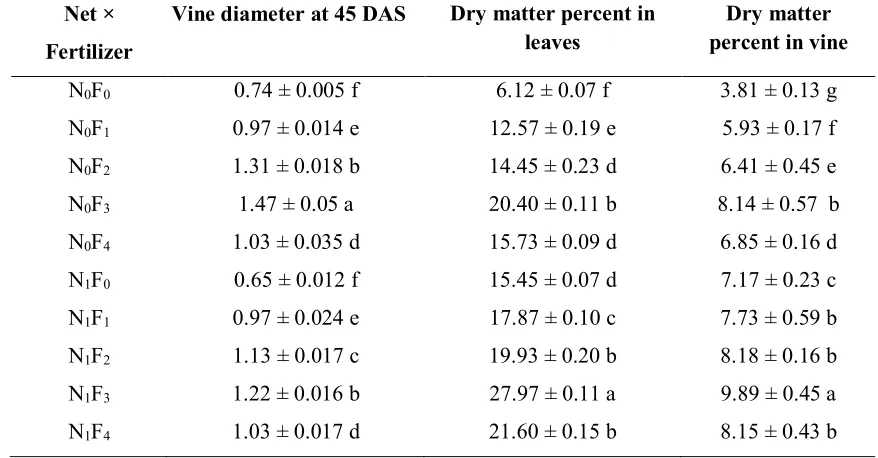
friendly. IBest performance of plant growth and yield was found from mixed of organic 139
and inorganic fertilizer with net except the vine diameter. Vine diameter was higher in 140
mixed fertilizer without net (Table 2). 141
142
143
144
6 146
147
Table 1. Combined effects of netting and different fertilizers on leaf numbers per
148
plantand leaf lengthat different DAS of Indian spinach
149
Net ×
Fertilizer
Leaf numbers per plant Leaf length (cm)
25 DAS 35 DAS 45 DAS 25 DAS 35 DAS 45 DAS
N0F0 3.26 ± 0.08 f 8.14 ± 0.09 f 15.59 ± 0.13 f 3.80 ± 0.07 e 6.25 ± 0.09 g 8.22 ± 0.11 f
N0F1 5.80 ± 0.3 e 13.07 ± 0.26 e 28.36 ± 0.45 e 5.67 ± 0.12 d 10.40 ± 0.1 f 13.15 ± 0.2 e
N0F2 6.20 ± 0.2 d 14.25 ± 0.07 d 33.99 ± 0.56 d 6.09 ± 0.13 c 12.00 ± 0.2 d 16.34 ± 0.17 d
N0F3 6.92 ± 0.03 b 17.06 ± 0.42 b 47.14 ± 0.87 b 7.07 ± 0.08 a 13.44 ± 0.22 c 18.54 ± 0.28 b N0F4 6.62 ± 0.14 c 15.37 ± 0.17 c 41.96 ± 0.09 c 6.37 ± 0.14 b 12.37 ± 0.19 c 17.18 ± 0.13 c N1F0 6.54 ± 0.15 d 14.51 ± 0.14 d 25.59 ± 0.38 e 5.60 ± 0.04 d 11.32 ± 0.07 e 13.89 ± 0.28 e
N1F1 7.16 ± 0.22 b 15.49 ± 0.77 c 34.74 ± 0.58 d 6.04 ± 0.4 c 12.69 ± 0.25 c 16.10 ± 0.55 d
N1F2 7.64 ± 0.26 b 16.89 ± 0.62 b 38.80 ± 0.85 c 6.63 ± 0.19 b 14.93 ± 0.23 b 18.23 ± 0.35 d N1F3 8.77 ± 0.29 a 20.48 ± 0.30 a 58.00 ± 1.25 a 7.88 ± 0.11 a 17.24 ± 0.47 a 21.49 ± 0.62 a
N1F4 7.92 ± 0.20 a 18.51 ± 0.54 a 49.59 ± 0.67 b 6.86 ± 0.16 b 15.70 ± 0.35 b 19.37 ± 0.33 b
Mean value ±SE followed by non-similar letters within a parameter are significantly different at p<0.05
150
according to Tukey’s test.
151
DAS = Days after sowing; N0= Control, N1 = Netting; F0 = Control (No fertilizer), F1 =
152
Vermicompost (10 t/ha), F2 = Vermicompost (15 t/ha), F3 = Mixed fertilizer (2/3rd of F2 + 1/3rd of
153
F4 treatment), F4 = Inorganic fertilizer.
154
The best performance on growth and yield findings are in line with study reported on 155
cabbage where thighest growth and yield was higher from the 2/3rd organic fertilizer 156
mixed with 1/3rd inorganic fertilizer [7-8]. Also, higher yield increased was found 157
invermicompost applications in lettuce and Amaranthus[15-16]. The higher yield from 158
the mixed fertilizerprovided nutrient supply to crop. Inorganic fertilizers provide rapid 159
release of nutrients and organic fertilizer (vermicompost) supply macro and 160
micronutrients slowly for the plant. Vermicompost application in soil increased their 161
microbial biomass and the dehydrogenase activity. Humic acids and others plant growth 162
influencing substances such as plant hormones produced by microorganisms during 163
vermicomposting and produced after microbial biomass and activity in soil, ultimately 164
increase the growth and yield of crop [17]. This finding has potential to reduce 165
applications of inorganic fertilizer to improve soil quality, and sustainable production 166
of crops. Higher production of spinach was obtained in colored shade nets such as red, 167
green, black, white along with control [18], which support the result of the present study. 168
7
open field (without net).Relative humidity (RH) and temperature were recorded inside 170
and outside of net (data is not shown). No significant variation of RH and temperature 171
were found from the inside and outside of net. Nevertheless, it can have some 172
microclimatic environmental impact on the production of Indian spinach. 173
174
N0= Control; N1 = Netting, F0 = Control (No fertilizer); F1 = Vermicompost (10 t/ha); F2 =
175
Vermicompost (15 t/ha); F3 = Mixed fertilizer (2/3rd of F2 + 1/3rd of F4 treatment); F4 = Inorganic
176
fertilizer
177
Dry matter content (%) both in leaves and stem were higher where the mixed fertilizer 178
(2/3rd organic fertilizer with 1/3rd inorganic fertilizer) with net was used (Table 2) and the 179
second highest dry matter content was found from the inorganic fertilizer with net. Dry 180
matter percentage of leaves is higher compared to vine. It indicates that the higher 181
moisture percentage remain in vine compare to leaves and stems are soft and succulent 182
is suitable for consumption. 183
184
185
0 5 10 15 20 25 30 35 40 45
F₀ F₁ F₂ F₃ F₄
Y
ie
ld
(t
/h
a)
Different fertlizers
Figure 2: Combined effects of netting and different fertilizers on yield of Indian spinach. Vertical bars represent the ± SE.
8
Table 2. Combined effects of netting and different fertilizers on vine diameter and
186
dry matter content in the leaves and vine of Indian spinach
187
Net ×
Fertilizer
Vine diameter at 45 DAS Dry matter percent in
leaves
Dry matter percent in vine
N0F0 0.74 ± 0.005 f 6.12 ± 0.07 f 3.81 ± 0.13 g
N0F1 0.97 ± 0.014 e 12.57 ± 0.19 e 5.93 ± 0.17 f
N0F2 1.31 ± 0.018 b 14.45 ± 0.23 d 6.41 ± 0.45 e
N0F3 1.47 ± 0.05 a 20.40 ± 0.11 b 8.14 ± 0.57 b
N0F4 1.03 ± 0.035 d 15.73 ± 0.09 d 6.85 ± 0.16 d
N1F0 0.65 ± 0.012 f 15.45 ± 0.07 d 7.17 ± 0.23 c
N1F1 0.97 ± 0.024 e 17.87 ± 0.10 c 7.73 ± 0.59 b
N1F2 1.13 ± 0.017 c 19.93 ± 0.20 b 8.18 ± 0.16 b
N1F3 1.22 ± 0.016 b 27.97 ± 0.11 a 9.89 ± 0.45 a
N1F4 1.03 ± 0.017 d 21.60 ± 0.15 b 8.15 ± 0.43 b
Mean value ±SE followed by non-similar letters within a parameter are significantly different at p<0.05
188
according to Tukey’s test.
189
DAS = Days after sowing; N0= Control; N1 = Netting, F0 = Control (No fertilizer); F1 =
190
Vermicompost (10 t/ha); F2 = Vermicompost (15 t/ha); F3 = Mixed fertilizer (2/3rd of F2 + 1/3rd of
191
F4 treatment); F4 = Inorganic fertilizer
192
4. Conclusions
193
This experiment conclude that the application of combined fertilizer (2/3rd of F2 + 1/3rd of 194
F4 treatment)with net showed the highest yield than the control treatment showed the 195
lowest result. Mixing of organic and inorganic fertilizers has the potential to enhance 196
yield in Indian spinach and to reduce the quantity and doses of inorganic fertilizer to 197
improve the soil quality and environment. 198
Acknowledgments: The first author expresses sincere thanks to Ministry of Science and 199
Technology (MoST), Bangladesh for awarding National Science and Technology (NST) 200
fellowship and financial support to conduct the research work. 201
Author Contributions: Mst. Mishu Akther designed field experiment, conducted data 202
analysis and prepared manuscript. Md. Ashraful Islam supervised during all over 203
research work like designed field experiment, data analysis, manuscriptpreparation. 204
Md.Saidee Rahman assisted in the field data collection.MR Karim assisted in manuscript 205
9
Conflicts of Interest: The authors declare no conflict of interest. 207
208
References
209
1 Chen, J.H. The combined use of chemical and organic fertilizers and/or biofertilizer 210
for crop growth and soil fertility. In Proceedings of the International Workshop on 211
Sustained Management of the Soil-Rhizosphere System for Efficient Crop 212
Production and Fertilizer Use, Bangkok, Thailand, 2006, 16–20. 213
2 Bulluck, L.R.; Brosius, M.; Evanylo, G.K.; Ristain, J.B. Organic and synthetic 214
fertility amendments influence soil microbial, physical and chemical properties on 215
organic and conventional farms. Appl. Soil Ecol. 2002, 19, 147–160. 216
3 Tiziano, G. Food quality assessment in organic vs conventional agricultural produce: 217
findings and issues. Applied Soil Ecology, 2017 http://dx.doi.org10.1016/j.apsoil. 218
2017.10.014 219
4 Kittas, C.; Baille, A.; Giaglaras, P. Influence of covering material and shading on the 220
spectral distribution of light in greenhouses. Journal of Agricultural
221
EngineeringResearch, 1999, 73, 341-351.
222
5 Edwards, C.A.; Burrows, I. The potential of earthworm composts as plant growth 223
media, In Earthworms in Environmental and Waste Management, Neuhauser CA 224
Editor, The Hague, the Netherlands: SPB Academic Publishing, 1988, pp. 211– 225
220. 226
6 Aira, M.; Monroy, F.; Dominguez, J.; Mato, S. How earthworm density affects 227
microbial biomass and activity in pig manure.European Journal of Soil Biology
228
2000, 38, 7–10. 229
7 Islam, M.A,;Ferdous, G; Akter, A; Hossain, M.M.; Nandwani, D., Effect of organic, 230
inorganic fertilizers and plant spacing on the growth and yield of cabbage. 231
Agriculture, 2017, 7, 31.
232
8 Islam, M.A.; Islam, M.S.; Akter, A.; Rahman, H.; Nandwani, D. Effect of organic 233
and inorganic fertilizers on soil properties and the growth, yield and quality of 234
10
9 Arancon, N.Q.C.A; Edwards, P; Birerman, P. Influences of vermicomposts on field 236
strawberries. Part 2: Effect on soil microbiological properties. Bioresource
237
Technology,2006, 97, 831-840.
238
10 Ghosh, S.; Guha, A. Vegetable production in India. Indian Journal of 239
MedicalResearch1993,21,447. 240
11 FRG 2012: Fertilizer Recommendation guide. Bangladesh Agricultural Research 241
Council, Farmgate, Dhaka. pp.196. 242
12 Moniruzzaman, M.; Islam, M.S.; Hossain, M.M.; Hossain, T.; Miah, M.G.Effects of 243
shade and nitrogen levels on quality bangladhonia production. Bangladesh Journal
244
of Agriculture Resources,2009, 34(2), 205-213
245
13 Alam, M.N.; Jahan, M.S.; Ali, M.K.; Ashraf, M.A.; Islam, M.K. Effect of 246
vermicompost and chemical fertilizers on growth, yield and yield components of 247
potato in Barind soils of Bangladesh. Journal of Applied Sciences Research 2007, 248
3(12), 1879–1888. 249
14 Azarmi, R.; Giglou, M.T.; Taleshmikail, R.D. Influence of vermicompost on soil 250
chemical and physical properties in tomato (Lycopersicumesculentum) 251
field.African Journal of Biotechnology,2009, 7(14), 2397–2401. 252
15 Papathanasiou, F.; Papadopoulos, I.; Tsakiris, I.; Tamoutsidis, E. Vermicompost as 253
a soil supplement to improve growth, yield and quality of lettuce ( Lactuca sativa
254
L. ).Journal of Food, Agriculture and Environment,2012, 10(2), 677–682.
255
16 Uma, B.; Malathi, M. Vermicompost as a soil supplement to improve growth and 256
yield ofAmaranthusspecies. Journal of Agricultural Biological Science,2009,5(6), 257
1054–1060. 258
17 Arancon, N.Q.; Edwards, C.A.; Babenko, A.; Cannon, J.; Galvis, P.; Metzger, J.D. 259
Influences of vermicomposts, produced by earthworms and microorganisms from 260
cattle manure, food waste and paper waste, on the germination, growth and 261
flowering of petunias in the greenhouse. Applied Soil Ecology. 2008. 39, 91-99. 262
18 Meena, R.K., Vashisth, A. 2014. Effect of microenvironment under different colour 263
shade nets on biophysical parameters and radiation use efficiency in spinach 264
(Spinaciaoleracea L.). Journal of Agricultural Physics. 2014. 14, 181-188.