Article
Improved Organic Dye Degradation using Highly
Efficient MXene Composites
M. Abdullah Iqbal,1 S. Irfan Ali,2,3 Ayesha Tariq, 1 Mohammad Z. Iqbal, 4 Syed Rizwan1*
1Department of Physics, School of Natural Sciences (SNS), National University of Sciences and Technology (NUST), Islamabad 44000, Pakistan.
2Shenzhen Key Laboratory of Advanced Thin Films and Applications, College of Physics and Energy, Shenzhen University, Shenzhen 518060, China.
3Key Laboratory of Optoelectronic Devices and Systems of Ministry of Education and Guangdong Province, College of Optoelectronic Engineering, Shenzhen University, Shenzhen 518060, China. ‡ Contributed equally to this work.
4Department of Chemical and Petroleum Engineering, United Arab Emirates University (UAEU), PO Box 15551, Al-Ain, United Arab Emirates.
* Correspondence: Syed Rizwan, Email: [email protected]; Tel: +92-9085-5599
Mohammad Z. Iqbal, Email: [email protected]
Abstract: Over the years, scarcity of fresh potable water has increased the demand for clean water. Meanwhile, with the advent of nanotechnology, the use of nanomaterials for photocatalytic degradation of pollutants in wastewaters has increased. Herein, a new type of nanohybrids of La and Mn co-doped bismuth ferrite (BiFeO3) nanoparticles embedded into transition metal carbide sheets (MXene) were prepared by a low-cost double solvent sol-gel method, and investigated for their photocatalytic activity. The photoluminescence results showed that pure BFO has highest electron hole recombination rate as compared to all the co-doped BFO/MXene nanohybrids. The larger surface area and higher electron-hole pair generation rate provides suitable environment for fast photo-degradation of organic molecules. The band gap of the prepared nanohybrids was tuned to 1.96 eV having largest BiFeO3 surface area (147 m2g-1) reported till date. Moreover, the BLFO/MXene and BLFMO-5/Mxene degraded the 92% organic pollutant from water in dark and remaining in light spectrum as compare to undoped BFO/Mxene due to enhancement of the surface area and electron-hole recombination rate upon doping. Therefore, these synthesized nanohybrids could be a promising candidate for photocatalytic applications in future.
Keywords: Doped-Ferrites nanoparticles/MXene; Nanocomposites; Photocatalysis; Chemical Etching
1. Introduction
With increasing population and industrialization globally, potential risks associated with contaminating potable water streams worldwide have increased tremendously. Different colouring industries discharge various kinds of organic dyes into the fresh water streams, consequently producing wastewaters. With increasing demand of potable water, these organic colouring substances must be treated in order to make water safe to drink. Congo red (CR) is sodium salt of benzidinediazo-bis -1-naphthylamine-4-sulfonic acid [1]. In this study, CR has been selected for this study due to its anionic structure and severe environmental issues. A large number of industries [1, 2] such as textiles, printing, dyeing, paper, and plastic industry produce CR effluents which can contaminate the fresh water supply. If metabolized, CR can turn into benzide, a well-known human carcinogen [3]. The treatment of CR-contaminated wastewater can also be complicated due the complex aromatic structure, which resists degradation. Several physical, chemical, and biological methods qualify for the treatment of coloured-waters. These methods include adsorption [4-7], reverse osmosis [8], coagulation [9, 10], biological [11], and photochemical degradation [12] of organic dyes in
water. Photocatalysis (photochemical degradation) is a low-cost treatment method that uses catalysts in order to accelerate degradation of organic dyes using sunlight. A class of photocatalysts called semiconductor photocatalysts have also been reported for effective degradation of organic compounds in water [12]. Over the years, several semiconductor particles such as TiO2 and ZnO2, were reported for photocatalysis [12, 13]. However, these materials usually exhibit lower photocatalytic activity which is attributed to wide band-gaps (~ 3.2 eV for TiO2 under visible light) in these materials [13-15]. Since the UV and visible lights constitute 3-5 % & 43% of the solar light spectrum respectively [13-15], developing new materials which can be used for photocatalysis under visible light irradiation are of great interests. Consequently, bismuth ferrites, BiFeO3 (called BFO hereafter) is a semiconductor material that can work as a promising candidate for photocatalysis using visible light irradiation due to the narrow band gap (~2.2 eV) [16-18]. The band gap in BFOs can be improved using doping with other ions [18, 19], which alternatively can also improve the photocatalytic activity of BFOs under the visible light irradiation. At room temperature, BFOs exhibit rhombohedrally distorted perovskite structure (R3c) [20], with lattice parameters arh = 3.965Å and rhombohedral angle of αrh=89.3-89.4o [21]. If the unit cell of BFOs is represented by hexagonal frame of reference, then hexagonal lattice parameters are ahex= 5.58Å, and chex= 13.90Å [21, 22]. Doping BFOs with other metallic atoms such a Lanthanum (La) and Manganese (Mn) not only affects the lattice structure of BFOs [23, 24] but also magneto-electric coupling can be strongly improved [25-27]. In addition, recently, co-doped BFOs has revealed improved photocatalytic activity [28, 29] which is required to degrade pollutants such as the organic dyes in wastewater under UV and visible light irradiation [17]. Furthermore, nanocomposites of BiFeO3 with graphene-derivatives and metal co-doped BiFeO3 have shown improved photocatalytic activity [19, 30]. With the discovery of graphene in 2004, a two-dimensional (2D) sheet of sp2-hybridized carbon atoms, a new era has emerged with the drive to discover new and unique 2D materials. The new 2D materials have been proposed to serve for a large number of potential applications [31-33]. These 2D materials gained an enormous attention due to their very high surface area and electronic properties compared to their bulk counterparts. Largely studied 2D materials include graphene [34, 35], boron nitride [36-38], transition metal di-chalcogenides [39, 40], which are essentially derived from 3D layered materials. Recently, a new 2D layered material composed of transition metal carbides and carbonitrides, also called as MXenes, have attracted considerable attraction from the research community [41-44]. The Mxenes are represented by the general formula Mn+1XnTx (n=1-3), where M stands for an early transition metal such as like Ti, Cr, and Mo, X is either carbon or nitrogen, and T represents surface functional groups such as -O, -OH, and/or –F. The first reported Mxene was Ti3C2Tx, which further led to the synthesis of an additional nineteen potentially important but different variations in MXene family that are considered significant for future nano-electronic devices and catalytic application [42-45].
2. Results
2.1 Structure and Morphology of Nanohybrids
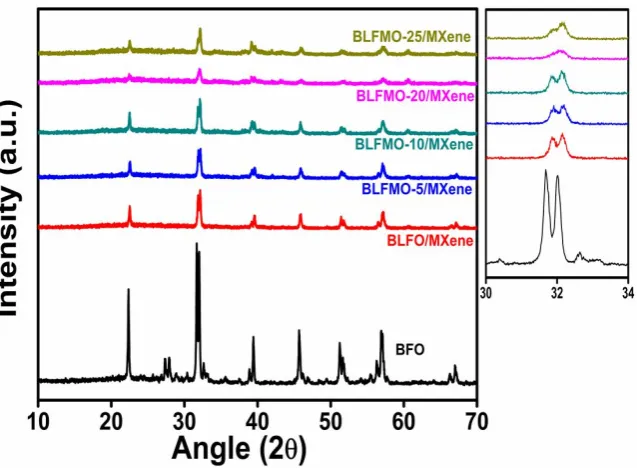
X-ray diffractometer (XRD) was used to study the phase morphology of the synthesized nanohybrids. The structures of nanohybrids prepared by sol gel method, and nanohybrids of (BLFO, BLFMO-5, BLFMO-10, BLFMO-20 and BLFMO-25)/MXene were studied by x-ray diffractometer (XRD) (Figure 1). The pure BFO matches the JCPDS card # 20-0169 for BiFeO3 structure. All diffraction peaks can be indexed as rhombohedral, corresponding to (012), (104), (110), (006), (202), (024), (116), (112), (018), and (214) reflections, respectively. The doublet peak at 32° merges into a single peak which shows the transformation of structure from rhombohedral to orthorhombic. Overall the peaks Shifts towards right in curves for Bi1-xLaxFe1-yMnyO3 is observed compared to the pure BFO, however the dual peaks at 2θ = 31.6° and 32.01° are reduced in intensity and are a bit merged as the concentration of Mn increases [49]. The average particles sizes calculated using Scherrer’s formula [50], D=kλ/βcosθ where D = Crystallite size, k = Debye constant, λ = Wavelength of X-ray, β = FWHM. For pure BFO, BLFO, BLFMO-5, BLFMO-10, BLFMO-20 and BLFMO-25 are 46.32 nm, 33.89 nm, 27.68 nm, 26.65 nm, 2.96 nm and 30.15 nm respectively. There is reduction in particle sizes from pure BFO up to BLFMO-20 as Mn doping increases; however larger particles are formed for BLFMO-25.
Figure 1. (a) XRD patterns of Bi1-xLaxFe1-yMnyO3 (x = 0.1, y = 0.0, 0.05, 0.10, 0.20, 0.25)/MXene nanohybrids (b) magnified patterns ranging 30° to 34°.
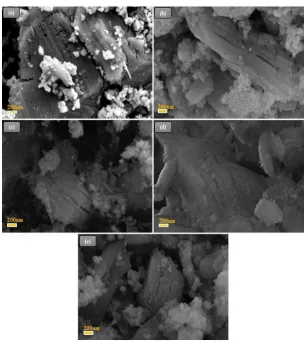
Figure 2. SEM images of (a) BLFO/MXene, (b) BLFMO-5/MXene, (c) BLFMO-10/MXene (d) BLFMO-20/MXene, (e) BLFMO-25/MXene
Figure 3. PL spectra of pure BFO and Bi1-xLaxF1-yMyO3/MXene nanohybrids.
The enhanced photocatalytic activity is due to the higher charge carrier generation/lower electron hole recombination rate and possibly higher surface area, thus providing plenty number ofactivated sites on the sheets for the reactions to take place.
2.2 X-ray photoelectron spectroscopy (XPS)
For the confirmation of elemental composition of the newly proposed hybrid structure x-ray photoelectron spectroscopy (XPS) has been performed for the sample BLFMO-5/MXene containing the doped La and Mn elements. Figure 4 explains the (XPS) analysis. Figure 4(a) shows the survey spectrum encompassing the elemental peaks of Bi, Fe, O, Ti and C in co-doped BFO/MXene nanohybrid. Elements traced in the hybrid structure are discussed in detail hereafter. The spectrum of Bi 4f is spread over a range from 156 to 167 eV as shown in Figure 4(b), the exact sharp peaks calculated at 158.9 eV and 164.2 eV representing the binding energies of Bi 4f7/2 and Bi 4f5/2, respectively. Further stating,the Bi is in the Bi3+ oxidation state.Figure 4(c) shoes the spectrum for Fe,it spreads over a range of 707 eV to 728 eV, qualifying sharp peaks are at 710.7 eV and at 724.4 eV, which show the binding energies of Fe 2p3/2 and Fe 2p1/2, respectively and those are related to Fe3+ ions. Figure 4(d) is for the spectrum of oxygen element in the hybrid, the peak spreads from 528eV to 534 eV; the exact binding energy for O 1s lies at the sharper peak at 529.8 eV which agrees to the binding energy of Fe-O bond.[19] Figure 4(e) shows the spectrum for the carbon C 1s bond, the sharp peak is traced at 284.8 eV as seen which can be deconvoluted into two peaks for C-C and C-O bonds but not described in figure.[21, 58]The presence of elements are justified with the binding energies traced in the hybrid structure’ XPS spectrum. Supporting the fact that a successful hybrid has been formed between the co-doped BFO nanoparticles and Mxene nano sheets
2.3 Diffusive Reflectance Spectroscopy of Nanohybrids
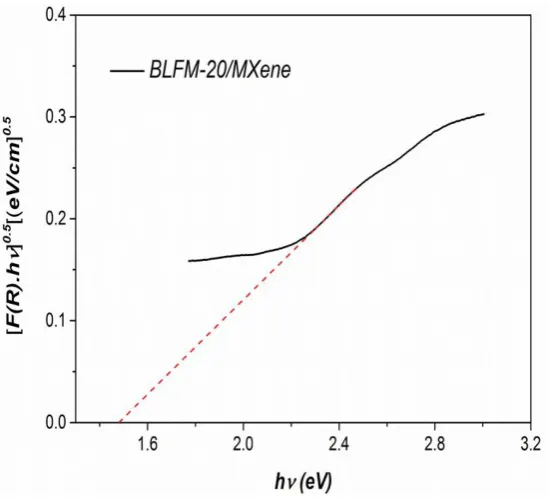
particular, 1.30 eV was calculated for BLFO/MXene, whereas for BLFM-20/MXene the band gap was 1.48 eV (Figure 5).
Figure 4. XPS analysisof BLFMO-5sample (a) survey spectrum (b) Bi 4f core levels (c) Fe 2p core levels (d) O 1s core levels (e) C 1s.
Precise EBG assessment of the rest of MLFM/MXene series was not possible due to the difficulty in discerning the onset of the decrease which may be attributed to small amount of impurity phases [12, 30]. The narrowing of the band gap in nanohybrids in comparison with bare BFO nanoparticles can be explained through the formation of Fe-O-C bonds at the surface of BLFM, which reduces the charge transfer from oxygen ion to Fe ions [30]. Analogous band gap narrowing was observed in literature for graphene/BiFeO3 nanohybrids [52]. The superior band gap narrowing of BFLO/MXene is indicative of better coupling of the BLFO nanoparticles and MXene sheets which was illustrated through SEM images.
2.4 Photocatalytic Degradation
carriers as wanted. Once the process starts, the superoxide anion radicals can be produced •O2−, and meanwhile •OH⁻ radicals can be produced by the reaction of OH⁻ with holes.
Figure 5 Tauc plot of BLFM-20 Mxene from DR-UV Spectroscopy
As the electrons react with the catalyst, the H2O molecules are converted into OH. The radicals produced in the process i.e. •O2 and •OH⁻, being highly reactive for the organic pollutants such as CR, degrades it to the harmless by-products that are CO2 and H2O. The mechanism of degradation is given by the equations below:
hν + Bi1-xLaxFe1-yMnyO3-MXene → e− + h+ (1)
MXene + e− → e− (trap sites MXene) (2)
e− (trap sites MXene) + O2 → •O2 − (3)
H2O + h+→ •OH⁻ (4)
CR + •OH−→ CO2 + H2O (degradation by-products) (5)
CR + •O2 −→ CO2 + H2O (degradation by-products) (6)
Figure 6 Photocatalytic degradation of CR by Pure MXene, BLFO/MXene and BLFMO/MXene nanohybrids against the time taken.
In about 20 minutes both the samples BLFO/MXene and BLFMO-5/Mxene degraded the organic pollutant in the water. The other three samples BLFMO-10/MXene, BLFMO-20/MXene and BLFMO-25/MXene have lower catalytic activity in dark as well as in the light spectrum, lesser efficient and more time consuming compared to the BLFO/MXene and BLFMO-5/MXene nano hybrids that might be due to the increasing Mn concentration. The improved catalytic activity of these proposed nanohybrids, are due to certain factors i.e. wider absorption of photons, reduced recombination rate of charge carriers and higher redox reactions on the surface of the photocatalyst.
3. Materials and Methods
Salts of Bismuth nitrate pentahydrate (Bi(NO3)3.5H2O, 99% pure), Iron nitrate (Fe(NO3)3.9H2O, 98.5% pure), ethylene glycol (C2H6O2, 99%), acetic acid (C2H4O2, 99.5%), and Hydrofluoric Acid (HF, 39 wt%) were used as received.
3.1 Synthesis of MXene sheets
Multi-layered sheets of Ti3C2Tx were fabricated from pure Ti3AlC2 (MAX phase) using the following procedure: Approximately 3g of Ti3AlC2 powder was dissolved in 70 mL of hydrofluoric acid (HF, 39 wt%) in a closed Teflon bottle and stirred magnetically for 60 h at room temperature. Solids were removed from the Teflon bottle, filtered under vacuum, and subsequently washed with DI water and ethanol until a pH~6 was reached. Finally, the washed residue was dried in a convection oven at 60°C for 6h. The residue obtained was Mxene sheets with formula Ti3C2.
3.2 Synthesis doped-BFO nanoparticles
electro-negativities of iron & bismuth during the chemical reaction, whereas acetic acid acted as a catalyst to maintain the solution concentration and for controlled chemical reaction during the synthesis process. The as-prepared solution was dried in a convection oven at 80°C for 12 h to obtain a gel which was calcined in a furnace at 600°C for 3 h. After calcination was completed, the powder was crushed to get a homogenous fine powder.
3.3 Synthesis of Mxene-based nanohybrid
The nanohybrids were fabricated using co-precipitation technique. MXene solution was made in DI water with the molarity of (0.5 mg/ml), followed by ultrasonication for 10 minutes. The co-doped BFO nanoparticles (Bi1-xLaxFe1-yMnyO3) were dissolved in a mixture of ethylene glycol and acetic acid with a 1:1 ratio and (0.01 M) molarity. The Bi1-xLaxFe1-yMnyO3 solutions were ultrasonicated for 1 hour at 60 °C; then the solutions of Bi1-xLaxFe1-yMnyO3were mixed with MXene solutions separately for all hybrids, then the Bi1-xLaxFe1-yMnyO3/Mxene solutions were stirred magnetically for 2 hours at 80°C for co-precipitation synthesis. The products were washed with DI water several times and were dried at 60 °C for 3 hours.
4. Characterization
Samples were analyzed for their structure using the X-ray diffraction (XRD), Cu-Kα radiation source (XRD, Rigaku 2500, Japan). The samples were analyzed for a range of 10-70 degrees. Surface and morphology of hybrids were investigated using field emission scanning electron microscope (FESEM, JEOL7001F). To avoid the charging effect platinum was sputter coated on the nanohybrid before FESEM exposure. Photoluminescence spectroscopy was done to calculate the carrier’s generation/recombination rate. Binding energies of elements present in hybrid were checked using X-ray photoelectron spectroscopy (XPS). The solid state diffuse reflectance UV/Vis spectra of the La-, Mn- co-doped BFO nanoparticles were recorded with a double beam UV/Vis-NIR spectrophotometer (Cary 5000, Varian) equipped with a diffuse reflection accessory (Praying Mantis, Harrick). Baseline correction was achieved using a BaSO4 standard. Approximately, 50 mg of each sample was dispersed in 150 mg BaSO4 for the measurement. The reflectance was converted to the Kubelka Munk function F(R) with Cary WinUV software.
5. Conclusion
La and Mn Co-doped BiFeO3 (BFO) nanoparticles as Bi1-xLaxFe1-yMnyO3with concentrations (x = 0.1, y = 0.0, 0.05, 0.10, 0.20, 0.25) were synthesized using double-solvent sol-gel method. The two-dimensional (2D) MXene sheets were synthesized from their pure MAX phase (Ti3AlC2) by selective etching of Aluminium using Hydrofluoric acid (HF) at room-temperature. The Bi1-xLaxFe1-yMnyO3/Mxene nanohybrids were fabricated using co-precipitation technique. Nanohybrids were found to have large electron-hole pairs generation and low recombination time compared to pure BFO nanoparticles. The nanohybridswere further tested for photocatalytic degradation of Congo red and were proved to be the best catalysts in dark and better photo °catalysts under visible light irradiation, BLFO/MXene degraded the dye in only 10 minutes of irradiation and BLFMO-5/Mxene in 20 minutes. The hybrids reported are novel and best candidates for catalytic activities, which makes them potential candidates for commercial applications owing to its low-cost synthesis route.
Authors Contribution
M. Abdullah Iqbal, S. Irfan Ali and Ayesha Tariq carried out experimentation, Muhammad Z. Iqbal helped in manuscript writing and data analysis, Syed Rizwan, designed and supervised the project.
Acknowledgement
Conflicts of interest
There are no conflicts of interests between the authors.
References
1. Walker, G.; Hansen L.; Hanna J-A.; Allen S-J.; Kinetics of a reactive dye adsorption onto dolomitic sorbents. Water Research 2003, 37(9), 2081–2089.
2. Flavio Pavan, A.; Silvio Dias, L-P.; Eder Lima C.; Edilson Benvenutti, V.; Removal of Congo red from aqueous solution by anilinepropylsilica xerogel. Dyes and Pigments 2008, 76(1), 64-69. 3. Mall, I-D.; Srivastava, V-C.; Mishra I-M.; Removal of congo red from aqueous solution by bagasse
fly ash and activated carbon: kinetic study and equilibrium isotherm analyses. Chemosphere 2005, 61(4), 492-501.
4. Gupta, V-K.; Agarwal, S.; Saleh, T-A.; Synthesis and characterization of alumina-coated carbon nanotubes and their application for lead removal. Journal of hazardous materials 2011, 185(1) 17-23. 5. Rafatullah, M.; Adsorption of methylene blue on low-cost adsorbents: a review. Journal of
hazardous materials 2010, 177(1), 70-80.
6. Iqbal, M-Z.; Abdala, A-A.; Thermally reduced graphene: synthesis, characterization and dye removal applications. RSC Advances 2013, 3(46), 24455-24464.
7. Iqbal, M.Z.; Priyabrata, P.; Moohamad S.; Ahmed A-A.; Efficient removal of different basic dyes using graphene. Desalination and Water Treatment 2017, 68, 226-235.
8. Al-Bastaki, N.; Removal of methyl orange dye and Na2SO4 salt from synthetic waste water using reverse osmosis. Chemical Engineering and Processing: Process Intensification 2004, 43(12), 1561-1567. 9. Lee, J.-W.; Seung-phil, C.; Ramesh, T.; Wang-geun S.; Evaluation of the performance of
adsorption and coagulation processes for the maximum removal of reactive dyes. Dyes and pigments 2006, 69(3), 196-203.
10. Moghaddam, S.-S.; Moghaddam, M.-A.; Arami, M.; Coagulation/flocculation process for dye removal using sludge from water treatment plant: optimization through response surface methodology. Journal of hazardous materials 2010, 175(1), 651-657.
11. Stolz, A.; Basic and applied aspects in the microbial degradation of azo dyes. Applied microbiology and biotechnology 2001, 56(1), 69-80.
12. Irfan, S.; Rizwan S.; Yang, S.; Liangliang L.; Asfandiyar, sajid, B.; Nan, C.-W; The gadolinium (Gd3+) and Tin (Sn4+) Co-doped BiFeO3 nanoparticles as new solar light active photocatalyst. Scientific Reports, 2017, 7, 42493-42505.
13. Carenco, S.; David, P.; Cedric, B.; Nicolas M.; Clement S.; Nanoscaled metal borides and phosphides: recent developments and perspectives. Chemical reviews 2013, 113(10) 7981-8065. 14. Tachikawa, T.; Yamashita, S.; Majima, T.; Evidence for crystal-face-dependent TiO2
photocatalysis from single-molecule imaging and kinetic analysis. Journal of the American Chemical Society 2011, 133(18), 7197-7204.
15. Sun, K.; Jing, Y.; Namseok P.; Chun, L.; Yoshio, B.; Wang, D.; Solution synthesis of large-scale, high-sensitivity ZnO/Si hierarchical nanoheterostructure photodetectors. Journal of the American Chemical Society 2010, 132(44), 15465-15467.
16. Gore, S.-K.; Santosh, S.; Vijaykumar V.-J.; Patange, S.-M.; Naushad, M.; Rajaram, S.-M.; Kwang, H.-K.; The structural and magnetic properties of dual phase cobalt ferrite. Scientific Reports, 2017, 7, 2524.
17. Gao, F.; Chen. X.-Y.; Yin, K.-B.; Dong, S.; Ren, Z.-F.; Yuan, F.; Yu, T.; Zou, Z.-G.; Liu, J.-M.; Visible- Light Photocatalytic Properties of Weak Magnetic BiFeO3 Nanoparticles. Advanced Materials 2007, 19(19) 2889-2892.
18. Chaturvedi, S.; Das, R.; Poddar, P.; Sulabha, K.; Tunable band gap and coercivity of bismuth ferrite–polyaniline core–shell nanoparticles: the role of shell thickness. RSC Advances 2015 5(30) 23563-23568.
19. Fatima, S.; Irfan, S.-A; Iqbal, M.-Z.; Rizwan, S.; The high photocatalytic activity and reduced band gap energy of La and Mn co-doped BiFeO3/graphene nanoplatelet (GNP) nanohybrids. RSC Advances 2017, 7(57) 35928-35937.
21. Kubel, F.; Schmid, H.; Structure of a ferroelectric and ferroelastic monodomain crystal of the perovskite BiFeO3. Acta Crystallographica Section B: Structural Science 1990, 46(6)698-702.
22. Bucci, J.; Robertson, B.; James, W.; The precision determination of the lattice parameters and the coefficients of thermal expansion of BiFeO3. Journal of Applied Crystallography 1972, 5(3) 187-191. 23. Zheng, X.; Xu, Q.; Wen Z.; Lang, X.; Wu, D.; Qiu, T.; Xu, M.-X.; The magnetic properties of La
doped and codoped BiFeO3. Journal of Alloys and Compounds, 2010, 499(1) 108-112.
24. Kothari, D.; Reddy, V.-R.; Ajay, G.; Phase, D.-M.; Lakshmi, N.; Deshpande, S.-K.; Awasthi, A.-M.; Study of the effect of Mn doping on the BiFeO3 system. Journal of Physics: Condensed Matter 2007, 19(13) 136202.
25. Li, M.; Ning, M.; Yungui, M.; Qibin, W.; Room temperature ferroelectric, ferromagnetic and magnetoelectric properties of Ba-doped BiFeO3 thin films. Journal of Physics D: Applied Physics 2007, 40(6) 1603.
26. Bartkowska, J.; Dynamical magnetoelectric coupling in multiferroic BiFeO3. International Journal of Thermophysics 2011, 32(4) 739-745.
27. Arya, G.; Negi, N.; Effect of In and Mn co-doping on structural, magnetic and dielectric properties of BiFeO3 nanoparticles. Journal of Physics D: Applied Physics 2013, 46(9), 095004. 28. Zhang, Z.; Liu, H.; Lin, Y.; Wei, Y.; Nan, C.-W.; Influence of La doping on magnetic and optical
properties of bismuth ferrite nanofibers. Journal of Nanomaterials 2012, 2012, 4.
29. Kanhere, P.; Chen, Z.; A review on visible light active perovskite-based photocatalysts. Molecules 2014, 19(12)19995-20022.
30. Li, Z.; Yang, S.; Yang, C.; Lei, Y.; Guan, Y.; Liu, D.; Nan, C.-W; Significant enhancement in the visible light photocatalytic properties of BiFeO3–graphene nanohybrids. Journal of Materials Chemistry A 2013, 1(3)823-829.
31. Mas-Balleste, R.; Gomez-Navarro, C.; Gomez-Herrero, J.; Zamora, F.; 2D materials: to graphene and beyond. Nanoscale 2011. 3(1) 20-30.
32. Novoselov, K.; Jiang, D.; Schendin, F.; Booth, T.-J.; Khotkevich, V.-V.; Morozov, S.-V.; Geim, A.-K.; Two-dimensional atomic crystals. Proceedings of the National Academy of Sciences of the United States of America 2005, 102(30) 10451-10453.
33. Gupta, A.-T., Sakthivel, Seal, S.; Recent development in 2D materials beyond graphene. Progress in Materials Science 2015, 73, 44-126.
34. Zhu, Y.; Murali, S.; Cai, W.; Li, X.; Suk, J.-W.; Potts, J.-R.; Rouff, R.-S.; Graphene and graphene oxide: synthesis, properties, and applications. Advanced materials 2010, 22(35), 3906-3924.
35. Geim, A.-K.; Graphene: status and prospects. Science 2009, 324(5934), 1530-1534. 36. Chopra, N.-G.; Boron nitride nanotubes. Science 1995, 269(5226) 966.
37. Watanabe, K.-T.; Taniguchi, Kanda, H.; Direct band-gap properties and evidence for ultraviolet lasing of hexagonal boron nitride single crystal. Nature materials 2004, 3(6) 404-409.
38. Song, L.; Ci, L.; Hao, L.; Pavel, B.-S.; Jin, C.; Jie, N.; Alexander G.-K.; Dmitry G.-K.; Jun, L.; Large scale growth and characterization of atomic hexagonal boron nitride layers. Nano letters 2010, 10(8), 3209-3215.
39. Jariwala, D.; Sangwan, V.-K.; Lauhon, L.-J.; Marks, T.-J.; Hersam, M.-C.; Emerging device applications for semiconducting two-dimensional transition metal dichalcogenides. ACS nano 2014, 8(2), 1102-1120.
40. Wang, Q.H., Kourosh, K.-Z.; Kis, A.; Jonathan, N.-C.; Michael, S.-S.; Electronics and optoelectronics of two-dimensional transition metal dichalcogenides. Nature nanotechnology 2012, 7(11), 699-712.
41. Ghidiu, M.; Naguib, M.; Mashtalir, O.; Zhang, B.; Yang, Y.; Billinge, S.-j.-l.; Barsoum, M.-W;. Synthesis and characterization of two-dimensional Nb4C3 (MXene). Chemical Communications 2014, 50(67) 9517-9520.
42. Anasori, B.; Xie, Y.; Beidaghi, M.; Lu, J.; Hosler, B.-C.; Hultman, L.; Kent, P.-R.-C; Gogotsi, Y.; Barsoum, M.-W.; Two-dimensional, ordered, double transition metals carbides (MXenes). Acs Nano, 2015, 9(10), 9507-9516.
43. Naguib, M.; Halim, J.; Lu, J.; Cook, K.-M; Hultman, L.; Gogotsi, Y.; Barsoum, M.-W.; New two-dimensional niobium and vanadium carbides as promising materials for Li-ion batteries. Journal of the American Chemical Society 2013, 135(43), 15966-15969.
45. Khazaei, M.; Arai, M.; Sasaki, T.; Ching, C.-Y.; Natarajan, S.-V.; Mehdi, E.; Sakka, Y.; Kawazoe, Y.; Novel electronic and magnetic properties of two- dimensional transition metal carbides and nitrides. Advanced Functional Materials 2013, 23(17), 2185-2192.
46. Soltani, T.; and Lee, B.-K.; Sono-synthesis of nanocrystallized BiFeO3/reduced graphene oxide composites for visible photocatalytic degradation improvement of bisphenol A. Chemical Engineering Journal 2016, 306, 204-213.
47. Wang, X.; Mao, W.; Wang, Q.; Zhu, Y.; Min, Y.; Zhang, J.; Yang, T.; Yang, J.; Li, X.; Huang, W.; Low-temperature fabrication of Bi25FeO40/rGO nanocomposites with efficient photocatalytic performance under visible light irradiation. RSC Advances 2017, 7(17), 10064-10069.
48. Dai, J.; Xian, T.; Di, L.-J.; Yang, H.; Preparation of BiFeO3-graphene nanocomposites and their enhanced photocatalytic activities. Journal of Nanomaterials 2013, 2013, 1-5.
49. Irfan, S.; Rizwan, S.; Shen, Y.; Tomovska, R.; Zulfiqar, S.; Iliyas, M.-I.; Nan, C.-W.; Mesoporous template-free gyroid-like nanostructures based on La and Mn co-doped bismuth ferrites with improved photocatalytic activity. RSC Advances 2016, 6(115), 114183-114189.
50. Asuha, S.; Zhou, X.-G.; Zhao, S.; Adsorption of methyl orange and Cr(VI) on mesoporous TiO2 prepared by hydrothermal method. Journal of Hazardous Materials, 2010, 181(1-3), 204-210. 51. López, R.; Gómez, R.; Band-gap energy estimation from diffuse reflectance measurements on sol–
gel and commercial TiO2: a comparative study. Journal of sol-gel science and technology 2012, 61(1), 1-7.