Video Denoising Algorithm: A Review
Preeti Shukla1, Mr. Jageshwar Srivas2
1
Research Scholar, M.Tech., Computer Science Department, C.V.R.U., Bilaspur(C.G.)
2
Asst.Prof., Computer Science department, C.V.R.U. , Bilaspur (C.G.)
Abstract- This paper provides a detailed literature survey of various video noising techniques. Most of the video de-noising algorithms are done through the motion detection technique. The main goal is to allow a survey of varied noise reduction techniques for video. Object detection is the first level of video de-noising. The first level are often achieved through Motion Detection. This paper explained about the motion estimation and compensation techniques. The different video de-noising techniques, motion detection techniques and the noises used have been studied thoroughly.
Keywords: Statistical image modeling ,motion estimation, video de-noising, Filter, Adaptive filtering
I. INTRODUCTION
VIDEO signals are thought of as a sequence of two-dimensional pictures, projected from a dynamic three-dimensional scene onto the image plane of a video camera. Luminance and chrominance are 2 attributes that describe the color sensation in an exceedingly video sequence of an individual's being. Luminance refers to the perceived brightness of the lightweight, while chrominance corresponds to the color tone of the sunshine. Numerous still images and video de-noising algorithms have been developed to boost the standard of the signals over the previous couple of decades [1]. Many of the algorithms are based mostly on probability theory, statistics, partial differential equations, linear and nonlinear filtering, spectral and multi-resolution analysis. How-ever, image de-noising can be extended to a video by applying it to every video frame severally. Depending on varied signal-processing issues varied algorithms are planned principally for image de-noising [2]. A human observer cannot resolve fine details within any image attributable to the presence of speckling. The available techniques are largely based mostly on noise suppression techniques within the post-image formation type; use framework to suppress the signal yet as its speckles. The property of image sparcity is associate degree necessary key to de-noise image and video signals yet. Sparcity additionally resides in videos. Most videos are temporally consistent; a new frame are often well expected from previous frames. The idea of mixing multiple pictures to urge a desired one is named image fusion and might be accustomed manufacture a de-noised video. Video signals are usually corrupted by additive noise or motion blur. Often, the noise can be sculptural effectively as a mathematician random method freelance of the signal. Although the state of the art video de-noising algorithms usually satisfy the temporal coherence criterion in removing additive white Gaussian noise (AWGN) [3]-[6]. Normally all coherent imaging processes, such as, synthetic aperture radio detection and ranging (SAR) and
narrow-band ultrasound suffer from speckle noise. The SAR images are accessible in 2 formats. One is amplitude format and the other one is in intensity format. The magnitude of the speckles follows the Rayleigh chance distribution and corresponding phases follow uniform distribution [7]. The speckle intensity is described by a negative exponential distribution. By multi-look averaging the undesirable effects of speckle in a SAR image are often easily reduced. For the case of intensity knowledge the applied math distribution of the resultant speckle within the degraded resolution image is given by the Gamma distribution and just in case of amplitude data multi-convolution of the Rayleigh. Probability density is thought of. Speckle in SAR images is typically sculptural as increasing random noise [8], whereas most available filtering algorithms were developed for additive white mathematician noise (AWGN) in the context of image de-noising and restoration, as additive noise is most common in imaging and sensing systems.
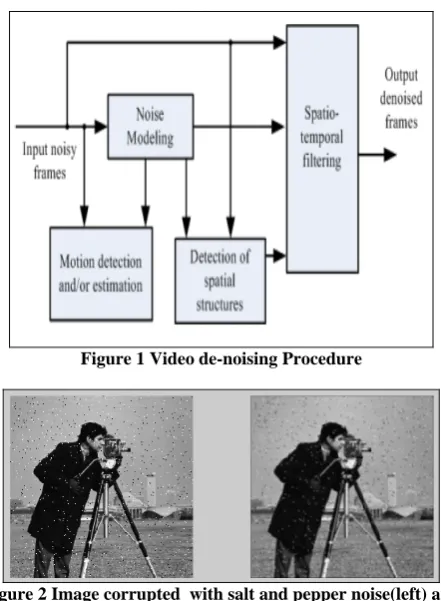
Figure 1 Video de-noising Procedure
Figure 2 Image corrupted with salt and pepper noise(left) and filtered image(right)
spatio-temporal sense. The best video de-noising may be achieved by exploiting information from each future and past frames. But this leads to a further delay of a minimum of one frame that is undesirable in some time period applications. For this reason, many algorithms exploit data from typically the current frame and one or 2 previous frames. In image frame de-noising algorithms focus to find the most effective compromise between noise removal and preservation of vital de-noised image frames. Here each frame is severally processed. That is why for optimal filter performance the spatio-temporal properties of the processed noisy image frames area unit taken into thought. The general framework for video de-noising is illustrated in Fig. 1. An correct modelling of noise is necessary so as to estimate noise-free spatio-temporal sequence structures. To distinguish between the noise and therefore the noise-free spatio-temporal correlations within the image frames the data concerning the noise and therefore the noisy input frames area unit combined along. In this way, the spatio-temporal structures can be calculable Associate in Nursing exceedingly in a very} noise-insensitive manner and consequently modify an computationally economical noise removal with the preservation of all the vital spatio-temporal sequence options [9].
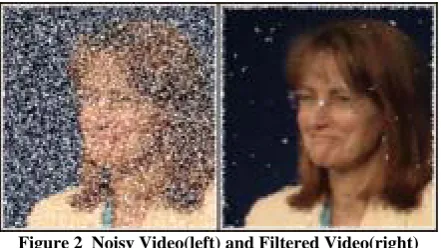
Figure 2 Noisy Video(left) and Filtered Video(right)
II. PAST WORK
In the paper [10] authors proposed a novel adaptive spatiotemporal filter, called the accommodative weighted averaging (AWA) filter, for effective noise suppression in image sequences without introducing visually worrying blurring artefacts. Filtering is performed by computing the weighted average of image values within a spatiotemporal support on the calculable motion mechanical phenomenon at every pixel. The weights are determined by optimizing a well outlined mathematical criterion, which provides AN implicit mechanism for deemphasizing the contribution of the outlier pixels inside the spatiotemporal filter support to avoid blurring. The AWA filter is therefore notably well suited for filtering sequences that contain segments with short ever-changing scene content as a result of, for example, rapid zooming and changes in the reading of the camera. The performance of the proposed AWA filter is compared with that of the spatiotemporal, local linear minimum mean sq. error (LMMSE) filtering. The results demonstrate that the proposed AWA filter-outperforms the LMMSE filter, especially in the cases of low S/N ratios and short variable scene content.
This paper [11] proposes a computationally fast theme for de-noising a video sequence. Temporal process is done individually from abstraction processing and also the 2 square measure then combined to urge the de-noised frame. The temporal redundancy is exploited using a scalar state 1D Kalman filter. A novel way is planned to estimate the variance of the state noise from the buzzing frames. The spatial redundancy is exploited mistreatment associate degree adaptation edge-preserving Wiener filter. These two estimates square measure then combined mistreatment easy averaging to get the ultimate de-noised frame. Simulation results for the foreman, trevor and susie sequences show an improvement of six to eight sound unit in PSNR over the buzzing frames at PSNR of twenty eight and twenty four dB.
In The paper[12] The de-noising of video data ought to take into account each temporal and abstraction dimensions, however, true 3D transforms are seldom used for video de-noising. Separable 3-D transforms have artefacts that degrade their performance in applications. This paper describes the design and application of the non-separable homeward-bound 3-D dual-tree ripple remodel for video de-noising. This transform offers a motion-based multi-scale decomposition for video - it isolates in its sub-bands motion on completely different directions. In addition, we investigate the de-noising of video mistreatment the 2-D and 3-D dual-tree homeward-bound ripple transforms, where the 2-D remodel is applied to every frame one by one.
In the paper[13], authors develop a new filter that mixes spatially adaptive noise filtering among the wave domain and temporal filtering among the signal domain. For spatial filtering, authors propose a new wave shrinkage technique, which estimates but probable it is that a wave constant represents a "signal of interest" given its price, given the locally averaged constant magnitude and given the world subband statistics. The temporal filter combines a motion detector and recursive time-averaging. The results show that this combination outperforms single resolution spatio-temporal filters in terms of quantitative performance measures furthermore as in terms of visual quality. Even though our current implementation of the new filter does not allow processing, authors believe that its optimized package implementation may be used for real- or near amount filtering.
spatio-temporal filters in time and ripple domains, both in terms of PSNR and visual quality.
In paper[15] authors propose a straightforward non-linear content-adaptive filter that's economical in removing noise from a video. The proposed filter is referred to as spatiotemporal varied filter (STVF) and is in a position to provide optimum ends up in the sense that it minimizes the weighted least sq. error. STVF combines the advantages of standard de-noising filters that modify it to decrease the noise variance in sleek areas however at a similar time retains the sharpness of edges in object boundaries. Simulation results show that STVF outperforms the conventional de-noising strategies like low-pass filtering, median filtering and Wiener filtering.
In the paper[16], Wavelet based image de-noising algorithm has been presented by the authors.-Wavelet-based image de-noising can be extended to a video by applying it to every video frame severally. The de-noising performance can be improved by exploiting inter-frame correlations, for example, using applicable temporal filtering. However, fixed temporal filters may not perform sufficiently well thanks to their inability to deal with the variability of inter-frame correlations across the video. While several adjustive temporal filtering approaches for de-noising in spatial domain have been projected, they do not straightforwardly reach wavelet-based de-noising. Authors propose a vector extension of in style hidden Markoff tree modelling that flexibly exploits the colour and frame dependency of wave coefficients. Experimental results confirm that the vector figurer of wave coefficients yields de-noising performance superior to that of existing solutions, both in CPSNR and visual quality sense.
In the paper[17], a new pixel domain spatio-temporal video noise filter for archive film restoration has been planned. The proposed filtering methodology takes motion changes and spatial data into account. Firstly, temporal filtering is carried out considering temporal changes adaptively. Afterwards, interpolation between degraded and temporally filtered images is carried out to preserve edge data exploitation native variance values. With respect to pixel domain techniques planned within the literature, the proposed methodology offers higher results for varied check videos and significantly provides superior results for archive film.
In Paper[18], authors propose associate degree economical and correct wavelet-based noise estimation methodology for white mathematician noise in video sequences. The proposed methodology analyzes the distribution of spatial and temporal gradients in the video sequence so as to estimate the noise variance. The estimate is derived from the foremost frequent gradient within the two distributions and is salaried for the errors thanks to the spatio-temporal image sequence content, by a novel correction function. The spatial and temporal gradients area unit determined from the finest scale of the spatial and temporal moving ridge rework, respectively. The main application of the noise estimation algorithm is in wavelet-based video process. The results show that the proposed methodology is additional correct than different progressive
noise estimation techniques and less sensitive to variable spatio-temporal content and amplitude.
Paper[19] propose Associate in Nursing effective video de-noising technique supported extremely distributed signal illustration in native 3D remodel domain. A noisy video is processed in block-wise manner and for every processed block authors tend to type a 3D knowledge array that authors tend to decision “group” by stacking along blocks found like the presently processed one. This grouping is realized as a spatio-temporal predictive-search block-matching, similar to techniques used for motion estimation. Each shaped 3D cluster is filtered by a 3D transform-domain shrinkage (hard-thresholding and Wiener filtering), the result of which area unit estimates of all sorted blocks. This filtering - that authors term “collaborative filtering” - exploits the correlation between sorted blocks and the corresponding extremely distributed illustration of actuality signal within the remodel domain. Since, in general, the obtained block estimates are reciprocally overlapping, authors mixture them by a weighted average in order to create a non-redundant estimate of the video. Significant improvement of this approach is achieved by exploitation a ballroom dancing algorithmic rule wherever Associate in Nursing intermediate estimate is made by grouping and cooperative hard-thresholding and so used each for rising the grouping and for applying cooperative empirical Wiener filtering. We develop Associate in Nursing economical realization of this video de-noising algorithmic rule. The experimental results show that at reasonable machine value it achieves progressive de-noising performance in terms of each peak magnitude relation, signal to noise ratio and subjective visual quality.
In this paper[20], the optimal spatial adaptation (OSA) methodology projected by Boulanger and Kervrann (2006) has tested to be quite effective for spatially adaptive image de-noising. This method, in addition to extending the non-local means (NLM) methodology of A. Buades et al. (2005), employs an iteratively growing window theme, and a local estimate of the mean sq. error to terribly effectively take away noise from pictures. By adopting an iteratively growing coordinate system window, the method was recently extended to 3D for video denoising in J. Boulanger et al. (2007). In the present paper, authors demonstrate a easy, but effective improvement on the OSA methodology in each 2- and 3D. Authors demonstrate that the OSA implicitly depends on a regionally constant model of the underlying signal. Thereby, removing this constraint and introducing the possibility of upper order native regression models, authors arrive at a comparatively easy modification that ends up in Associate in Nursing improvement in performance. While this improvement is ascertained in each second and 3D, authors concentrate on demonstrating it in 3D for the applying of video de-noising.
support regions and a lot of orientations than DDWT wavelets. To determine the decomposition structure, authors develop a greedy basis choice algorithmic program for ADDWP, which has considerably lower machine quality than a antecedent developed best basis choice algorithmic program, with only slight performance loss. For de-noising the ADDWP coefficients, a statistical model is used to use the dependency between the important and notional elements of the coefficients. The proposed de-noising theme offers higher performance than many progressive DDWT-based schemes for pictures with made directional options. Moreover, our scheme shows promising results while not victimization motion estimation in video de-noising. The visual quality of images and videos de-noised by the planned theme is additionally superior .
Paper[22] present a nonlocal algorithms for video de-noising, simplification and in-painting based on a generic framework of separate regularization on graphs. Author performed categorical video de-noising, simplification and in-painting problems mistreatment the same variational formulation. The main advantage of this framework is that the unification of local and nonlocal approaches for these process procedures. Authors take advantage of temporal and spatial redundancies so as to provide top quality results. In this paper, author think about a video sequence as a volume rather than a sequence of frames, and employ algorithms that don't need any motion estimation. For video in-painting, author unify geometric- and texture-synthesis-based approaches. To reduce the procedure effort, authors propose AN optimized technique that is quicker than the nonlocal approach, while manufacturing equally appealing results.
Most existing video de-noising algorithms assume a single statistical model of image noise, e.g. additive Gaussian white noise, which usually is desecrated in follow. In the paper[23], authors gift a new patch-based video de-noising formula capable of removing serious mixed noise from the video information. By grouping similar patches in both abstraction and temporal domain, they formulate the downside of removing mixed noise as a low-rank matrix completion downside, which leads to a de-noising theme while not sturdy assumptions on the applied mathematics properties of noise. The resulting nuclear norm connected step-down downside will be with efficiency solved by several recently developed ways. The robustness and effectiveness of our planned de-noising formula on removing mixed noise, e.g. heavy mathematician noise mixed with impulsive noise, is validated in the experiments and this planned approach compares favourably against some existing video de-noising algorithms.
Although the recent advances in the distributed representations of pictures have achieved outstanding de-nosing results, removing real, structured noise in digital videos remains a challenging drawback. This paper[24] shows the utility of reliable motion estimation to establish temporal correspondence across frames so as to attain high-quality video de-noising. In this paper, authors propose Associate in Nursing adaptive video de-nosing framework
that integrates strong optical flow into a non-local suggests that (NLM) framework with noise level estimation. The spatial regularization in optical flow is the key to make sure temporal coherence in removing structured noise. Furthermore, authors introduce approximate K-nearest neighbor matching to considerably scale back the complexness of classical NLM strategies. Experimental results show that our system is comparable with the state of the art in removing AWGN, and significantly outperforms the state of the art in removing real, structured noise.
III. CONCLUSION
In this research paper we have reviewed the sundry methodologies for Image and video De-noising. The performances of several prominent algorithms for de-noising videos were investigated. This work was staunch to the review on the performances of image de-noising algorithms predicated on sundry methods including the Wavelet transform. The Wavelet transform and its characteristics were investigated through literature review. Effects of different Wavelet bases on the de-noising performance were studied. Wavelets may be good for de-noising of images because of their energy compactness, sparseness and correlation properties still simple thresholding methods are inadequate in their de-noising performance. There are sundry image de-noising filters such as moving average, Wiener filtering, median filtering and the non-local mean algorithm can be adopted for getting the optimum video de-noising performance.
REFERENCES-
[1] C. Liu and W. T. Freeman, “A High-Quality Video Denoising Algorithm Based on Reliable Motion Estimation.” Computer Vision – ECCV 2010. Ed. Kostas Daniilidis, Petros Maragos, & Nikos Paragios. LNCS Vol. 6313. Berlin, Heidelberg: Springer Berlin Heidelberg, 2010, pp.706–719.
[2] P. Moulin and J. Liu, “Analysis of multiresolution image denoising schemes using generalized Gaussian and complexity priors,” IEEE Trans. on Info. Theory, Vol. 45, No. 3, 1999, pp.909-919. [3] M. Maggioni, G. Boracchi, A. Foi and K. Egiazarian, “Video
Denoising, Deblocking, and Enhancement Through Separable 4-D Nonlocal Spatiotemporal Transforms,” , IEEE Trans. on Image Process., Vol. 21, No. 9, 2012, pp.3952 - 3966.
[4] A. Amer and E. Dubois, “Fast and reliable structure-oriented video noise estimation,” IEEE Trans. on Circuits and Systems for Video Technology, Vol. 15, No. 1, 2005, pp.113–118.
[5] H. Cheong, A. Tourapis, J. Llach and J. Boyce, “Adaptive spatio-temporal filtering for video de-noising,” IEEE, Inter. Conf. on Image Process., 2004, pp.965–968.
[6] G. de Haan, P. Biezen, H. Huijgen, and O. Ojo, “True-motion estimation with 3-d recursive search block matching,” IEEE Trans. on Circuits and Systems for Video Technology, Vol. 3, No. 5, 1993, pp.368–379
[7] J. S. Lee, “Speckle analysis and smoothing of synthetic aperture radar images,” Comput. Graph. Image Process., Vol-17, 1981, pp.24-32.
[8] J. A. Stiles, K. S. Shanumugan, and J. C. Holtzman, “A model for radar images and its application to adaptive digital filtering of multiplicative noise,” IEEE Trans. Pattern Anal. Mach. Intell., Vol. 4, No. 2, 1986, pp. 157-165.
[9] V. Zlokolica, "Advanced Nonlinear Methods for Video Denoising," PhD Thesis, Faculteit Ingenieurswetenschappen Academiejaar, 2005-2006, Universiteit Gent.
[10] Ozkan M. K., Sezan I., and Tekalp A. M, Adaptive Motion Compensated Filtering of Noisy Image Sequences, IEEE Transaction on Circuits and Systems for Video Technology, Vol.3, No. 4, (1993) 277-290.
and Wiener Estimates”, IEEE International Conference on Image Processing, Kobe, Japan, 4, (1999) 152-161.
[12] Selesnick I. W., and Li K. Y, “Video Denoising Using 2d and 3d Dual-Tree Complex Wavelet Transforms”, In Wavelet Applications in Signal and Image Processing (SPIE 5207), San Diego, 5207, (2003) 607-618.
[13] Pizurica A, Zlokolica V, Philips W, Combined Wavelet Domain and Temporal Video Denoising, IEEE Conference on Advanced Video and Signal Based Surveillance (AVSS2003), (2003) page 334-341.
[14] [10] Gupta N, Swamy M. N. S, and Plotkin E. I, Low-Complexity Video Noise Reduction in Wavelet Domain, IEEE 6th Workshop on Multimedia Signal Processing, (2004) 239-242.
[15] Chan T.-W, Au O. C, Chong T. S, and Chau W.S,A Novel Content-Adaptive Video Denoising Filter, IEEE ICASSP, Philadelphia, PA, USA, Vol. 2, (2005) 649-652.
[16] Nai-Xiang Lian, Vitali Zagorodnov and Yap Peng Tan, “Video denoising using vector estimation of wavelet coefficients”, IEEE 2006, ISCAS2006.
[17] M Kermal Gullu, Oguzhan urhan and Sarp Eeturk, “Pixel domain spatio-temporal denoising for archive videos”, ISCIS 2006, springer-Verlag Berlin Heidelberg 2006
[18] Vladimir Zlokolica, Aleksandra Pizurica, Wilfried Philips, Noise estimation for video processing based on saptio temporal gradients,
IEEE signal processing letters,Vol.13, No.6, june 2006.
[19] Kostadin Dabov, Alessandro Foi and Karen Egiazarian, “video denoising by sparse 3D transform-domain collaborative filtering”, EUSIPCO 2007, Poland, Sep. 3-7,2007.
[20] Hae Jong Seo and Peyman Milanfar, “video denoising using higher order optimal space-time adaptation”, ICASSP 2008,I EEE 2008. [21] Jingyu Yang, Yao Wang, Wenli Xu and Qionghai Dai, “Image and
video denoising using adaptive dual tree Discrete wavelet packets”, IEEE transaction on circuits and systems for video technology.
[22] Mahmoud Ghoniem, Yoursef chahir and Ahdrrahim Elmoatar,” Non local video denoising, simplification and inpainting using discrete regularization on graphs”, 2009 ELSEVIER.
[23] HuiJi,ChaoqiangLiu, Zuoweishon and Yuhongxu,“Robust video
denoising using lowranKmatrixcompletion,http.//media.xiph.org/video/derf.
[24] William T. Freeman, C Liu, “A High quality video denoising algorithm based on reliable motion estimation”, 2010 Spinger, ECCV2010.