Secure Color Visual Secret Sharing Scheme Using
Shifting Coefficient with No Pixel Expansion
John Justin M, Manimurugan S, Alagendran B
Department of Computer Science and Engineering, Karunya University,
Coimbatore,India
Abstract-The focus is to design a framework for a color visual secret sharing scheme highlighting towards its security and pixel expansion problems. A Secret image has been diffused in between two meaningful cover images called share images. The participant who stacks both the share images can only obtain the secret image. In addition to that an extra confidential image has been embedded in share images to provide additional security in promoting the authentication to the participant and it carries the lifetime of the secret image. To reveal the extra confidential image, place the first share constantly and shift the second share to some unit. In this Paper a shifting coefficient value has been introduced to shift the second share image to certain unit, here the shifting coefficient acts as a key in-between the participant without which the Extra confidential image will not be revealed, which promotes good level of security also no pixel value has been expanded throughout the process.
Keywords-Visual Cryptography, Visual Secret Sharing Scheme, No Pixel expansion, Shifting Coefficient.
I. INTRODUCTION
Internet is important but insecure platform for communication. Many digital images that carry secret information are transmitted via internet. Hence it becomes common, sending secret information through internet in our day to day life. Once if the Secret information is leaked to unauthorized users then it leads to unpredictable loss to the owner or participant. For example, if the bank accounts detail or credit card information were leaked then it leads to financial risk. Therefore it is necessary to secure the secret information while transmitting it through internet. For securing the information many encryption algorithm has been proposed earlier like conventional cryptosystem such as AES(Advanced Encryption Standard),DES(Data Encryption Standard),ECC (Elliptic Curve
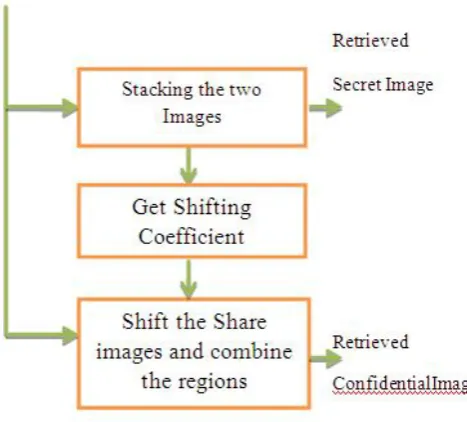
Cryptography),RSA (RSA) they are vulnerable to the attacks perform by the attackers one or in the other way. In order to meet this vulnerability data hiding scheme like visual secret sharing scheme has been proposed. Visual Secret Sharing actually hides a secret image in two cover images called share images and sends it via internet; the participant at the receiver end stacks both the image to reveal the secret image. Mainly it does not need any computation work rather the secret image can be viewed by the human vision. The extra confidential image is revealed by placing the first share image constantly and shifting the second share image to certain units by using the shifting coefficient value introduced in this paper. The shifting coefficient is a key like structure added during the embedding of the extra confidential image into the cover images and the key value is needed while extracting of the share images to reveal the extra confidential image.
II. LITERATURE SURVEY
good level of increase in terms of quality of the obtained secret image when compared with the other existing techniques.[2]
Hsien Chu Wu et al has put forth a visual cryptographic method for color images using the meaningful shares. In this paper, the halftone technique is used along with the (CCT) cover coding table and (SCT) secret coding table for generating the meaningful shares to avoid the attention of the hackers or attackers. Here the secret image is obtained by superimposing the two share images one on another. Results shows good achievement in attaining good range of security.[3]
Shyong Jian Shyu has designed a framework for Image encryption by using random grids. When compared to the existing visual cryptography schemes, this algorithm does not need any basis matrices for encoding the shares. Hence the pixel expansion problem has been fixed.[4]
A novel secret image sharing scheme for the true color images with size constraint was proposed by Du-Shiau Tsai. In this paper, the combination of neural networks with the variant visual image secret sharing scheme, the quality of the revealed secret images and camouflage images were observed to be the same to its appropriate original images. Experimental results proves the feasibility of the method.[5]
Modifying
Diffusion
Stacking
Fig 1. Block diagram of Der-Chyuan Lou et al’s model [1]
Stacking
Swap Kernel
Fig 2. Block diagram of Chang et al’s model [2]
Halftone
Cover
Image H
AHalftone
Cover
Image H
BSecret
Image
S
Share
Image
B
Share
Image
A
Revealed
Secret
Image
*
+
*
Halftone
Cover
Image H
AHalftone
Cover
Image H
BSecret
Image
S
Share
Image
B
Share
Image
A
Revealed
Secret
Image
1.
nec one Hal may pixe gray den deg part toni pixe dist not dist four dith the valu Wh , an Fig
A. A Error Di
Before diffu cessary to conv e extra con
lftonning is th y vary in the els. Hence th yscale with th nsity of the bla gree of grays ticular area re ing, Floyd St el has been v tribute the err been visite tributing the q
r neighboring hering process The Floyd St following eq ue for all the p
.
,
here,
is the quanti nd . is
g 3. Floyd Steinbe
3/1
III. RELA
iffusion Halfto
using the secre vert the two in nfidential im
he pixel repre eir size, shap he half toning he denser app ack pixels in a scale. The sp epresents the h teinberg dithe visited and ch rors to its nei d yet. Floyd quantification g pixels show s flow chart is teinberg dithe quations (1) a pixels.
255 0
, 2 . , ,
ified error at l used to determ
erg diffusion matr pix
7
16
5/16
ATED WORKS
one Technique
et image into t nput images, mage into h
esentation in pe and the d g process rep pearance of th a particular ar parser of the
high degree o ering process hecked with t ighboring pix d Steinberg residuals can wn in Fig.3 a
given in Fig.4 ering process and (2) here
,
(1)
255, , 12
128
(2)
location (i, j), mine a pixel v
rix of distributing xels.[1]
7/16
1/16
S
e
the input imag one secret im halftone equ the space eac distance betw presents the d he black pixe rea represents e black pixel of grayscale. F
is used. He threshold valu xels that shou
diffusion ma n be distribute
and Floyd–St 4.
can be descr 128 is the th
, , 128
, 128
28
value to be 0 o
g the error to neig ges it is mage and uivalent. ch pixel een the different els. The the low ls in a For half
re each ue then uld have atrix of
d to the teinberg ribed by hreshold or 255, ghboring to is firs thr in sub nei fra rig dow in eac nei pix nei Ex
Grays
Pixel
Fig. 4. Flow Follow halftone pixel 128.From the st pixel whic reshold value. the place o btracting the v The res ighborhood p actional to the ght down diag
wn diagonal. the matrix. T ch column. Fo ighboring pix xels. The th
ighboring pix xample is discu
+
scale
w chart of the Flo ing is an exam l. As already d e figure (Fig 5
ch is 159, i Hence it is of 159, then value 159 by 2
sultant is -96 pixel by the m
e right next p gonal,5/16 to
Repeat the pr The distributio or eg., the firs els. The secon hird pixel r xels and so on
ussed in the fi
(a)
Error
Diffusion
Halft
Pixel
oyd–Steinberg dit mple for convediscussed the 5) each pixel it should be
128 , replace n evaluate th 255 according 6, now distribu matrix given pixel,1/16 of its down pixe rocess to meet on of error dif st pixel residu nd pixel residu residual distr n till every pi ig.5.
(
Thresh
one
thering process.[1 erting the inpu threshold val is processed,
compared w 255 as halfto he error resi g to equation ( ute the residu in fig.3. 7/1 the fractiona el and 3/16 to t or visit all th ffers in each ual distributed ual distributed ributed to t ixel is met, s
(b)
hold
1] ut image ue taken take the with the ne value dual by 2) . ual to the6 of the al to the o its left he pixels row and d to three d to four the two
ee fig.3.
-Fig. repre visit outp repr blac bina
C
s
5 Floyd’s Stein esented in pixel ting the second pi
In this put share im resent the pro ck pixels. Eac ary image wit
Fig.6 Emb
Floyd–Stei
Floyd–Stei
an
Convert to C
shifting coef
Modifyin
(c)
nberg Dithering pr (b) resultant after ixels(d) resultant
IV. PROPO proposed sys mages are ha operty of the ch Pixel in the th only black a [Input image
Share Image bedding Phase of
inberg Half
inberg Half
d extra conf
Get shifting
CMY and ap
fficient for
ng Diffusion
…
rocess an exampl r visiting the first after meeting all
OSED SYSTE stem, the inpu alftone image images by va e multi tone i and white pixe e1] and [input
e A Share Im the Shifting Coe
f toning of In
f toning of s
fidential im
g coefficien
pply Pixel sw
extra confid
n and Pixel
(d)
le [1](a) Image t pixel (c) resulta
the pixels.[1]
EM
ut cover imag es. Halftone arying the den
mage is conv el.
t image 2]
mage B fficient Method
nput Image
secret image
mage
nt
wapping wi
dential Imag
Swapping
ant after ges and images nsity of verted to als sho dif con con the im the con con coe the the sw dep 2. im to get val the the una 3. ano sep the the Wi im sep shi val the to t Co 4. dec Sh can recs
e
ith
ge
Half to so retains the ould also be ffusion techniqThe tw nfidential ima nverting the e e shifting co mage. Because
e share imag nfidential im nstant and the Thus th efficient techn e algorithm sh e shifting co wapped to diffu
picted clearly
A. Shifting C
After c mage to the hal convert and t tting the shift lue is like a k e sender, cann e shifting coe
authorized att
B. Stacking
Stackin other image. parately, no se e receiver. W e secret image
ith no additio mage can be vi
parately by an ifting the othe lue thus the ex e message also the participan oefficient Meth C. Advantag This sh crypting the hifting coeffic
nnot be reco covering the e
oning reduces e image quali e converted in
que.
wo input ima age are conv extra confiden
efficient valu revealing sec ges together mage, the firs
e second share hat certain un nique. After g hifts the secon oefficient val use the secret in the fig.6.
Coefficient
converting inp lftone techniq
then undergo fting coefficie key unless the not recover th efficient value
tacks.
ng is the proce If the two ecret image ca Whereas by sta
e can be reve onal computa ewed in huma ny tools. Also
er share to rig xtra confident o promotes th nt or receiver.T
hod is illustra
ge
hifting coeffici share imag cient key val
vered. There xtra confident
the size of th ity. The mult nto half tone ages, secret i verted into h
ntial image it ue to obtain t cret image is whereas for st share imag e has to be shif nit is given a getting the shif nd share to N/ lue. Further
image and th
put image A, que the extra c the process o ent value. Thi
e receiver get he extra confi e is maintaine
ess of superim o share imag an be revealed acking both th ealed to the p
ation has bee an visual syst
by keeping th ght by using th
tial data which he authenticati The extraction ted as a flow d
ient act as a k es, hence w lue the extra fore it provi tial data for au
he original im ti toned inpu ed by using t image and th
alftone image t is necessary the extra con simply stack revealing th ge has to be fted to certain as a value in
fting coefficie /2 units in ad
the pixel h he complete pr
input image B confidential im of pixel swap is shifting co
s this key val idential image ed as secret t
mposing one im ges have be
d to the partic he share imag articipant or r en made. Th tem and not de he one share fi he shifting co h holds the lif ion has been n phase of the
diagram in fig
Share Image A Share Image B
Fig 7. Extraction phase of the Shifting Coefficient Method
V. PERFORMANCE PARAMETER
To evaluate the performance of the proposed system, it is necessary to calculate the accurate rate of images used in this system (i.e.) the accurate rates of stacking result of original cover images and share images generated by the algorithm. The accurate rates of black secret area and white secret area are
represented as ARB and ARW which can be obtained by the following equations (3) and (4).
| |
| |
(3)
| |
| |
(4)
Where SR represents the stacking result of share images, SI represents secret image, symbol ‘0’ (zero) denotes black pixels and symbol ‘1’ (one) denotes the white pixels. For white secret region, this method converts the stacking result to as white as possible in order to increase the revealing contrast. On the other side, for the black secret region, this method converts the stacking result to as black as possible in order to increase the accurate. Hence, the difference between the white secret region and the black secret region is observed.
VI. RESULTS AND DISCUSSIONS
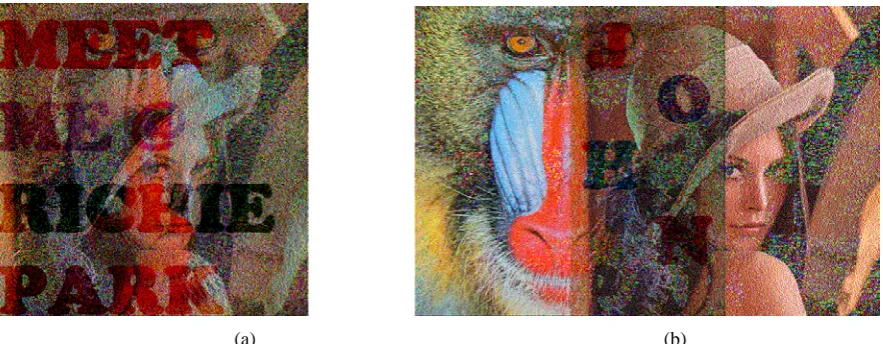
The following is the experimental results obtained from the proposed method of Visual Secret Sharing Scheme. fig.8 is the basic input images Baboon and Lena which are ready to be processed. Fig.9 holds the Half toned images of Baboon and Lena. The Secret image holds the secret message of “meet me at Richie park” fig .10 (a) and Extra Confidential Image holds the name “John” fig 10(b).Finally the fig.11are the share images which are to be sent to the receiver or participant. Fig.12.(a) is the Revealed Secret Image and Revealed Extra Confidential Image by Shifting Coefficient is obtained fig 12(b).
(a)
(b)
(a)
(b)
Fig.9. Halftoned Images (a) Baboon (b)Lena
(a) (b)
Fig.10. Images (a) Secret Image (b) Extra Confidential Image
(a)
(b)
(a) (b)
Fig.12. Images (a) Revealed Secret Image (b) Revealed Extra Confidential Image by Shifting Coefficient
The accurate rate of the different main secret images and extra confidential images are calculated by the formula given in equation (4) and (5) and its result is given separately for the black pixels and white pixels as well called the ARb and ARw for four different set of secret images and extra confidential images in the following Table I. and its corresponding graphical representation for four trials is given in the fig. 13.depicts the accurate rate for black and white pixels for different secret images and extra confidential images.
TABLE I . ACCURATE RATE OF THE DIFFERENT SECRETS IMAGE AND EXTRA CONFIDENTIAL IMAGES
ARB ARw
Main Secret 1 0.8912 0.6934
Extra Confidential 1 0.8722 0.3155
Main Secret 2 0.9065 0.7219
Extra Confidential 2 0.9041 0.3388
Main Secret 3 0.9076 0.8495
Extra Confidential 3 0.8719 0.3865
Main Secret 4 0.9139 0.8634
Extra Confidential 4 0.8890 0.3989
Fig.13. graphical chart for the readings taken as accurate rates fro m the experiment (table I)
VII. CONCLUSION
This paper generates a secure color visual secret sharing scheme in which a secret image has been hidden into two other meaningful cover images without the pixel expansion and also embeds an extra confidential data for authentication by using the shifting coefficient method in order to provide more security. The receiver or participant who receives the two share images can place one on another image to reveal the secret image and to reveal the extra confidential image the shifting coefficient is needed to shift it with N/2 units. Unless the receiver is aware of the shifting coefficient cannot reveal the extra confidential image. Thus this method provides more security with key like structure in transmitting of the images across internet.
REFERENCES
[1] Der-Chyuan Lou, Hong-Hao Chen, Hsien-Chu Wu, Chwei-Shyong Tsai, “A novel authenticable color visual secret sharing scheme usingnon expanded meaningful shares”, Elsevier on Displays,vol.32,pp.118-134,2011
[2] Y.-F.Chang,J.-B.Feng,,C.-S.Tsai,Y.-P.Chu,H.C.Syu, “New data hiding scheme using pixel swapping halftone images” The Imaging Science Journal, vol 56,pp no.279 -290, 2008.
[3] H.C. Wu, H.C. Wang, R.W. Yu, “Color visual cryptography scheme using meaningful shares”, Eighth International Conference on Intelligent System Design and Applications vol. 3 pp. 173–178, 2008. [4] S.J. Shyu,” Image encryption by random grids”, Pattern Recognition
vol .40 no.3 pp.1014–1031, 2007
[5] Du-Shiau Tsai , Gwoboa Horng , Tzung-Her Chen c, Yao-Te Huang “ A novel secret image sharing scheme for true-color images with size constraint” Information Sciences vol. 179 pp. 3247– 3254,2009.
0 0.2 0.4 0.6 0.8 1
Trial 1 Trail 2 Trail 3 Trail 4
1.M.John Justin received the B.E degree in Computer Science and Engineering from the Anna University, Chennai, India, in 2010,and pursuing his M.Tech degree in Software Engineering in Karunya University, Coimbatore ,India .His research interests include image processing, software engineering.
2.S.Manimurugan received the B.E. degree in Computer Science and Engineering from the Anna University, Chennai, India, in 2005, and the M.E. degree in Computer Science and Engineering in 2007. He is currently pursuing the Ph.D. degree in Computer Science and Engineering in Anna University, Coimbatore, India. His current research interests are in Image Processing, Information Security.
![Fig 1. Block diagram of Der-Chyuan Lou et al’s model [1]](https://thumb-us.123doks.com/thumbv2/123dok_us/7819204.1295583/2.595.87.482.398.697/fig-block-diagram-der-chyuan-lou-et-model.webp)
![Fig. 4. Floww chart of the Flooyd–Steinberg ditthering process.[11]](https://thumb-us.123doks.com/thumbv2/123dok_us/7819204.1295583/3.595.306.554.89.269/fig-floww-chart-flooyd-steinberg-ditthering-process.webp)