CONTINUOUS-TIME NON-LINEAR NON-GAUSSIAN STATE-SPACE MODELING OF ELECTROENCEPHALOGRAPHY WITH SEQUENTIAL
MONTE CARLO BASED ESTIMATION
TING CHEE MING
A thesis submitted in fulfilment of the requirements for the award of the degree of
Doctor of Philosophy (Mathematics)
Faculty of Science Universiti Teknologi Malaysia
ACKNOWLEDGEMENT
First of all, I wish to thank heartedly my supervisors Dr. Zaitul Marlizawati Zainuddin, Prof. Sheikh Hussain and Dr. Arifah Bahar. It is their endless guidance whether technical knowledge or ways of conducting research, that build up my foundation on this interdisciplinary field. Thanks to Dr. Zaitul and Dr. Arifah for their advices in mathematical and statistics area. Thanks to Prof. Sheikh Hussain, my first teacher in research, for his moral and financial support that survived me during my PhD program. He gave freedom to me in term of development of ideas, research direction, and in doing what I’m interested in.
Secondly, I am grateful to all my research colleagues at Center for Bio-medical Engineering (CBE), Mr. Amar, Dr. Tan, Mr. Kamarul and others. Thanks you for your generosity to share the resource and knowledge with me. Special thanks to CBE for providing me resource and conducive environment to make my research a success.
ABSTRACT
Biomedical time series are non-stationary stochastic processes with hidden dynamics that can be modeled by state-space models (SSMs), and processing of which can be cast into optimal filtering problems for SSMs. The existing studies assume discrete-time linear Gaussian SSMs with estimation solved analytically by Kalman filtering for biomedical signals which are continuous, non-Gaussian and non-linear. However, general non-linear non-Gaussian models admit no closed form filtering solutions. This research investigates the general framework of continuous-time non-linear and non-Gaussian SSMs with sequential Monte Carlo (SMC)
estimation for biomedical signals generally, electroencephalography (EEG) signal in particular, to solve two of its analysis problems. Firstly, this study proposes time-varying autoregressive (TVAR) SSMs with non-Gaussian state noise to capture abrupt and smooth parameter changes that are inappropriately modeled by Gaussian models, for parametric time-varying spectral estimation of event-related
desynchronization (ERD). Evaluation results show superior parameter tracking performance and hence accurate ERD estimation by the proposed model. Secondly, a partially observed diffusion model is proposed for more natural modeling the
continuous dynamics and irregularly spaced data in single-trial event-related potentials (ERPs) for single-trial estimation of ERPs in noise. More efficient Rao-Blackwellized particle filter (RBPF) is used. Evaluation on simulated and real auditory brainstem response (ABR) data shows significant reduction in noise with the underlying ERP dynamics clearly extracted. In addition, two linear Gaussian stochastic volatility (SV) models are proposed for better modeling of non-Gaussian dynamics of volatility in EEG noise especially of impulsive type.
ABSTRAK
Siri masa bioperubatan, stokastik process bukan pegun dengan dinamik tersembunyi, boleh dimodel oleh model ruang keadaan (SSM), dengan
pemprosesannya boleh dijadikan masalah penurasan. Kajian kini menganggap SSMs sebagai diskrit, linear Gaussian dengan anggaran secara analitis oleh penapisan Kalman untuk isyarat bioperubatan yang biasanya berterusan, tidak linear dan tidak Gaussian. Tetapi, model tidak linear tidak Gaussian tiada penyelesaian tertutup. Kajian ini menyelidik rangka kerja umum model tidak linear dan tidak Gauss dengan penapisan Monte Carlo berjujukan (SMC) untuk isyarat bioperubatan secara umum dan electroencephalography (EEG) khasnya, untuk menyelesaikan dua masalah analisis khusus. Pertama, kajian ini mencadangkan model time-varying
autoregressive (TVAR) dengan bunyi keadaan tidak Gaussian untuk menangkap perubahan parameter yang mendadak dan lancar yang tidak sesuai dimodelkan oleh model Gaussian, untuk anggaran spektrum event-related desynchronization (ERD) yang berubah masa. Penilaian menunjukkan model ini memberikan prestasi
penjejakan yang lebih baik dan anggaran ERD yang tepat. Kedua, kajian ini mencadangkan partially observed diffusion model untuk memodelkan dinamik berterusan dan data berjarakan tak seragam dalam single-trial event-related
TABLE OF CONTENTS
CHAPTER TITLE PAGE
DECLARATION ii
DEDICATION iii
ACKNOWLEDGEMENT iv
ABSTRACT v
ABSTRAK vi
TABLE OF CONTENTS vii
LIST OF TABLES xi
LIST OF FIGURES xii
LIST OF SYMBOLS AND ABBREVATIONS xvi
LIST OF APPENDIXES xxi
1 INTRODUCTION 1
1.1 Introduction 1
1.2 Background of Problems 2
1.2.1 Filtering Problems in EEG
Analysis 5
1.2.1.1 Parametric Time-varying Spectral Estimation 6 1.2.1.2 Single-trial ERP
Estimation 6
1.3 Statement of Problems 7
1.4 Objectives of the Research 9
1.5 Scope of the Research 10
1.7 Outline of the Thesis 14
2 LITERATURE REVIEW 18
2.1 Introduction 18
2.2 General State-Space Models 19 2.2.1 Linear Gaussian Model 20 2.2.2 Non-Linear Non-Gaussian Model 20
2.3 Optimal Bayesian Filtering 21
2.4 Kalman Filtering 23
2.5 Sequential Monte Carlo Methods for
Filtering 25
2.5.1 Bayesian Importance Sampling 26
2.5.2 Sequential Importance Sampling 27
2.5.2.1 Re-sampling 29
2.5.2.2 Choice of Importance
Density 30
2.5.3 Rao-Blackwellized Particle
Filtering 31 2.6 Sequential Monte Carlo Methods for
Parameter Estimation 32
2.6.1 Maximum Likelihood Estimation 32 2.6.2 Bayesian Estimation 35 2.7 Analysis of EEG Signals using
Discrete-time Linear Gaussian Models 36 2.7.1 Gaussian Time-Varying
AR Models for Spectral
Estimation of EEG 36 2.7.2 Discrete-time Dynamical Models
for Estimation of Single-Trial ERPs 37
3 SPECTRAL ESTIMATION OF
NON-STATIONARY EEG USING PARTICLE FILTERING WITH APPLICATION TO
EVENT-RELATED DESYNCHRONIZATION 42
3.1 Introduction 42
3.2 Motivation 43
3.3 Model Formulation 45
3.4 Particle Filtering for Estimation of
TVAR Coefficients 47
3.5 Experimental Results 49
3.5.1 Simulation Results 49
3.5.2 ERD Tracking Results 54 3.5.2.1 Estimation of ERD 54
3.5.2.2 Dataset 55
3.5.2.3 Model Order Selection 56 3.5.2.4 Results and Discussion 58 3.5.2.5 Model Evaluation 65
3.6 Summary 67
4 MODELING OF SINGLE-TRIAL
EVENT-RELATED POTENTIAL DYNAMICS BY PARTIALLY OBSERVED
ORNSTEIN-UHLENBECK PROCESS 68
4.1 Introduction 68
4.2 Motivation 69
4.3 Partially Observed OU Modeling of ERPs 71
4.3.1 The Model 71
4.3.2 State-Space Formulation 76 4.4 Rao-Blackwellised Particle Filtering for
ERP Model 79
4.5.1 Simulation Results 85 4.5.2 Estimation of ABR Dynamics 91 4.5.3 Estimation Results for Irregularly
Spaced Data 96
4.6 Summary 97
5 NON-LINEAR NON-GAUSSIAN MODELING
OF STOCHASTIC VOLATILITY
IN EEG NOISE 98
5.1 Introduction 98
5.2 Motivation 99
5.3 Non-linear Non-Gaussian SV Models of
EEG Noise 99
5.3.1 Non-Gaussian Random-Walk
Model 100
5.3.2 Cox-Ingersoll-Ross Process 101
5.4 Experimental Results 106
5.5 Summary 116
6 CONCLUSION AND FUTURE WORKS 117
6.1 Conclusion 117
6.2 Future Works 119
REFERENCES 121
LIST OF TABLES
TABLES NO. TITLE PAGE
2.1 Comparison of different studies on parametric
time-varying spectral estimation of biomedical signals. 40
2.2 Comparison of different studies on single-trial dynamical
estimation of ERPs using optimal filtering. 41
3.1 The optimal AR and ARMA model orders using
AIC and BIC. 57
3.2 Model evaluation results of Gaussian and Cauchy
models on fitting the EEG data for each subject. 66
5.1 Model evaluation results of different SV noise models
LIST OF FIGURES
FIGURES NO. TITLE PAGE
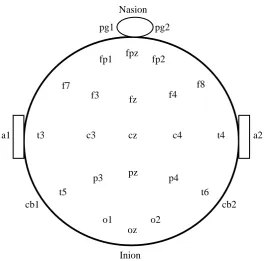
1.1 The 10 – 20 system of electrode placement for EEG
recording. 2
1.2 (a) Two classes of filtering problems in EEG analysis. (b) Contributions of the research for solving the filtering
problems in EEG analysis. 16-17
2.1 Graphical representation of a HMM. 20
2.2 (a) Single-trial ABRs. (b) Image and epoch
plots for single trials. (b) Average over 500 trials. 38
3.1 Tracking of TVAR coefficients by Gaussian and
Cauchy model. 50
3.2 MSE performance (in log scale) versus time for
Gaussian and Cauchy model. 51
3.3 Estimated filtered densityp a( t,1|y1:t)by
Gaussian model. 52
3.4 Estimated filtered mean and the 5th, 25th, 75th,
3.5 Kernel smoothed filtered densityp a( t,1|y1:t) by
Cauchy model. 53
3.6 Estimated filtered mean and the 5th, 25th, 75th
, 95th percentiles by Cauchy model. 53
3.7 The AIC and BIC values as a function of AR order p for AR(p) on 1 s EEG segments before and after
the event at position C4 for subject 3. 57
3.8 Comparison of time-varying spectral representations of ERD for average EEG of subject 1 at position C4
for left-hand motor imagery. 60
3.9 (a) Average EEG measured at position C4 for left-hand motor imagery, with its spectrum, band power and ERD estimates by Cauchy TVARMA model. The horizontal line marks band power in reference period. (b) Estimated residuals ˆvt, posterior mean of dispersion of Cauchy AR state noiseqct, and variance of Gaussian MA state
noiseσgt2 . 62
3.10 ERD estimates by Cauchy TVARMA model and Gaussian TVAR model for average EEGs of subject 1
at position C4 and C3 for left-hand motor imagery. 63
3.11 ERD estimations by Cauchy TVARMA model
, Cauchy TVAR model and Gaussian TVAR model for subject 1, subject 2, and subject 3 on left-hand
motor imagery EEG at position C4. 64
for a simulated single-trial ABR data. 89
4.2 Estimated time-varying log-varianceφ n
v and variance
2
σ
n
v for random-walk SV model on simulated data. 90
4.3 Estimation of ABR dynamics for single-trial recordings from subject 1 with normal hearing. 93
4.4 Estimation of ABR dynamics for single-trial recordings from subject 2 with normal hearing. 94
4.5 Estimated time-varying log-varianceφ n
v and variance
2
σvnby random-walk SV model for subject 1. 95
4.6 Estimated time-varying log-varianceφ n
v and variance
2
σ
n
v by random-walk SV model for subject 2. 95
4.7 Estimation of ABR dynamics for recordings from subject 1 in Figure 4.5 with simulated missing
observations. 96
5.1 Gamma stationary pdf of CIR process with parameters 1 0.7
θ = , θ2 =1and θ3=0.55. 103
5.2 Noncentral chi-squared conditional densities of CIR process 1 2 2 ( | ) n n v v
p σ σ − for 1 2 0.1 n v σ − = , 1 2 0.5 n v
σ − = , and
1 2
1 n
v
σ − = . 103
5.3 (a) Image plot for trials of background noises. (b) Sample variances for each trial, ˆ2
n
v
partial ACF of 2 ˆ
n
v
σ . 104
5.4 Marginal densities of ˆ2 n
v
σ (histogram, estimated (by maximum likelihood methods) Gamma and Gaussian
densities). 105
5.5 Effect of varyingθ1on marginal and conditional densities
of CIR SV process. 107
5.6 Effect of varyingθ3on marginal and conditional densities
of CIR SV process. 108
5.7 Estimation of ABRs through subcomponent parameters for a simulated single-trial ABR data with artifacts using Gaussian random-walk SV noise model. 110
5.8 Estimation of ABRs through subcomponent parameters for a simulated single-trial ABR data with artifacts using alpha-stable random-walk SV noise model. 111
5.9 Estimation of ABRs through subcomponent parameters for a simulated single-trial ABR data with artifacts using
CIR SV noise model. 112
5.10 (Top) Sample variances over each trial for artifact segment. (Bottom) Filtered mean of the time-varying variance of observation noise,
n 2 v 1:n
E[σ |y ] by the Gaussian random-walk, alpha-stable random-walk
and CIR SV model. 113
5.11
n 2 v 1:n
E[σ |y ] by CIR SV model withθ3 =0.4,θ3 =0.55
LIST OF SYMBOLS AND ABBREVATIONS
ABR - Auditory brainstem response
AIC - Akaike information criterion
APF - Auxiliary particle filter
AR - Autoregressive
ARMA - Autoregressive moving-average
BCI - Brain computer interface
BIC - Bayesian information criterion
BS - Bowman-Shenton
CIR - Cox-Ingersoll-Ross
dB - decibel
EEG - Electroencephalography
EKF - Extended Kalman filter
EM - Expectation-maximization
ERD - Event-related desynchronization
ERP - Event-related potential
ERS - Event-related synchronization
ESS - Effective sample size
HMM - Hidden Markov model
i.i.d. - Independent identically distributed
KF - Kalman filter
LB - Ljung-Box
LMSE - log mean square error
MC - Monte Carlo
ML - Maximum likelihood
MLE - Maximum likelihood estimation
MMSE - Minimum mean-squared error
MSE - Mean square error
OU - Ornstein-Uhlenbeck
PF - Particle filter
RBPF - Rao-Blackwellized particle filter
RLS - Recursive least square
SDE - Stochastic differential equation
SIR - Sequential importance sampling-resampling SIS - Sequential importance sampling
SMC - Sequential Monte Carlo
SNR - Signal-to-noise ratio
SSM - State-space model
STFT - Short-time Fourier transform
SV - Stochastic volatility
TVAR - Time-varying autoregressive
TVARMA - Time-varying autoregressive moving-average
{ }xt - Hidden states
{ }yt - Observations
0
0:t ={ ,0 , }t
x x … x - Sequence of states until time t
0:t ={ 0, , t}
y y … y - Sequence of observations until time t
t
v - Observation noise
t
w - State noise
θ - Model parameters
ˆ
θ - Estimated model parameters
2
σv - Variance of observation noise
2
σw - Variance of state noise
2
g
σ - Variance of driving noise for moving-average
(MA) coefficient
2
c
q - Dispersion parameter of Cauchy distribution ( )
q x and ( | )π y x - Importance density ( ' | )
f x xθ - State transition density ( | )
gθ y x - Observation density
0: 0: ( t| t)
p x y - Posterior density
0: ( t| t)
p x y - Filtering density
0: 1 (x yt | t− )
p - One-step ahead prediction density
0: ( ) θ y t
p - Marginal likelihood of y0:tgiven θ
0: 1 (y yt| t− )
p - Predictive likelihood
( )
T θ - Log-likelihood of y0:Tgiven θ
| 1 ˆt t−
x - Mean of p(x yt | 0: 1t− )
| 1
t t−
| ˆt t
x - Mean of p(x yt | 0:t)
|
t t
P - Covariance of p(x yt| 0:t)
t
θ - Mean of p(θt |y1:t)
t
V - Covariance of p(θt |y1:t)
( ) xi
t - Particle or sample i at time t
N - Number of samples
eff
N - Effective sample size
ˆ
eff
N - Estimated effective sample size
( )i
W - Normalized weights
( )i
w - Unnormalized weights
p - Order of AR model
q - Order of MA model
δ - Discounting factor
( t, )
b X θ - drift
( t, )
σ X θ - diffusion coefficient
t
W - Standard Brownian motion
β - Rate of reversion
[ , ]
U a b - Uniform distribution over interval[ , ]a b 2
( , )
N μ σ - Univariate Gaussian distribution with mean
μand variance σ2
( , )
( c, c)
C μ Q - Multivariate Cauchy distribution with location
c
μ and dispersion matrix Qc
( , )
S Sα α γ - Symmetric alpha-stable distribution with
characteristic exponent αand scale parameter γ
R - Number of realizations
k - Number of estimated parameters
T - Observation length
Δt - Time step
(.)
δ - Delta function
LIST OF APPENDICES
APPENDIX TITLE PAGE
A.1 Stationary AR model fitting to assumed locally stationary short-time segment of motor-imagery
EEG for different subjects. 132
A.2 Stationary ARMA model fitting to assumed locally stationary short-time segment of motor-imagery
EEG for different subjects. 133
B.1.1 Effect of varying the variance of the Gaussian state noise on the TVAR(4) coefficient tracking for Section 3.5.1. 135
B.1.2 Average MSEs and fitted log-likelihoods for the Cauchy
model using different number of particles N. 136
B.2 Evaluation of OU noise variances for dynamical ABR
estimation in Section 4.5.2 for subject 1. 137
CHAPTER 1
INTRODUCTION
1.1 Introduction
Most physiological processes from human body are accompanied by or manifest themselves as signals that reflect their nature and activities. One type of such signals is electrical in the form of potential, among others are electromyogram (EMG), electrocardiogram (ECG), electroencephalography (EEG), phonocardiogram (PCG) (Rangayyan, 2002). The signal as a function of time is time series in
Figure 1.1: The 10 – 20 system of electrode placement for EEG recording (Copper et al., 1980). Notes regarding channel labels: pg- naso-pharyngeal, a- auricular (ear lobes), fp- pre-frontal, f- frontal, p- pareital, c- central, o- occipital, t- temporal, cb- cerebellar, z- midline, odd number on the left, even numbers on the right of the subject.
1.2 Background of Problems
Many digital signal processing (DSP) techniques have been adopted in the modern biomedical engineering field for the analysis of biomedical signals. Processing of biomedical signals such as recovering the clean signals from noises and artifacts (filtering) as well as extracting its features in time or frequency domain are of much importance to their uses as reliable tools for diagnostics purposes. Biomedical time series are complex real world processes which are highly non-stationary. The underlying dynamics behind biomedical signals contain important information for analysis. Many time series models and analysis techniques can be used for biomedical signal processing. Non-stationary processes (Kitagawa, 1987) with underlying hidden dynamics can be modeled by state-space models (SSMs).
a1 a2
cb1 cb2
Inion fpz
fp1 fp2
t3 cz t4 c3 c4
oz
o1 o2 fz
f3 f4
f7 f8
pz
p3 p4 t6 t5
The SSMs have become a powerful tool for modeling and forecasting dynamic systems. The SSM consists of two components: (1) state equation which models the dynamics of the hidden states{ }xt where t is the discrete time index, typically following a Markov process and (2) observation equation which describes the mapping of the hidden states to the observations{ }yt . Besides, this formulation enables modeling of underlying hidden process behind the observations. The SSMs have been applied as statistical modeling framework for various kinds of time series such as speech signals, biomedical signals, DNA sequences, and financial time series. SSMs have been extensively used for modeling biomedical signals. However, the existing studies assume linear Gaussian model for biomedical signals, which is inappropriate for the complex real processes typically which exhibit non-linearity and non-Gaussianity. Besides, biomedical signals are mostly modeled by discrete-time model in the literature. However, biomedical signals are generated by
continuous process for which continuous-time modeling may be appropriate choice, even though biomedical signals themselves are discrete-time samples. Continuous-time models are able to model conveniently and naturally irregularly spaced data which is also inherent in biomedical signal.
Formulation in state-space form enables online inference of the hidden states given the observations, which is known as Bayesian filtering or optimal filtering problem (Doucet et al., 2000). Within the Bayesian framework, all the information about the system states x0:t ={ ,x0 …,xt}given sequence of observations
0:t ={ 0, , t}
y y … y is reflected in the posterior densityp(x0:t |y0:t). Since the
observation often arrives sequentially in time, the objective is to perform online state inference which involves estimating recursively in time the posterior
However, the posterior distributions can be evaluated in closed form only in a few cases including the linear Gaussian state-space models using the well-known Kalman filter (KF) and hidden finite state-space Markov chain using hidden Markov model (HMM) filter. Analytical solution is intractable for more general non-linear non-Gaussian SSMs. KF has been used extensively to solve the optimal filtering problems related to signal processing based on linearity and Gaussianity assumptions of the models. Relaxing the assumptions to non-linearity and non-Gaussianity
precludes analytical filtering solutions. This also poses a challenge in estimation of non-linear non-Gaussian modeling of biomedical signals. To solve this problem, many approximation schemes have been proposed such as the popular extended Kalman filter (EKF) which approximate the nonlinear model by local linearization using first order Taylor series expansion, however fails for substantial nonlinearity. Another example is the Gaussian sum filter which approximates the posterior distribution by a mixture of Gaussians. These approximation methods are still constrained by the assumption of linearity and Gaussianity. Refer to Cappe et al. (2007) for a review.
The likelihood evaluation and maximum likelihood estimation (MLE) of linear Gaussian SSMs can be obtained analytically by KF. The analytical derivation of the marginal likelihood for the non-linear and non-Gaussian SSMs is intractable. This thesis also considers model parameter estimation problems in general SSMs. Many SMC techniques have been proposed to solve unknown static parameter estimation for general SSMs (Kantas et al., 2009). In MLE, the optimal estimates are obtained by maximizing the particle approximated (marginal) likelihood of the observations. Gradient methods and expectation-maximization (EM) algorithm have been proposed for maximizing the likelihood in the SMC approximation framework. These methods provide guaranteed convergence, however, tends to be easily trapped in a local maximum. We consider another approach i.e. Bayesian estimation where the unknown parameters are augmented with the hidden states and cast the problem to the filtering one. This method is simple and needs less computational effort than the approximation based maximum likelihood approach and thus more practical for real biomedical signal processing problems. Besides, the setting of prior distribution of parameters can be tailored by prior knowledge. This method, however, gives estimates optimal in minimum mean-squared error (MMSE) sense.
1.2.1 Filtering Problems in EEG Analysis
1.2.1.1Parametric Time-varying Spectral Estimation
Time-varying spectrum of non-stationary EEG signals can be obtained by parametric approach using varying autoregressive (TVAR) models and time-varying autoregressive moving-average (TVARMA) models. The parametric spectral estimates, which provide high time resolution, have been used for analysis of event-related desynchronization (ERD) and synchronization (ERS). ERD and ERS are used to represent frequency-specific changes of on-going EEG activity, induced by
specific stimulus, which consist either of decrease or increase of power in specific frequency band. The objective is to estimate sequentially the TVAR coefficients which are subsequently used to compute the time-varying power spectral density. This can be formulated into optimal filtering problem, i.e. formulating TVAR model into state-space model and estimating sequentially in time the filtered density of TVAR coefficients given the EEG observations. The challenge is that the underlying TVAR process of EEG, especially in ERD and ERS, exhibit abrupt changes, which is kind of non-Gaussian behavior and cannot be tracked rapidly by Gaussian TVAR models used in the existing studies.
1.2.1.2Single-trial ERP Estimation
ERPs are scalp-recorded bioelectrical potentials generated by brain activity in response to specific stimulation. ERPs provide useful information about various neurological disorders and cognitive processes. Besides, ERP waveforms vary from trial to trial due to different degrees of fatigue, habituation, or levels of attention of subjects (Georgiadis et al., 2005). The single-trial based ERP estimation involves extracting these inter-trial dynamics of ERPs hidden in various noisese.g.
solved implicitly by the discrete-time models. The variances in real EEG noise are time-varying with smooth and occasionally abrupt changes, especially in noises of impulsive type. This non-Gaussian characteristic of EEG noise volatility cannot be properly modeled by conventional linear Gaussian random-walk of log-variance.
To the best of author’s knowledge, there are no studies on applying
continuous-time non-linear non-Gaussian state-space models estimated using SMC filtering to address these two problems, and limited studies for biomedical signal processing in general.
1.3 Statement of Problems
The problems of the research are summarized as follows:
(1) Existing studies assume inappropriate linear Gaussian SSMs for biomedical signals. Relaxing this invalid assumption to non-linear non-Gaussian form in modeling biomedical signals is the main concern of this research.
(2) Existing studies use discrete-time models for biomedical signals which are typically continuous processes. Continuous-time models may be appropriate for continuous process of biomedical signals and are ideally suited for modeling irregularly spaced data in biomedical signals. Continuous-time state-space modeling of continuous transient process in real biomedical signals is considered in this research. (3) Many biomedical signal processing problems are optimal filtering
(4) Motivated by the abovementioned more appropriate modeling of biomedical signals in continuous-time non-linear non-Gaussian models and advantages of SMC methods for their estimation, studies of which are still limited in the literature, this research investigates the non-linear non-Gaussian SSMs with online inference problems solved by SMC methods for biomedical signal processing. In addition, we investigate continuous-time state-space modeling of biomedical signal with SMC estimation.
(5) This research focuses on the state-space modeling and estimation of a particular type of biomedical signal i.e. EEG, with application to two specific filtering problems as discussed in Section 1.2.1. EEG signal is inappropriately modeled by linear Gaussian models with estimation by KF in the existing studies. This is because EEGs are non-linear non-Gaussian processes, modeling of which however, renders filtering solution intractable. Besides, continuous process of EEG is modeled by discrete-time models. Development of continuous-time non-linear non-Gaussian models for EEG time series with their online parameter estimation solved by SMC filtering methods is the main interest of this thesis. Applications of these general SSMs of EEG with SMC estimation to the two important areas of EEG analysis, have not been studied in the literature, but are addressed in this research.
i. Use of Gaussian state noise in TVAR state-space modeling of EEG signals is inappropriate due to its inability to model both abrupt and smooth changes of TVAR state parameters which are typically inherent in ERD/ERS in EEG process. Modeling this non-Gaussian behavior in TVAR parameter changes in state-space form is studied in this research.
continuous physiological process generating ERP observations, even though the observations themselves are available only at discrete times, i.e. at each single-trial. Besides, continuous-time models are able to solve implicitly the irregularly spaced data problem in ERPs.
iii. The changing volatility in real noises in EEG is
inappropriately modeled by fixed variance models. The variance of the observation noise can be allowed to be time-varying for better capturing the changing-variance
characteristics in real EEG noises. Besides, volatilities in real noises especially of the impulsive type e.g. artifacts typically exhibit non-Gaussian dynamics which are inappropriately modeled by linear Gaussian stochastic volatility (SV) models. Modeling of the changing volatility in EEG noise and its non-Gaussian dynamics is addressed.
iv. Online state inference and parameter estimation for the use of non-linear non-Gaussian state-space modeling of EEG do not admit closed form solutions, and will be solved in this research. v. Performance comparisons between linear Gaussian and
non-linear non-Gaussian modeling of biomedical signals are limited. Comparisons are performed in term of performance in the two EEG analyses.
1.4 Objectives of the Research
The main objectives of the research are as follows:
(1) To develop the general framework of continuous-time linear non-Gaussian state-space models with SMC based estimation for
(2) To propose continuous-time non-linear non-Gaussian state-space modeling of EEG signals, with parameter estimation solved by SMC methods.
i. To propose non-Gaussian TVARMA SSM of EEG signals to capture non-Gaussian parameter changes.
ii. To introduce continuous-time diffusion process in state-space form for more natural modeling of continuous dynamics and irregularly spaced data in ERPs.
iii. To apply non-linear non-Gaussian SV models for modeling the non-Gaussian dynamics of volatility in EEG noise, and to incorporate them in the state-space framework of EEG for reduction of impulsive noise.
iv. To apply SMC methods to solve online state inference problems and model parameter estimation in the proposed models.
(3) To solve two class of filtering problems in EEG analysis as special case investigation of this framework: (a) Parametric time-varying spectral estimation and (b) Single-trial ERP estimation.
1.5 Scope of the Research
The scope of this research is given as follows:
(2) To develop continuous-time non-linear non-Gaussian SSMs of EEG signals. The models developed with application to solve the two filtering problems are respectively:
Non-Gaussian TVARMA state-space models of EEG.
i. Non-Gaussian state noise i.e. heavy-tailed distribution (such as Cauchy distribution) is used to model the abrupt and smooth changes of TVARMA coefficients.
ii. This proposed model is used for modeling EEG signals and applied to parametric spectral estimation for ERD.
Partially observed diffusion model of single-trial ERP dynamics.
i. The ERP dynamics are modeled as continuous-time
diffusion process discretely observed in background noises, formulated in state-space form.
ii. In observation equation, the ERP waveform at each trial is modeled as a mixture of shifted Gaussian functions
observed in additive noise. The single-trial ERPs are assumed as discrete samples from an underlying continuous process.
iii. In state equation, the underlying ERP transients are modeled by an example of diffusion process, i.e. mean-reverting Ornstein-Uhlenbeck (OU) process, to model both the inter-trial dynamic changes in ERP parameters and their stationary trends.
iv. The SV of observation noise in the SSM of ERPs is modeled as follows
(b) Log-variance follows a random walk model with Gaussian heavy-tailed noise. (discrete-time linear non-Gaussian SV model)
(c) Cox-Ingersoll-Ross (CIR) process (continuous-time non-linear SV model).
v. The proposed model is applied to modeling and dynamical estimation of single-trial chirp-evoked auditory brainstem responses (ABRs).
(3) SMC methods are applied to online state inference problems in the proposed SSMs to solve the two EEG analysis problems.
i. Online inference of the state of TVARMA coefficients are performed by a generic SMC method i.e. sequential importance sampling Resampling (SIR).
ii. The ERP SSM are estimated by more efficient Rao-Blackwellized particle filtering (RBPF) based on variance reduction techniques.
(4) SMC methods are applied for model parameter estimation. i. The unknown parameters of the non-Gaussian TVARMA
model, such as the variance of the Cauchy state noise, need to be estimated.
ii. The unknown model parameters of the proposed partially observed OU SSM includes stationary trend components and the time-varying variance of observation noise. iii. Bayesian estimation is used, where the model parameters
are augmented to the state and jointly estimated using PF.
(5) To perform comparison
ii. Linear Gaussian and non-linear non-Gaussian SV models in estimating the volatility changes on impulsive type of EEG noise for noise reduction in ERPs.
1.6 Contribution of the Research
The research contributes in developing continuous-time linear non-Gaussian SSMs of EEG with SMC based estimation with application to solve two classes of optimal filtering problems in EEG analysis.
Firstly, this research proposes non-Gaussian TVAR SSM which allows the state noise to be non-Gaussian heavy-tailed distributed to simultaneously capture smooth and abrupt parameter changes. The heavy-tailed distribution has larger spread out at tails to predict rare large parameter changes. We extend to TVARMA model with the MA coefficients to smooth the spurious spectral pole by the heavy-tailed AR model and formulate it in state-space form. We apply SMC methods for parameter estimation in the proposed model. The model is used for modeling EEG signals with application to solve spectral estimation of ERP.
Secondly, we develop a partially observed mean reverting OU process where the continuous-time OU process is discretely observed in noise. The process is used for modeling time-varying Gaussian mixture model parameters. We allow the model parameters i.e. the variance of observation noise and process asymptotic mean, to be time-varying. We use SV models to model the stochastic observational noise
variance. Thus, a hybrid model based on combination of partially observed diffusion process and SV model is introduced. We formulate it into state-space form and apply combined state and model parameter estimation using SMC methods. A more
The OU process which is a continuous-time model described by SDE is able to describe the continuous transient underlying ERPs. Besides, the continuous-time model can implicitly define arbitrary time-intervals between observations, and thus is convenient and flexible to handle irregularly spaced data in ERPs. The asymptotic mean of mean-reverting OU process can also model the trends of ERP dynamics. The approach is applied for dynamical estimation of single-trial ABRs hidden in noises and to solve missing data problem in ERP estimation.
Finally, two linear Gaussian SV models for better modeling the non-Gaussian dynamics of volatility in EEG noise especially of impulsive type are
introduced. We propose random-walk model with non-Gaussian noise and non-linear CIR process with adjustable heavy-tailed conditional distribution to better capture both smooth and abrupt volatility changes in impulsive EEG noise. The models are applied for denoising of single-trial ABRs corrupted by artifacts.
The contributions of the research are summarized in Figure 1.2.
1.7 Outline of the Thesis
The structure of the thesis is summarized as follows. The thesis consists of introductory material (motivation, objectives, scope and contributions of the research – Chapter 1), review on SMC methods (Chapter 2), and our novel contributions and methodology (Chapter 3, 4 and 5) and conclusion and future works (Chapter 6).
Chapter 2 presents literature review on SMC methods for state and model parameter estimation in general state-space models. The mathematical formulation of general SSMs is presented and their related filtering objectives are defined.
importance function, variance reduction techniques. SMC methods for model parameter estimation are also introduced.
Chapter 3 proposes non-Gaussian TVARMA state-space models for parametric spectral estimation with application to event-related desynchronization (ERD) estimation of non-stationary EEG. We firstly introduce non-Gaussian state-noise to capture the abrupt and smooth changes in TVAR coefficients. We extend the non-Gaussian TVAR model to TVARMA to further smooth spurious spectral peaks and illustrate its formulation into state-space form. We show how to apply PF methods for estimation of TVARMA coefficients and static model parameters and the subsequent spectral estimation of ERD. Simulation results and comparisons of the Gaussian and non-Gaussian models on ERD estimation and model fitness evaluation are presented and discussed.
Chapter 4 proposes partially observed diffusion model of ERP dynamics with RBPF estimation for single-trial estimation of ERPs. We propose the use of partially observed OU process for modeling the continuous process underlying ERP dynamics. We illustrate how the proposed model is formulated into conditionally linear
Gaussian state-space model with its joint state and model parameters estimation efficiently solved by the RBPF. Single-trial dynamical estimation results for simulated and real ABR data are presented and discussed. We also demonstrate the proposed continuous-time model in solving irregularly spaced data problem in ERPs.
Chapter 5 proposes non-linear non-Gaussian SV models for modeling
stochastic volatility of impulsive EEG noise. We discuss two types of models for SV i.e. non-Gaussian random walk model and non-linear CIR process for modeling the non-Gaussian volatility changes in impulsive noise. Comparisons of different SV models of EEG noise for denoising of ABRs on simulated data with artifacts are presented and discussed.
Parametric Time-varying Spectral Estimation
(Frequency domain analysis)
Single-Trial ERP Estimation
(Time domain analysis)
Analysis of EEG Signals
Application:
Estimation of event-related Desynchronization (ERD) of motor imagery.
Application:
De-noising of ABRs for analysis of inter-trial variability and detection of wave V.
Objective:
To estimate the TVAR coefficients to obtain the time-frequency representation of EEG.
Objective:
To extract the inter-trial dynamics of ERPs hidden in various noises.
Filtering Problem:
To estimate sequentially in time the filtered density of TVAR coefficients given the EEG observations.
Filtering Problem:
To estimate sequentially in time the filtered density of ERP parameters given the noisy EEG observations.
Motivation:
The underlying TVAR coefficients of EEG process in ERD exhibit abrupt changes which cannot be tracked rapidly by Gaussian TVAR models.
Motivation:
• The real noises in EEG exhibit changing volatility with non-Gaussian dynamics, for which linear Gaussian SV models are inappropriate.
• The physiological processes underlying ERP dynamics are continuous processes which are unsatisfactorily modeled by discrete-time models.
• Irregularly spaced data problem in ERP estimation cannot be solved implicitly by discrete-time models.
16
Proposed Models:
Non-Gaussian TVARMA state-space model of EEG
Observation Eq.:
TVARMA with Gaussian noise (fixed variance)
State Eq. for AR Changes:
Random-walk model with non-Gaussian noise (heavy-tailed distribution)
Proposed Models:
Partially observed diffusion model of single-trial ERP dynamics
Observation Eq.:
Gaussian mixture modeling of ERP components, with
additive Gaussian noise with time-varying variance modeled by: • Log-variance follows random-walk with Gaussian noise
(discrete-time linear Gaussian SV model)
• Log-variance follows random-walk with non-Gaussian noise (discrete-time linear non-Gaussian SV model)
• Cox-Ingersoll-Ross (CIR) process (continuous-time non-linear SV model)
State Eq. for ERP Dynamics:
Continuous-time diffusion model (Mean-reverting Ornstein-Uhlenbeck process)
Filtering Methods: Particle filter
Model Parameter Estimation: Bayesian approach
Filtering Methods:
Rao-Blackwellized particle filter
Model Parameter Estimation: Bayesian approach
REFERENCES
Aboy, M., Marquez, O. W., McNames, J., Hornero, R., Tron, T., and Goldstein, B. (2005). “Adaptive modeling and spectral estimation of nonstationary
biomedical signals based on Kalman filtering,” IEEE Trans. on Biomed. Eng., vol. 52. No. 8, pp. 1485-1489.
Akashi, H., and Kumamoto, H. (1977). “Random sampling approach to state estimation in switching environments,” Automatica, vol. 13, pp. 429-434.
Alspach, D. L. and Sorenson, H. W. (1972). “Nonlinear Bayesian estimation using Gaussian sum approximation,” IEEE Trans. Automat. Control, vol. AC-17, no. 4, pp. 439–448.
Andrieu, C. and Doucet, A. (2002). “Particle filtering for partially observed Gaussian state space models,” J. R. Statist. Soc. B, vol. 64, no. 4, pp. 827-836.
Andrieu, C., Doucet, A., Singh, S. S. and Tadic, V. (2004). “Particle methods for change detection, identification and control,” Proceedings of the IEEE, vol. 92, no. 3, pp. 423-438.
Arulampalam, M., Maskell, S., Gordon, N. and Clapp, T. (2002). “A tutorial on particle filters for on line non-linear/non-Gaussian Bayesian tracking,” IEEE Trans. on Signal Processing, vol. 50, no. 2, pp. 241–254.
Assecondi, S., Bianchi, A. M., Hallez, H., Staelens, S., Casarotto, S., Lemahieu, I. and Chiarenza, G. A. (2009). “Automated identification of ERP peaks through dynamic time warping: An application to developmental dyslexia,” Clinical Neurophysiology, vol. 120, pp. 1819-1827.
Barkat, B. and Boashash, B. (2001). “A high-resolution quadratic time–frequency distribution for multicomponent signals analysis,” IEEE Trans. on Signal Processing., vol. 49, No. 10, pp. 2232-2239.
Blankertz, B., Müller, K. R., Curio, G., Vaughan, T. M., Schalk, G., Wolpaw, J. R., Schlögl, A., Neuper, C., Pfurtscheller, G., Hinterberger, T., Schröder, M. and Birbaumer, N. (2004). “The BCI Competition 2003: progress and perspectives in detection and discrimination of EEG single trials,” IEEE Trans. on Biomed. Eng., vol. 51, No. 6, pp. 1044-1051.
Cappe, O., Godsill, S. J. and Moulines, E. (2007). “An overview of existing methods and recent advances in sequential Monte Carlo,” Proc. of IEEE, vol. 95, no. 5, pp. 899-924.
Cappe, O., Moulines, E. and Ryden, T. (2005). Inference in Hidden Markov Models. New York: Springer Verlag.
Cassidy, M. J. and Penny, W. D. (2002). “Bayesian nonstationary autoregressive models for biomedical signal analysis IEEE Trans. on Biomed. Eng., vol. 49, No. 10, pp. 1142-1152.
of Interest Rate Derivatives,” Financial Markets, Institutions, and Instruments vol. 5, pp. 1–88.
Chen, R. and Liu, J. S. (2000). “Mixture Kalman filters,” J. R. Statist. Soc. B, vol. 62, no. 3, pp. 493-508.
Cooper, R, Osselton, J. W., and Marshall, R. E. (1980). EEG Technology, 3rd Ed, Butterworths, London, UK.
Corona-Strauss, F. I., Delb, W., Schick, B. and Strauss, D. J. (2009) “Phase stability analysis of chirp evoked auditory brainstem responses by Gabor frame
operators,” IEEE Trans Neural Syst. Rehabil. Eng., vol. 17, no. 6, pp. 530-536.
Cox, J. C., Ingersoll J. E., and Ross S. A. (1985). “A Theory of the Term Structure of Interest Rates,” Econometrica, vol. 53, no. 2, pp. 385-407.
Crisan, D. and Doucet, A. (2002). “A survey of convergence results on particle filtering methods for practitioners,” IEEE Trans. on Signal Processing, vol. 50, no. 3, pp. 736–746.
Dau, T., Wegner, O., Mellert, V. and Kollmeier, B. (2000). “Auditory brainstem responses (ABR) with optimized chirp signals compensating basilar- membrane dispersion,” J. Acoust. Soc. Am., vol. 107, pp. 1530–1540.
Delgado, R. E. and Ozdamar, O. (1994). “Automated auditory brainstem response interpretation,” IEEE Engineering in Medicine and Biology Magazine, vol. 12, no. 2, pp. 227-237.
Djuric, P., Kotecha, J. H., Esteve, F. and Perret, E. (2002). “Sequential parameter estimation of time-varying non-Gaussian autoregressive processes,” EURASIP Journal on Applied Signal Processing, pp. 865-875.
Doucet, A. and Johansen, A. M. (2008) “A tutorial on particle filtering and
smoothing: Fifteen years later,” in Handbook of Nonlinear Filtering, Oxford University Press.
Doucet, A., de Freitas, J. F. G. and Gordon, N. J. (2001). Sequential Monte Carlo Methods in Practice, Eds. New York: Springer-Verlag.
Doucet, A., Godsill, S. J. and Andrieu, C. (2000) “On sequential Monte Carlo
sampling methods for Bayesian filtering,” Statistics and Computing, vol. 10, no. 3, pp. 197-208.
Edwards, R. M., Buchwald, J. S., Tanguay, P. E. and Schwafel, J. A. (1982). “Sources of variability in auditory brain stem evoked potential measures over time,” Electroencephalography and Clinical Neurophysiology, vol. 53, no. 2, pp. 125-132.
Favetto B. and Samson A. (2010). “Parameter estimation for a bidimensional partially observed Ornstein-Uhlenbeck process with biological application,” Scandinavian Journal of Statistics, vol. 37, no. 2, pp. 1-31.
Fearnhead, P., Papaspiliopoulos, O. and Roberts, G. O. (2008). “Particle filters for partially observed diffusions,” J. R. Statist. Soc. B, vol. 70, no. 4, pp. 755-777.
Georgiadis, S. D., Ranta-aho, P. O., Tarvainen, M. K. and Karjalainen, P. A. (2005) “Single-trial dynamical estimation of event-related potentials: A Kalman filter-based approach,” IEEE Trans. Biomed. Eng., vol. 52, no. 8, pp. 1397–1406.
Georgiadis, S. D., Ranta-aho, P. O., Tarvainen, M. K. and Karjalainen, P. A. (2007). “A subspace method for dynamical estimation of evoked potentials,”
Computational Intelligence and Neuroscience, vol. 2007, pp. 1-11.
Godsill, S. J., Doucet, A. and West, M. (2004). “Monte Carlo smoothing for non-linear time series,” Journal of the American Statistical Association, vol. 50, pp. 438–449.
Golightly, A. and Wilkinson, D. J. (2006). “Bayesian sequential inference for nonlinear multivariate diffusions,” Stat. Comput., vol. 16, pp. 323-338.
Gordon, N., Salmond, D. and Smith, A. F. (1993). “Novel approach to
nonlinear/non-Gaussian Bayesian state estimation,” IEE Proc. F. Radar Signal Processing, vol. 140, pp. 107-113.
Gustafsson, F., Gunnarsson, F., Bergman, N., Forssell, U., Jansson, J., Karlsson, R. and Nordlund, P. J. (2002). “Particle filters for positioning, navigation, and tracking,” IEEE Trans. on Signal Processing, vol. 50, no. 2, pp. 425–437.
Handschin, J. and Mayne, D. (1969). “Monte Carlo techniques to estimate the conditional expectation in multi-stage non-linear filtering,” International Journal of Control, vol. 9, pp. 547–559.
Harvey, A., Ruiz, E. and Shephard, N. (1994). “Multivariate stochastic variance models,” Review of Economic Studies, vol. 61, pp. 247-264.
Heston S. L. (1993). “A Closed-Form Solution for Options with Stochastic Volatility with Applications to Bond and Currency Options,” The Review of Financial Studies vol. 6, no. 2, pp. 327–343.
Higuchi, T. (2001). “Self organizing time series model,” in Doucet et. al. (2001), pp. 429-444.
Iacus, S. M. (2008). Simulation and Inference for Stochastic Differential Equations with R Examples, Springer.
Jarchi, D., Sanei, S., Mohseni, H. R. and Lorist, M. M. (2011). “Coupled particle filtering: A new approach for P300-based analysis of mental fatigue,” Biomedical Signal Processing and Control, vol. 6, pp. 175-185.
Jaskowski, P. and Verleger, R. (1999). “Amplitudes and latencies of single-trial ERP’s estimated by maximum-likelihood method,” IEEE Trans. on Biomed. Eng., vol. 46. no. 8, pp. 987-993.
Jazwinski, A. (1970). Stochastic Processes and Filtering Theory. New York: Academic.
Kantas, N., Doucet, A., and Singh, S. S. and Maciejowski, J. M. (2009). “An overview of sequential Monte Carlo methods for parameter estimation in general,” in Proc. 15th IFAC Symposium on System Identification.
estimation from EEG,” IEEE Trans. on Biomed. Eng., vol. 52. No. 7, pp. 1191-1198.
Kitagawa, G. (1987). “Non-Gaussian state-space modeling of nonstationary time series,” Journal of the American Statistical Association, vol. 82, no. 400, pp. 1032-1041.
Kitagawa, G. (1996). “Monte Carlo filter and smoother for non-Gaussian Nonlinear state space models,” Journal of the American Statistical Association, vol. 5, no. 1, pp. 1-25.
Kitagawa, G. (1998). “Self organizing state-space model,” J. Amer. Statistical Assoc., vol. 93, no. 443, pp. 1203–1215.
Liu, J. and Chen, R. (1998). “Sequential Monte Carlo methods for dynamic systems,” Journal of the American Statistical Association, vol. 93, pp. 1032-1044.
Liu, J. and West, M. (2001). “Combined parameter and state estimation in simulation-based filtering,” in (Doucet et. al., 2001), pp. 196-223.
Lombardi, M. J. and Godsill S. M. (2005). “On-line Bayesian estimation of signals in symmetric α -stable noise,” IEEE Trans. on Signal Processing, vol. 53, no. 6, pp. 1–6.
Mao, X. (2008). Stochastic Differential Equations and Applications, 2nd ed., Horwood, UK.
Mohseni, H. R., Nazarpour, K., Wilding, E. L. and Sanei, S. (2009). “The application of particle filters in single trial event-related potential estimation,”
Moral, P. D., Jacod, J. and Protter, P. (2001). “The Monte-Carlo method for filtering with discrete-time observations,” Probab. Theory Relat. Fields, vol. 30, no. 3, pp. 346-368.
Moral, P. Del, Doucet, A., and Jasra, A. (2006). “Sequential Monte Carlo samplers,” Journal of the Royal Statistical Society: Series B, vol. 68, no. 3, pp. 411-436.
Moral, P. Del. (1996). “Nonlinear filtering: Interacting particle solution,” Markov Process. Relat. Fields, vol. 2, pp. 555-579.
Nikias C. L. and Shao M. (1995). Signal Processing with Alpha-Stable Distribution and Applications, Wiley-Interscience.
Pfurtscheller, G. and da Silva, F. H. L. (1999). “Event-related EEG/EMG synchronization and desynchronization: basic principles,” Clinical Neurophysiology, vol. 110, pp. 1842-1857.
Pitt, M. K. (2002). Smooth particle filters for likelihood evaluation and maximisation, Warwick Economic research papers no. 651.
Pitt, M. K. and Shephard, N. (1999). “Filtering via simulation: Auxiliary particle filters,” Journal of the American Statistical Association, vol. 94, no. 446, pp. 590–599.
Poyiadjis, G., Singh, S. S. and Doucet, A. (2006). “Online parameter estimation for partially observed diffusions,” Nonlinear Statistical Signal Processing
Workshop, pp. 197-200.
Punskaya, E. (2003). Sequential Monte Carlo Methods for Digital Communications. Ph.D. Thesis, University of Cambridge.
Rangayyan R. M. (2002). Biomedical Signal Analysis A Case-study Approach, Wiley-Interscience.
Raz, J. Turetsky, B. and Fein, G. (1988). “Confidence intervals for the signal-to-noise ratio when a signal embedded in signal-to-noise is observed over repeated trials,” IEEE Trans. on Biomed. Eng., vol. 35, no. 8, pp. 646-649.
Rimmer, D., Doucet, A. and Fitzgerald, W. J. (2005). Particle filters for stochastic differential equations of nonlinear diffusions Technical Report. Department of Engineering, University of Cambridge.
Rowe III, M. J. (1978). “Normal variability of the brain-stem auditory evoked response in young and old adult subjects,” Electroencephalography and Clinical Neurophysiology, vol. 44, no. 4, pp. 459-470.
Schlögl, A., “Dataset IIIa: 4-class EEG data,” [Online]. Available:
http://www.bbci.de/competition/iii/desc_IIIa.pdf. (Retrieved in 2010)
Sørensen, H. (2004). “Parametric inference for diffusion processes observed at discrete points in time: a survey,” International Statistical Review, vol. 72, no. 3, pp. 337-354.
Sorenson, H. (1988). “Recursive estimation for nonlinear dynamic systems,” In Bayesian Analysis of Time Series and Dynamic Models, Dekker, ed. J.C. Spall.
Tarvainen, M. P., Georgiadis, S. D., Ranta-aho, P. O. and Karjalainen, P. A. (2006). “Time-varying analysis of heart rate variability signals with Kalman smoother algorithm,” Physiol. Meas., vol. 27, pp. 225-239.
Tarvainen, M. P., Hiltunen, J. K., Ranta-aho, P. O., and Karjalainen, P. A. (2004). “Estimation of nonstationary EEG with Kalman smoother approach: An application to event-related synchronization (ERS),” IEEE Trans. on Biomed. Eng., vol. 51, no. 3, pp. 516-524.
Tseng, S. Y., Chen, R. C., Chong, F. C. and Kuo, T. S. (1995). “Evaluation of parametric methods in EEG signal analysis,” Med. Eng. Phys., vol. 17, pp. 71-78.
Vermaak, J., Andrieu, C., Doucet, A. and Godsill, S. J. (2002). “Particle methods for Bayesian modeling and enhancement of speech signals,” IEEE Trans. on Speech and Audio Process., vol. 10, no. 3, pp. 173-185.
Wegner, O. and Dau, T. (2002). “Frequency specificity of chirp-evoked auditory brainstem responses,” J. Acoust. Soc. Am., vol. 111, pp. 1318–1329.
Woolfson, M. S. (1991). “Study of cardiac arrhythmia using the Kalman filter,” Medical and Biological Engineering and Computing, vol. 29, no. 4, pp. 398-405.