LOW NOISE AMPLIFIER PERFORMANCE STUDY FOR WIRELESS MAN BASED ON IEEE 802.16A STANDARD
MAZHANIZA BINTI MAZUMIL
A project report submitted in partial fulfillment of the requirements for the award of the degree of
Master of Engineering (Electrical – Electronics and Telecommunications)
Faculty of Electrical Engineering Universiti Teknologi Malaysia
iii
iv
ACKNOWLEDGEMENT
In the name of Allah, Most Merciful, Most Compassionate. It is by God willing; I was able to complete this project within the time given. Here, I would like to take this opportunity to express my sincere gratitude to my project supervisor, Professor Dr. Tharek Abdul Rahman for his invaluable guidance, advice and support towards completing this thesis succesfully.
Besides, I also thank to laboratory technician, Mr. Mohamed Abu Bakar, postgraduates, undergraduates and the staffs of Wireless Communication Centre in Universiti Teknologi Malaysia who have directly or indirectly assisted me in this project. My deepest gratitude also goes out to my examiners, P.M. Dr. Jafri bin Din and Dr. Nor Hisham bin Hj. Khamis for their constructive comments and suggestions in evaluating my project
A special thank to research Master student, Mr. Waeil for his guidance and support in this project.
v
ABSTRACT
vi
ABSTRAK
vii
TABLE OF CONTENT
CHAPTER TITLE PAGE
TITLE i
DECLARATION ii
DEDICATION iii
ACKNOWLEDGEMENT iv
ABSTRACT v
ABSTRAK vi
TABLE OF CONTENT vii
LIST OF TABLES x
LIST OF FIGURES xi
LIST OF SYMBOLS xiii
LIST OF ABBREVIATION xiv
LIST OF APPENDICES xviii
1 INTRODUCTION 1
1.1 Introduction 1
1.2 Project Background 2
1.3 Problem Statement 4
1.4 Objective 4
1.5 Project Scope 5
viii
2 LITERATURE REVIEW 7
2.1 Project Overview 7
2.2 RF Receiver Architecture 9
2.2.1 Superheterodyne Receiver 10
2.3 Amplifier 11
2.3.1 Low Noise Amplifier 13
2.3.2 IF Amplifier 14
2.4 Mixer 14
2.5 Oscillator 16
2.6 Filters 18
2.6.1 Band-Select (BS) Filter 19
2.6.2 Image-Reject (IR) Filter 19
2.6.3 Channel Select (CS) Filter 20
3 METHODOLOGY 21
3.1 Introduction 21
3.2 Instrument and Tools 22
3.2.1 ADS 2002C 22
3.2.2 89600S Vector Signal Analyzer 23 3.2.3 E4438C ESG Vector Signal Generator 24
3.3 Procedures 24
3.3.1 Concept Diagram 25
4 RF RECEIVER PERFORMANCE
MEASUREMENTS
30
4.1 Introduction 30
4.2 BER Definition 31
4.3 Eb/NoDefinition 32
ix
5 SIMULATION AND MEASUREMANT SETUP 38
5.1 Introduction 38
5.2 Setup on Hardware and Software 39
5.2.1 Setup on E4438C Vector Signal Generator 39 5.2.2 Setup on 89600S Vector Signal Analyzer 40 5.2.3 Setup on Agilent 89600 VSA software 40
5.2.4 Setup on ADS 2002C 42
5.3 Simulation Setup 42
5.3.1 Simulation 1 43
5.3.2 Simulation 2 45
5.3.3 Simulation 3 50
5.3.4 Simulation 4 52
5.3.5 Simulation 5 52
5.4 Device Under Test (DUT) Setup 55
6 RESULT AND ANALYSIS 56
6.1 Introduction 56
6.2 Label of Graph 56
6.3 Analysis of Result 58
7 CONCLUSION 65
7.1 Future Work 67
REFERENCES 68
APPENDIX A 70
APPENDIX B 72
APPENDIX C 73
APPENDIX D 74
x
LIST OF TABLES
TABLE NO TITLE PAGE
6.1 Explanation on types of performance 57
6.2 Explanation on simulations 57
6.3 Labeling of traces according to the type of performance and simulation
xi
LIST OF FIGURES
FIGURE NO TITLE PAGE
1.1 Superheterodyne Receiver 5
2.1 Verification of specification for the RF front-end subsystem
10
2.2 Amplifier with power gain G 12
2.3 A Generalized mixer model 15
2.4 Example of a mixer downconverter system 15
2.5 Example of a mixer upconverter system 16
2.6 The spectrum (fundamental and harmonics) of a square wave with phase noise sidebands. The inset shows the effect of the sidebands in the time domain: jitter
18
3.1 89600 VSA 23
3.2 Agilent E4438CESG Vector Signal Generator 24 3.3 Simulation on RF Receiver for BER and PER
Performance
25
3.4 Simulation on RF Receiver for BER and PER Performance using Captured Signal (sdf file format)
25
3.5 Simulation on RF Receiver (except LNA is real) for BER and PER Performance
27
3.6 Simulation on the LNA only for BER and PER performance
28
3.7 BER and PER measurement for LNA 28
4.1 Typical RF Communication System Receiver Block Diagram
32
xii simulation platform and saved as SDF file
5.2 Signal from source is downloaded to E4438C ESG 48 5.3 Signal from 89600S VSA is captured back to
simulation platform and saved as SDF file
48
5.4 Signal from SDF file is brought back to ADS 2002C to perform the rest of simulation
49
5.5 Signal enters an AWGN channel before passing through BS filter and downloading to ESG 4438C
51
5.6 Signal from SDF file is brought back to simulation platform to perform the rest of the simulation with the exclusion of band select filter and one of the LNAs from RF receiver block
51
5.7 Simulation of LNA only for overall BER and PER performance
53
5.8 First part of simulation 5 where the signal passes through an AWGN channel before being downloaded
54
5.9 Second part of simulation 5 where signal that captured as SDF file is measured for its BER and PER
performance
54
6.1 Result on RF receiver for BER performance (20 MHz) 61 6.2 Result on RF receiver for BER performance (10 MHz) 61 6.3 Result on RF receiver for BER performance (5 MHz) 61 6.4 Result on RF receiver for PER performance (20 MHz) 62 6.5 Result on RF receiver for PER performance (10 MHz) 62 6.6 Result on RF receiver for PER performance (5 MHz) 62 6.7 Comparison of BER performance between simulation
1, simulation 2 and simulation 3
63
6.8 Comparison of PER performance between simulation 1, simulation 2 and simulation 3
63
6.9 Comparison of BER performance between simulation 4 and simulation 5
64
6.10 Comparison of PER performance between simulation 4 and simulation 5
xiii
LIST OF SYMBOLS
Eb - Energy-per-bit
F - Noise Figure
Fcenter - Center Frequency
FIF - Frequency IF
fLO - Frequency Local Oscillator
FRF - Frequency RF
G - Gain
Kvco - Tuning Constant
N - Noise
NBW - Receiver Noise Bandwidth
NO - Noise Density
Pin - Input Power
Pout - Output Power
R - Data Rate
S - Signal
T - Temperature
Tb - Bit Time
Vcarrier - Carrier Voltage
Vout - Output Voltage
Vtune - Tuning Voltage
xiv
LIST OF ABBREVIATION
ADS - Advanced Design System
AP - Access Point
AWGN - Additive White Gaussian Noise
BER - Bit Error Rate
BS - Band Select
CDMA - Code Division Multiple Access
CRC - Cyclic Redundancy Check
CS - Channel Select
DC - Direct Current
DSL - Digital Subscriber Line
DSSS - Direct Sequence Spread Spectrum
DUT - Device Under Test
ESG - Electronic Signal Generator EDA - Electronic Design Automation FET - Field effect transistor
FER - Frame Error Rate
GPIB - General Purpose Interface Bus
3G - Third Generation
GP - Good Packet
IEEE - Institute of Electrical and Electronics Engineer
IF - Intermediate Frequency
xv IPTV - Internet Protocol Television
IIP3 - Input at Third Order Intercept Point
IR - Image Reject
LNA - Low Noise Amplifier
LO - Local Oscillator
LOS - Line of Sight
MAC - Medium Access Control
NF - Noise Figure
OFDM - Orthogonal Frequency Division Multiplexing
PE - Probability of Error
PER - Packet Error Rate
PSDU - Physical Sublayer Service Data Units QPSK - Quadrature Phase Shift Keying
RF - Radio Frequency
SDF - Standard Data Format
SNR - Signal-to Noise Ratio
TD-SCDMA
- Time Division-Direct Sequence Code Division Multiple Access
UNII - Unlicensed National Information Structure
USB - Universal Serial Bus
VOIP - Voice over Internet Protocol
VSA - Vector Signal Analyzer
WEP - Wired Equivalent Privacy
WiMAX - Worldwide Interoperability for Microwave Access Wi-FI - Wireless Fidelity
WLAN - Wireless Local Area Network
xvi
LIST OF APPENDICES
APPENDIX TITLE PAGE
A LOW NOISE AMPLIFIER (LNA) Datasheet 70
B Behavioural Model for RF Tranceiver Modeling 72
C RF Transceiver Model 73
D Instrument Setup 74
CHAPTER 1
INTRODUCTION
1.1 Introduction
Due to the development of communication technology, the wireless communication system grows rapidly to compete in the world market. Nowadays, many systems in wireless communication have been introduced for a variety of application such as wireless internet, 3G, Bluetooth, EDGE and many more. There are many reasons why this technology becomes important today. For areas poorly served by wired infrastructure, wireless is a good alternative to overcome this limitation. Wireless MAN (IEEE 802.16a) is a standard for MANs (metropolitan-area network), as opposed to the LANs (local-(metropolitan-area networks) served by the more well-known Wi-Fi (Wireless Fidelity). Wireless MAN is introduced to improve wireless LAN (IEEE 802.11a) standard by providing increased bandwidth and stronger encryption.
2 wireless LAN. The purpose of designated is to extend the wireless LAN application that can connect IEEE 802.11a hotspots with each other and to other parts of internet.
Orthogonal Frequency Division Multiplexing (OFDM) is adopted in wireless MAN to support high data rate up to 70Mbps for internet access. Wireless MAN uses of OFDM and scheduled MAC allows wireless mesh network to be more robust and reliable.
1.2 Project Background
Wireless MAN is a standards-based wireless technology providing high-speed data and voice services in networks covering long distances and wide ranges without the need for direct line-of-sight with a base station. Therefore, a high
complexity in the digital system part as well as very accurate signal processing in the analog RF subsystem is required. High transmission rates within band limited radio channels affect the growing complexity of the devices and require the following [4]: i) very high transmission frequencies must be used
ii) sophisticated modulation and coding technologies are used to achieve a high spectral efficiency
iii) high requirements for the RF front-end (robustness against interferer, adjacent channels and high linearity
3 Wireless MAN can cover a large geographical area without line of sight with higher data rate transmission by introducing OFDM technique. The high transmission data rate needs high requirements for RF front end. The performance of the RF subsystem will be tested by using ADS (Advanced Design System) simulation tool. The signal from ADS must be captured by ESG (Electronic Signal Generator). The system must be verified by Vector Signal Analyzer.
Recently, the performance test of RF subsystem has been done by undergraduate student from Wireless Communication Centre (WCC) of Universiti Teknologi Malaysia (UTM) for wireless LAN standard. IEEE 802.16a extends this coverage while offering the features consistent with the stringent demands of operators in a wide variety of deployment scenarios. The Wireless MAN technology fills a critical need in the end-to-end wireless network by bridging the gap between IEEE 802.11 wireless LANs and the wide area network.
4 of overall RF receiver. The best performance of these three bandwidth range is used as a project based for the next steps of simulation.
1.3 Problem Statement
Major problem in RF System will certainly degrade the performance of RF system are nonlinearity and Noise. The nonlinearity phenomena are harmonic generation, intermodulation distortion (IMD), gain compression and spurious response. The noises are thermal noise, phase noise and image noise. These problems will affect the RF system. So, the early intention of this project is to judge how these nonlinearities and noises will affect the RF system by measuring the BER and PER performance.
Normally, after a RF transceiver has been designed, the system will be tested and verified. This is to ensure the standard of the system as well as its reliability. A powerful instrument as well as simulation software will be implemented. In this project a unique method need to be identified to complete the task of verification.
1.4 Objective
5
1.5 Project Scope
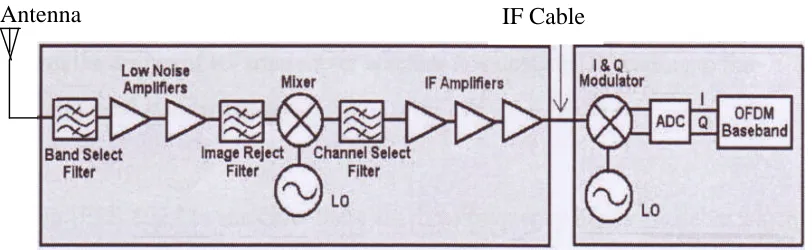
Generally in radio transmitter receiver, the system is divided into two sections, analog section and digital section. Analog section consists RF part and IF part. Second section is digital part. All the baseband processing such as demodulating, channel decoding and deinterleaving is done in this part. This project is focused on RF part consist of main components such as low noise amplifier, mixer, amplifier, filters (band-select filter, image-reject filter and channel select filter), and local oscillator.
A wireless MAN superheterodyne receiver might look likes a block diagram shown in figure 1.1. The performance for the subsystem to be studied is LNA. This project will cover some important features and specifications of Wireless MAN that will be focused on fixed broadband access and the concepts and techniques of LNA including the simulation by using ADS and testing to obtain the performance of the system. LNA will be verified for its specification and standard.
Antenna
Figure 1.1: Superheterodyne Receiver
In IEEE 802.16a standard, three frequency bands are available for U-NII band. There are lower U-NII band (5.150-5.250 GHz), middle U-NII band (5.250-5.350 GHz) and upper U-NII band (5.725-5.825GHz) where the maximum allowable
6 output power are 40mW (16.02dBm), 200mW (23dBm) and 800mW (29dBm) respectively. In wireless MAN, the transceiver under study is using the upper band for its frequency operation.
1.6 Project Contribution
As mentioned earlier, this project is extended from undergraduate student by doing some modification of Wireless LAN source. So, the same concept as WLAN will be implemented in this project. This is continuative work of the previous researcher which is to design, simulate and measure a RF transceiver operating at 5.725-5.825 GHz. This is then lead to the important purpose purpose of the project which is to verify the real subsystem of the designed RF transceiver.