PROFILING OF ILLICIT CANNABIS SAMPLES USING HIGH PERFORMANCE LIQUID CHROMATOGRAPHY AND MULTIVARIATE
ANALYSIS
YUVENDRAN MUNIANDY
A dissertation submitted in partial fulfillment of the requirements for the degree of Master of Science (Forensic Science)
FACULTY OF SCIENCE
UNIVERSITI TEKNOLOGI MALAYSIA
PROFILING OF ILLICIT CANNABIS SAMPLES USING HIGH PERFORMANCE LIQUID CHROMATOGRAPHY AND MULTIVARIATE
ANALYSIS
YUVENDRAN MUNIANDY
DEPARTMENT OF CHEMISTRY, FACULTY OF SCIENCE
Tel : 607-5534050 Faks: 607-5566162 http://www.fs.utm.my Emel: [email protected]
RUJ. KAMI:
RUJ. TUAN: 1.11.2010
To,
The Librarian
Perpustakaan Sultanah Zanariah Universiti Teknologi Malaysia 81310 UTM Skudai, Johor.
Dear Sir/Madam,
CLASSIFICATION OF PROJECT REPORT AS RESTRICTED
PROJECT TITLE : PROFILING OF ILLICIT CANNABIS SAMPLES USING HIGH PERFORMANCE LIQUID CHROMATOGRAPHY AND MULTIVARIATE ANALYSIS
Please be informed that the above mentioned project report be classified as
RESTRICTED for a period of five (5) years from the date of this letter. The reasons for this classification are:
The project involved the analysis of illicit cannabis seized from various parts of Malaysia.
The developed method has not been rigorously tested.
The study was part of an initial investigation of the profiling of seized drugs, carried out in collaboration with Jabatan Kimia Malaysia.
Thank you.
Sincerely yours,
(Assoc. Prof. Dr. Umi Kalthom bt. Ahmad) Program Head of MSc. (Forensic Science) Course Jabatan Kimia, Fakulti Sains
UTM Skudai. 07-5534522
iii
Special dedication towards these special people: ~Father~
iv
ACKNOWLEDGEMENT
v
ABSTRACT
vi
ABSTRAK
vii
TABLE OF CONTENTS
CHAPTER TOPIC PAGE
DECLARATION ii
DEDICATION iii ACKNOWLEDGEMENT iv
ABSTRACT v
ABSTRAK vi
TABLE OF CONTENTS vii
LIST OF TABLES xi
LIST OF FIGURES xiii
LIST OF ABBREVIATIONS xiv
LIST OF APPENDICES xv
1 INRODUCTION 1.1 Background of Study 1
1.2 Statement of Problem 3
1.3 Objectives of Study 3
1.4 Scope of Study 4
viii
1.6 Hypothesis of Study 4
2 LITERATURE REVIEW 2.1 Classification of Drugs 5
2.2 Trends of Drug Abuse in Malaysia 8
2.3 Cannabis 12
2.3.1 Cannabis Origins, Taxonomy & Nomenclature 12
2.3.2 Cannabis as Natural Medicinal Plant 14
2.3.3 Chemical Components of Cannabis 15
2.3.4 Forms of Cannabis Drugs 18 2.4 Drug Analysis 19
2.4.1 Identification of Drugs of Abuse 19
2.4.2 Quantitative Analysis of Drugs of Abuse 23
2.4.3 Forensic Toxicological Analysis of Cannabis 25 2.5 Monolithic Column 26
2.6 Drug Profiling 28
2.6.1 Multivariate Statistical Analysis 30 2.6.2 Principal Component Analysis (PCA) 31
ix
3 METHODOLOGY
3.1 Introduction 36
3.2 Chemicals & Reagents 36 3.3 Illicit Cannabis Samples 37
3.4 Apparatus 37
3.5 HPLC Instrument 38
3.6 Procedure 38
3.6.1 Extraction of Cannabis Samples 38 3.6.2 Physical Properties of Cannabis Samples 39 3.6.3 Microscopic Analysis of Cannabis Samples 39 3.6.4 High Performance Liquid Chromatography 39
3.6.5 Principal Component Analysis 40
3.6.6 Cluster and SIMCA Analysis 40
4 RESULTS AND DISCUSSION
4.1 Introduction 42
4.2 Illicit Cannabis Samples 42 4.3 Visual Inspection Microscopic Analysis of Illicit Cannabis 44
Samples
4.4 HPLC Separation of Cannabis 46
x
4.4.2 HPLC separation of Cannabis Standards 48 4.4.3 Chromatographic Profile of Illicit Cannabis 49 4.5 Principal Component Analysis using Unscrambler X 10.0 52
4.5.1 Loading Plot 54
4.5.2 Correlations Loading Plot 54
4.5.3 Score Plot 55
4.5.4 Comparison of HPLC and PCA for Profiling of 59 Illicit Cannabis Extracts
4.6 Cluster Analysis 61
4.7 SIMCA Analysis 63
5 CONCLUSIONS AND SUGGESTIONS
5.1 Conclusions 65
5.2 Suggestions 66
REFERENCES 68
xi
LIST OF TABLES
TABLE NO. TITLE PAGE
1.1 Number of cases and samples received by Department of 2
Chemistry 1.2 Major types of drugs handled by Department of Chemistry 2
from 2005 to 2007 2.1 Classification of drugs & their potential medicinal values 7
2.2 Cannabis arrest in South East Asia from 2004 – 2008 9
2.3 Latest reported rank and trend of drug abuse in Malaysia 10
2.4 Drug related arrests in Malaysia 10
2.5 Morphology of cannabis plant of different species 13
2.6 Chemical structure and physical properties of CBD, CBN and 17
∆9 -THC 2.7 Different solvent systems used to analyze illicit cannabis samples 23
And Rf ×100 values for each cannabinoids 2.8 Comparison of traditional particulate column and Monolithic 27
Column 3.1 Sample code corresponding to area of seizure for twenty five 37 Illicit cannabis samples 4.1 Sample codes of cannabis analyzed 43
xi
4.3 Variation of retention time and peak area for within-day 47 analysis of three cannabinoids
4.4 Groupings of fifty six cannabis extracts based on 50 observation of chromatogram and peak area size
4.5 Color, shape & numbering codes to differentiate cannabis 53 extracts from different area of seizures
4.6 Groupings of illicit cannabis samples using principal 55 component analysis
xiii
LIST OF FIGURES
FIGURE NO. TITLE PAGE
2.1 Schematic diagram of stages involved in drug profiling 20
2.2 Microscopic examination of cannabis samples 21 2.3 Electron microscope image of silica skeleton and macropore of 28
a silica based monolithic column
4.1 Cystolithic hairs observed on cannabis leaves 44
4.2 Head of grandular trichomes observed on cannabis leaves 45 4.3 Seed of cannabis plant observed under stereomicroscope 45 4.4 HPLC separation of three cannabinoid standards 48
4.5 HPLC separation of cannabis samples 51
4.6 Score plot of illicit cannabis extracts 56
4.7 Loading plot for illicit cannabis extracts 57
xiv
LIST OF ABBREVIATIONS
CBD - Cannabinoid
CBN - Cannabinol
THC - Tetrahydrocannabinol
PCA - Principal Component Analysis
SIMCA - Soft Independent Modeling Class Analogy RSD - Relative Standard Deviation
HPLC - High Performance Liquid Chromatography
GC - Gas Chromatography
PC - Principal Component
Rpm - Revolution per Minute
UNODC - United Nations Office on Drugs and Crime UNAIDS - United Nations Join Programme on HIV/AIDS
xv
LIST OF APPENDICES
APPENDIX TITLE PAGE
1 Mathematical equation involved in PCA, Cluster and SIMCA analysis 75 2 Unscrambler X 10.0 interface for importing Microsoft Excel data 76
spreadsheet
3 Chromatographic data (peak area of cannabinoids) used to 77 perform PCA
4 Unscrambler X 10.0 interface to perform PCA 78
2
CHAPTER 1
INTRODUCTION
1.1 Background of Study
Drug usage is not a new occurrence, the usage of drugs dates back to 10, 000 years ago, where there are archaeological evidences showing the usage of psychoactive substances (Mechoulam, 1973). In Malaysia, drug abuse is reaching an alarming rate and has caused a stir to the country’s economy, whereby it has been identified as one of the major social illness among youths in Malaysia. Over the past decade, the main problematic drugs in Malaysian context have been heroin and morphine with total estimate of drug abusers to be within 350,000 to 500,000 (Devaney et al., 2005). However, for the past five years cannabis, heroin, and morphine were the most dominant drugs in Malaysian law enforcement statistics (UNODC, 2010). According to statistics from Department of Chemistry of Malaysia, the number of cases and samples analyzed for illicit cannabis samples are substantial. Table 1.1 provides details on number of cases and samples of illicit cannabis analyzed by Department of Chemistry from the year 2007 till 2009.
2
Table 1.1 : Number of cases and samples of cannabis received by Department of Chemistry, Malaysia.
Year Number of Cases Number of Samples
2005 2,644 9,263
2006 3,344 21,738
2007 3,226 15,411
2008 2,403 11,075
2009 3,066 13,690
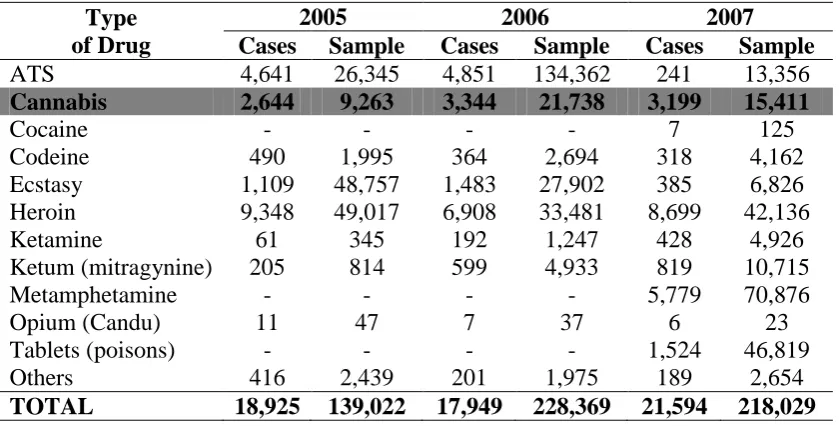
Though the figures are not showing a constant increase or decrease, but the quantity of cannabis samples received for analysis are indeed significant. This shows that cannabis is one of the most abused illicit drugs in Malaysia. Furthermore, cannabis is also one of the most highly trafficked drugs in Malaysian scenario (Table 1.2).
Table 1.2 : Major types of drugs handled by Department of Chemistry, Malaysia from 2005 to 2007.
Type of Drug
2005 2006 2007
Cases Sample Cases Sample Cases Sample
ATS 4,641 26,345 4,851 134,362 241 13,356
Cannabis 2,644 9,263 3,344 21,738 3,199 15,411
Cocaine - - - - 7 125
Codeine 490 1,995 364 2,694 318 4,162
Ecstasy 1,109 48,757 1,483 27,902 385 6,826
Heroin 9,348 49,017 6,908 33,481 8,699 42,136
Ketamine 61 345 192 1,247 428 4,926
Ketum (mitragynine) 205 814 599 4,933 819 10,715
Metamphetamine - - - - 5,779 70,876
Opium (Candu) 11 47 7 37 6 23
Tablets (poisons) - - - - 1,524 46,819
Others 416 2,439 201 1,975 189 2,654
TOTAL 18,925 139,022 17,949 228,369 21,594 218,029
3
need for drug profiling in Malaysia. Drug profiling is the extraction of drug sample’s chemical and/ or physical profile based on properties that they portray (Esseiva et al., 2006).
1.2 Statement of Problem
The core of this research is to profile illicit cannabis samples by assessing chemical properties and also by using a type of multivariate analysis known as Principal Component Analysis (PCA). Drug abuse and trafficking in Malaysia has reached an alarming rate. A call for draconian measures to curb drug-related crimes is required in order to preserve our future younger generations. Although drug profiling is not a new phenomenon for overseas countries like United States, Australia and United Kingdom, this branch of forensic study is a new field to be tackled in Malaysia. Extensive research is required in the field of drug profiling in Malaysia to engage in combating against drug abuse and trafficking. These are the problem statements which have initiated research on this area of study.
1.3 Objectives of Study
The objectives of this study are:
i. To develop drug profiling based on chemical properties of the cannabis using high performance liquid chromatography.
4
1.4 Scope of Study
The scope of research encompasses profiling of illicit cannabis samples using chemical properties and Principle Component Analysis.
1.5 Significance of Study
Characterizing properties of illicit drugs by means of forensic analysis is known as drug profile. Drug profiling can provide intelligence information by linking different samples to a common source. Besides, profiling also helps in retrieving valuable information about the operation of illicit drug supply networks. Adequate intelligence information can facilitate police officers and custom enforcers to narrow down illegal drug trafficking.
1.6 Hypothesis of Study
68
REFERENCES
Ahmad, U. K., and Yaacob, A.R. (2003). “Pengenalan Sains Forensik” Malaysia: Penerbit Universiti Teknologi Malaysia.
Baby, S. T. (2008). “Importance Of Impurity Profiling In Drug Substances”,
Pharmaceutical Reviews, 6(1).
Baker, P. B., Fowler, R., Bagon, K. R., and Gough, T. A. (1980). “Determination of
the Distribution of Cannabinoids in Cannabis Resin Using High Performance
Liquid Chromatography”, J. Anal. Toxicol., 4: 145-152.
Bazzaz, F. A., and Dusek, D. (1971). “Photosynthesis, Respiration, Transpiration,
And ∆9 THC Content of Tropical and Temperate Populations Of Cannabis Sativa”, American J. Botany, 58: 462.
Bazzaz, F. A., Dusek, D., Seigler, D.S., and Haney, A. W. (1975). “Photosynthesis
and Cannabinoid Content of Temperature and Tropical Populations of
Cannabis Sativa”, Biochemical Systematics and Ecology, 3: 15-18.
Bell, S. (2006). “Forensic Chemistry”. Upper Saddle River, New Jersey: Pearson, Prentice Hall.
Bidlingmeyer, B. A. (1992). “Practical HPLC Methodology And Applications”.
Wiley Interscience Publications.
Chan, K. B. and Kunalan, V. (2005). “A Comparison of Cannabis Samples”, Buletin
Kualiti dan Teknikal, 7(2): 14-20.
68
Cole, M. D. (2003). “The Analysis of Controlled Substances”, John Wiley & Sons. Collins, M., Huttunen, J., Evans, I., and Robertson, J. (2007). “Illicit Drug Profiling”.
Australian J. Forensic Sci., 39(1): 25-32.
Cirimele, V., Sachs, H., Kintz, P., and Mangin, P. (1996). “Testing Human Hair for Cannabis. III. Rapid Screening Procedure for the Simultaneous Identification of THC, Cannabinol and Cannabidiol”, J. Anal. Toxicol. 20: 13–16.
de Zeeuw, R. A. (2002). “Gas Chromatographic Retention Indices of Toxicologically Relevant Substances on Packed or Capillary Columns with
Dimethylsilicone Stationary Phases”, 3rd Edition, Report XVIII of the DFG Commission for Clinical-Toxicological Analysis, Weinheim, The International Association of Forensic Toxicologists and Deutsche Forschungsgemeinschaft.
Devaney, M., Reid G. and Baldwin, S. (2005). “Situational Analysis of Illicit Drug Issues and Responses in the Asia Pacific Region”, A collaborative project conducted by the Centre for Harm Reduction, Burnet Institute and Turning Point Alcohol and Drug Centre, Macfarlane Burnet Institute for Medical Researchand Public Health,Australia.
Dunteman, G. H. (1989). “Principal Component Analysis”. Newbury Park, London: Sage Publications.
Elsohly, M. (2007). “Marijuana and the Cannabinoids”. Totowa, New Jersey: Human Press.
Esseiva, P., Ioset, S., Anglada, F., Gaste, L., Ribaux, O., Margot, P., Galluser, A., Bierdermann, A., Specht, Y., and Ottinger, E. (2006). “Forensic Drug Intelligence: An Important Tool in Law Enforcement”. J. Forensic Sci. Int., 167(2): 247-254.
Esbensen, K., Guyot, D., Westad, F., and Houmoler, L. P. (2002). “Multivariate Data Analysis In Practice: An Introduction to Multivariate Data Analysis and
69
Fellermeier, M., Eisenreich, W., Bacher, A., and Zenk, M. H. (2001). “Biosynthesis of Cannabinoids: Incorporation Experiments with 13C-labeled Glucoses”, European J. Biochem., 268(6): 1596-1604.
Fisher, B. A. J. (1992). “Techniques of Crime Scene Investigation”. 5th Edition. New York: Elseiver.
Futoshi, T., Satoshi, M., and Yukihiro, S. (1995). “First Direct Evidence for the Mechanism of ∆1
-Tetrahydrocannabinolic Acid Biosynthesis”, J. Am. Chem. Soc., 117: 9766-9767.
Futoshi, T., Satoshi, M., and Yukihiro, S. (1996). “Purification and Characterization of Cannabidiolic-Acid Synthase from Cannabis Sativa L. Biochemical Analysis of a Novel Enzyme that Catalyzes the Oxidocyclization of Cannabigerolic Acid to Cannabidiolic Acid”, J. Biol. Chem., 271: 17411-17416.
Gambaro, V., Dell’ Acqua, L., Fare, F., Froldi, R., Saligari, E., and Tassoni, G. (2002). “Determination of Primary Active Constituents in Cannabis Preparations by High-Resolution Gas Chromatography/ Flame Ionization Detection and High Performance Liquid Chromatography/ UV Detection”, Anal. Chim. Acta, 468: 245-254.
Gill, J. S., Chee Chan, F. L., Sulaiman AH., and Habil, H. (2004). Methadone Maintenance Programme at University Malaya Medical Centre. Paper presented at the Drug Treatment Workshop, Malaysian Medical Association,
Pulau Pinang, Malaysia.
Guiochon, G. (2007). “Monolithic Columns in High Performance Liquid Chromatography”, J. Chromatogr. A, 1168: 101-168.
70
Harvey, D. J and Paton, W. D. M. (1975). “Use of Trimethylsilyl and Other Homologous Trialkylsilyl Derivatives for the Separation and Characterization of Mono- and Dihydroxycannbinoids by Combined Gas Chromatography and Mass Spectrometry”, J. Chromatogr., 109: 73–80.
Hughes, J. R., Higgins, S. T., Bickel, W. K., Hunt, W. K., Fenwick, J.W., Gulliver, S. B., and Mireault, G. C. (1991). “Caffeine Self-Administration, Withdrawal, and Adverse Effects among Coffee Drinkers”. Archives General Psychiatry, 48: 611-617.
Jacoby, M. (2006). “Monolithic Chromatography: Nontraditional Column Materials Improve Separations of Biomixtures”, Chemical and Engineering News, 84 (50): 14-19.
Jackson, A. R. W and Jackson, J. M. (2004). “Forensic Science”. 1st Edition. Harlow: Pearson, Prentice Hall.
Jenkins, R. W. and Patterson, D. A. (1973). “The Relationship between Chemical Composition and Geographical Origin of Cannabis”, Forensic Science, 2: 59-66.
Jolliffe, I. T. (2002). “Principal Component Analysis”, 2nd Edition. New York: Springer.
Jurado, C., Giménez, M. P., Menéndez., M., and Repetto, M. (1995). “Simultaneous Quantification of Opiates, Cocaine and Cannabinoids in Hair”, Forensic Sci. Int., 70: 165–174.
Karch, S. B. (2007). “Drug Abuse Handbook”, 2nd Ed. CRC Press, Taylor & Francis Group
Kealey, D. and Haines, P. J. (2002). “Analytical Chemistry”. 1st Edition. Oxford, UK: BIOS Scientific Publishers Ltd.
71
Kromidas, S. (2006). “HPLC Made to Measure: A Practical Handbook for Optimization”. Wiley VCH.
Lebel-Hardenack, S. and Grant, S. R. (1997). “Genetics of Sex Determination in Flowering Plants”, Trends Plant Sci. 2(4): 130–136.
Lehmann T. and Brenneisen, R. (1995). “High Performance Liquid Chromatography of Cannabis Products”, J. Liq. Chromatogr., 18(4): 689-700.
Mahlberg, Paul, G. and Eun Soo Kim. (2001). THC (tetrahyrdocannabinol) Accumulation in Glands of Cannabis (Cannabaceae). The Hemp Report 3(17). Retrieved 11 September, 2009.
Maseda, C., Hama, K., Fukui, Y., Matsubara, K., Takahashi, S., and Akane, A. (1986). “Detection of Δ9
-THC in Saliva by Capillary GC/ECD After Marihuana Smoking”, Forensic Sci. Int., 32: 259–266.
Massart, D. L, Vandeginste, B.G.M., Buydens, L.M.C., De Long, S., Lewi P.J., and Smeyers-Verbeke, J. (1998). “Data Handling in Science and Technology: Handbook of Chemometrics and Qualimetrics”, Part B, Amsterdam, Elsevier. McDonald, G. and Russel, A. D. (1999). “Antiseptic and Disinfectants Activity,
Action and Resistance”. Clinical Microbiology Reviews, 12 (1), 147-179. Mechoulam, R. (1973). “Marijuana Chemistry, Pharmacology, Metabolism and
Clinical Effects”. New York: Academic Press. 45 – 47.
Miller J. N. and Miller J. C. (2005). “Statistics and Chemometrics for Analytical Chemistry”. 5th Edition. Pearson Prentice Hall.
Nakamura G. R. (1969). “Forensic Aspects of Cystolith Hairs of Cannabis and Other Plants”, J. Assoc. Off. Anal.Chem., 52(5): 5-16.
Nakamura, G. R. and Thornton, J. I. (1973). “Forensic Identification of Marijuana: Some Questions and Answers”, J. Police Sc. & Admin., 1(1): 102-112.
Ndjoko, K., Wolfender, J.L., and Hostettmann, K. (1998). “Analysis of Cannabinoids
72
Chromatography – Tandem Mass Spectrometry”, Chromatographia, 47(1/2):
72-76.
Niedbala R. S., Kardos K, W., Fritch D. F., Kardos, S., Fries T., Waga J., Robb J., and Cone E. J. (2001). “Detection of Marijuana Use by Oral Fluid and Urine Analysis Following Single–dose Administration of Smoked and Oral Marijuana”, J. Anal. Toxicol. 25: 289–303.
Onyx Finish First Monolithic HPLC Columns Brochure, Phenomenex®.
Prailser, M. Bocxlaer, J. V., De Leenheer, A., and Massart, D. L. (2002). “Automated Recognition of Ergonic Aids Using Soft Independent Modeling Class Analogy (SIMCA)”, Turk. J. Chem., 26: 45-58.
Reid, G., Kamarulzaman, A., and Sran, S. K. (2007). “Malaysia and Harm Reduction: The Challenges and Responses”, Int. Drug Policy, 18, 136-140. Remberger, B., Krenn Kopp B, L., Buchbauer, G., and Nikiforov, A. (1994).
“Principal Component Analysis (PCA) of Opium Alkaloid Contents for Origin Determination”. Pharmazie, 49(10): 766-768.
Ryder, A. (2002). “Classification of Narcotics in Solid Mixture using Principal Component Analysis and Raman Spectroscopy”, J. Forensic Sci., 47: 275-284.
Saferstein, R. (2007). “Criminalistics: An Introduction to Forensic Science”. 9th Edition. New Jersey: Prentice Hall.
Small, E. 1975. “Morphological Variation of Achenes of Cannabis”, Canadian J. Botany, 53(10): 978-987.
Smith, R. N. and Vaughan, C. G. (1976). “High-Pressure Liquid Chromatographic of Cannabis: Quantitative Analysis of Acidic and Neutral Cannabinoids”, J. Chromatogr., 129: 347-354.
73
Tabchnik, B. G., and Fidell, L. S. (2001). “Using Multivariate Statistics”, 4th Edition. Needham Heights Mass,: Allyn & Bacon.
Turner, J. C. and Mahlberg, P. G. (1982). “Simple High Performance Liquid Chromatography Method for Separating Acidic and Neutral Cannabinoids in Cannabis sativa L”, J. Chromatogr. A, 253: 295-303.
United Nations Office on Drugs and Crime (UNODC). (1987). Recommended Methods for Testing Cannabis. UNODC Division of Narcotic Drugs.
United Nations Office on Drugs and Crime (UNODC). (2006). Drug Characterization/ Impurity Profiling, Background & Concepts. UNODC Regional Centre for East Asia and Pacific.
United Nations Office on Drugs and Crime (UNODC). (2009). Recommended Methods for the Identification and Analysis of Cannabis and Cannabis
Products. UNODC Division of Narcotic Drugs.
United Nations Office on Drugs and Crime (UNODC). (2010). Patterns & Trends of Amphetamine Type Stimulants (ATS) & Other Drugs of Abuse in East Asia &
the Pacific 2009. UNODC Regional Centre for East Asia and Pacific.
UNAIDS and UNDCP. (2000). Drug Use and HIV Vulnerability: Policy Research Study in Asia. Bangkok, Thailand: Regional Centre for East Asia and the Pacific, UNAIDS and UNDCP.
Unscambler ® X Contents Manual, 2009-2010 CAMO Software.
Weyermann, C., Marquis, R., Delaporte, C., Esseiva, P., Lock, E., Aalberg, L.,
Bonzenko Jr., J. S., Dieckmann, S., Dujourdy, L., and Zrcek, F. (2008).
“Drug Intelligence based on MDMA Tablets Data I. Organic Impurities Profiling”, Forensic Sci. Int., 177: 11-16.
74
Wong, K. (2001). “Caffeine May Protect against Parkinson Disease”, Scientific
American. Retrieved August 29, 2009 from
http://www.scientificamerican.com/article.cfm?id=caffeine-may-protect-agai