O R I G I N A L A R T I C L E
Open Access
Analysis of opioids in postmortem urine
samples by dispersive liquid-liquid
microextraction and high performance
liquid chromatography with photo diode
array detection
Elham Alahyari
1, Mehrdad Setareh
2,3, Ahmad Shekari
2,3, Gholamreza Roozbehani
2,3and Kambiz Soltaninejad
3*Abstract
Background:Opioids abuse and related deaths are increasing in the world. Therefore, the design of new analytical methods for detection of opioids in biological samples is necessary for clinical and forensic settings.
Methods:In this study, dispersive liquid-liquid microextraction (DLLME) combined with high-performance liquid chromatography with photo diode array detector (HPLC-PDA), as a new and sensitive method were examined for the extraction and determination of morphine, codeine and methadone in postmortem urine samples. Effective factors on DLLME were optimized. The extracts were analyzed by HPLC-PDA using a Eurospher® C18column (250 mm × 4.6 mm, particle size: 5μm).
Results:The volumes of chloroform as the extraction solvent and acetone as the dispersive solvent were selected 300μl and 500μl, respectively. The optimum pH 9.8 and extraction time was 0.5 min were selected. Under optimum condition, the enrichment factor and the recovery of morphine, codeine, and methadone spiked into postmortem urine samples were in the range of 175–215.8 and 87.5–107.9%, respectively. Calibration curves for each analyte are linear in the range of 0.5–100μg ml−1. Limit of detection (LOD) for the analytes was in the range of 10–25μg l−1. Finally, the proposed method was successfully applied to 50 postmortem urine samples for determination of the opioids.
Conclusions:The proposed method is an easy, fast, low cost and efficient for the extraction and determination of opioids in postmortem urine samples and should be considered as analytical method for determination of opioids in forensic and clinical toxicology labs.
Keywords:Opioids, Urine, Postmortem, DLLME, HPLC-PDA
Background
In recent years, substance abuse has been widely spread in the world and has social, economic, cultural and political dimensions in the society and considered as a major health threat (UNODC 2016). Opioids are a class of analgesics commonly used in clinical medicine for treatment of mod-erate and sever pain (Gergov et al. 2009; Pathan and Williams2012). Also, they have the high potential for abuse
(UNODC 2016). Therefore, analysis of the opioids in biological samples has been considered as an important issue in the forensic and clinical toxicology (Gergov et al.
2009; Shamsipur and Fattahi 2011). The determination of abused drugs in postmortem samples can provide some special challenges in comparison with clinical samples (Drummer2004). The variety and quality of the biological samples such as decomposed tissues, instability and degrad-ation of drugs of abuse in the postmortem conditions and drug redistribution are the some special features in analysis of drugs in postmortem forensic toxicology (Drummer
2004). Furthermore, the development of new analytical * Correspondence:[email protected]
3Department of Forensic Toxicology, Legal Medicine Research Center, Legal Medicine Organization, Tehran 1114795113, Iran
Full list of author information is available at the end of the article
methods for the qualitative and quantitative analysis of opi-oids in postmortem biological samples is an important con-cern in the forensic toxicology (Drummer 2004). A fast, easy and effective method for sample preparation is a key role for achieving to the better analytical procedures. Some traditional analytical techniques such as liquid-liquid extrac-tion (LLE) and solid-phase extracextrac-tion (SPE) have been de-veloped for extraction and determination of drugs including opioids in biological specimens (Wey and Thorman 2001; Whittington and Kharasch 2003; Mabuchi et al. 2004). There are some limitations on using of these methods of sample preparation. LLE method is time-consuming and re-quires the use of large volumes of high purity and toxic or-ganic solvents. The SPE is a method with relatively good efficacy, but it is relatively time-consuming for some long processes such as the washing and evaporation of the solvents. Also, in some cases, the method recovery is not enough for trace analysis (Shamsipur and Fattahi 2011). Therefore, the development of rapid, easy and environ-ment–friendly analytical methods is encouraged.
Recently, microextraction procedures are the most effect-ive sample preparation methods prior analysis. For example, liquid-phase microextraction (LPME) was successfully used for extraction of analytes from aqueous samples (Jeannot and Cantwell1996; He and Lee1997). Hollow fiber LPME (HF-LPME) is another easy and low-cost sample prepar-ation method in order to extraction of analytes from com-plex samples (Shen and Lee 2002; Lee et al. 2008; Saraji et al.2011). The combination of ultrasound with microex-traction and solvent drop solidification (LPME-SFO) are the two examples of developed methods based on microextrac-tion (Leong and Huang2008; Ma et al. 2009; Cheng et al.
2011; Zhang and Lee2012).
Dispersive liquid-liquid microextraction (DLLME) is another type of microextraction method that consists of a trinary system of solvents including a high-density and water- immiscible extraction solvent (extractant), a disper-sive solvent highly miscible with the extraction solvent and aqueous sample, and an aqueous sample (Rezaee et al.
2006). The method based on the formation of very small droplets of extraction solvent in the sample solution after injection of extractant and dispersive solvent into aqueous sample (Shamsipur and Fattahi 2011). The large contact surface area between the extraction solvent and aqueous sample forms a cloudy mixture. This phenomenon facili-tates a rapid equilibration. When the cloudy solution is cen-trifuged, the extractant forms the sediment phase and removed with a microsyringe for later analysis (Yan and Wang2013; Saraji and Boroujeni2014).
The DLLME is a simple, fast, efficient, environmentally-friendly and economic method for sample preparation (Rezaee et al.2006; Nagaraju and Huang2007; Shamsipur and Fattahi2011). It has been used for various types of bio-logical matrices (Li et al. 2008; Xiong et al. 2009;
Mashayekhi et al. 2010; Rezaee et al. 2010a; Rezaee et al.
2010b; Fernández et al.2013). DLLME could be combined with a variety of chromatography techniques such as Gas chromatography- Mass Spectrometry (GC-MS) (Leong and Huang 2008; Meng et al. 2015), High Performance Liquid Chromatography (HPLC) (Ahmadi-Jouibari et al.
2013; Fernández et al.2015) and capillary electrophoresis (Kohler et al.2013).
Although, there are few studies about the analysis of opium alkaloids and opioids drugs in clinical biological samples (Wey and Thorman 2001; Whittington and Kharasch2003; Saraji et al.2011; Shamsipur and Fattahi
2011; Ranjbari et al.2012; Ahmadi-Jouibari et al.2013), but there are scant data about the analysis of opioids by DLLME-HPLC-PDA in postmortem urine samples. Therefore, in this study, we optimized a DLLME-HPLC-PAD for the extraction and determination of morphine, codeine, and methadone in postmortem urine samples.
Methods
Chemicals
Standard morphine, codeine and methadone were obtained from Darou Pakhsh Pharmaceutical Co. (Tehran, Iran). HPLC grade solvents including acetonitrile, methanol, acetone, chloroform, water, phosphoric acid, potassium dihydrogen phosphate, sodium carbonate were purchased from Merck Co. (Darmstadt, Germany). To prepare the 0.05 M phosphate buffer, 16.65 g potassium dihydrogen phosphate was dissolved in 2.5 l of HPLC-grade water and the pH of the buffer in the mobile phase was adjusted to pH 2.3 using phosphoric acid 85% w/v. Stock standard solution with concentration level 1 mg ml−1were prepared for morphine, codeine and methadone in methanol was prepared. Working standards were made by dilution of stock solution to final concentrations in urine. All solutions were stored at 4 °C.
Instrumentation
Extraction of opioids in postmortem urine samples with DLLME
Blank postmortem urine samples (drug-free) were obtained during the autopsy of cadavers without any drug abuse/poi-soning history. The blank samples tested by routine post-mortem toxicological analysis (Thin layer chromatography (TLC) for screening and GC-MS for confirmation). Also, postmortem urine samples were collected from the cadavers with opioids abuse/poisoning which have been transferred to forensic toxicology laboratory of Zanjan legal
medicine center (Zanjan, Iran). The samples were stored at
−20 °C until analysis. The ethical committee of the Legal Medicine Research Center (Tehran-Iran) approved this project (Grant No. 20726).
Initially, the frozen urine samples were thawed at room temperature and then were centrifuged for 15 min at 4000 rpm. The supernatant was transferred into clean 15 ml conical test tube and filtrated by a 0.22μm filter, then 2 ml of the sample was transferred to a 10 ml test tube and 3 ml distilled water was added (to reduce matrix effects).
Fig. 1Effect of the volume of acetone as disperser solvent and the volume of chloroform as extraction solvent on the recovery of morphine, codeine and methadone. Extraction conditions: sample volume, 5 ml, volumes of acetone: 300, 500, 750, 1000, 1500 and 2000μl with containing 100, 300, 150, 88, 200 and 350μl of chloroform, respectively, pH 9.8; extraction time, 0.5 min and the spiked concentration of morphine, codeine and methadone was 10μgml−1
For the DLLME, an aliquot of 5 ml samples containing 2, 10 and 30μg ml−1of morphine, codeine and methadone were prepared and pH of the samples was adjusted at 9.8 by adding appropriate amounts of sodium carbonate (10%w/v). 300 μl of chloroform (extraction solvent) and 500 μl of acetone (disperser solvent) were mixed well to-gether then this mixture was injected rapidly by using a 2 ml syringe into the sample solution and a cloudy mixture has been formed. In this step, the analytes were extracted into the tiny droplet of chloroform, in a very short time. Then the samples were vortexed for 30 s and centrifuged at 4000 rpm for 10 min. After the centrifugation, fine droplets of extraction solvent were sediment at the bottom of the test tube. The sediment phase removed with a 100 μl microsyringe (Hamilton, USA) and replaced to a 1 ml glass vial. After evaporation of the solvent under stream of nitrogen gas, the residue was dissolved in 50μl methanol and injected into the HPLC-PDA.
Optimization of DLLME
Affecting factors the DLLME procedure including the type and volume of extraction solvent, type and volume of dis-perser solvent, pH and extraction time were optimized in this study. Optimization of these factors was done by using postmortem blank urine samples spiked with mor-phine, codeine, and methadone.
Validation of DLLME- HPLC-PDA method
Limit of detection (LOD), limit of quantification (LOQ) and linearity
The limit of detection (LOD) and the limit of quantification (LOQ) were considered as the lowest concentration of the analytes corresponding to relationship of signal to noise ratio 3:1 and 10:1, respectively (SWGTOX 2013). The linearity of the method determined in the concentration ranges of 0.5–100 μg ml−1 of morphine, codeine, and methadone. The calibration curves were drawn for morphine, codeine and methadone into blank postmortem urine samples spiked with concentrations of 0.5, 2, 5, 10, 20, 30, 40, 50 and 100μg ml−1for each analyte. All concen-trations were analyzed in triplicate.
Precision, accuracy, enrichment factor, recovery, and relative recovery
Inter-day and intra-day precisions method, and the enrich-ment factors and recovery for morphine, codeine and methadone were studied by extracting the spiked blank postmortem urine samples with 2, 10 and 30μg ml−1 con-centrations. In order to evaluate the accuracy of the method acting to prepare three urine samples with concentrations of 2, 10 and 30 μg ml−1 of morphine, codeine, and
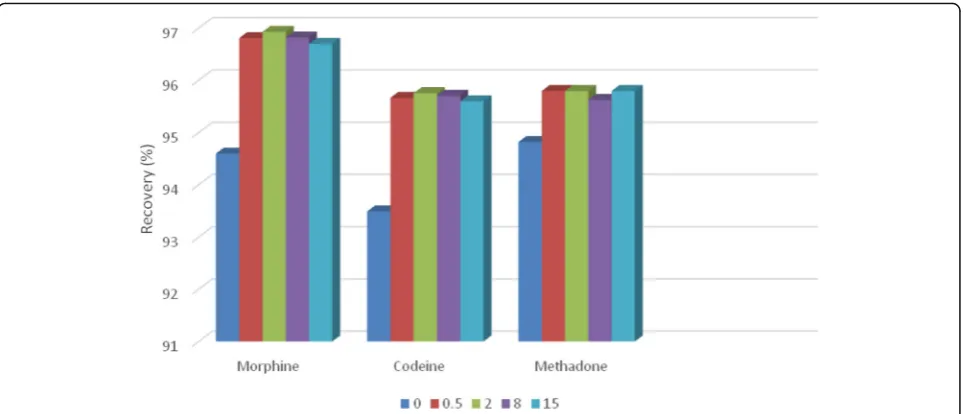
Fig. 3Effect of extraction time (minutes) on the recovery of morphine, codeine and methadone. Extraction conditions: sample volume: 5 ml, volume of acetone: 500μl and volume of chloroform: 300μl, pH 9.8, the spiked concentration of morphine, codeine and methadone were 10μg ml−1
Table 1Quantitative results of morphine, codeine and methadone in spiked postmortem urine samples by DLLME-HPLC-PDA
Analyte Linearity R2 LOD (μgl−1) LOQ (μg l−1)
Morphine y = 22,063 x + 1135.8 0.9991 25 100
Codeine y = 669,350 x - 217,207 0.9995 9 30
Methadone y = 892,444 x - 50,709 0.9989 10 35.5
Extraction condition: sample volume, 5 ml, pH = 9.8, volume of acetone as disperser solvent: 500μl; volume of chloroform as extraction solvent: 300μl and extraction time of 0.5 min
methadone (control urine samples). Then each of the three control samples was divided into three equal parts and was extracted by DLLME process. Accuracy in the format of the relative error (RE%) and preci-sion to form of the relative standard deviation (RSD %) were reported.
The enrichment factor (EF) is the analytes concentra-tion in the sediment and initial concentraconcentra-tion of analytes within the sample and calculated according to previous study (Rezaee et al.2006).
The extraction recovery (%ER) was defined as the ratio between the amount of the analyte in the sediment and the initial amount of the analyte within the sample and deter-mined as previous method (Rezaee et al.2006).
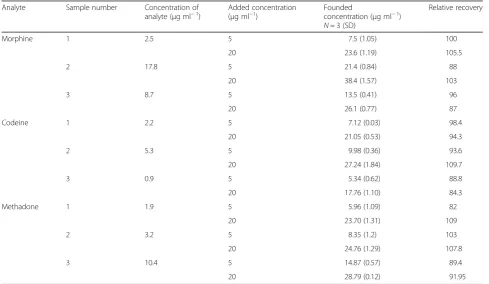
The relative recovery was studied by extracting the spiked postmortem urine samples (with suspected drug abuse) with two concentrations of morphine, codeine, and metha-done (5 and 20 μg ml−1). And then the relative recovery (%RR) was calculated according to the previous method (Rezaee et al.2006).
Table 2Validation parameters of analytes in postmortem urine samples
Analyte Added concentration
(μgml−1) Intraday precisionRSD (%) (n= 3)
Interday precision RSD (%) (n= 3)
Accuracy (Relative Error %) (SD,n= 3)
Recovery (%) (SD,n= 3)
EF
Morphine 2 4.1 2.8 −4.5 (0.12) 95.5 (0.05) 191
10 1.63 3.04 −2.7 (0.09) 107.9 (0.28) 215.8
30 5.6 4.05 −2.6 (0.23) 101.87 (0.04) 203.74
Codeine 2 3.8 4.1 −51 (0.23) 87.5 (0.09) 175
10 3.9 6.07 −2.3 (0.37) 93.5 (0.4) 187
30 3.8 1.17 3.9 (1.11) 101.5 (0.83) 203
Methadone 2 4.9 4.4 −8 (0.1) 89.5 (0.14) 179
10 5.7 5.7 1.7 (0.26) 97 (0.12) 194
30 3.4 3.6 −4.8 (0.44) 98.6 (0.73) 197.2
Extraction condition: Sample volume, 5 ml, pH 9.8, volume of acetone as disperser solvent: 500μl; volume of chloroform as extraction solvent: 300μl and extraction time: 0.5 min
EFEnrichment Factor
Table 3Relative recoveries and standard deviations of opioids in actual postmortem urine samples
Analyte Sample number Concentration of analyte (μg ml−1)
Added concentration (μg ml−1)
Founded
concentration (μg ml−1)
N= 3 (SD)
Relative recovery
Morphine 1 2.5 5 7.5 (1.05) 100
20 23.6 (1.19) 105.5
2 17.8 5 21.4 (0.84) 88
20 38.4 (1.57) 103
3 8.7 5 13.5 (0.41) 96
20 26.1 (0.77) 87
Codeine 1 2.2 5 7.12 (0.03) 98.4
20 21.05 (0.53) 94.3
2 5.3 5 9.98 (0.36) 93.6
20 27.24 (1.84) 109.7
3 0.9 5 5.34 (0.62) 88.8
20 17.76 (1.10) 84.3
Methadone 1 1.9 5 5.96 (1.09) 82
20 23.70 (1.31) 109
2 3.2 5 8.35 (1.2) 103
20 24.76 (1.29) 107.8
3 10.4 5 14.87 (0.57) 89.4
20 28.79 (0.12) 91.95
Results and discussion
Selection of extraction solvent
Selection of a suitable extraction solvent is one of the key steps in the DLLME procedure that direct impact on the efficiency of method (Rezaee et al. 2006). The extraction solvent should be have a characteristics such as higher density and low solubility in water, miscible with disperser solvent and capability for extraction of target analytes (Saraji and Boroujeni2014; Sharifi et al.2016). Chloroform due to have characteristics such as the higher density than water, the boiling point and the solubility in water, was used as appropriate extraction solvent to extract opioids from the postmortem urine samples (Shamsipur and Fattahi
2011).
Selection of disperser solvent
The disperser solvent should be miscible in the water and dissolve in the extraction solvent and capable to form a cloudy solution (Saraji and Boroujeni2014; Shar-ifi et al.2016). In this study, acetone was selected as dis-persive solvent due to the highest recovery of opium alkaloids, lower toxicity and cheaper than methanol and acetonitrile.
Optimization of extraction solvent volume
The effect of extraction solvent volume in the recovery of morphine, codeine and methadone in postmortem urine samples in the DLLME process, was investigated using different volumes of chloroform (88, 100, 150, 200, 300 and 350μl). All concentrations were analyzed in triplicate. With increase the volume of chloroform from 88 to 350μl, increased the volume of the sediment phase. With the in-creasing volume of chloroform from 88 to 300μl, for each analyte, extraction efficiency were increased, while a further increase in the volume of chloroform (higher than 300μl) were given a small reduction in extraction efficiency and a reduction in the enrichment factor of these three com-pounds. At low volumes of chloroform (88 and 100 μl) a significant reduction in analyte extraction efficiency were observed. Therefore, based on the results, 300μl was se-lected as the optimal volume of extraction solvent (Fig.1).
Optimization of disperser solvent volume
Performance of DLLME method directly influences by the volume of dispersive solvent. Changes in the volume of dispersive solvent cause changes the volume of the sediment phase. To obtain an optimal volume of acetone, was performed by several experiments using different volumes of acetone contains (300, 500, 750, 1000, 1500 and 2000μl) and various volumes of chloroform (88, 100, 150, 200, 300 and 350 μl). All concentrations were analyzed in triplicate. The results showed that at low volume of acetone (300μl) dispersion of the chloroform did not complete and
a decrease in extraction recovery was observed. Also, in the high volume of acetone (1500 and 2000 μl), extraction recovery of morphine, codeine, and methadone decreased due to the increased solubility of the analyte in the sample solution and reducing entry them into the organic phase. Therefore, based on the results, 500 μl of acetone was selected as the optimal volume of disperser solvent in this study.
Optimization of pH
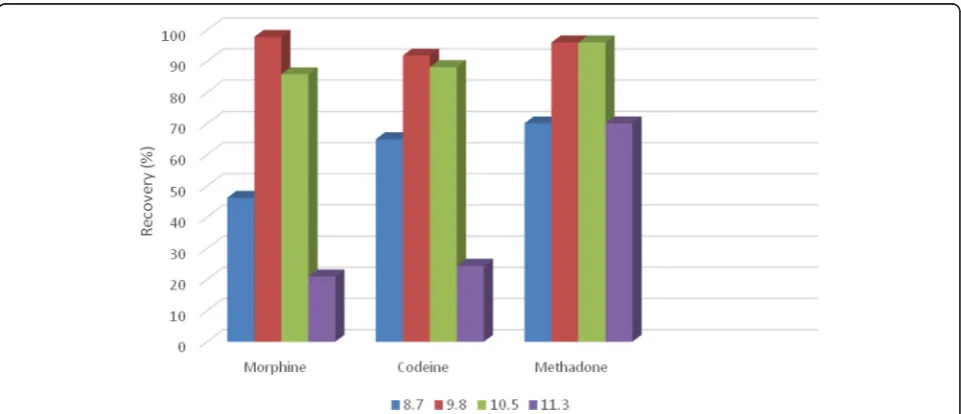
Addition of adequate amount of sodium carbonate to the sample solutions, in order to adjust the pH and ionic strength of solutions, directly effect of the extraction effi-ciency. In this study, the extraction recovery of morphine, codeine, and methadone was examined in different pH in the range of 8.5–11.5 (an average of 8.7, 9.8, 10.5 and 11.3). The results obtained showed that very low pH in the range of 8.5–9 (average 8.7) and as well as in high pH in the range of 11–11.5 (average 11.3), extraction efficiency for all three compounds in the study, significantly decreased. Also, in the pH 10–11 (average 10.5) is a very small reduction in the extraction efficiency. So, with the view of increasing the extraction efficiency of morphine, codeine, and methadone in the pH 9.8, this pH was selected as optimum for extrac-tion of the opioids from postmortem urine samples (Fig.2).
Optimization of extraction time
Optimization of extraction time in a variety of liquid-phase microextraction, is a critical factor that plays a great impact on the extraction efficiency. In DLLME method, the extraction time is defined as the interval time between fast injecting a mixture of extraction and dispersive solvents into the sample solution before the start of centrifuges (Rezaee et al. 2006; Shamsipur and Fattahi2011). In this study, the effect of extraction time on the enrichment factor and extraction efficiency was determined. A range time from 0 to 15 min (0, 0.5, 2, 8 and 15 min) were evaluated. The results showed that extraction time has no significant effect on the extrac-tion recovery for morphine, codeine and methadone. Thus the extraction time in all experiments carried out in this study was 30 s (Fig.3).
Validation of method
codeine, and methadone, was reported (Table 2). Also, the accuracy of the method was evaluated by calculating of relative error. Relative error is not more than % ± 15. In this study, the relative error for morphine, codeine and methadone in the ranges of −8 to 3.9% was ob-tained (Table2). LOD and LOQ for all the analytes were in the ranges of 9-25μgl−1and 30-100μgl−1, respectively (Table 1). The enrichment factor, recovery and relative recovery for morphine, codeine and methadone, was cal-culated and showed in the tables (Tables2and3).
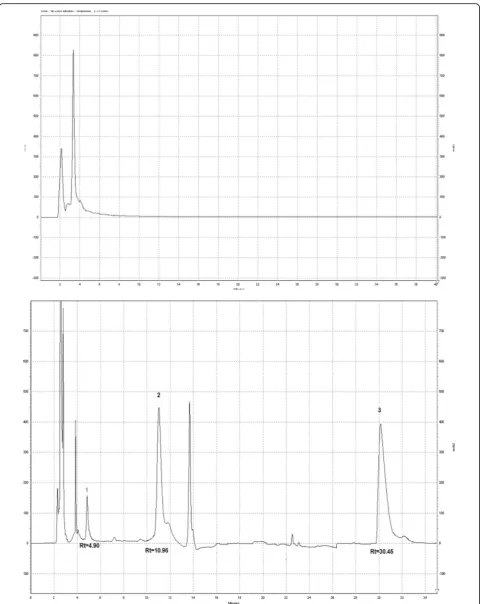
The simplest method for evaluation of selectivity of an analytical method is checking of absence of response in blank samples. There were no interferences at the reten-tion times of three target analytes in the method (Fig.4).
Application of DLLME-HPLC-PDA procedure
After the optimization of the effective factors on DLLME and achieving to good and satisfactory results from the vali-dated method, the DLLME-HPLC-PDA was used success-fully for extraction and determination of morphine, codeine, methadone in 50 actual postmortem urine sam-ples. Based on the obtained results, morphine was found in 22 samples, codeine was detected in 17 samples and methadone was detected in 27 samples. Some of the opium alkaloids such as papaverine, thebaine and noscapine were identified at 2, 1 and 3 samples, respectively. Also, 6-monoacetylmorphine and tramadol were determined in 8
and 6 samples, respectively. Concentration of morphine, codeine and methadone in postmortem urine samples were calculated in the range of: 0.28-26 μg ml−1 (mean: 6.7 μg ml−1) for morphine, 0.9–25.4 μg ml−1 (mean: 13.52 μg ml−1) for codeine and 0.4–43.8 μg ml−1(mean: 33.5μg ml−1) for methadone.
Comparison of DLLME-HPLC-PDA method with other methods
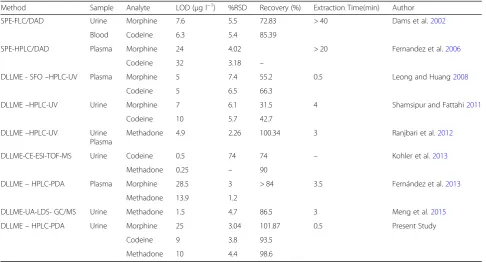
Table4summarized the comparison of the proposed method for the determination of morphine, codeine, and methadone in postmortem urine samples by the DLLME-HPLC-PDA with previous methods such as SPE-HPLC-DAD, SPE-FLC-DAD, GC-MS, SFO-HPLC and DLLME-HPLC-UV. The recovery and extraction time of the present method is better than other methods (Table4). LOD in the proposed method is similar to the previous studies (Dams et al.2002; Leong and Huang2008; Shamsipur and Fattahi
2011; Ranjbari et al.2012; Kohler et al.2013; Fernández et al.
2013; Meng et al.2015) (Table4). Conclusion
In this study, the efficiency and performance of DLLME process were assessed under optimum conditions for the extraction of opioids from postmortem urine samples. According to repeatability, linearity, high extraction effi-ciency and good enrichment factor, this method is Table 4Comparison of DLLME-HPLC-PDA with other analytical methods for determination of morphine, codeine and methadone in biological samples
Method Sample Analyte LOD (μg l−1) %RSD Recovery (%) Extraction Time(min) Author
SPE-FLC/DAD Urine Morphine 7.6 5.5 72.83 > 40 Dams et al.2002
Blood Codeine 6.3 5.4 85.39
SPE-HPLC/DAD Plasma Morphine 24 4.02 > 20 Fernandez et al.2006
Codeine 32 3.18 –
DLLME - SFO–HPLC-UV Plasma Morphine 5 7.4 55.2 0.5 Leong and Huang2008
Codeine 5 6.5 66.3
DLLME–HPLC-UV Urine Morphine 7 6.1 31.5 4 Shamsipur and Fattahi2011
Codeine 10 5.7 42.7
DLLME–HPLC-UV Urine Plasma
Methadone 4.9 2.26 100.34 3 Ranjbari et al.2012
DLLME-CE-ESI-TOF-MS Urine Codeine 0.5 74 74 – Kohler et al.2013
Methadone 0.25 – 90
DLLME–HPLC-PDA Plasma Morphine 28.5 3 > 84 3.5 Fernández et al.2013
Methadone 13.9 1.2
DLLME-UA-LDS- GC/MS Urine Methadone 1.5 4.7 86.5 3 Meng et al.2015
DLLME–HPLC-PDA Urine Morphine 25 3.04 101.87 0.5 Present Study
Codeine 9 3.8 93.5
Methadone 10 4.4 98.6
suitable for qualitative and quantitative analysis of opi-oids in postmortem urine samples. This is the first DLLME-HPLC-PDA method which optimized for post-mortem urine samples and should be considered as an applied analytical method for determination of opioids in forensic toxicology laboratory.
Acknowledgements
We would like to show our gratitude to the Legal Medicine Research Center, Legal Medicine Organization, Tehran- Iran for financial support of this study.
Funding
This research was supported by Legal Medicine Research Center, Legal Medicine Organization, Tehran- Iran (Grant No. 20726).
Availability of data and materials Not applicable
Authors’contributions
EA attributed in method validation, analysis of samples, data gathering and analysis and writing of the draft of the manuscript. MS attributed in sample collection and data gathering. AS attributed in method validation and analysis of the samples. GR attributed method validation and data gathering. KS attributed in study design, supervision on all of the research’s steps, revision the draft and writing the final version. All authors approved the final version of the paper.
Authors’information
EA (MSc in Toxicology) works as a technical expert in Laboratory of Toxicology. MS (MD, Forensic Medicine specialist) is head of the Zanjan Legal Medicine Center, Zanjan, Iran and member of the Legal Medicine Research Center, Legal Medicine Organization, Tehran Iran.AS (MSc in Toxicology) and GR (BS) are work as technical experts in Forensic Toxicology Laboratory of Zanjan Legal Medicine Center, KS (PharmD, PhD in Toxicology) is Associate Professor of Toxicology, Department of Forensic Toxicology, Legal Medicine Research Center, Legal Medicine Organization, Tehran Iran.
Ethics approval and consent to participate
All procedures performed in study involving human participants were in accordance with the ethical standards of the Legal Medicine Research Center’s ethical committee (Grant No. 20726) and with the 1964 Helsinki declaration and its later amendments or comparable ethical standards.
Consent for publication Not applicable
Competing interests
The authors declare that they have no competing interest.
Publisher’s Note
Springer Nature remains neutral with regard to jurisdictional claims in published maps and institutional affiliations.
Author details 1
Department of Pharmacology and Toxicology, Faculty of Pharmacy, Pharmaceutical Sciences Branch, Islamic Azad University (IAUPS), Tehran, Iran. 2
Legal Medicine Center of Zanjan Province, Zanjan, Iran.3Department of Forensic Toxicology, Legal Medicine Research Center, Legal Medicine Organization, Tehran 1114795113, Iran.
Received: 30 August 2017 Accepted: 23 January 2018
References
Ahmadi-Jouibari T, Fattahi N, Shamsipur M, Pirsaheb M (2013) Dispersive liquid– liquid microextraction followed by high-performance liquid
chromatography–ultraviolet detection to determination of opium alkaloids in human plasma. J Pharm Biomed Anal 85:14–20
Cheng J, Matsadiq G, Liu L, Zhou YW, Chen G (2011) Development of a model ultrasound-assisted surfactant-enhanced emulsification microextraction method and its application to the analysis of eleven polycyclic aromatic hydrocarbons at trace levels in water. J Chromatography A 1218:2476–2482 Dams R, Benijts T, Lambert WE, De Leenheer AP (2002) Simultaneous
determination of in total 17 opium alkaloids and opioids in blood and urine by fast liquid chromatography–diode-array detection–fluorescence detection, after solid-phase extraction. J Chromatography B 773:53–61
Drummer OH (2004) Postmortem toxicology of drugs of abuse. Forensic Sci Int 42:101–113 Fernandez P, Morales L, Vazquez C, Bermejo AM, Tabernero MJ (2006) HPLC-DAD determination of opioids, cocaine and their metabolites in plasma. Forensic Sci Int 161:31–35
Fernández P, González C, Pena MT, Carro AM, Lorenzo RA (2013) A rapid ultrasound-assisted dispersive liquid-liquid microextraction followed by ultra-performance liquid chromatography for the simultaneous determination of seven benzodiazepines in human plasma samples. Anal Chim Acta 767:88–96 Fernández P, Regenjo M, Bermejo A, Fernández A, Lorenzo R, Carro A (2015)
Analysis of drugs of abuse in human plasma by dispersive liquid–liquid microextraction and high performance liquid chromatography. J Applied Toxicol 35(4):418–425
Gergov M, Nokua P, Vuori E, Ojanpera I (2009) Simultaneous screening and quantification of 25 opioid drugs in post-mortem blood and urine by liquid chromatography–tandem mass spectrometry. Forensic Sci Int 186:36–43 He Y, Lee HK (1997) Liquid-phase microextraction in a single drop of organic solvent by using a conventional microsyringe. Anal Chem 69:4634–4640 Jeannot MA, Cantwell FF (1996) Solvent microextraction into a single drop. Anal
Chem 68:2236–2240
Kohler I, Schappler J, Sierro T, Rudaz S (2013) Dispersive liquid-liquid microextraction combined with capillary electrophoresis and time-of-flight mass spectrometry for urine analysis. J Pharm Biomed Anal 73:82–89 Lee J, Lee HK, Rasmussen KE, Pedersen-Bjergaard S (2008) Environmental and
bioanalytical applications of hollow fiber membrane liquid-phase microextraction: a review. Anal Chim Acta 624:253–268
Leong M, Huang SD (2008) Dispersive liquid-liquid microextraction method based on solidification of floating organic drop combined with gas chromatography with electron-capture or mass spectrometry detection. J Chromatography A 1211:8–12
Li Y, Hu J, Liu X, Fu L, Zhang X, Wang X (2008) Dispersive liquid-liquid microextraction followed by reversed phase HPLC for the determination of decabrominated diphenyl ether in natural water. J Sep Sci 31:2371–2376 Ma JJ, Du X, Zhang JW, Wang LZ (2009) Ultrasound-assisted emulsification
microextraction combined with flame atomic absorption spectrometry for determination of trace cadmium in water samples. Talanta 80:980–984 Mabuchi M, Takatsuka S, Matsuoka M, Tagawa K (2004) Determination of
morphine, morphine-3-glucuronide and morphine-6-glucuronide in monkey and dog plasma by high-performance liquid chromatography–electrospray ioniza- tion tandem mass spectrometry. J Pharm Biomed Anal 35:563–573 Mashayekhi HA, Abroomand-Azar P, Saber-Tehrani M, Hussain SW (2010) Rapid
determination of carbamazepine in human urine, plasma samples and water using DLLME followed by RP-LC. Chromatographia 71:517–521
Meng L, Zhang W, Meng P, Zhu B, Zheng K (2015) Comparison of hollow fiber liquid -phase microextraction andultrasound-assisted low-density solvent dispersive liquid–liquid microextraction for the determination of drugs of abuse in biological samples by gas chromatography–mass spectrometry. J Chromatography B 989:46–53
Nagaraju D, Huang SD (2007) Determination of triazine herbicides in aqueous samples by dispersive liquid-liquid microextraction with gas chromatography-ion trap mass spectrometry. J Chromatography A 1161:89–97
Pathan H, Williams J (2012) Basic opioid pharmacology: an update. Br J Pain 6(1):11–16 Ranjbari E, Golbabanezhad-Azizi AA, Hadjmohammadi MR (2012)
Preconcentration of trace amounts of methadone in human urine, plasma, saliva and sweat samples using dispersive liquid–liquid microextraction followed by high performance liquid chromatography. Talanta 94:116–122 Rezaee M, Assadi Y, Hosseini MRM, Aghaee E, Ahmadia F, Berijani S (2006)
Determination of organic compounds in water using dispersive liquid–liquid microextraction. J Chromatography A 1116:1–9
Rezaee M, Yamini Y, Faraji M (2010a) Evolution of dispersive liquid–liquid microextraction method. J Chromatography A 1217:2342–2357
Saraji M, Boroujeni MK (2014) Recent developments in dispersive liquid–liquid microextraction. Anal Bioanal Chem 406(8):2027–2066
Saraji M, Khalili Boroujeni M, Hajialiakbari Bidgoli AA (2011) Comparison of dispersive liquid–liquid microextraction and hollow fiber liquid–liquid–liquid microextraction for the determination of fentanyl, alfentanil, and sufentanil in water and biological fluids by high-performance liquid chromatography. Anal Bioanal Chem 400:2149–2158
Shamsipur M, Fattahi N (2011) Extraction and determination of opium alkaloids in urine samples using dispersive liquid–liquid microextraction followed by high-performance liquid chromatography. J Chromatography B 879(28):2978–2983 Sharifi V, Abbasi A, Nosrati A (2016) Application of hallow fiber liquid phase
microextraction and dispersive liquid-liquid microextraction techniques in analytical toxicology. J Food Drug Anal 24:264–276
Shen G, Lee HK (2002) Hollow fiber-protected liquid-phase microextraction of triazine herbicides. Anal Chem 74:648–654
SWGTOX (2013) Scientific working Group for Forensic Toxicology (SWGTOX) standard practices for method validation in forensic toxicology. 2013. Available from:https://academic.oup.com/jat/articlepdf/37/7/452/2299550/ bkt054.pdf, 11 Oct 2017
UNODC (2016) World drug report 2016. United Nations publications, New York Wey AB, Thorman W (2001) Capillary electrophoresis–electrospray ionization ion
trap mass spectrometry for analysis and confirmation testing of morphine and related compounds in urine. J Chromatography A 916:225–238 Whittington D, Kharasch ED (2003) Determination of morphine and morphine
glucuronides in human plasma by 96-well plate solid-phase extraction and liquid chromatography–electrospray ionization mass spectrometry. J Chromatography B 796:95–103
Xiong C, Ruan J, Cai Y, Tang Y (2009) Extraction and determination of some psychotropic drugs in urine samples using dispersive liquid–liquid microextraction followed by high-performance liquid chromatography. Jl Pharm Biomed Anal 49:572–578
Yan H, Wang H (2013) Recent development and applications of dispersive liquid– liquid microextraction. J Chromatography A 1295:1–15