©
Perspectives
Anecdotal, Historical and Critical Commentaries on Genetics
Edited by James F. Crow and William F. Dove
Cornfests, Cornfabs and Cooperation: The Origins and Beginnings
of the Maize Genetics Cooperation News Letter
Lee B. Kass,*
,1Christophe Bonneuil
†and Edward H. Coe, Jr.
‡*Department of Plant Biology, Cornell University, Ithaca, New York 14853,†CNRS, Centre Koyre´ d’Histoire des Sciences et des Techniques,
75231 Paris, Cedex 05, France and‡United States Department of Agriculture-Agricultural Research Service,
Plant Genetics Research Unit and University of Missouri, Columbia, Missouri 65211
I
N the early 1920s, the Maize Genetics Cooperation who granted him funds to support his information and supply network in 1934. The work of Barbara McClin-(MGC) began in an informal way among R. A.Emer-son and his students. His ethical and cooperative spirit tock in cooperation with Beadle, Rhoades, Creighton, Burnham, and others at Cornell between 1928 and 1934 paved the way for an expanded network of maize
re-searchers who freely shared their materials and unpub- resulted in a definitive correlation of chromosomes and linkage groups in maize—ultimately published in 1935 lished research, thus resulting in rapid progress in
funda-mental genetic research (Coe2001;KassandBonneuil by Emersonet al.The cytogenetics of maize was also re-viewed in that year (RhoadesandMcClintock1935). 2004).
The first letter summarizing both published and un- The exhibits that Emerson submitted to support his Rockefeller Foundation grant included a historical sum-published maize linkage data was compiled by Emerson
and his student George Beadle and sent to students of mary of the MGC and MNL. These documents allowed us to reconstruct the events that established these im-maize genetics on April 12, 1929. This communication
was an outcome of a “cornfab” held in Emerson’s hotel portant resources for the maize genetics community. Emerson’s legacy lives on in the cooperative spirit of room in December 1928, during the annual American
Association for the Advancement of Science (AAAS) maize researchers and in the News Letter he founded 75 years ago.
meetings. The “Historical Notes on Maize Cooperation”
identifies Emerson’s 1929 communication as the first At the 1932 ICG held in Ithaca, New York, Rollins Adams Emerson (Nelson 1993), Head of the Depart-Maize Genetics Cooperation News Letter (MNL;
Emer-ment of Plant Breeding at Cornell University, gave an
son1940). Beadle was the first secretary of the MGC
opening address titled, “The Present Status of Maize and he solicited material for additional summaries of
Genetics.” In his introduction he declared, “I cannot linkage data, which were distributed in two parts in
refrain from noting here a very real advantage experi-1930. Rhoades succeeded Beadle as secretary and
con-enced by students of maize genetics . . . I am aware of tinued to summarize and publish the reports of
coopera-no other group of investigators who have so freely tors in the MNL, which continues to be published
annu-shared with each other not only their materials but ally.
even their unpublished data. The present status of maize The cooperators met at the Sixth International
Con-genetics, whatever of noteworthy significance it presents, gress of Genetics (ICG) at Ithaca in 1932 and organized
is largely to be credited to this somewhat unique, un-a committee to estun-ablish the mun-aize stock center un-at
Cor-selfishly cooperative spirit of the considerable group of nell University and to seek funding for their enterprise.
students of maize genetics” (Emerson1932, p. 141;Kass
Emerson’s grant application to the National Research
2001). Council (NRC) was denied and he was encouraged to
During this Congress, Emerson called a meeting of apply immediately to the Rockefeller Foundation (RF),
ⵑ45 students of maize genetics and formalized what would soon be called the Maize Genetics Cooperation. Following their meeting Emerson and his graduate
stu-1Corresponding author:Department of Plant Biology, 228 Plant
Sci-dent Marcus Rhoades issued on October 5, 1932, what ence Bldg., Tower Rd., Cornell University, Ithaca, NY 14853-5908.
E-mail: [email protected] has long been considered the first Maize Genetics
Figure1.—R. A. Emerson with former and current students and colleagues at Fernow Hall, Cornell University, January 1, 1922, follow-ing the AAAS meetfollow-ing in Toronto, where the second “cornfest” was held. Back row, from left to right: Milislav Demerec, Sterling Emer-son, Ernest G. AnderEmer-son, and Charles Metz; front row, from left to right: Maxwell J. Dorsey, Sewall Wright, Rollins A. Emerson, Wil-liam Bateson, Claude Burton Hutchison, Calvin Bridges, Frank P. Bussell, and Lewis A. Eyster (with permission of Royse P. Mur-phy, Department of Plant Breed-ing, Cornell University; see also
Provine1986, p. 103).
operation News Letter (Rhoades1932a). Our research A. Kroch Library, Cornell University (CU) Library, Ith-aca, NY]. Soon afterward, Emerson arranged informal (BonneuilandKass 2001; Coe2001;Kass and
Bon-neuil 2004; E. H. Coe and L. B. Kass, unpublished “cornfests” in conjunction with the AAAS meetings. It seems that Emerson organized theseⵑ10 years before results), which we offer in keeping with the long
tradi-tion of maize cooperatradi-tion, provides a historical perspec- the famous “cornfab” held in his hotel room in New York City in December of 1928, as recalled byRhoades
tive on the actual origin of the MGC and the beginnings
of the MNL, which was first issued in 1929. We present (1984). Emerson much earlier had invited Paul Weath-erwax of Indiana University to attend a “second corn-here the history of Emerson’s successful negotiations
with the Rockefeller Foundation to fund his cooperative fest” along with the “general genetics section” he had planned for the AAAS meetings in Toronto in 1921. enterprise at Cornell University following his
unsuccess-ful attempt to obtain funding from the NRC. Future Weatherwax apologized for not being able to attend (Weatherwax to Emerson, November 22, 1921, CU) but Nobel laureates George Beadle, Emerson’s student, and
Barbara McClintock, Lester W. Sharp’s student and Bea- Emerson’s former and current students and colleagues joined him there and, following the meeting, held a dle’s collaborator, freely submitted their results to the
MNL; this laid the groundwork for a similar publication, reunion on January 1, 1922, at Cornell (Figure 1). The following winter, Emerson emphasized the im-theDrosophila Information Service, for the Drosophila
ge-neticists in March 1934 (BridgesandDemerec1934) portance of agreeing on uniformity for factor notation (gene symbols) and he set the tone for cooperating on and for theWorm Breeders Gazette, the community
news-letter of the roundworm biologists (Edgar1975;Cohen this problem in a letter on March 7, 1923 (Emerson
1923, p. 147), “To Students of Corn Genetics : . . . . It 1995), among others. We rejoice in the founding of
Emerson’s ideal and celebrate the 75th anniversary of seems wise to follow the notation used by the Drosophila workers, tho, in some respects, their usage is perhaps the MNL.
no more nearly consistent than our own.” Emerson also asked his colleagues for assistance with numbering the
EARLY COOPERATION maize linkage groups and requested advice on using
bi-literal gene symbols:
Cornfests—a cooperative enterprise to map maize:
As early as November 1918, Emerson wrote to Donald Shall priority of publication of any linkage determine
the numerical order? Or shall the order be determined
F. Jones at the Connecticut Agricultural Experiment
arbitrarily? . . . I suggest . . . that we number the groups
Station that he was “hoping that all the men in this
in the order given by [William H.] Eyster and by [Claude
country who are working on related problems with corn
B.] Hutchison as follows: 1-C-wx; 2-g-R; 3-su-Tu; 4-B-Lg;
may cooperate to such an extent that we can cover the 5-Y-Pl; 6-P-f. . . . It may be wise, however, to assign no field more quickly” [Emerson to Jones, November 8, numbers to groups other than the six listed above until
the newer groups have been tested further. Another
Figure2.—R. A. Emerson and members of the Synapsis Club, 1923. Herbert J. Webber started this student/faculty organization at Cornell in 1907, and Emerson continued and encouraged mem-ber participation (Department of Plant Breeding Records, Courtesy of the Division of Rare and Manu-script Collections, Cornell Univer-sity Library). Members are identi-fied from left to right (an asterisk designates corn researchers). Front row: William T. Craig, J. Randal Livermore, Ernest Dorsey, Frank-lin D. Keim, Robert D. Lewis, Laurens J. Henning, John P. Jones, *Helen A. Z. Trajkovich, G. V. Wazalwar. Second row: Frank P. Bussell, *Allan C. Fraser, Harry H. Love, *Rollins A. Emer-son, Clyde I. Myers, *Roy G. Wig-gans, *Lester W. Sharp, *Lowell F. Randolph. Back row: T. Sasaki, Archie F. Barney, Harold D. Brown, Leo A. Van Rooyen, *Pavao Kvakan, Andrew D. Suttle, Walter A. Burkholder, Lua A. Minns, Edward L. Proebsting, Clif-ford V. Kightlinger, Merl C. Gillis, and *Iang Chandrastitya.
lem is bothering us. Shall we continue to use bi-literal 1924). In addition to Anderson and Lindstrom, several symbols for genes as we have usually done in the past other students pursued graduate work with Emerson [i.e.,bl, blotched leaf], or adopt the recommendations of
on corn genetics (including women and students from
the Naturalist’s committee to use single letter symbols
abroad, Figures 2 and 3): William H. Eyster, Milislav
[i.e.,b1]? If the corn men desire to stick to the use of
bi-literal symbols, we shall probably have to refrain from Demerec (Figure 1), Helen A. Trajkovich, Pavao
Kva-publishing in Genetics . . . but if the corn men think best kan, Thomas Bregger, Ivan F. Phipps, George W. Beadle, to adopt the plan followed by Genetics [using single letter Hsien W. Li, George F. Sprague, Johannes D. J. Hof-symbols], I shall use it (p. 149).
meyr, Marcus Rhoades, Swarm Singh, Sylvia Allen, and others (R. P. Murphy, unpublished results; CU). Emerson ended his five-page review with words for
con-tinued cooperation, “I am sending this to a considerable During the period 1918–1920, Emerson realized that he could not avoid investigating the linkage of maize, number of corn genetics workers. When I have received
replies from the majority, I may want to refer some of our which was crucial both to closing the gap with Drosoph-ila workers and to providing a deeper basis for the breed-problems to the Chairman of the Naturalist’s committee
with the suggestion that he consider the advisability of ing work on corn. Whereas from 1913 to 1928 Drosoph-ila linkage mapping remained the concern of a few referring it to the committee for consideration” (p. 149).
Two of Emerson’s former students at Nebraska, laboratories (WagnerandCrow2001), Emerson
pro-moted the idea that maize genetic mapping should be Ernest G. Anderson (Figure 1) and Ernest W.
Lind-strom, had followed him to Cornell in 1914 and contin- a larger cooperative enterprise (Kass and Bonneuil
2004), which would allow individuals to devote the best ued to work on corn problems after graduating.
Stu-dents and established researchers from around the of their research time to more fundamental research projects. Furthering this end, Emerson also developed country and throughout the world soon joined
Emer-son’s group and studied corn breeding and genetics at a regular collaboration and acted as advisor to the U.S. Department of Agriculture (USDA) program in corn Cornell. C. B. Hutchison (Figure 1), a former Cornell
graduate, was appointed Professor of Plant Breeding in research from 1920 onward [U.S. National Archives and Records Administration (NARA), College Park, MD]. 1916. By 1921, he continued Emerson’s unpublished
study ofC-Sh linkage and established thatShwas part Several graduate students, including Barbara McClin-tock, George Beadle, and Marcus Rhoades, were sup-of theC-Sh-Wxlinkage group (Hutchison1921, 1922).
Figure3.—R. A. Emerson, Mr. S. C. A. R. Crow, and students of corn genetics posing in front of the Plant Breeding shed near the Plant Breeding Garden at Cornell University, 1927 (see also Kass
and Murphy 2003) (courtesy of
William B. Provine). From left to right, front row: Hsien W. Li (China), Ivan F. Phipps (Austra-lia), Allan C. Fraser, George dle’s dog (Toto), George W. Bea-dle, and Harold B. Riley. From left to right, back row: Thomas Breg-ger, George F. Sprague, R. A. Emerson, S. C. A. R. Crow, Profes-sor Emerson’s dog, Roy G. Wig-gans, and Wiggans’ technician.
son, Thomas Bregger, Lowell F. Randolph, Marcus trisomic ratios correlating genes with specific chromo-somes were major contributions to Beadle’s “Summary Rhoades, and George Sprague, all of whom contributed
to the cooperative endeavors. of Data on the Independence of the Linkage Groups
in Maize,” which Emerson distributed “To Students of Following Emerson’s early work on multiple factor
inheritance (EmersonandEast1913), his maize genet- Maize Genetics” on April 17, 1930 (Emerson 1930a). McClintock, then an instructor at Cornell, collaborating ics school contributed concurrently to the progress of
corn breeding and to general knowledge in genetics. with students George Beadle, Henry Hill, Harriet
Creighton, and Marcus Rhoades, and with Charles Burn-In this respect, Emerson’s program may be considered a
parallel to Thomas Hunt Morgan’s group [at Columbia ham, a visiting scientist, and others, began a golden age for maize genetics and cytogenetics at Cornell (Rhoades
University and later at The California Institute of
Tech-nology (Caltech)]. Emerson’s students had close scien- 1984).
At the Ithaca Congress in August 1932, Emerson could tific associations with the Drosophila geneticists and with
geneticists and cytologists at other institutions. Concepts, confidently present a genetic map with linkage groups correlated with numbered chromosomes, thus setting the methods, standard nomenclatures, along with students
(including E. G. Anderson, M. Demerec, G. Beadle, and stage for further cooperative and significant contributions to maize cytogenetics (RhoadesandMcClintock1935). M. Rhoades) who were trained in corn genetics and
later also worked on Drosophila, circulated between the Rhoades also organized a “living chromosome map” in which mutant plants were arranged according to their two communities. Maize geneticists maintained strong
relations with Drosophila geneticists during the 1920s chromosomal positions (Crow1992). (e.g., C. Metz, C. Bridges; Figure 1). This connection
was due primarily to Emerson and his students, who
FOUNDING THE MAIZE GENETICS
kept Emerson informed about the exciting work that
COOPERATION NEWS LETTER
was progressing in these laboratories. Consequently,
Cornell maize geneticists were aware that the use of By February 1934, Emerson had applied to the RF
for a grant-in-aid for support of work in collecting and cytogenetics by Drosopholists had opened a fertile
sec-ond front to tackle problems. disseminating maize stocks and information (CU).
Em-erson submitted a separate portfolio of exhibits (RF
Linkage groups:By 1928, however, significant general
contributions to genetics from corn were quite limited exhibits A–J, Rockefeller Foundation Archives, Sleepy Hollow, NY) to document his application dated Febru-(McClelland1930). Furthermore, maize linkage studies
and genetic mapping stood nearly a decade behind Dro- ary 6, 1934. Emerson’s “Historical summary of coopera-tion among maize geneticists” (RF exhibit A) described sophila. The 10 linkage groups in corn were not all clearly
identified and the mapping work in each group was still how the maize cooperation beganⵑ15 years previously in a small way among his former students. Soon other very rough, as illustrated by the “rainbow maps” drawn by
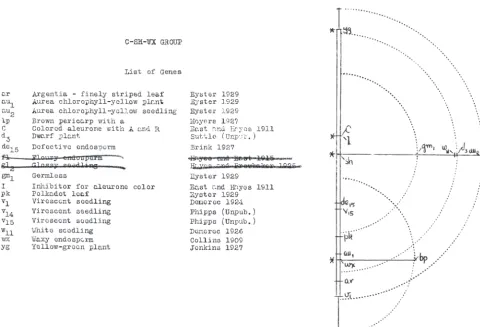
Beadle and Emerson in April 1929(Figure 4) (Emerson investigators were asked to be included. He documented interactions among these researchers with a “mimeo-1929).
Within the year, however, Barbara McClintock’s iden- graphed summary of linkage in maize, 1929 [sic]” (RF exhibit D); this exhibit was actually Emerson’s “second tification of the morphology of the corn chromosomes
Figure4.—Linkage group 9 and Rainbow map as of April 12, 1929 (afterEmerson1929; excerpted from E. G. Anderson’s annotated copy in MNL archives; reprinted in MNL, Vol. 53, pp. 118–119, 1979).
after the first one” (mentioned inEmerson1940). His attack on certain important genetic problems now awaiting just such tools as accurate linkage maps afford” “mimeographed summary” (RF exhibit D) included all
of the linkage data compiled and sent to maize geneticists (Emerson1929, p. 117).
Although Barbara McClintock’s name appears amid on April 17, 1930, and July 26, 1930 (Emerson1930a,b).
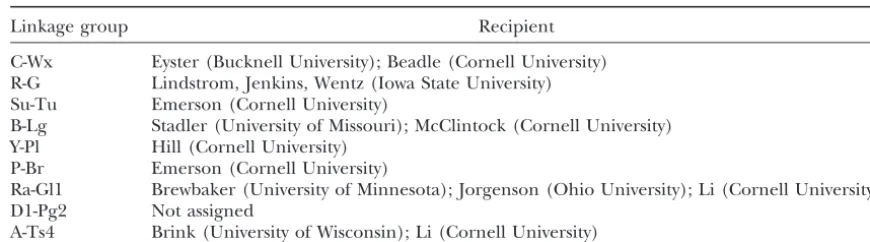
Emerson’s first (our emphasis) mimeographed letter, Emerson’s list of cooperators, we have no documenta-tion that she attended the meeting and it would not dated April 12, 1929 (Emerson1929), “considered News
Letter 1” by Emerson himself (seeEmerson1940), was have been appropriate in that era for a single woman to attend a gathering in a man’s hotel room. The cooper-distributed to maize geneticists shortly after the
“corn-fab” held in Emerson’s hotel room at the time of the ators who did attend, however, were most familiar with McClintock’s work (see Kass 2003) and would have AAAS Christmas meetings in New York City in 1928. It
included a long folder of linkage information and the recommended her for this endeavor. Following the New York meeting (December 1928), George Beadle acted as names of researchers assigned each linkage group (see
Table 1 based on the original). Emerson (April 12, secretary of the group (Beadle1929a,b, 1930;Emerson
1931). Beadle requested from maize cooperators the 1929) carefully explained, “To those not at the New
York Meeting . . . this assignment [of linkage groups] summaries of linkage data, which Emerson, in coopera-tion with Beadle and Fraser, would send to cooperators was . . . made in accordance with the expressed interests
of those assuming the responsibilities entailed. It was far in the spring and summer of 1930. Beadle left Cornell in late 1930 for Caltech as a National Research Council from our purpose to preempt groups for ourselves and
thereby warn off other workers. Our purpose rather was Fellow (Plant Breeding Records, CU) (BergandSinger
2003), but continued to receive unpublished linkage data to make sure that each known group would be given
immediate and adequate attention to the end that the from cooperators (Emerson1931), until Marcus Rhoades subsequently succeeded him as secretary (Rhoades1932a). not very exciting job of chromosome mapping may go
TABLE 1
To whom linkage groups were parceled out at New York, at the “Cornfab” held in R. A. Emerson’s hotel room in December 1928
Linkage group Recipient
C-Wx Eyster (Bucknell University); Beadle (Cornell University) R-G Lindstrom, Jenkins, Wentz (Iowa State University) Su-Tu Emerson (Cornell University)
B-Lg Stadler (University of Missouri); McClintock (Cornell University) Y-Pl Hill (Cornell University)
P-Br Emerson (Cornell University)
Ra-Gl1 Brewbaker (University of Minnesota); Jorgenson (Ohio University); Li (Cornell University) D1-Pg2 Not assigned
A-Ts4 Brink (University of Wisconsin); Li (Cornell University)
Based onEmerson(1929).
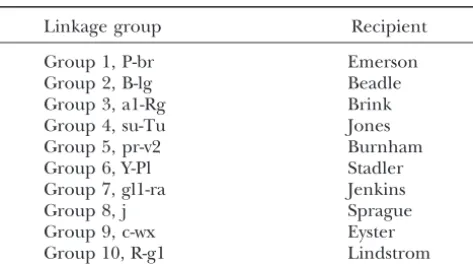
Rhoades(1984) recalled the New York City “cornfab,” assume primary responsibility for the group assigned (Table 2) (see alsoCoe2001).
which was his first with the maize cooperators. Rhoades
had arrived at Cornell in the fall of 1928 from the By this time McClintock had left Cornell but her pio-neering contributions to maize cytogenetics had been University of Michigan, where he had studied with
Emerson’s former student E. G. Anderson. Anderson both recognized and rewarded. She was awarded a Na-tional Research Council Fellowship (1931–1933) and, was soon recruited by Morgan for his newly established
Biology Division at Caltech. Rhoades then spent the after spending time with L. J. Stadler at the University of Missouri, had joined Anderson’s group at Caltech, 1929–1930 academic year there with Anderson (CU)
(AndersonandRhoades1931;Birchleret al. 2003). where she resumed cooperating with Beadle and Burn-ham. They returned to Cornell to attend the ICG in It seems clear, however, that the 1928 AAAS “cornfab”
was not Emerson’s first. the summer of 1932, whereEmerson(1932) recognized
their contributions to maize cytogenetics.
Following the Congress, Rhoades’ first letter to maize
ESTABLISHING AND FUNDING THE MAIZE cooperators made clear that “anyone may begin or con-GENETICS COOPERATION AT CORNELL tinue to work with any group whether or not it has been
assigned to him.” It was expected that when “two or
Establishment of the Maize Genetics Cooperation:
more are interested in the same group, they will work Emerson also submitted to the Rockefeller Foundation
in close cooperation!” Rhoades then distributed a call a copy of Rhoades’ first letter to corn geneticists dated
for stocks, wants, and news items, on December 12, October 5, 1932 (RF exhibit C ;Rhoades1932a), which
1932 (Rhoades1932b), and the third Corn News Letter was retroactively numbered “Vol. 2,” in the Cornell Plant
followed on January 23, 1933 (Rhoades 1933; RF ex-Breeding Department’s bound volumes of the MNL
hibit C in part). These two letters are bound together [MNL, Vols. 2–14, 1932–1940, and MNL, Vols. 15–21,
at Cornell (MNL, Vols. 2–14, 1932–1940, PB) and the 1941–1947; Plant Breeding Department Archives (PB),
latter is numbered “Vol. 3.” Cornell University, Ithaca, NY]. Therein, Rhoades
sum-Funding the Maize Genetics Cooperation:Emerson’s marized the resolutions discussed and favorably acted
“historical summary” (RF exhibit A) additionally re-upon by a committee of maize-genetics workers at the
vealed that his committee was also responsible for devis-Ithaca meeting held on August 26, 1932, in connection
ing a way to “carry out the work which the Cornell maize with the International Genetics Congress. In addition to
geneticists were asked to continue and to enlarge.” His discussing the numbering and naming of gene symbols,
committee did not find a way to provide funds, but it linkage groups, and chromosomes, the group agreed
led to an alternative opportunity. The committee on that Cornell should be the “clearing house” where the
agronomy appointed by the Division of Biology and records would be kept and that a repository should be
Agriculture of the NRC, a unit of the National Academy formed for storing and disseminating the new
informa-of Sciences, unanimously recommended a grant-in-aid tion. Emerson, chair of the committee to oversee their
of $1000/year for 5 years for an information and supply resolutions, along with R. Alexander Brink, Donald F.
service for maize work to be headed by R. A. Emerson Jones, Paul C. Mangelsdorf, and Lewis J. Stadler, had
of the Plant Breeding Department of Cornell University, chosen Rhoades (1) to act as custodian of the seed
for the purpose of maintaining the service for “one of stocks, (2) to furnish a list of stocks received, and (3)
the most important crops and . . . for extending our to distribute stocks to workers. They also reallocated
TABLE 2 cation had been denied, Emerson applied to the Rocke-feller Foundation for funding and submitted Rhoades’
Reassigned linkage groups
most recent “mimeographed letter to maize geneticists,” dated January 25, 1934 (RF exhibit J; MNL Vol. 4, PB).
Linkage group Recipient
By this time, among the 53 maize geneticists engaged
Group 1, P-br Emerson in cooperative work on genetic mapping, it appears
Group 2, B-lg Beadle
that not fewer than 30 were Emerson’s collaborators at
Group 3, a1-Rg Brink
Cornell, had been graduate students there, or had done
Group 4, su-Tu Jones
some postdoctoral work in his department. Emerson
Group 5, pr-v2 Burnham
Group 6, Y-Pl Stadler identified 24 cooperators as “most actively engaged in
Group 7, gl1-ra Jenkins genetic studies”; 16 had been graduate students and 2
Group 8, j Sprague had been postdoctoral fellows at Cornell (RF exhibit
Group 9, c-wx Eyster E). He submitted the exhibits (RF exhibits A–J), which
Group 10, R-g1 Lindstrom
we have described here, and also explained that in the
Maize linkage groups 1–10 were reassigned to individuals spring of 1933, parts of a manuscript of “A Summary
by the committee of maize researchers convened at the ICG of Linkage in Maize” then in the course of preparation on August 26, 1932 (afterRhoades1932a). Researchers listed by Fraser, Beadle, and himself (RF exhibit F) “together are from Rhoades’ letter of October 5, 1932.
with work sheets had been sent to those to whom particu-lar linkage groups had been assigned.” The draft manu-script was, of course, the notable “A Summary of Linkage (RF exhibit B). The NRC committee supported their
recommendation with six exhibits (cited as exhibits I– Studies in Maize” that would be published by Emerson, Beadle, and Fraser in 1935.
VI), which Emerson had submitted to document his
accomplishments to date. These exhibits were not in On March 16, 1934, the Rockefeller Foundation ap-propriated $5000 for the New York State College of the files at RF but we did locate two exhibits identified
by Roman numerals: exhibit IV, Rhoades’ letter dated Agriculture at Cornell University for the “support of collecting and disseminating maize stocks and informa-December 12, 1932 (Rhoades 1932b), and exhibit V,
dated January 23, 1933 (Rhoades1933); we found these tion relating thereto” directed by Professor R. A. Emer-son. Within the week,Emerson(1934) asked cooperators numbered exhibits in archived files of the Maize Coop
(see alsoEmerson1940, where maize communications if they were willing to allow him to use their unpublished linkage data in “the much heralded and too long de-are identified by roman numerals). The committee,
com-posed of M. Francis Morgan, Ralph J. Garber, and Richard layed” general linkage summary to be published from Cornell (NARA). Students of maize genetics responded Bradfield (chairperson), emphasized that “maize occupies
about the same relative position among plants that the without reservations, fostered by Emerson’s cooperative and enthusiastic, yet trustworthy, nature. Emerson soon fruit flyD. melanogasterdoes among insects” (RF exhibit
B). Surprisingly, their recommendation was not accepted after announced the Rockefeller award in a letter to cooperators on September 13, 1934 (MNL Vol. 7, 1934, by the Council.
On December 26, 1933, the secretary of the NRC PB). At that time, 60 genetics researchers were receiving the News Letter.
committee on grants-in-aid notified Emerson that after
careful study of the application they had decided against By April 1934, McClintock returned to Cornell where she completed her year-long Guggenheim Fellowship making the grant of funds. Emerson received their letter
upon returning from the Boston AAAS meetings, where but worried about finding a job (Kass2003). Emerson recognized her abilities toward his MGC enterprise and both maize and Drosophila geneticists had suggested
“standardizing nomenclature and symbolization for requested a separate grant-in-aid to hire her as his re-search assistant (RF; CU;Kass2003) for continued re-maize” (RF exhibit H). While there, Emerson had
dis-cussed with Frank Blair Hanson (Assistant Director, Nat- search on maize cytogenetics. With Emerson’s encour-agement, his students took advantage of her presence ural Sciences, Rockefeller Foundation) an alternative
plan for applying for funds to the Rockefeller Founda- to learn new techniques and to receive her cooperative guidance. Within the year,Emersonet al.(1935) recog-tion should the NRC grant not be approved (Hanson’s
diary, RF). Four months previously (September 1933) nized McClintock’s, and other maize cooperator’s, con-tributions toward their maize linkage studies. Their link-RF officers Warren Weaver (Director, Natural Sciences)
and Hanson, while visiting Cornell on other matters, age summary reported that, using trisomic ratios, McClintock identified 8 linkage groups with chromo-had been apprised of Emerson’s “information and
sup-ply service to corn geneticists” and his need for funds; somes 2, 3, 5, 6, 7, 8, 9, and 10. In 1935, Rhoades and McClintock reported that, by using trisomic methods, but at that time Emerson was confident that the NRC
would support the work (Weaver’s diary, RF; Emerson 6 of the 10 linkage groups had been associated with chromosomes: 2 [B-lg], initially incorrectly assigned to to Stadler, November 8, 1933, CU).
that other methods (i.e., reciprocal translocations) gave a definite check on previous trisomic determinations for linkage groups 1, 4 (su-Tu), and 9 (c-wx). The early MNLs (1929–1932, reprinted in MNL, Vols. 52–57, 71, and 72) demonstrate McClintock’s and other coopera-tors’ contributions to their maize linkage studies.
Continued cooperation throughout the country and the world: The work of maize cooperators stimulated interests in cytogenetics. By 1935 translocations were used to construct many tester lines that contained both phenotypic characters and a translocation. About one-third of the three-point and four-point tests reported in the linkage monograph (Emersonet al. 1935) involved a translocation as a marker. Such translocation-associ-ated three-point tests were extremely valuable, since they allowed confirmation of gene associations with specific chromosomes and gave the order of genes and of cytological locations with translocation breakage points (McClintock 1931; Rhoades 1931). In addi-tion,Creighton(1934) used pachytene stage chromo-somes to continue deletion mapping studies.
Early on, Emerson fostered cooperation among re-searchers throughout the world. He encouraged both domestic and foreign students to join his research team at Cornell (Figures 3 and 4) and published their find-ings in the Cooperation’s News Letter. Soon, this news circular, which united the maize genetics group, was not limited to offers and demands for strains but also disseminated unpublished results among the research-ers. The rule was that any data appearing there could not be cited in publications without the direct consent of the contributor. Maize researchers from around the world—Austria, USSR, Yugoslavia, China, South Africa, Brazil, and Mexico—were honored to share their
un-Figure5.—Cover of Maize Genetics Cooperation News
Let-published results, as we found in MNL reports through
ter 19, February 15, 1945. The disclaimer was added to the
1934. News Letter cover for the first time in 1945.
The first numbered Maize Genetics Cooperation News Letters:The first set of bound News Letters, which
we located in the Department of Plant Breeding at Cor- struct the historical events leading to the establishment of both the MGC and the MNL and to update and nell (MNL, Vols. 2–14, 1932–1940), was numbered by
hand in pencil, beginning with Rhoades’ letter of Octo- expand the MNL files (CoeandKass2005). The Plant Breeding Department also has a second set of bound ber 5, 1932, labeled “Vol. 2.” This led us to believe that
Rhoades’ letter was not Maize News Letter 1. These News Letters with similar hand numbering (MNL, Vols. 15–21, 1941–1947); both sets are currently in the cus-News Letters appear to have been bound and numbered
retroactively under the guidance of Emerson, who was tody of Professor Margaret E. Smith on loan to L. Kass). Professor William B. Provine’s reprint collection in-the secretary for MNL, Vol. 14, 1940. The “Historical
Notes on Maize Cooperation,” listed on p. 56, of MNL, cludes a set of unnumbered and unbound News Letters that belonged to Lester Sharp. Sharp’s unnumbered Vol. 14, although unsigned, were probably prepared by
Emerson, who was secretary for that News Letter. Those collection spans the years 1933–1938 and includes im-portant annotations to linkage in maize. Anderson’s notes clearly state that the mimeographed letter of April
12, 1929, is “considered News Letter 1.” Coe (1976, and Stadler’s unnumbered collections span 1929–1939 and are also annotated. The first covered and hand-1978) used the “Historical Notes” as a guide to compile
an archival list of materials of the MNL and related numbered News Letter that we found in Cornell’s Col-lege of Agriculture Mann Library is “Maize Genetics cooperation. While conducting research on the history
of maize linkage studies, Kass and Bonneuil (2004) Cooperation News Letter 13, April 15, 1939.” Thereaf-ter, the News Letter covers are professionally printed recently found some of the missing (starred) items on
De-TABLE 3
partment of Plant Breeding, Cornell University. In the
reserve copies transferred from Indiana to Missouri in Transitions of the Maize Genetics
1974, mimeo copies without covers were on file before Cooperation responsibilities
1940, followed by printed-cover copies beginning with
Vol. 14. In 1943, Emerson consulted 13 of his most Years News Letter Stocks Database
trusted maize cooperators about his concern that some
1929–1953 Cornell Cornell NA
MNL reports had been quoted without permission 1953–1955 Cornell Illinois NA
(Emerson to Cooperators, November 22, 1943, ap- 1956–1957 Illinois Illinois NA
pended to MNL, Vol. 17, 1943, PB). A disclaimer was 1958–1974 Indiana Illinois NA
subsequently added to the News Letter cover in 1945 1975–1991 Missouri Illinois NA
1991–2002 Missouri Illinois Missouri
(Figure 5), and since that time the published covers
2003– Missouri Illinois Iowa State and Missouri
have not changed with the exception of venue and the contraction to “Newsletter” on the cover beginning in 1990.
from 1953 to 1955, with subsidies from seed companies like DeKalb Agricultural Association; Green Giant;
North-CHANGES AND TRANSITIONS IN MAIZE rup, King; and Pioneer Hi-Bred Corn (MNL 28: 1, 1954). GENETICS COOPERATION
In 1955, oversight of the MNL moved from Cornell to Illinois under Marcus Rhoades as secretary (MNL, Vol. Emerson officially retired in 1941, and thereafter the
MNL was edited by his colleagues, students, and occa- 30, pp. 1–3, 1956) and it accompanied him to Indiana in 1958 (Table 3). At Illinois funding for the MNL was sionally by Emerson himself. He remained active in
re-search until his death on December 8, 1947 (Bussell obtained from seed companies and a grant from NSF. The MNL continued to be edited by Rhoades, aided by
et al.1948). Emerson’s colleagues, former students, and
friends contributed to a memorial fund in his name Ellen Dempsey (his research associate and former stu-dent), as previously, and prepared and distributed at Indi-(MNL, Vol. 27, 1953). The funds were applied toward
the purchase of a lighted exhibit case placed in the hall ana through 1974. That year the MNL transferred to the University of Missouri, under Edward Coe as secretary, of the Plant Breeding Department at Cornell (MNL,
Vol. 29, 1955). Part of the exhibit case was used to until 2000, when Mary Polacco and Jim Birchler became cosecretaries. The News Letter (now “Newsletter”) con-display continuously some of Emerson’s own work. This
case was on the first floor of the Plant Science Building tinues to be compiled, edited, printed, and distributed at Missouri and is available online at http://www.maize at Cornell until the department moved to Emerson Hall,
named for R. A. Emerson, in 1968 (Williams 1968). gdb.org/mnl.php for previously printed issues or at http://www.agron.missouri.edu/mnl/ for issues that are One of the authors (L. B. Kass) recalls assiduously
ex-ploring this case in the lobby of Emerson Hall when in process. Support for its distribution is from an endow-ment fund established from individual and corporate she was a graduate student at Cornell in the 1970s.
The case is no longer maintained and its contents and contributions.
Annual Maize Genetics Conferences were initiated in whereabouts are not known at this time.
The Rockefeller Foundation supported the MNL and 1959, following a proposal from John R. Laughnan at the University of Illinois. The conferences are organized Stock Center at Cornell through 1953, when funding
was withdrawn (MNL, Vol. 27, 1953). Rhoades recog- and run by a Steering Committee. The 2004 meeting
was held in Mexico City. Information about past and nized and confirmed that by the early 1950s scientists
at Cornell were ready to forego the Stock Center and future conferences is provided at http://www.maizegdb. org/cooperators.php.
News Letter functions when RF withdrew funding, and
he arranged to move them to Illinois (see MNL, Vol. The Maize Genome Database (MaizeGDB) was begun
in 1991 as an extended medium for communication and 27, pp. 1–2, 1953; Table 3). In 1953, responsibility for
the MGC-Stock Center collection moved from Cornell for access to data, established by the U.S. Department of Agriculture-Agricultural Research Service at Missouri to Illinois, where it was again undertaken by Marcus
Rhoades, joined by Earl Patterson (MNL, Vol. 28, pp. (USDA-ARS) under the direction of Ed Coe, joined by Mary Polacco. Content of the database, including gene 2–10, 1954). Support was provided by the National
Sci-ence Foundation (NSF) until 1981, following which the lists, maps, bibliography, and cooperator’s addresses, initially was drawn directly from the files and compila-U.S. Department of Agriculture supported the program.
The Stock Center is now a permanent USDA-Agricultural tions of the MNL, supplemented by entries of new data. In 2003, the MaizeGDB became a joint endeavor, sup-Research Service program under the direction of Marty
Sachs. Its history, catalogs, and ordering procedures are ported by USDA-ARS, between Missouri (Mary Polacco) and Iowa State University (Volker Brendel, Trent Seig-at http://www.aces.uiuc.edu/maize-coop/.
Coe, E. H.,Jr., 1978 News letter files. Maize Genet. Coop. News Lett. and the database is served from Iowa State at http://
52:146.
www.maizegdb.org/. Coe, E. H., Jr., 2001 The origins of maize genetics. Nat. Rev. Genet.
2:898–905. In 2000, a Maize Genetics Executive Committee was
Coe, E. H., andL. B. Kass, 2005 Maize Genetics Cooperation News elected whose mission is “to identify both the needs and
Letter files: expanded chronological list of materials and related the opportunities for maize genetics, and to communi- cooperation. Maize Genet. Coop. News Lett.79:(in press).
Cohen, J., 1995 Conduct in science. The culture of credit. Science cate this information to the broadest possible life
sci-268:1706–1711. ence community. This community includes scientists,
Creighton, H. B., 1934 Three cases of deficiency in chromosome funding sources for scientists, and the end users for the 9 ofZea mays.Proc. Natl. Acad. Sci. USA20:111–115.
Crow, J. F., 1992 Sixty years ago: the 1932 International Congress accomplishments of maize genetics, from farmers to
of Genetics. Genetics131:761–768. consumers.” Information about the Committee is given
Edgar, B., 1975 Worm Breeder’s Gazette, Vol. 1, pp. 1–22. Santa Cruz,
at http://www.maizegdb.org/mgec.php. CA.
Emerson, R. A., 1923 To students of corn genetics, March 7, 1923; This perspective was developed from a presentation given at the
reprinted in Maize Genet. Coop. News Lett.52:47–149 (1978). workshop, “The Mapping Cultures of 20th Century Genetics,” at The
Emerson, R. A., 1929 To students of maize genetics, April 12, 1929; Max Planck Institute for the History of Science, Berlin, Germany, in reprinted in Maize Genet. Coop. News Lett.53:117–130 (1979). March 2001. We thank R. MacIntyre for sharing bound and numbered Emerson, R. A., 1930a To students of maize genetics, April 17, 1930; copies ofDrosophila Information Service, Vols. 1–8, 1934–1937; M. E. reprinted in Maize Genet. Coop. News Lett.54:136–139 (1980). Smith for sharing bound and hand-numbered copies of MNL, Vols. Emerson, R. A., 1930b To maize geneticists, July 26, 1930; reprinted
in Maize Genet. Coop. News Lett.54:140–145 (1980). 2–14, 1932–1940, and Vols. 15–21, 1941–1947; William Provine for
Emerson, R. A., 1931 To corn geneticists, Nov. 18, 1931; reprinted sharing Lester Sharp’s unbound and unnumbered copies of MNL,
in Maize Genet. Coop. News Lett.71:119 (1997). 1933–1938, and for extensive use of his reprint collections; R. P.
Emerson, R. A., 1932 The present status of maize genetics. Proceed-Murphy for significant insights and encouragement for this project
ings of the Sixth International Congress of Genetics, Brooklyn and for sharing his unpublished manuscript on the history of Cornell’s
Botanical Garden, Brooklyn, NY, Vol. 1, pp. 141–152.
Plant Breeding Department; archivists at the Rockefeller Archives Emerson, R. A., 1934 To cooperators who have contributed unpub-Center, Sleepy Hollow, New York, with special thanks going to T. lished data for a summary of linkage in maize, March 22, 1934. Rosenberg; U.S. National Archives and Records Administration, Col- U.S. National Archives and Records Administration, College Park, lege Park, Maryland, with special thanks going to J. Schwarz; Division MD.
Emerson, R. A., 1940 Historical notes on maize cooperation. Maize of Rare and Manuscript Collections, Carl A. Kroch Library, Cornell
Genet. Coop. News Lett.14:56. University, with special thanks going to E. Engst; librarians at the
Emerson, R. A., andE. M. East, 1913 Inheritance of quantitative Mann Library, especially Tom Clausen; and The L. H. Bailey
Hortor-characters in maize. Nebraska Agric. Exp. Station. Res. Bull.2:
ium Library, especially P. Fraissinet for bringing many valuable
refer-1–120.
ences to our attention. We are grateful to R. P. Murphy, W. B. Provine, Emerson, R. A., G. W. BeadleandA. C. Fraser, 1935 A summary and R. H. Whalen for reading early drafts of this article. L.B.K. acknowl- of linkage studies in maize. Cornell Univ. Agric. Exp. Sta. Mem. edges the following for support of archival research: National Science 180:1–83.
Foundation (grants SBR9511866 and SBR9710488); American Philo- Fraser, A. C., 1924 Heritable characters of maize. XVII. Intensified red and purple aleurone color. J. Hered.15:119–125. sophical Society Library, Mellon Resident Research Fellowship; and the
Hutchison, C. B., 1921 Heritable characters of maize. VII. Departments of Plant Biology and Plant Breeding and Genetics, Cornell
Shrunken endosperm. J. Hered.12:76–83. University, Ithaca, New York, for logistical support.
Hutchison, C. B., 1922 The linkage of certain aleurone and endo-sperm factors in maize and their relation to other linkage groups. Cornell Univ. Agric. Exp. Station Mem.60:1421–1473.
LITERATURE CITED
Kass, L. B., 2001 Ethics in science: preparing students for their Anderson, E. G., andM. M. Rhoades, 1931 The distribution of career. Plant Sci. Bull.47(2, summer): 42–48.
interference in the X-chromosome ofDrosophila. Papers of the Kass, L. B., 2003 Records and recollections: a new look at Barbara Michigan Academy of Sciences, Arts and Letters, Vol. 13, pp. McClintock, Nobel-Prize-winning geneticist. Genetics164:1251–
227–239. 1260.
Beadle, G. W., 1929a Dear Sir, Nov. 23, 1929; reprinted in Maize Kass, L. B., andC. Bonneuil, 2004 Mapping and seeing: Barbara
Genet. Coop. News Lett.72:129–130 (1998). McClintock and the linking of genetics and cytology in maize
Beadle, G. W., 1929b Dear Sir, Dec. 19, 1929; reprinted in Maize genetics, 1928–1935, pp. 91–118 inClassic Genetic Research and Its Genet. Coop. News Lett.54:136 (1980). Legacy: The Mapping Cultures of 20th Century Genetics, edited by Beadle, G. W., 1930 Dear Sir, Feb. 5, 1930; reprinted in Maize H.-J.Rheinbergerand J.-P.Gaudilliere. Routledge, London.
Genet. Coop. News Lett.54:136 (1980). Kass, L. B., andR. P. Murphy, 2003 Will the real maize genetics
Berg, P., andM. Singer, 2003 George Beadle: An Uncommon Farmer. garden please stand up? Maize Genet. Coop. News Lett.77:41–43. Cold Spring Harbor Laboratory Press, Cold Spring Harbor, NY. McClelland, C. K., 1930 The genetics, breeding and improvement Birchler, J. A., R. K. Dawe and J. F. Doebley, 2003 Marcus of corn. A bibliography covering more than forty years work Rhoades: preferential segregation and meiotic drive. Genetics (1889–1929) in the breeding, improvement, and study of
inheri-164:835–841. tance in corn. Published by the author, Fayetteville, AR.
Bridges, C. B., andM. Demerec, 1934 Dros. Inf. Serv.1:1–88. McClintock, B., 1929 Chromosome morphology inZea mays. Sci-Bonneuil, C., andL. B. Kass, 2001 Mapping and seeing: Barbara ence69:629.
McClintock and the articulation of genetics and cytology in maize McClintock, B., 1931 The order of the genes C, Sh, and Wx in genetics, 1928–1935, presented at the workshop “The Mapping Zea mayswith reference to a cytologically known point in the Cultures of 20th Century Genetics,” The Max Planck Institute chromosome. Proc. Natl. Acad. Sci. USA17:485–491.
for the History of Science, Berlin. Nelson, O. E., 1993 A notable triumvirate of maize geneticists.
Ge-Bussell, F. P., B. S.Monroeand L. F. Randolph, 1948 Rollins netics135:937–941.
Adams Emerson, May 5, 1873–December 8, 1947, pp. 17–20, 40 Provine, W. B., 1986 Sewall Wright and Evolutionary Biology. University in Necrology of the Faculty, 1947–1948. Cornell University, Ith- of Chicago Press, Chicago.
aca, NY; reprinted in part in Maize Genet. Coop. News Lett.22: Rhoades, M. M., 1931 Linkage values in an interchange complex
1–2 (1948). in Zea. Proc. Natl. Acad. Sci. USA17:694–698.
Coe, E. H.,Jr., 1976 News letter files. Maize Genet. Coop. News Lett. Rhoades, M. M., 1932a To corn geneticists, Oct. 5, 1932; reprinted in 1982 in Maize Genet. Coop. News Lett.56:173–174.
Rhoades, M. M., 1932b To maize geneticists, Dec. 12, 1932; re- Rhoades, M. M., and B. McClintock, 1935 The cytogenetics of maize. Bot. Rev.1:292–325.
printed in Maize Genet. Coop. News Lett.57:192 (1983).
Rhoades, M. M., 1933 To maize geneticists, Jan. 23, 1933; reprinted Wagner, R. P., andJ. F. Crow, 2001 The other fly room: J. T. Patterson and Texas genetics. Genetics157:1–5.
in Maize Genet. Coop. News Lett.57:192–200 (1983).