Mallya, Ashok Ullal. Modeling and Enacting Business Processes via Commitment Protocols Among Agents (Under the direction of Professor Munindar P. Singh).
Multiagent systems involve a rich variety of interactions among agents–situated compu-tations that are autonomous in their behavior and heterogenous in structure. These interactions can be realized unambiguously if they are governed by published protocols, since agents diverse in their structure and behavior can interact as long as they respect the protocols. However, traditional pro-tocol specifications are unduly rigid for application in open settings involving autonomous entities. They represent protocols simply as an ordering of steps and stifle the participants’ autonomy due to a lack of flexibility during enactment.
Commitments among agents, which are akin to contractual obligations among businesses, are a powerful abstraction for modeling flexible protocols. Commitment-based design enables a more faithful model of the openness of the business world. However, modeling business interac-tions requires a rich variety of interaction protocols that can capture the needs of different appli-cations. Whereas general (business) protocols might most flexibly characterize the interactions of their participants, protocols often must be refined based on the environment in which they are to be deployed, so as to yield improvements along various properties such as performance and risk outlay, when applied to real-world tasks such as in e-business.
We introduce a formal semantics and an operational characterization for commitment-based protocols wherein traditional software engineering notions such as refinement and aggrega-tion are extended to apply to protocols. We also develop a principled approach for the design of such protocols in addition to methodologies for modeling and handling exceptions in them. We demonstrate, with appropriate examples, the benefits of this approach over traditional ones when applied to business process modeling and enactment.
Our chief contributions are
• A theoretical basis for describing protocol refinement using subsumption hierarchies and an algebra for composing protocols using existing ones.
from agent conversations.
by
ASHOK ULLALMALLYA
A dissertation submitted to the Graduate Faculty of North Carolina State University
in partial satisfaction of the requirements for the Degree of
Doctor of Philosophy
COMPUTERSCIENCE
Raleigh
2005
APPROVED BY:
DR. DENNISR. BAHLER DR. RADAY. CHIRKOVA
Biography
Acknowledgment
First and foremost, I thank Dr. Singh for his help, guidance, and support—financial, intellectual, and moral. I could not possibly list here the ways in which he has inspired me. I thank my com-mittee members, Drs. Bahler, Chirkova, and Lester, for insightful comments and Dr. Silverstein for attending my preliminary and final exams as the graduate school representative. This dissertation was funded partially by the NSF under its Digital Society and Technology Program in the Intel-ligent Information Systems Division (Grant DST-0139037), partially by the DARPA Information Exploitation Office (Contract F30603-00-C-0178), and partially by a North Carolina State Univer-sity graduate assistantship.
I thank my current and former colleagues at the MultiAgent Systems lab, Pınar Yolum, Raghuram Sreenath, Subhayu Chatterjee, Mike Maximilien, Amit Chopra, Nirmit Desai, Yathi Udupi, Leena Wagle, Payal Chakravarthy, and Arnav Jhala for their comments. They have helped improve the quality of this dissertation and my knowledge of the field. Raghu, Pınar, Amit, Yathi, and Nirmit found time in their busy schedules to patiently proof-read entire chapters of this disserta-tion, for which I am grateful to them. I thank Michael Huhns from the University of South Carolina, and Rogier Van Eijk and Frank Dignum from the Utrecht University, for providing me a forum for publishing my research early in my graduate studies. I am grateful to Mike Wooldridge from the University of Liverpool, Nanjangud Narendra from IBM Global Services India, and Paolo Giorgini from the University of Trento, Italy for their constructive comments about my research.
I thank Ruben Lobo, Vishwas Puttasubbappa, Bhargava Mallapragada, Naveen Kolli, Mi-hir Pise, and Raoul Jetley for being great roomates and patient listeners. I thank all my friends for making me the person I am today. Life would not have been half as interesting or fun with-out Partha Sundaram, Shakti Shenoy, Basty Sridhar, Sandhya Jagannath, Sunil Mathew, Sachin Rasquinha, Bharath Beedu, Nithin Bhat, and Shweta Pai.
Shalini, Veda, and Dinesh Pai provided me a home away from home and valuable advice whenever I needed it. I thank them for their hospitality. I am indebted to Subhash and Rohini Neginhal for their faith in me. I thank Narahari and Arundathi Mallya for a lifetime of sacrifices and encouragement. I thank Rashmi and Vikram Mallya for their love, affection, and their superlative faith in my abilities.
long, dull semesters and unearthly work hours, especially in the days leading up to paper submis-sions. Her pragmatic wisdom has proved invaluable time and again, when common sense has eluded me. I could not have done it without her succor and the intensity of her belief in a bright future for us.
Contents
List of Figures x
List of Tables xii
1 Introduction: Agents, Business Processes, and the Web 1
1.1 Agents and Multiagent Systems . . . 1
1.1.1 Commitments. . . 2
1.1.2 Agent Interaction . . . 2
1.2 Business Processes . . . 3
1.3 The Internet as a Computing Platform . . . 3
1.3.1 The Semantic Web . . . 3
1.3.2 Web Services . . . 4
1.3.3 The Impact and Scope of the Web . . . 4
1.4 Scope and Relevance . . . 5
1.5 Approach . . . 6
1.6 Contributions . . . 8
2 Background: Flexible Protocols and Commitments among Agents 9 2.1 Protocol Design Concepts. . . 9
2.2 Commitments . . . 11
2.2.1 Commitments Among Agents . . . 11
2.2.2 Commitments in Business Interactions. . . 12
2.3 The Purchase Example . . . 13
2.4 Status and Trends . . . 15
2.4.1 Trends in Workflows . . . 15
2.4.2 Trends in Web Services. . . 16
Coordination and Process Flow Technologies.. . . 17
Distributed Transaction Technologies. . . 18
2.4.3 Trends in Agent Communication. . . 18
3 A Formalization of Interaction Protocols 20 3.1 Technical Framework . . . 20
3.1.1 Commitments. . . 20
3.1.3 Propositions . . . 21
3.1.4 States . . . 23
3.1.5 Actions . . . 24
3.1.6 Runs . . . 24
3.2 Reasoning about Protocols . . . 26
3.2.1 Similarity of States . . . 26
3.2.2 Subsumption and Similarity of Runs . . . 28
3.2.3 Subsumption and Similarity of Protocols . . . 30
3.2.4 The Protocol Algebra. . . 31
Formal Results . . . 32
3.3 Applying the Algebra . . . 36
3.3.1 Designing Protocols via Aggregation . . . 37
3.3.2 Refining Protocols via Merge . . . 38
3.3.3 Exception Modeling and Handling . . . 40
3.3.4 Designing Interaction Among Components . . . 41
4 Modeling and Handling Exceptions in Commitment Protocols 42 4.1 Motivation. . . 43
4.2 Challenges. . . 45
4.3 Contributions . . . 46
4.4 Approach . . . 47
4.4.1 Preferences Specification and Resolution . . . 48
4.4.2 Exception Modeling and Handling . . . 48
4.5 Room Reservation Example . . . 49
4.6 Modeling and Handling Exceptions . . . 52
4.6.1 Expected Exceptions . . . 53
4.6.2 Unexpected Exceptions. . . 55
Splicing Exception Handlers . . . 55
Splicing Exceptions Handlers in Practice . . . 56
4.7 Specifying and Resolving Preferences . . . 56
OWL-P . . . 57
4.7.1 Specifying Preferences . . . 58
The Constraint Specification Language . . . 58
Constraint Language Semantics . . . 59
Preferences . . . 60
4.7.2 Resolving Preferences . . . 63
Evolution of Preference Graphs . . . 63
Residuation . . . 63
Choosing Between Runs . . . 64
Selecting the Best Path . . . 67
Types of Events. . . 68
4.7.3 Patterns for Path Selection . . . 69
Incorporating Preferences into Rule-Based Protocols . . . 69
Clear Myopic Choice . . . 70
Unclear Myopic Choice . . . 70
Unclear Non-Myopic Choice. . . 70
4.8 Discussion. . . 71
4.8.1 Related Literature. . . 72
Exceptions in Programming . . . 72
Exceptions in Multiagent Systems . . . 72
Exceptions in Workflows . . . 73
Preferences in Commitment Protocol . . . 73
Preferences in Business Processes . . . 73
Preferences in Agent Interaction . . . 74
5 Protocol Engineering: Developing Commitment Protocols 75 5.1 Contributions . . . 76
5.2 Commitment Protocols and Tropos . . . 76
5.2.1 Background: Tropos by Example . . . 77
The eCulture Example . . . 78
Early Requirements. . . 78
Late Requirements . . . 80
Architectural Design . . . 81
5.2.2 Dependencies in Tropos . . . 82
5.2.3 Protocols Based on Dependencies . . . 83
Identifying Related Dependencies . . . 85
Identifying 3-Party Protocols. . . 85
Refining Protocols . . . 87
5.3 Protocols from Discourses . . . 87
5.3.1 Objectives and Foundations . . . 87
Objectives. . . 89
5.3.2 Motivation . . . 89
Contributions . . . 90
5.3.3 Communicative Acts and Relationships . . . 90
Communicative Acts . . . 91
Agent Autonomy . . . 92
Separation of Concerns. . . 93
Roles and Peers. . . 93
Conversational Relationships. . . 94
Commitments Revisited . . . 95
Commitment Operation Patterns . . . 96
create(c1) . . . 96
discharge(c1) . . . 96
cancel(c) . . . 97
release(c1) . . . 99
delegate(c1, z) . . . 99
assign(c1, z) . . . 100
update(x, c1, p, p0) . . . 100
5.3.5 Generating Dooley Graphs . . . 102
Singh’s Algorithm . . . 102
Our Algorithm . . . 104
5.3.6 Reasoning About Conversations . . . 106
Character Aggregation via Commitment Operations . . . 108
Peer Identification via Conversation Similarity . . . 108
Conversation Rearrangement via Commitment Lifecycle . . . 110
Improvements. . . 111
5.4 Discussion. . . 111
5.4.1 Related Literature. . . 112
Commitment Protocols using Conversations. . . 112
Commitment Protocols using Tropos . . . 112
6 OWL-P: Realization of Commitment Protocols 114 6.1 Motivation: Why OWL-P? . . . 114
6.2 The OWL-P Language and Ontology . . . 115
6.2.1 The Protocol Model . . . 117
6.2.2 The OWL-P Agent Architecture . . . 118
6.3 The Composition Profile . . . 120
6.4 Rules in OWL-P. . . 121
6.5 Business Process Development using OWL-P . . . 124
6.6 Related Work . . . 124
6.7 Summary . . . 127
List of Figures
2.1 The tradeoff between flexibility allowed by a protocol and the ease of verifying
compliance with it. . . 11
2.2 Purchase scenario 1.. . . 13
2.3 Purchase scenario 2.. . . 13
2.4 Purchase scenario 3.. . . 14
3.1 Subsumption of runsτ1,τ2, andτ3 underι. . . 30
3.2 Subsumption of runsτ1,τ2, andτ3 underσ. . . 30
3.3 A payment and a shipping protocol . . . 38
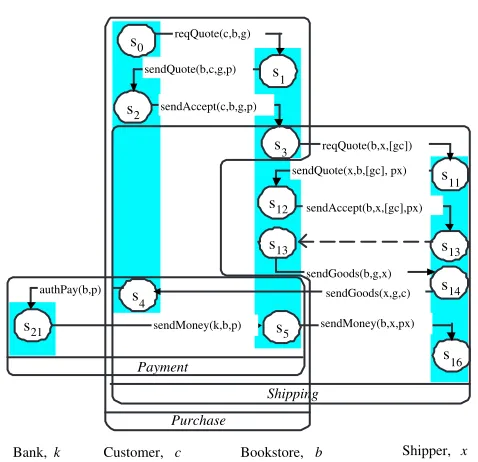
3.4 A refinement of the purchase protocol by splicing in the shipping protocol.. . . 39
4.1 The room reservation process model using traditional systems. Thick circles repre-sent terminating states. . . 49
4.2 Some runs of the room reservation protocol. Filled circles are exceptions; thick circles are terminating states.s0is the unique start state. . . 51
4.3 An exception handler and its usage by splicing. Thick circles denote terminating states. . . 55
4.4 A preference graph. . . 60
4.5 A preference graph for the purchase protocol. . . 62
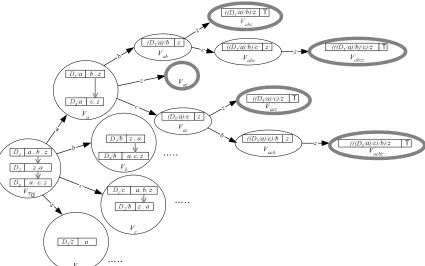
4.6 The partial evolution tree for the preference graph shown in Figure 4.4, using resid-uation. . . 65
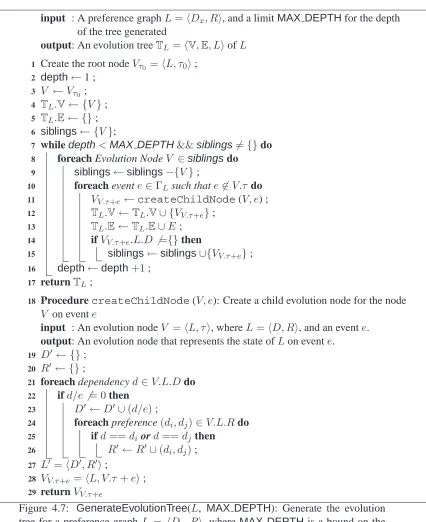
4.7 GenerateEvolutionTree(L,MAX DEPTH): Generate the evolution tree for a pref-erence graphL=hDx, Ri, whereMAX DEPTHis a bound on the depth of the tree to be generated. . . 66
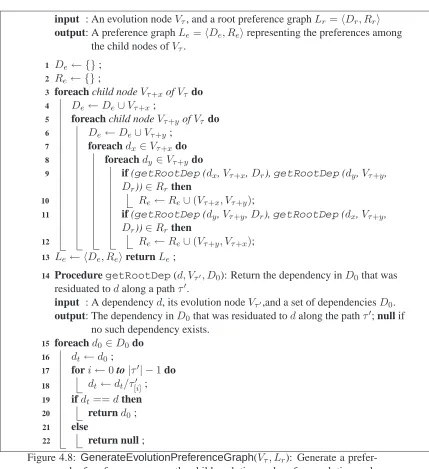
4.8 GenerateEvolutionPreferenceGraph(Vτ, Lr): Generate a preference graph of pref-erences among the child evolution nodes of an evolution node Vτ, given the root preference graphLr. . . 67
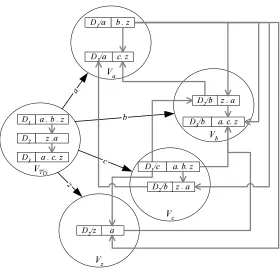
4.9 The preference graph for the evolution nodes shown in Figure 4.6 . . . 68
4.10 A detailed view of the evolution node preference graph shown in Figure 4.9. . . 68
4.11 Clear myopic choice. . . 71
4.12 Using aNoop . . . 71
5.1 Actors identified in early requirements . . . 79
5.3 Partial actor and goal models . . . 81
5.4 Types of dependencies in Tropos . . . 82
5.5 Realizing dependencies using one protocol per dependency . . . 84
5.6 Identifying 3-party protocols . . . 86
5.7 Parunak’s classification of communicative acts. . . 91
5.8 Our proposal for a classification of communicative acts . . . 94
5.9 The pattern to create a commitment. . . 96
5.10 The pattern for a creditor to propose creation of a commitment. . . 97
5.11 The pattern for a debtor to propose creation of a commitment. . . 97
5.12 The pattern for discharging a commitment.. . . 98
5.13 The pattern for cancelling a commitment. . . 98
5.14 The pattern for delegating a commitment. . . 100
5.15 GenerateDooleyOld(D): Singh’s algorithm (Singh, 2000) to generate the Dooley graph for a discourseD=hu1, u2, . . . uni, whereuis are utterances. . . 105
5.16 The bipartite graph used in the construction of the Dooley graph. . . 106
5.17 The Dooley graph of the travel planning example. . . 107
5.18 ConnectVertices(g): Connect vertices in the sender and receiver sets . . . 107
5.19 The Dooley graph of the travel planning example in Table 5.3, generated using our algorithm. . . 108
5.20 The Dooley graph of the travel planning example in Table 5.3, after character ag-gregation. . . 109
6.1 The conceptual model of the OWL-P framework as described by Desai and Singh (2004) . . . 117
6.2 The OWL-P ontology for describing protocols. . . 118
6.3 A pictorial representation of the OWL-P specification of an order, a shipping, and a payment protocol and a composition profile specifying constraints to be satisfied when combining them. . . 119
6.4 The architecture of an OWL-P agent. Numbers is parentheses represent the typical order of activities during the enactment of an OWL-P protocol. . . 120
6.5 Typical usage of OWL-P in the development and enactment of business processes.. 125
List of Tables
3.1 Messages used in the purchase example . . . 22
3.2 Propositions in the purchase example. . . 23
3.3 Meanings of some states in the purchase example . . . 24
3.4 State labels in the purchase example . . . 24
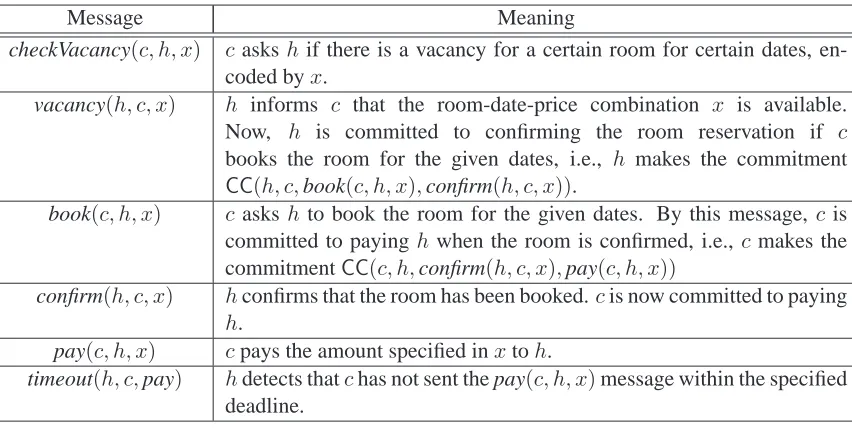
4.1 Messages used in the room reservation example, with their associated meanings.. . 50
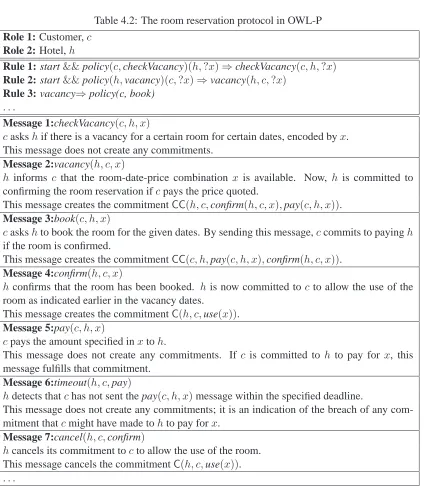
4.2 The room reservation protocol in OWL-P . . . 52
4.3 A mapping between the messages of the room reservation example and the messages of the purchase example. crdenotes the customer for the room,rthe room details, hthe hotel,cpthe customer in the purchase,gthe goods sold in the purchase,pthe price of the good sold, andbdenotes the merchant in the purchase example. . . 53
5.1 Tasks performed in modeling actors, dependencies, goals, plans, and capabilities in different stages of Tropos. Within each stage, the different modeling techniques are not ordered. . . 79
5.2 The annotated discourse for the trip planning example. The sequential conversa-tional relationships used to annotate utterances are Respond(Rsp), Reply(Rpl), Re-solve(Rsl), Complete(Cml), and Update(Upd). . . . 101
Chapter 1
Introduction: Agents, Business
Processes, and the Web
Agents, which are persistent, autonomous software entities situated within a software en-vironment, have been successfully applied to solve problems in which collaboration, cooperation, or communication is required between independent partners, for example, in online auctions, dis-tributed information processing, and human-computer interaction. In this dissertation, we study in-teractions between agents and develop a formal framework for modeling agent interaction protocols based on the contractual obligations that exist between the participating agents as they communicate with each other and proceed with their interactions. We show how this abstraction of obligations, called commitments supports judgments about protocols based on knowledge-engineering notions such as subsumption and composition. Our framework and results contribute to the field of agent communication. Using these concepts, we demonstrate how business processes can be modeled and enacted with flexibility. Our work also introduces a sophisticated exception handling scheme for business processes. Both these contributions advance the state of the art in business process au-tomation. To emphasize the broader area of application for our results, we show how commitment-based agent interaction protocols can be applied to software engineering. We do this by using the TROPOS agent-oriented software engineering methodology as an example.
1.1
Agents and Multiagent Systems
We define an agent as a persistent, situated computation, that is capable of autonomous
They are said to be situated because they reside in some software environment that contains other agents with whom communication is possible. An agent’s environment can also be viewed from the social angle, in which the agent’s (social) relationships with other agents are described in terms of permissions, obligations, and norms. An agent’s actions seem autonomous to other agents. Mul-tiagent systems are systems consisting of more than one interacting agents. Whereas developing single-agent systems presents challenges in modeling the reasoning, perception, and behavior of an agent, we concentrate on multiagent systems, in which coordination and communication among the agents is of prime importance.
1.1.1 Commitments
Commitments among agents represent the contractual obligations that exist among them. An agent can commit to bringing about a certain state in the environment in which it exists or to carry out a certain action. Commitments always exist within a well-defined social structure, which forms their context. Commitments provide a powerful formalism for modeling and understanding interactive behavior in multiagent systems, as we shall demonstrate in this dissertation. We use the word commitment to refer to what is more precisely called a social commitment. Social com-mitments are distinguished from private comcom-mitments, which are comcom-mitments an agent makes to itself to perform some task or achieve some goal. Private commitments may be used in modeling the reasoning of a single agent. For modeling the behavior of multiagent systems, however, we need publicly observable aspects of agents such as social commitments.
1.1.2 Agent Interaction
1.2
Business Processes
One of the most important application areas of intelligent agents has been in automating businesses and developing newer, more productive ways of conducting business. Following this trend, we study how agents and multiagent systems can be applied in business process modeling and enactment. A business process is the way an organization conducts it business. This encom-passes the businesses’ dealings with its customers, suppliers, and all other entities external to it that it interacts with. A business can have several processes defined, or no documented process at all. Whereas a precise definition and clear documentation makes a business process reproducible, what we aim to achieve is a well defined methodology to change a business process to handle external factors such as a change in government regulations or change in market preferences and internal factors such as a change in the businesses goals and policies. To this end, this dissertation develops a theoretical framework for modeling business processes and describes applications of this frame-work. The Internet, which we present next, is one of the most influential among technologies that have affected business processes.
1.3
The Internet as a Computing Platform
The Internet has become a large, distributed-computing platform. Applications whose reach was limited to a single machine now have access to and incorporate the services of other pro-grams that are distributed over a wide area, span multiple heterogeneous organizations and systems, and are governed by different policies. Two key factors driving this transformation are The Semantic
Web and web services.
1.3.1 The Semantic Web
1.3.2 Web Services
The vision of web services is to enable programs to dynamically discover and interact with other programs, over the WWW using XML-based standards. Examples of such standards are the Web Service Description Language (WSDL) (Christensen et al.,2001) for describing the data and message formats of a service and the Universal Description, Discovery and Integration (UDDI) (Clement et al.,2004) protocol for describing a directory system for advertising and finding web services, and the Business Process Execution Language for Web Services (BPEL4WS) ( An-drews et al.,2003) for describing workflows that involve invocation of web services. Web services are relatively more mature when compared to the Semantic Web, and have been implemented by large corporations such as Google and Amazon. However, web services are low-level specifications, and can form the foundation on which richer frameworks such as the Semantic Web are built to fully realize their potential.
These developments hold great promise for automating business processes just as com-puterization revolutionized business processes in the last century. The two most important benefits that the Semantic Web and web services offer to businesses are dynamism and global reach when choosing and interacting with business partners and customers. Modern businesses have moved the processes that they use to interact with their partners to the web, so that they can leverage the wide reach of the Web to increase productivity and profits (Petrie and Sahai,2004).
1.3.3 The Impact and Scope of the Web
for advertising and discovering services (via UDDI). For its part, the Semantic Web can be used to markup services using a rich vocabulary for specifying elements of quality of service, thus enabling intelligent (automated) selection of services, as done in the OWL-S (Web Ontology Language for Services) (Martin et al.,2004) project.
Since Internet-based operations are more cost effective than traditional brick-and-mortar businesses, even small businesses set up operations online using online marketplaces such as eBay. In this model of online business, the marketplace—here, eBay—provides a common platform, avoiding incompatibilities between the partners’ software systems and governing the interaction between them, for a fee. In an open setting, however, businesses will want to eliminate the cost of operating in such marketplaces. Web services, with standards that are free to use, provide a viable solution for such a need. The standardization of message formats (SOAP) (Gudgin et al., 2003) and interface definitions (WSDL) and the wide adoption of these standards enables businesses ac-cess partners anywhere in the world. Semantic markup of data and services can help reconcile differences in representation used by different businesses.
1.4
Scope and Relevance
While standardization facilitates interoperability between diverse systems over the Inter-net, business process specifications rarely specify each step of the process and its possible outcomes (if there is any documented process at all). A business process in most organizations comes about due to a complex interplay between legality of the organization’s operating procedures, market trends, and company policies. Further, processes evolve over time due to changes in local poli-cies, governmental polipoli-cies, and market situations. In an open setting, it is in the best interests of a business to change its partners to adapt to new situations. Web services standards have not in-corporated business-level abstractions that are needed when new processes need to be developed or existing ones need to be modified. Recent efforts in business process management and business process composition indicate an increasing interest in the area. If processes are modeled without a clear understanding of the changes that may occur and without a capability to handle such changes easily, standardization efforts are rendered ineffective. Further, the standards themselves might be too restrictive in that they might prevent a participating business from exercising its autonomy. Au-tomating business processes is therefore an exercise in finding the right tradeoff between flexible process models and well-defined standards.
and enactment. We propose that business processes (cross-enterprise or intra-enterprise) be com-posed of well-defined protocols in which different roles interact. We treat protocols as first-class entities and develop a protocol algebra to aid designers of processes. Further, we develop method-ologies for dealing with exceptions in protocols. Our theoretical results formalize high-level, se-mantic aspects of business protocols leading to better and easier process design and enactment.
We propose an agent-based framework and a new way of thinking about interaction pro-tocols. This yields a new approach for synthesizing processes from existing protocols (which are templates for interactions) that aids process designers in developing such hybrid processes. The use of commitments also helps us develop a theory of exception handling and a methodology for the same. Our work has applications to traditional technologies such as workflow management sys-tems and emerging areas such as multi-agent syssys-tems. In the course of our efforts we also have contributed significantly to the agent communication research community.
1.5
Approach
We propose a novel approach for designing flexible processes. Simply put, a process
instantiates one or more protocols among designated parties. We define a protocol as a specification
of a logically related set of interactions. For example, we can have protocols for negotiation, for payment, for selecting a shipping company, and so on. Protocols are interfaces. By this we mean that a protocol specifies only the key desired aspects of the interactive behavior; it leaves the details of a local implementation entirely up to those who implement the protocol.
would be satisfied.
While at first it seems that protocols in which the participants are free to do as they wish would be the best means of preserving their autonomy, standardized protocols are required to enable interaction between disparate systems. Standardization helps check if all parties in an interaction are compliant with the protocol specification. Protocols should therefore be designed with the right balance of participants’ autonomy and standardization of the interaction.
We take inspiration from such protocols that exist in the literature already; specifically net-working and distributed systems protocols such as IP, TCP, HTTP, and SIP (Rosenberg et al.,2002). These protocols provide published specifications of the behavior of the roles interacting through them. Thus they enable implementors to independently create components that, if compliant, are guaranteed to work together. If we could specify business protocols precisely, we could enable the desired business processes in which the autonomy of the participants is maximized (limited only by the requirements of the protocols in effect) and their implementations are heterogeneous. Com-ponents could be plugged in or out with ease and processes could be readily adjusted so that the participants can handle exceptions and exploit emerging opportunities.
1.6
Contributions
Protocols will be needed for every aspect of business processes that involves standardized interaction. Payment is just one aspect, but there are as many aspects as business interactions. Clearly, developing sophisticated protocols would not be a trivial undertaking. It needs abstraction support akin to information or object modeling in traditional systems.
Chapter 2
Background: Flexible Protocols and
Commitments among Agents
This chapter describes concepts that underlie the design of interaction protocols and ex-plains the intuitions and formalism we have developed to capture these concepts. Section2.1 de-scribes the intuition behind our approach to develop modular and flexible protocols. Section 2.2 informally introduces the concept of commitments among agents, which are an important abstrac-tion in our protocol model. This secabstrac-tion also describes how commitments are applicable in business interactions(in Section2.2.2). Section2.3outlines an example of a business interaction that we use in many parts of this dissertation to demonstrate our approach.
2.1
Protocol Design Concepts
funds to the payee’s bank, which would make those funds available to the payee. Thus payment by check is a specialization of payment, but it involves a lot more steps. We know it is a refinement of the payment protocol because, as the payment protocol requires, it ends up transferring funds to the payee.
In general, the refinement of protocols can involve a mix of changes along two dimensions as explained below.
1. A protocol can be refined by a shrinkage along the dimension of the number of computations allowed by it. Protocols that allow many computations are the most flexible because there are numerous ways to satisfy such protocols. Protocols that allow fewer computations have limited ways in which they can be satisfied.
2. A protocol can be refined by an expansion along the dimension of the number of steps in-volved in an allowed computation. If a protocol dictates a large number of steps that have to be taken achieve the interaction that it models, that protocol unduly restricts the autonomy of its participants as compared to a protocol which specifies few steps and allows variations in the length of computations.
The combination of changes along these dimensions result in the following observations.
• Protocols that allow a few long computations are the most restrictive because there are only a few ways to enact these protocols.
• Protocols that allow many long computations are more flexible than the above, because they offer more alternatives.
• Protocols with a few long computations restrict the autonomy of the participants. Such proto-cols are not necessarily bad, though. They have a distinct advantage in checking compliance. In an extreme case, if a protocol allows exactly one sequence of actions, we will know imme-diately if it has been violated when one of the expected actions does not occur.
There is thus a tradeoff between protocol flexibility and the complexity of compliance-verification. Figure2.1shows this tradeoff schematically.
• General protocols allow more computations; are more flexible.
Long, inflexible protocols (A few long computations)
Short, flexible protocols (Many short computations)
Length of a computation
Number of computations allowed by a protocol Simple
compliance verification
Complex compliance verification
Figure 2.1: The tradeoff between flexibility allowed by a protocol and the ease of verifying compli-ance with it: Complicompli-ance with flexible protocols is harder to verify because of the large number of computations it allows.
2.2
Commitments
Commitments are an important abstraction that we use to build our model of protocols. Commitments are obligations that autonomous agents have towards one another because of promises they make. Commitments are thus akin to contracts and enable predictability in agent interactions to a certain degree. Here, we provide arguments for the use of commitments in business processes.
2.2.1 Commitments Among Agents
To talk about how a protocol specializes or aggregates one or more protocols presupposes that we can characterize the computations allowed by a protocol and the evolving states of those computations so we can consider whether a particular refinement or detour is legitimate. For busi-ness protocols, therefore, this means we must represent not just the behaviors of the participants, but also how the contractual relationships among the participants evolve over the course of an in-teraction. Doing so enables us to determine if the interactions are indeed compliant with the stated protocols.
To apply commitments presupposes that we are modeling the participants as agents, which, for our purposes can be regarded as persistent computations capable of forming commit-ments with other agents. Agents naturally represent parties such as the business partners involved in an e-business scenario, who might collaborate but retain their autonomy. Agent interaction is a lively field of ongoing research (Huget,2003;Dignum,2003) which this work contributes to as well as draws from. Commitments lend coherence to the interactions because they enable agents to plan based on the actions of others. In principle, violations of commitments can be detected and, with the right social relationships, commitments can be enforced—by penalizing agents who do not comply with their commitments. Enforceability of contracts is necessary in practical settings where the participants are autonomous and heterogeneous (Singh,1998).
2.2.2 Commitments in Business Interactions
Commitments have been used to model interaction protocols, especially in e-business settings (Verdicchio and Colombetti,2002;Yolum and Singh,2002). Such formulations generally afford more flexibility to the participants in choosing the actions they may take at different stages. However, this line of research does not adequately address the specific need of designing business protocols, particularly with respect to reasoning such as specialization and aggregation. One of the objectives of this dissertation is to develop notions akin to traditional subsumption and aggregation that are applicable to protocols. Doing so presupposes that we have a crisp semantics and can reason formally about protocols. Accordingly, our first task is to develop a semantics that facilitates flexible actions.
The semantics of protocols is orthogonal to the methodology used for specifying proto-cols. A designer may proceed top-down by first specifying a high-level protocol and then refining it; another designer may proceed bottom-up by first specifying a variety of refined protocols and then generalizing over them. Still another designer may begin with an abstract protocol and merge in specific protocols for some of its steps. In Chapter6, we describe a group effort that has sought to realize commitment protocols. This chapter describes some protocol design considerations with examples.
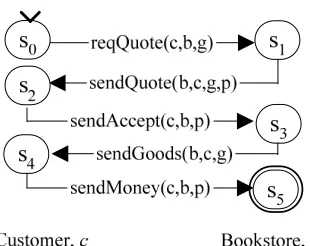
Figure 2.2: Purchase scenario 1: Customer agent asks Bookstore agent for a quote and is given one which it accepts. Customer agent is then sent the goods for which it pays.
Figure 2.3: Purchase scenario 2: Customer agent asks for a quote and receives one which it accepts. Customer agent is then sent the goods for which it pays. Customer agent then returns the goods for a refund.
2.3
The Purchase Example
As a running example, we consider a purchase interaction in which a customer wants to buy a book from an online bookstore. The process involved is a Sell process as defined in the MIT Process Handbook (Malone et al.,2003), specifically the Obtain order, Deliver product or service, and the Receive payment parts of the Sell process. The bookstore obtains the customer’s order for a book if the customer accepts the price quoted by the bookstore for that book. The book is then shipped to the customer, and the bookstore is paid for the book. The actual execution of the process, however could involve many different scenarios, as described next.
We identify four distinct, but related, scenarios that can arise during the above book pur-chase interaction. Each of these scenarios requires a different amount of effort from the participants in terms of protocol execution, planning, and coordination. All participating agents would bene-fit from being able to compare scenarios to choose the one that best serves their interests. These scenarios are shown in Figures2.2,2.3,2.4, and3.4. Customer refers to the customer’s agent and
Bookstore refers to the bookstore’s agent. Ellipses represent states, labeledsi. Solid arrows are
Figure 2.4: Purchase scenario 3: Customer agent asks for a quote and receives one which it accepts. After receiving the books sent by the Bookstore agent, the Customer agent authorizes its Bank agent to pay the Bookstore agent on its behalf.
1. Normally, the customer would ask the bookstore for a price quote on the book it wishes to buy, and upon receiving a quote from the bookstore, would accept the bookstore’s offer. The bookstore would then send the book, after which the customer would send the payment. This is modeled after the NetBill protocol (Sirbu,1997). Figure2.2shows this interaction. 2. The bookstore might be willing to give a refund if the customer returns the book for some
reason. This scenario is similar to the scenario described above till the book is delivered to the customer. However, this scenario is longer, since the customer returns the book, and the interaction terminates only when the bookstore sends the refund to the customer. Figure2.3 shows this interaction.
3. The customer might delegate the payment to a third party, e.g., a bank. Such a situation is not very different from using a credit card to pay for goods, and is shown in Figure2.4. The customer, after accepting the bookstore’s price quote and later receiving the book, sends a message to both the bookstore and the bank (although only one arrow is shown in the figure, between statess4ands21) indicating that the bank will honor the customers commitment to pay.
Table3.3explains the meanings of the states that the first scenario runs through. Table3.1 shows the meanings of the messages passed. In this table, crepresents the customer,brepresents the bookstore,grepresents the book that the customer is interested in buying, andkrepresents the customer’s bank. The delegate and assign messages relate to corresponding operations that can be performed on commitments. Commitments and the operations that are possible over them are defined in the next section.
2.4
Status and Trends
Current models of processes specify an ordering of steps to be taken to enact the pro-cess. These approaches prove inflexible for modeling complex processes that change frequently. Even when such systems allow re-configuration to meet the demands of a dynamic organization, it comes at a high price, that of intensive software re-engineering (Janssens et al.,2000). This has been an important reason for workflows not being very successful. Modern business processes span multiple autonomous entities or business partners. Such processes, therefore, are based on a rich variety of interactions among software components that are independently designed and configured, and which represent independent (sometimes mutually competitive) business interests. Even though technologies for implementing processes have advanced, the fundamental concepts underlying the interaction between business components remain largely unchanged from those used in early cen-tralized systems. We outline here the main trends in technologies that have been employed for business process automation.
2.4.1 Trends in Workflows
require human intervention to handle most exceptions. Because of their inflexibility, workflows have had only limited success. Workflows are executed by a central workflow engine that steps through the flow, invoking applications as required, and supplying the result of one invocation to the next application in the flow. Such engines view these applications as black boxes, and are not equipped to handle high-level exceptions (where the workflow system and its components function correctly but are in disagreement with business policies) in an intelligent manner. The engine can retry a failed application at best, or abort the entire workflow instance, at worst. What processes need are models that better handle semantic exceptions, resolving them by compensating techniques. When something bad happens in a process, retrying the failed components is not always the best thing to do. For example, if a process involves shipment of goods, and the shipment is delayed due to adverse weather,a monetary compensation might be more prudent than sending the goods again after a timeout.
Although advances have been made in workflow technologies (Fischer,2004) and excep-tion handling in workflows (Casati, 1998; Kamath and Ramamritham, 1998), workflows provide marginal gains over procedural scripts because they still view process enactment as a series of steps to be performed, not as a principled combination of meaningful interactions. Agent-based tech-nologies have been applied to workflows such as agent conversations, where a process is treated as a conversation between partners (Hanson et al.,2002a), and multiagent system-models that enact workflows that adapt easily to changes (Buhler and Vidal,2003;Hanson et al.,2002b). Our efforts are in line with the agent approach.
2.4.2 Trends in Web Services
A recent trend is to expose services offered by a business as web services and engage a service over the web (Singh and Huhns, 2005). Web services are being promoted as the most suitable medium to enact cross-enterprise processes because web services allow systems to interact in a platform-independent manner. Whereas web services have helped standardize important aspects of interoperation such as advertising a service and invoking a service, our chief concern is with the interaction between a service provider and a service consumer, which has only recently been addressed by efforts for web service choreography—which deals with the way services interact— and orchestration—which deals with the way services are composed using other services (Peltz, 2003).
together service components to expose a service interface for consumers to use. For example, a travel agency would put together software to access its internal databases and various airlines’ systems as part of orchestration of its service. The agency would reveal an interface for customers to access and utilize the service it offers. Orchestration is therefore analogous to an implementation of an interface. Web service choreography, on the other hand, refers to the actual interaction pattern between services. It involves the specification of the ordering requirements among messages and method invocations. In the above travel agency example, choreography of the interaction with the customer would involve the sequence of operations that the customer has to invoke or messages that it has to send to the travel agency service to engage the service normally. Among the emerging standards for web service interaction and composition, the Business Process Execution Language for Web Services (BPEL4WS) (Andrews et al., 2003) seems to be the most popular. BPEL4WS specifies abstract processes for choreography and executable processes for orchestration of web services. Our effort applies to service choreography more than orchestration.
While web service orchestration and choreography standards facilitate interoperation, they are too low a level of abstraction to help much with the rich variety of interactions that real-life businesses engage in because web services, like workflows do not provide a meaning to interactions. This has led to interest in a range of technologies and standards for coordination and process flows.
Coordination and Process Flow Technologies.
The need for process composition and interoperability has led to the development of stan-dards for orchestration and choreography of web services (Peltz, 2003). Orchestration refers to intra-service planning and choreography to an overall view of inter-service coordination. Notable standards among these are the Web Service Choreography Interface (WSCI) (Arkin et al., 2002) for describing the interface of one service in a choreography, the Web Services-Choreography model (Burdett and Kavantzas,2004) for describing the format and sequence of globally observable messages sent between services in a choreography, the Business Process Management Language (BPML) (Arkin,2002) that specifies orchestration, The Web Services Coordination (WS-C) ( WS-C,2003) standard, and the Business Process Execution Language for Web Services (BPEL4WS), which is currently the most widely used web services standard for describing business processes ( An-drews et al.,2003). BPEL4WS is based partly on WS-C.
mostly take a centralized perspective, akin to workflow technologies, viewing a process as a series of tasks to be performed. This proves too tedious for reliable modeling and too rigid for enactment. The Collaxa BPEL Orchestration Server (Collaxa,2003) and the IBM BPWS4J (BPWS4J,2004), for example, are execution engines for BPEL4WS. Both function like workflow engines, invoking services as necessary, treating the BPEL4WS document as a script.
Fu and colleagues (2004) develop methods to verify if a given web service will adhere to a given conversation protocol. Their work develops formal results about verification of protocol compliance. We intend to study their work further. Hamadi and Benatallah (2003) develop a proto-col algebra for petri nets and show its applicability to workflows and web services. However, this approach suffers from the same pitfalls as workflows modeled using Petri nets. Buhler et al. (2003) and Vidal et al. (2004) are working on applying multiagent systems to create agile workflows.
The MIT Process Handbook (Malone et al.,2003) is a project that aims to create a hier-archy of commonly used business processes. The goal of the project to create an extensive clas-sification and systematic organization of business processes based on two dimensions of process hierarchies, one that composes the uses of a process out of its constituent parts, and another that subclasses generalizations of a process into specializations. Based on this hierarchy, Grosof and Poon (2003) develop a system to represent and execute business rules.
Distributed Transaction Technologies.
These include such technologies as the web service transaction (WS-T) (WS-T, 2002) standard, which BPEL4WS improved upon, the Tentative Hold Protocol (THP) (Roberts and Srini-vasan,2001), and the Business Transaction Protocol (BTP) (BTP,2002).
This dissertation relates to both workflow and web services efforts, but concentrates on the semantical aspects of the interactions among business partners. We introduce the concept of commitments, as used in multiagent systems, to accommodate high-level reasoning about processes that involve interaction between business partners. Such reasoning enables business partners handle special situations in a natural manner.
2.4.3 Trends in Agent Communication
Yolum and Singh (2002) give one of the first accounts of the use of commitments in mod-eling agent interaction protocols and the flexibility that it affords the participating agents. Fornara and Colombetti (2003) describe how commitments relate to FIPA-ACL messages and demonstrate with an example. Both approaches highlight the benefits of a commitment-based approach to inter-action protocol design.
Johnson et al. (2003) develop a scheme for identifying when two commitment-based pro-tocols are equivalent. Their scheme, however, is simplistic, classifying propro-tocols based solely on their syntactic structure. Our work provides stronger results about the relationships between proto-cols from an application point of view and relates better to the Web Services approach.
Bussmann et al. (2003) present a design methodology to aid in the selection of a protocol from a library of existing protocols to apply to agent-based control applications. They identify criteria like the number of agents, the number of roles, and the number and kind of commitments and use these to select a protocol from an existing pool of interaction protocols. This approach is quantitative, and lacks a formal semantics to base the methodology on.
Pitt and Mamdani (2000) describe a semantics for agent interaction protocols using the Belief-Desire-Intention (BDI) theory. Using this semantics, they outline the design of a system of agent plans that are instantiated by agents to carry on conversations with other BDI agents. In our work, an agents beliefs, desires, and intentions are private to that agent. We work with social commitments which are observable by all agents and whose breach is easier to verify.
In more recent work, Vitteau and Huget (2004) describe an approach for designing agent interaction protocols using modular micro-protocols. This scheme is similar to our protocol design proposal in spirit. However, Vitteau and Huget do not provide a formal basis for putting protocols together.
Chapter 3
A Formalization of Interaction Protocols
In this chapter, we develop our formalism for modeling commitment protocols and an algebra for protocols. Our formalism is developed so as to capture the flexibility of execution that commitment protocols provide. We demonstrate the use of this algebra in combining protocols with an example. We also outline the technical developments and applications of this algebra that will be presented in the rest of the dissertation.
3.1
Technical Framework
We represent protocols as transition systems similar in spirit to finite state machines. These protocols generate computations or runs, which are sequences of states that a valid proto-col computation (execution) goes through. State changes are caused by actions that the participants perform. We devise a hierarchical classification based on the runs generated by protocols. This classification forms the basis of our work. The remainder of this section introduces commitments, our running example, and the basic technical concepts of propositions, states, actions, runs, and protocols.
3.1.1 Commitments
Much of our technical development is based on established concepts of distributed artifi-cial intelligence. We first introduce commitments, a concept used in the agent realm.
Definition 1. A commitment C(x, y, p) denotes that the agentx is responsible to the agent y for
Herexis called the debtor, ythe creditor, andpthe condition of the commitment. The condition is expressed in a suitable formal language.
Commitments can also be conditional, denoted byCC(x, y, p, q), meaning thatxis com-mitted toyto bring aboutpifqholds.
3.1.2 Commitment Operations
Commitments are created, satisfied, and transformed in certain ways. The following op-erations are conventionally defined for commitments (Singh,1999).
1. create(x,C)establishes the commitmentCin the system. This can only be performed byC’s
debtorx.
2. cancel(x,C)cancels the commitmentC. This can only be performed byC’s debtorx.
Gener-ally, cancellation is compensated by making another commitment.
3. release(y,C)releasesC’s debtorxfrom commitmentC. This only can be performed by the
creditory.
4. assign(y, z,C)replacesywithzasC’s creditor. 5. delegate(x, z,C)replacesxwithzas theC’s debtor. 6. discharge(x,C)C’s debtorxfulfills the commitment.
A commitment is said to be active if it has been created, but not yet been operated upon by a
discharge, delegate, assign, cancel, or release. We adopt this definition from our previous work
on the temporal aspect of commitments (Mallya and Singh,2005) to maintain consistency with the commitment semantics defined therein. Although this definition suffices for our study of contracts among businesses, models that require a concept of responsibility might necesitate the use of other definitions in which a commitment is tracked as being active even after it has been delegated or assigned.
3.1.3 Propositions
Table 3.1: Messages used in the purchase example
Message Meaning
reqQuote(c, b, g) casksbwhat the price ofgis. sendQuote(b, c, g, p) bquotes pricepto thec, forg.
sendAccept(c, b, g, p) caccepts the pricepquoted bybforg.cis now committed to pay if the book is sent to it.
sendGoods(b, c, g) bsendsgtoc.
sendMoney(c, b, p) csends the moneyptob.
delegate(c, k,C) cdelegates the commitmentCtok. returnGoods(c, b, g) creturnsgtob.
sendRefund(b, c, p) brefunds the moneyptoc.
authPay(c, b, p) cauthorizes its bank to pay the amountptob. Essentiallyc delegates
C(c, b, p)tok.
1. Domain propositions. The set Dom of protocol-specific atomic propositions. A domain
proposition used in the purchase example is goods(b, c, g), which means that agentbhas de-liveredgto agentc. Table3.2describes some domain propositions for the purchase example.
2. Commitment propositions. The setComof propositions which represent active commitments.
An example of such a proposition isC(c, b,pay(c, b, p)), which means that agentcis commit-ted to agentbto pay the amountp, as in Definition1.
3. Commitment operation propositions. The setComOpof propositions that represent
commit-ment operations that were described in Section3.1.2, and form the setComOp. An example of such a proposition is assign(c, x,C), which means that agentcassigns its commitmentC
(which is of the formC(c,·,·)to agentk. In addition to the six commitment operations, this set of propositions also contains propositions that represent whether a commitment has been fulfilled (satisfied(·)) or violated (breached(·)).
The propositions used in a protocol are assumed to be understood by parties involved in the protocol. In the purchase example, we use the domain propositions given in Table3.2. These propositions belong to the setDom, but do not form an exhaustive listing of the set, since propositions given here are parameterized bygandp. Here,crepresents the customer,bthe bookstore,gthe book the customer wants to buy, andpthe price quoted forgbyb.
Table 3.2: Propositions in the purchase example
Proposition Meaning
reqQuote(c, b, g) chas requested a quote forgfromb
quote(b, c, g, p) b quotes to c price p for g, i.e., b will deliver if c commits to pay upon delivery. This is represented by
CC(b, c,goods(b, c, g)),acceptQuote(c, b, g, p)
acceptQuote(c, b, g, p) c has accepted the price p that b quoted for g, i.e, c com-mits to pay if the goods are delivered. This is represented by
CC(c, b,pay(c, b, p),goods(b, c, g)) goods(b, c, g) ghas been delivered tocbyb.
pay(c, b, p) The amountphas been paid tobbyc. return(c, b, g) ghas been returned tobbyc.
refund(b, c, p) The amountphas been refunded tocbyb.
a meta-symbol of the BNF,aandbbelong to the set of roles, or participantsRof the protocol, and
atomic prop belongs toDom.
The nonterminal Commit prop generates commitment propositions and Commit oper prop generates commitment operation propositions.
1. P−→atomic prop|Commit prop|Commit op prop
2. Commit prop−→C(a, b,atomic prop)|CC(a, b,atomic prop,atomic prop)
3. Commit op prop−→
create(a,Commit prop)
|cancel(a,Commit prop)
|delegate(a,Commit prop)
|assign(a,Commit prop)
|discharge(a,Commit prop)
|satisfied(Commit prop)
|breached(Commit prop)
3.1.4 States
Definition 2. A state is an assignment of truth values to members ofP.
{quote(b, c, g, p)}. We denote the label of a statesby[s]. Table3.4gives the labels that are assigned to states in the purchase example. The set of states is denoted byS.
Table 3.3: Meanings of some states in the pur-chase example
State Meaning
s1 Customer has asked the bookstore the price of the goods. No commitments made.
s2 Bookstore has quoted a price for the said goods. The bookstore is now willing to send the goods if the cus-tomer promises to pay for them
s3 Customer has agreed to the bookstores price. The customer is willing to pay the price if the books are delivered
s4 Bookstore has delivered the book
s5 Customer has paid for the book
Table 3.4: State labels in the purchase example
State Associated Label
s0 {true}
s1 {reqQuote(c, b, g)}
s2 {quote(b, c, g, p)}
s3 {C(b, c,goods(b, c, g)),
CC(c, b,pay(c, b, p),goods(b, c, g))}
s4 {goods(b, c, g),C(c, b,pay(c, b, p))}
s5 {goods(b, c, g),pay(c, b, p)}
s21 {goods(b, c, g),C(k, b,pay(k, b, p))}
s17 {goods(b, c, g),pay(c, b, p)}
s18 {goods(b, c, g),return(c, b, g),
C(b, c,refund(b, c, p))}
s19 {goods(b, c, g),return(c, b, g), refund(b, c, p)}
3.1.5 Actions
Agents perform actions to bring about changes in the world. The communicative actions of the agents correspond to messages sent by the agents to others. A communicative action of an agent affects the state of a protocol in which it participates. For simplicity, we use messages to model even interactions that take place in the real world. For example, a sendMoney(c, b, p)message sent during the execution of Scenario 1 of the purchase example models the action of the customerc paying the bookstoreban amountp, and a returnGoods(c, b, g) message models the action of the customerc shipping the bookg back to the bookstoreb. Messages model actions just like in the real world where, for example, filling a form and submitting it over the web can cause a transfer of funds.
The set of actions is denoted byA. The meanings of actions used in our purchase example are given in Table3.1. In addition to the actions shown,Aalso contains an action for each proposi-tion formed from the commitment operaproposi-tions described in Secproposi-tion3.1.2. For example,Acontains an action delegate(c, b, p)sincePcontains the proposition delegate(c, b, p).
3.1.6 Runs
A run is one possible execution sequence of a protocol. A protocol can allow many com-putations, or runs. A run is a sequence of stateshs0. . . si. . .i. We use∈to indicate the occurrence
of a state on in a run. For example,si ∈ hs0. . . si. . .i. In this paper, we consider only finite runs.
The empty run is allowed.
The operator≺τ orders states temporally with respect to a runτ, so thatsi ≺τ sj implies
thatsi occurs beforesj in the run τ. The concatenation of a statesn to a run τ = hs0s1. . . ski,
written asτ ◦sn, is given by appending the state to the run, i.e., byhs0s1. . . sksni. The sequence
of states in a subrun of a runτ =hs0. . . sniis a possibly noncontiguous subsequence ofs0. . . sn.
We denote the first state of a runτ by[τ]0, thenth state by[τ]n, and the last state by[τ]>.
Computationally, a protocol corresponds to a set of computations that it allows. These can be captured as a set of runs where any of the runs that subsume the given runs may be realized. That is, each run in a protocol defines a sequence of steps that must be performed in the same order relative to each other. The subsumption of runs is defined below. A protocol is represented as a transition system as defined by a tuplehA,S, S0,∆,F,RiwhereAis a set of actions,Sis a set of states,S0 is the set of initial states (S0 ⊆S),∆is a set of transitions (∆⊆S×A×S),Fis a set of final states, (F⊆S), andRis a set of roles (or participants).
∆contains transitions of the formhsi, a, sji, wheresi, sj ∈ Sanda∈A. Heresi is the
source of the transition andsj its destination. Such a transition advances a computation from state
sito statesjwhen an actionais performed, i.e., when the message corresponding toais sent (and
received, assuming synchronous message passing, for convenience). In other words, a run can be generated from a protocol by the successive concatenation of transitions beginning from the initial state of the transition system. The concatenation of a transition to a run appends the destination of transition to the run if the source of the transition matches the last state of the run. Consequently, a runhs0s1s2. . . snican be generated by a protocol whose initial state iss0, and whose transition set
contains the elementshs0, , s1i,hs1, , s2iand so on tillhsn−1, , sni, wheres0 ∈ S0andsn ∈F.
The set of all such runs is denoted by[P].
with a set of rules for determining the new state given the old state and the action taken would define the purchase protocol.
• Commitments can be operated upon by a fixed set of operations.
• Propositions capture the universe of discourse of a commitment protocol. • States of a commitment protocol are labeled by propositions that hold true. • Runs are finite sequences of states.
3.2
Reasoning about Protocols
This section presents the development of relationships among runs and protocols based on the notion of state similarity. We develop our results based on the theoretical work presented above. We categorize based on our definition of similarity of states, similarity and subsumption relationships between runs and protocols. Our theory captures our intuition that generic protocols specify little and allow a lot, whereas specific protocols specify in detail and allow little freedom.
3.2.1 Similarity of States
States form the fundamental components of runs, and are identified (and labeled) by sets of propositions. Any comparison of states, therefore, must be based on comparing propositions. This section introduces three state-similarity functionsι, σ, andαA,P, all based on commitment
propositions, and shows how these help relate different runs.
A state-similarity functionf is a mapping from a state to a set of states, i.e.,f :S7→2S.
From such a function, we can induce a binary relation ≈f⊆ S ×S, which is defined as ≈f=
{(s, f(s)) :s∈S}. That is,
si ≈f sj ⇐⇒ sj ∈f(si) (3.1)
Definition 4. A state similarity functionfis well formed if≈fis reflexive, symmetric, and transitive,
i.e.,≈f is an equivalence relation.
We denote byFthe set of all well-formed state-similarity functions.
Identity State-Similarity. ιis the identity state-similarity function. That is,si ≈ι sj if and only
ifsi andsj are labeled by same set of propositions. ι(si) ={sj|[si] = [sj]}. ≈ιis an equivalence
relation.
What other kinds of similarity functions can one develop? We have developed our se-mantics to support reasoning about protocols on commitments among autonomous agents. States are labeled by the propositions that hold in them. Whereas domain propositions can have different semantics in different applications, commitments are an abstraction that can be used across do-mains with uniform semantics. Since a commitment has a well-defined life cycle and is a directed obligation, comparison of commitments can be performed based on two criteria.
• A comparison based on which agent is committed to which other agent. • A comparison based on which commitment operations were performed.
As examples of usage of both the above criteria, we introduce two state similarity functions, the creditor state-similarity functionσand the role-and-commitment state-similarity functionα.
Creditor State-Similarity. As another state-similarity function, considerσ. Underσ, a statesiis
similar to a statesjif in the two states all the participants of the protocol have the same commitments
being made towards them, regardless of which agent makes it. Since the creditor of a commitment is immaterial underσand a delegate(·,·,·)action changes the creditor of a commitment,σcan be defined asσ(si) ={sj|sj can be reached by finite number of delegate(·,·,·) actions fromsi}
As an example, consider statess4ands21from the of the example scenarios.These states are similar underσ because, as described in Table3.4, these states have propositions representing commitments that differ only in their creditors.≈σ is an equivalence relation.
Role-and-Commitment State-Similarity. From the point of view of a participant of a protocol, two states can be said to be similar if they involve the same commitments. Based on this intuition, we describe role-and-commitment state-similarity functionα. A statesiis similar to a statesjunder
αA,P, whereAis a set of roles andP is a set of propositions, if the commitments made by any role inAto any other role inA, and the propositions inP that hold atsi, also hold atsj. If, for example,
Arepresents all the roles in a protocol andP represents all the proposition used by that protocol, thenαA,P can be used as a similarity function to detect cases where the protocol has been merged
3.2.2 Subsumption and Similarity of Runs
Comparisons among protocols are based on a notion of subsumption of runs. [[f]idenotes subsumption operator over runs. The operator[[f]iis an order-preserving mapping from one run to another, and depends on the functionf.
Definition 5. A run τj subsumes a run τi under function f if and only if, for every statesi that
occurs inτi, there occurs a state sj inτj that is similar under f, and sj has the same temporal
order relative to other states inτj assidoes with states inτi.
τj[[f]iτi ⇐⇒ (∀si, si0 ∈τi : (∃sj, s0j ∈τj (3.2)
andsi ≈f sj ands0i ≈f s0j
and(si≺τi s 0
i ⇒sj ≺τj s 0
j)))
That is, longer runs subsume shorter ones, provided they have similar states occurring in the same order. Before we describe properties of run subsumption, we define run-similarity.
Definition 6. A runτiis similar to a runτj under a well-formed state-similarity functionf if and
only if the two runs are of equal length and everykth state ofτi is similar underf to thekth state
inτj. In notation,[τi]k ≈f [τj]k,0≤k <|τi|and|τi|=|τj|.
Lemma 1. If a runτjsubsumes a runτiunderf, then, for all subrunsβiofτi, there exists a subrun
βj ofτj such thatβi ≈f βj. That is,τj[[f]iτi⇒(∀βisubrun ofτi,∃βj subrun ofτj :βi ≈f βj).
Proof. This lemma holds trivially for subruns of lengths 0 or 1. We prove this lemma by induction on the length of subruns.
Base Case: We note that by the definition of run subsumption, there must be a pair of
states in both runs for which the above property holds, that is,(∀βi subrun ofτi :|βi|= 2⇒(∃βj
subrun ofτjandβi ≈f βj)).
Induction Hypothesis: Assume this property holds for subruns of a particular lengthk >
2.
Induction Step: Consider|βi0|=k+ 1, where[βi0]k =s0i. The firstkstates ofβi0form a subrun of lengthk. Therefore, there exists a subrunβjofτjsuch thatβi ≈f βjandβj is the earliest
such subrun inτj. Consider thekpairwise temporal precedence relationships (in τi) between the