Available Online atwww.ijcsmc.com
International Journal of Computer Science and Mobile Computing
A Monthly Journal of Computer Science and Information Technology
ISSN 2320–088X
IJCSMC, Vol. 4, Issue. 5, May 2015, pg.792 – 796
RESEARCH ARTICLE
A Comparative Review of Cluster-Based
Energy Efficient Routing Protocols in WSN
Jyoti Attri
1, Tanuj Wala
2 1Department of Computer Science, Career Point University Hamirpur, India
2Assistant Professor, Department of Computer Science, Career Point University Hamirpur, India
1 [email protected], 2 [email protected]
Abstract— A wireless sensor network extends our capability to explore, monitor and control the physical world. The sensor networks have evolved over a period of time. Routing is a vital technology in WSN. There are many routing protocols like: location based, multipath, data centric, mobility based, hierarchical routing, hybrid routing etc. The energy is a critical factor in order to extend the lifetime of the network as nodes once deployed cannot be recharged. The clustering besides reducing energy consumption also helps in achieving efficient and scalable control. In this paper we present the study of different clustering based energy efficient routing protocols of wireless sensor networks and compared them on various parameters.
Keywords— Wireless Sensor Networks, Sensor Nodes, Energy Efficiency, Clustering, Routing Protocols
I. INTRODUCTION
Wireless Sensor Networks (WSNs) comprise of numerous tiny sensor nodes that are deployed in an application area to measure the given physical phenomenon. Sensor nodes communicate wirelessly and often self organize after being deployed in an ad-hoc fashion. Sensor nodes (SNs) have limited processing capabilities. SNs cooperatively transmit there data through the network to a central gateway also called base station. This data is collected at base station, get analyzed and processed according to needs [1]. Basically WSN consist a number of sensor node, called tiny device and these are working together to detect a region to take data about the environment. WSN has two types: Structured and Unstructured [2].
Fig. 1 Basic Structure of Wireless Sensor Network
Basically a sensor node is made by four components: a sensing unit, a processing unit, a communication unit, a power unit. A sensing unit is made up of one or many sensors and analog to digital convertor.[6].
II. LITERATURE SURVEY
To provide energy efficient different techniques can be used at different layers of energy consumption to avoid the collision. This paper focuses on the different energy efficient routing protocols. Clustering process discussed in the next section is one of the most common and efficient technique to provide energy efficiency. Clustering based routing schemes can be further classified into block cluster- based routing (LEACH, HEED etc), chain cluster based routing (PEGASIS, CCS[16] etc.) and grid cluster based routing(GAF[13] etc). Based on the cluster head selection process many clustering protocols were designed like LEACH[8], HEED[11], SEP[14], etc.
III.CLUSTERING IN WSN AND ENERGY EFFICIENT ROUTING PROTOCOLS
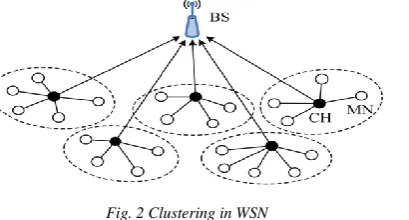
Clustering is a technique employed in sensor network to provide balance in the network. Clustering is sample of layered protocols where the network is composed of several clusters of sensor nodes. As shown in Fig.2, each cluster has a leader node which is also called as cluster head [7].
Fig. 2 Clustering in WSN
Clustering process takes place in two steps- first cluster heads are chosen and then clusters are formed. Cluster head selection-Number of cluster to be chosen can be either fixed in priori or dynamically depending upon the application. Selection of cluster head can take place in two ways distributed and centralized. In distributed each node is independent to take the decision of becoming the cluster head whereas in centralized approach a central authority chooses the cluster head based on certain parameters. Formation of clusters- The chosen cluster heads then broadcast invite packets to all the nodes that comes in their range. Thus it is necessary for all the nodes to turn their receivers ON during this stage. Nodes join the cluster head whose signal it receives. In case it receives signal from more than one cluster head it compares the strength of signal to estimate the distance from cluster head, it chooses the nearer cluster head. In this way clusters are formed.
1. Low Energy Adaptive Clustering Hierarchy (LEACH [8]
LEACH is one of the most popular algorithms for WSNs. It forms clusters based on the received signal strength and uses the CH nodes as routers to the base-station. All the data processing such as data fusion and aggregation are local to the cluster. It guarantees that every node evenly become CH, but does not take into account battery level and the Inter-relationship among nodes. In LEACH, CHs are determined in a distributed autonomous fashion. At each round l, each node v independently decides to be a CH with probability if the node v has
not been a CH in the most recent rounds.
2. Threshold Sensitive Energy Efficient Sensor Network Protocol (TEEN) [9]
TEEN is a combination of hierarchical protocol and data centric approach. It is introduced to minimize the number of transmissions from ordinary nodes to cluster head. After the formation of clusters, the cluster heads broadcast two threshold values to ordinary sensor nodes known as hard threshold (Ht) and soft threshold (St). Hard threshold denotes the minimum value for an attribute beyond which the node should turn on its transmitter and send data to cluster head. Soft threshold refers to the small change in value of attribute for which the node should turn its transmitter on and transmit the sensed value to the cluster head. This protocol significantly reduced the number of transmissions between ordinary sensor nodes and the cluster head, thus saving a huge amount of energy.
3. Adaptive Threshold Sensitive Energy Efficient Sensor Network Protocol (APTEEN) [10]
This protocol is used to capture the data periodically. Three types of data query are made: historical, one time, persistent etc. In historical, the previous recorded values are analyzed and further decisions are also being taken based on their value (previous value). In one time, the snapshot of current network is taken and also envisioned (visualized). In persistent, when a event takes place than it monitors the network.
4.
Hybrid Energy-Efficient Distributed Clustering (HEED) [11]HEED is a distributed clustering scheme in which CH nodes are picked from the deployed sensors. HEED considers a hybrid of energy and communication cost when selecting CHs. Only sensors that have a high residual energy can become cell-head nodes. This percentage value, , is used to limit the initial CH announcements to the other sensors. Each sensor sets its probability of becoming a cluster-head, , as follows
Where, is the current energy in the sensor and is the maximum energy, which corresponds to a fully charged battery.
5. Power-Efficient Gathering in Sensor Information System PEGASIS [12]
PEGASIS that is a series based protocol provide improvement over LEACH algorithms. In PEGASIS, each node communicates alone with an in depth neighbour and takes turns transmission to rock bottom station, so reducing the number of energy spent per spherical. mistreatment greedy formula, the nodes are progressing to be organized to create a series, after SB can reason this chain and broadcast it to all or any or any the detector nodes. Energy saving in PEGASIS over LEACH takes place by many stages: initial, at intervals the native military operation, the distances that just about all of the detector nodes transmit unit long less compared to transmission to a cluster-head in LEACH. Second, only one node transmits to the SB in each spherical of communication. PEGASIS outperforms LEACH by limiting the amount of transmissions, eliminating the overhead of dynamic.
6. Geographic adaptive fidelity (GAF) [13]
It locates nodes in the network and makes the best use of them to have a better fidelity. All the nodes use a location identification technique to locate itself with its nearest neighbors by using location-information systems like GPS. In GAF, all the nodes arrange themselves according to grids also. All the nodes divide themselves in grids and all nodes which are under a same grid coordinate among themselves to see who will go into sleep state and for how long.
7. Stable election protocol (SEP) [14]
It is improved version of LEACH. It operates like LEACH but the difference in SEP that there are two types of nodes; 1.Normal nodes, 2.Advance nodes which has different level of energy. In SEP, weighted election probabilities are used to select the cluster head from all the sensor nodes according to their energy.
H. Distributed Energy Efficient Hierarchical Clustering for Wireless Sensor Network (DWEHC) [17]
DWEHC improves shortcomings of HEED by generating balanced cluster sizes and optimizing intra cluster topology. It is a distributed weight based hierarchical clustering protocol. Each node calculates its weight by measuring its residual energy and proximity with the neighbors by using the following formula
8. Improved and balanced LEACH (IBLEACH) [15]
It is improved version of LEACH. Some high energy nodes declare themselves to be gateway nodes and send ADV (advertisement) messages to other non-gateway nodes. The other non-gateway nodes with maximum energy declare themselves to be cluster head and send ADV messages to non-cluster nodes. The non-cluster nodes can receive two or more ADV requests. A node sends Join-Request to that cluster head which require minimum communication energy. Each node starts their task after the construction of clusters.
9. Distributed energy-efficient clustering (DEEC) [16]
It is also based on LEACH protocol and used for heterogeneous WSN. The network is divided into clusters and each cluster head is chosen by a probability of ratio between residual energy of each node and average energy of the network. DEEC is better than LEACH, SEP because it has longer lifetime.
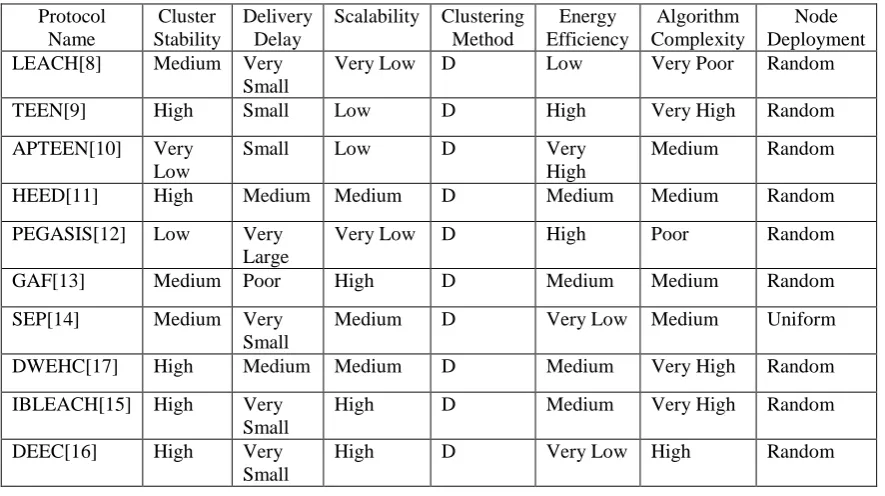
Table 1. COMPARISON OF ENERGY EFFICIENT ROUTING PROTOCOLS IN WIRELESS SENSOR NETWORKS
Protocol Name Cluster Stability Delivery Delay
Scalability Clustering Method Energy Efficiency Algorithm Complexity Node Deployment LEACH[8] Medium Very
Small
Very Low D Low Very Poor Random
TEEN[9] High Small Low D High Very High Random
APTEEN[10] Very Low
Small Low D Very High
Medium Random
HEED[11] High Medium Medium D Medium Medium Random
PEGASIS[12] Low Very Large
Very Low D High Poor Random
GAF[13] Medium Poor High D Medium Medium Random
SEP[14] Medium Very Small
Medium D Very Low Medium Uniform
DWEHC[17] High Medium Medium D Medium Very High Random
IBLEACH[15] High Very Small
High D Medium Very High Random
DEEC[16] High Very Small
High D Very Low High Random
IV. CONCLUSION AND FUTURE SCOPE
In this paper we can listed some of the energy efficient protocols based on the cluster head clustering in WSN. In this paper we have surveyed the past research works which mainly focuses on energy efficient clustering based routing protocols for wireless sensor networks and we have systematically analyzed a few classical WSN clustering routing protocols in deep, and compare these protocols in Table 1 on the bases of different parameters. Energy efficiency is the major issue in wireless sensor networks. In future we can proposed a new clustering protocol which are more helpful in the energy efficiency.
ACKNOWLEDGEMENT
I take this opportunity to express my deepest and sincere gratitude to most esteemed HOD of CSE Dept. Ms. Pratibha Sharma and my guide Ms. Tanuj Wala of CSE Department, who have been kind enough to spare their valuable time, and inspire me to do better than I can. Their guidance and motivation conceived a direction in me.
REFERENCES
[1] Jun Zheng and Abbas Jamalipour, ―Wireless Sensor Networks: A Networking Perspective,‖ A John Wiley & sons, inc., Publication, (2009).
[2] Kiran Maraiya, Kamal Kant and Nitin Gupta, ―Efficient Cluster Head Selection Scheme for Data Aggregation in Wireless Sensor Networks,‖ International Journal of Computer Applications, June 2011.
[3] Y. Jennifer, B. Mukherjee and D. Ghosal, ―Wireless sensor network survey,‖ In ELSEVIER, computer networks, pp. 2292-2330, 2008.
[4] E. Fasoloy, M. Rossiy, J. Widmer and M. Zorziy, ―In-network Aggregation Techniques for Wireless Sensor Networks: A Survey‖, IEEE Wireless Communications, 2007.
[6] I.F. Akyildiz, W. Su, Y. Sankarasubramaniam and E. Cayirci, ―Wireless sensor networks: a survey,‖ In ELSEVIER, computer networks, pp. 393-422, 2002.
[7] S.K Singh, M.P Singh and D.K Singh, ―A Survey of Energy-Efficient Hierarchical Cluster-Based Routing in Wireless Sensor Networks,‖ In International Journal of Advanced Networking and Applications, vol.02, pp.570-580, 2010.
[8] W. R. Heinzelman, A. Chandrakasan and H. Balakrishnan, ―Energy-efficient communication protocol for wireless microsensor networks,‖ in Proceedings of the 33rd Hawaii International Conference on System Sciences, Maui, Hawaii, vol. 8, Page: 8020, 4-7 January 2000.
[9] A Manjeshwar and D. P. Agrawal, ―TEEN: A Routing Protocol for Enhanced Efficiency in Wireless Sensor Networks,‖ in Proc. of 15th International Parallel and Distributed Processing Symposium, pp. 2009–2015.
[10] D.P Manjeshwar and A. Agrawal, ―APTEEN: A Hybrid Protocol for Efficient Routing and Comprehensive Information Retrieval in Wireless Sensor Networks,‖ In Proceedings of the 2nd International Workshop on Parallel and Distributed Computing Issues in Wireless Networks and Mobile computing, Lauderdale, FL, USA, pp. 195–202, 15– 19 April 2002. [11] O. Younis and S. Fahmy, ―HEED: A Hybrid, Energy-Efficient, Distributed clustering approach for Ad Hoc sensor networks,‖ IEEE Transactions on Mobile Computing, vol. 3 no.4, pp. 366–379, 2004.
[12] S. Lindsey and C.S. Raghavendra, ―PEGASIS: Power-efficient gathering in sensor information systems,‖ in IEEE proceeding on aerospace, 3, 1125-1130.
[13] Ya Xu, John Heidemann and Deborah Estrin, ―Geography informed Energy Conservation for Ad Hoc Routing,‖ Proceedings of the Seventh Annual ACM/IEEE International Conference on Mobile Computing and Networking (ACM Mobicom), 2001.
[14] Smaragdakis Georgios, Ibrahim Matta and AZER BESTAVROS, ―SEP: A Stable Election Protocol for Clustered Heterogeneous Wireless Sensor Networks,‖, 2004.
[15] Ben Alla Said and Ezzati Abdellah, ―Improved and Balanced LEACH for Heterogeneous Wireless Sensor Networks,‖, 2010.
[16] L. Qing, Q. Zhu and M. Wang, ―Design of a distributed energy-efficient clustering algorithm for heterogeneous wireless sensor networks,‖ In ELSEVIER, Computer Communications, 2006.