Product Identification using Multiple RFID
Tags
Prof Abhilasha Kulkarni
1, Radhika Bhong
2, Kavita Padgilwar
3, Shubhankar Sant
4, Tejraj Phutane
5Assistant Professor, Department of Computer Engineering, MMCOE, Karve Nagar, Maharashtra, India 1
U.G. Students, Department of Computer Engineering, MMCOE, Karve Nagar, Maharashtra, India 2,3,4,5
ABSTRACT: Internet of Things (IoT) conceptualizes the idea of remotely connecting monitoring real world objects (things) through the Internet. When it comes to shopping mall, this concept can be aptly incorporated to make it smarter and automated. Today purchasing various items in malls or supermarkets is a complex process. In a traditional supermarket environment, each customer fills the cart takes it to the billing counter but, has to wait in a queue for billing payment. To overcome that we have been developed a smart way for shopping. In this project, we discuss an innovative concept of Multiple Radio Frequency Identification (RFID) tags based smart shopping billing system. Each product has an RFID tag on it. Each billing counter has an RFID reader. As soon as customer passes through the billing counter, RFID reader will read all tags of all the products in the cart simultaneously the bill will be generated. This project will increase efficiency of billing counter.
KEYWORDS: Raspberry Pi, IOT, Automated billing, RFID, Multi-Tag, Anti-collision
I. INTRODUCTION
The basic idea of this paper is to read multiple RFID tags simultaneously and to create a billing system. The items in shopping cart are equipped with RFID tags and read by the RFID reader using Slotted ALOHA algorithm. The data extracted is then used to calculate the bill. Malls and supermarkets have been a growing standard in India. With more and more Indians being elevated into the higher economic zones and with such a gigantic population, Queues in the supermarket/mall scenario takes most time of the shopping experience. While shopping, Customers have to first take the product they need and stand in a long queue to finally be able to pay and check-out. The market/mall also has to store Inventory and log it in a computer system to keep track of it. There is a need to revolutionize the shopping mechanism as well as the experience provided to the customers. While other existing identification and data-carrying technologies like magnetic stripes, barcode, vision systems are present, RFID is more efficient as it trumps barcodes with its possible features. RFID doesn’t require a defined line of sight. Barcodes have an orientation limitation as in it is only read properly if it’s oriented correctly. Some features of RFID technology include:
• No Line Of Sight (LOS) required.
• Higher range than other technologies available. • Greater Durability and reliability.
• Multiple and Concurrent Read/Write Speed
Using this technique along with an algorithm which enables the RFID reader to accept values concurrently, the process of check-out can be vastly minimized and time required for billing can reduced. This system also directly links the product log which keeps the inventory.
II. LITERATURE SURVEY
reduce time/labor but it can also be used to help the store collect valuable information of the ongoing environment in the supermarket/mall and using it to the advantage of building a completely isolated system whose data can later be mined to extract precious information such as trends, popularity, peak hours, average time etc. Paper [2] proposes ALOHA and its types to be used as the main algorithm for the RFID based billing system. Overall, this paper is a complete study about different types of ALOHA considering transmission time and packet size while testing. Paper [3] compares various Dynamic Frame Slotted ALOHA (DFSA) based anti collision multitag identification algorithms. It describes how tag number estimation and frame size estimation techniques play a vital role in determining the performance of the Dynamic Frame Slotted ALOHA (DFSA) based anti collision multitag identification algorithms hence helps to consider DFSA algorithm for our system. We learn from the experiments conducted in the paper [4] that multi tags are highly effective in improving object detection probability, yielding double digit improvements over traditional single tagged RFID systems using both linear and circular antennas. The issues of tag orientation, variability, effects of multi tag on anti collision algorithms and object detection in presence of metals and liquids is discussed. Paper [5] encompasses the current and envisioned fields of applications as well as the advantages and limitations of the RFID technology are briefly discussed. We learn from this paper that despite the limitations and unresolved issues that hinder the widespread application of the RFID technology, it continues to be popular in the product inventory system. Furthermore, as time goes by, the current technical limitations of the RFID will be solved by new and extensive engineering efforts into the field. . Paper [6] proposes an anti collision algorithm based on the Dynamic Frame Slotted ALOHA (DFSA) called NEDFSA for passive RFID systems to be used in the Automatic RFID billing system. We learn from paper[6] that the proposed algorithm uses an estimation mechanism which helps adjust the initial frame length to a closer value to the total number of tags present. The high scalability of the algorithm is also demonstrated in this paper. Paper [7] proposes a design methodology with two different RF modules. The authors suggest using two different frequencies, one 433.92 MHz and the second operating at 315 Mhz. This is done so the RFID reader can identify the individual tags that need to transmit data. When a reader is placed in front of multiple tags, all tags will try to communicate with the reader and thus no tag will be able to communicate with the reader as it will result in collisions. In this proposed system, the reader will emit a set frequency and the tag that is addressed will reply with a separate, distinct frequency that will distinguish it from other tags. This will help our project as it will consist of multiple tags on a single product, and thus will help us reduce latency and collisions.
Hence we can conclude that most RFID systems designed for this specific project are based on making a fully automatic checkout system. The important advantages of such systems are time reduction and work reduction. We also derive that the multi tag automatic billing system can also be used for extracting important data like user pattern, product demand, and peak hours. Some of the researchers have also proposed a smart trolley system where the whole system (RFID readers, IR sensors, LCD screen) is mounted on each individual trolley. However, as this will drive up the cost of the project, a combo of RFID readers located at strategic locations along with multiple tags on the product is a cost effective way of approaching this system.
III. SYSTEM ARCHITECTURE
1. Customer will authenticate and takes cart for shopping.
2. Customer will add items (to which RFID tags are attached) to be purchase in shopping cart.
3. After this, customer will go to billing counter which is having RFID reading tunnel.
4. Reader will use Radio waves to read RFID tags.
5. Slotted ALOHA algorithm will be used to read multiple RFID tags simultaneously. 6. Compare with the database, extract data and calculate the bill.
A. Working Principle:
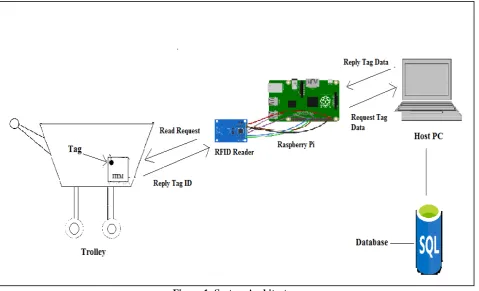
readers placed at strategic locations. Reader will be connected to the brain of our system i.e. Raspberry Pi. The reader will send read request to the RFID tags in cart. Tags will reply with their ID. Using specialized anti collision algorithms, the tags will be read by the reader in a simultaneous i.e. fast read times fashion. This process will continue to retrieve information about all tags i.e. purchased products and required operations will be performed on the Raspberry system.
Figure 1: System Architecture
B. Raspberry Pi 3:
All the computations for calculating accurate bill is done using Raspberry Pi 3.
Specifications:
CPU Quad Cortex A53@ 1.2GHz
Wireless 802.11n/Bluetooth 4.0
GPIO 40
Storage Micro-SD
RAM 1 GB SDRAM
Ports Supported 4 USB2 Ports,1 Ethernet,1 HDMI port
C. RFID Reader
Specifications:
Frequency High Frequency (13.56 MHz)
Read Range up to 30 cm
D. RFID Tags
Fast processing, short range, adhesive passive RFID (Radio Frequency Identification) tags having high frequency (13.56MHz) are used. Tags contain electronically stored information. These passive tags collect energy from nearby RFID readers interrogating radio waves for communication.
Specifications:
Frequency High Frequency (13.56 MHz)
RFID Tags Type Passive Adhesive
E. Software Tools
MariaDB database is used to store unique identification number, product name and cost of all the products. Python is used as it is a powerful programming language and very easy to understand.
Specifications:
Database MariaDB
Programming Language Python
IV. EXPERIMENTALRESULTS
Radio Frequency Identification (RFID) is an increasingly popular technology that uses Radio signals for object identification. Successful object identification is the primary objective of RFID technology. Today purchasing various items in malls or supermarkets is a complex process. In a traditional supermarket environment, each customer fills the cart & takes the trolley to the billing counter but, has to wait in a queue for billing and payment .To overcome that we have developed a smart way for shopping. In this system, we have proposed an innovative concept of using Multiple Radio Frequency Identification (RFID) tags based for smart shopping & billing system. Each product has multiple RFID tags on it and there is a RFID reader region at checkout for reading these tags on products in the cart. This system uses Dynamic Framed Slotted ALOHA to as an anti-collision algorithm. This algorithm is used to overcome radio frequency collision issues when multiple products in each customer's cart are to be detected simultaneously as he\she passes through this reader region. This eventually speeds up the process of bill generation and payment process thus reducing waiting time of customers in long queues during checkout at supermarkets.
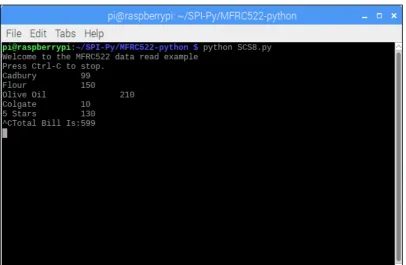
Figure 2: Connection of devices and working of reader to identify the products
Figure 3 Description: The figure shown above displays the information about all the products that were detected by the reader. As soon as the reader identifies any product its tag ID is mapped to the database containing product information such as product name and product cost. This information is immediately displayed on the terminal.
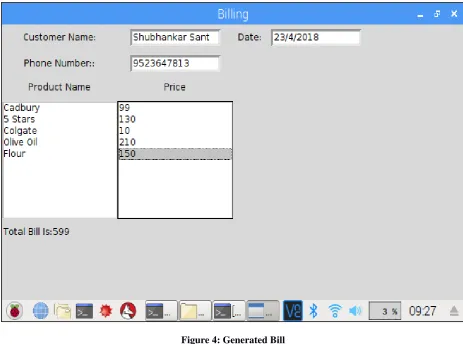
Figure 4: Generated Bill
Figure 4 Description: The above figure shows the final result where after all products in the basket are identified the next step is to calculate the total bill for that particular customer. Here it displays a GUI for billing which contains the customer name, date of billing, customer's phone number along with the list of products bought by the customer and their price. Finally the total bill is calculated and displayed at the end.
V. SIMULATIONANDRESULTS
VI. CONCLUSION AND FUTURE SCOPE
The Automatic bill generation system provides a promising solution for Accurate billing process and reduces the overall time and effort taken by the customer. The Automatic RFID billing system has a throbbing future. The System can be condensed in a cart, thus making each cart “smart”. This system also has a potential and a likely future in logistics especially in the cold-chain domain where the products can be validated without manual registry or a stop and scan system. The system will also provide for automatic inventory monitoring and ordering eliminating human interference. This system can be further implemented in other domains such as Laundry Management, Inventory Tracking, Real-time location system, Library Management.
REFERENCES
[1] Ali, Zeeshan, and Reena Sonkusare, "Rfid based smart shopping: an overview", IEEE International Conference on Advances in
Communication and Computing Technologies (ICACACT), 2014.
[2] S. Kang and Z. Prodanoff, "Rfid model for simulating framed slotted aloha based anti-collision protocol for multi-tag identification", Current Trends and Challenges in RFID, 2011.
[3] N. Kamineni and X. Li, "Analysis of anti-collision multi-tag identification algorithms in passive rfid systems", Second International conference on Computing, Communication and Networking Technologies, 2010.
[4] L. Bolotnyy, S. Krize, and G. Robins,"The practicality of multi-tag rfid systems", Proceedings of the 1st International Workshop on RFID
Technology - Concepts, Applications, Challenges, 2007.
[5] M. Kaur, M. Sandhu, N. Mohan, and P. S. Sandhu, "Rfid technology principles, advantages, limitations its applications", International
Journal of Computer and Electrical Engineering, pp.151–157, 2011.
[6] Mota, Rafael Perazzo Barbosa, and Daniel M. Batista, "A dynamic frame slotted aloha anti-collision algorithm for the internet of things", Proceedings of the 29th annual ACM symposium on applied computing, ACM, 2014.
[7] S. kodali and E. P., "Implementing anti collision algorithm for multiple tag identification", International Journal of Scientific Engineering Research, Vol. 2(5), May2011.