ISSN(Online) : 2319-8753 ISSN (Print) : 2347-6710
I
nternational
J
ournal of
I
nnovative
R
esearch in
S
cience,
E
ngineering and
T
echnology
(An ISO 3297: 2007 Certified Organization)
Website: www.ijirset.com
Vol. 6, Issue 4, April 2017
Intelligent Currency Recognition System
Mugdha Dalvi1, Sachin Palve2, Priya Pangare3, Lakhan Modani4, Ritesh Shukla5
Student, Dept. of Electronics, V.E.S Institute of Technology, Affiliated to University of Mumbai, India1,2,3,4,5
ABSTRACT: There are many different currency in the world. Knowing each and every currency by its feature is very difficult and sorting them is a tedious job. Practically it is not possible to recognize them. Our aim is to solve this problem and make the currency recognition an easy task. Each and every currency have a unique feature and a hidden identity. The process of currency recognition helps to extract the visible and also the hidden features on the currency. This system of currency recognition is used in places where there are money exchange taking place on a larger scale. For them sorting the difference currency of different countries and different monetary value become a difficult task. So, to help them out currency recognition system is implemented. This system help to identify the currency which have blur or damage features, because the currency with damage or blur feature is difficult to recognize. The software used can be implemented on any currencies. The algorithm implemented should be simple but efficient, the speed of execution should be fast. There are many security features available on the currency and it is not feasible to take into account all the features present on the currencies, so we need to consider only those features which have unique identification for that currency. Our aim is to generate one such algorithm that is more efficient and easy to implement and sometime it is a tedious job to implement one single algorithm for all the available currencies. The main purpose of this system is to recognize the currency.
KEYWORDS: Currency Recognition; Digital Image Processing
I. INTRODUCTION
All the currencies around the world are different from each other. For instance, the size of the paper is different, same as the colour and pattern. The staffs who work in offices like money exchange for them to remember each and every symbol for all the different currencies become a tedious job. This may result into wrong recognition, so we need an efficient and a full proof system. The aim of our system is to help people to recognize different currencies and work with convenience and efficiently. With development of modern banking system, it is necessary to develop an automatic system for currency recognition. This project proposes image processing technique for currency recognition. The image processing approach is discussed using MATLAB to detect the features of the currency. Image processing involves changing the nature of the image in order to improve the pictorial information for human interpretation. There are various techniques for currency recognition, texture, pattern and colour based [4]. The proposed system will work on two images one is the original image and other is the test image on which the verification need to be done.
II. RELATED WORK
ISSN(Online) : 2319-8753 ISSN (Print) : 2347-6710
I
nternational
J
ournal of
I
nnovative
R
esearch in
S
cience,
E
ngineering and
T
echnology
(An ISO 3297: 2007 Certified Organization)
Website: www.ijirset.com
Vol. 6, Issue 4, April 2017
The image we get from the camera is in the JPEG format. A distinctive point extraction method use a coordinate data extraction method for a specific part of the currency representing same colour.
A. SECURITY FEATURES
Watermark: The Mahatma Gandhi Series of banknotes contain the Mahatma Gandhi watermark with a light and shade effect and multi-directional lines in the watermark window. The fig2 show the watermark image of the currency.
FIG 2.WATERMARK
Security thread: Rs.2000 notes introduced contain a readable, windowed security thread alternately visible on the obverse with the inscriptions ‘Bharat’ (in Hindi), ‘2000’ and ‘RBI’, but totally embedded on the reverse. The Rs.500 and Rs.100 notes have a security thread with similar visible features and inscription ‘Bharat’ (in Hindi), and ‘RBI’. When held against the light, the security thread on Rs.2000, Rs.500 and Rs.100 can be seen as one continuous line fig 3 show the difference of the optical thread when hold against light and in normal condition. Notes issued prior to the introduction of the Mahatma Gandhi Series have a plain, non-readable fully embedded security thread.
FIG 3. OPTICAL STRIP
Optically Variable Ink: This is a new security feature incorporated in the Rs.2000 and Rs.500 notes with revised colour scheme. The numeral 2000 and 500 on the obverse of Rs.2000 and Rs.500 notes respectively is printed in optically variable ink viz., a colour-shifting ink. The colour of the numeral 2000/500 appears green when the note is held flat but would change to blue when the note is held at an angle.
FIG 4. VARIABLE INK
Eurion pattern: The EURion constellation (also known as Omron rings or doughnuts) is a pattern of symbols incorporated into a number of banknote designs worldwide. It is added to help imaging software detect the presence of
a banknote in a digital image. Such software can then block the user from reproducing banknotes to prevent
ISSN(Online) : 2319-8753 ISSN (Print) : 2347-6710
I
nternational
J
ournal of
I
nnovative
R
esearch in
S
cience,
E
ngineering and
T
echnology
(An ISO 3297: 2007 Certified Organization)
Website: www.ijirset.com
Vol. 6, Issue 4, April 2017
FIG 5.EURION PATTERN
III. ALGORITHM USED
A. Algorithm
i) Obtain the image of the currency from camera.
ii) On the image obtain use the pre-processing algorithm to extract the desired features from the currency. iii) Detect the boundaries and extract the ROI (Region of Interest) by cropping.
iv) Extract the desired features of currency.
v) Compare the extracted features of the currency with the reference data calculated. vi) Display the result.
B. Description of Algorithm
The aim of this algorithm is to develop an algorithm that can be implemented on any currencies. Step 1: Obtain an image
We can obtain an image from the camera or from the scanner, but we need to consider that the environment condition should not affect it that is they should be controllable.
Step 2: Pre-processing operation
Pre-processing helps to alter the nature of the currency. It helps to segment the obtain currency and also used to convert it to gray image. It helps to identify the boundary of the image and ROI.The pre-processing does not increase image information content but decrease it if entropy is an information measure [1]
Step 3: Boundary detection and cropping
This helps to separate the background and foreground of the image and also help to extract the ROI for further processing.
Step 4: Feature extraction
ISSN(Online) : 2319-8753 ISSN (Print) : 2347-6710
I
nternational
J
ournal of
I
nnovative
R
esearch in
S
cience,
E
ngineering and
T
echnology
(An ISO 3297: 2007 Certified Organization)
Website: www.ijirset.com
Vol. 6, Issue 4, April 2017
FIG 6. ALGORITHM
IV. TECHNIQUES AND FUNCTIONS USED
I) SEGMENTATION
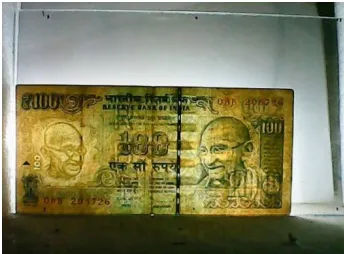
Segmentation is one of the important parts to process image data. It aims to divide an image into parts that have a strong correlation with objects. In our project, we should use it to segment the captured image i.e. to extract the currency from the background as shown in fig7 is the captured image and fig 8 show the segmented image.
ISSN(Online) : 2319-8753 ISSN (Print) : 2347-6710
I
nternational
J
ournal of
I
nnovative
R
esearch in
S
cience,
E
ngineering and
T
echnology
(An ISO 3297: 2007 Certified Organization)
Website: www.ijirset.com
Vol. 6, Issue 4, April 2017
FIG 8.SEGMENTED IMAGE
II) HISTOGRAM EQUALIZATION
Histogram equalization is used to adjust contrast based on the image’s histogram. This method is useful for the image with background and foreground that are both bright or both dark. The fig 9 show the histrogram for the colour change in the latent image of Rs 500 currency. where the red, blue and green colour show the RGB form of the image.
FIG 9. HISTOGRAM
III) STRUCTURAL SIMILARITY INDEX (SSIM)
ssim (A, REF) calculates the Structural Similarity Index (ssim) value for image A, with the image REF as the reference. A and REF can be 2D gray scale or 3D volume images, and must be of the same size and class [9].
IV) COLOUR
ISSN(Online) : 2319-8753 ISSN (Print) : 2347-6710
I
nternational
J
ournal of
I
nnovative
R
esearch in
S
cience,
E
ngineering and
T
echnology
(An ISO 3297: 2007 Certified Organization)
Website: www.ijirset.com
Vol. 6, Issue 4, April 2017
V) CEIL
Ceil Round towards plus infinity. Ceil (X) rounds the elements of X to the nearest integers towards infinity.
VI) EUCLIDEAN DISTANCE
Euclidean distance weight function. Weight functions apply weights to an input to get weighted inputs. The Euclidean distance d between two vectors X and Y isd = sum((x-y).^2).^0.5 . Z = dist(W,P,FP) takes these inputs, and returns the S-by-Q matrix of vector distances.dim = dist('size',S,R,FP) takes the layer dimension S, input dimension R, and function parameters, and returns the weight size [S-by-R].
dw = dist('dw',W,P,Z,FP) returns the derivative of Z with respect to W. dist is also a layer distance function which can be used to find the distances between neurons in a layer.
VII) BWAREAOPEN
bwareaopen Remove small objects from binary image. BW2 = bwareaopen(BW,P) removes from a binary image all connected components (objects) that have fewer than P pixels, producing another binary image BW2. This operation is known as an area opening. The default connectivity is 8 for two dimensions, 26 for three dimensions,and CONNDEF(NDIMS(BW),'maximal') for higher dimensions.
VIII) REGIONPROPS
regionprops Measure properties of image regions. STATS = regionprops(BW,PROPERTIES) measures a set of properties for each connected component (object) in the binary image BW, which must be a logical array; it can have any dimension. If PROPERTIES is the string 'all', regionprops returns all of the Shape measurements. If called with a gray scale image, regionprops also returns Pixel value measurements. If PROPERTIES are not specified or if it is the string 'basic', these measurements are computed: 'Area', 'Centroid', and 'Bounding Box'.
V. RESULTS
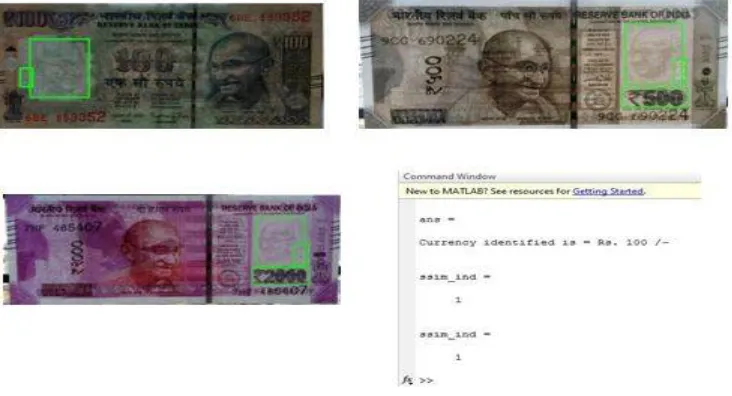
From now the system can check the Indian currency of bigger denomination. The system can be modified for different currency of different denomination and of different countries, just by adding there feature to the database. For now, the system gets the image from the camera and the light intensity is also kept under control.
ISSN(Online) : 2319-8753 ISSN (Print) : 2347-6710
I
nternational
J
ournal of
I
nnovative
R
esearch in
S
cience,
E
ngineering and
T
echnology
(An ISO 3297: 2007 Certified Organization)
Website: www.ijirset.com
Vol. 6, Issue 4, April 2017
The above fig (12) show that the currency is identified and the features are correctly extracted. The green box show that the currency is proper or we can say that the currency is real.
VI. CONCLUSION
From the project we conclude that, the proposed algorithm is based on the colour and different identification features on the currency. We segment the pattern from the currency and then we matched it with the database for checking the currency. Currency is differentiated based on their colour and size related features. The experiment based on proposed algorithm is accurate and since we have used system based on image processing it is quick and accurate. This system can also face some drawbacks, such as quality of currency, damage level of the currency can affect the recognition rate. It may also face the problem of light intense. In order to use this system widely we can work on involving the first sight inspection method in algorithm so that the system become more useful and effective. This system may be a very useful tool in order to prevent higher order counterfeiting by taking advantage of cheaper and high quality equipment.
REFERENCES
1. Ahmed, M. J., Sarfraz, M., Zidouri, A., and Alkhatib, W. G., License Plate Recognition System, The Proceedings of the 10th IEEE International Conference on Electronics, Circuits and Systems (ICECS2003), Sharjah, United Arab Emirates (UAE), 2003.
2. Andrew S. Glassner. Principles of Digital Image Synthesis. Morgan Kaufmann Publishers, 1995. 3.Steven J. Murdoch (13 June 2004)."Software Detection ofCurrency". Cl.cam.ac.uk. Retrieved 2014-05-20.
4. Vipin Kumar Jain, Dr.Ritu Vijay, “Indian Currency Denomination Identification Using Image Processing Technique” ,Vipin Kumar Jain et al, / (IJCSIT) International Journal of Computer Science and Information Technologies, Vol. 4 (1) , pp 126 – 128,2013.
5. http://in.mathworks.com/help
6. Rafael C. Gonzalez, Richard E. Woods, Steven L.Eddins. Digital Image Processing Using MATLAB. Pearson Education, 2004 7. www.rbi.org.in/features
8. Rafael C. Gonzalez, Richard E. Woods. Digital Image Processing 2ndedition. Pearson Education, New York, 2001
9. Wang Zhou, Bovik, Alan C., Sheikh, Hamid R., and Simoncelli, EeroP.ImageQualifty Assessment: From Error Visibility to Structural Similarity. IEEE Transactions on Image Processing, Volume 13, Issue 4, pp. 600–612, April 2004
10. Rafael C. Gonzalez, Richard E. Woods, Steven L.Eddins. Digital Image Processing Using MATLAB. Pearson Education, 2004.
11. Rubeena Mirza, Vinti Nanda, “Paper Currency Verification System Based on Characteristic Extraction Using Image Processing”, International Journal of Engineering and Advanced Technology (IJEAT) ISSN: 2249 –8958, Volume-1, Issue-3, February 2012 4