Original Research Article
Persistent adenoids and their secondary effects
Sowmya Tumkur Rangaiah
1, Vikram Kemmannu Bhat
2*, Mona Yadav
2INTRODUCTION
The symptoms of recurrent colds, snoring and mouth breathing are a few of the commonest ailments among the adolescents and young adults. Even though they might sound trivial, they could lead to long lasting after effects in the middle ear and the nose, if not evaluated and treated properly for the presence of persistent adenoids. The pathological adenoid acts as the initial focus of infection, cascading a series of other secondary effects
like rhinosinusitis, Eustachian tube dysfunction, otitis media and otitis media with effusion. These after effects add to the morbidity and disease burden on the patient and can make the treatment more difficult as they necessitate the need for more surgical procedures. Hence prevention of these secondary effects by timely intervention is crucial. In one of our own previous studies, we have discovered that the adenoids could pose a considerable risk factor for the development of chronic otitis media.1 This paper aimed to study the
ABSTRACT
Background: Regression of adenoids is assumed to be a physiological phenomenon at puberty. However, it has been found that it can persist well beyond adolescence into early adulthood, cascading a series of after effects in the upper respiratory tract that can cause considerable morbidity leading to public health problems. This study aimed to explore the clinicopathological features of persistent adenoids and their secondary effects on the upper respiratory tract.
Methods: This was a prospective controlled study of 100 eligible patients in the age group of 15-60 years presenting with enlarged adenoids confirmed by nasal endoscopy. Equal number of controls without enlarged adenoids was also taken. Both the groups were evaluated for secondary effects like chronic rhinosinusitis, otitis media with effusion, chronic otitis media and Eustachian tube dysfunction. The relationship between adenoid enlargement in adults and secondary effects was analysed statistically.
Results: Seventy-seven patients with persistent adenoids had some or the other secondary effect. Eustachian tube dysfunction was present in 21, otitis media with effusion in 10, chronic otitis media in 29 and chronic rhinosinusitis in 33. In the control group only 46 had secondary effects. The association between the presence of adenoids and secondary effects was statistically significant.
Conclusions: Adenoids can persist into early adulthood and majority of them can have secondary effects. Chronic rhinosinusitis was the commonest in this study. Careful evaluation by means of nasal endoscopy is required to identify them. This is crucial for the timely treatment of this condition in order to prevent the associated secondary effects.
Keywords: Adenoid, Chronic otitis media, Chronic rhinosinusitis, Otitis media with effusion
Department of Otolaryngology, Head and Neck surgery, Mandya Institute of Medical Sciences, Mandya, Karnataka, India
Department of Otolaryngology, Head and Neck surgery, Karnataka Institute of Medical Sciences, Hubli, Karnataka, India
Received: 22 April 2020
Revised: 31 May 2020
Accepted: 01 June 2020
*Correspondence:
Dr. Vikram Kemmannu Bhat, E-mail: [email protected]
Copyright: © the author(s), publisher and licensee Medip Academy. This is an open-access article distributed under the terms of the Creative Commons Attribution Non-Commercial License, which permits unrestricted non-commercial use, distribution, and reproduction in any medium, provided the original work is properly cited.
clinicopathological features of persistent adenoids and their secondary effects on the upper respiratory tract.
METHODS
This prospective study was conducted in a tertiary referral hospital from October 2018 to December 2019. The study was approved by the institutional ethical committee. Informed consent was taken from all subjects included in the study. The inclusion criteria for the cases (aged 15 to 60 years) were the clinical features of adenoid enlargement (confirmed endoscopically) with or without Eustachian tube dysfunction (ETD), otitis media with effusion (OME), chronic otitis media (COM) or chronic rhinosinusitis (CRS). Symptoms like nasal obstruction, nasal discharge, decreased hearing, ear discharge or aural fullness were considered. The controls (same age group) had no evidence of adenoid enlargement clinically or endoscopically. The exclusion criteria were the non-adenoid nasopharyngeal and nasal masses.
All patients were initially evaluated with a detailed history of ear, nose and throat complaints. They were then subjected to rigid diagnostic nasal endoscopy (DNE) and findings noted in each case with respect to the morphology of adenoid, tubal tonsil, Eustachian tube opening on swallowing, septum, turbinate, discharge in the middle meatus etc. Airway/Choana/Eustachian tube (ACE) grading system classification was used to grade the adenoid enlargement.2 In grade I, minimal
enlargement, adenoid in the nasopharynx occupying <1/3rd of choana, in grade II, moderate enlargement,
adenoid occupying 2/3rd of choana, in grade III, huge
enlargement, adenoids completely filling the choana.
One hundred patients attending the outpatient and inpatient clinic of the department who presented with
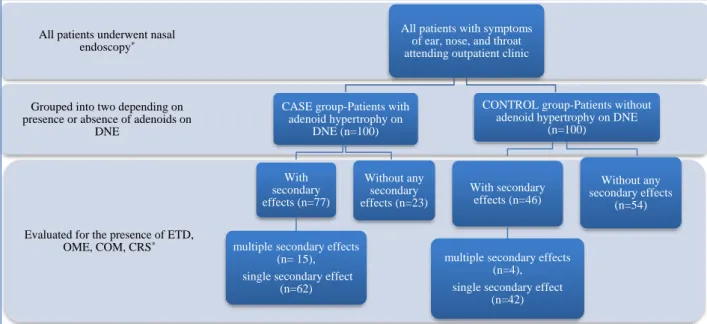
nasal obstruction and had adenoids (grade 2 or greater) in nasopharynx on endoscopy were recruited into the study (Figure 1). The after effects considered were ETD, OME, COM and CRS. Equal number of age and sex matched controls who did not have adenoids in nasopharynx on endoscopy were also recruited. These patients presented with symptoms of nasal obstruction, nasal discharge, headache, decreased hearing, giddiness, foreign body sensation in the throat, sore throat, excessive watering from the eyes etc.
Number of controls presenting with the same secondary effect were noted and were compared with the case group (Table 1). Patients with mild enlargement of adenoids were managed conservatively with topical steroid nasal spray for duration of three months. Those patients with moderate grade and huge enlargement of adenoids underwent adenoidectomy and the specimen was sent for histopathological examination.
Patients presenting with symptoms in the ear like fullness in the ear, ear ache with tympanic membrane retraction, and/or ‘C’ type curve on tympanogram were diagnosed to have ETD. Those patients with decreased hearing and with fluid or bubbles behind the tympanic membrane on otoscopy were considered to have OME. Impedance audiometry was also done in patients with OME. Patients with COM presented in all the stages, namely active, quiescent and inactive stages of the disease. Patients who presented with repeated episodes of cold and history of nasal obstruction, chronic rhinorrhoea with mucopurulent discharge in middle meatus were diagnosed to have CRS.
The data from the patients was entered in an excel sheet and analyzed by descriptive statistics (percentage) and analytical statistics (Chi-square test with level of significance at 95%).
Figure 1: The sequence of patient recruitment into the groups. Evaluated for the presence of ETD,
OME, COM, CRS*
Grouped into two depending on presence or absence of adenoids on
DNE
All patients underwent nasal endoscopy*
All patients with symptoms of ear, nose, and throat attending outpatient clinic
CASE group-Patients with adenoid hypertrophy on
DNE (n=100)
With secondary effects (n=77)
multiple secondary effects (n= 15), single secondary effect
(n=62)
Without any secondary effects (n=23)
CONTROL group-Patients without adenoid hypertrophy on DNE
(n=100)
With secondary effects (n=46)
multiple secondary effects (n=4), single secondary effect
(n=42)
Without any secondary effects
RESULTS
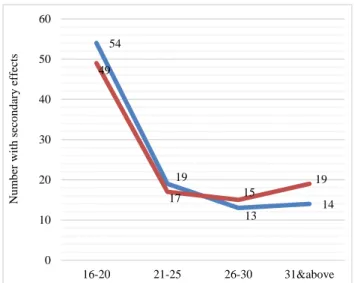
The demographic characteristics of the cases and controls are given in Figure 2. Patients with persistent adenoids presented with nasal obstruction as the most common complaint followed by rhinorrhea, ear discharge, decreased hearing, mouth breathing and snoring. There was no asymptomatic patient in either of the groups. Lateral pharyngeal bands were observed clinically only in 17 of the 100 cases. Sixty three percent of the secondary effects in this study were associated with persistent adenoids and 77% of the cases had secondary effects (Table 1). Among the cases and controls, 79% with multiple secondary effects and 60% with single secondary effect had persistent adenoids (Table 2). However, the occurrence of single secondary effect was commoner in both cases (80.5%) and controls (91.3%) in
this study. CRS was found to be the commonest secondary effect among the cases and was also significantly associated with adenoids along with ETD. All secondary effects had a higher risk of occurrence in the presence of adenoid among the cases (Table 3). As seen in Table 4, CRS tended to be more often bilateral (70%) than the rest of the secondary effects, while OME was mostly unilateral (80%). Among the cases, unilateral secondary effect was commoner (70%) than bilateral. Secondary effects in relation to different grades of adenoid enlargement on DNE are described in Table 5. ETD and OME mostly occurred when adenoids were of moderate to large size. However, COM and CRS occurred more commonly when adenoids were moderately sized. COM was the commonest secondary effect with minimal to moderate adenoids, while CRS was the commonest with larger adenoids (Table 5).
Table 1: Comparison of secondary effects between cases and controls.
Secondary effects present Secondary effects absent Total
Adenoid present (cases) U54+B23=77 23 100
Adenoid absent (controls) U42+B4=46 54 100
Total 123 77 200
Relative Risk=1.717 p=0.0001; association extremely significant, U-Unilateral B-Bilateral.
Table 2: Multiple and single secondary effects between cases and controls.
Multiple secondary effects Single secondary effect Total
Adenoid present (cases) 15 62 77
Adenoid absent (controls) 4 42 46
Total 19 104 123
Relative risk=0.88; p=0.128.
Table 3: Comparison of the statistics of various secondary effects among cases.
Statistical test ETD OME CRS COM
Percentage of cases with secondary effect (n=77) 21 10 33 29
Two tailed p value 0.049* 0.164 0.022* 0.0638
Relative risk 2.1 2.5 1.83 1.7
*Statistically significant.
Table 4: Comparison of various bilateral and unilateral secondary effects in the cases.
Secondary effects in cases (n=77) ETD OME CRS COM
Bilateral (n=23) 10 2 23 11
Unilateral (n=54) 11 8 10 18
Total 21 10 33 29
Table 5: Secondary effects in relation to different grades of adenoid enlargement on nasal endoscopy.
Grades of adenoid enlargement in cases ETD OME CRS COM
N (%) N (%) N (%) N (%)
Minimal (n=25) 6 (24) 1 (4) 5 (20) 8 (32)
Moderate (n=56) 8 (14.3) 4 (7.1) 17 (30.4) 19 (33.9)
Large (n=19) 7 (36.8) 5 (26.3) 11 (57.9) 2 (10.5)
Total (n=100) 21 10 33 29
Two tailed p value 0.104 0.03* 0.023* 0.141
Figure 2: Demographic characteristics of the cases and controls (age group in years).
DISCUSSION
The pathophysiology of adenoid regression during puberty remains an enigma in the medical world and the reasons for its persistence into adolescence and early adulthood are poorly understood. Multiple factors play different roles in sustaining the size and infection within the adenoids. Even though persistent adenoids could remain clinically silent in a majority of the patients, nevertheless they could be a potential focus of infection at some point of time and contribute to the pathogenesis of infections in the middle ear, nose and the paranasal sinuses. Even when uninfected, the sheer size could lead to obstructive symptoms. Yildirim et al, Babu et al and Shetty et alfound nasal obstruction as the most common symptom of persistent adenoid.3-5 Rout et al found
persistent adenoid as the second common cause of nasal obstruction after DNS in adults.6 However, snoring was
more common in the paediatric cases as described by Emerick et al.7 The discovery of these asymptomatic
adenoids has become possible with the advent of the nasal endoscope. This is an under diagnosed condition and commonly believed to be just CRS, both by the patient and the physician, even though the adenoid might be the cause for CRS.8,9 Hamdan et al found an overall
prevalence of 63.6% adenoids in adults with nasal obstruction and 55.1% in the control group.10 Hence there
is a need to positively search and rule out this condition even in the asymptomatic cases. Khafagy et al recommended a routine nasal endoscopy in cases of persistent nasal obstruction even in the presence of an apparent cause of obstruction.11 When undiagnosed,
adenoids can pose significant public health problem due to the multiple after effects that follow them. This could lead to inappropriate or insufficient treatment, paving the way for recurrences of adenoid, middle ear and sinus infections. Singh et al reported a case of unresolving COM even after mastoidotympanoplasty due to the silent presence of a persistent adenoid.12
Even though the etiopathogenesis of secondary effects is interlinked, multifactorial and hence complicated, there is no doubt that the pathological adenoid is the initial trigger factor and the risk drastically reduces in its absence. Also being a midline structure, bilateral disease too becomes commoner with its presence. The chance of the occurrence of persistent adenoid is more in the presence of bilateral secondary effects than unilateral secondary effects. In our study, secondary effects in the controls seemed to have occurred due to causes other than persistent adenoids. Since these effects occur much more commonly in the presence of enlarged adenoid and also share an extremely significant association with it, the nomenclature of ‘secondary’ or ‘after’ effects seems to be justified.
CONCLUSION
Adenoids could persist beyond puberty into adolescence and majority of them have some or the other secondary effect. There was significant association between the grades of enlarged adenoid with OME and CRS in this study. CRS was the commonest secondary effect even though the risk of developing OME was the highest. Among the unilateral and bilateral secondary effects, OME and CRS were the commonest respectively. Multiple co-existing secondary effects were mostly found in association with persistent adenoids. The risk of developing bilateral secondary effects too was higher in patients with persistent adenoids than without them. Hence DNE should be included in the battery of investigations for symptoms of recurrent common cold and cough in young adults. This calls for referral of these cases to the ENT specialist to rule out persistent adenoids and prevent their secondary effects.
Funding: No funding sources Conflict of interest: None declared
Ethical approval: The study was approved by the Institutional Ethics Committee
REFERENCES
1. Bhat VK, Paramu AT, Nagachar S. Predisposing sinonasal disease foci: Do they really affect mucosal chronic otitis media? Ann Otol Neurotol. 2018;1:100-104.
2. Varghese AM, Naina P, Cheng AT, Asif SK, Kurien M. ACE grading- A proposed endoscopic grading system for adenoids and its clinical correlation. Int J Pediatr Otorhinolaryngol. 2016;83:155-9.
3. Yildirim N, Sahan M, Karslioğlu Y. Adenoid hypertrophy in adults: clinical and morphological characteristics. J Int Med Res. 2008;36(1):157-62. 4. Babu AR, Shetty TS, Bharathi MB, Joshi P.
Evaluation and management of adult patients with bilateral nasal obstruction secondary to adenoid hypertrophy using endoscopic adenoidectomy. Int J Contemp Med Res. 2016;3(6):1674-7.
54 19 13 14 49 17 15 19 0 10 20 30 40 50 60
16-20 21-25 26-30 31&above
5. Shetty S, Aroor R, Bhandary SK, Bhat VS, Saldanha M, Alva S. Adult adenoid hypertrophy, is it persistent childhood adenoid hypertrophy? Med J DY Patil Univ. 2016;9:216-8.
6. Rout MR, Mohanty D, Vijaylaxmi Y, Bobba K, Metta C. Adenoid hypertrophy in adults: A case series. Indian J Otolaryngol Head Neck Surg. 2013;65(3):269-74.
7. Emerick KS, Cunningham MJ. Tubal tonsil hypertrophy: A cause of recurrent symptoms after adenoidectomy. Arch Otolaryngol Head Neck Surg. 2006;132:153-6.
8. Al-Juboori AN. Adenoid Hypertrophy in Adults, a Rare Cause of Nasal Obstruction: an Evaluation of 12 Cases. Int J Clin Med Res. 2014;1(1):1-4. 9. Bidaye R, Desarda K, Thakkar J. Adenoid
Hypertrophy in Adults. JSM Head Face Med. 2018;3(1):1007.
10. Hamdan AL, Sabra O, Hadi U. Prevalence of adenoid hypertrophy in adults with nasal obstruction. J Otolaryngol Head Neck Surg. 2008;37(4):469-73.
11. Khafagy YW, Mokbel KM. Choanal adenoid in adults with persistent nasal symptoms: endoscopic management to avoid misdiagnosis and unsuccessful surgeries. Eur Arch Otorhinolaryngol. 2011;268:1589-92.
12. Singh I, Jain A, Prasad P, Rajpurohit P. Adenoid Hypertrophy in Adults: An Underdiagnosed Entity? Arch Otolaryngol Rhinol. 2017;3(1):6-8.