ON A FINITE BUFFER PROBLEM
Bih-Hwang Lee
and
Arne A. Nilsson
Center for Communications and Signal Processing
Department of Electrical and Computer Engineering
North Carolina State University
December 1988
1. INTRODUCTION
In data communication, there are three major components, the source
system, the transmission medium, and the destination system. Generally,
the source system contains an input device and a transmitter and the
destination system contains an output device and a receiver ( Figure 1 ). In
this paper, we will focus only on the source system.
INPUT
DEVICE
TRANSMISSION TRANSMITTER
MEDIUM RECEIVER
OUTPUT
DEVICE
) \..~----...y, - - - - '
DESTINAnON SYSTEM
,"""---...
. , - - - ' )Y
SOURCE SYSTEM
Figure 1 communication model
The input device can be any data generator or data handling machine. If
the input device is an image coder, the image Intorrnatlon is manipulated
into a series of digital data by the coder, and then the transmitter sends
the data to the transmission medium upon receiving the data from the
coder. The data can immediately be transmitted by the transmitter if the
transmission rate of the transmitter is greater than the rate of the coder.
Unforturnately, the transmission rate of a transmitter is sometimes less
I
~GE
CODERI
1
BUFFERI 1
lRANSWTIERI
TRANSMISSION
MEDIUM
Figure 2 a buffer in the source system
In order to prevent the data loss, we need a buffer in which the excess
input to the transmitter is temporarily stored ( Figure 2 ). An interesting
question is that of how large a buffer we need. Of course, there will be no
loss if we have an infinite buffer, but this is very inefficient and also
totally unrealistic. We also know that if the size of the buffer is small,
the loss can be considerable, unless we adapt a smaller rate of a coder;
however, this implies a degraded performance. Consequently, we have to
face a trade-off problem, which is to decide the optimum buffer size to
achieve the required performance.
In this paper, we assume that the transmission rate of the coder is
much greater than that of the transmitter, so the transmitter receives the
entire input data instantaneously. Thus, the data has to be stored in a
buffer before being transmitted, otherwise, the loss of data is inevitable.
2. ANALYSIS
For a finite-capacity resource system, a queueing model is usually a
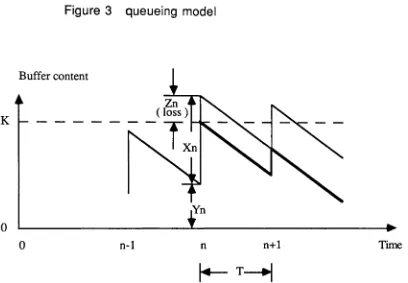
good tool to describe the system ( Figure 3). We assume that (1) this is a
FCFS system, (2) the inter-arrrival time between each input is a constant
time period, T, and (3) the amount of data entering the buffer at each input
time is a generally distributed random variable whose probability
distribution function is denoted by B(x). According to this, the queueing
system can be said to be a D/G/1 with variations, ie., a D/G/1 queue with
PERIODIC INPUT
1
FINITE QUEUEIFigure 3 queueing model
Buffer content
K
Yn
o
o
n-l n n+l TimeFigure 4 an embedded Markov chain description
The system can be analyzed by an embedded Markov chain ( Figure 4 ).
Let Ynand Xn represent the buffer content, in bits, at time n and the
message, in bits, entering the buffer at time n respectively. Any excess of
the buffer's capacity, which is K bits, is lost. The amount of loss at time n
is denoted by Zn ' where n = 0,1,2, . .. · For simplicity, let us assume that
the transmission rate of the transmitter is one bit per second, we find
Y n+1
= [
min ( Yn+ Xn ' K ) - Tr
z
n = [Yn + X - Kn ]+ · where [ xI'
= max [ 0, x ] ·(1)
Let Wn+1 (y) represent the probability distribution function of Yn+1· Then,
using some probability properties, we get Wn+1 (y) as follows.
Wn+1 (y) = Pr { Yn+ 1
s
y}= Pr { [ min ( Yn + Xn ' K ) - T
t
s
y}= Pr { min (
Y
n + Xn ' K ) - Ts
y}= Pr {
Y
n + Xns
y+T < K or K-Ts
Y }= Pr {
Y
n + Xns
Y+T < K } + Pr { K-T $; Y }= Pr {
Y
n + Xns
y+T and y+T < K } + Pr { K-Ts
Y }= Pr { Yn + Xn$;y+T } * Pr { y+T < K } + Pr { K-T
s
Y }= Pr {
Y
ns
y+T-xI
Xn=x } * Pr { y < K-T } + Pr { K-Ts
Y }== {
f:+
T Wn ( Y+T-x ) d B (x ) }
* Pr { y< K-T } + Pr { K-Ts
Y }y+T
fa
Wn ( Y+T-x ) d B ( x )1
o
s
y
< K-Ty~ K-T (3)
(5)
Let us represent the stationary distribution for Yn+1
by
w (
y )=
lim Wn+1( Y ) (4)n~oo
where we assume that the limit exists. W(y) will be the stationary
distribution for the buffer content, and also this limiting distribution is
independent of the initial state
Yo.
Thus we have y+Tfo
W ( Y+T-x ) d B ( x ) 0s
Y< K-TW(y)
={
loss at time n. Using some probability properties, we have
Ln
=
Pr {Zn
s
Z }= Pr { [ Yn + Xn - K
I'
s
z }=
Pr { Yn + Xn - K ~ z }=
fo
oo
Pr { Yn
s
z + K - xI
x,
=
x} d B ( x )=
fo
oo
W
n (z-K-x )
d B (
x)
z+K=
fo
Wn ( z+K-x) d B ( x ) ·Similarly, let us represent the stationary distribution for Zn by
L ( Z )
=
lim i., (z )n~oo
(6)
(7)
and the limit must exist. L(z) will be the stationary distribution for the
amount of loss, and this limiting distribution is independent of the initial
state
Zoe
Thus we havez-K
L ( z )
=
fo
W ( z+K-x) d B ( x ) · (8)Until now, we have obtained W(y) and L(z) for the system. In the next
section, we will select a specific probability distribution function for
3. SOLUTION FOR THE ERLANG DISTRIBUTED DATA INPUT
In many applications, like telephone traffic theory and data
manipulation, the Erlang distributed random service time has been widely
used. For such a service demand, we have obtained the solution to the
integral equation of the probability distribution function of the buffer
content. If the probability distribution function B ( x) and the probability
density function b ( x) are given as :
k-1 i
B ( x )
=
1 _e-k~x
" " (kJlx).L..J
·
I .I i=0d ku (
kux
)k-1b ( x )= - B ( x ) = r- e-k~x ,
dx ( k-1 ) I
(9)
(10)
then, based on the structure of the probability density function, we guess
a solution of the form to be :
k
W(y) =
L
aje-~iY
i=0
where ~o
=
0 . (11)Using the integral equation, we derive it as follows.
y+T
W ( y) =
fa
W ( Y+T-x) d B ( x )v-r
k k-1=
1
L
a·e-~'
(Y+T-x) kJl ( kJlX )e-k~x
dxa i=0 I ( k-1 ) !
k
=
L
aje-~I(y+T)
(kJl)k 1 I fY+TXk-1e-(k~-~i)X
dx1=0 (k-1). 0
k k k k k-n
=
L
<Ije-~Ye-~IT
(kJl) -L
<lje-~I(y+T) (kJl)ke-(1CJ1-~,)(Y+T)
L
(y+nk
=
L
(Xie-
lliYi=Q
(12)
Fortunately, the solution is obvious if the following two equations hold.
and
(13)
n
=
1,2, ... ,k (14)Let us first consider the transcendental equation, which is
This is a kth-root equation and ~i can be found as below.
ku (R.T _i21ti )11k (~.T+j21ti)/k
-~ = etJ1 e =e 1
kJl-~i
where j = -v-1 ·
i = 1, 2, ... ,k
i= 1,2, ... ,k
(15)
(16)
In order to obtain ( x . , We need to solve k+1 linear equations of the form
(17)
n= 1,2, ... ,k k
I
(Xi =0i= 0 (kJl-~i)D
and make sure that the boundary condition W ( K-T ) = 1 is satisfied.
Thus, the probability distribution function of the buffer content, W(y), has
been obtained.
Now, the probability distribution function of loss L ( z ) can easily be
found by solving the integral equation below.
z+K
L ( z )=
fo
W ( z+K-x) d B ( x )z-F z+K
=
1
d B ( x)+
J
W ( z+K-x) d B ( x )o
z+Tk k ~n
=
B ( z+T ) +~ (x. e-kl!(Z+n
~ [k/J.(Z+T)] e~i [(n/k+1)T-Kl+j21tni/k (18)~ I
£.J
(k-n)!1=0 n=1
4. EXAMPLE
For specified parameters, the probability distribution function of
buffer content, W(y), and of loss, L(z), have been found. For the parameters
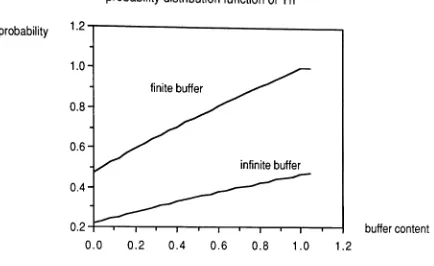
of k=2, Jl= 1.1, and K=2 ( bits ), the curve of the probability distribution
function of buffer content, W(y) , is shown in Figure 5 and the probability
of no loss is 94% in this case. Furthermore, we know that if the buffer
size is increased, the loss is decreased. If the buffer size is increased
immensely, i.e., an infinite buffer system, the probability distribution
function of buffer content has also been found, and of course, there is no
loss. The curve of the probability distribution function of buffer content in
probability distribution function of Yn
probability
1.2.,---
--..
buffer content
1.2 1.0
0.8 0.6
0.4 0.2
finite buffer
0.2;-...,..-r--..--...-,r----r--~__r-~....,.._--....___1
0.0 0.4 0.8
0.6 1.0
Figure 5 probability distribution functions for finite and infinite buffer
5. CONCLUSION
The buffer problem is an important factor in a queueing system. In
other words, if the capacity of a system is finite, the loss has to be
considered. Although a small buffer can minimize cost and a smaller
transmission rate of a coder can reduce the loss of data, these
characteristics will degenerate the performance of a system. A goOd
performance can be obtained by using a bigger buffer, but the cost may be
prohibitive. However, we can use the model derived in this paper to
6. REFERENCES
[1] L. Kleinrock, Queueing system Vol. 1 : theory, Wiley, 1976.
[2] D.
J.
Daley, "Single-server Queueing System with Uniformly LimitedQueueing Time", J. Austral. Math. Society 4 ( 1964) pp. 489-505.
[3] J. W. Cohen, The Single server Queue, North Holland publishing Co.,
Amsterdam, 1969.
[4] W. Stallings, Data and Computer Communications, Macmillan