Communication Using Future Wireless
Technology Li-Fi
Swati Keshari1, Rushiraj Jagdale2, Wasim Choudhari3, Sohan Choudhary4, Tushar Bhavar5.
Assistant Professor, Department of Computer Engineering, MES College of Engineering, Pune, Maharashtra, India1 B.E Student, Department of Computer Engineering, MES College of Engineering, Pune, Maharashtra, India2 B.E Student, Department of Computer Engineering, MES College of Engineering, Pune, Maharashtra, India3 B.E Student, Department of Computer Engineering, MES College of Engineering, Pune, Maharashtra, India4 B.E Student, Department of Computer Engineering, MES College of Engineering, Pune, Maharashtra, India5
ABSTRACT: Li-Fi is another remote innovation to furnish the availability with in restricted system structure. The fundamental standard of this innovation is we can transmit the information utilizing light enlightenment by utilizing light-discharging diodes where radio recurrence is media in Wi-Fi and LED knob light power is speedier than human eye can take after. Prof Harald Haas a specialist in optical remote correspondences at the University of Edinburgh, he was shown how a LED knob furnished with flag handling innovation could stream a top quality video to a PC. By utilizing this innovation a one-watt LED light would be sufficient to give net network to four PCs. He instituted the expression "light constancy" or li-fi and set up a privately owned business, Pure VLC, to abuse the innovation. He imagines a future where information for portable PCs, advanced mobile phones, and tablets is transmitted through the light in a room. Furthermore, security would be snap on the off chance that you can't see the light, you can't get to the information. This innovation comes to be ten times less expensive than the Wi-Fi and furthermore considerably more secure, on the grounds that paying little respect to get to control frameworks and passwords. In Li-Fi fundamentally we centre to transmitting media information between two terminals utilizing LEDs.
KEYWORDS: LED (Light Emitting Diode), Wi-Fi (Wireless Fidelity), Li-Fi (Light Fidelity), VLC (Visible Light Communication), RF (Radio Frequency).
I. INTRODUCTION
With constantly developing needs of media transmission world, there is an expanded pushed for higher data transmission that encourages quicker what's more, secure information transmission. Existing media transmission industry depends on radio floods of electromagnetic range for information transmission. Unfortunately, the radio wave range has certain key impediments: capacity, efficiency, availability and security. With the coming of most recent advancements for communication and the way that it's coming to far and wide to each nook and corner of the world, the electromagnetic range of radio waves is running out. A solution to this issue is Li-Fi is a wireless optical networking technology that uses light-emitting diodes (LEDs) for data transmission. Li-Fi (Light Fidelity) which is an approach in light of information transmission by means of optical fibre and LED. Exactly describing it is nothing else except for an optical variant of Wi-Fi (Wireless Fidelity) innovation that depends on the idea of optical light speeding up digital communication instead of radio waves.
radio frequency range. In this paper, text/image transmission between two personal computers is finished by utilizing the medium of visible light of electromagnetic range. In this Li-Fi data transmission works in view of a basic innovation. At the point when LED light is ON digital bit stream of one is transmitted. Whenever LED light turns off, digital bit stream of zero is transmitted. Based on this simple procedure text data transmission was done through visible light.
Fig 1. The Logo of Li-Fi Technology
Fig. 1 Displays the Logo of Li-Fi Technology.
II. RELATED WORK
Li-Fi is a most recent innovation that makes utilization of LED light which helps in the transmission of information great deal speedier and adaptable than information that can be transmitted through Wi-Fi. Light reaches about wherever so correspondence can likewise oblige light effectively. Light Fidelity is a branch of optical remote correspondence which is a rising innovation. By utilizing unmistakable light as transmission medium, Li-Fi gives remote indoor correspondence. The bit rate accomplished by Li-Fi can’t be accomplished by Wi-Fi In basic terms, Li-Fi can be considered as a light-based Wi-Fi. That is, it utilizes light rather than radio waves to transmit data. Furthermore, rather than Wi-Fi modems, Li-Fi would utilize handset fitted LED lights that can light a room and in addition transmit and get data. Since basic lights are utilized, there can in fact be any number of get to focuses.
Fig 2. Li-Fi Environment
Fig. 2 represents the Li-Fi environment.
III. PROPOSED ALGORITHM
Algorithm:
AES (Advanced Encryption Standard) is a strong symmetric encryption algorithm.
A secret key is used for the both encryption and decryption of data. Only someone who has access to the same secret key can decrypt data. AES encryption provides strong protection to your data.
The following sample Java program shows how to encrypt data using AES encryption algorithm. Java provides a number of helper classes for AES encryption such as Cipher (for encryption/decryption), Secret Key (represents the shared secret key) and Key Generator (generates the shared secret key).
Also note that both secret key and encrypted data is binary data and hence cannot be printed directly.
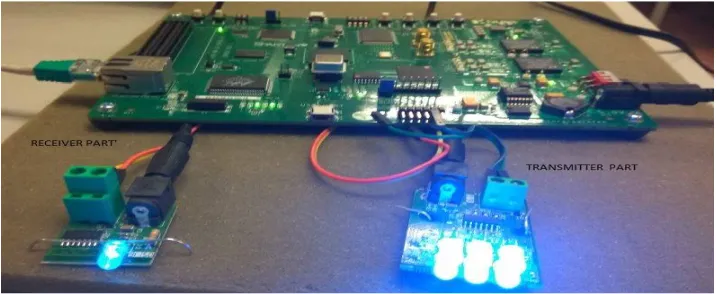
Fig 3: Image of Sender Algorithm andReceiver Algorithm Circuit.
Transmitter and Receiver Algorithm: Transmitter Algorithm:
Step 1: Start
Step 2: Initialize the Microcontroller AVR. Step 3: Initialize the LCD Display.
Step 4: Select the appropriate Comm port for connection establishment. Step 5: Select Band Rate as 9600.
Step 6: Select 8N1 Message Format for sending the message. Step 7: Open Text Box (Laptop).
Step 8: Type your Message in Text Box.
Step 9: Apply AES algorithm for encryption of the message. Step 10: Send it to serial port.
Step 11: Go to Step 8.
Receiver Algorithm:
Step 1: Start
Step 2: Initialize the Microcontroller AVR. Step 3: Initialize the LCD Display.
Step 4: Check whether the appropriate Comm port is selected. Step 5: Select Band Rate as 9600.
Step 6: Select 8N1 Message Format Step 7: Open Text Box (Laptop)
Step 8: Receive String from Transmitter side.
Step 9: Apply AES algorithm on receiver side for decrypting the message. Step 10: Display Message in text box.
Step 11: End.
Working of Li-Fi:
The PCB controls the electrical inputs and outputs of the lamp. It houses the microcontroller which is used to manage different lamp functions. An RF (radio- frequency) signal is generated by the solid-state PA. An RF signal is guided into an electric led about the bulb.
The logic is so simple as follows-If the LED light is on, a digital 1 is transmitted. If the LED light is on, a digital 0 is transmitted. These large brightness LEDs lights can be switched on and off very quickly which gives us an opportunity for transmitting data through light.
There is a light emitter on one corner, for example, an LED, and a photo detector (light sensor) on the other corner. The photo detector detects a binary one when the LED is on; and a binary zero if the LED is o_ same.
The data can be encoded in the light by varying the flickering rate at which the LEDs flicker on and off to generate different strings of 1s and 0s. Light-emitting diodes can be switched on and off faster than the human eye can detect which causes the light source to appear continuously, even though it is in fact 'flickering'.
The ARM has serial communication capability built into it, thereby making probable fast data transfer using only a few wires.
According to the data provided ARM microcontroller will modulate signals using PWM technique and convert it to digital form to serve as a input value for LED lamp, which is the sequence of led lights.
Power Supply:
Bridge Rectifier: Full wave bridge rectifier is used to convert incoming AC signal into varying DC signal i.e. it consist of ripple at the output.
Filter Capacitor: Filter capacitor of 2200f at output of bridge rectifier is used to provide less ripple at the output which is suitable for most electronic circuits.
Regulator: Regulator IC is used to provide constant DC or smooth output with no ripple 28
IV. EXPERIMENTAL RESULTS
Register Page:
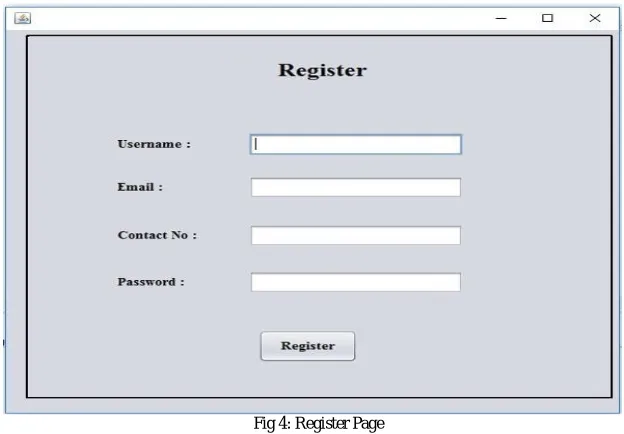
Fig. 4 shows the register page is used by the user to register his/her information. The register page includes the Following entities: Which are username, email, contact number and password.
The user can register by entering the above information specified for sending the message to another user. The Username provided by the user should be unique in nature otherwise it will show failure during registration process.
The password strength set by the user should be good or strong.
Fig 4: Register Page
Fig. 4Shows the Register page where the user has to register his/her details before sharing the information
Login Page:
Fig. 5the login page is the next step after the register page so that registered user can login and share the information.The user can login through his/her unique username and password which are provided during the registration process.Once successfully logged in,the user is ready to send message.
Fig 5: Login Page
Fig. 5 Shows the Login Page which is used by the user to Login and share the information
Main Page:
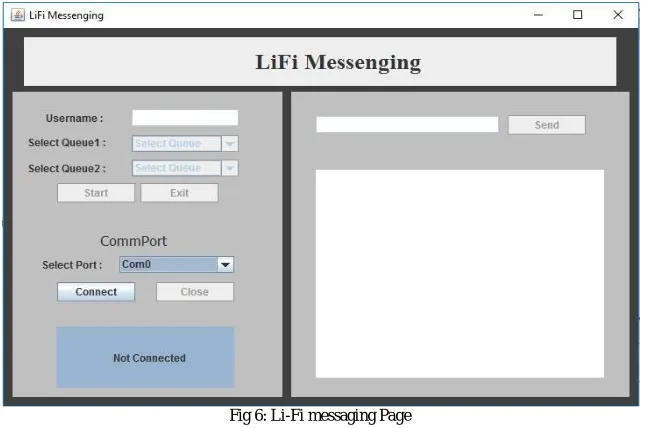
Fig. 6 Shows the Li-Fi messaging page is the main page where we can see the messages/ information which are Shared among eachother. The main page shows the logged in user’s username, comm port on which message is to be transmitted and the text Box for sending the message to the authenticated user.The messages transmitted and received appear in the display box.
Result Page:
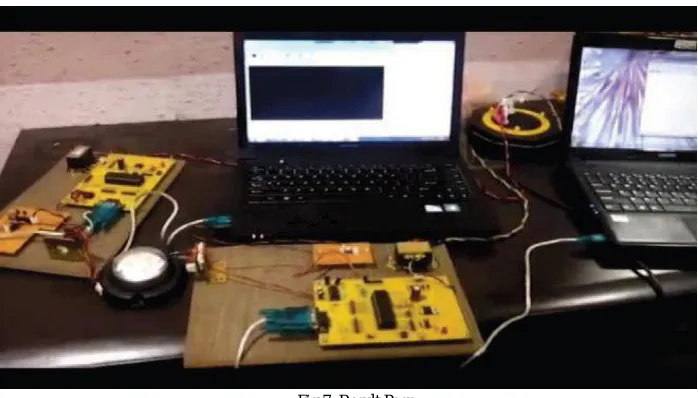
Fig.7 Is the Result Page image which shows the connection of the project.
The image displays two laptops (sender and receiver), LED bulbs. The snapshot represents successful sending and receiving of messages without any loss of information during transmission process.
Fig 7: Result Page
Fig.7 Is the Result Page image which shows the connection of the project.
V. ADVANTAGES OF LI-FI
Underwater Communication:Underwater Communication below water is of utmost importance especially to naval officers, divers, etc. Wi-Fi, a technology that uses radio waves, is usually not deployed for underwater communication. This is due to poor propagation of radio waves through water. Acoustic systems-telephones for underwater communication- have always been limited by factors like strong signal attenuation, low data rates, small available bandwidth, etc. With Li-Fi, underwater communication becomes easier and faster with relatively higher bandwidth. Sending email or surfing the web below water becomes a possibility using visible light.
Airways: Airline Fi. Ugh. Nothing says captive audience like having to pay for the "service" of dial-up speed Wi-Fi on the plane. And don’t get me started on the pricing. The best I’ve heard so far is that passengers will "soon" be offered a "high-speed like" connection on some airlines. United is planning on speeds as high as 9.8 Mbps per plane
Hospitality: Operating rooms in hospitals do not allow Wi-Fi over radiation concerns, and also there is lack of
Dedicated spectrum. Wi-Fi is in place in many hospitals, but interference from cell phones and computers can block signals from the monitoring equipment. Li-Fi solves both problems: lights are not only allowed in operating rooms, but tend to be the most glaring fixtures in the room. It can also be used for advanced medical instruments.
efficiency, and fuel flexibility. The smartness of these power plants is facilitated by fast, interconnected data systems for monitoring which can be readily achievable with Li-Fi.
Vehicle to Vehicle:Vehicular communication system With Li-Fi,an intelligent transport system (ITS) can be developed to facilitate communication and information sharing between vehicles and units located along roadside. Such information may include: warning of an impending danger, traffic-related information,etc. with the primary aim of preventing accidents on the high way. A vehicle to vehicle (V2V) system is a typical example. V2V is a technology that allows vehicles to communicate with one another. This is achievable using visible light communication (VLC) system with LEDs as the light source and camera as the receiver.
VI. CONCLUSION
This innovation is still under research and clearly it will be an achievement in correspondence .It guarantees information speed of 100gbps which is completely more noteworthy than radio waves. In this paper transmission of picture is done through this Li-Fi innovation. The extent of this Li-Fi was at last more noteworthy. The objective of this paper is Li-Fi gives secured, ease, simple information transmission and gives dependable correspondence. It can likewise be utilized as a part of modern, restorative, military applications. Li-Fi is still in its starting stages, however upgrades are being made quickly, and soon this innovation will have the capacity to be utilized as a part of our everyday lives. It is planned that this examination will give the beginning strides to further review. Inspite of the exploration issues it is our conviction that the VLC framework will end up noticeably a standout amongst the most encouraging advances for the future era in optical remote correspondence.
REFERENCES
[1] Manolo Dulva Hina, Hongyu Guan, Amar Ramdane-Cherif, Nan Deng,Secured dataprocessing, noti_cation and transmission in a human- vehicle interaction system, Institute of Electrical and Electronics Engineers (IEEE),November-2016
[2] R.Mahendran, Integrated Li_(Light Fidelity) For Smart Communication ThroughIllumination, International Conference on Advanced Communication Control andComputing Technologies (ICACCCT), 2016.
[3] Harald Haas and Cheng Chen ,What is LiFi? Institute of Electrical and ElectronicsEngineers (IEEE),Ecoc 2015-ID:0871.
[4] P.Nandhakumar, S.Dinesh Kumar , Incredible Innovation In Visible Light Communication - Light Fidelity (LI-FI) , International Journal of Engineering SciencesResearch Technology , ISSN: 2277-9655 , August, 2015.
[5]Aman Sodhi, Jeslin Johnson , Light Fidelity (LI-FI) - The Future of Visible LightCommunication , International Journal of Engineering Research and General ScienceVolume 3, Issue 2, ISSN 2091-2730, March-April, 2015.
[6] Shubham Chatterjee , Shalabh Agarwal , Asoke Nath , Scope and Challenges in LightFidelity(LiFi) Technology in Wireless Data Communication, International Journalof Innovative Research in Advanced Engineering (IJIRAE) ISSN: 2349-2163 Issue 6,Volume 2(June 2015). [7]Akshata M Sonnad, Amjana Gopan, Sailaxmi N R, Divya S, Ambika R , RecentAdvancements in LI-FI Technology, International Journal of Electrical, Electronicsand Data Communication, Volume-1, Issue-10, Dec9.-2013.
[8] S. D. Fabiyi , Li-Fi: A Full-Fledged Wireless Communication Technology , Inter-national Journal of Science and Research (IJSR) ISSN (Online): 2319-7064 IndexCopernicus Value (2013).
[9] Jyoti Rani, Prerna Chauhan, Ritika Tripathi , Li-Fi (Light Fidelity) - The futuretechnology In Wireless communication, International Journal of Applied EngineeringResearch, ISSN 0973- 4562 Vol.7 No.11 (2012).