Text Mining on Twitter Data Using
Visualizing Technique R
Aalia Bano Qureshi, Dr. Tripti Arjariya, Dr. Mohit Gangwar
Department of Computer Science & Engineering, Bhabha Engineering Research Institute, Bhopal, India
Prof. & Head, Department of Computer Science & Engineering, Bhabha Engineering Research Institute, Bhopal, India
Principal, Department of Computer Science & Engineering, Bhabha Engineering Research Institute, Bhopal, India
ABSTRACT: ‘BIG DATA’ is getting a more importance in different industries over the last year or two, on the basis of large amount of data is generated by different industries every day. The term Big Data is applied to large data sets so the traditional databases was unable to store thar large data sets like a traditional way and unable to process such large datasets. It has huge potential to transform business and power in several ways. Here the challenge is not only storing the data, but also accessing and analyzing the required data in specified amount of time. One of the most powerful aspects of using R is that you can download free packages for so many tools and types of analysis. Text analysis is still somewhat in its infancy, but is very promising. It is estimated that as much as 80% of the world’s data is unstructured, while most types of analysis only work with structured data. In this paper, we will explore the potential of R packages to analyze unstructured text and pre-processed the text and after that we can visualize the result.
KEYWORDS: Big data, R, Unstructure data, text mining, visualization I. INTRODUCTION
Over past ten years, industries and organizations don’t need to store and perform much operations and analytics on data of the customers. But around from 2005, the need to transform everything into data is much entertained to satisfy the requirements of the people. So Big data came into picture in the real time business analysis of processing data. From 20th century onwards this WWW has completely changed the way of expressing their views. Present situation is completely they are expressing their thoughts through online blogs, discussion forms and also some online applications like Facebook, Twitter, etc. If we take Twitter as our example nearly 1TB of text data is generating within a week in the form of tweets. So, by this it is understand clearly how this Internet is changing the way of living and style of people. Among these tweets can be categorized by the hash value tags for which they are commenting and posting their tweets. So, now many companies and also the survey companies are using this for doing some analytics such that they can predict the success rate of their product or also they can show the different view from the data that they have collected for analysis. But, to calculate their views is very difficult in a normal way by taking these heavy data that are going to generate day by day.
difficult exercise two-faced by beginners in knowledge science / analytics specialists. the most important challenge is one has to totally assess the underlying patterns in text, that too manually. For example: it's pretty common to delete numbers from the text before we tend to do any quite text mining. however what if we would like to extract one thing like “24/7”. Hence, the text cleansing exercise is extremely personalised as per the target of the exercise and therefore the sort of text patterns.
R is each a language and surroundings orienting towards applied math computing and graphics creation (R Core Team, 2016). R is created on the market below the antelope General Public License; as a results of sturdy community involvement, there are various extensions, referred to as packages, developed over time, likewise as sturdy documentation. thanks to this extensibility and flexibility, R has remained systematically common for knowledge and text mining applications across several domains, and includes powerful text mining tools.
II. LITERATURE REVIEW
Anjali Ganesh Jivani [22] mentioned that the aim of stemming is to scale back completely different grammatical forms or word kinds of a word like its noun, adjective, verb, adverb etc. The goal of stemming is to scale back inflectional types and generally derivationally connected kinds of a word to a standard base form. This paper discusses completely different ways of stemming and their comparisons in terms of usage, blessings yet as limitations. the fundamental distinction between stemming and lemmatization is additionally mentioned.
Vishal Gupta et.al [23] has analysed the stemmer‟s performance and effectiveness in applications like lexicon varies across languages. A typical easy stemmer rule involves removing suffixes employing a list of frequent suffixes, whereas a additional complicated one would use morphological information to derive a stem from the words. The paper provides an in depth define of common stemming techniques and existing stemmers for Indian languages.
K.K. Agbele [24] mentioned the technique for developing pervasive computing applications that square measure versatile and pliable for users. During this context, however, info retrieval (IR) is usually outlined in terms of location and delivery of documents to a user to satisfy their info want. In most cases, morphological variants of words have similar linguistics interpretations and may be thought of as equivalent for the aim of IR applications. The rule Context-Aware Stemming (CAS) is planned, that may be a changed version of the extensively used Porter‟s stemmer. Considering solely generated purposeful stemming words because the stemmer output, the results show that the changed rule considerably reduces the error rate of Porter‟s rule from seventy six.7% to 6.7% while not compromising the effectuality of Porter‟s rule.
Hassan Saif [25] has investigated whether or not removing stop words helps or hampers the effectiveness of Twitter sentiment classification ways. For this investigation he has applied, six {different|totally completely different|completely different} stop word identification ways to Twitter knowledge from six different datasets and observe however removing stop words affects 2 well-known supervised sentiment classification ways. The result shows that victimisation pre-compiled lists of stop words negatively impact the performance of Twitter sentiment classification approaches. On the opposite hand, the dynamic generation of stop word lists, by removing those rare terms showing one time within the corpus seems to be the best technique for maintaining a high classification performance whereas reducing the information scantness and considerably shrinking the feature area.
III RELATED WORK
information from documents based on their content. Selection of feature selection is an important and challenging step in text mining.
IV. PROBLEM DEFINITION
Text mining can help an organization derive potentially valuable business insights from text-based content such as word documents, email and postings on social media streams like Facebook, Twitter and LinkedIn. Data mining or Text mining plays a important role in decision making because through these mining techniques we can analyse the data and on the basis of result we can take a decision. Now a days social media sites like twitter are widely used to share user options on various topics, twitter gives a platform to user to share their views and thoughts on various field like political, industrial, education and there is a petabytes of data generated by twiiter in a day.
So the mining techniques are used to analysis the social twiiter data thorough we get large amount of datasets to analysis.so the analysis of twitter data provides a better way for making decision.
V. PROPOSED WORK
Text mining of Twitter data with R packages twitteR, tm and ggplot2
1. twitteR
Package twitteR provides access to Twitter information, 1st we have a tendency to square measure making a twitter streaming API known as twitter app by that we are able to get out access token keys . through this package we have a tendency to square measure retrieving information known as tweets from the twitter server and supply storage.
2. tm
tm package provides functions for text mining, the most structure for managing documents in Tm may be a questionable Corpus, representing a group of text documents. A corpus is associate abstract conception, and there will exist many implementations in parallel. The default implementation is that the questionable VCorpus.
3. ggplot2
ggplot2 package may be a plotting system for R, supported the synchronic linguistics of graphics, that tries to require the nice elements of base and lattice graphics and none of the unhealthy elements. It takes care of the many of the fiddly details that build plotting a trouble (like drawing legends) similarly as providing a strong model of graphics that produces it simple to provide advanced multi-layered graphics.
VI. PROPOSED METHODOLOGY
Our Steps or Algorithm Steps will follow:
Step 1: first we create a twitter API for retrieving text from twitter for analysis.
Step 2: after retrieving we transformed the text, tweets are first converted to a data frame and then to a corpus. After that, the corpus needs a couple of transformations, including changing letters to lower case, removing punctuations/numbers and removing stop words.
Step 4: after transforming and stemming process is done then we build a document term matrix. Based on the matrix, many data mining tasks can be done, for example, clustering, classification and association analysis.
Step 5: with the help og matrix we can identify the frequent words and their association between words.
Step 6: After building a document-term matrix, we can show the importance of words with a ggplot2 package.
ANALYSIS STEPS
VII. EXPERIMENTAL & RESULT ANALYSIS
All the experiments were performed using an i5-2410M CPU @ 2.30 GHz processor and 4 GB of RAM running Windows. After that we can install r base core on windows and Rstudio and than we are fetching real tweets and after that performing text mining on that collected tweets. So, to achieve this we are going to follow the following methods:
Collecting Tweets.
Text mining on Tweets.
Analyze the result.
Collecting Tweets:-
For consumer key and access tokens we need to create a twitter app through which we can generate our twitter keys and put into twitter_oauth and than we are storing to collects tweets on RTextMining with framesize of 3200 and stored into tweets variable.
Text Mining on Tweets:-
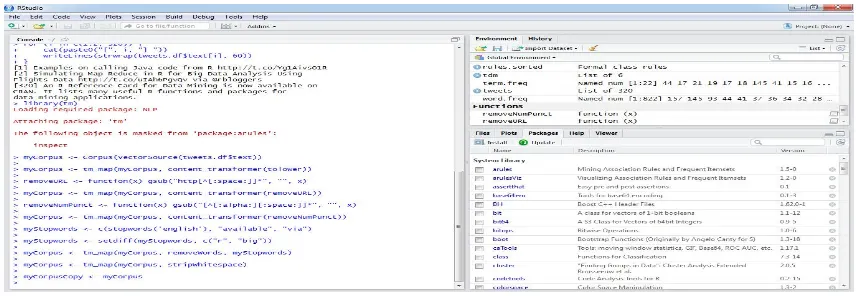
For performing text mining on tweets we need a package called tm package which internally consist natural language processing NLP package. Figure 1 shows the loading and performing operation through tm package.
Figure 1: Performing text pre-processing using tm package
We are using corpus for pre-processing twitter text and tm package consist many function through which we can remove numbers, punctual, and special characters coming from text. And first we are converting all the text into lower case to remove noise and we can also eliminate url’s coming from text.
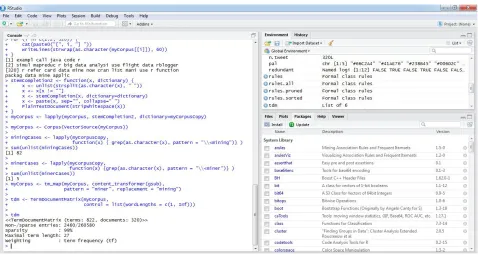
Figure 2: Performing stemming on preprocessed text
After stemming process we can develop a term-document matrix and find the frequency of each term using association properties. Figure 3 describe the operation on tdm (term document matrix) and finding most frequent keywords.
Analysis the result:-
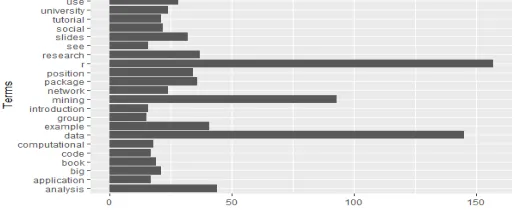
After text mining using tm package we can analyse the text mining result using visualizing package called ggplot2 , In tm package we can find the frequent terms and using ggplot2 we can visualize these frequent terms based on their count value which indicates how many time the terms is coming from the text. Through visualization we can easily say that which terms is coming frequently or which term is least frequent. Figure 4 indicates the terms along with their count.
Figure 4: Frequency of terms in the text
VIII. CONCLUSION
Twitter data is very useful in decision making because its provide a variety of opinions on various topics. so the texting mining will perform on twitter data and we are using a visualizing techniques called R which comes with a variety of packages. Through which we are uses twitteR package and ROAuth package we can authenticate and fetching text from the tweets and stored into tweets variable, After that we can perform text mining on the text or preprocessing a text with the help of tm package. With the help of these we can eliminate the redundancy and numbers, special characters, url’s from the text and then we performing the stemming on text and create a term-document matrix to find frequent terms and their association. After that we can visualize the result and say that which keywords are most or least frequent.
REFERENCES
[01] Mehmet Ula_ Çak_r” Text Mining Analysis in Turkish Language Using BigData Tools” 2016 IEEE 40th Annual Computer Software and Applications.
[02] Anjali Ganesh Jivani , A Comparative Study of Stemming Algorithms, International Journal of Computer, Technology and Application, Volume 2, ISSN:2229-6093.
[03] Vishal Gupta, Gurpreet Singh Lehal, A Survey of Common Stemming Techniques and Existing Stemmers for Indian Languages, Journal of Emerging Techniloigies in Web Intelligence, VOL. 5, NO. 2, MAY 2013.
[04] Agbele, A.O. Adesina, N.A. Azeez, & A.P. Abidoye , Context-Aware Stemming Algorithm for Semantically Related Root Words, African Journal of Computing & ICT.
[05] Hassan Saif, Miriam Fernandez,Yulan He, Harith Alani , On Stopwords, Filtering and Data Sparsity for Sentiment Analysis of Twitter. [06] Vishal Gupta and Gurpreet S. Lehal, A Survey of Text Mining Techniques and Applications, JOURNAL OF EMERGING TECHNOLOGIES IN WEB INTELLIGENCE, VOL. 1, NO. 1, AUGUST 2009.
[07] Porter M.F, Snowball: A language for stemming algorithms. 2001.
[08] Mladenic Dunja, Automatic word lemmatization. Proceedings B of the 5th International Multi- Conference Information Society IS. 2002, 153-159.
[09] Ning Zhong, Yuefeng Li, and Sheng-Tang Wu, “Effective Pattern Discovery for Text Mining”, IEEE Transactions on Knowledge AndData Engineering, Vol. 24, No.1, January 2012..
[10] Yuefeng Li, Sheng-Tang Wu and Xiaohui Tao, “Effective Pattern Taxonomy Mining in Text Documents”, ACM, October 26–30, 2008. [11] Pattan Kalesha, M. Babu Rao and Ch. Kavitha, “Efficient
Preprocessing and Patterns Identification Approach for Text Mining”, International Journal of Computer Trends and Technology (IJCTT), Vol. 6, No. 2, December 2013.