R E S E A R C H
Open Access
Automatic movie restoration based on wave
atom transform and nonparametric model
Hongteng Xu
*, Guangtao Zhai, Li Chen and Xiaokang Yang
Abstract
This article presents a new scheme for movie de-scratching, de-noising and de-blotching based on wave atom transform and nonparametric model. According to the analysis of the noise, scratches and blotches in the film, we establish a hybrid model for movie signal. In the proposed model, we model scratch as directional additive noise, which can be represented effectively by a new multi-scale analysis tool called wave atom transform. Based on wave atoms, de-noising and de-scratching are combined in a nested thresholding framework which can suppress both homogeneous noise and structural artifacts. On the other hand, blotch is described as multiplicative noise in the model, which can be restored by a “detecting and inpainting” strategy. We use the inter- and intra-frame discontinuity of blotch to detect them and then restore them by kernel regression method. Combining the processing operations above together, we design an effective automatic movie restoration system. Experimental results show that the proposed method not only achieves excellent performances even for seriously damaged movies but also has low computational complexity compared with the existing methods.
Keywords: Movie restoration, Wave atom transform, Nested thresholding, Nonparametric inpainting
Introduction
Movie restoration is a problem with both academic chal-lenge and great practical value. Due to long display time and undesirable storage environment, movies are dam-aged by various kinds of artifacts such as noise, loss of contrast, scratch, blotch, etc. These artifacts have nega-tive influences on the artistic and commercial values of movie. For recent years, many efforts have been devoted to movie restoration, especially to de-noising, de-scratching and de-blotching problems.
In the literature, wavelet domain soft-thresholding based algorithms [1-4] have shown good performances in image de-noising. For those methods, the selection of threshold is of vital importance. Although Donoho [1] gives the universal upper bound of threshold and researchers try to achieve even better solutions in [2,4], performances of these algorithms largely hinge on accurate noise variance estimation. An expectation-maximization (EM) algorithm for noise estimation is pro-posed in [3], but its computational complexity is very
*Correspondence: [email protected]
Institute of Image Communication and Information Processing, Shanghai Jiao Tong University, Dongchuan Road 800, Shanghai, China
high. Besides transform-based methods mentioned above, non-parametric and parametric model based algorithms [5-7] also achieve good de-noising results. Currently, the methods combining parametric and nonparametric model achieve state-of-the-art results in image and video de-noising, such as the BM3D in [8] algorithm and the training-based sparse de-noising method in [9]. Both of them take advantages of self-similarity of the patches in the image and represent the image sparsely by a dictio-nary. However, although those algorithms are effective to remove Gaussian noise, they do not work well for structural artifacts.
Recently, some algorithms for structural artifacts removal are proposed. For example, in [10,11], a training-based adaptive least square filter is designed to remove the coding artifacts in the image. Many de-scratching and de-blotching algorithms have also been proposed in the literature [12-15]. A joint scratch and blotch restoration method using Markov Random Field (MRF) model was presented in [16]. However, this method is not robust enough for movies with large motion. The methods in [12,17-20] exploit inter-frame information in the Bayesian framework for scratch detection and
restoration. Because of using the directionality of scratch in the detection phase, these method cannot be extended to blotch restoration straightforwardly. In our opinion, because scratch has strong directionality whereas blotch is isotropic, scratch and blotch should be restored sepa-rately. How to restore them respectively to achieve better result is a problem we try to solve. On the other hand, a common point of all these methods is that all of them use sequential detection and restoration steps, thus the overall performance will be limited by the accuracy of the detection stage, which is often very ad hoc in nature. How to reduce the dependence of restoration result on the accuracy of detection is another interesting problem.
The contribution of this work includes three folds. Firstly, according to the analysis of the scratches in the film, we model scratch as directional additive noise which can be represented effectively by wave atoms. Secondly, inspired by soft-thresholding de-noising method, we com-bine de-noising and de-scratching in a nested threshold-ing framework based on wave atom transform, which is robust to the performance drift of detection step. Thirdly, after de-noising and de-scratching, we detect blotches by the inter- and intra-frame discontinuity and restore them by kernel regression. Because scratches have been restored before, the computational complexity caused by applying kernel regression to de-blotching.
The article is organized as follows. In Signal model of movie section, we establish a hybrid model of movie signal and analyze the properties of noise, scratch and blotch in the movie. InJoint de-scratching and de-nois-ing section, we propose a nested thresholding method in wave atom domain, which can be used for de-noising and de-scratching. In Blotch detection and restora-tion section, we design a robust blotch detection and restoration algorithm based on motion estimation and nonparametric kernel regression. The integrated system and experimental results are given in Implementation
details and experimental resultssection. Conclusions
and future worksection concludes this article.
Signal model of movie Hybrid noise model
We model movie signal by a hybrid noise model, as shown in (2.1).
Y=qX+(1−q)B+S+N, (2.1)
where Xis the ideal pixel value of video signal andYis the noisy observation.Nis homogeneous additive noise andSis the scratch component.Bis the blotch compo-nent.qis a random variable controlling the transparency of blotch, and q ∈[ 0, 1] generally. If B is regarded as additive noise, (2.1) becomes a pure additive noise model. However, becauseBhas not homogeneous property, the
additive noise model increases the difficulty of analysis and restoration. For simplification, we restrictq ∈ {0, 1}. Based on the binarization ofq,Bis modeled as multiplica-tive noise and (2.1) becomes a hybrid noise model.
This hybrid model is different from the model proposed in [21-24], which regards scratch as multiplicative noise. This change is based on both physical and chemical causes of scratch. Scratch results from the shedding of coats on the film. As long as the contact surface between the pro-jector and the film is not clean, scratches will appear in the film during displaying. We can model the phenomenon as an additive process, i.e. the film coat becomes thinner damaged by those foreign matters. On the other hand, blotch artifacts can be caused by mildews, dirty spots or the shedding of film coats. The spatial and temporal dis-continuity of blotch makes it suitable to be modeled with the multiplicative noise model. The hybrid model guides us restore them by different methods.
The analysis of noise, scratch and blotch
Generally, distribution of N in our model (2.1) can be modeled as Gaussian noise. However, since the variance σ2is not known beforehand, soft-thresholding based de-noising algorithm cannot be used directly. For simplifying the problem, we make the following assumption: the noise in the movie is homogeneous, which obeysN(0,σ2)in the spatiotemporal domain. In other words, the noise in the movie is assumed to be stationary in the spatiotemporal domain, which can be estimated by the residual signal of successive frames.
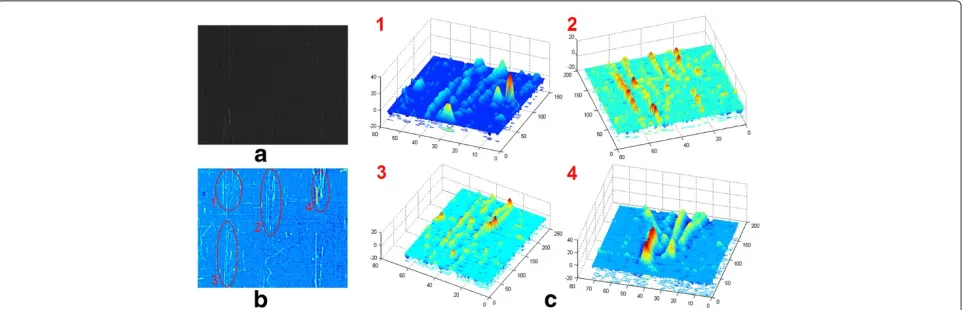
Considering its generative mechanism, scratch is a kind of anisotropic sudden interference, usually along an approximate vertical direction. It means thatSis a direc-tional noise. Further, scratch can be classified into two types according to its inter-frame continuity, as exempli-fied in Figure 1. In Figure 1a, we can find that the first type of scratch is relatively “weak”, which is short and nar-row and does not have inter-frame continuity. This kind of scratch can be detected straightforwardly by motion esti-mation based method. Figure 1b shows another type of scratch whose location in adjacent frames is almost stable. Motion estimation based method cannot be useful for the second type of continuous scratch.
Figure 1The comparison of two kinds of scratch.(a)Two adjacent frames with the type of discontinuous scratch.(b)Two adjacent frames with the type of continuous scratch.
the whole scratches in the frame obey oscillatory pattern. As shown in Figure 2, we choose several frames from some old movies to investigate the pattern of scratch. It can be found that scratches in the film have local oscil-latory patterns, and such pattern would change from a local phenomenon to a global one with the increase of the displaying time.
Bruni’s model aims to solve the detection problem only while the proposed model provides a guidance to design a restoration algorithm directly. Based on the analysis above, we can find that additivity, directionality and local (even global) oscillation are three features of
scratch. According to the intrinsic properties, wave atom-based method matches this problem perfectly, which will be addressed with details in Joint de-scratching and de-noisingsection.
Different from scratch, blotch artifact shows the isotropic pattern in most situations. Generally, it does not have the spatiotemporal continuity between and among movie frames. The blotch artifact can be very bright, very dark or even semi-transparent, as instanced in Figure 3. All of these properties increase the difficulty of removing blotch [16,21-25].
Joint de-scratching and de-noising Overview of wave atom transform
Wave atom transform is developed firstly by Demanet and Ying [26,27]. It is a variation of traditional wavelet aim-ing to overcome the weakness of wavelet in representaim-ing the directionality of high dimensional signals. The def-inition of wave atoms is closely related to the Fourier transform. Consider a 2D Fourier transform pair off(x) andfˆ(ω), wherex=(x1,x2),ω=(ω1,ω2)are the coordi-nates in spatial domain and frequency domain, then wave atoms can be defined as ϕμ(x), whereμ = (j,m,n) = (j,m1,m2,n1,n2) is a label representing the scale, direc-tion and locadirec-tion of the corresponding wave atom in 2-D situation. The indexed point (xμ,ωμ) in phase-space is defined as
xμ=2−jn, ωμ=π2jm, C12j≤max|mi| ≤C22j,
(3.1)
whereC1,C2are positive constants.
It can be seen that the notations follow those of the wavelet and curvelet, wherejcontrols the resolution scale, andmandncontrol the location in frequency and spatial domain, respectively. However, there are two differences
Figure 3Examples of blotch artifacts.
between wavelet and wave atom. First, wavelets obey a linear scaling wavelength while wave atoms obey the parabolic scaling wavelength: at scale 2−2j the essential frequency support is of size 2j, and at frequency 22j, the essential time support is of size 2−j. Second, the basis function of wave atom is different from that of conven-tional wavelet.
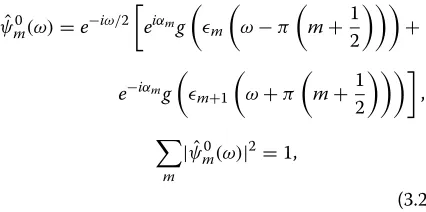
In the 1D situation, the frequency formula of basis functionψm0(x)is
ˆ
ψm0(ω)=e−iω/2
eiαmg
m
ω−π
m+ 1
2
+
e−iαmg
m+1
ω+π
m+ 1
2
,
m
| ˆψm0(ω)|2=1,
(3.2)
withm=(−1)mandαm= π2(m+ 12).gis a real-valued,
C∞bump function on a compact support with length 2π, which promises the energy of basis function is normalized (ψ02=1). Similarly, the 2D basis function of wave atom can be written as
ϕμ(x1,x2)=2jψm01(2
jx
1−n1)ψm02(2
jx
2−n2). (3.3)
The transform process of wave atom transform is sim-ilar to that of curvelet, which is based on FFT and IFFT.
For a 2-D signalu ∈ RN×N, we first perform a FFT of size N × N of u, and then get uˆ. For each pair(j,m), we wrap the productψˆmj uˆby periodicity insert the inter-val [−2jπ, 2jπ]×[−2jπ, 2jπ]. We then compute inverse FFT of size 2jof the result to getcμ. We repeat the pro-cess above over each pair(j,m)to get all the coefficients of wave atom transform. Finally, we permute these coeffi-cients according to the labelμ= (j,m,n)to get a matrix of coefficients. Please refer to [26,27] for the details of wave atom transform.
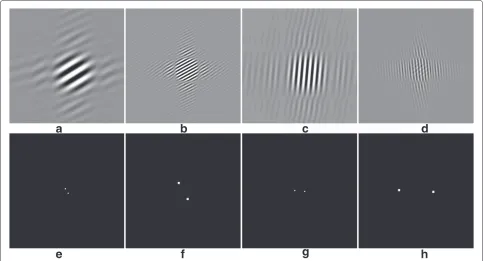
Figure 4 gives some examples of wave atoms and their frequency representation. It can be found that wave atoms have outstanding performance in directional representa-tion. This is one reason why wave atoms are used for scratch representation.
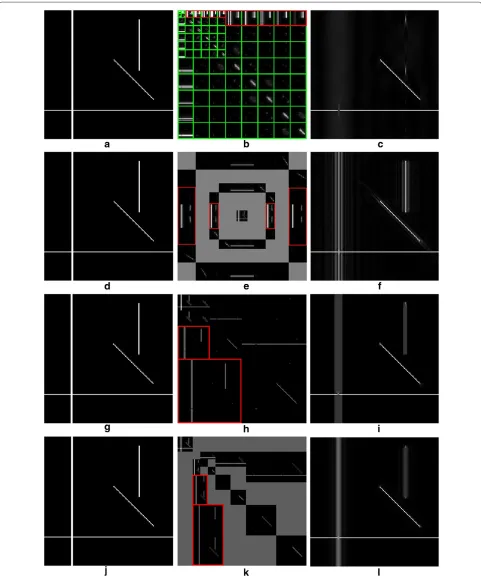
The features of wave atom transform to represent scratch Recalling the analysis in “The analysis of noise, scratch and blotch” section, we know that scratch is a direc-tional additive noise having an oscillatory pattern. Figure 5 illustrates the coefficient’s distribution of a straight-line image in wave atom, curvelet, wavelet and dual tree com-plex wavelet [28] domains after 3-level decomposition. All the four coefficient domains can be divided into several regions corresponding to different directions and scales. We can find that the coefficients corresponding to verti-cal, horizontal and diagonal lines are separated perfectly in wave atom domain. The coefficients in red boxes in Figure 5b,e,h,k correspond to vertical signal. An intuitive thresholding example is to remove the coefficients con-tained in red boxes in both domains. Figure 5c,f,i,l give the vertical line removal results. We find that under the same situation (removing the coefficients corresponding to the first two levels), the vertical line removal result using wave atom transform is clearly superior. It means that under the same decomposition level, the directionality of wave atom transform is better than three competitors.
Another feature of wave atom transform is its spar-sity of representing oscillatory signals. In [27], wave atom transform has been proven to be able to achieve sparser representation of oscillatory signal than the existing trans-forms including wavelet, and curvelet. IfO(N)wave atom coefficients suffice to represent an oscillatory signal to rea-sonable accuracy,O(N3/2)curvelet coefficients orO(N2) wavelet coefficients will be needed to achieve the same accuracy.
The analysis above implies that if we decompose an image with scratches by wave atoms, the coefficients cor-responding to scratches will be sparse and distribute in a narrow region in transform domain.
Nested thresholding in wave atom domain
Figure 4The examples of wave atoms.The first row shows two wave atoms with different directions and scales. The second row shows their frequency responses. The corresponding labels areμa=(3, 6, 3, 0, 0),μb=(4, 10, 5, 0, 0),μc=(3, 1, 6, 0, 0),μd=(4, 1, 10, 0, 0).
representing scratch will be limited in the narrow region corresponding to vertical component of signal, as shown in the red boxes in Figure 5b. A naive method that removes all the coefficients in this region will damage meaningful vertical image pixels rather than scratch. Another diffi-culty is to avoid ringing artifacts caused by the sidelobes of signal, which is common in wavelet shrinkage methods. To overcome these two problems, we propose a nested thresholding method.
We use a vertical 5×5 Sobel detector to find where scratches are likely to appear and get a mask matrix M. To ensure an accurate scratch detection, morphological dilation operation [29] is applied to M. Besides Sobel detector, there exists many other effective edge and ridge detector, such as the method in [30]. However, consider-ing the requirement for processconsider-ing a large volume of data real-time, we apply the simple strategy.
The threshold of Sobel detector is critical toM. If the selected threshold is too low, it will not only generate false detection result of scratch; if the threshold is too high, then many of the scratches may not be detected or the detected scratches are too segmented. To make a trade off between computational complexity and robustness, we choose the threshold adaptively by Otsu threshold seg-mentation method [31]. According to the analysis below we will prove that the proposed method is robust to detection false.
Rather than classic shrinkage of the coefficients in trans-form domain, we propose to iteratively subtract a quan-tized residual from the reconstructed signal (or original signal in the first step) in the detected region. We define a quantization function asST(•)with quantization stepT
as follows.
ST(•)=T×round
•
T
. (3.4)
LetFandFˆbe transform and inverse transform respec-tively. We perform wave atom transform to input frameY and get coefficient matrixC=F(Y).Csis the set of
coef-ficients in the region corresponding to vertical signal. The scale level ofCscorresponding to the first and the second
level. Figure 5b gives an example of 3-level decomposition and the region ofCsas the red boxes shows.
We compute the quantized residual ST(F(ˆ Cs)) and
restore scratch in spatial domain by the following proce-dure
˜
Y=Y−MST
ˆ
F(Cs)
, (3.5)
Figure 5The comparison of different multi-scale transforms.(a),(d),(g)and(j)are the same test image with size of 128×128.(b)The green boxes illustrate the scale segments of wave atom domain and the red boxes contain the coefficients corresponding to the vertical signals.(e)The red boxes contain the curvelet coefficients corresponding to the vertical signals.(h)The red boxes contain the wavelet (db1) coefficients
Although M may carry some texture and edge regions besides scratches, the directionality selection of wave atom transform ensures only those pixels along vertical direction will be modified. The quantization function in (3.5) further reduces ringing effect by setting the small oscillatory tails to zero.
Meanwhile, we can incorporate soft-thresholding de-noising process into our iterative framework. Denote the soft shrinkage function as Thresσ(•), as following shows
Thresσ(x)= sign(x)(|x| −
δσ), |x|> δσ
0, otherwise. (3.6)
Here we use the conclusion in [4] and define δσ ∈ [ 0,2σ2logN], N is the size of signal. Based on the assumption of noise mentioned inSignal model of movie section, the varianceσ2can be estimated according to the residual between adjacent frames after motion compensa-tion. In the first iteration,δσ1is set as the upper bound of the interval. To theith iteration,δσi = 0.8δσi−1. This strat-egy ensures the convergence of residual signalXi−Xi−1 during iteration. When max|Xi−Xi−1| < 3, the itera-tion is stopped. Under such stop criterion, we find that 4-8 iteration can achieve excellent performance for scratch restoration.
The algorithm of the nested thresholding scheme for joint de-scratching and de-blotching is summarized in Algorithm 1. One of the contributions of our algorithm is reducing the dependence of the scratch restoration results on the accuracy of detection. A dilation operation will enlarge the region of scratch in the detection mask, which may introduce positive false intoM. However, our method is robust to the enlarging of detection mask. The residual quantization step in our algorithm can reduce the influ-ence of sidelobes. As a result, even if the scratched region is enlarged by dilation operation, the sidelobes can still be suppressed by iterative quantization of residual, which will not influence on visual effect seriously.
Algorithm 1. The nested thresholding scheme
Task:
De-noising and de-scratching restoration forY. Initialization:
Maximum iteration numberI, initial resultX0=Y,
quantization stepT,
estimation of variance of noiseσ2. Process:
Get mask matrixM=Dilation(Sobel(Y)). In thei th iteration,i>0
Ci=F(Xi−1);
Xi=Xi−1−MST(F(ˆ Cis));
T = Ti;
Xi= ˆF(Thresσ(F(Xi))).
Ifmax|Xi−Xi−1|<3ori=I
˜
Y=XI. Elsei=i+1.
Because our algorithm only processes the signal regis-tered by detection mask, it is robust to the positive false of detection. In other words, even if an unscratched area is detected as scratch, the proposed method can still protect it. But if a scratch is not detected, the proposed method cannot restore it. For reducing the risk of negative false, we think the dilation operation is necessary, which ensures the robustness of our method.
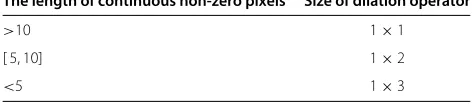
To reduce the negative influence of negative-false, we apply an adaptive dilation operation row by row. To each row of M, the detected scratched region is registered as continuous non-zero pixels. Generally, the longer the length of the continuous non-zero pixels is, the smaller size of dilation operator we should use. Based on this prin-ciple, we adaptively select the size of dilation operation according to Table 1.
Figure 6 gives an illustration of the restoration process for a row from an image with scratches, where it can found that with the increase of iteration, the scratch artifact can be restored without introducing serious ringing effect.
Blotch detection and restoration Blotch detection
Recall that blotch is modeled as a multiplicative noise in our degradation model. Motion estimation can be used for blotch detection because the inter-frame residual of motion estimation in the location of blotch will be much higher than other regions. Currently, the general blotch detection method is using ranked order difference (ROD) detector. In [24], a two-stage simple ROD detector (two-stage SROD) is proposed, which measures the inter-frame discontinuity of blotch in the 3×3 patches of three suc-cessive frames. However, abrupt motion of image objects can also cause large residual if the size of the search window in motion analysis is not large enough. On the other hand, too-large search window size will increase the computational complexity significantly. So, merely taking advantage of the inter-frame residual is insufficient for blotch localization.
To detect blotch robustly, we will also exploit the intra-frame information. Although both blotch and motion
Table 1 Choosing dilation operator based on the length of continuous non-zero pixels in the row ofM
The length of continuous non-zero pixels Size of dilation operator
>10 1×1
[ 5, 10] 1×2
Figure 6An illustration of de-scratching.(a)The original signal with obvious catastrophe points.(b, e, h)The residual signalMST(fˆ(Cis))in
each iteration.(c, f, i)After subtracting the residual signals in(b, e, h)during each iteration, we get restored signal marked by blue dots.(d, g)The initial signal of each iteration is the restoration result from the former iteration.(j)Compared with original signal represented by red points, after 3 times iteration, our algorithm produces a smooth result without ringing effect.(k)The final results of joint de-noising with scratch restoration (blue dots) and the original signal (red points).
object have large inter-frame residual, we can discriminate them according to their intra-frame features. Based on the analysis ofSignal model of moviesection, we know that blotch artifact is incoherent to its neighbor pixels. On the other hand, the pixels of the moving objects are more likely to have similar values in the neighborhood.
We define the pixel in the ith row, jth column and tth frame as Yijt. Pijt ∈ RL×L is a patch with the center
at Yijt. L is the size of the patch. Calculating the
resid-ual between the patches in adjacent frames, we can get Resijt= |Pijt−Pij,t−1|. If there are pixels inPijtbelonging
a threshold anda,bis the coordinates of pixel inPijt. We
can get a maskM1as following shows.
M1(a,b)= 1, Resijt(a,b) >t1
0, otherwise a,b=1,. . .,L. (4.1)
M1chooses the candidates of blotch according to the inter-frame discontinuity of blotch. For getting a more accurate estimation, we should take intra-frame disconti-nuity into consideration. So, we defineE ∈ RL×L as the
residual amongYijtand its neighborhood pixels as follows.
E(a,b)= |Yijt−Pijt(a,b)|,
a,b=1,. . .,L/2−1,L/2+1,. . .,L. (4.2)
Similarly, if there are pixels inPijt belonging to blotch,
they should satisfy E(a,b) > t2, where t2 is another threshold. We can get another mask M2 as following shows.
M2(a,b)=
⎧ ⎪ ⎪ ⎨ ⎪ ⎪ ⎩
1, E(a,b) >t2
a,b=1,. . .,L/2−1, L/2+1,. . .,L. 0, otherwise
(4.3)
Only the pixels satisfyingM2(a,b) = M1(a,b) = 1 are considered as blotch. After getting the primary detection result, a dilation operation is used to suppress the negative false of detection further.
It should be noted that if the blotch has almost uni-form luminance value,M2will contain the pixels of the boundary of the blotch rather than the whole region of the blotch. Generally, blotches having almost uniform lumi-nance value are likely to have small areas. After finding their boundaries inM2, we can detect their whole regions by dilation operation. On the other hand, if a blotch has large area, its luminance value is generally not uniform. In such situation, we can still detect blotch with the help of M1andM2.
Our method can be regarded as an extension of the work in [13,24]. The improvement of our method is that we not only consider the inter-frame discontinuity of blotch but also consider the intra-frame discontinuity. In [24], there is only one threshold in two-stage SROD controlling the criterion of inter-frame discontinuity. The principle of the Bayesian method in [13] is also taking advantages of inter-frame discontinuity. In our method, we use two thresholds t1 and t2 to control the criterions of inter-and intra-frame discontinuity respectively. Because intro-ducing intra-frame information of blotch, our method is
c
d
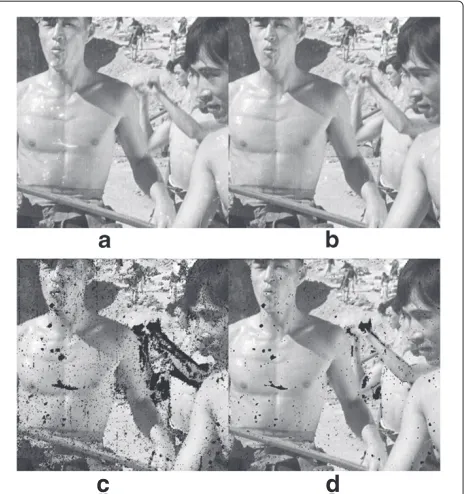
Figure 7The comparison of different blotch detectors.(a,b)Test frame 1,2 of size 1024×1024 for blotch detection.(c)The inter-frame blotch detection result of frame 1.(d)The inter- and intra-frame detection result of frame 1.
more robust to pathological motion [13] and occlusions in the movie.
Figure 7 shows an example of blotch detection, where it can be found that using intra-frame discontinuity prop-erty, the detection is robust to large motion. In this algorithm, t1 and t2 are thresholds for inter-frame and intra-frame discontinuity. Note that t2 is related to the search window sizeL. Generally, with the increase ofL, intra-frame coherence of arbitrary two pixels in the win-dow becomes weaker, so the value oft2should decrease. Too larget1andt2will increase the risk of false-negative response while too small thresholds may cause a false-positive response. In our experiments, we chooseL=18,
Table 2 Comparison among different noise estimator
Video name Actualσ The method in [35] The method in [36] Proposed
ˆ
σ Error rate (%) σˆ Error rate (%) σˆ Error rate (%)
Demo 1 25.5 23.5576 7.6 23.0676 9.5 29.5166 15.8
Demo 2 25.5 23.3363 8.5 21.1579 17.0 26.7723 5.0
Demo 4 25.5 22.3471 12.4 23.1300 9.3 30.2774 18.7
Demo 5 25.5 23.7797 6.7 16.3132 36.0 28.2639 10.8
Prof. Bullinger 25.5 24.3093 4.7 21.9882 13.8 27.4088 7.5
Outdoor Flower 25.5 23.4828 7.9 21.5795 15.4 26.6728 4.6
t2= 2, andt1 =15 empirically based on the experimen-tal results of over 4,000 frames. A dilation operation [29] is used to the detection result for improving the accuracy. The dilation operator is a square with size of 5× 5 for the test frame with size of 1024×1024. From Figure 7, we can find that our detection result is good enough for a computationally efficient algorithm.
Blotch restoration
For blotch restoration of the old movie, we can take advan-tages of both inter- and intra- frame information with a nonparametric kernel regression based approach. For a missing pixel valuey, its temporal and spatial context is denoted as a vector formx. We can approximateyusing conditional expectation as
y=E(Y|X=xi)=
yiP(yi|xi)dyi=
yi
P(yi,xi)
P(xi)
dyi.
(4.4)
To gety = E(Y|X = x)we have to compute the joint probability P(yi,xi) and the marginal probability P(xi),
without presuming any parametric relationship between yiandxi. Kernel regression is a widely used nonparametric
technique to estimate probability functions [32,33]. With kernel regression, we have
ˆ
P(xi)=
1 n
n
j=1
Kh(xi−xj), (4.5)
ˆ
P(yi,xi)=
1 n
n
j=1
Kh(xi−xj)Kg
yi−yj
, (4.6)
where the kernelsK(◦) = 1K◦can be chosen from functions that are nonnegative, sum to 1 and symmetric around 0. hand g are called bandwidth of the kernels. Widely used kernel function includes the triangle ker-nel, Gaussian kerker-nel, Epanechnikov kernel among others. Note that the product kernels rather than multivariate kernels are used in (4.6) to simplify the analysis. See [32] for more details.
SubstitutingP(ˆ xi)andP(yˆ i,xi)into (4.4), we have
y=E(Y|X=xi) (4.7)
=
yinj=1Kh(xi−xj)Kg(yi−yj)dyi
n
j=1Kh(xi−xj)
=
n
j=1Kh(xi−xj) yiKg(yi−yj)dyi
n
j=1Kh(xi−xj)
.
Now we have to deal withyiKg(yi−yj)dyi. By
defin-ing a residual term as y = yi − yj, and omitting the
bandwidth parametergfor simplicity, we have
yiK(yi−yj)dyi=
(yj+y)K(y)dyi≈yj, (4.8)
Figure 10Scratch removal results.In each sub-figure, images from top to bottom and from left to right are: original image; the de-scratching results gotten byBM3Drestoration, non-local means inpainting, MCA inpainting, the method in [12], coefficients removing in wave atom domain and the proposed method. The test frames are:(a)“TAO LI JIE”;(b)“FANG ZHEN ZHU”;(c)the test image in [12,15].
where we used the properties of the kernel function that it sums to 1 and is symmetric around the origin. Letting (4.8) into (4.7), we have
y=E(Y|X=xi)≈
n
j=1Kh(xi−xj)yj
n
j=1Kh(xi−xj)
. (4.9)
The nonparametric conditional expectation estima-tor in (4.9) is known as the Nadaraya–Watson (NW) estimator, which is weighted average of the observa-tions{y1,y2,. . .,yn}with the weight in inverse proportion
Table 3 Comparison among different algorithms on PSNR (dB)
Original Non-local + BM3D MCA + BM3D Proposed
Demo 1 25.015 25.423 25.507 24.496
Demo 4 25.547 25.969 26.193 26.538
Demo 5 25.109 25.806 25.692 26.336
Prof. Bullinger 26.553 30.002 29.372 29.583
Outdoor Flower 24.932 27.114 27.020 26.149
Pepper 25.358 26.188 26.097 26.295
Lena 25.360 27.171 26.943 27.606
House 25.382 26.578 26.826 27.288
Man 25.292 26.122 26.245 27.053
higher accuracy of the approximation, normalization is recommended and we can rewrite (4.9) as following shows
y=E(Y|X=xi)≈
n
j=1Kh(ˆxi− ˆxj)δjyj
n
j=1Kh(ˆxi− ˆxj)
, (4.10)
where xˆ is the normalized vector of x and δj is the
ratio between thel2 norm ofxj and that ofxi. The
ker-nel we choose is Gaussian kerker-nel
exp((•/h)2)
h√π
, where h is the bandwidth of the kernel. The adaptive band-width selection for the kernel is based on cross validation. By minimizing the following cost function, we get the optimized bandwidth.
h=arg min1 n
n
j=1
(ˆyj−yj)2, (4.11)
whereyˆjis the estimated pixel value ofyjwithout using the
jth contextxj. Because the cross validation method is
com-putationally very demanding, we only take the neighbors ofyiinto consideration and setn≤9 in (4.11).
Implementation details and experimental results The diagram of the proposed movie restoration system is given in Figure 8. The system includes three modules: parameter estimation, joint scratch and noise removal, and blotch restoration. And the implementation details will be introduced in this section.
Noise estimation and de-noising
We estimate the variance of noise using motion esti-mation. For each patch in the current frame, we search the patch with the shortest Euclidean distance in the
Table 4 Comparison among different algorithms on SSIM
Original Non-local + BM3D MCA + BM3D Proposed
Demo 1 0.6128 0.6659 0.6673 0.6604
Demo 4 0.2976 0.4207 0.4222 0.4233
Demo 5 0.1218 0.2067 0.2061 0.2060
Prof. Bullinger 0.2986 0.3724 0.3699 0.3792
Outdoor Flower 0.3809 0.4383 0.4370 0.4306
Pepper 0.4392 0.5417 0.5402 0.5545
Lena 0.4372 0.5532 0.5507 0.5644
House 0.5707 0.6619 0.6638 0.6650
Man 0.5570 0.6396 0.6399 0.6401
preceding frame to get the motion vector and the resid-ual patch. For simplicity, we employ the three-step motion estimation method [34] in this research. DefinePiandPj
as original patches,WiandWjthe i.i.d. Gaussian random
variables obeyingN(0,σ2). It is obvious thatWi−Wj
N(0, 2σ2). Moreover, according to the spatiotemporal sta-tionary assumption of the noise in the movie,Pi−Pjhas
Laplacian distributionLaplace(0,b)[29]. So, we can esti-mate the variance of noise with the residual images from the sequential frames.
Compared with other professional noise estimator, such as the methods in [35,36], the proposed estimator has lower computational complexity, which can be achieved real-time. Considering the large volume of data in the movie restoration system, the complexity of the algo-rithm should be limited. Moreover, the methods in [35,36] focus on estimate the noise in the single image while the proposed method takes advantage of the inter-frame continuity of movie signal.
For testing the performance of the proposed method, we select six test sequences from the database http://sp. cs.tut.fi/mobile3dtv/stereo-video/ and add Gaussian noise to them. After applying different estimators to these
Figure 12The comparison of different resotration methods in blotch detection.(a)The region waiting for inpainting in our method, which only contains blotches.(b)The region waiting for inpainting in other methods, which contains both blotches and scratches.
sequence, we give comparison results of different meth-ods on the accuracy of noise estimation in Table 2. We can find that the proposed method achieves a comparable even better performance on noise estimation.
Based on the noise estimation result, we can apply wave atom based de-noising algorithm proposed in Nested
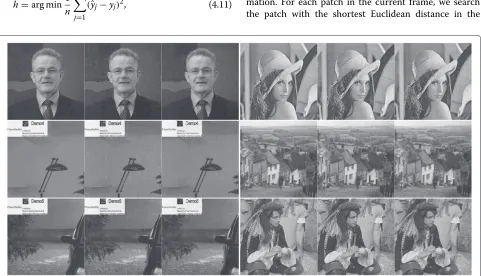
thresholding in wave atom domain section. Figure 9
gives a comparison among original video frames, the degraded frames and de-noising results. After perform-ing the proposed de-noisperform-ing method, we can improve the visual effect of the frames greatly.
Scratch restoration
We compare our algorithm with some existing scratch restoration algorithms. The initial quantization step is 8. The four test movies are from China Film Archive, namely “TAO LI JIE”, “FANG ZHEN ZHU”, “DA LU” and “GUAN LIAN ZHANG”.
Figure 10 shows the experimental results of scratch removal (without blotch restoration) by different algo-rithms, including BM3D, non-local means restoration [6], MCA inpainting [37,38], the method in [12,15] (we used the method proposed in [15] to detect scratch, after that, we use the method in [12] to restore the degraded images), the simple wave atom coefficients pruning based method mentioned inJoint de-scratching and de-nois-ingsection and our proposed algorithm.
Figure 15The enlarged images of results.In each sub-figure, the images from left to right are: the original image; non-local mean inpainting; MCA inpainting; the method in [12]; the proposed method. The test frames are:(a)“TAO LI JIE”;(b)FANG ZHEN ZHU”.
Table 5 Run time per frame
Method Non-local MCA Method in [13] Proposed
Run time (sec) 263.217 3109.581 287.335 60.317
proposed algorithm overcomes the drawback and gets the best restoration results in our test.
Objective quality evaluation
We have also designed an objective evaluation test for the proposed algorithm. First, we select five test sequences from the database http://sp.cs.tut.fi/mobile3dtv/stereo-video/ and another four normally used test images as orig-inal data. Then we extract some frames with scratches from the beginning of old movies. After removing the mean of those scratched frames, we add the residual to the test sequences. As a result, we have both the origi-nal clean sequences and relevant degraded sequences, so we can calculate PSNR as an objective quality measure. We compared our algorithm with other restoration algo-rithms, including the non-local means, MCA and BM3D. Table 3 lists the PSNR comparison of these algorithms. Figure 11 gives some visual results as well. From the results, we can find that our algorithm outperforms other methods under most conditions. Note that for a faith-ful test, scratches are detected by the method in [15] and blotches are detected by the method in the tests before inpainted by the algorithms of non-local means or MCA.
Besides PSNR, another objective image quality assess-ment method called structural similarity indexing (SSIM) [39,40] is used to evaluate the performance of the pro-posed method. Similarly, the quality index of our results is better in most situations, as Table 4 shows.
The reason for the outstanding performance of the pro-posed method can be summarized as follows. (1) As we have said that our method is robust to the positive false in the detection phase. The region not belonging to scratch and blotch can be protected better than other methods.
(2) The inpainting based restoration method aban-dons the information hidden by scratch and blotch. It estimates original signal merely according to the neigh-borhood of the signal. When the region of scratch or blotch is too large, this method can not get enough prior knowledge from the neighborhood of signal, which makes the result of restoration over-smooth. In the pro-posed method, instead of abandoning the information of original signal totally, we just suppress the interference added on the signal as much as possible. This strategy is better than inpainting based method when it comes
to serious degraded image. Figure 12 gives an illustra-tion of the advantage of our method. Because we only apply inpainting algorithm to blotches, to the same frame, the region waiting for inpainting in our method is much smaller than that of other method.
Overall performances of de-scratching, de-noising and de-blotching in old movie
Results of the proposed system on practical data are shown in Figure 13, 14, 15 and 16. In Figure 13, each sub-figure reports the result from the step marked in Figure 8. The size of test frames is 1024×1024. We can find that the proposed system can produce outstanding results even to seriously damaged movies.
Our proposed system also has the advantage of high computational efficiency. On the platform of MATLAB with Inter Core2 CPU and with 3 Gb memory, the pro-cessing speed of our algorithm is on average 60.317 s per frame. In fact, compared with other existing methods, such as those based on pure nonparametric inpainting for both scratch and blotch, MCA inpainting and the method in [13], our method is much faster on the same hardware and software platform. Table 5 shows the aver-age CPU time for processing a test frame of the testing algorithms. In Figure 16, we test our system on four dif-ferent movie segments and give three consecutive frames and corresponding restoration results respectively.
The high efficiency of our proposed system can be explained by the following facts.
(1) In scratch restoration stage, we do not have to perform complex detection, which is a large part of total time.
(2) Wave atom transform is based on FFT and IFFT, whose complexity isO(NlogN), so the complexity of our nested-thresholding method is only
O(INlogN)withI the iteration number, which is much lower than wavelet based methods.
(3) Our empirically test shows that the iterative thresholding algorithm converges fast and the iteration number we need is less than 10, whereas the iteration number of MCA can be hundreds times and even more.
(4) It is noted that inpainting is the most computationally expensive step in our movie restoration system, whose complexity is aboutO(NL2), whereN is the number of pixel to be inpainted andL2is the number of pixel in the neighborhood. Taking scratch out of
Table 6 Average run time per frame and percentage in total time of each phase
Phase Parameters estimation Scratch, noise restoration Blotch detect Blotch inpaint
Run time (s) 6.280 8.327 13.067 32.643
non-parametric inpainting step can further reduce the computation time.
The average time cost of each phase and their percent-age in the total processing time in our system is given in Table 6. The blotch inpainting phase costs most of the processing time while the de-noising and de-scratching phases occupy much less processing time.
It should be mentioned that although our system in Figure 8 shows an obvious serial type of process manner for a single frame, it can be highly paralleled on GPU for the processing of movie sequence due to the following observations.
(1) wave atom transform and inverse-transform is block-by-block, which can be done with a high degree of parallelism.
(2) The kernel regression based inpainting process using only local data can also be conducted in parallel. Therefore, our proposed system already has lower com-plexity as compared to the existing competitors, and it is expected by facilitating GPU and other parallel computing techniques in practical implementation.
Conclusions and future work
In this article, we propose an automatic system for movie restoration. Based on the analysis of features of noise, scratch and blotch artifacts in the damaged movie, we combine a nested thresholding method in wave atom domain with nonparametric model towards effective restoration. In scratch restoration stage, we use wave atom transform to achieve joint scratch detection, restoration and de-noising. In blotch restoration stage, we take full advantages of inter- and intra-frame discontinuity and use nonparametric inpainting.
Although our work gets outstanding performances, there still exists some problems for further investigation in future work. In our model, blotch is modeled as multi-plicative noise, so that the parameterqis binary. However, in practical situation, some blotches are semi-transparent in the movie. How to design a more practical model for the degradation of movie is one of our future works. On the other hand, the values of some parameters in our system are empirical.
(1) Based on the experimental results of four films from Chinese film archive (over 4,000 frames), the configura-tion ofL,t1andt2in de-blotching step achieves satisfying results for blotch restoration. However, we still need to investigate more evidence to support the configuration of them.
(2) In de-scratching and de-noising phase of our system, the quantization stepT, the stop criterion and the multi-plicative constant of the threshold value in the de-noising step are fixed. We think that the selection ofT may have a strong relationship with the intensity of scratch in the
movie. For example, the value of T may not be global. To different regions, the quantization step can be adap-tive according to the maximum value of the scratch in the region. According to noise level and image content, the stop criterion and the multiplicative constant of the threshold value in the de-noising step should be adap-tive as well. In this article, they are fixed to be 3 and 0.8, respectively. We think that the estimation of the variance of noise can provide the selection of them with a useful prior knowledge. It is reasonable to think that the values of them should be increase with the variance of noise. In summary, establishing an adaptive strategy for the choice of these parameters will be one of our future work.
Competing interests
The authors declare that they have no competing interests.
Acknowledgements
This article was supported in part by the NSFC (60932006, 61025005, 61001145, 61102098), RFDP (20090073110022), postdoctoral foundation of China 20100480603, 201104276, postdoctoral foundation of Shanghai 11R21414200 and the 111 Project (B07022).
Received: 30 November 2011 Accepted: 6 June 2012 Published: 3 July 2012
References
1. DL Donoho, Denoising by soft-thresholding. IEEE Trans. Inf. Theory.41(3), 613–627 (1995)
2. SG Chang, B Yu, M Vetterli, Adaptive wavelet thresholding for image denoising and compression. IEEE Trans. Image Process.9(9), 1532–1546 (2000)
3. MAT Figueiredo, RD Nowak, An EM algorithm for wavelet-based image restoration. IEEE Trans. Image Process.12(8), 906–916 (2003) 4. F Luisier, T Blu, M Unser, A new SURE approach to image denoising:
interscale orthonormal wavelet thresholding. IEEE Trans. Image Process. 16(3), 593–606 (2007)
5. M Bertalmio, V Caselles, A Pardo, Movie denoising by average of warped lines. IEEE Trans. Image Process.16(9), 2333–2347 (2007)
6. A Buades, B Coll, J Morel, Nonlocal image and movie denoising. Int. J. Comput. Vis.76(2), 123–139 (2008)
7. N Bose, N Ahuja, Superresolution and noise filtering using moving least squares. IEEE Trans. Image Process.15(8), 2239–2248 (2006)
8. K Dabov, A Foi, V Katkovnik, K Egiazarian, Image denoising by sparse 3D transform-domain collaborative filtering. IEEE Trans. Image Process.16(8), 2080–2095 (2007)
9. J Mairal, F Bach, J Ponce, G Sapiro, A Zisserman, inIEEE 12th International Conference on Computer Vision,Non-local sparse models for image restoration. (Kyoto, Japan, 2009), pp. 2272–2279
10. L Shao, H Zhang, G de Haan, An overview and performance evaluation of classification-based least squares trained filters. IEEE Trans. Image Process. 17(10), 1772–1782 (2008)
11. L Shao, J Wang, I Kirenko, G de Haan, Quality adaptive least squares filters for compression artifacts removal using a no-reference bloc visibility metric. J. Vis. Commun. Image Represent.22, 23–32 (2011)
12. AC Kokaram, inIEEE International Conference on Multimedia Computing and Systems,Removal of line artefacts for digital dissemination of archived film and video. (Florence, Italy, 1999), pp. 245–249 13. AC Kokaram, On missing data treatment for degraded video and film
archives: a survey and a new Bayesian approach. IEEE Trans. Image Process.13(3), 397–415 (2004)
14. V Bruni, D Vitulano, A Kokaram, inProceedings of the 3rd International Symposium on Image and Signal Processing and Analysis,Line scratches detection and restoration via light diffraction. (2003), pp. 5–10 15. V Bruni, D Vitulano, A generalized model for scratch detection. IEEE Trans.
16. MJ Nadenau, SK Mitra, inTime-Varying Image Processing and Moving Object Recognition,Blotch and scratch detection in image sequences based on rank ordered differences. (Florence, Italy, 1997), pp. 27–35
17. M Haindl, J Filip, inProc. IEEE International Conference on Pattern Recognition,Fast restoration of colour movie scratches. (Quebec, Canada, 2002), pp. 269–272
18. L Joyeux, S Boukir, B Besserer, inFifth IEEE Workshop on Applications of Computer Vision,Film line scratch removal using Kalman filtering and Bayesian restoration. (Palm Springs, America, 2000), p. 8
19. L Maddalena, A Petrosino, Restoration of blue scratches in digital image sequences. Image Vis. Comput.26(10), 1314–1326 (2008)
20. S Muller, J Buhler, C Thebault, I Doser, O Neisse, in16th IEEE International Conference on Image Processing (ICIP),Scratch detection supported by coherency analysis of motion vector fields. (Cairo, Egypt, 2009), pp. 89–92 21. F Stanco, G Ramponi, L Tenze, in5th COST 276 Workshop,Removal of
semi-transparent blotches in old photographic prints, (Prague, Czech, 2003)
22. F Stanco, G Ramponi, A de Polo, inEUROCON 2003. Computer as a Tool. The IEEE Region 8,vol. 2,Towards the automated restoration of old
photographic prints: a survey. (Ljubljana, Slovenia, 2003), pp. 370–374 23. A Licsar, L Czuni, inIEEE International Conference on Image Processing,vol. 2,
Trainable post-processing method to reduce false alarms in the detection of small blotches of archive films. (Genoa, Italy, 2005), pp. 562–565 24. MK Gullu, O Urhan, S Erturk, Blotch detection and removal for archive film
restoration. AEU-Int. J. Electron. Commun.62(7), 534–543 (2008) 25. AC Kokaram, inIEE Seminar on Digital Restoration of Film and Video
Archives,Advances in the detection and reconstruction of blotches in archived film and video. (London, UK, 2001), pp. 1–7
26. L Demanet, Curvelets, wave atoms, and wave equations, Thesis of California Institute of Technology, 2006
27. L Demanet, L Ying, Wave atoms and sparsity of oscillatory patterns. Appl. Comput. Harmon. Anal.23(3), 368–387 (2007)
28. I Selesnick, R Baraniuk, N Kingsbury, The dual-tree complex wavelet transform. IEEE Signal Process. Mag.22(6), 123–151 (2005)
29. RC Gonzalez, RE Woods,Digital Image Processing(Publishing House of Electronics Industry, Prentice Hall, Beijing, 2002)
30. E Nezhadarya, RK Ward, A new scheme for robust gradient vector estimation in color images. IEEE Trans. Image Process.20(8), 2211–2220 (2011)
31. NA Otsu, A threshold selection method from gray-level histograms. IEEE Trans. Syst. Man Cybern.9, 62–66 (1979)
32. W Hardle,Nonparametric and Semiparametric Models. Springer Series in Statistics (Springer, New York, 2004)
33. H Takeda, S Farsiu, P Milanfar, Kernel regression for image processing and reconstruction. IEEE Trans. Image Process.16(2), 349–366 (2008) 34. X Jing, LP Chau, An efficient three-step search algorithm for block motion
estimation. IEEE Trans. Multimed.6(3), 435–438 (2004)
35. D Zoran, Y Weiss, inIEEE 12th International Conference on Computer Vision, Scale invariance and noise in natural images. (Kyoto, Japan, 2010), pp. 2209–2216
36. C Tang, X Yang, G Zhai, inIEEE 12th International Conference on Multimedia Expo,Dual-transform based noise estimation. (Melbourne, Australia, 2012), accepted
37. M Elad, JL Starck, P Querreb, D Donoho, Simultaneous cartoon and texture image inpainting using morphological component analysis (MCA). Appl. Comput. Harmon. Anal.19(3), 340–358 (2005)
38. JM Fadili, JL Starck, M Elad, D Donoho, Mcalab: reproducible research in signal and image decomposition and inpainting. IEEE Des. Test.12, 44–63 (2010)
39. Z Wang, HR Sheikh, AC Bovik,Objective Video Quality Assessment. The Handbook of Video Databases: Design and Applications(CRC Press, Boca Raton, 2003), pp. 1041–1078
40. Z Wang, A Bovik, H Sheikh, E Simoncelli, Image quality assessment: from error visibility to structural similarity. IEEE Trans. Image Process.13(4), 600–612 (2004)
doi:10.1186/1687-6180-2012-132
Cite this article as:Xuet al.:Automatic movie restoration based on wave atom transform and nonparametric model.EURASIP Journal on Advances in Signal Processing20122012:132.
Submit your manuscript to a
journal and benefi t from:
7Convenient online submission 7Rigorous peer review
7Immediate publication on acceptance 7Open access: articles freely available online 7High visibility within the fi eld
7Retaining the copyright to your article


![Figure 10 Scratch removal results. In each sub-figure, images from top to bottom and from left to right are: original image; the de-scratchingresults gotten by BM3D restoration, non-local means inpainting, MCA inpainting, the method in [12], coefficients remo](https://thumb-us.123doks.com/thumbv2/123dok_us/1140773.1143141/11.595.58.540.85.620/figure-scratch-original-scratchingresults-restoration-inpainting-inpainting-coecients.webp)